
In This Article
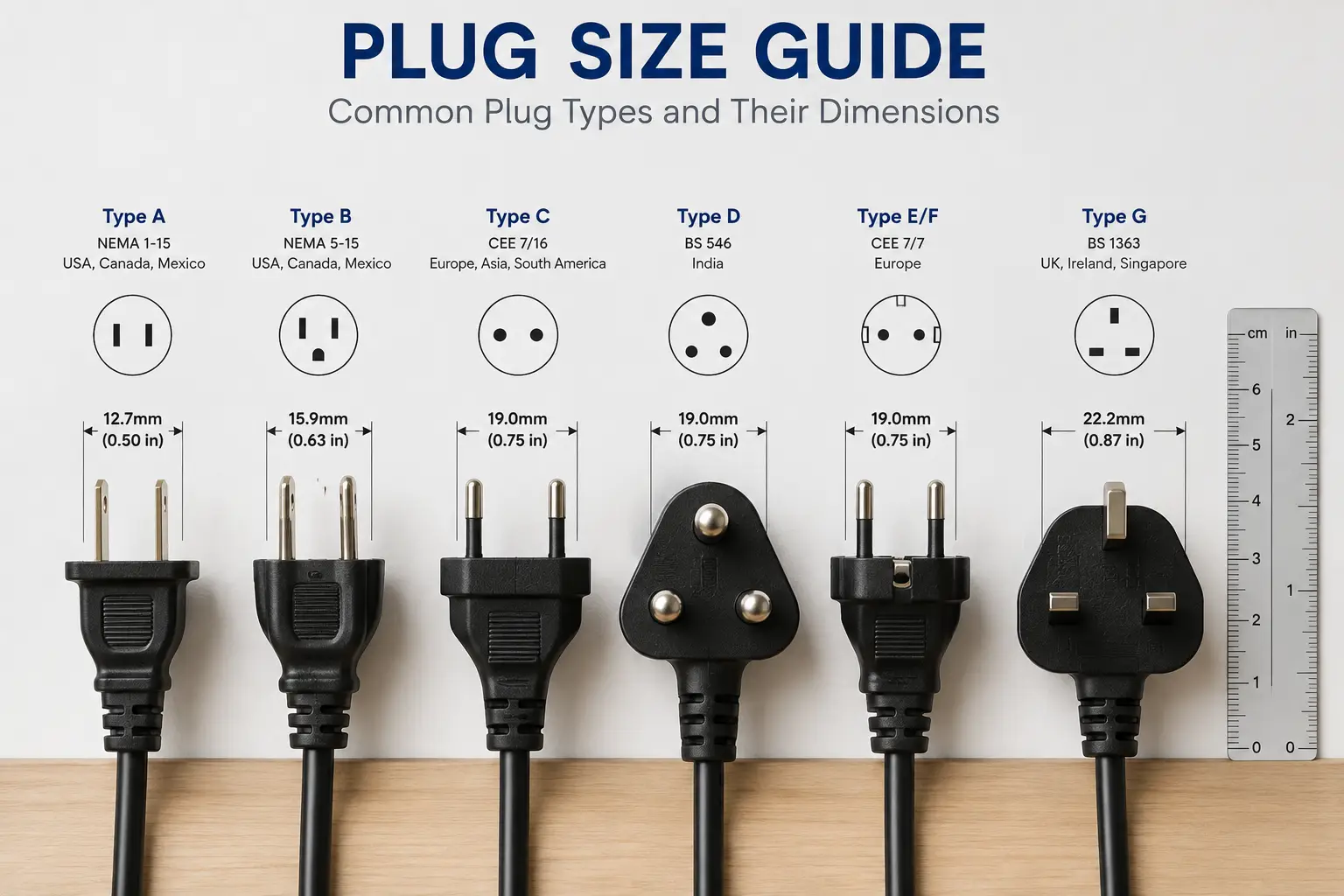
Nothing derails the first night of a trip faster than staring at a hotel wall outlet that doesn’t match the plug on your phone charger. That mismatch is a plug size problem, and it trips up even seasoned travelers because plug size isn’t standardized worldwide the way a phone’s charging port is. Plug size refers to the physical shape, prong count, and dimensions of an electrical plug — flat parallel blades in the US, round pins in much of Europe, angled blades in Australia — and each region uses its own standard, officially cataloged by letter (Type A through Type N).
This guide breaks plug size down the way a frequent flyer would explain it over coffee: which plug size you need for which region, how to avoid buying the wrong adapter twice, and seven real travel adapters currently sold on amazon.com, researched from real spec sheets and aggregated customer reviews rather than guesswork. According to Wikipedia’s overview of AC power plugs and sockets, there are roughly 15 plug types in active use globally, grouped under voltage standards of either 100–127V or 220–240V — which is exactly why a “one size fits all” mentality gets travelers into trouble.
Whether you’re packing for a single European city break or a multi-continent work trip, understanding plug size before you fly saves you from hunting down an overpriced airport-kiosk adapter or, worse, forcing an incompatible plug into a socket it was never built for.
Quick Comparison Table: 7 Best Travel Adapters by Plug Size
| Product | Plug Types Covered | Grounded? | Best For |
|---|---|---|---|
| Anker Nano Travel Adapter | Type A, C, G, I | No | Smallest, lightest carry |
| Ceptics 12-Piece Grounded Adapter Set | 12 types (A, C, G, I, EF, and more) | Yes | Budget, multi-region trips |
| TESSAN GM-636 100W | Type A, C, G, I | Partial (G, I grounded) | Safety-focused travelers |
| EPICKA Air 40W Universal | Slide-out A, C, G, I | Partial | Best all-around plug size |
| Ceptics World-Way 6 (WPS-5B) | Type A, B, C, E/F, G, I | Yes | Fully grounded devices |
| EPICKA TA-105 Pro 70W | Slide-out A, C, G, I | Partial | Laptop-heavy travel |
| Zendure Passport III | A, B, C, E, F, G, I, J, L, N | Yes (select plugs) | Widest global coverage |
Looking at the table above, plug size coverage varies more than most shoppers expect — the Anker Nano Travel Adapter covers four plug types and skips grounding entirely, while the Zendure Passport III covers ten and grounds most of them. If your travel is limited to a couple of regions, a narrower, lighter option like the Anker Nano makes sense; if you’re hopping continents or carrying grounded electronics, the wider coverage of the Ceptics World-Way 6 or Zendure Passport III is worth the extra bulk.
💬 One click helps other shoppers make an informed choice too! 😊
Top 7 Travel Plug Adapters for Every Plug Size
1. Anker Nano Travel Adapter — smallest footprint of any plug adapter
The Anker Nano Travel Adapter is built around a simple premise: shrink the plug size down as far as physically possible while still covering the four most common plug types worldwide. At 3.39 x 1.97 x 0.98 inches, Anker states it’s roughly 43% smaller than comparable travel adapters, with foldable, retractable pins that tuck flat for packing. It covers Type A (US, Canada, Japan), Type C (most of Europe), Type G (UK and parts of Africa and Asia), and Type I (Australia, China), and adds five charging ports — one AC outlet, two USB-A, and two USB-C, with the primary USB-C port delivering up to 20W.
Based on comparing the specs, the tradeoff for that ultra-compact plug size is grounding: this is a 2-pin to 2-pin design, meaning it does not accept 3-prong grounded plugs like EU Schuko, UK 3-pin appliances, or grounded laptop chargers. What most buyers overlook is that this limitation rules out charging bricks for many laptops, which increasingly ship with grounded 3-prong cords in Europe and the UK. Reviews consistently report that the compact size and Anker’s brand reliability make it a favorite for phone-and-tablet-only trips, with less enthusiasm from travelers who also needed to charge a grounded laptop charger.
Pros:
- ✅ Smallest and lightest adapter in this roundup
- ✅ Five charging ports including 20W USB-C fast charging
- ✅ Foldable, retractable pins built for carry-on packing
Cons:
- ❌ No support for 3-prong grounded plugs
- ❌ Only four plug types, fewer than several rivals here
The Anker Nano Travel Adapter typically runs in the $25 to $40 range for a single unit — prices may vary, so check the current listing. For travelers whose devices are all 2-pin (phones, tablets, most modern chargers), its plug size advantage is hard to beat.
2. Ceptics 12-Piece Grounded Adapter Set — most plug types covered on a budget
Where the Anker Nano goes narrow and compact, the Ceptics 12-Piece Grounded Adapter Set goes broad and affordable. This kit uses a single universal input socket that accepts nearly any plug — including both 2-prong and 3-prong North American plugs — paired with 12 individually labeled, grounded adapter heads covering Type A, C, EF, G, I, and several regional variants across Africa, the Middle East, and Asia. Each adapter is rated up to 10A at 250V max, and Ceptics clearly labels the plug type on each piece, a small detail that matters when you’re digging through a bag at a hotel front desk at midnight.
Here’s what to weigh: this is a plug-shape solution only, with zero USB ports or built-in charging electronics, so you’ll still need your own USB wall charger or charging brick to plug into it. Reviews consistently report that the labeled, grounded design is the standout feature for travelers who’ve been burned by unlabeled universal adapters in the past, since sorting through unmarked pieces at 2 a.m. in an unfamiliar country is nobody’s idea of a good time. What the spec sheet doesn’t say, but owner reviews reveal, is that the South African Type M plug is the one notable gap in coverage, so travelers headed there specifically need a different Ceptics kit.
Pros:
- ✅ Covers 12 distinct plug types at a low price
- ✅ Every adapter individually labeled by plug type
- ✅ Grounded design, unlike many budget alternatives
Cons:
- ❌ No built-in USB ports or fast charging
- ❌ Excludes the South African Type M plug
Pricing generally lands between $15 and $25 for the full 12-piece set — always check the current price before ordering. For budget-conscious travelers who want broad plug size coverage without paying for GaN charging tech they may not need, this is the strongest value here.
3. TESSAN GM-636 100W — toughest safety features
The TESSAN GM-636 takes a different approach to plug size: rather than minimizing bulk, it uses its slightly larger body to house real safety hardware. Its slide-out plugs cover Type A, C, G, and I, with the G (UK) and I (Australia) plugs grounded, and TESSAN backs the unit with a double fuse, safety shutters over the AC outlet, and a thermal-monitoring chip that automatically lowers power output if the adapter starts running hot. The main USB-C port can push up to 100W, enough to fast-charge a laptop, while five additional ports (one AC outlet plus USB-A and USB-C) let up to six devices charge at once.
What most buyers overlook with this model is that “100W” describes total system output, not what every port delivers simultaneously — the headline number applies to the primary USB-C port when used alone. Independent reviewers who track this product niche closely have singled out the GM-636’s double fuse and shutter design as genuinely above-average for the category, distinguishing it from cheaper universal adapters that skip these protections entirely. Reviews consistently report that the extra plug size is a worthwhile tradeoff for travelers who prioritize build quality and safety certifications over minimizing pack weight.
Pros:
- ✅ Double fuse plus safety shutters, above-average for the category
- ✅ Thermal-monitoring chip reduces power if it overheats
- ✅ 100W main port fast-charges laptops, not just phones
Cons:
- ❌ Bulkier than the smallest adapters in this roundup
- ❌ Only two of four plug types are grounded
Expect to pay somewhere around $35 to $45, based on recent listings — prices shift, so check the current price at checkout. For travelers who’d rather carry a slightly bigger adapter than gamble on build quality, the GM-636 earns its plug size.
4. EPICKA Air 40W Universal — best all-around plug size for most trips
The EPICKA Air 40W Universal lands in the sweet spot of this roundup’s plug size spectrum: compact enough for daily carry, but built with GaN (gallium nitride) semiconductor technology that keeps the internal electronics smaller and cooler than older silicon-based designs. It uses slide-out prongs to cover Type A, C, G, and I, plus three USB-C ports and two USB-A ports for up to 40W of combined fast charging. Independent travel-gear reviewers who tested it across multiple trips named it their top overall pick for most travelers in 2026.
Based on comparing the specs, the one notable limitation is that its AC socket is labeled by EPICKA as a “US/EU socket” rather than a true universal socket — meaning it accepts US two-pin and three-pin plugs plus European two-pin plugs, but not a UK three-pin appliance plug directly into the AC port (you’d charge that device over USB instead). Reviews consistently report that EPICKA’s built-in 10A fuse, while sealed rather than user-replaceable, has held up reliably in testing, and the adapter carries CE, FCC, and UL/VI safety markings.
Pros:
- ✅ GaN technology keeps the plug size compact despite 40W output
- ✅ Named a top overall pick by independent travel-gear reviewers
- ✅ CE, FCC, and UL-family safety certifications included
Cons:
- ❌ AC socket doesn’t directly accept UK three-pin plugs
- ❌ Built-in fuse is sealed, not user-replaceable
Typical pricing runs $30 to $40 — check the current listing, since GaN-based adapters see frequent promotional pricing. If you want one adapter that balances plug size, power, and reliability without overthinking it, this is the safest all-around pick.
5. Ceptics World-Way 6 (WPS-5B) — best grounded universal kit
The Ceptics World-Way 6 solves the grounding gap that trips up several adapters on this list. Its SWadAPt interchangeable plug system swaps between six attachments covering Type A, B, C, E/F, G, and I, with a fully grounded connection running from the input all the way through to the output — a detail Ceptics emphasizes because many competing “universal” adapters only ground some plug types, not all of them. The kit includes two US-standard outlets, two USB-A ports, two USB-C ports, and an attached USB-C cable, letting up to five devices charge simultaneously, along with surge protection and voltage indicator lights that show the socket’s live output.
What the spec sheet doesn’t say, but the plug size tradeoff makes clear, is that the swap-and-adapt design necessarily runs larger than a fixed slide-out unit, since it has to physically house the interchangeable attachment mechanism. Reviews consistently report that the labeled, fully grounded attachments are the deciding factor for travelers packing grounded electronics — laptop chargers, certain hair tools, CPAP machines — where an ungrounded adapter simply isn’t an option regardless of how compact it is.
Pros:
- ✅ Fully grounded connection across all six plug types
- ✅ Voltage indicator lights show live socket output
- ✅ Charges five devices at once with built-in surge protection
Cons:
- ❌ Larger plug size than fixed-prong universal adapters
- ❌ Six-attachment system means more small parts to track
Pricing typically falls between $35 and $45 — always confirm the current price, since kit-based products see frequent bundle promotions. For anyone traveling with grounded electronics, this kit’s plug size tradeoff is worth accepting.
6. EPICKA TA-105 Pro 70W — most power for laptops
The EPICKA TA-105 Pro 70W is EPICKA’s higher-wattage sibling to the Air 40W, built for travelers who need to fast-charge a laptop alongside phones and tablets rather than just topping up smaller devices. It uses the same slide-out plug mechanism covering Type A, C, G, and I, but steps the main USB-C port up to 70W of GaN-based Power Delivery, enough headroom for most ultrabooks and many gaming laptops that ship with USB-C charging.
On paper, this means the TA-105 Pro trades a modest amount of plug size compactness for meaningfully more charging headroom than the Air 40W. What most buyers overlook is that a 70W adapter doesn’t magically make every laptop charge at 70W — output is capped by whatever the connected device requests, so a phone will still draw its normal 20-25W even when plugged into the higher-wattage port. Reviews consistently report that travelers who specifically bought this model for laptop charging found it eliminated the need to pack a separate laptop brick internationally, which offsets the modestly larger plug size in checked-bag math.
Pros:
- ✅ 70W GaN Power Delivery handles most USB-C laptops
- ✅ Same reliable slide-out plug mechanism as the Air 40W
- ✅ Eliminates the need for a separate laptop charger abroad
Cons:
- ❌ Larger and heavier than the 40W version
- ❌ Same UK three-pin AC socket limitation as the Air 40W
Expect to pay roughly $40 to $55 depending on current promotions — check the listing before buying. For travelers who need one adapter to replace their laptop charger internationally, the extra plug size buys real headroom.
7. Zendure Passport III — most advanced GaN design
The Zendure Passport III sits at the premium end of this roundup, and its plug size reflects genuinely wider coverage than anything else on this list: it plugs into Type A, B, C, D, E, F, G, H, I, J, K, L, M, N, and O outlets, with press-and-slide controls switching between US, UK, EU, and AU plug configurations in seconds. Inside, GaN semiconductors deliver up to 65W of Power Delivery through the primary USB-C port, alongside three more USB-C ports and one USB-A port, letting up to six devices charge simultaneously. A built-in auto-resetting 10A fuse is rated to survive thousands of overload events without needing replacement.
Based on comparing the specs, the Passport III’s larger plug size buys the broadest plug-type coverage of any product in this guide, which matters most for travelers hitting multiple continents on one itinerary rather than a single region. Reviews consistently report that its metal-gradient, translucent design draws more attention (in a good way) than the typically utilitarian look of competing adapters, while the primary tradeoff is price — it sits meaningfully above every other option here, even accounting for frequent sale pricing.
Pros:
- ✅ Widest plug-type coverage of any adapter in this guide
- ✅ 65W GaN Power Delivery charges laptops and phones alike
- ✅ Auto-resetting fuse rated for thousands of overload cycles
Cons:
- ❌ Most expensive adapter in this roundup by a wide margin
- ❌ Larger plug size than every other option here
Pricing generally runs $60 to $80 at full price, with the brand running frequent promotions closer to $60 — always check the current price. For frequent, multi-continent travelers who want the fewest plug size compromises, the Passport III is the most capable option available.
Full Comparison: Wattage, Ports, and Plug Size Tradeoffs
| Product | Max Output | Total Ports | Plug Size Class |
|---|---|---|---|
| Anker Nano Travel Adapter | 20W | 5 | Ultra-compact |
| Ceptics 12-Piece Grounded Adapter Set | N/A (pass-through) | N/A | Compact per piece |
| TESSAN GM-636 100W | 100W | 6 | Mid-size |
| EPICKA Air 40W Universal | 40W | 6 | Compact |
| Ceptics World-Way 6 (WPS-5B) | Varies by USB port | 6 | Mid-size |
| EPICKA TA-105 Pro 70W | 70W | 6 | Mid-size |
| Zendure Passport III | 65W | 6 | Larger |
This second comparison view shows the pattern clearly: the smallest plug size options, like the Anker Nano Travel Adapter, deliberately limit both plug-type coverage and output wattage to stay compact, while the Zendure Passport III and EPICKA TA-105 Pro 70W accept a larger plug size in exchange for laptop-grade charging power and, in the Passport III’s case, dramatically wider plug-type coverage. Neither approach is objectively better — it depends entirely on whether your priority is minimizing bag weight or minimizing the number of adapters you pack.
✨ Don’t miss these exclusive deals! 🔍 Take your plug size shopping to the next level with this carefully curated lineup. Click a highlighted item to check current pricing and availability. These picks will help you get through airport security and hotel check-in without a single charging headache!
How to Find the Right Plug Size for Your Destination Country
- Identify your destination’s plug type by letter, not by country name alone. Multiple countries can share a plug type — for example, Type C covers most of continental Europe — so learning the letter system saves you from researching every stop separately on a multi-country trip.
- Check your device’s voltage rating before assuming an adapter is enough. Look for “Input: 100–240V” printed on the charger itself; if you see that range, you need only a plug size adapter, not a voltage converter.
- Separate single-voltage appliances from dual-voltage electronics. Hair dryers, curling irons, and older shavers are frequently single-voltage and need a converter, while phone chargers, laptop bricks, and camera chargers are almost always dual-voltage.
- Decide between a single-country adapter and a universal one. A single-destination trip is often lighter with a dedicated Type C or Type G adapter; a multi-country itinerary justifies the extra plug size of a universal model like the Zendure Passport III.
- Confirm grounding needs before you fly. If you’re carrying a grounded 3-prong laptop charger, a CPAP machine, or certain hair tools, rule out ungrounded 2-pin adapters like the Anker Nano for those specific devices.
- Pack a backup adapter on multi-leg trips. Adapters get left in hotel outlets more often than travelers expect — a lightweight second unit, even a basic single-type adapter, is cheap insurance.
- Verify airline and cruise line rules before departure. Most airlines and cruise lines allow single-socket travel adapters without restriction, though some cruise lines specifically prohibit adapters with built-in surge protection or multiple AC outlets, so check your carrier’s current policy.
Real-World Scenarios: Matching Plug Size to Your Trip
The one-country vacation. A traveler spending ten days in the UK doesn’t need to carry ten plug types — a compact, grounded Type G adapter is all that’s required, and even a broader kit like the Ceptics 12-Piece Grounded Adapter Set is overkill weight-wise if the whole trip stays within one region. In this scenario, minimizing plug size and cost both point toward the simplest solution.
The multi-continent business trip. Someone flying from the US to a conference in Germany, then on to a client meeting in Singapore, needs genuine plug-type flexibility without repacking gear between stops. The Zendure Passport III‘s ten-plug-type coverage and 65W laptop charging handle both destinations from a single device, justifying its larger plug size and higher price for someone whose itinerary changes plug types mid-trip.
The budget backpacker hitting a dozen countries. A backpacker moving through Southeast Asia, then on to Europe, needs the broadest plug-type coverage at the lowest possible cost, and doesn’t necessarily need built-in USB fast charging since they likely already carry a separate USB charging brick. The Ceptics 12-Piece Grounded Adapter Set fits that profile well: low price, wide labeled coverage, and grounded connections, even though it adds no charging electronics of its own.
Common Plug Size Problems When Traveling and How to Solve Them
Problem: The adapter fits the wall but not the outlet’s recessed depth. Some European and UK outlets are recessed behind a wall plate, and a wide adapter body can’t seat fully even though the prongs are the correct plug size. Solution: favor slimmer designs like the EPICKA Air 40W over bulkier kit-style adapters when you know you’ll be dealing with older or recessed outlets.
Problem: A “universal” adapter doesn’t actually cover your destination. Not every product marketed as universal covers every plug type — the Anker Nano, for instance, covers four types, not all fifteen. Solution: always cross-reference the specific plug letters listed on the product page against your destination before assuming “universal” means “everywhere.”
Problem: A grounded device won’t plug into an ungrounded adapter. This is a genuine safety issue, not just an inconvenience — forcing a grounded 3-prong plug into a 2-pin adapter, even if it physically seems to fit with pressure, defeats the grounding protection entirely. Solution: check grounding compatibility specifically, using kits like the Ceptics World-Way 6 that ground the connection end to end.
Problem: You packed the wrong plug type for a layover country. Long layovers sometimes mean charging in a country you didn’t plan to visit. Solution: a broad-coverage universal adapter, like the Zendure Passport III or Ceptics 12-Piece set, absorbs this risk better than a single-country adapter.
Problem: The adapter overheats during extended charging sessions. Cheap, uncertified adapters are more prone to this than certified ones. Solution: prioritize models with documented thermal protection, like the TESSAN GM-636’s thermal-monitoring chip, especially if you’ll be charging a laptop overnight.
How to Choose the Right Travel Plug Adapter
- Map your actual itinerary to plug types first. Don’t buy based on the most plug types available if your trip only touches two regions — that’s paying for coverage you’ll never use.
- Weigh grounding needs against plug size. Grounded kits like the Ceptics World-Way 6 run larger; if none of your devices need grounding, a compact ungrounded option saves pack space.
- Match charging wattage to your actual devices. A phone-only traveler doesn’t need the EPICKA TA-105 Pro’s 70W laptop-charging headroom; a traveler charging a MacBook definitely does.
- Check the fuse type. A sealed fuse, as in the EPICKA Air 40W, means a full adapter replacement if it blows; a user-replaceable fuse, as in several Ceptics kits, means a cheap fix instead.
- Confirm certification markings. CE, FCC, and UL-family markings indicate independent safety testing — treat their absence as a red flag regardless of how good the price looks.
- Consider whether you need built-in USB ports at all. If you already own a separate GaN wall charger, a plug-shape-only kit like the Ceptics 12-Piece set may be all you need, at a lower price than an all-in-one unit.
- Read aggregated review sentiment for your specific plug types, not just overall star ratings. A 4.5-star adapter can still have a recurring complaint specifically about its Type G (UK) grounding — details that matter more to you than the average.
Common Mistakes to Avoid When Buying by Plug Size
The most common mistake is assuming “universal” on a product listing means every plug type on Earth is covered — as this guide’s tables show, coverage genuinely ranges from four plug types to fifteen among products all marketed with similar universal language. A second frequent mistake is ignoring voltage entirely and assuming a plug size adapter alone makes any device safe to use abroad; a single-voltage 120V hair dryer plugged into a 230V outlet through nothing but a shape adapter can be damaged or become a fire hazard, regardless of how well the prongs fit.
A third mistake is buying the smallest, lightest adapter available without checking whether your specific devices need grounding — the Anker Nano Travel Adapter‘s compact plug size is genuinely appealing until you realize your laptop charger’s 3-prong grounded plug simply won’t seat in it. Finally, travelers frequently underestimate how often adapters get left behind in hotel outlets; packing only one adapter for a multi-leg trip, rather than a primary unit plus a lightweight backup, turns a five-dollar oversight into a scramble for an overpriced replacement at the next airport.
Universal Travel Adapter vs Single-Country Plug Adapter: Size Showdown
A single-country plug adapter — say, a dedicated Type G adapter for a UK trip — is almost always smaller, lighter, and cheaper than a universal model, since it only needs to physically support one plug shape rather than a sliding or interchangeable mechanism for several. The tradeoff is obvious: it becomes dead weight (or worse, useless) the moment your itinerary adds a second region.
| Factor | Single-Country Adapter | Universal Adapter |
|---|---|---|
| Typical Plug Size | Smallest possible | Larger, houses multiple mechanisms |
| Plug Types Covered | One | Four to fifteen |
| Best For | Single-destination trips | Multi-country or unpredictable itineraries |
| Example | Dedicated Type G-only adapter | Zendure Passport III |
Looking at the comparison above, the practical calculus comes down to trip predictability. If you know exactly where you’re going and it’s one region, a single-country adapter’s smaller plug size is the more efficient choice. If your itinerary spans multiple plug-type regions, or you simply want one adapter that works regardless of where a work trip sends you next, the larger plug size of a universal model like the Zendure Passport III or Ceptics World-Way 6 pays for itself the first time your travel plans change.
Travel Plug Adapters for Frequent Flyers and Digital Nomads
Frequent flyers and digital nomads face a different plug size calculus than occasional vacationers, since their itineraries change on short notice and often span multiple plug-type regions within a single month. For this group, minimizing the number of adapters carried matters more than minimizing any single adapter’s plug size — a nomad juggling three different single-country adapters is more likely to lose one mid-trip than someone carrying a single universal unit.
The Zendure Passport III and Ceptics World-Way 6 both suit this profile well, covering the widest range of plug types in this roundup while consolidating charging into one unit. Reviews consistently report that frequent travelers specifically value the auto-resetting fuse on the Passport III, since a blown, non-resetting fuse mid-trip in an unfamiliar city is a genuine logistical headache, not just an inconvenience. For nomads who also work from laptops daily, pairing that broad plug-type coverage with meaningful wattage — as the Passport III’s 65W GaN output provides — means one device replaces both a laptop charger and a phone charger internationally.
Long-Term Cost and Value of a Universal Travel Adapter
A universal travel adapter is one of the rare travel purchases that can pay for itself within a single trip if it prevents even one impulse buy at an airport kiosk, where basic single-country adapters routinely sell for two to three times their online price. Over several years of travel, the total cost of ownership comparison favors a single well-built universal adapter over a drawer full of single-country adapters accumulated trip by trip — not just in dollars, but in the packing friction of remembering which adapter matches which upcoming destination.
The durability difference matters here too: products with a user-replaceable fuse, like several Ceptics kits, or a genuinely auto-resetting fuse, like the Zendure Passport III, avoid the most common failure mode for this product category — a blown fuse turning an otherwise functional adapter into e-waste. A cheap, uncertified adapter that fails after one trip isn’t actually cheaper once you factor in the replacement purchase, especially if that replacement happens at inflated airport pricing rather than at leisure online.
Plug Adapter Features That Actually Matter (and Ones That Don’t)
Cutting through the marketing language, a handful of plug size-related claims genuinely affect how an adapter performs on the road. The specific plug-type letters listed on a product page matter enormously, since that’s the only reliable way to confirm compatibility with your destination — generic claims like “works in 200+ countries” are true in aggregate but say nothing about your specific itinerary. Grounding, fuse type (sealed versus replaceable), and safety certifications (CE, FCC, UL) all matter because they affect real safety and longevity outcomes, not just convenience.
On the other hand, cosmetic plug size claims like “ultra-slim” or “pocket-sized” mean little without actual inch measurements, since — as this guide’s comparison tables show — self-described compact adapters from different brands vary meaningfully in real dimensions. Similarly, the number of USB ports on an all-in-one adapter matters less than it appears if you’re traveling with only one or two devices; a six-port adapter offers no practical benefit over a four-port one if you’ll never plug in more than two things at once. Focus on plug-type letters, grounding, and certification; treat marketing adjectives about size as a starting point, not a specification.
Safety, Regulations, and Standards for Travel Plug Adapters
Every product featured in this guide carries CE, FCC, or UL-family certification markings, which matter specifically because a travel adapter sits between mains electricity and whatever device you plug into it, often overnight and unattended in an unfamiliar hotel room. The FTC’s Endorsement Guides require that affiliate content like this article clearly disclose any commission relationship with retailers — which we do, in the disclaimer below — so readers can weigh these recommendations with full context about how the article is funded.
On the electrical safety side, the same overload and overheating risks that apply to any household electrical accessory apply to travel adapters too; the Consumer Product Safety Commission’s warnings about faulty extension cords, power strips, and surge protectors apply the same underlying logic to uncertified electrical accessories generally, including cheap plug adapters sold without independent safety testing. Beyond product certification, an NBC Select roundup of travel adapters notes that electronics experts specifically recommend checking whether a device’s charger is truly dual-voltage before relying on a plug size adapter alone, since a shape-only adapter does nothing to protect a single-voltage device from an incompatible electrical current.
FAQs
❓ What plug size do I need for Europe?
❓ Does plug size affect how fast my phone charges abroad?
❓ Can one travel adapter really cover every plug size worldwide?
❓ Where can I buy a travel adapter that matches my exact plug size needs?
❓ Is a bigger plug size ever worth it for a travel adapter?
Conclusion
Plug size might sound like a minor detail next to flight times and hotel bookings, but it’s the one travel-prep step that determines whether your devices actually charge when you land. Across the seven adapters in this guide, the pattern holds: the smallest, lightest options, led by the Anker Nano Travel Adapter, suit single-region trips with ungrounded devices, while broader, larger units like the Zendure Passport III and Ceptics World-Way 6 earn their extra bulk through wider plug-type coverage and genuine grounding for multi-country or laptop-heavy travel.
There’s no single “right” plug size — only the size and plug-type coverage that matches your specific itinerary and devices. Map your destinations to plug-type letters, confirm whether any of your gear needs grounding, and match that against the comparison tables above rather than trusting “universal” marketing language alone. Whichever adapter you choose, sticking with a CE-, FCC-, or UL-certified option keeps the safety side of the equation solid no matter how compact the footprint gets.
✨ Ready to stop guessing at hotel outlets? Compare the plug size options above and pack the one that actually matches your trip — your phone battery will thank you on day one!
Recommended for You
- Best Smart Wifi Outlet 2026: 7 Picks That Actually Save You Money
- Smart Light Switch Timer: 7 Best Picks & Buying Guide (2026)
- Remote Lamp Switch Wireless: 7 Best Picks for 2026
Disclaimer: This post contains affiliate links. As an Amazon Associate, I earn from qualifying purchases made through these links, at no additional cost to you.
✨ Found this article helpful? Share it with someone who needs it! 💬🤗