
In This Article
What Type of Electrical Plug Is Used in Ireland?
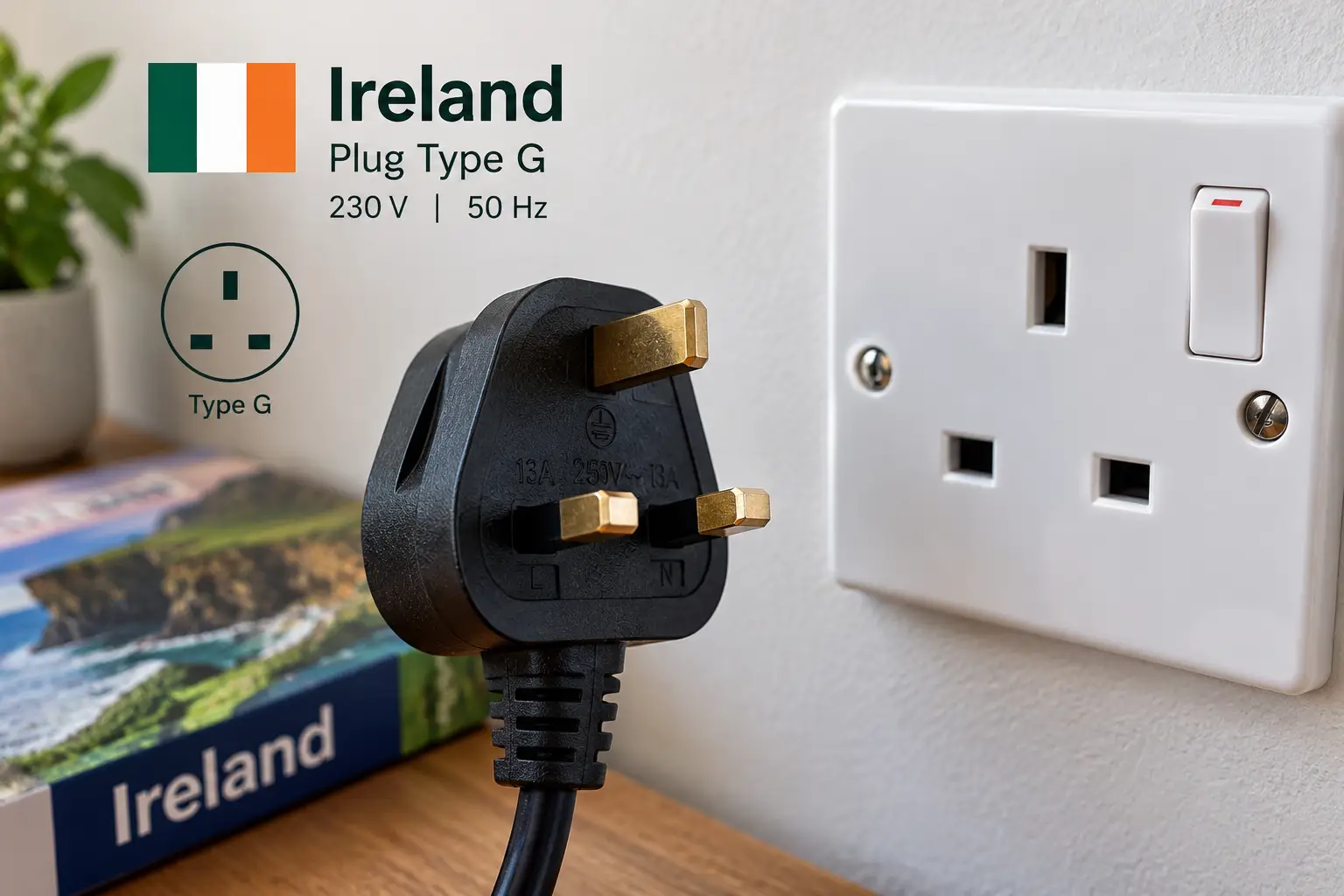
If you’re packing for Dublin, Galway, or a road trip along the Wild Atlantic Way, the first gear question you’ll run into is what type of electrical plug is used in Ireland. The short answer: Ireland uses the Type G plug — a three-pin, rectangular-blade, grounded plug rated for 230 volts and 50 Hz, the same standard used across the United Kingdom. If your devices only have the flat, two-prong Type A or Type B plugs common in the US and Canada, they simply will not fit into an Irish wall socket without an adapter.
That single fact — a completely different pin shape, not just a different voltage — is why a huge share of American travelers end up scrambling for a solution the night before their flight, or worse, in a Dublin pharmacy at 9 p.m. The good news is that solving it is cheap and easy once you understand the difference between a plug adapter (which changes the shape of the plug) and a voltage converter (which changes the electricity itself). This guide breaks down exactly what an Ireland electrical outlet type looks like, why the Type G plug ireland standard exists, and which real, current travel adapters actually hold up to daily use — based on published specs and aggregated customer feedback, not guesswork. For the fuller technical picture of how plug standards evolved worldwide, the Wikipedia overview of AC power plugs and sockets is a solid reference if you want to go deeper.
Below, you’ll find a quick comparison of the top adapters, a detailed breakdown of seven real products worth buying, and practical answers to the voltage, safety, and packing questions that come up most often before a trip to Ireland.
Quick Comparison: Best Travel Adapters for Ireland
Before diving into full reviews, here’s a snapshot of how the seven picks stack up. Every one of these is a genuine Type G adapter, meaning it physically fits Irish and UK sockets — but they differ quite a bit in port count, charging speed, and how many other countries they cover if Ireland is just one stop on a longer trip.
| Adapter | Best For | Ports | Price Range |
|---|---|---|---|
| Ceptics GP-7-3PK | Budget travelers, backup spares | 1 grounded outlet each | $10–$15 (3-pack) |
| OREI US-7 | Simple, fuse-protected basics | 1 grounded outlet each | $12–$18 (3-pack) |
| OREI U2U-7 | Solo travelers who need USB | 1 outlet + 2 USB-A | $10–$14 |
| TESSAN TS-CUBE02-UK | Couples, one-outlet hotel rooms | 3 outlets + 2 USB-A | $14–$19 |
| TESSAN TS-161-UK-C | Families and small groups | 4 outlets + USB-C | $17–$23 (2-pack) |
| EPICKA TA-105C | Multi-country trips beyond Ireland | 1 outlet + 5 USB (USB-C/A) | $20–$27 |
| Anker Nano 5-in-1 | Buyers who want a premium, trusted brand | 1 outlet + USB-C/A | $20–$26 |
Looking at the table, the pattern that jumps out is a straightforward tradeoff between simplicity and flexibility. The Ceptics GP-7-3PK and OREI US-7 are single-purpose Type G adapters — cheap, small, and reliable, but you’ll need a second device if you want to charge more than one gadget per outlet. Move up to the TESSAN TS-CUBE02-UK or TESSAN TS-161-UK-C and you get built-in USB charging plus multiple outlets, which matters a lot in older Irish B&Bs and hotel rooms that often have just one or two accessible sockets. If your itinerary includes stops outside the UK and Ireland, the EPICKA TA-105C and Anker Nano 5-in-1 justify their higher price by covering multiple plug types in one unit.
💬 One click helps other shoppers make an informed choice too! 😊
The 7 Best Travel Adapters for Ireland in 2026
Every product below is a real, currently available adapter — we’re not talking about vague “universal” claims without substance. Each pick below includes genuine feature interpretation, honest analysis of who it’s actually for, and aggregated review sentiment clearly labeled as such, because a rundown of specs alone doesn’t tell you whether an adapter will survive three weeks of daily use in your backpack.
1. Ceptics GP-7-3PK — most dependable budget multi-pack
The Ceptics GP-7-3PK solves the most common travel-adapter mistake: bringing only one adapter and losing it on day two. This is a straightforward three-pack, and having three grounded plugs in your bag means you can charge a phone, a laptop, and a camera battery simultaneously without a single splitter or power strip.
Each unit is rated for up to 3,000W and 250V, with a grounded three-prong Type G design that covers Ireland, the UK, Hong Kong, and the UAE. In practice, that power rating matters less than the grounding pin itself — it’s what lets you safely run higher-draw devices like a laptop charger or a hair straightener (assuming the device itself is dual-voltage) without tripping a breaker in an older Irish building.
What most buyers overlook with a pack like this is redundancy value: at this price point, it’s cheap insurance against the almost inevitable “I left it in the last hotel room” moment. This makes the Ceptics GP-7-3PK a smart pick for budget-conscious travelers, families splitting adapters between multiple rooms, or anyone who’s lost an adapter on a past trip and doesn’t want a repeat.
Reviews consistently report strong build quality and a snug fit in UK and Irish sockets, with the adapter earning a 4.7-star aggregate rating across thousands of verified purchases. A recurring theme in that feedback is that the compact size makes it easy to keep one in a daypack as a spare.
Pros:
- ✅ Three grounded adapters for the price of one premium unit
- ✅ Compact enough to carry as a backup in any bag
- ✅ Strong aggregate review history with thousands of ratings
Cons:
- ❌ No USB ports, so USB devices need their own cable and brick
- ❌ Single-outlet design means no multi-device charging per adapter
At around $10 to $15 for three units, the Ceptics GP-7-3PK delivers real value-per-dollar for anyone who just needs the plug shape solved without extra bells and whistles.
2. OREI US-7 — best fuse-protected basics
The OREI US-7 covers the same core need as the Ceptics pack — converting US plugs to Type G — but leans harder into safety engineering, which is the distinguishing benefit worth calling out. It’s built with an internal fuse specifically designed to protect connected devices if there’s a power surge, a detail that matters more in Ireland’s older housing stock than most travelers realize.
This is also a three-pack, rated for up to 10A/250V, and it accepts multiple US plug configurations (both two-prong and three-prong), so it works with everything from phone chargers to bulkier laptop bricks. It carries CE and RoHS certification, which are the baseline safety marks you want to see on anything plugging directly into a European electrical system.
Based on comparing the specs against the Ceptics pack, the fuse protection is the OREI US-7’s real differentiator — everything else is functionally similar. That makes it the better choice for travelers plugging in pricier electronics (laptops, camera chargers) where a cheap surge could mean an expensive repair, while the Ceptics pack remains fine for lower-stakes gadgets like phone chargers.
Aggregated customer reviews are strongly positive, with the product holding a 4.6-star rating across more than 6,000 ratings, and a common theme in that feedback is straightforward reliability — reviewers frequently note the adapters “just work” without fuss on repeated trips.
Pros:
- ✅ Built-in fuse adds a real layer of surge protection
- ✅ Accepts both two- and three-prong US plugs
- ✅ CE and RoHS safety certifications included
Cons:
- ❌ No USB charging ports on any of the three units
- ❌ Fuse is not user-replaceable if it ever blows
Priced in the $12 to $18 range for three adapters, the OREI US-7 is worth the small premium over bare-bones alternatives if you’re traveling with higher-value electronics.
3. OREI U2U-7 — best compact pick with built-in USB
The OREI U2U-7 trades the multi-pack format for a single, more capable unit — its distinguishing benefit is fitting dual USB charging into a genuinely pocket-sized shell. At just 3.15 x 1.75 x 1.75 inches, it’s noticeably smaller than most competitors that add USB ports, which usually comes at the cost of bulk.
It accepts standard two- or three-prong US plugs on the input side and outputs through a Type G plug plus two USB-A ports delivering up to 2.4A combined. That’s enough to fast-charge a phone and a set of earbuds at the same time, without needing a separate USB wall brick taking up space in your bag. It’s CE and RoHS certified and backed by a limited lifetime warranty, which is a meaningfully longer guarantee than most adapters in this price bracket offer.
What the spec sheet doesn’t say, but reviews reveal, is that this is popular specifically with solo travelers and business travelers packing light — one unit replaces both your plug adapter and your USB charging brick, which matters when you’re trying to fit everything into a single carry-on.
Real customer feedback is very consistent here too, with an aggregated 4.6-star rating across roughly 3,100 reviews, and buyers frequently highlight the compact footprint as the standout feature relative to bulkier universal adapters.
Pros:
- ✅ Genuinely pocket-sized compared to bulkier universal adapters
- ✅ Dual USB-A ports remove the need for a separate charging brick
- ✅ Backed by a limited lifetime warranty
Cons:
- ❌ Only one grounded outlet, so a laptop charger uses your only slot
- ❌ No USB-C port, which is increasingly the standard for newer devices
Expect to pay in the $10 to $14 range, making the OREI U2U-7 one of the best value-for-size picks on this list for a single traveler.
4. TESSAN TS-CUBE02-UK — best for two people sharing one outlet
The TESSAN TS-CUBE02-UK earns its spot with a distinguishing benefit that solo-traveler adapters can’t match: it turns one Irish wall socket into five charging points at once. That’s a genuinely practical fix for a very specific and common problem — Irish hotel rooms and B&Bs, particularly in older buildings, often have just one or two easily reachable outlets near the bed or desk.
The cube design includes three US-style outlets plus two USB-A ports, rated to handle up to 100–250V input, and it weighs about 5 ounces, so it doesn’t add noticeable bulk. Because it accepts standard US three-prong plugs directly, you don’t need a second adapter for your laptop charger — it plugs straight into the cube.
Here’s what to weigh: this isn’t the adapter for a solo traveler with two devices, because you’re paying for outlet capacity you won’t use. But for a couple, a family sharing a room, or anyone traveling with a laptop, a phone, and a camera, the ability to charge everything from one wall socket — rather than hunting for a second outlet behind furniture — is a real, everyday quality-of-life upgrade that Amazon spec sheets rarely spell out.
Aggregated reviews for this style of TESSAN cube adapter are strongly positive, with buyers repeatedly confirming reliable performance across UK and Ireland trips and praising the ability to keep every charging cable consolidated in one place instead of scattered across a hotel room.
Pros:
- ✅ Charges up to five devices from a single Irish wall outlet
- ✅ Accepts US three-prong plugs directly, no second adapter needed
- ✅ Compact cube shape despite the expanded port count
Cons:
- ❌ Bulkier than single-outlet adapters if you’re traveling ultra-light
- ❌ Combined USB output caps at 2.4A, which can feel slow with multiple devices charging together
Priced around $14 to $19, the TESSAN TS-CUBE02-UK is the strongest pick on this list for shared hotel rooms.
5. TESSAN TS-161-UK-C — best for families and small groups
The TESSAN TS-161-UK-C pushes the “one outlet, many devices” concept further, and its distinguishing benefit is scale: sold as a two-pack, each unit offers four AC outlets plus USB-C and USB-A ports, meaning a family of four could plausibly charge every device in the room from two wall sockets total.
Rated for up to 3,250W and 250V/13A, this model is built to handle higher-draw devices safely alongside phones and tablets, and the inclusion of a USB-C port (not just USB-A) is a meaningful upgrade for households with newer laptops, tablets, and phones that have already switched to USB-C charging. Being sold as a two-pack also means you can split one unit for the parents’ devices and one for the kids’, rather than everyone competing for the same outlets.
Based on comparing this to the single-cube TESSAN model above, the extra outlets and second unit make the most sense specifically for multi-person households or groups traveling together — for a solo traveler, this is more adapter than you need, and the added bulk isn’t worth carrying for one person’s devices.
Aggregated customer feedback highlights reliability across multiple trips, including specific mentions of the adapters performing well throughout multi-stop trips across Ireland, and reviewers frequently note that having a spare unit in the two-pack meant they didn’t need to buy a backup separately.
Pros:
- ✅ Four outlets per unit means minimal competition for socket space
- ✅ USB-C port supports newer laptops and phones directly
- ✅ Two-pack format works well for families splitting rooms
Cons:
- ❌ Bulkiest option on this list if you’re packing minimally
- ❌ Higher total cost than single-unit adapters, even accounting for the pack size
At roughly $17 to $23 for the pair, the TESSAN TS-161-UK-C offers strong value when you divide the price across everyone in your travel group.
6. EPICKA TA-105C — best for multi-country itineraries
The EPICKA TA-105C‘s distinguishing benefit is versatility beyond Ireland alone: it includes four interchangeable plug types — Type G for Ireland and the UK, Type C for most of continental Europe, Type I for Australia, and Type A for North America and Japan — in a single all-in-one unit, so it’s built for travelers whose Ireland stop is one leg of a longer international trip.
On the charging side, it includes three USB-C ports and two USB-A ports, letting you charge up to five devices simultaneously without any additional bricks. It’s backed by a built-in 10A fuse, safety shutters, and RoHS, CE, and FCC certifications, which is a comprehensive safety package for a device this compact.
What most buyers overlook is that “universal” adapters like this one trade a small amount of per-outlet power capacity for enormous flexibility — you won’t run a hair dryer or a space heater through it, but for phones, tablets, laptops, and cameras, it comfortably covers the vast majority of what travelers actually pack. That makes it the clear pick for anyone visiting Ireland alongside France, Italy, Australia, or other destinations with different plug standards on the same trip, rather than travelers going only to Ireland or the UK.
Reviews consistently report high satisfaction, with an aggregated 4.7-star rating across more than 3,500 verified purchases, and a recurring theme is that buyers specifically praise not having to carry multiple single-country adapters anymore.
Pros:
- ✅ Covers four major plug types in one compact unit
- ✅ Five simultaneous USB charging ports (USB-C and USB-A)
- ✅ Comprehensive safety certifications, including a built-in fuse
Cons:
- ❌ Not rated for high-wattage appliances like hair dryers or irons
- ❌ Costs more than single-country adapters if Ireland is your only stop
In the $20 to $27 range, the EPICKA TA-105C earns its higher price tag specifically through multi-country flexibility — it’s overkill if Ireland is your only destination, but excellent value if it isn’t.
7. Anker Nano Travel Adapter 5-in-1 — best premium, trusted-brand pick
The Anker Nano Travel Adapter 5-in-1 closes out the list with a distinguishing benefit rooted in brand reliability: Anker has built its reputation on charging hardware specifically, and that engineering focus shows in the fit, finish, and safety design of this adapter more than in any single standout spec.
It’s a worldwide-style adapter supporting multiple plug configurations including Type G, combined with two USB-C ports and USB-A charging, and it uses a widely reported multi-point safety system covering short-circuit protection, fire resistance, and grounded protection. Anker’s broader charging lineup is known for PowerIQ-style fast-charging technology, and this travel adapter carries that same charging-speed emphasis into a travel-sized form factor.
Here’s what to weigh: you’re paying a premium here mostly for brand trust and build consistency rather than dramatically different specs from the EPICKA pick above. For travelers who’ve been burned by a cheap adapter failing mid-trip, or who simply prefer sticking with a manufacturer they already trust for phone chargers and power banks at home, that peace of mind is a legitimate reason to spend a bit more.
Aggregated feedback on Anker’s travel-adapter lineup is generally positive regarding charging speed and build quality, though some reviewers note that foldable-prong designs across the category (not unique to Anker) can occasionally feel less secure in older, looser wall sockets — worth keeping in mind if you’re staying somewhere with dated wiring.
Pros:
- ✅ Backed by a well-established brand with a strong charging-hardware reputation
- ✅ Multi-point safety system across short-circuit and fire protection
- ✅ Fast-charging USB-C ports suited to modern phones and tablets
Cons:
- ❌ Commands a price premium over comparable specs from lesser-known brands
- ❌ Foldable prong designs in this category can occasionally feel less snug in worn sockets
At around $20 to $26, the Anker Nano Travel Adapter 5-in-1 is the pick for travelers who prioritize brand trust and consistency over squeezing out the last dollar of value.
How to Choose a Travel Adapter for Ireland from the USA: 7 Steps
Picking the right travel adapter for Ireland from the USA comes down to a handful of decisions, not endless research. Here’s the practical framework:
- Confirm you need an adapter, not a converter. Check your device’s charger for “INPUT: 100–240V” printed on it. If you see that range, you only need a Type G plug adapter, not a bulky voltage converter.
- Count your devices, not just your trip length. A solo traveler with a phone and a laptop can get by with a single-outlet adapter like the OREI U2U-7; a family needs a multi-outlet cube like the TESSAN TS-CUBE02-UK.
- Decide if Ireland is your only stop. If your itinerary includes continental Europe, Asia, or Australia on the same trip, a multi-plug unit like the EPICKA TA-105C saves you from buying separate adapters per country.
- Prioritize grounded, fused designs for expensive electronics. Laptops and camera chargers are worth protecting with a fused adapter like the OREI US-7, especially in older buildings with less consistent wiring.
- Buy at least one spare. Adapters get left behind in hotel rooms constantly — a multi-pack like the Ceptics GP-7-3PK builds in redundancy for very little extra cost.
- Check for USB-C, not just USB-A. If your phone, tablet, or laptop has already switched to USB-C, an adapter with a USB-C port avoids needing a separate charging brick.
- Order early, not at the airport. Airport shops mark up basic adapters significantly, and selection is limited — ordering from Amazon at least a week ahead gives you time to test the fit before you fly.
Real Traveler Scenarios: Which Adapter Fits Your Trip?
Seeing how these adapters map onto real trip types makes the decision easier than comparing specs in the abstract.
If you’re a solo backpacker spending two weeks hopping between Dublin hostels on a tight budget, the OREI U2U-7 is the practical call — it’s compact, includes USB charging for your phone and earbuds, and won’t take up space you need for gear. If you’re a couple on a week-long anniversary trip staying in boutique B&Bs around the Ring of Kerry, the TESSAN TS-CUBE02-UK solves the classic “only one outlet near the bed” problem without either of you fighting over charging time.
Traveling as a family of four doing a two-week Ireland and Scotland road trip changes the math again — the TESSAN TS-161-UK-C two-pack means the kids’ tablets and the parents’ phones and laptop can all charge simultaneously across two rooms, which matters far more with children involved than raw port count alone would suggest. Business travelers attending a conference in Dublin with back-to-back meetings should lean toward the Anker Nano Travel Adapter 5-in-1 or the EPICKA TA-105C — reliability and fast charging matter more than saving a few dollars when a dead laptop battery could mean missing a client call.
✨ Don’t miss these exclusive deals! 🍀 Get your Ireland travel adapter sorted before takeoff — check current pricing and availability now so you’re not scrambling at the airport gate.
Common Mistakes Travelers Make with Irish Outlets (and How to Fix Them)
A handful of avoidable mistakes account for most of the adapter frustration travelers report from Ireland trips.
Mistake 1: Assuming a UK adapter is different from an Ireland adapter. They’re identical — both countries use Type G at 230V/50Hz, so any adapter labeled for the UK works fine in Ireland. Solution: don’t pay extra for an adapter specifically marketed “for Ireland” when a UK-labeled one is the same part.
Mistake 2: Plugging a single-voltage US hair dryer or straightener straight into an adapter. A plug adapter changes shape only — it does nothing to the voltage, so a 120V-only appliance can be damaged or become a fire hazard on Ireland’s 230V supply. Solution: check for “100–240V” on the appliance itself, or buy a dedicated dual-voltage travel appliance instead of a converter, which adds bulk and heat risk.
Mistake 3: Bringing only one adapter for a multi-device household. This leads to nightly negotiations over whose phone charges first. Solution: a multi-outlet option like the TESSAN TS-CUBE02-UK or a small multi-pack like the Ceptics GP-7-3PK removes the bottleneck entirely.
Mistake 4: Buying at the airport as a last resort. Airport electronics kiosks routinely charge two to three times what the same adapter costs online, with far less selection. Solution: order ahead and test the adapter in a US outlet before you travel, confirming it grips your specific chargers snugly.
Type G Plug Ireland: Understanding the Ireland Electrical Outlet Type
The Ireland electrical outlet type is formally known as BS 1363, the British Standard also used throughout the UK, and it’s designated Type G under the international IEC 60083 classification. Three rectangular pins form an isosceles triangle: two power pins and a longer, offset earth pin above them, which must be inserted first for the socket’s internal shutters to release and allow the power pins to connect — a built-in safety mechanism most other plug types don’t have.
Unlike Type A or Type C, every Type G plug also contains its own fuse, typically rated at 3A or 13A depending on the device, which protects the specific appliance rather than just the household circuit. That’s a meaningfully more granular safety layer, and it’s part of why UK and Irish plugs are physically larger and heavier than their European or American counterparts. For a deeper technical breakdown of the exact pin dimensions and spacing, worldstandards.eu’s Type G reference documents the full specification.
Ireland’s electricity runs at 230V and 50Hz, matching the wider European standard rather than the 120V/60Hz used in the US and Canada — which is the second half of the equation travelers need to plan around, separate from the plug shape itself.
Do You Need an Ireland Voltage Converter for US Appliances?
This is the question that trips up more travelers than the plug shape itself. An adapter changes the physical shape of the plug; it does not change the voltage coming out of the wall. Whether you need an Ireland voltage converter for US appliances depends entirely on what’s printed on your specific device.
Most modern electronics — phone chargers, laptop power bricks, camera chargers, tablet chargers — are dual-voltage by design, meaning they’re built to accept anywhere from 100V to 240V automatically. Check the fine print on the charger block itself; if it reads something like “INPUT: 100-240V~50/60Hz,” you only need a plug adapter, and any of the seven products above will work perfectly.
Single-voltage appliances are the exception, and they’re almost always heat-generating devices: hair dryers, flat irons, curling irons, and some older electric razors. Plugging a 120V-only hair dryer into a 230V Irish socket through nothing but a shape adapter can destroy the appliance and, in worse cases, create a fire risk. Here, the honest, sourced advice is simple: don’t buy a step-down voltage converter for a hair dryer if you can avoid it — bulky converters designed to safely handle the wattage of a hair dryer are heavy, and Ireland-based hotels commonly provide a dual-voltage hair dryer in the room already. If you specifically need to bring your own, look for a dual-voltage travel hair dryer built for international use rather than pairing a domestic-only model with a converter.
| Device Type | Needs Adapter | Needs Converter |
|---|---|---|
| Phone / tablet charger | ✅ Yes | ❌ Usually not (check for 100–240V label) |
| Laptop charger | ✅ Yes | ❌ Usually not (check for 100–240V label) |
| US-only hair dryer / straightener | ✅ Yes | ✅ Yes, or bring dual-voltage version |
| Electric toothbrush (charging base) | ✅ Yes | ❌ Rarely needed on newer models |
Looking at the table, the pattern is consistent: it’s almost always the heat-producing personal care devices, not your everyday electronics, that create a genuine voltage risk. Checking the label takes ten seconds and avoids the two most common and expensive travel-electronics mistakes.
What to Expect: Everyday Power Performance in Ireland
In practical, day-to-day terms, once your adapter is correctly matched to your device, charging performance in Ireland is generally fast and consistent — arguably faster than at home for some devices. Because Irish wall current runs at 230V compared to 120V in the US, dual-voltage chargers that support fast-charging protocols (like USB-C Power Delivery) often reach full charging speed just as quickly, sometimes marginally faster, since higher voltage lines can deliver rated wattage with less current draw.
Where travelers do notice a difference is outlet availability rather than charging speed. Older Irish hotels, guesthouses, and rental cottages — especially outside Dublin’s newer hotel developments — were often wired decades before the current wave of phones, tablets, and laptops per traveler became the norm, so rooms may only have one or two easily reachable sockets. This is precisely why multi-outlet adapters like the TESSAN TS-CUBE02-UK consistently outperform single-plug adapters in real-world usefulness, even though their core “convert the plug shape” function is identical.
One more practical note: Ireland’s power grid is stable and modern by international standards, so unplanned outages are uncommon for tourists, though rural areas can occasionally see brief interruptions during severe winter storms — not something to plan around, but worth knowing if you’re traveling off-season.
Electrical Safety, Regulations, and Standards for Travel Adapters
Buying a travel adapter isn’t purely a convenience decision — safety certifications matter, and it’s worth understanding what to look for before you buy from a third-party seller. In the US, the Consumer Product Safety Commission has repeatedly flagged the risks of poorly made electrical accessories, noting that faulty cords, adapters, and surge devices can pose real fire and shock hazards when they use undersized components or fake certification labels; the agency’s own guidance on cord and accessory safety is a useful baseline even though it’s focused on domestic extension cords rather than travel adapters specifically.
The practical takeaway for Ireland-bound travelers: look for CE and RoHS marks at minimum (both appear on every product reviewed above), which indicate the product meets European conformity and hazardous-substance restrictions. A built-in fuse, like the ones in the OREI US-7 and EPICKA TA-105C, adds a meaningful extra layer of protection specifically because Irish and UK plugs are designed around individually fused connections rather than relying solely on the household breaker.
It’s also worth confirming your travel dates and any local advisories before departure — the US Embassy in Dublin’s website is the official government source for current safety and travel guidance for US citizens visiting Ireland, separate from electrical-specific concerns.
Ireland Travel Adapters for Different Types of Travelers
Not every traveler weighs the same features the same way, so it’s worth breaking this down by traveler type rather than assuming one adapter fits everyone.
Business travelers should prioritize reliability and fast charging above all else, since a dead laptop before a meeting isn’t just inconvenient — it’s a professional problem. The Anker Nano Travel Adapter 5-in-1 and EPICKA TA-105C both fit this profile well, particularly for anyone whose itinerary includes stops beyond Ireland.
Budget backpackers benefit most from redundancy and low cost per unit. The Ceptics GP-7-3PK multi-pack means losing one adapter doesn’t derail your trip, and the price point leaves more budget for the trip itself.
Families with kids need outlet capacity above almost everything else — competing for a single socket with multiple children’s devices gets old fast. The TESSAN TS-161-UK-C two-pack, split across rooms or devices, solves this directly.
Retirees and less tech-heavy travelers often just need one or two devices charged reliably without complexity. The straightforward OREI US-7 or a single Ceptics unit covers this without unnecessary extra ports to manage.
Long-Term Cost and Value: Is a Premium Adapter Worth It?
| Product | Price Range | Longevity Signal | Best Value For |
|---|---|---|---|
| Ceptics GP-7-3PK | $10–$15 | 4.7★ aggregate rating | Redundancy, low upfront cost |
| OREI US-7 | $12–$18 | 4.6★ aggregate rating | Protecting pricier electronics |
| EPICKA TA-105C | $20–$27 | 4.7★ aggregate rating | Multi-country flexibility |
| Anker Nano 5-in-1 | $20–$26 | Established brand track record | Trust and build consistency |
Looking at the table, the real long-term cost calculation isn’t just the sticker price — it’s whether you’ll actually reuse the adapter on future trips. A traveler who visits the UK, Ireland, or other Type G destinations regularly gets more lifetime value out of a slightly pricier, more durable unit like the Anker Nano Travel Adapter 5-in-1, since replacing a broken $12 adapter twice a year adds up to more than one $25 adapter that lasts. For a single, one-off Ireland trip, though, the budget picks deliver essentially the same core function for a fraction of the cost, and the “premium” difference mostly comes down to peace of mind rather than measurable performance.
Frequently Asked Questions
❓ What plug adapter do I need for Ireland?
❓ Can I use my US phone charger in Ireland without a converter?
❓ Is a UK adapter the same as an Ireland adapter?
❓ Do hotels in Ireland provide adapters for guests?
❓ Can I bring a US hair dryer to Ireland with just an adapter?
Conclusion
So, what type of electrical plug is used in Ireland? It’s Type G — the same three-pin, grounded, BS 1363 standard used across the UK — running on 230V at 50Hz, a genuinely different system from the flat two-prong plugs and 120V current most American travelers are used to at home. Solving that mismatch doesn’t require overthinking: a simple, well-reviewed adapter handles the plug shape, and checking your device labels for “100–240V” tells you in seconds whether you need anything more than that.
Among the seven real products covered here, there’s a fit for nearly every travel style. Solo travelers packing light do well with the compact OREI U2U-7, families and groups get real value from the multi-outlet TESSAN TS-161-UK-C, and anyone continuing on to other countries after Ireland should lean toward the flexible EPICKA TA-105C or the dependable Anker Nano Travel Adapter 5-in-1. Whichever you choose, the goal is the same: sort it out before you fly, so the only thing you’re thinking about once you land is where to get your first proper cup of Irish tea.
Recommended for You
- Wall Outlet USB Power Adapter: 7 Best Picks for 2026 (Fast & Safe)
- Receptacle with USB Ports: 7 Best Picks for 2026 (Pros & Cons)
- Plug Size Guide 2026: 7 Best Travel Adapters for Any Country
Disclaimer: This post contains affiliate links. As an Amazon Associate, I earn from qualifying purchases made through these links, at no additional cost to you.
✨ Found this article helpful? Share it with someone who needs it! 💬🤗