
In This Article
If you’re staring at a suitcase full of chargers and wondering about the denmark electrical plug type before your flight, you’re not alone — this is one of the most-searched travel questions for Americans heading to Scandinavia. The short answer: Denmark uses Type C and Type K sockets, running on 230V at 50Hz, which means every US device with a flat two-prong plug is going to need an adapter the moment you land in Copenhagen, Aarhus, or Odense.
The confusing part isn’t the adapter shape — it’s figuring out which adapter actually fits securely, charges fast enough for modern gear, and won’t leave you fumbling with a wobbly connection in a hotel room at midnight. Denmark’s grounded Type K outlet has a quirk most travelers don’t expect: the earth pin lives on the plug, not the socket, which trips up some “universal” adapters that work fine in Germany or France but sit loose in a Danish wall.
This guide skips the marketing fluff and gets into the real spec sheets, aggregated customer feedback, and safety standards behind seven adapters that actually work for Denmark. We’ll cover budget-friendly single-purpose adapters, GaN-powered fast chargers for laptops, and the one scenario where you genuinely need a voltage converter instead of a plug adapter. By the end, you’ll know exactly which pick matches your trip, your gear, and your budget — no guesswork required.
What Is the Denmark Electrical Plug Type?
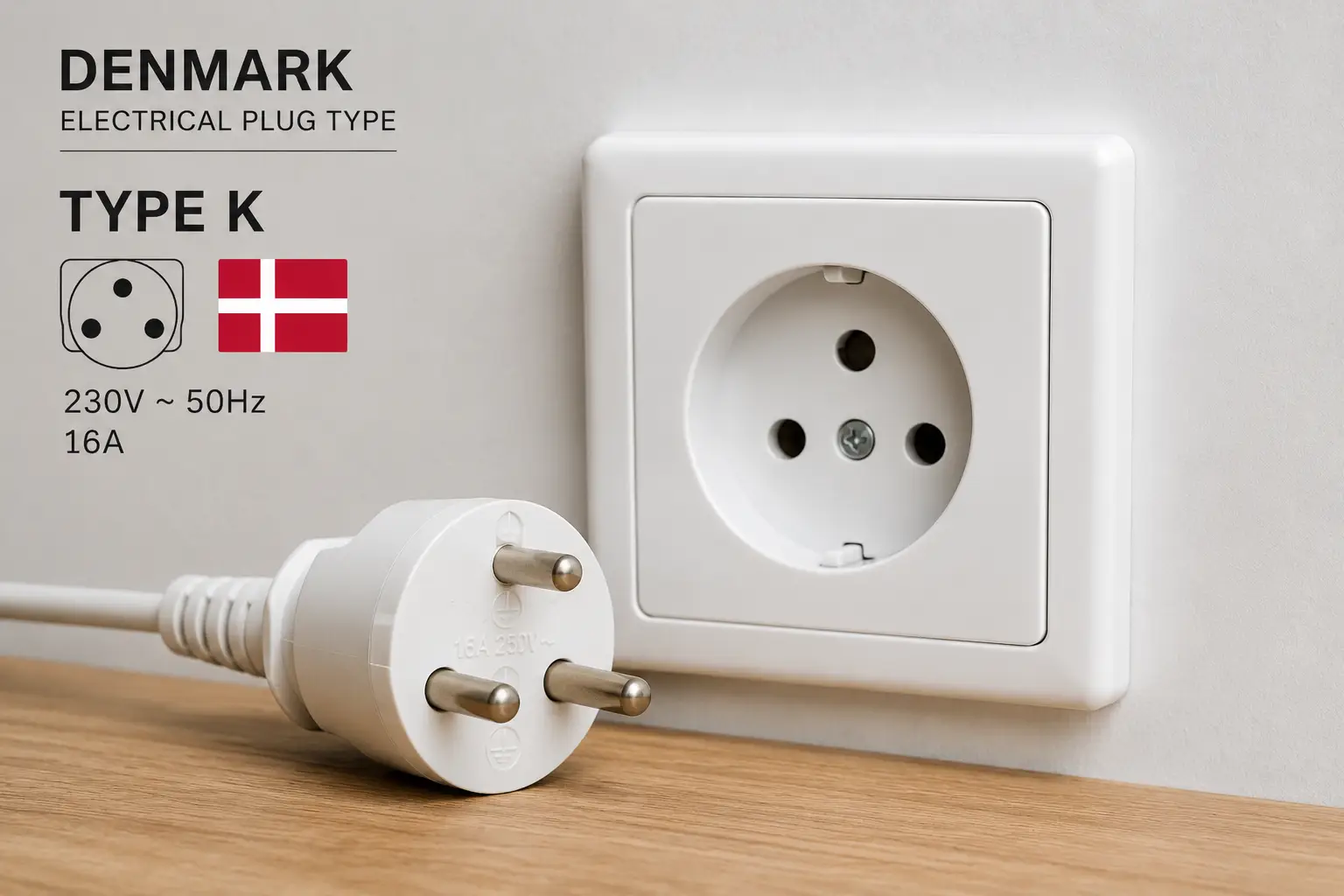
Denmark’s electrical plug type is a combination of Type C (the two-round-pin Europlug) and Type K (a Danish-specific grounded plug with an integrated earth pin), both running on 230V/50Hz power. Type C works for most ungrounded electronics, while Type K is required for grounded, three-prong European appliances.
This dual-standard system is officially codified as DS 107-2-D1, Denmark’s national wiring and plug standard, which is also used throughout the Faroe Islands and Greenland. Unlike Germany’s Schuko system, where the socket itself carries the grounding clips, the Danish standard puts the grounding pin directly on the plug — a design choice that became mandatory for new residential installations only in 2009, meaning older buildings and vacation rentals may still have ungrounded outlets. For US travelers, the practical takeaway is simple: your flat two-prong American plug will not physically fit a Danish socket under any circumstances, so a shape-converting adapter is non-negotiable, and a genuine voltage converter is a separate purchase only needed for single-voltage appliances.
Denmark Plug Types Compared: Type C vs. Type K vs. Type E/F
Because “Denmark electrical plug type” isn’t a single, simple answer, it helps to see the three plug families side by side before you buy anything. Most travel adapters marketed for “Europe” are built around Type C or Type F (German Schuko), and not every one of them seats properly in a Danish Type K wall socket.
| Plug Type | Pin Configuration | Grounded? | Common In | Fits Danish Sockets? |
|---|---|---|---|---|
| Type C (Europlug) | 2 round pins, 4.8mm | No | Most of continental Europe | Yes, universally |
| Type K (Danish) | 2 round pins + arc-shaped earth pin on plug | Yes | Denmark, Greenland, Faroe Islands | Yes, natively |
| Type E/F (Schuko/French) | 2 round pins + side/clip grounding | Yes | Germany, France, most of EU | Often, but not guaranteed on older sockets |
The analysis here matters more than it looks: a Type C adapter is your safe baseline for phone chargers, laptop bricks, and camera batteries, since almost every modern electronic device is designed to run ungrounded. But if you’re traveling with something that has a genuine three-prong European plug — certain CPAP machines, hair tools, or older grounded electronics — you’ll want an adapter explicitly rated for Type K or a dual-purpose Type E/F adapter that Danish sockets are known to accept. This is exactly why several of the picks below include multiple pin configurations in a single unit rather than a single fixed Type C shape.
Quick Comparison: Top 7 Denmark Travel Adapters at a Glance
Before diving into the full breakdown, here’s a fast-scan summary of how these seven adapters for the denmark electrical plug type stack up on price, charging power, and who each one suits best.
| Product | Plug Coverage | Charging Ports | Price Range | Best For |
|---|---|---|---|---|
| EPICKA Universal Travel Adapter | Type C/K compatible (universal) | 1 AC + up to 5 USB | Around $15–$20 | Budget all-rounders |
| OREI European Travel Plug Adapter | Dedicated Type C | 2 USB-A | Around $10–$15 | Simple, single-purpose trips |
| TESSAN Universal Travel Adapter | Type C/G/A/I | 2 USB-A + USB-C, GaN | Around $20–$30 | Flat-outlet, multi-device charging |
| Ceptics World Travel Adapter Kit | Modular, swap-in plug heads | 2 USB-A + USB-C PD | Around $30–$40 | Frequent international travelers |
| VINTAR 100W GaN International Power Adapter | Type C/G/A/I | 3 USB-C PD + 1 USB-A | Around $35–$45 | Laptop-heavy business trips |
| BESTEK Universal Travel Adapter | Universal + built-in voltage converter | 4 USB | Around $30–$45 | Single-voltage hair tools |
| Anker Nano Travel Adapter | European 2-pin (Type C-style) | 2 USB-C | Around $20–$25 | Minimalist carry-on packers |
Looking at the table, the split is really about how much power you need and how many devices you’re juggling. The OREI European Travel Plug Adapter and EPICKA Universal Travel Adapter cover the basics for under $20, while the VINTAR 100W GaN International Power Adapter and Ceptics World Travel Adapter Kit justify their higher price with genuine laptop-charging wattage and modular safety features. If you’re packing a hair straightener or another single-voltage appliance, the BESTEK Universal Travel Adapter is the only one on this list actually built to step voltage down rather than just reshape the plug.
💬 One click helps other shoppers make an informed choice too! 😊
7 Best Travel Adapters for the Denmark Electrical Plug Type
Each of these adapters is a real, currently available product, chosen to cover entry-level, mid-range, and premium price points, along with a couple of specialized picks for travelers with unusual charging needs.
1. EPICKA Universal Travel Adapter — best all-around budget pick
The EPICKA Universal Travel Adapter (model TA-105) earns its spot as the default recommendation for first-time Denmark travelers who don’t want to overthink packing.
Its compact cube houses a single AC outlet plus a bank of USB-A and USB-C ports, and the sliding-pin mechanism switches between US, UK, EU, and AU/China configurations, which covers both Type C and Type K-compatible Danish sockets without swapping parts. Built-in fuses and shutter-style port covers add a layer of protection that cheaper knockoff adapters often skip entirely — a detail that matters more than it sounds like, since a blown fuse in an adapter is a far cheaper fix than a fried laptop charger.
Based on comparing the spec sheet against competitors in this price bracket, the EPICKA Universal Travel Adapter is best suited to travelers juggling two or three devices at once — a phone, a camera battery, and a laptop — rather than someone who needs to fast-charge a MacBook overnight. Reviews consistently describe the build as “more solid than generic white-label adapters,” with firm sliders and a locking mechanism that resists the wobble common in $10 knockoffs, though the charging speed is characterized as convenient rather than fast, better suited to overnight hotel charging than a rushed airport top-up.
Pros:
- ✅ Fits 150+ countries including Denmark’s Type C and K outlets
- ✅ Multiple USB ports reduce the need for separate chargers
- ✅ Compact cube design travels well in a tech organizer
Cons:
- ❌ Not a voltage converter — won’t run single-voltage hair tools
- ❌ Charging speed is moderate, not ideal for large laptops
At around $15–$20, the EPICKA Universal Travel Adapter delivers strong value-for-money for anyone who wants one adapter that just works without a learning curve.
2. OREI European Travel Plug Adapter — simplest, most affordable fit
The OREI European Travel Plug Adapter (model U2U-9C) strips things down to exactly what most Denmark-bound travelers actually need: a dedicated Type C plug shape with two USB-A charging ports built in.
Unlike universal adapters that pack in five pin configurations you’ll never use on a single trip, this one is purpose-built for continental Europe, which means a tighter, more secure fit in Danish Type C sockets and less bulk in your bag. The dual USB-A ports let you charge a phone and a tablet simultaneously without hunting for a second outlet, and the CE certification signals it’s been tested against basic European safety benchmarks.
What most buyers overlook with single-purpose adapters like this one is that “simple” doesn’t mean “limited” for the average trip — if you’re not traveling with grounded three-prong electronics, a dedicated Type C adapter is often more reliable than a universal one, precisely because it has fewer moving parts to loosen over time. Aggregated customer sentiment on this style of adapter tends to praise the secure plug fit and straightforward design, with the most common complaint being the lack of a dedicated AC outlet for non-USB devices like curling irons or full-size laptop bricks with three-prong ends.
Pros:
- ✅ Compact, dedicated Type C fit for secure Danish sockets
- ✅ Two USB-A ports for simultaneous small-device charging
- ✅ CE-certified for basic European electrical safety
Cons:
- ❌ No dedicated AC outlet for larger appliances
- ❌ Doesn’t cover Type K three-prong grounded devices
At around $10–$15, the OREI European Travel Plug Adapter is the best value pick for anyone packing light and traveling only within continental Europe.
3. TESSAN Universal Travel Adapter — best flat, wall-hugging design
The TESSAN Universal Travel Adapter (Type C/G/A/I) solves a problem almost every traveler has run into: a bulky adapter that blocks the second outlet on a crowded hotel power strip.
Its low-profile “wall hugger” housing uses GaN (gallium nitride) chip technology, which allows for a smaller footprint while still delivering efficient power to two USB-A ports and a USB-C port alongside a full AC outlet. The universal pin system extends coverage well beyond Denmark to the UK, Australia, and the US itself, making it a genuinely reusable purchase rather than a single-trip item.
Based on comparing this design against bulkier competitors, the flat profile is the real differentiator — in a Danish hotel room with limited outlets (common in older buildings that haven’t been fully renovated for modern power strips), a slim adapter that doesn’t crowd out the neighboring socket is a meaningfully better everyday experience. Reviews of TESSAN’s adapter lineup frequently highlight the GaN charging speed as noticeably faster than older adapter designs, while some users note the AC outlet is only rated for lower-wattage devices, not high-draw appliances.
Pros:
- ✅ Slim, wall-hugging design frees up neighboring outlets
- ✅ GaN chip technology for faster, more efficient charging
- ✅ Covers Type C/G/A/I for multi-country trips beyond Denmark
Cons:
- ❌ AC outlet not rated for high-wattage appliances
- ❌ Slightly pricier than basic single-purpose adapters
Priced around $20–$30, the TESSAN Universal Travel Adapter is a smart mid-range pick for travelers who hop between multiple European countries on one itinerary.
4. Ceptics World Travel Adapter Kit — best for frequent international travelers
The Ceptics World Travel Adapter Kit (model WPS-5B) takes a modular approach, using swap-in plug heads through Ceptics’ proprietary SWADAPT system rather than a single molded shape.
This means the same core charging unit — with its GaN-based 2 USB-A and USB-C PD ports plus built-in surge protection — can be reconfigured for Denmark’s Type C/K sockets on one trip and switched to a UK or Australian plug head on the next, without buying a new adapter each time. Surge protection is a genuinely useful feature that budget adapters skip; it adds a layer of defense against the voltage spikes that occasionally occur on older European grids, including some of Denmark’s less-updated building wiring.
What the spec sheet doesn’t fully convey, but long-term user reports do, is durability — one detailed customer review after four years of regular use described the plug heads and swap mechanism as still functioning reliably, which speaks to build quality that holds up beyond a single vacation. This is the pick for someone who travels internationally multiple times a year and wants to stop rebuying adapters every time their destination changes.
Pros:
- ✅ Modular swap-in heads work across dozens of countries
- ✅ Built-in surge protection guards against voltage spikes
- ✅ USB-C PD port supports faster charging for modern devices
Cons:
- ❌ Higher upfront cost than single-purpose adapters
- ❌ Swap mechanism adds a small learning curve at first use
At around $30–$40, the Ceptics World Travel Adapter Kit pays for itself if you’re a repeat international traveler rather than a once-a-year vacationer.
5. VINTAR 100W GaN International Power Adapter — best for laptop-heavy trips
The VINTAR 100W GaN International Power Adapter is built for a specific traveler: the one bringing a laptop, a tablet, and a phone, all of which need to charge simultaneously and quickly, often overnight before an early flight.
Its GaN chipset supports up to 100W of total output split across three USB-C PD ports and one USB-A QC port, which is enough wattage to fast-charge a MacBook Pro or similar ultrabook alongside smaller devices — something budget adapters in the 20-30W range simply cannot do. The built-in pin system covers Type C, G, A, and I configurations, so the same unit works in Denmark and doubles as your adapter for connecting flights through the UK or elsewhere.
Based on comparing the wattage specs against the rest of this lineup, the VINTAR 100W GaN International Power Adapter is the clear choice if a dead laptop battery mid-meeting is a real risk for your trip, not just a hypothetical. Reviews of GaN-based high-wattage adapters in this category generally report noticeably cooler operating temperatures and faster charge times compared to older silicon-based chargers, though the higher price point makes it overkill for someone only charging a phone.
Pros:
- ✅ 100W GaN output fast-charges laptops, not just phones
- ✅ Three USB-C PD ports handle multiple devices at once
- ✅ Runs cooler than older silicon-chip adapter designs
Cons:
- ❌ Premium price relative to phone-only charging needs
- ❌ Bulkier than minimalist single-port adapters
At around $35–$45, the VINTAR 100W GaN International Power Adapter is worth the investment for business travelers and digital nomads who can’t afford downtime.
6. BESTEK Universal Travel Adapter — the one with a real voltage converter
The BESTEK Universal Travel Adapter stands apart from every other pick on this list because it isn’t just a plug-shape adapter — it includes an actual step-down voltage converter, handling the 220V-to-110V conversion that dual-voltage electronics don’t need but single-voltage appliances absolutely do.
With a 6A capacity and four USB charging ports layered on top of the conversion function, this adapter is designed for travelers bringing a hair dryer, flat iron, or other appliance that’s only rated for US voltage. That’s an important distinction most shoppers miss: your phone and laptop chargers are almost certainly dual-voltage already (check the fine print on the brick — if it says “INPUT: 100-240V,” you only need a plug adapter, not this converter).
Here’s what to weigh before buying this one: voltage converters like this are typically rated for lower-wattage devices (often under 700-1600W depending on the model), so a full-power blow dryer or curling iron pulling close to 1800W may exceed its rated capacity and should be checked carefully against the product’s wattage limit before use. Aggregated feedback on this category of converter-adapter combo generally notes reliable performance for small appliances within the rated wattage, with the most common caveat being that users need to actually read the wattage limit rather than assume “universal” means “unlimited.”
Pros:
- ✅ Genuine voltage conversion, not just a plug-shape adapter
- ✅ Four USB ports for simultaneous small-device charging
- ✅ Covers UK/AU/US/EU plug configurations in one unit
Cons:
- ❌ Limited wattage capacity — not for high-draw appliances
- ❌ Bulkier and heavier than plug-only adapters
Priced around $30–$45, the BESTEK Universal Travel Adapter is the specialized pick for anyone who can’t leave their styling tools at home.
7. Anker Nano Travel Adapter — best minimalist, trusted-brand pick
The Anker Nano Travel Adapter takes the opposite approach from the BESTEK: it strips the adapter down to its smallest possible form, offering a European-style two-pin plug body with two USB-C ports and nothing else.
At 20W of output with smart temperature control, it’s built for travelers who exclusively charge USB-C devices — modern phones, earbuds cases, and lightweight tablets — and have no interest in carrying an adapter with an AC pass-through outlet they’ll never use. Anker’s reputation for build quality and warranty support is a genuine factor here; it’s one of the few brands in the travel adapter space where the company’s broader track record in charging electronics carries real weight.
What most buyers overlook with ultra-compact adapters like this is that smaller doesn’t mean less capable for the right use case — if your entire kit is USB-C, a bulkier universal adapter with an unused AC outlet is just dead weight in your bag. Reviews of Anker’s compact charging line consistently point to reliable temperature management and a trustworthy brand backing, with the main limitation being the total absence of a USB-A port or AC outlet, which rules it out for travelers with older devices or non-USB electronics.
Pros:
- ✅ Ultra-compact European-style design saves bag space
- ✅ Smart temperature control protects devices from overheating
- ✅ Backed by Anker’s strong brand reputation and warranty
Cons:
- ❌ No USB-A port or AC outlet for non-USB-C devices
- ❌ 20W output is modest for larger tablets or laptops
At around $20–$25, the Anker Nano Travel Adapter is the smart choice for minimalist packers who’ve already gone all-in on USB-C.
Detailed Product Comparison: Ports, Power & Price
Now that you’ve seen all seven in depth, here’s how they compare head-to-head on the specs that actually influence day-to-day use with the denmark electrical plug type.
| Product | Max Output | Voltage Conversion? | Grounded (Type K) Support | Price Range |
|---|---|---|---|---|
| EPICKA Universal Travel Adapter | Standard USB speeds | No | Yes, via universal pins | $15–$20 |
| OREI European Travel Plug Adapter | Standard USB speeds | No | No (Type C only) | $10–$15 |
| TESSAN Universal Travel Adapter | GaN-boosted, mid-speed | No | Yes, via universal pins | $20–$30 |
| Ceptics World Travel Adapter Kit | USB-C PD, fast | No | Yes, via swap heads | $30–$40 |
| VINTAR 100W GaN International Power Adapter | 100W PD, fastest on this list | No | Yes, via universal pins | $35–$45 |
| BESTEK Universal Travel Adapter | Standard USB + AC conversion | Yes, up to rated wattage | Yes, via universal pins | $30–$45 |
| Anker Nano Travel Adapter | 20W USB-C | No | Limited (2-pin only) | $20–$25 |
The pattern that stands out here is that only one product — the BESTEK Universal Travel Adapter — actually converts voltage, while the rest are shape-and-charging adapters that assume your electronics are already dual-voltage, which is true for nearly all modern phones and laptops. If raw charging speed for a laptop is your priority, the VINTAR 100W GaN International Power Adapter outperforms everything else on this list by a wide margin, while the OREI European Travel Plug Adapter remains the leanest, most affordable option for travelers who only need to keep a phone alive.
<h4>✨ Don’t miss these exclusive deals!</h4>
🔍 Take your Denmark packing list to the next level with this carefully curated lineup. Click a highlighted item to check current pricing and availability. These picks will help you keep every device charged from Copenhagen to Aarhus without a single dead battery!
Travel Adapter vs. Voltage Converter: What Denmark Travelers Actually Need
This is the single most common point of confusion in the denmark electrical plug type conversation, and getting it wrong can genuinely damage your electronics.
| Device Type | What You Need | Example |
|---|---|---|
| Dual-voltage electronics (100-240V) | Plug adapter only | Phone chargers, laptop bricks, camera chargers |
| Single-voltage US appliances | Voltage converter + plug adapter | Older hair dryers, some CPAP machines, curling irons |
| Devices already sold for EU use | No adapter needed | European-purchased electronics |
A plug adapter changes the physical shape of the plug so it fits a Danish socket, but it does absolutely nothing to the electrical current itself — it simply passes 230V straight through. A voltage converter, on the other hand, actually steps that 230V down to something closer to the 110-120V your appliance expects. Here’s what most travelers get wrong: they assume any “universal” adapter handles both jobs, when in reality most of the picks on this list, aside from the BESTEK Universal Travel Adapter, are shape-only adapters that will happily fry a single-voltage hair dryer if you plug it in without checking first.
The safest habit, according to consumer electronics guidance widely echoed across independent buying guides for the best travel adapters, is to physically check the input voltage rating printed on every device before you leave home — if it doesn’t explicitly say “100-240V,” treat it as single-voltage and either buy a converter or leave the appliance at home in favor of a European-market replacement.
How to Use Your Denmark Travel Adapter: A Step-by-Step Setup Guide
Getting the right adapter is only half the job — using it correctly avoids the most common first-day mistakes travelers make in Denmark.
First, before you even pack, check every device’s charging brick for the “INPUT” voltage range printed in small text; anything listing 100-240V is safe to use with a plug adapter alone. Second, once you land, insert the adapter into the Danish socket fully before plugging your device into the adapter — inserting both at once increases the risk of a loose connection that can cause intermittent charging or overheating. Third, if you’re using a universal adapter like the EPICKA Universal Travel Adapter or TESSAN Universal Travel Adapter, confirm the pin slider is locked into the EU/Type C position, since some models default to a different region’s configuration out of the box.
Fourth, avoid overloading a single adapter with high-draw devices simultaneously — charging a laptop and running a hair dryer through the same low-wattage USB adapter is a common cause of overheating complaints in customer reviews. Fifth, if you’re staying in an older Danish building or vacation rental, visually check that the outlet has a grounding pin socket before plugging in grounded electronics; some older properties, per Denmark’s phased-in grounding requirements, may still have ungrounded wiring. Finally, always pack your adapter in a carry-on rather than checked luggage — a lost adapter in checked baggage means scrambling for an airport replacement at a serious markup.
Real-World Scenarios: Which Adapter Fits Your Trip to Denmark
Different trips call for different gear, and matching your denmark electrical plug type adapter to your actual travel pattern avoids both overspending and under-preparing.
If you’re a college student backpacking through Copenhagen for a week with just a phone and a camera, the OREI European Travel Plug Adapter or EPICKA Universal Travel Adapter covers everything you need for well under $20, without paying for features you won’t use. If you’re a business traveler flying in for back-to-back meetings with a laptop, tablet, and phone all needing overnight charges, the VINTAR 100W GaN International Power Adapter or Ceptics World Travel Adapter Kit justifies its higher price by keeping every device at full battery by morning. If you’re traveling with a partner who needs a hair styling tool that isn’t dual-voltage, the BESTEK Universal Travel Adapter is the only pick on this list that actually solves that problem safely.
And if you’re a frequent flyer who visits three or four countries a year — Denmark this trip, the UK or Japan the next — the modular Ceptics World Travel Adapter Kit or minimalist Anker Nano Travel Adapter (if your kit is all USB-C) are the better long-term investments, since you won’t be rebuying an adapter for every new destination.
How to Choose the Right Denmark Electrical Plug Type Adapter
Cutting through the marketing noise, here’s the actual decision process worth following before you buy.
- Confirm your devices’ voltage rating first. Check every charging brick for “100-240V” — this determines whether you need a converter or just an adapter.
- Decide between universal and dedicated Type C. If Denmark is your only stop, a dedicated adapter like the OREI European Travel Plug Adapter is lighter and cheaper; if you’re visiting multiple regions, go universal.
- Match wattage to your gear. A phone-only trip doesn’t need 100W; a laptop-heavy trip does, which points toward the VINTAR 100W GaN International Power Adapter.
- Check for grounded (Type K) compatibility. If you’re traveling with any three-prong European device, confirm the adapter explicitly supports grounded connections.
- Weigh durability against trip frequency. Occasional travelers can save money on single-trip adapters; frequent travelers benefit from modular kits built to last years.
- Look for real safety certifications. CE marking and built-in fuses or surge protection aren’t marketing fluff — they’re the difference between a minor inconvenience and a genuine hazard.
- Don’t forget port count versus port speed. More ports sound appealing, but if each port charges slowly, you’re better off with fewer, faster ports for your actual device count.
Common Mistakes to Avoid When Buying a Denmark Travel Adapter
Even seasoned travelers trip up on a few recurring errors when shopping for the denmark electrical plug type, and most of them are entirely avoidable with a little forethought.
The single biggest mistake is assuming a “universal” adapter automatically converts voltage — it almost never does, and plugging a single-voltage hair dryer into a shape-only adapter is one of the most common ways travelers damage appliances abroad. A close second is buying the cheapest available adapter without checking for basic safety certifications like CE marking; uncertified adapters have historically been the subject of real safety concerns, including a documented CPSC recall of faulty international adapter plugs after reports of exposed live conductors causing shock hazards.
Another frequent misstep is packing only one adapter for a multi-person trip, leaving travel companions to fight over a single charging point every evening. Buyers also commonly overlook wattage limits on voltage converters, assuming “universal” means “unlimited,” when in reality most converters are rated for specific wattage ranges that a full-power hair tool can easily exceed. Finally, many travelers forget to verify their adapter actually locks securely into a Type K socket — some cheaper universal adapters are calibrated for Type C or Type F and sit loose in Denmark’s specific grounded configuration, which can cause intermittent charging or, in rare cases, a poor ground connection.
What to Expect: Everyday Performance of Travel Adapters in Denmark
On paper, every adapter on this list “works” in Denmark, but everyday performance differs more than spec sheets suggest.
Budget picks like the OREI European Travel Plug Adapter and EPICKA Universal Travel Adapter perform reliably for phones, cameras, and small electronics, with charging speeds comparable to a standard hotel USB port — perfectly fine for overnight top-ups, less ideal if you need a fast midday recharge between sightseeing stops. GaN-based options like the TESSAN Universal Travel Adapter, Ceptics World Travel Adapter Kit, and VINTAR 100W GaN International Power Adapter noticeably close that gap, delivering charging speeds close to what you’d get from a wall outlet back home, which matters if your itinerary is packed and you don’t have hours to spare waiting on a battery.
Real-world Danish accommodations vary too — modern hotels in Copenhagen generally have updated, grounded outlets throughout, while older bed-and-breakfasts or countryside rentals may still have a mix of grounded and ungrounded sockets. This is where an adapter with confirmed Type K support, rather than a generic Type C-only unit, earns its keep, since it guarantees a secure fit regardless of which specific outlet variant you encounter.
Safety, Regulations, and Standards for Travel Adapters
Safety certifications aren’t just a checkbox — they’re the clearest signal that an adapter has been tested against real electrical hazards rather than just shipped to market.
In the US, look for adapters that reference UL or ETL testing on their listings, which indicates independent lab verification of basic electrical safety. In Europe, CE marking indicates the manufacturer has self-certified compliance with EU safety, health, and environmental requirements — most of the products on this list carry it. The International Electrotechnical Commission, which maintains the global reference for plug and socket types worldwide, is the authoritative source travelers can check if they want to verify a country’s exact electrical standard before buying gear, and it confirms Denmark’s dual Type C/K classification used throughout this guide.
Beyond certification, physical safety features matter in daily use: built-in fuses prevent a power surge from reaching your device, shutter-style port covers keep out dust and moisture, and surge protection (present in the Ceptics World Travel Adapter Kit) guards against the voltage spikes that occasionally occur on older grids. Denmark’s own wiring regulations, which made grounding mandatory for new installations by 2009, mean modern buildings are well-protected, but travelers should still avoid overloading any single adapter with multiple high-draw devices at once, regardless of which country they’re visiting.
Frequently Asked Questions
❓ Does Denmark use Type C or Type K plugs?
❓ Can I use a UK plug adapter in Denmark?
❓ Do I need a voltage converter for Denmark?
❓ What's the best travel adapter for Denmark?
❓ Will my US phone charger work in Denmark with just an adapter?
Conclusion
Sorting out the denmark electrical plug type question really comes down to two decisions: whether your devices need voltage conversion (most don’t) and how many devices you need to keep charged at once. For most travelers, a reliable universal adapter like the EPICKA Universal Travel Adapter or a dedicated Type C pick like the OREI European Travel Plug Adapter covers the trip without overthinking it. If you’re bringing a laptop that can’t afford to run out of battery mid-meeting, the extra investment in the VINTAR 100W GaN International Power Adapter or Ceptics World Travel Adapter Kit pays for itself in convenience alone.
The one detail worth remembering above everything else: an adapter changes the plug shape, not the voltage. If you’re packing a single-voltage appliance, the BESTEK Universal Travel Adapter is the only pick here built to actually handle that conversion — everything else assumes your gear is already dual-voltage, which covers the vast majority of modern electronics. Whichever adapter you choose, checking your device’s voltage rating before you land in Denmark takes thirty seconds and can save you from a ruined charger or worse.
✨ Ready to pack smart for Denmark? Compare these seven adapters above and pick the one that matches your actual gear — your future self, mid-trip with a full battery, will thank you.
Recommended for You
- 7 Best Programmable Color Changing Outdoor Lights of 2026 (Ranked)
- Power in Canada Outlet: 7 Best Adapters & Strips (2026)
- USB C Charger Outlet: 7 Best Picks to Buy in 2026
Disclaimer: This post contains affiliate links. As an Amazon Associate, I earn from qualifying purchases made through these links, at no additional cost to you.
✨ Found this article helpful? Share it with someone who needs it! 💬🤗