
In This Article
Is Australia Plug Same as UK? The Short Answer
No — and it’s one of the most common packing mix-ups for anyone planning a London-then-Sydney itinerary. If you’ve typed “is australia plug same as uk” into a search bar at midnight before a flight, here’s the answer in one breath:
What Is the Difference Behind “Is Australia Plug Same as UK”?
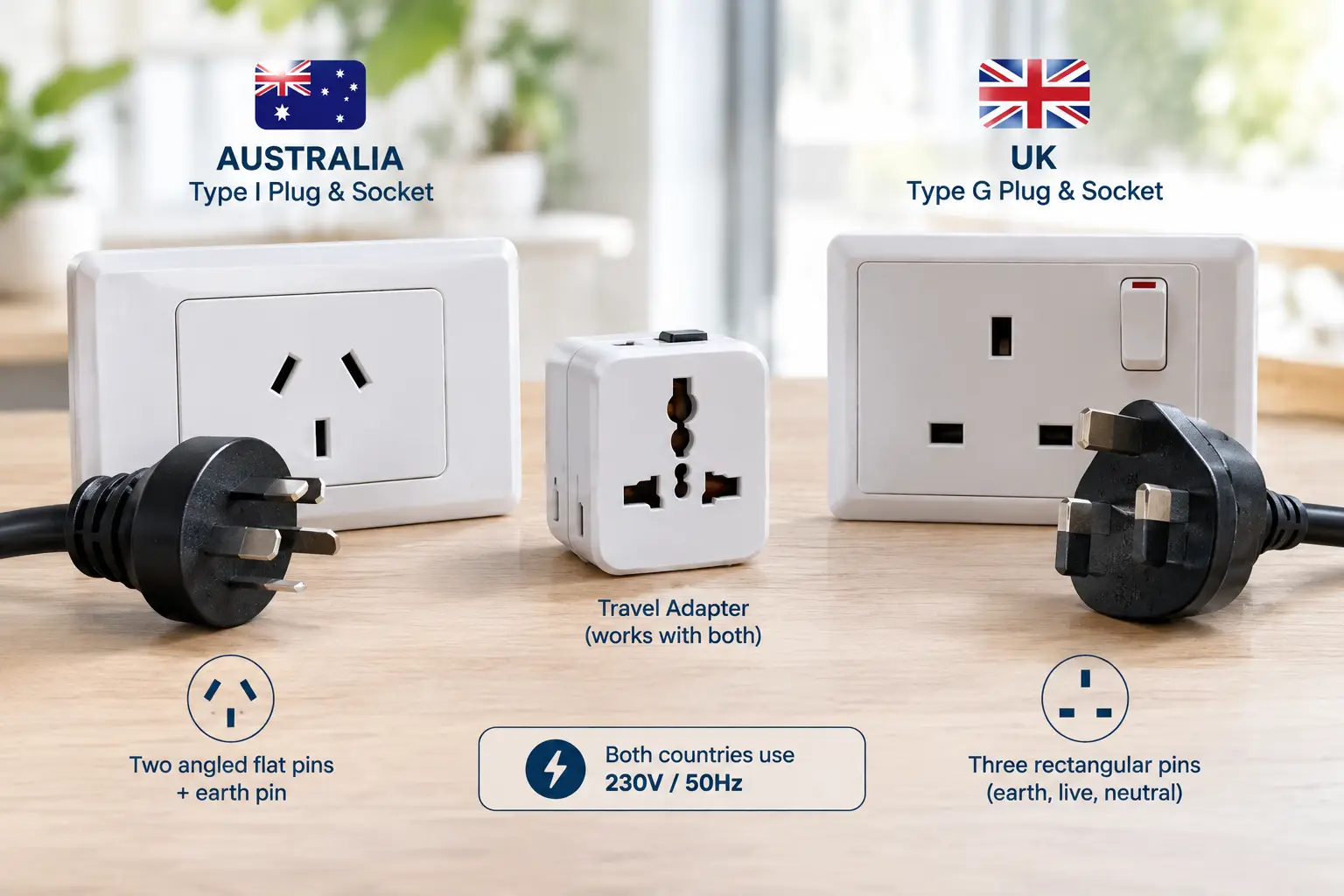
✅ The Australian plug (Type I) has two flat pins angled into an upside-down V, plus a vertical earth pin below. The UK plug (Type G) has three thick rectangular pins and a fuse inside the plug. Both countries run on 230V at 50Hz, but neither plug fits the other’s socket.
So why does the question come up so often? Because on paper, the two systems look like cousins. Both nations share Commonwealth history, both use three-pin grounded plugs, both have switched wall sockets, and both deliver the same voltage. It’s natural to assume one adapter covers both. It doesn’t. The Australian design is formally defined by the AS/NZS 3112 standard, which traces back to a 1930s American Hubbell design — not to anything British.
For American travelers, there’s a second wrinkle. The US runs on 120V at 60Hz with Type A and Type B plugs, so you need a plug adapter in both countries, and every device you pack must be rated for 100–240V. Phone chargers and laptop bricks almost always are. Hair dryers and curling irons often aren’t.
In this guide, you’ll get a clear australian plug vs uk plug breakdown, seven real adapters sold on amazon.com (from $10 single-country plugs to 75W laptop-grade chargers), practical setup tips, and the safety details most listings skip. Let’s sort out your power situation before it sorts you out at the hotel. ⚡
Australian Plug vs UK Plug: Quick Comparison
Before you shop, it helps to see the australian plug vs uk plug differences next to the plug you already use at home. Here’s the side-by-side that settles the “is australia plug same as uk” debate in about ten seconds.
| Spec | Australia (Type I) | United Kingdom (Type G) | United States (Type A/B) |
|---|---|---|---|
| Pin shape | 2 flat angled pins + vertical earth pin | 3 thick rectangular pins | 2 flat parallel pins (+ round ground) |
| Governing standard | AS/NZS 3112 | BS 1363 | NEMA 1-15 / 5-15 |
| Voltage | 230V | 230V | 120V |
| Frequency | 50 Hz | 50 Hz | 60 Hz |
| Standard socket rating | 10A | 13A | 15A |
| Fuse inside the plug | No | Yes (up to 13A) | No |
| Shared with | New Zealand, Fiji, PNG, (China and Argentina use near-identical variants) | Ireland, Singapore, Hong Kong, Malaysia, UAE | Canada, Mexico, Japan |
| Best for a US traveler | Ceptics AP-16 Australia Adapter | Anker Nano Travel Adapter (covers both) | No adapter needed |
Looking at the table, the voltage rows are the good news: Australia and the UK match each other, so a device that works in London will work in Melbourne once the plug shape is sorted. The pin-shape row is the bad news, because no amount of wiggling gets a rectangular Type G pin into a slanted Type I slot. For Americans, the 120V-vs-230V gap matters more than either plug shape — that’s what actually fries gear.
💬 One click helps other shoppers make an informed choice too! 😊
Top 7 Travel Adapters for Australia (and the UK): Expert Analysis
Every pick below is a real product listed on amazon.com. The analysis is based on comparing manufacturer spec sheets and published reviews — not on invented hands-on claims — so you can see exactly why each one earns its spot.
1. Ceptics AP-16 Australia Adapter — best all-in-one for Type I only
If your trip is Australia or New Zealand only, a dedicated travel adapter for australia beats a bulky universal block. The Ceptics AP-16 Australia Adapter turns one Type I socket into two US outlets plus a USB-A and a USB-C port, with the listing claiming Quick Charge 3.0 and Power Delivery support.
What that means in practice: you plug your laptop brick into one US outlet, your camera charger into the other, and still fast-charge your phone over USB-C. That’s four devices from a single hotel socket — which matters in older Australian motels where outlets can be scarce and oddly placed.
This is the pick for the traveler who wants zero fiddling: no sliders, no folding prongs, nothing to lose. The trade-off is obvious — it’s useless in the UK, so a two-country trip needs a second adapter.
We couldn’t verify a representative, model-specific review summary for this exact listing, so weigh the spec sheet and the brand’s long Type I catalog rather than star counts.
Pros:
- ✅ Four devices from one wall socket
- ✅ USB-C port handles modern phones directly
- ✅ Fixed Type I prongs feel solid in the wall
Cons:
- ❌ Works only in Type I countries
- ❌ Bulkier than a plain plug converter
Expect it in the $15–$25 range (check the current price) — strong value if Australia is your only stop.
2. OREI US-16 Type I Adapter (3-Pack) — cheapest way to cover every room
Sometimes the smartest buy is the simplest. The OREI US-16 Type I Adapter (3-Pack) gives you three small, grounded plug converters, each with two US inputs on a Type I output.
OREI rates each unit at up to 10A and 250V, measures it at roughly 44 × 44 × 46 mm, and puts its weight around 33 grams. Translation: it fully matches a standard 10A Australian socket, so it won’t be the weak link for a dual-voltage laptop, and three of them disappear into a toiletry bag. Grounded US inputs also mean your three-prong laptop cord keeps its earth connection.
This is the family pick. When four people each want to charge something overnight in separate rooms, three cheap adapters beat one expensive hub. There’s no USB, so you’ll bring your own chargers.
We couldn’t verify a detailed review summary for this pack; OREI’s own listing backs it with a lifetime limited warranty and CE/RoHS marks.
Pros:
- ✅ Three adapters for the price of one hub
- ✅ Grounded inputs keep three-prong cords safe
- ✅ Full 10A rating matches Australian sockets
Cons:
- ❌ No USB ports at all
- ❌ Type I only, so no UK coverage
Typically under $15 for the pack — the best per-room value in this list.
3. OREI U2U-16 Type I Adapter — single plug plus two USB ports
The OREI U2U-16 Type I Adapter sits between the bare plug and the full hub: one grounded US outlet and two USB-A ports on a Type I plug.
The outlet is rated to 10A at 250V, so it handles anything dual-voltage you’d plug into it at home. The USB ports are the honest caveat. Retail listings describe USB charging up to 2.4A, which works out to about 12W — fine for earbuds, a Kindle, or an older phone, but noticeably slower than a USB-C PD charger for a recent iPhone or Galaxy.
Based on comparing specs, this suits the light packer: one laptop, one phone, one pair of earbuds. If your phone needs fast charging, bring its USB-C brick and plug it into the outlet instead of using the built-in ports.
As with its sibling, we couldn’t verify a representative review summary for this model; judge it on the 10A rating and the brand’s warranty.
Pros:
- ✅ Grounded outlet plus two USB ports
- ✅ Compact enough for a jacket pocket
- ✅ Full 10A rating on the AC side
Cons:
- ❌ USB-A ports charge slowly by modern standards
- ❌ No USB-C port
Usually around $12–$18 — good value for minimalists heading Down Under only.
4. Anker Nano Travel Adapter (5-in-1, 20W) — smallest pick for UK and Australia
Here’s the adapter that actually answers the two-country problem in one pocket-sized block. The Anker Nano Travel Adapter (5-in-1, 20W) carries four plug types — A, C, G, and I — so the same unit works in London and Sydney.
You get one AC outlet, two USB-C ports, and two USB-A ports. Anker’s spec sheet is refreshingly honest: the primary USB-C port delivers 20W when used alone, and all four USB ports share 15W when loaded together. In plain English, one phone fast-charges; four devices trickle. The AC outlet is rated at 6A, or about 1,380W at 230V.
What most buyers overlook: the AC socket accepts two-flat-pin US plugs and round-pin Euro plugs, not a three-prong grounded US plug. It’s a 2-pin-to-2-pin design, so a grounded laptop cord won’t go in.
Reviews and hands-on coverage consistently praise the size, while a recurring complaint is that the shared 15W limit disappoints people charging several devices at once. Some buyers also report the adapter slipping out of looser US and EU sockets, while the UK prongs held firmly.
Pros:
- ✅ Covers UK and Australia in one unit
- ✅ Genuinely pocket-sized design
- ✅ 20W USB-C for a single phone
Cons:
- ❌ Shared 15W across all USB ports
- ❌ No grounding for three-prong plugs
Usually $20–$30 — excellent value for phone-and-tablet travelers covering both countries.
5. TESSAN Universal Travel Adapter 28W — most USB-C ports for the money
The TESSAN Universal Travel Adapter 28W is built for travelers whose cables have all gone USB-C. It packs three USB-C ports, two USB-A ports, and a universal AC outlet into a 3.03 × 2.13 × 1.97-inch block weighing about 5.67 ounces.
Each USB-C port tops out at 15W, and the USB side shares 28W total. That’s a good fit for phones, earbuds, and watches charging overnight, but not for a laptop over USB — plug the laptop brick into the AC outlet instead. TESSAN rates that outlet at 2,500W at 250V and protects it with a double 10A fuse plus safety shutters, so a blown fuse is a swap, not a dead adapter.
One listing note worth flagging: TESSAN says the outlet won’t take India or South Africa plugs. That doesn’t matter for a UK/Australia trip.
Review roundups regularly call it cruise-friendly because it has no surge protection, which many cruise lines prohibit. The most consistent complaint in reviews is that it runs warm when every port and the outlet are loaded together.
Pros:
- ✅ Three USB-C ports for modern cables
- ✅ Replaceable 10A fuse with a spare
- ✅ Cruise-friendly design without surge protection
Cons:
- ❌ USB-C ports cap at 15W each
- ❌ Can run warm when fully loaded
Generally $20–$30 — strong value for USB-C-heavy households.
6. EPICKA TA-105 Universal Travel Adapter — proven budget universal workhorse
The EPICKA TA-105 Universal Travel Adapter is the model that tops many 2026 travel-adapter roundups, and the spec sheet explains why. One sliding-plug block covers US, EU, UK, and AU sockets, with a universal AC outlet, four USB-A ports, and one USB-C port.
EPICKA lists an 8A fuse, safety shutters, and a plug-lock system, plus two spare fuses in the box. Max power is 880W at 110V and 1,920W at 240V. Practically, that’s plenty for laptops and camera chargers, but EPICKA itself warns against hair dryers, straighteners, and curling irons. The plug lock matters more than it sounds: it stops the prongs sliding back mid-use in a loose socket.
The catch is the port mix. Four USB-A ports at 2.4A each feel dated if your devices are USB-C. It’s best for families with mixed older gadgets, kids’ tablets, and power banks.
Across published 2026 roundups, it’s repeatedly named the best all-rounder for most travelers, with praise for country coverage and the included carry case.
Pros:
- ✅ One block covers UK and Australia
- ✅ Plug lock and two spare fuses included
- ✅ Six devices at once for families
Cons:
- ❌ Only one USB-C port
- ❌ Lower 8A fuse rating than rivals
Typically $15–$25 — the best budget value for a two-country itinerary.
7. EPICKA TA-105 Max — laptop-grade 75W charging
If you travel with a laptop and refuse to pack its charger, the EPICKA TA-105 Max is the upgrade. It uses GaN (gallium nitride) circuitry to fit 75W of total USB output into a 3.3 × 2.1 × 2.2-inch body.
The layout is three USB-C ports and two USB-A ports, all supporting PD 3.0 or QC 3.0, plus a universal AC outlet rated at 10A — up to 2,400W at 240V. Reviewers report a single USB-C port can push roughly 67W, which is enough to charge most 13- and 14-inch laptops directly. That means one block replaces your laptop brick, phone charger, and plug adapter.
The trade-offs are weight and price. At about 10.34 ounces, it’s nearly double the standard TA-105. It also skips Type D (India) and Type M (South Africa), which won’t matter in London or Sydney.
Published reviews consistently highlight fast charging across all ports and the included carry case; one recurring wish from buyers is a second AC outlet.
Pros:
- ✅ Charges a laptop over USB-C
- ✅ Five fast-charging USB ports
- ✅ 10A AC outlet with plug lock
Cons:
- ❌ Heavier than every other pick here
- ❌ Costs two to three times more
Expect $50–$65 at the time of writing — worth it only if it replaces your laptop charger.
Top 7 Adapters Compared
| Adapter | Plug types | USB ports | AC rating | Price range | Best for |
|---|---|---|---|---|---|
| Ceptics AP-16 Australia Adapter | Type I | 1 USB-A, 1 USB-C | 2 US outlets | $15–$25 | Ceptics AP-16: Australia-only trips |
| OREI US-16 (3-Pack) | Type I | None | 10A / 250V | Under $15 | OREI US-16: families, multiple rooms |
| OREI U2U-16 | Type I | 2 USB-A | 10A / 250V | $12–$18 | OREI U2U-16: light packers |
| Anker Nano Travel Adapter | A, C, G, I | 2 USB-C, 2 USB-A | 6A | $20–$30 | Anker Nano: UK + Australia minimalists |
| TESSAN Universal 28W | A, C, G, I | 3 USB-C, 2 USB-A | 10A fuse | $20–$30 | TESSAN 28W: USB-C households, cruises |
| EPICKA TA-105 | A, C, G, I | 1 USB-C, 4 USB-A | 8A fuse | $15–$25 | EPICKA TA-105: budget two-country trips |
| EPICKA TA-105 Max | A, C, G, I | 3 USB-C, 2 USB-A | 10A, 75W USB | $50–$65 | EPICKA TA-105 Max: laptop travelers |
The split is clear: the three Type I-only picks win on simplicity and price, but they’re dead weight in the UK. If your itinerary includes both countries, the Anker Nano Travel Adapter wins on size, the TESSAN Universal 28W on USB-C count, and the EPICKA TA-105 Max on raw power. The EPICKA TA-105 remains the safest default when you just want one affordable block that works everywhere you’re going.
✨ Don’t miss these exclusive deals!
🔍 Take your travel prep to the next level with this carefully curated lineup. Click a highlighted adapter to check current pricing and availability. These picks will help you stay charged from Heathrow to Bondi Beach — with zero socket surprises! 🔋
How to Get Your Adapter Ready: A First-Trip Setup Guide
Buying the right travel adapter for australia is half the job. The other half happens at your kitchen table a week before you fly.
Step 1: Read every label you plan to pack
Flip each charger over and find the “INPUT” line. If it says something like 100–240V ~ 50/60Hz, it’s dual voltage and only needs a plug adapter. If it says 120V alone, it needs a voltage converter in both the UK and Australia — or it stays home.
Step 2: Test the adapter at home
Plug the adapter into a US outlet (universal models have a US slider), connect your phone, and confirm the USB ports and indicator light work. Finding a dead unit in your living room costs nothing. Finding it in a Brisbane hotel at 11 p.m. costs a taxi ride to a convenience store.
Step 3: Practice the slider once
Universal adapters like the EPICKA TA-105 and TESSAN Universal 28W use sliding prongs. Practice switching to the AU and UK positions until each one clicks and locks. A half-deployed prong is the most common reason “it doesn’t fit.”
Step 4: Flip the wall switch
Australian and UK sockets usually have their own on/off switch. If nothing charges, check that before blaming the adapter.
Step 5: Watch your load in the first 30 days
Don’t stack a kettle, laptop, and phones on one adapter. Keep sustained loads well under the rated amps, and unplug any adapter that feels hot rather than warm. Pack the spare fuse that comes with fused models in your carry-on, not your checked bag.
Which Adapter Fits Your Trip? Three Traveler Scenarios
The “best” adapter depends entirely on your route, your gear, and how many people share the outlets. Here’s how the picks map to real itineraries.
Scenario 1: The two-week Sydney-and-Melbourne couple
Two phones, two watches, one laptop, no UK leg. Budget-minded. The OREI US-16 (3-Pack) covers the bedroom and the desk for under $15, and you’ll use your existing phone chargers. If you’d rather have USB built in, one Ceptics AP-16 Australia Adapter handles four devices from a single socket. Neither needs sliders or spare parts.
Scenario 2: The London-then-Sydney business traveler
This is the classic “is australia plug same as uk” trip. One 14-inch laptop, a phone, earbuds, and a strict carry-on limit. The EPICKA TA-105 Max earns its higher price here because it replaces the laptop brick entirely; its USB-C output charges the laptop while the other ports handle the rest. Net result: one block, one cable bag, two countries.
Scenario 3: The family of four doing a month across the UK, Australia, and New Zealand
Four tablets, four phones, a camera, and constant overnight charging in multiple rooms. Pair one EPICKA TA-105 (six devices, two countries) for the main room with a TESSAN Universal 28W for the kids’ room. Both cover Type G and Type I, and their replaceable fuses mean a single overload doesn’t end your charging for the trip. Budget roughly $35–$55 total for both.
Problem → Solution: Fixing Common Plug Headaches Down Under
Even with the right gear, a few problems pop up again and again. Here’s how to fix them fast.
Problem 1: “My UK adapter won’t go into the Australian socket.”
That’s working as designed. Type G pins are thick rectangles; Type I slots are thin and angled. Don’t force it. Switch to a Type I adapter or the AU slider on a universal model. Forcing a plug can damage the socket contacts and create heat.
Problem 2: “The adapter fits but nothing charges.”
Check the wall switch first. Then check the fuse: on the TESSAN Universal 28W and the EPICKA TA-105, a blown internal fuse cuts power, and both ship with spares.
Problem 3: “My hair dryer died in five seconds.”
It was almost certainly a 120V-only model running on 230V. No plug adapter prevents this. Buy a dual-voltage travel dryer or use the one at your hotel.
Problem 4: “My three-prong laptop plug won’t fit the adapter.”
The Anker Nano Travel Adapter is 2-pin only, so it can’t take a grounded US plug. Use the laptop’s two-prong “duckhead” if it has one, or switch to a grounded adapter like the OREI U2U-16.
Problem 5: “The adapter keeps sagging out of the wall.”
Heavy charger bricks act like a lever. Use a short extension cable between brick and adapter, or choose a compact model with a plug-lock feature like the EPICKA TA-105 Max.
How to Choose a Travel Adapter for Australia
Use these steps in order. Each one rules out options faster than reading product pages.
- Map your route. Australia only? A Type I adapter is cheapest and simplest. UK plus Australia? You need Type G and Type I, which points to a universal model.
- Check device voltage. Anything not rated 100–240V needs a converter, not just an adapter. Most phones and laptops pass; many styling tools don’t.
- Count your USB-C devices. Two or more modern phones or a USB-C laptop make the TESSAN Universal 28W or EPICKA TA-105 Max worth the extra few dollars.
- Decide on laptop charging. If you want to leave the laptop brick home, look for 60W+ on a single USB-C port. Only the EPICKA TA-105 Max does that here.
- Respect grounding. Three-prong US plugs need a grounded adapter like the OREI U2U-16. Two-pin designs can’t pass the earth through.
- Look for a replaceable fuse and shutters. Both add real protection on a trip where you can’t easily buy a replacement.
- Weigh size against ports. Every extra port adds bulk. Buy only what you’ll actually plug in at night.
Type I vs Type G Plug: A Detailed Side-by-Side
The type I vs type G plug difference goes deeper than looks. The UK’s BS 1363 standard specifies two horizontal rectangular pins and a larger vertical earth pin on top, a cartridge fuse inside every plug, and mandatory shutters on the socket. That fuse protects the cord, not the appliance — a detail even many Brits get wrong.
The Australian Type I plug skips the fuse entirely. Its two flat pins sit 30° off vertical, with a longer earth pin below, and since the early 2000s Australian plugs have needed insulated sleeves halfway down the active and neutral pins. Standard Australian outlets are rated at 10A, compared with 13A in the UK.
The IEC World Plugs reference groups them as two entirely separate families, which is why no “UK-ish” adapter can bridge them. One more nuance: China and Argentina use near-identical Type I sockets, but Argentina reverses live and neutral. A universal adapter handles that fine for dual-voltage chargers.
Universal Adapter vs Single-Country Plugs vs Buying Local
You have three realistic ways to power up in Australia and the UK. Here’s how they stack up.
| Approach | Covers UK + Australia? | Typical cost | Grounding | Best for |
|---|---|---|---|---|
| Universal adapter | Yes | $15–$65 | Often 2-pin only on AU/UK slider | EPICKA TA-105: multi-country trips |
| Single-country Type I plugs | No | Under $25 | Usually grounded | OREI US-16: Australia-only trips |
| Buying chargers in Australia | Australia only | $20–$40 per charger | Built in | Long stays and expats |
For most short trips, the universal adapter wins because it travels with you across borders. Single-country plugs win on price and grounding when you’re staying in one place. Buying local chargers only makes sense for multi-month stays, and you’ll still need adapters for those chargers once you get home.
Australia Voltage vs UK Voltage: Do You Need a Converter?
Here’s the quick version of australia voltage vs uk voltage: they match. Australia moved its nominal supply from 240V to 230V, and the UK runs at 230V too, both at 50Hz. Anything that works in London works in Perth electrically.
The real question for Americans is US versus both. Your home outlets deliver 120V at 60Hz, roughly half the voltage. A dual-voltage device (labeled 100–240V) adjusts automatically. A 120V-only device sees almost double its rated voltage and can overheat in seconds.
Plug adapters, including every model in this guide, do not convert voltage. Most manufacturers say so on the listing — Anker, EPICKA, and TESSAN all state it plainly.
If you must bring a 120V-only appliance, you need a step-down converter sized well above the device’s wattage. In practice, for hair tools that’s a heavy, expensive box. It’s usually smarter to buy a dual-voltage travel version or use the hotel’s.
Safety, Regulations, and Standards
The US has no single standard for travel adapters sold online, so the safety burden falls on you. Two outside benchmarks help. In the UK, adapters with a UK plug or socket section must meet BS 8546, and the charity Electrical Safety First’s travel adaptor guidance recommends buying adapters before you leave, since products sold abroad may not meet the same rules. It also warns that some adapters aren’t suitable for appliances that need an earth connection.
In Australia, plugs must comply with AS/NZS 3112. US-designed adapters rarely carry Australian approval marks, so look for the protections you can verify: safety shutters, a replaceable fuse, a stated amp rating, and CE/RoHS markings.
On cruises, many lines ban surge-protected devices. That’s why the TESSAN Universal 28W is often called cruise-friendly. Finally, never use mains-powered gadgets in a hotel bathroom, and never force a plug that doesn’t seat easily.
Common Mistakes to Avoid When Buying an Australia Adapter
❌ Assuming your UK adapter works in Australia. It doesn’t. That’s the whole “is australia plug same as uk” trap.
❌ Confusing an adapter with a converter. An adapter changes shape; a converter changes voltage. Most travelers need only the first.
❌ Ignoring the amp rating. A 6A adapter like the Anker Nano Travel Adapter is fine for chargers but not for a space heater or kettle.
❌ Buying for ports you won’t use. Six ports sound great until the adapter weighs more than your phone.
❌ Forgetting grounding. If your laptop has a three-prong cord, a 2-pin universal adapter won’t accept it.
❌ Packing the spare fuse in checked luggage. Keep it with the adapter.
Long-Term Cost and Value
Travel adapters are cheap, but cost per trip still matters if you travel often.
| Adapter | Price range | Trips covered | Replaces | Best for |
|---|---|---|---|---|
| OREI US-16 (3-Pack) | Under $15 | Australia, NZ, Pacific | Nothing extra | OREI US-16: one-time Australia trip |
| EPICKA TA-105 | $15–$25 | 200+ countries (per brand) | Separate plug sets | EPICKA TA-105: occasional world travelers |
| EPICKA TA-105 Max | $50–$65 | 200+ countries (excl. Type D/M) | Laptop + phone chargers | EPICKA TA-105 Max: frequent flyers |
The cheapest adapter isn’t always the cheapest choice. If the EPICKA TA-105 Max lets you leave a $60–$80 laptop charger at home and survives several years of trips, its cost per trip drops below the budget picks. For a single vacation, though, the OREI US-16 is unbeatable value.
FAQs
❓ Do I need an adapter for Australia if I already own a European one?
❓ Can I use the same adapter in Australia and New Zealand?
❓ Will an Australian plug adapter work in China?
❓ Can I buy a travel adapter after I land in Australia?
❓ Is a universal travel adapter safe for a CPAP machine?
Conclusion: Is Australia Plug Same as UK? No — But One Adapter Can Cover Both
So, is australia plug same as uk? Definitely not. Australia’s Type I plug uses slanted flat pins with no fuse, while the UK’s Type G uses chunky rectangular pins with a fuse in every plug. The good news is that both countries share 230V at 50Hz, so the only thing standing between your gear and a working socket is plug shape — plus, for Americans, the 120V-to-230V jump.
Here’s the simple decision path. Visiting only Australia or New Zealand? The OREI US-16 (3-Pack) or Ceptics AP-16 Australia Adapter is the cheapest, sturdiest fix. Covering London and Sydney on one trip? The EPICKA TA-105 is the budget default, the Anker Nano Travel Adapter is the pocket pick, and the TESSAN Universal 28W suits USB-C-heavy families. If you’d love to leave your laptop charger at home, the EPICKA TA-105 Max is worth the premium.
Whichever you choose, check every device label for 100–240V, test the adapter before you fly, and keep the spare fuse in your carry-on. Do that, and plugs become the least interesting part of your trip. 🦘🇬🇧
✨ Ready to plug in anywhere from London to Sydney?
🔍 Click a highlighted adapter above to check current pricing and availability, and pick the one that matches your route. A few minutes now saves you a frantic late-night hunt for a working socket later! ⚡
Recommended for You
- Third Reality Smart Plug: 7 Smart Picks, Honestly Ranked (2026)
- Solar Power Monitor: 7 Best Picks That Actually Pay Off (2026)
- Smart Outlet USB: 7 Best Picks for 2026, Ranked Honestly
Disclaimer: This post contains affiliate links. As an Amazon Associate, I earn from qualifying purchases made through these links, at no additional cost to you.
✨ Found this article helpful? Share it with someone who needs it! 💬🤗