
In This Article
Belgium Power Plug Type: What US Travelers Need to Know Before Packing
You’ve booked the Brussels flight, mapped out a waffle crawl, and maybe even reserved a table at a Bruges brewery. Then the practical question hits at 11 p.m. the night before you leave: will your phone charger actually fit the wall? Knowing the belgium power plug type ahead of time saves you from the classic traveler’s scramble — hunting for an overpriced adapter at the airport kiosk while your phone sits at 4%.
What Is the Belgium Power Plug Type?
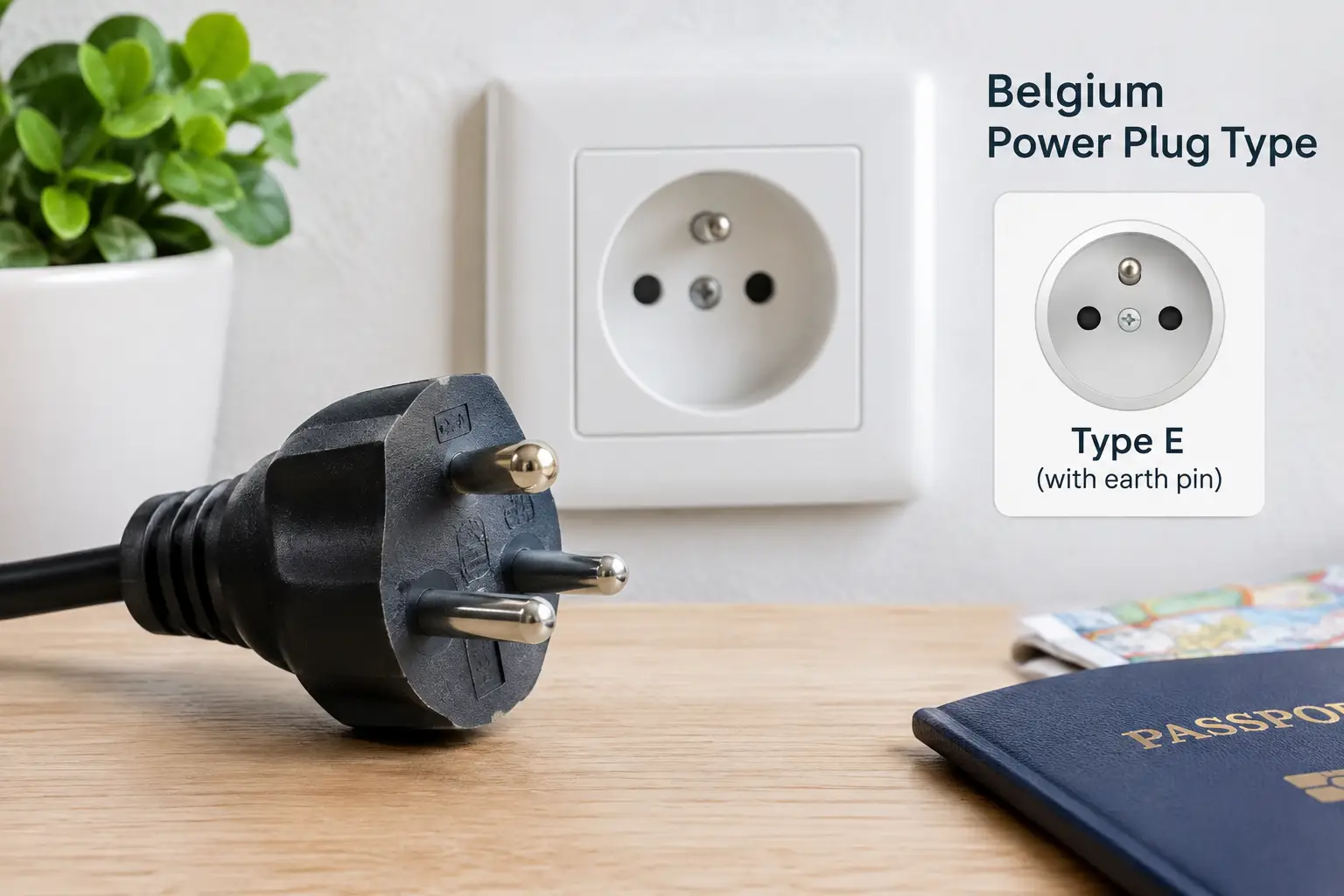
The belgium power plug type is Type E: a round socket with two holes and a round earth (ground) pin that sticks out of the wall. Type C “Europlugs” (two thin round pins) also fit. Belgium runs on 230 volts at 50 Hz, versus 120V/60Hz in the US, so your flat-bladed American plugs won’t fit without an adapter.
That short answer hides two traps that catch Americans every year. First, the earth pin. Because Belgian sockets have a pin protruding from the socket itself, a plug or adapter needs a matching hole to sit flush. German-style “Schuko” plugs without that hole simply won’t go in. Second, voltage. An adapter changes the shape of your plug — it does nothing to the electricity coming through it. Phones and laptops shrug off 230V; a cheap US hair straightener does not.
The IEC’s World Plugs reference (the international body that assigns those A-through-N letters) is the definitive source if you want to double-check any country on your itinerary. In this guide, we go further: we compare seven real adapters and converters available on amazon.com, explain what each spec means in practice, and show you exactly which one fits your trip — whether you’re a backpacker with one phone or a family hauling four tablets, two laptops, and a curling iron.
Quick Comparison: 7 Belgium Plug Adapters at a Glance
| Product | Type | Fits Belgian Type E outlet? | Converts voltage? | Best for |
|---|---|---|---|---|
| Ceptics European Plug Adapters Combo | Plug adapter (2-pack style combo) | Yes (grounded E/F hybrid) | No | Budget grounded fit |
| TESSAN Type E/F European Plug Adapter | Adapter + charging hub | Yes (grounded E/F) | No | Families, hotel rooms |
| Anker Nano Travel Adapter (5-in-1, 20W) | Universal adapter | Yes (Type C prong) | No | Light packers |
| EPICKA TA-105S Universal Travel Adapter | Universal adapter, 45W GaN | Yes (Type C prong) | No | Multi-country trips |
| Zendure Passport III | Universal adapter, 65W GaN | Yes (Type C prong) | No | Laptop users |
| BESTEK 200W Travel Voltage Converter | Step-down converter | Yes (EU cord) | Yes, up to 200W | 120V-only gadgets |
| BESTEK 2000W Voltage Converter | High-watt converter | Yes (Type C plug) | Yes, up to 2000W | Hair tools |
Looking at the table, the dividing line isn’t brand — it’s whether you need voltage conversion. Five of these seven are pure plug adapters, which is all most travelers need because modern phone and laptop chargers are dual voltage. The two BESTEK units exist for the stubborn minority of devices labeled “120V only,” and the BESTEK 2000W Voltage Converter is the only one here built for heat-based styling tools.
💬 One click helps other shoppers make an informed choice too! 😊
Top 7 Belgium Plug Adapters and Converters: Expert Analysis
1. Ceptics European Plug Adapters Combo — cheapest grounded fit for Belgian outlets
If you just need your American plugs to fit Belgian walls safely, this is the no-drama pick. The Ceptics European Plug Adapters Combo pairs a grounded Type E/F “Schuko-style” adapter with a slimmer Type C adapter, and the grounded unit includes a USB-A port, a USB-C port, and a US socket input. In practice, that means one wall outlet can charge your phone over USB while your laptop brick plugs into the US socket — no extra cube required.
The grounded E/F design matters more than it sounds. Belgian sockets have that protruding earth pin, and an E/F hybrid adapter is built with the hole that accepts it, so it seats fully instead of wobbling. The included Type C piece is the better fit for tight spots like behind a hotel nightstand, where a bulky body would block the neighboring outlet.
Based on comparing the specs, this is for travelers with a short device list — a phone, maybe earbuds, and one dual-voltage laptop. Ceptics positions it explicitly for dual-voltage electronics only, and the listing doesn’t advertise high-wattage fast charging, so treat the USB ports as “phone speed,” not “laptop speed.” We couldn’t verify detailed aggregated review data for this exact combo, so we’d rather say so than guess; Ceptics is, however, a long-running US travel-adapter brand with a broad Amazon catalog.
Pros:
- ✅ Grounded hybrid shape seats properly in Type E sockets
- ✅ Two plug styles cover most of mainland Europe
- ✅ USB-A and USB-C ports free up your charger bricks
Cons:
- ❌ No voltage conversion for 120V-only devices
- ❌ USB output isn’t fast enough for laptop charging
Expect to pay roughly $10–$20 at the time of writing; for a grounded, Belgium-ready setup, the value is hard to beat.
2. TESSAN Type E/F European Plug Adapter — turns one outlet into a charging station
European hotel rooms are notorious for having one usable outlet, often behind the bed. The TESSAN Type E/F European Plug Adapter solves that by fanning a single Belgian socket out into four US-style AC outlets plus four USB ports (two USB-C, one with 20W Power Delivery). That 20W PD port is the practical headline: it fast-charges a recent iPhone or Pixel, so a morning top-up before a day trip to Ghent actually moves the needle.
Because it uses the grounded E/F form factor, it fits Belgian sockets and still passes ground through to three-prong US plugs — handy for a laptop brick with a grounded cord. TESSAN also sells a Type F sibling carrying cETLus certification, a US/Canada safety listing, which signals the brand submits at least part of its lineup to independent testing.
This is the family-trip workhorse: four people, four phones, a tablet, and a camera battery can all charge overnight from one wall socket. Reviews consistently praise the number of ports, while a recurring complaint is weight and bulk — some owners note heavier multi-outlet TESSAN units can sag or slip out of loose or worn sockets. Here’s what to weigh: if your hotel sockets are recessed and snug, no problem; if they’re tired, pair it with a short extension cable.
Pros:
- ✅ Four AC outlets solve the one-socket hotel room
- ✅ 20W USB-C PD fast-charges modern phones
- ✅ Grounded design passes ground to three-prong plugs
Cons:
- ❌ Bulky body can sag in worn wall sockets
- ❌ Not a voltage converter despite all the outlets
Usually around $15–$30 depending on pack size; strong value for groups and families.
3. Anker Nano Travel Adapter (5-in-1, 20W) — slimmest all-in-one for carry-on packers
Most universal adapters are chunky cubes. The Anker Nano Travel Adapter (5-in-1, 20W) goes the other way: a slim, flat body with one AC outlet, two USB-A ports, and two USB-C ports, plus slide-out plugs for Type A, C, G, and I. In Belgium, you’ll use the Type C prong, which fits Type E sockets without fuss.
That 20W figure is the number to understand. It’s the maximum USB output, and owner reports note you only get the full 20W when a single device is charging. Translation: it fast-charges one phone nicely, but it won’t replace a laptop’s USB-C brick. The AC outlet is two-pin only and capped at 6A, so it’s meant for small chargers rather than anything power-hungry, and Anker states plainly that it doesn’t convert voltage.
The spec sheet doesn’t say this, but reviewers do: slimness is the real feature. Pack Hacker’s review highlights how low-profile the Nano sits compared with boxier universal adapters, meaning less leverage pulling it out of the wall. Owner feedback on Anker’s channels is mostly positive, with isolated reports of a stiff USB-A port and one complaint of crackling noise — rare, but worth a return if it happens. Best for solo travelers carrying a phone, watch, and earbuds.
Pros:
- ✅ Remarkably slim, sits close to the wall
- ✅ Four plug types cover 200+ countries
- ✅ Five ports in a pocket-sized body
Cons:
- ❌ 20W total USB output limits multi-device charging
- ❌ Two-pin AC outlet won’t take grounded US plugs
Typically in the $20–$30 range; excellent value for minimalists.
4. EPICKA TA-105S Universal Travel Adapter — 45W GaN power for multi-country trips
Planning Brussels, then Amsterdam, then a hop to London? The EPICKA TA-105S Universal Travel Adapter is built for exactly that. It packs four plug types covering 200+ countries, three USB-C ports, two USB-A ports, and an AC outlet that accepts 12 of the 15 worldwide plug types — all running off GaN (gallium nitride) internals that keep heat and size down.
The key spec is 45W on the main USB-C port, with PPS support. In plain English: that’s enough to charge an iPad Pro at full speed or keep a MacBook Air topped up during a work session, which the 20W Anker Nano Travel Adapter (5-in-1, 20W) can’t do. A replaceable 10A fuse (with spares in the box) and safety shutters add protection, and the AC outlet handles up to 2,400W at 240V — though remember, that’s pass-through power, not conversion.
Based on comparing the specs, this is the sweet spot for most travelers who carry a phone and a tablet or light laptop. The broader TA-105 family has strong reviewer credibility — Men’s Journal named the original TA-105 its best travel adapter in its 2026 Travel Awards — and the S version upgrades that design with faster charging. At about 5.6 oz, it’s heavier than the Anker, so it sits further from the wall.
Pros:
- ✅ 45W USB-C handles tablets and light laptops
- ✅ Replaceable fuse with spares included
- ✅ Covers nearly every socket on a multi-country trip
Cons:
- ❌ Heavier body can droop in loose sockets
- ❌ AC outlet doesn’t convert 230V to 120V
Generally priced around $30–$40; strong value if you charge more than a phone.
5. Zendure Passport III — 65W power that can replace your laptop brick
The Zendure Passport III is the adapter for people who hate carrying a separate laptop charger. Its side USB-C port delivers up to 65W, enough for a 13-inch MacBook Pro or many Windows ultrabooks, and it adds three more USB-C ports plus one USB-A. Slide-out prongs fit outlets in over 200 countries, including Belgium via the Type C prong.
Here’s the catch most buyers overlook: the 65W figure drops to 45W when you plug devices into the other ports, according to AppleInsider’s hands-on review. So if your laptop is hungry and your partner’s phone is charging next to it, expect slower laptop charging. The upside is a self-resetting fuse — instead of hunting for a tiny replacement fuse in a dim hotel room, the unit recovers on its own after a trip.
Reviews consistently land on the same verdict: a premium, well-built adapter that genuinely lets you leave chargers at home, with the shared-power limitation as the main caveat. Note that the Passport III launched in 2022, so it’s no longer the newest design on the market; check current availability on amazon.com before building your packing list around it. Best for remote workers and business travelers with a USB-C laptop.
Pros:
- ✅ 65W USB-C can charge many laptops directly
- ✅ Self-resetting fuse means no spare fuses needed
- ✅ Four USB-C ports suit modern gear
Cons:
- ❌ Laptop power drops when other ports are busy
- ❌ Older 2022 design; availability can vary
Usually in the $35–$50 range; worth it if it replaces a laptop charger.
6. BESTEK 200W Travel Voltage Converter — rescue for 120V-only gadgets
Every adapter above assumes your devices are dual voltage. The BESTEK 200W Travel Voltage Converter (model MRJ201GU) is for the ones that aren’t — that older electric toothbrush, a CPAP humidifier accessory, a 120V-only shaver, or a kid’s tablet charger stamped “120V.” It accepts 100–240V input and outputs 110–120V to three US AC outlets, plus four USB ports sharing 6A.
The numbers translate directly into rules. 200W rated means low-power electronics only: chargers, shavers, small lamps. It will not run a hair dryer (typically 1,200W+), and BESTEK warns against exactly that. A 5-foot detachable EU (Type C) cord plugs into Belgian sockets, which also keeps the weight of the converter off the outlet, a real advantage over wall-hanging adapters.
Based on comparing the specs, this is insurance for travelers with one or two stubborn 120V-only devices. The trade-off is noise: a cooling fan runs at around 60 dB at full load per the product listing — roughly conversation volume — which light sleepers will notice if it’s charging overnight near the bed. It’s also NRTL safety tested with overcurrent, overload, overheat, and short-circuit protection. We couldn’t verify a reliable aggregate of customer review sentiment for this specific model, so judge it mainly on its well-documented specs.
Pros:
- ✅ Converts Belgian 230V down to US 120V
- ✅ Detachable cord keeps weight off the outlet
- ✅ NRTL safety tested with multiple protections
Cons:
- ❌ 200W ceiling rules out hair dryers
- ❌ Cooling fan can be noticeable at night
Expect around $35–$45 at the time of writing; good value if you own any 120V-only essentials.
7. BESTEK 2000W Voltage Converter — built for hair dryers and flat irons
This is the only pick here designed for heat-based styling tools. The BESTEK 2000W Voltage Converter has two AC outlets with different jobs: one steps 100–240V down to 120V at up to 2,000W for hair dryers, flat irons, and travel kettles; the other is a wide-voltage 200W outlet for laptops and phone chargers. Three USB ports — two with 35W PD — round it out.
The split-outlet design is the clever part. Your dual-voltage laptop doesn’t need conversion, so it goes into the 200W outlet, while your 1,800W US blow dryer uses the high-power side. In practice, you have one box handling both “needs conversion” and “doesn’t need conversion” devices without mixing them up.
Here’s what to weigh honestly: high-wattage converters work, but the simplest long-term fix for frequent travelers is buying a dual-voltage hair dryer or straightener, which skips the converter entirely. If you already own a beloved 120V-only styler and travel once or twice a year, this converter makes more sense than replacing the tool. Check the manual for recommended continuous-use time with high-heat appliances. Detailed aggregated reviews for this specific model weren’t verifiable during our research, so lean on the spec sheet and BESTEK’s reputation as a long-standing converter brand.
Pros:
- ✅ 2,000W outlet handles most US hair dryers
- ✅ Separate 200W outlet for dual-voltage electronics
- ✅ Two 35W USB-C PD ports charge tablets fast
Cons:
- ❌ Heavier and bulkier than any plain adapter
- ❌ A dual-voltage styler may be cheaper long term
Typically priced around $45–$70; fair value if a 120V styling tool is non-negotiable.
✨ Don’t miss these traveler-approved picks!
🔍 Take your Belgium trip prep to the next level with this carefully curated lineup. Click a highlighted item to check current pricing and availability. These picks will help you stay charged from the Grand-Place to the Bruges canals — no dead phones, no fried gadgets!
Getting Started: How to Set Up Your Charging Kit for Belgium
A great adapter still fails if you set it up wrong. Here’s a practical, start-to-finish routine.
Step 1: Audit your devices before you buy
Lay out everything you’ll charge and flip each charger over. Look for the input line. “100-240V ~ 50/60Hz” means dual voltage: an adapter alone is fine. “120V ~ 60Hz” means single voltage: you need a converter like the BESTEK 200W Travel Voltage Converter, or a replacement charger. This five-minute check prevents 90% of travel electronics disasters.
Step 2: Do a dry run at home
Plug your adapter into a US outlet (most universal models accept US plugs) and confirm every port charges each device. A dead USB-C port discovered in Antwerp is a lot more annoying than one discovered in your kitchen.
Step 3: Pack smart
Keep the adapter in your carry-on, not checked luggage — you’ll want it at the airport gate or on a long layover. Bring at least one adapter per person if you’re traveling as a group; fighting over one outlet gets old fast.
Step 4: First night in the hotel
Push the adapter firmly into the socket until it’s flush. Belgian sockets are recessed, so a partially inserted adapter may light up but connect poorly. If it sags, use a short cable or charge on a desk-level outlet.
Common mistakes in the first 30 days
- Plugging a US hair dryer into a plain adapter (instant smoke, often a tripped breaker).
- Daisy-chaining a US power strip into an adapter — many US strips are rated for 125V only.
- Leaving a fan-cooled converter under pillows or bedding, which blocks airflow.
- Forgetting the adapter in the hotel wall on checkout day; snap a phone photo of your outlets as a reminder.
Real-World Scenarios: Which Adapter Fits Your Trip?
Specs make more sense when attached to real people. Here are three common traveler profiles and the reasoning behind each match.
Scenario 1: The weekend city-breaker
Maya is flying to Brussels for four days with a phone, smartwatch, and wireless earbuds. Her budget is tight, and she travels carry-on only. She charges nightly, nothing more. Best match: the Anker Nano Travel Adapter (5-in-1, 20W). Its slim body fits her small packing cube, the 20W USB-C tops up her phone quickly, and its universal plugs mean she can reuse it on her next trip to London. Spending more on 65W of laptop power would be paying for capacity she’ll never use.
Scenario 2: The family of four
The Johnsons are spending ten days between Brussels and Bruges with two kids, four phones, two tablets, and a camera. Their hotel rooms average one or two accessible outlets. Best match: two TESSAN Type E/F European Plug Adapter units — one per bedside. Each turns a single socket into eight charging points, which ends the nightly “who gets the outlet” negotiation. Mom’s 120V-only electric toothbrush goes on the short list for a separate converter or a cheap local replacement.
Scenario 3: The remote worker
Daniel is working from Belgium for three weeks with a USB-C MacBook Pro, an iPad, and a phone, and he hops to Amsterdam and Paris on weekends. He uses his laptop eight hours a day. Best match: the Zendure Passport III. Its 65W port charges his laptop directly, so his Apple charger stays home, and the universal design covers all three countries. If availability is a problem, the EPICKA TA-105S Universal Travel Adapter is the close runner-up — just slower for a hungry 14- or 16-inch laptop.
The pattern across all three: match the adapter’s wattage to your hungriest device, and its outlet count to your group size.
Problem → Solution: Fixing Common Charging Headaches in Belgium
Problem 1: “My adapter won’t go into the wall.” Solution: You likely have a German-style Schuko adapter without an earth-pin hole. Belgian sockets have a pin sticking out that blocks it. Switch to a grounded E/F hybrid like the Ceptics European Plug Adapters Combo, or a slim Type C prong.
Problem 2: “My phone charges painfully slowly.” Solution: You’re probably on a 5V USB-A port. Move to a USB-C PD port — the TESSAN Type E/F European Plug Adapter offers 20W, and the EPICKA TA-105S Universal Travel Adapter offers 45W.
Problem 3: “The adapter keeps falling out of the socket.” Solution: Heavy, cube-shaped adapters act like a lever. Use a short USB or extension cable so the adapter’s weight hangs on the cord, or choose a slimmer unit like the Anker Nano Travel Adapter (5-in-1, 20W).
Problem 4: “My laptop says ‘not charging.'” Solution: Your adapter’s USB-C port may not deliver enough watts, or other ports are sharing the power. Unplug the other devices or plug your laptop’s original brick into the AC outlet instead — it’s dual voltage and will work at 230V.
Problem 5: “My universal adapter suddenly went dead.” Solution: The internal fuse likely blew from an overload. Models like the EPICKA TA-105S Universal Travel Adapter include spare fuses; the Zendure Passport III resets itself after a short wait.
How to Choose a Belgium Power Plug Type Adapter
Use these seven steps, in order, to narrow your choice fast.
- Confirm the socket shape. The belgium power plug type is Type E, so you need an adapter with a Type C prong or a grounded E/F hybrid with an earth-pin hole.
- Check every device’s voltage label. “100-240V” means adapter only; “120V” means a converter. This single step decides your budget.
- Count your devices. One or two devices: a compact adapter. Four or more: a hub with multiple outlets.
- Match wattage to your hungriest device. Phones need about 20W; tablets 30–45W; most laptops 45–65W.
- Decide on grounding. If you plug in a three-prong US cord, choose a grounded E/F adapter so the ground connection passes through.
- Think beyond Belgium. Visiting the UK or Switzerland too? A universal adapter avoids buying a second one.
- Look for safety features. Fuses, shutters, and recognized certifications (ETL, UL, FCC, CE) separate quality gear from bargain-bin risk.
Here’s what most buyers overlook: steps 2 and 4 matter more than brand. A premium adapter with the wrong wattage disappoints, while an inexpensive one matched to your devices just works.
Belgium Voltage: Do I Need a Voltage Converter for Belgium?
Belgium voltage is 230V at 50Hz — almost double the 120V/60Hz Americans are used to. Whether that matters depends entirely on your devices, not on the country.
Devices that are almost always fine
Smartphones, tablets, laptops, camera battery chargers, e-readers, and most power banks use “switching” power supplies rated 100–240V. These need only a plug adapter. That covers the vast majority of what modern travelers pack.
Devices that often need help
Hair dryers, curling irons, flat irons, some electric toothbrushes and shavers, travel kettles, and small fans are frequently 120V-only. Plug one straight into 230V and it can overheat, burn out, or trip the circuit within seconds.
Converter versus transformer
A voltage converter steps 230V down to roughly 120V. Lightweight travel converters, like the BESTEK 200W Travel Voltage Converter, are designed for small electronics. High-wattage heat appliances need a converter rated above the appliance’s wattage — that’s where the BESTEK 2000W Voltage Converter fits.
The 50Hz wrinkle
Even with the correct voltage, the 50Hz frequency can affect devices with motors or clocks designed for 60Hz — some may run slightly slower or warmer. For chargers this is irrelevant; for a 120V-only analog clock radio, it’s a reason to leave it at home.
The honest bottom line: most travelers do not need a converter at all. Buy one only after your voltage audit proves you do.
Type E Plug vs Schuko (Type F): Why the Earth Pin Matters
This is the single most misunderstood detail about the type e plug, and it explains why some “European adapters” fail in Belgium.
Belgium and France use the CEE 7/5 socket, which has a round earth pin projecting from the socket. Germany, the Netherlands, and much of Europe use the CEE 7/3 “Schuko” socket, which grounds through metal clips on the sides instead. According to Wikipedia’s overview of AC power plugs and sockets, a pure Schuko plug won’t fit a Belgian socket because of that fixed earth pin, while a Belgian/French plug won’t fit a Schuko socket because of its side clips. Fun fact: the same source notes the Type E design most likely originated in Belgium in the 1930s.
The fix: the CEE 7/7 hybrid
Manufacturers solved the clash with the CEE 7/7 hybrid plug, which has both a hole for the Belgian earth pin and side contacts for Schuko clips. When an adapter is sold as “Type E/F,” it should be this hybrid — and that’s why grounded adapters like the Ceptics European Plug Adapters Combo and the TESSAN Type E/F European Plug Adapter work in Brussels and Berlin alike.
What about Type C?
The thin, two-pin Europlug (Type C) has no ground at all, so it slips into both socket types. Every universal adapter here uses a Type C prong for Europe. That’s fine for dual-voltage chargers, but it means no ground passes to a three-prong device.
How to check before you buy
Look at product photos: a Belgium-compatible grounded adapter shows a small round hole between the two pins. No hole and no Type C prong? It won’t fit.
Universal Travel Adapter vs Belgium-Specific Adapter vs Converter
| Feature | Belgium-specific (E/F) adapter | Universal travel adapter | Voltage converter |
|---|---|---|---|
| Fits Belgian Type E outlet | Yes, grounded | Yes, ungrounded Type C | Yes, via EU cord/plug |
| Passes ground to US 3-prong plugs | Yes | Usually no | Varies by model |
| Works in UK, Switzerland, Australia | No | Yes | Only with extra plugs |
| Converts 230V to 120V | No | No | Yes |
| Example | TESSAN Type E/F European Plug Adapter | EPICKA TA-105S Universal Travel Adapter | BESTEK 200W Travel Voltage Converter |
| Best for | Belgium/EU-only trips | Multi-country itineraries | 120V-only devices |
Looking at this comparison, a Belgium-specific grounded adapter wins on fit and grounding but loses the moment your itinerary crosses into the UK. Universal adapters trade grounding for flexibility, which is fine because most travel chargers are two-prong anyway. Converters are a specialist tool — only reach for one when a device label demands it.
Features That Actually Matter (and Ones That Don’t)
Travel adapter listings are packed with buzzwords. Here’s the expert cut-through.
Features that matter
- USB-C Power Delivery wattage. This decides whether your device fast-charges or crawls. 20W covers phones; 45–65W covers tablets and laptops.
- Correct socket geometry. An earth-pin hole or Type C prong is the difference between “works” and “useless” in Belgium.
- A fuse. Replaceable or self-resetting, it protects both the adapter and your devices from overloads.
- Safety shutters. Especially useful if kids share the hotel room.
- Weight and profile. A slim adapter stays in the wall; a heavy cube sags.
Features that matter less than marketed
- “Charges six devices at once.” True, but total wattage is shared. Six devices on a 30W adapter means six slow charges.
- “Surge protection.” Helpful, but many travel adapters offer modest protection compared with a true home surge protector. Don’t treat it as a lightning shield.
- Country counts (“200+ countries!”). If you’re only visiting Belgium and France, coverage for Mongolia doesn’t matter.
- Color options and LED rings. Nice, not functional — and a bright LED can be annoying in a dark hotel room.
The rule of thumb: pay for watts, safety, and fit. Skip paying for headline numbers that don’t change your trip.
Safety, Regulations, and Standards
Electricity abroad deserves respect, and a few standards help you separate quality gear from risky knockoffs.
Certifications to look for
In the US, UL and ETL listings show a product was tested by a Nationally Recognized Testing Laboratory (NRTL) under OSHA’s program. The TESSAN Type F sibling carries cETLus marking, and the BESTEK 200W Travel Voltage Converter is described as NRTL safety tested. FCC marking covers electromagnetic interference, and many adapters also carry CE and RoHS marks for European conformity and hazardous-substance limits. None of these marks guarantee perfection, but their absence on a no-name product is a red flag.
Universal sockets: a known trade-off
Universal adapters accept many plug shapes in one outlet, which is convenient but involves compromises. Safety advocates and standards bodies have long flagged concerns with “universal” sockets, including loose fits, missing ground connections, and exposed pins on partially inserted plugs. Quality brands mitigate this with shutters, fuses, and plug locks — one more reason to avoid unbranded bargain adapters.
Practical safety rules in Belgium
- Never use a plain adapter with a 120V-only heat appliance.
- Don’t plug a US power strip into an adapter; many US strips are rated 125V.
- Keep converters ventilated, especially fan-cooled models.
- Unplug adapters during thunderstorms if you’re charging a laptop you can’t afford to lose.
Belgian electrical installations are modern and generally well protected by residual-current devices, but the weak link is almost always the traveler’s own gear.
Long-Term Cost and Value
| Product | Price range (approx.) | Max USB output | Voltage conversion | Best for |
|---|---|---|---|---|
| Ceptics European Plug Adapters Combo | $10–$20 | Phone-level | No | Lowest cost |
| TESSAN Type E/F European Plug Adapter | $15–$30 | 20W PD | No | Groups |
| Anker Nano Travel Adapter (5-in-1, 20W) | $20–$30 | 20W | No | Minimalists |
| EPICKA TA-105S Universal Travel Adapter | $30–$40 | 45W | No | Balanced value |
| Zendure Passport III | $35–$50 | 65W | No | Laptop replacement |
| BESTEK 200W Travel Voltage Converter | $35–$45 | 6A shared USB | Yes, 200W | 120V electronics |
| BESTEK 2000W Voltage Converter | $45–$70 | 35W PD | Yes, 2000W | Hair tools |
The real cost of ownership isn’t the sticker price — it’s what you avoid buying. A Zendure Passport III that replaces a $50–$80 spare laptop charger pays for itself on the first trip, while a $15 adapter is a bargain only if it actually fits your devices. Frequent travelers get the best long-term value from one quality universal adapter they reuse for years, plus a converter only if a voltage audit proves it’s needed. Prices vary — check the current price before buying.
Think about cost per trip, too. A $35 universal adapter used on ten trips over five years costs about $3.50 per trip. Airport kiosk adapters, by contrast, often cost more for a single basic plug — and buying one at the last minute every trip adds up quickly.
FAQ: Belgium Plug Adapters and Power
❓ Does a travel adapter for Belgium also work in France and the Netherlands?
❓ Can I buy a belgium plug adapter after I land in Brussels?
❓ Will my US power strip work with a Belgium adapter?
❓ Is a Type C adapter enough to charge a laptop in Belgium?
❓ Is it safe to leave a travel adapter plugged in overnight in Belgium?
Conclusion: Stay Charged in Belgium Without the Guesswork
The belgium power plug type comes down to two facts: Type E sockets with a protruding earth pin, and 230V power. Get those right and the rest is simple. For most travelers, a plug adapter is all you need, because phones, tablets, and laptops are dual voltage.
If you want the cheapest grounded fit, the Ceptics European Plug Adapters Combo does the job. Families should look at the TESSAN Type E/F European Plug Adapter for its outlet count, while light packers will love the slim Anker Nano Travel Adapter (5-in-1, 20W). Multi-country travelers get the best balance from the EPICKA TA-105S Universal Travel Adapter, and laptop users can leave the charger at home with the Zendure Passport III. Only reach for the BESTEK 200W Travel Voltage Converter or the BESTEK 2000W Voltage Converter if a device label says “120V.”
Before you fly, run the five-minute voltage audit, test your adapter at home, and check the U.S. State Department’s Belgium travel page for entry requirements and safety updates. Then go enjoy the frites — your phone will be ready for every photo.
🔌 Power up your Belgium adventure today!
⚡ Pick the adapter that matches your devices and travel style, then click a highlighted product to check current pricing and availability. A few dollars now saves a dead phone (or a fried hair dryer) later — your future self in Brussels will thank you!
Recommended for You
- Is Australia Plug Same as UK? 7 Best Adapters That Work (2026)
- 20 Amp Smart Outlet: 7 Best Picks That Handle Real Loads (2026)
- Energy Monitor Plug In: 7 Best Picks to Slash Your Bill in 2026
Disclaimer: This post contains affiliate links. As an Amazon Associate, I earn from qualifying purchases made through these links, at no additional cost to you.
✨ Found this article helpful? Share it with someone who needs it! 💬🤗