
In This Article
European Sockets and Switches in an American Home: Why the Interest Keeps Growing
Picture this: you’ve just moved back from three years in Munich, and your garage is stacked with a 230V espresso machine, a German stand mixer, and a box of chargers that refuse to fit anything on your walls. Or maybe you’re simply tired of chunky toggle switches and want the flat, frameless glass look you saw in a Lisbon Airbnb. Either way, you’ve landed on european sockets and switches — and you’ve probably noticed that Amazon is full of them.
Here’s the honest framing up front. European sockets and switches are excellent products in the system they were designed for: 230V, 50Hz, round 60 mm wall boxes, and European wiring codes. Bringing them into a 120V/240V US home can absolutely be done in specific, carefully planned situations — a dedicated 240V circuit for imported appliances, a decorative switch upgrade, an expat workshop — but it is not a plug-and-play swap. The difference between a beautiful upgrade and a failed inspection usually comes down to three things: voltage, box size, and certification.
That’s what this guide is built around. Instead of reciting spec sheets, we’ll translate the numbers into decisions. You’ll find seven real products available to US shoppers, from budget rocker switches to Schneider Electric’s professional-grade Schuko inserts, along with a frank look at who each one actually suits. We’ll also cover the US rules (NEC, NRTL listing, local permits), a step-by-step planning guide, and the mistakes that send people back to the hardware store.
⚡ Quick note before you scroll: if you only need to charge a phone or run a dual-voltage laptop, a simple plug adapter is cheaper and safer than rewiring a wall. Everything below is for readers who genuinely want EU-standard hardware in the wall.
What Are European Sockets and Switches?
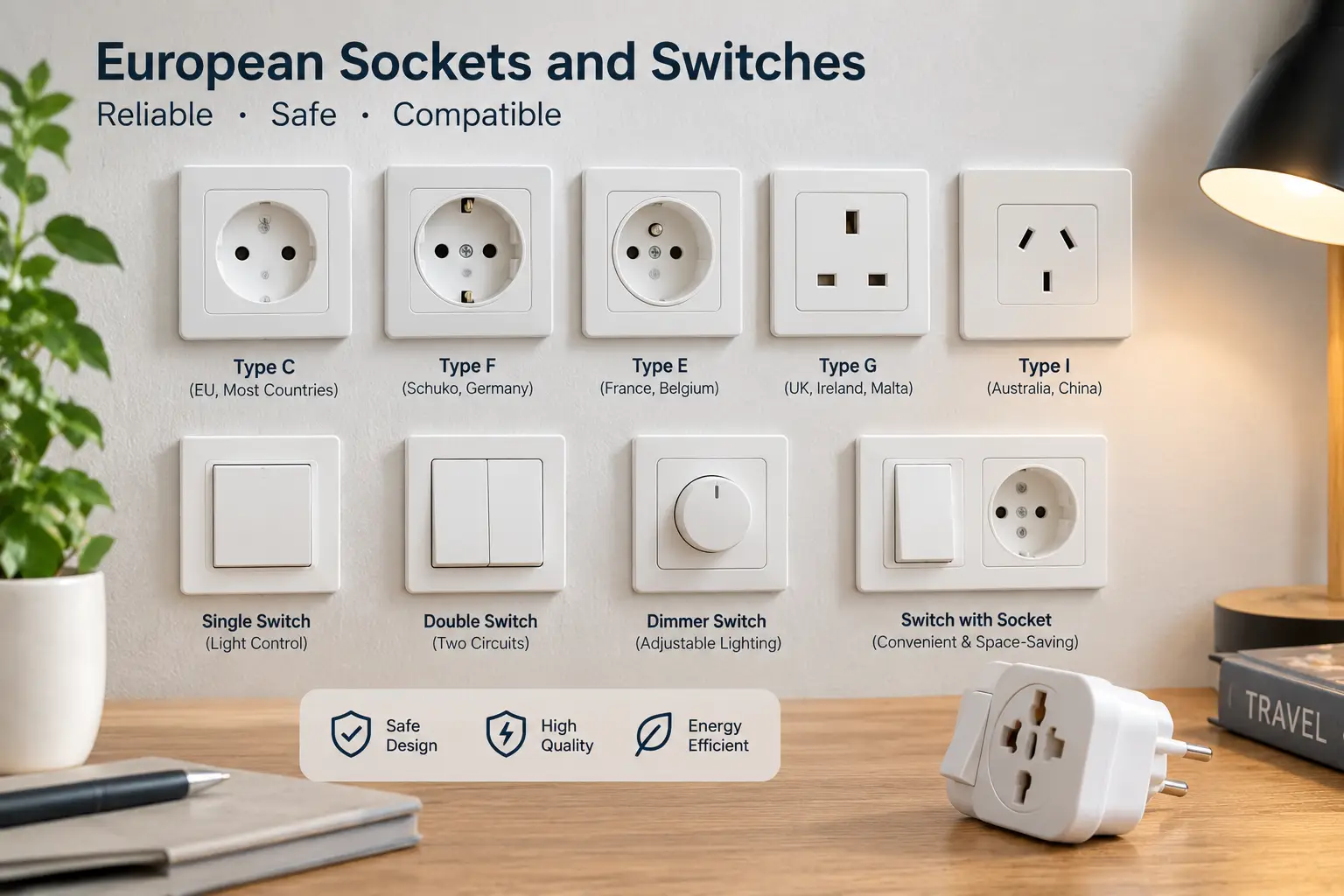
European sockets and switches are wall-mounted electrical outlets and light controls built to continental European standards — typically the Type F “Schuko” socket (CEE 7/3) rated 16A at 250V, and rocker or touch switches sized for 86 mm square plates over round 60 mm back boxes.
That’s the snippet answer. The longer version is that “European” covers a family of standards rather than one design. The IEC’s World Plugs reference lists Type F across Germany, Austria, the Netherlands, Spain, and much of the continent at 230V/50Hz, while France and Belgium use the closely related Type E with a protruding earth pin. Italy adds Type L, and Denmark and Switzerland have their own variants. In practice, when Amazon sellers say “EU standard socket,” they almost always mean Schuko.
What does that mean for you? Three practical things:
- ✅ Grounding works differently. Schuko sockets use side earthing clips instead of a third round pin, so any Schuko or Europlug appliance plugs in either way up.
- ✅ The footprint is different. Most EU-standard plates are 86 × 86 mm (single) or 157 mm wide (double), and their mounting screws are set roughly 60 mm apart — not the spacing of a US single-gang box.
- ✅ The ratings are higher-voltage. A switch rated 10A/250V is perfectly happy on a 120V lighting circuit electrically, but a socket designed for 230V appliances only makes sense on a 240V circuit.
Keep those three facts in mind and every product decision below gets much easier.
Quick Comparison: 7 European Sockets and Switches at a Glance
| Product | Type | Key Spec | Price Range (approx.) | Best for |
|---|---|---|---|---|
| BSEED Schuko 2-Way Glass Double Socket | Double Schuko socket | 16A / 250V, 157 mm glass plate | $15–$30 | BSEED Schuko 2-Way Glass Double Socket: kitchens and workbenches with 230V appliances |
| BSEED Schuko Socket with USB & Type-C | Socket + USB charger | Schuko + USB-A + USB-C | $30–$45 | BSEED Schuko Socket with USB & Type-C: bedside and desk setups |
| BSEED Double Socket with Waterproof Cover | Covered double socket | Flip lid, fits 60 mm box | $25–$40 | BSEED Double Socket with Waterproof Cover: laundry rooms and splash zones |
| Schneider Electric Unica Schuko Socket (NU303718TA) | Modular Schuko insert | 2P+E, shuttered, pro-grade | $10–$25 + import fees | Schneider Electric Unica Schuko Socket (NU303718TA): buyers who want a major brand |
| BSEED Touch Light Switch (1-Gang, 2-Way) | Touch switch (non-smart) | 1000W/gang, glass, LED | $18–$30 | BSEED Touch Light Switch (1-Gang, 2-Way): minimalist, frameless walls |
| BSEED WiFi Smart Touch Switch | Smart touch switch | Tuya/Smart Life, Alexa, Google | $25–$45 | BSEED WiFi Smart Touch Switch: app and voice control fans |
| JSFZM Type 86 Rocker Switch | Mechanical rocker | 10AX / 250V, indicator light | Under $20 | JSFZM Type 86 Rocker Switch: budget rentals and workshops |
Prices are approximate ranges at the time of writing; check the current price, as listings and sellers change often.
Reading the table as a whole, the pattern is clear: BSEED dominates the affordable end of this category, and its glass-plate family lets you match sockets and switches visually across a whole room. The Schneider Electric Unica Schuko Socket (NU303718TA) is the outlier — less glamorous, but backed by one of Europe’s largest electrical manufacturers. If you only buy one thing, decide first whether you need power (a socket on a 240V circuit) or control (a switch on your existing lighting), because those are two completely different projects.
💬 One click helps other shoppers make an informed choice too! 😊
Top 7 European Sockets and Switches: Expert Analysis
Each pick below was chosen from real listings and real spec sheets. Where verified customer data was thin, we say so and lean on the specs instead of guessing.
1. BSEED Schuko 2-Way Glass Double Socket — best all-round double outlet
This is the workhorse of the lineup: two Schuko outlets under one tempered crystal-glass plate, giving a clean, modern look that hides fingerprints better than glossy plastic. The rating is 16A at 250V, which in practical terms means it can feed a 2,000W-plus kettle or espresso machine on a proper 240V circuit without strain. The 157 mm horizontal plate is designed for a European double back box, so plan for that footprint rather than a standard US two-gang opening.
Based on comparing the specs, this is the most sensible starting point for an expat kitchen or a hobby bench where several 230V appliances live. You get two outlets for roughly the cost of one premium-brand socket, and BSEED sells matching switches in the same glass finish, so the wall stays visually consistent. Who shouldn’t buy it? Anyone hoping to plug it into an ordinary 120V branch circuit — the appliances will underperform or not work at all.
Across BSEED’s glass socket listings on European Amazon stores, aggregated feedback tends to praise the finish and solid feel of the glass, while the recurring caution is that the plate size doesn’t match every back box. We couldn’t verify a large body of US-specific reviews for this exact variant.
Pros:
- ✅ Two Schuko outlets under a single glass plate
- ✅ 16A rating handles high-wattage European appliances
- ✅ Matches BSEED switches for a coordinated wall
Cons:
- ❌ 157 mm plate won’t fit a standard US two-gang box
- ❌ Not UL-listed, which can complicate inspections
💵 Typically around $15–$30 at the time of writing, which is strong value if you genuinely need two 230V outlets.
2. BSEED Schuko Socket with USB & Type-C — best for charging without adapters
The pitch here is simple: one Schuko outlet plus a USB-A port and a USB-C port in a single glass plate, so your phone, earbuds, and a 230V lamp share one spot. The listing on Amazon Belgium describes it as a 3-in-1 unit and recommends a back box deeper than 40 mm — deeper than a normal socket needs. That spec matters: the built-in charger module takes up space, and shallow boxes are the number-one reason these installs stall.
Here’s what to weigh. For a bedside or desk in a home that already has a 240V circuit for European gear, this saves a separate USB brick and an outlet. But if your main goal is USB charging, a US-standard USB receptacle is far simpler; this model only earns its place when the Schuko outlet is the primary need. The listing’s USB output is modest (BSEED has also released a 20W USB-C variant), so don’t expect laptop-class fast charging.
At the time of writing, the Belgian Amazon listing shows roughly 4.4 out of 5 stars across nearly 5,000 ratings, which suggests broadly positive aggregated sentiment. Reviews in this product family commonly flag box depth as the main installation hurdle.
Pros:
- ✅ Combines Schuko, USB-A, and USB-C in one plate
- ✅ Large rating base on European Amazon stores
- ✅ Frees up outlets otherwise used by chargers
Cons:
- ❌ Needs a back box deeper than 40 mm
- ❌ USB output isn’t laptop-grade fast charging
💵 Expect roughly $30–$45; fair value for a convenience upgrade, poor value if you only need USB.
3. BSEED Double Socket with Waterproof Cover — best for damp, splash-prone spots
This amazon.com listing pairs two Schuko outlets with a hinged protective cover over a crystal-glass plate, and the seller states it fits a 60 mm wall box. It also uses plug-in (push-in) terminals, which speed up wiring compared with traditional screw clamps. In practice, the flip lid keeps dust, flour, and the occasional splash out of the contacts when nothing is plugged in.
On paper, this is the right pick for a laundry area, a utility room, or a covered patio wall where a European washing machine or pressure washer needs power. But “waterproof cover” is not the same thing as a US weather-resistant, in-use cover rated for outdoor wet locations, and it is definitely not a substitute for GFCI protection. Treat it as splash protection for indoor damp areas, and put GFCI or RCD protection upstream in the circuit regardless.
We couldn’t verify a meaningful volume of US reviews for this specific listing, so judge it on specs: the cover and push-in terminals are genuine conveniences, while the lack of an independent wet-location rating is the main gap.
Pros:
- ✅ Hinged lid keeps contacts clean when idle
- ✅ Push-in terminals make wiring faster
- ✅ Two outlets for washers, dryers, or tools
Cons:
- ❌ No independent US wet-location rating confirmed
- ❌ Still requires separate GFCI or RCD protection
💵 Usually in the $25–$40 range; good value for indoor utility spaces.
4. Schneider Electric Unica Schuko Socket (NU303718TA) — best brand pedigree for purists
Schneider Electric is one of the largest names in European electrical hardware, and this insert — listed on amazon.com through the Amazon Global Store as a Schuko 2P+E socket in Polar White — is the kind of part a European electrician would actually install. It’s a mechanism-and-cover module, which means it is designed to sit inside a matching Schneider frame and plate rather than arriving as a complete all-in-one unit.
What most buyers overlook with modular systems is the shopping list: you’ll need the correct frame (and possibly a mounting adapter) from the same product family, so confirm compatibility before checkout. The payoff is consistent manufacturing quality, child-safety shutters across the range, and the ability to mix sockets, switches, and blanks in a single multi-gang frame. For anyone building a proper 230V corner — say, a home studio running European audio gear — that modularity is worth the extra planning.
Customer review volume for this specific ASIN on amazon.com appears limited. Across Schneider’s Schuko sockets on European Amazon stores, aggregated feedback is generally positive about build quality, though those reviews cover sister products rather than this exact part.
Pros:
- ✅ Major-brand build quality and consistency
- ✅ Modular design mixes sockets and switches in one frame
- ✅ Shuttered contacts add child protection
Cons:
- ❌ Frame and cover may need to be bought separately
- ❌ Import shipping and fees can raise the real cost
💵 The insert itself sits around $10–$25 at the time of writing, plus import costs — excellent value for quality if you plan the full kit.
5. BSEED Touch Light Switch (1-Gang, 2-Way) — best frameless glass look
This is the switch that sells the “European apartment” aesthetic: a flat tempered-glass panel with an LED indicator, no moving rocker, and a light tap to toggle. BSEED’s spec sheet (model GL86TS12BEU11) lists an 86 × 86 × 35 mm body, a 1000W-per-gang average rated load, and CE and RoHS marks, and the listing explicitly says it is not a smart switch. The “2-way” label is European terminology for what Americans call a 3-way setup — two switches controlling one light.
Based on comparing the specs, the 1000W load is generous for LED lighting; at 120V that works out to roughly 8A of lighting, far more than a typical room needs. The real compatibility question is the electronics: electronic touch switches can make very low-wattage LED bulbs glow faintly or flicker, so check the listing’s supported voltage range and minimum load. Also note the 35 mm depth, which is shallow enough for most boxes.
Aggregated feedback on European Amazon stores tends to praise the look and touch response; the most common complaints involve wiring confusion and faint LED glow with small loads.
Pros:
- ✅ Sleek glass panel with no moving parts
- ✅ 1000W per gang covers most room lighting
- ✅ Supports two-location (US “3-way”) control
Cons:
- ❌ Tiny LED loads may flicker or glow faintly
- ❌ 86 mm plate needs an adapted box in US walls
💵 Typically $18–$30; solid value for a high-end look on a modest budget.
6. BSEED WiFi Smart Touch Switch — best for app and voice control
BSEED’s WiFi touch line adds what the standard model lacks: remote control through the Tuya/Smart Life app, voice control with Amazon Alexa and Google Assistant, and scheduling. BSEED’s own spec pages for its smart switches list a 110–240V input range, a 1000W-per-gang load, and — crucially — a neutral wire requirement. That last detail decides whether this switch works in your wall at all, since many older US switch boxes have no neutral.
Here’s what to weigh. If you want European glass aesthetics and smart features, this is the most direct route, and the wide voltage range is genuinely useful in a US home. But BSEED sells both EU-format (86 mm) and US-format versions, so read the listing title and dimensions carefully before ordering. Smart switches running on 2.4GHz WiFi also depend on your router; if you already run a Zigbee hub, BSEED’s Zigbee variants tend to be more stable on large networks.
We couldn’t verify a large pool of US reviews specific to the EU-format WiFi model. Common themes across Tuya-based smart switches include easy app pairing and occasional WiFi drop-outs on congested networks.
Pros:
- ✅ Works with Alexa, Google Assistant, and Smart Life
- ✅ Wide 110–240V input suits US and EU circuits
- ✅ Scheduling and timers built in
Cons:
- ❌ Requires a neutral wire at the switch box
- ❌ EU and US formats are easy to confuse when ordering
💵 Usually $25–$45 at the time of writing; good value if you’d otherwise buy a separate smart controller.
7. JSFZM Type 86 Rocker Switch — best budget mechanical option
Sometimes you just want a big, satisfying European-style rocker that clicks. The JSFZM switch on amazon.com is an 86 × 86 mm panel with a large paddle, a polycarbonate (PC) faceplate, a fluorescent locator light, and a 10AX/250V rating, offered in 1-gang 2-way form. The “AX” in that rating signals it’s intended for inductive and lamp loads — a good sign for a lighting switch.
Based on the specs, this is the simplest pick in the lineup: no electronics, no app, no minimum load worries in the switching mechanism itself. Because it’s purely mechanical, it doesn’t need a neutral and works at 120V without fuss. The one quirk to know about is the built-in indicator light; small neon or LED locator lights in any switch can cause a faint glow in very efficient LED bulbs when the switch is off. For a garage, workshop, or rental refresh where cost matters more than glass panels, it does the job.
We found little verifiable aggregated review data for this specific listing, so we’re judging it on its specs and category norms rather than customer sentiment.
Pros:
- ✅ Large rocker paddle is easy to hit in the dark
- ✅ Purely mechanical with no neutral required
- ✅ Very low cost per switch
Cons:
- ❌ Plastic panel feels less premium than glass
- ❌ Locator light may cause faint LED glow
💵 Usually under $20 at the time of writing; excellent value for utility spaces.
Head-to-Head: Comparing the Top 7 on What Matters
| Product | Rated Current | Voltage Rating | Needs Neutral? | Smart Features | Best for |
|---|---|---|---|---|---|
| BSEED Schuko 2-Way Glass Double Socket | 16A | 250V | N/A (socket) | No | BSEED Schuko 2-Way Glass Double Socket: multi-appliance kitchens |
| BSEED Schuko Socket with USB & Type-C | 16A (socket) | 250V | N/A | No | BSEED Schuko Socket with USB & Type-C: desks and nightstands |
| BSEED Double Socket with Waterproof Cover | 16A | 250V | N/A | No | BSEED Double Socket with Waterproof Cover: utility rooms |
| Schneider Electric Unica Schuko Socket (NU303718TA) | 16A | 250V | N/A | No | Schneider Electric Unica Schuko Socket (NU303718TA): brand-conscious builds |
| BSEED Touch Light Switch (1-Gang, 2-Way) | 1000W/gang | Check listing range | Check listing | No | BSEED Touch Light Switch (1-Gang, 2-Way): modern living rooms |
| BSEED WiFi Smart Touch Switch | 1000W/gang | 110–240V | Yes | Yes | BSEED WiFi Smart Touch Switch: smart homes |
| JSFZM Type 86 Rocker Switch | 10AX | 250V | No | No | JSFZM Type 86 Rocker Switch: workshops and rentals |
Looking at the comparison side by side, every socket here shares the same core 16A/250V Schuko rating, so your choice between them comes down to form: two outlets, USB charging, a protective lid, or a modular pro-grade system. The switches split more sharply. The JSFZM Type 86 Rocker Switch is the only one that needs no neutral and has no electronics, which makes it the safest bet in older US boxes, while the BSEED WiFi Smart Touch Switch offers the most features but also the strictest wiring requirement.
✨ Don’t miss these standout picks!
🔍 Take your home electrical upgrade to the next level with this carefully curated lineup. Click a highlighted item to check current pricing and availability. These picks will help you power European appliances and modernize your walls with confidence!
How to Install European Sockets and Switches in a US Home: A Practical Planning Guide
Let’s be clear: in most US jurisdictions, adding or changing permanent wiring requires a licensed electrician and often a permit. This guide is about planning the job well so the electrician’s visit is fast and the result passes inspection.
Step 1: Decide which circuit you’re working with
For sockets feeding 230V appliances, you need a 240V circuit. US homes already have 240V available at the panel through split-phase service (the same supply that feeds dryers and ranges), so an electrician can run a dedicated 240V branch circuit. For switches, you’ll simply reuse your existing 120V lighting circuit.
Step 2: Solve the box problem before you buy
European plates mount on round 60 mm boxes with screws about 60 mm apart, while US devices use rectangular boxes with different screw spacing. Your options include installing European-style round boxes in new drywall, using an adapter plate or mud ring, or choosing a US-format version of the same switch design.
Step 3: Translate the wire colors
European wiring uses brown (line), blue (neutral), and green-yellow (protective earth). US circuits typically use black or red (hot), white (neutral), and bare or green (ground). On a 240V US circuit there are two hots and no neutral at the socket — your electrician should mark them clearly.
Step 4: Add protection
Put GFCI protection on any circuit serving kitchens, bathrooms, laundry areas, or garages, as US code generally requires.
Step 5: Label everything
Mark each 230V outlet clearly (“240V — European appliances only”) so no guest ever plugs in a 120V device through an adapter.
Real-World Scenarios: Which Setup Fits Your Situation?
Specs only make sense in context, so here are three common buyer profiles and how we’d match them.
🏠 The returning expat with a 230V kitchen
Budget: $150–$300 for hardware, plus electrician. Frequency: daily use. You’ve got a European espresso machine, kettle, and mixer that you love. Buying three step-up transformers would clutter the counter and cost more over time. The smarter move is a single dedicated 240V circuit ending in a BSEED Schuko 2-Way Glass Double Socket, plus a BSEED Schuko Socket with USB & Type-C at the end of the counter for small appliances and phones. Label both clearly.
🎨 The design-focused renovator
Budget: $100–$250 for a living area. Frequency: everyday lighting. You don’t need European power at all — you want the look. Skip the sockets entirely and use the BSEED Touch Light Switch (1-Gang, 2-Way) for hallways and the BSEED WiFi Smart Touch Switch where you want voice control, both on your existing 120V circuits. Confirm neutrals first, and ask about US-format versions if box adaptation looks messy.
🔧 The hobbyist with imported tools or audio gear
Budget: $60–$150. Frequency: weekends. A garage or studio with a couple of German power tools or 230V audio units benefits from the Schneider Electric Unica Schuko Socket (NU303718TA) in a proper frame, with a JSFZM Type 86 Rocker Switch controlling task lighting. Robust, simple, and inexpensive.
Problem → Solution: Fixing the Most Common Headaches
Problem 1: “My 230V appliance runs weakly or won’t start on a US outlet.” ➡️ Solution: That’s expected — 120V is roughly half the voltage the appliance needs. Either use a properly sized step-up transformer for occasional use or have a dedicated 240V circuit installed for a BSEED Schuko 2-Way Glass Double Socket.
Problem 2: “The European switch plate won’t line up with my wall box.” ➡️ Solution: Measure screw spacing before buying. Use an adapter plate, a round European box in new drywall, or the US-format version of the switch.
Problem 3: “My LED lights glow faintly when the touch switch is off.” ➡️ Solution: Electronic and illuminated switches can leak a tiny current. Try a higher-wattage or dimmable LED bulb, or switch to a purely mechanical model such as the JSFZM Type 86 Rocker Switch (and disable its locator light if the design allows).
Problem 4: “The smart switch won’t power on.” ➡️ Solution: The BSEED WiFi Smart Touch Switch needs a neutral wire. If your box lacks one, look for a no-neutral smart switch or have a neutral pulled.
Problem 5: “The USB socket won’t fit in the box.” ➡️ Solution: The BSEED Schuko Socket with USB & Type-C needs more than 40 mm of depth; a deeper box or extension ring fixes it.
How to Choose European Sockets and Switches
- Define the job: power or control. Sockets bring 230V power to European appliances; switches only change how you control existing lights. Mixing up the two causes most buying mistakes.
- Confirm the circuit voltage. Schuko sockets belong on a 240V circuit; switches rated 250V work fine on 120V lighting.
- Measure your wall box. European plates assume round 60 mm boxes — check depth and screw spacing first.
- Check the neutral. Smart and some touch switches need one; mechanical rockers don’t.
- Match the load. A 16A socket covers big appliances; for switches, check both maximum and minimum load against your bulbs.
- Look at certification. CE marks are self-declared European conformity, not a US listing. Ask your electrician what your inspector will accept.
- Plan for the full kit. Modular brands need frames and covers; budget for them.
If you want deeper background on the Type F system itself — including why its symmetric design and side earthing clips matter — Wikipedia’s Schuko overview is a clear, well-referenced starting point.
Schuko Socket vs US NEMA Outlet: An Honest Comparison
| Feature | Schuko (Type F) Socket | US NEMA 5-15 Outlet | Best for |
|---|---|---|---|
| Standard voltage | 230V | 120V | Schuko: European appliances |
| Rated current | 16A | 15A | Schuko: higher-wattage devices |
| Max power (approx.) | ~3,600W | ~1,800W | Schuko: kettles, espresso machines |
| Grounding | Side earthing clips | Third round pin | Tie — both are grounded |
| Polarized plug | No (reversible) | Yes | NEMA: polarity-sensitive devices |
| Recessed socket | Yes, plug sits inside a cavity | No | Schuko: touch-safety |
| US code acceptance | Generally not listed for US use | Fully listed | NEMA: inspection-friendly installs |
The numbers tell an interesting story: at 230V and 16A, a Schuko socket delivers roughly twice the power of a standard US outlet, which is exactly why European kettles boil so quickly. Schuko’s recessed cavity is also a genuine safety advantage, since the plug body covers the pins before they make contact. But the US outlet wins on the factor that matters most for a permanent install — code acceptance — and its polarized plug keeps the switched conductor consistent.
There’s a broader context too. As the Wikipedia article on mains electricity by country explains, most of the world runs at 220–240V, with North America the notable exception. That’s why European sockets and switches feel “foreign” here: they’re mainstream almost everywhere else. The practical takeaway is to treat Schuko as a dedicated-purpose outlet for European gear, never as a replacement for your general-purpose US receptacles.
European Light Switches: Rocker vs Touch vs Smart
European light switches come in three broad families, and the right one depends on how much complexity you’re willing to manage.
Mechanical rockers
The classic wide paddle — think of the JSFZM Type 86 Rocker Switch. These are simple, durable, need no neutral, and are electrically indifferent to whether your circuit is 120V or 230V as long as the current rating is respected. They’re the lowest-risk way to get the European look.
Touch switches (non-smart)
Glass panels with capacitive sensors, like the BSEED Touch Light Switch (1-Gang, 2-Way). They look stunning and have no moving parts to wear, but their electronics need a small standby current, which is where LED glow and minimum-load issues come from. Check the supported voltage range carefully for US use.
Smart switches
Touch switches with WiFi or Zigbee radios, such as the BSEED WiFi Smart Touch Switch. They add schedules, scenes, and voice control, but almost always require a neutral and a stable network.
Here’s the decision shortcut: if your wall boxes are old and you’re not sure about neutrals, go mechanical. If you’re renovating with new wiring, touch and smart switches become far easier to justify.
Safety, Regulations, and Standards in the US
This is the section most product roundups skip, and it’s the one that protects you.
In the US, the National Electrical Code (NEC) generally expects permanently installed electrical equipment to be listed or approved for its use. Listing is typically done by a Nationally Recognized Testing Laboratory — UL, ETL (Intertek), and CSA are familiar names. OSHA’s NRTL program page explains how these labs certify products to safety test standards and how their registered marks show that a product has been tested. Most European sockets and switches carry CE marking instead, which is a European self-declaration of conformity — not a US listing.
What does that mean in practice?
- ⚠️ Inspections: Your local authority having jurisdiction (AHJ) decides what’s acceptable. Some inspectors may reject unlisted devices in permanent wiring; others may accept a dedicated, clearly labeled installation. Ask before you build.
- ⚠️ Insurance: Unlisted wiring devices can become a point of contention after a fire claim. A quick call to your insurer is cheap peace of mind.
- ⚠️ Rentals and resale: Landlords and home inspectors may flag non-US devices. Keep receipts and spec sheets.
- ✅ GFCI/AFCI: US code requires GFCI protection in many locations and AFCI protection on many dwelling circuits. European devices don’t change those requirements.
- ✅ Child safety: US code requires tamper-resistant receptacles in dwellings; look for shuttered Schuko designs, like the Schneider Electric Unica Schuko Socket (NU303718TA), if kids are around.
The honest summary: european sockets and switches can be installed responsibly in specific situations, but the decision belongs to you, a licensed electrician, and your local inspector together.
Long-Term Cost and Maintenance
The sticker price of european sockets and switches is low, but the total cost of ownership depends far more on installation than on hardware.
| Approach | Upfront Hardware | Installation | Long-Term Cost | Best for |
|---|---|---|---|---|
| Step-up transformer per appliance | $40–$150 each | None | Ongoing standby losses, clutter | Occasional use of one appliance |
| Dedicated 240V circuit + BSEED Schuko 2-Way Glass Double Socket | $15–$30 | Electrician, often a few hundred dollars and up | Minimal | Daily use of several 230V appliances |
| European switch upgrade (BSEED Touch Light Switch (1-Gang, 2-Way)) | $18–$30 per switch | Box adaptation may add labor | Minimal; occasional glass cleaning | Design-led renovations |
| Smart switch (BSEED WiFi Smart Touch Switch) | $25–$45 per switch | Requires neutral | Network upkeep, app updates | Smart-home households |
The comparison shows why the “cheap” option is often the expensive one. A single step-up transformer per appliance looks thrifty, but buying three or four of them quickly matches the cost of one dedicated circuit, and transformers draw standby power and take up counter space. For daily users of multiple European appliances, a properly installed 240V circuit usually wins over a five-year horizon.
Maintenance is light: wipe glass panels with a soft, dry or slightly damp cloth (never spray liquid directly onto a switch), check that socket plates remain firmly seated every year or so, and replace any outlet that feels loose or shows discoloration.
Common Mistakes to Avoid When Buying European Sockets and Switches
Mistake 1: Wiring a Schuko socket to a 120V circuit
It’s the most common error. The socket accepts the plug, but the appliance gets half its intended voltage. Worse, someone may later plug a 120V device into the same outlet via an adapter once it’s moved to 240V. Dedicated circuits and clear labels prevent both problems.
Mistake 2: Ignoring box depth and size
USB sockets and smart switches carry electronics that need depth. The BSEED Schuko Socket with USB & Type-C specifically calls for more than 40 mm, and 86 mm plates don’t sit on US single-gang boxes without adaptation.
Mistake 3: Assuming CE equals UL
CE is a European self-declaration; it isn’t a US safety listing. Ask your inspector before you install.
Mistake 4: Forgetting the neutral
Smart switches like the BSEED WiFi Smart Touch Switch need one. Check your box before ordering.
Mistake 5: Buying the wrong “2-way”
European “2-way” equals the US “3-way” (two switches, one light). Order accordingly.
Mistake 6: Buying a modular insert without a frame
The Schneider Electric Unica Schuko Socket (NU303718TA) is part of a system. Confirm frame and cover compatibility first.
🚀 Ready to upgrade your walls the smart way?
💡 Compare the picks above, click a highlighted product to check current pricing and availability, and bring the spec sheet to your electrician. A little planning now delivers a cleaner, safer European-style setup for years!
Features That Actually Matter (and Ones That Don’t)
Features that matter
- ✅ Current and voltage rating: 16A/250V for sockets, and a clear load rating for switches, determine what you can safely run.
- ✅ Shutters (child protection): Shuttered contacts block single-object insertion; worth having in family homes.
- ✅ Neutral requirement: It decides whether a smart or touch switch works in your wall at all.
- ✅ Box compatibility: Depth and screw spacing make or break the installation.
- ✅ Terminal type: Push-in terminals, like those on the BSEED Double Socket with Waterproof Cover, speed up wiring; screw terminals are more forgiving of re-work.
Features that matter less than marketing suggests
- ❌ “Fireproof” claims without a test standard: Without a named standard, it’s just a word.
- ❌ Exotic finishes: Gold and champagne plates look great but don’t change performance.
- ❌ Very high gang counts on one plate: Convenient, but harder to fit into US walls.
- ❌ Backlight brightness: Nice at night, but the most common cause of faint LED glow.
The short version: prioritize ratings, safety, and fit, then pick the finish you love.
FAQ: European Sockets and Switches
❓ Can I use European sockets and switches in the US legally?
❓ Do I need a 240V circuit for a Schuko socket?
❓ Will a European light switch work on 120V wiring?
❓ Are European sockets safer than American outlets?
❓ Where can I buy European sockets and switches online?
Conclusion: Getting European Sockets and Switches Right
European sockets and switches deliver real benefits — faster kettles, cleaner walls, and the satisfying feel of a well-designed glass panel — but only when they’re matched to the right circuit and the right box. If you’re powering European appliances every day, the BSEED Schuko 2-Way Glass Double Socket on a dedicated 240V circuit is the most practical place to start, with the BSEED Schuko Socket with USB & Type-C adding convenient charging. For utility spaces, the BSEED Double Socket with Waterproof Cover offers sensible splash protection, while purists will appreciate the Schneider Electric Unica Schuko Socket (NU303718TA) and its modular system.
If your goal is the look rather than the voltage, focus on switches. The BSEED Touch Light Switch (1-Gang, 2-Way) brings the frameless glass aesthetic, the BSEED WiFi Smart Touch Switch layers in voice and app control, and the JSFZM Type 86 Rocker Switch keeps things simple and affordable.
Whatever you choose, remember the three checks that matter most: voltage, box size, and certification. Talk to a licensed electrician, confirm what your inspector accepts, and label every 230V outlet. Do that, and your European-style upgrade will be both beautiful and safe.
🌟 Your European-style upgrade starts here!
🛒 Click any highlighted product above to check current pricing and availability. With the right picks and a solid plan, you’ll power your favorite European appliances and enjoy sleek, modern walls the whole family will love!
Recommended for You
- Power Meter Monitor: 7 Best Energy Monitoring Options
- Defiant Smart Plug Setup: 7 Easy Steps & Best Picks (2026)
- Belgium Power Plug Type: 7 Best Adapters That Work in 2026
Disclaimer: This post contains affiliate links. As an Amazon Associate, I earn from qualifying purchases made through these links, at no additional cost to you. This article is for general information only and is not a substitute for advice from a licensed electrician; always follow your local electrical code.
✨ Found this article helpful? Share it with someone who needs it! 💬🤗