
In This Article
What Is General Electric Outdoor Lighting?
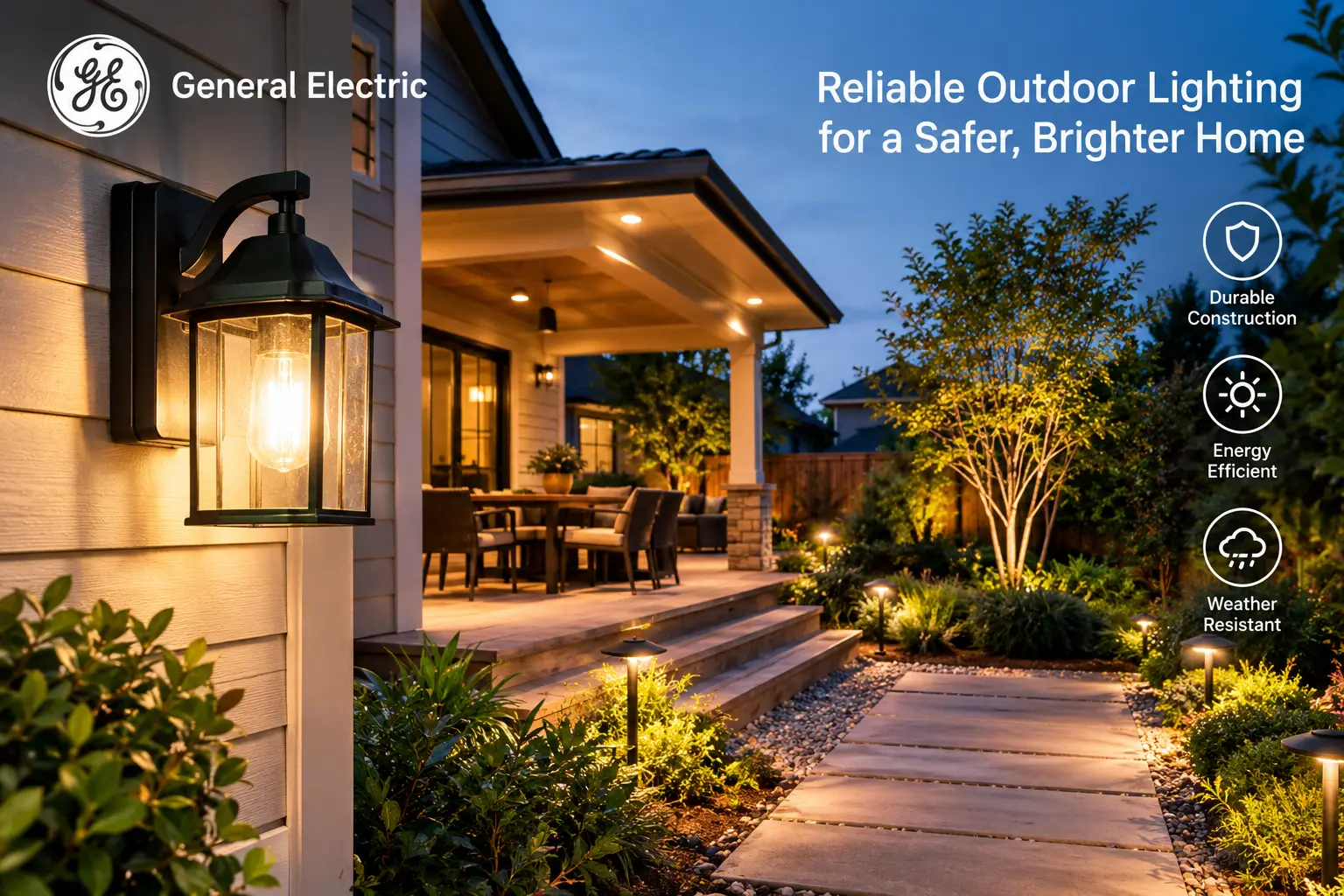
General electric outdoor lighting refers to the GE-branded bulbs, fixtures, and smart lights built for porches, driveways, eaves, and yards. Today the lineup splits into three families: LED+ motion-sensor bulbs, LED+ dusk-to-dawn bulbs, and Cync app-controlled smart lights, all designed to work in standard household sockets or simple plug-in setups.
One quick reality check before we dig in. The consumer GE light bulb business is no longer run by General Electric itself; it was sold to the smart-home company Savant, which now makes products under the GE Lighting and Cync names (you can read the backstory on the GE Lighting Wikipedia page). That matters because the “GE” on the box today means Savant-era engineering, a Cync app, and a support team that answers reviews under the “GE Lighting, a Savant Company” banner.
So is general electric outdoor lighting still worth your money? For most homes, yes, but only if you match the right family to the right job. A motion bulb on a porch you want lit all night is a mistake. A smart color floodlight in a spot your Wi-Fi barely reaches is a headache. In this guide, you’ll get seven real GE products, honest analysis grounded in spec sheets and aggregated review sentiment, and practical setup advice that the product listings never bother to give you. ⚡
Quick Comparison: GE Outdoor Lights at a Glance
Here’s the whole lineup on one screen, so you can narrow things down before reading the deep dives. Price ranges reflect what we saw at the time of writing; always check the current price on Amazon.
| Product | Type | Key spec | Approx. price range | Best for |
|---|---|---|---|---|
| GE LED+ Motion Sensor PAR38 Floodlight | Motion bulb | 14W, 90W equivalent, 24 ft sensor range | Around $15–$30 | Garages and side doors |
| GE LED+ Motion Sensor A21 Security Bulb | Motion bulb | 12W, 75W equivalent, E26 base | Under $25 per pack | Budget porch fixtures |
| GE LED+ Linkable Motion Sensor Light | Motion fixture | 250W replacement, up to 4 linked zones | Roughly $40–$80 | Large yards and long driveways |
| GE LED+ Dusk to Dawn A19 Bulb | Light-sensing bulb | 8.5–9W, 800 lumens, 60W equivalent | Around $20–$30 for a 3-pack | All-night porch lighting |
| GE LED+ PAR38 Dusk to Dawn Floodlight | Light-sensing flood | 90W replacement, daylight tone | In the $15–$30 range | All-night driveway coverage |
| GE Cync Full Color PAR38 Smart Floodlight | Smart bulb | 15W, 1,300 lumens, Wi-Fi | Around $40–$50 for a 2-pack | Holiday color and schedules |
| GE Cync Dynamic Effects Outdoor Smart Eave Lights | Permanent smart strip | 100 ft, IP65, extendable to 150 ft | Roughly $140–$250 | Year-round roofline accents |
Reading the table, the clearest split is automation style, not brightness. The GE LED+ Motion Sensor PAR38 Floodlight and GE LED+ Dusk to Dawn A19 Bulb both need zero apps, so they’re the safest picks for renters and anyone who hates setup. If you want control from your phone, the GE Cync Full Color PAR38 Smart Floodlight is the cheapest way in, while the GE Cync Dynamic Effects Outdoor Smart Eave Lights is a bigger, more permanent commitment that only pays off if you’ll use it all year.
💬 One click helps other shoppers make an informed choice too! 😊
Top 7 General Electric Outdoor Lighting Picks: Expert Analysis
Every pick below is a real GE or Cync product sold to US shoppers. The analysis comes from manufacturer spec sheets and aggregated retailer review sentiment, not from hands-on testing, so you’ll see clearly which claims are verified and which are judgment calls.
1. GE LED+ Motion Sensor PAR38 Floodlight — easiest motion upgrade for any flood socket
This is the bulb that turns a dumb floodlight fixture into a motion light without touching a single wire. The GE LED+ Motion Sensor PAR38 Floodlight draws about 14 watts while replacing a 90-watt halogen, and it screws into a standard E26 socket. Its built-in sensor watches a 90-degree cone out to about 24 feet, which in practice covers a single-car driveway or a side door, not a whole backyard.
Based on the specs, this is the right pick for garages, side entries, and trash-can corners where you want light only when someone’s there. It’s wet-rated, needs no app, hub, or Wi-Fi, and GE’s listing describes it staying lit for roughly five minutes after motion. That fixed window is fine for walking in with groceries, but short if you’re unloading a car.
Across retailer pages, reviews consistently praise the no-setup install. The recurring complaint is sensor reliability: a minority of buyers report the motion feature failing or behaving erratically, so keep your receipt.
Pros:
- ✅ Screw-in install with no wiring changes
- ✅ Uses roughly 85% less power than halogen floods
- ✅ Works without Wi-Fi, apps, or hubs
Cons:
- ❌ Narrow 90-degree detection cone limits coverage
- ❌ No adjustable on-time or sensitivity setting
Price range: around $15–$30 depending on pack size, which is strong value for a no-wiring motion upgrade.
2. GE LED+ Motion Sensor A21 Security Bulb — cheapest way to add motion to a porch
If your porch fixture takes a regular household bulb, this is the budget route to motion lighting. The GE LED+ Motion Sensor A21 Security Bulb uses about 12 watts to replace a 75-watt incandescent (a warm-white variant lists 11 watts), with the same 24-foot, 90-degree sensor as its PAR38 sibling.
What most buyers overlook is the fixture itself. The sensor sits at the bulb’s tip, so it needs a clear line of sight. In an open-bottom lantern or bare-bulb socket, it works as intended. In a frosted, fully enclosed jar fixture, the sensor may struggle to see motion at all. That makes this a smart pick for simple porch and garage sockets, and a poor one for decorative enclosed lanterns.
Review sentiment is mixed. Shoppers like the price and the instant on, while some recent retailer reviews report a sensor that never triggered, which suggests unit-to-unit variation.
Pros:
- ✅ Fits any standard E26 medium-base socket
- ✅ Lowest cost of entry in GE’s motion line
- ✅ Available in warm white and daylight tones
Cons:
- ❌ Struggles inside frosted or enclosed fixtures
- ❌ Some buyers report sensors that never activate
Price range: typically under $25 for a multi-pack, making it the best value for basic porch security.
3. GE LED+ Linkable Motion Sensor Light — one trigger lights the whole yard
This is the problem-solver for long driveways and wide backyards. The GE LED+ Linkable Motion Sensor Light is a full outdoor flood fixture rated as a 250-watt replacement in a cool daylight tone. Its standout trick is linking: you can create up to four linked zones, and when one fixture detects motion, every linked fixture in that zone turns on together.
In practice, that means someone stepping onto your side gate lights up the driveway too, instead of leaving them half in shadow. GE rates the fixture at 25,000 hours and estimates roughly $4.30 a year in energy cost, which is tiny next to old halogen security lights. On paper, it’s the most capable motion product in the lineup, but it is a hardwired fixture, so plan for an electrician if you aren’t comfortable with outdoor junction boxes.
We couldn’t verify a meaningful volume of independent reviews for this specific fixture, so treat the linking feature as promising rather than proven at scale.
Pros:
- ✅ Links up to four zones for coordinated coverage
- ✅ Very bright 250W-equivalent daylight output
- ✅ Rated for 25,000 hours of use
Cons:
- ❌ Requires hardwiring rather than a simple screw-in swap
- ❌ Limited independent review data to confirm reliability
Price range: roughly $40–$80 at the time of writing, fair value if you’d otherwise buy several separate floods.
4. GE LED+ Dusk to Dawn A19 Bulb — set-and-forget all-night porch light
Some spots should simply stay lit all night, and this bulb handles it automatically. The GE LED+ Dusk to Dawn A19 Bulb uses a built-in light sensor to switch on at dusk and off at dawn, drawing roughly 8.5 to 9 watts for 800 lumens, the brightness of an old 60-watt bulb.
The spec sheets show versions in 2700K soft white and 5000K daylight, with a CRI of 90 and a 25,000-hour rating on several SKUs. That high CRI means faces and house numbers look natural rather than washed out, which matters for doorbell cameras too. Daylight versions read sharper for security; soft white feels warmer and friendlier on a front porch.
Here’s the catch the box mentions only briefly: the sensor must see ambient daylight. Mount it under a deep porch roof or inside a fixture that reflects its own light back, and it can stay on during the day or flicker at dusk. Reviews generally praise how cheap and simple it is, with complaints clustering around placement issues like these.
Pros:
- ✅ Fully automatic with no timer to reset
- ✅ High 90 CRI renders colors naturally
- ✅ Very low running cost at about 9 watts
Cons:
- ❌ Not compatible with dimmer switches
- ❌ Misbehaves in shaded or reflective fixtures
Price range: around $20–$30 for a three-pack, excellent value for porches that should never go dark.
5. GE LED+ PAR38 Dusk to Dawn Floodlight — all-night coverage for driveways
Think of this as the floodlight-sized version of pick No. 4. The GE LED+ PAR38 Dusk to Dawn Floodlight replaces a 90-watt halogen flood in a crisp daylight tone and switches itself on at sunset and off at sunrise, with no app, hub, or scheduling required.
Why choose a flood over an A19? Beam shape. A PAR38 reflector throws light forward in a controlled cone, so it can wash a driveway or the side of a garage from a mounted fixture instead of glowing in every direction. GE pitches its dusk-to-dawn line as an occupancy signal too: a lit driveway at 2 a.m. suggests someone’s home, which is a reasonable deterrent when you travel.
The trade-off is that an all-night flood is the definition of light that’s on when nobody needs it. For neighbors, angle it down rather than outward. For your bill, the LED draw is low enough that it’s rarely a dealbreaker. We couldn’t verify a large pool of independent reviews for this exact SKU, so our view rests on the spec sheet and on how the wider LED+ dusk-to-dawn family is described.
Pros:
- ✅ Automatic dusk-to-dawn operation with zero setup
- ✅ Focused PAR38 beam reaches driveways and walls
- ✅ Daylight tone helps security cameras
Cons:
- ❌ Can light neighbors’ windows if aimed poorly
- ❌ Few independent reviews for this specific model
Price range: in the $15–$30 range at the time of writing, good value for a hands-off security flood.
6. GE Cync Full Color PAR38 Smart Floodlight — best entry into smart outdoor color
This is where general electric outdoor lighting gets playful. The GE Cync Full Color PAR38 Smart Floodlight uses about 15 watts for 1,300 lumens, roughly a 90-watt flood, and adds millions of colors plus a tunable white range, all controlled through the Cync app.
The practical upgrade isn’t the color; it’s the scheduling. You can set the bulb to turn on at a fixed time, control it away from home, and pair it with Alexa or Google Assistant for voice control. It connects directly to 2.4 GHz Wi-Fi with no hub, but GE’s setup notes say the bulb must be within about 40 feet of your router. That single spec decides whether this bulb is a joy or a chore.
Aggregated review summaries praise the easy install, bright output, and holiday-ready colors. The repeated complaints are a finicky connection and, on older versions, no Apple Home support. GE’s own store now lists a Matter-compatible version, so check which one you’re buying.
Pros:
- ✅ Bright 1,300-lumen output with full color
- ✅ Schedules and remote control without a hub
- ✅ Works with Alexa and Google Assistant
Cons:
- ❌ Needs strong 2.4 GHz Wi-Fi near the fixture
- ❌ Some owners report dropped connections
Price range: around $40–$50 for a two-pack, solid value if your Wi-Fi reaches the yard.
7. GE Cync Dynamic Effects Outdoor Smart Eave Lights — permanent roofline lighting without a contractor
These are for homeowners who are tired of climbing a ladder every December. The GE Cync Dynamic Effects Outdoor Smart Eave Lights come in a 100-foot run split into 25-foot sections, mount permanently along a roofline, and can be cut or extended up to 150 feet.
GE rates the system IP65, which means dust-tight and protected against water jets from any direction, so it can stay up year-round (more on that rating later). Through the Cync app, you can set white accent lighting for everyday curb appeal, then switch to colors, animated effects, or music-synced shows for holidays and game days. Like other Cync gear, it connects to 2.4 GHz Wi-Fi only and works with Alexa and Google Home.
Here’s the honest framing: this is a project, not a bulb swap. You’re screwing clips into your fascia, planning power near the eave, and committing to a look. Independent review volume is still limited, and earlier Cync light strips drew criticism from Reviewed.com for weak adhesive and rigid tubing, so use the included screw clips instead of tape.
Pros:
- ✅ Year-round use replaces seasonal holiday lights
- ✅ IP65 weather rating for permanent mounting
- ✅ Cuttable and extendable to fit most rooflines
Cons:
- ❌ Installation takes real time and ladder work
- ❌ 2.4 GHz-only Wi-Fi can complicate setup
Price range: roughly $140–$250 depending on length and promotions, worth it only if you’ll use it beyond the holidays.
Detailed Comparison: All 7 Picks Side by Side
| Product | Control | Weather rating | Power draw | Review sentiment | Best for |
|---|---|---|---|---|---|
| GE LED+ Motion Sensor PAR38 Floodlight | Built-in motion | Wet-rated | ~14W | Positive, some sensor complaints | Side doors and garages |
| GE LED+ Motion Sensor A21 Security Bulb | Built-in motion | Outdoor-rated | ~11–12W | Mixed | Open porch sockets |
| GE LED+ Linkable Motion Sensor Light | Linked motion zones | Outdoor fixture | 250W-equivalent output | Limited data | Large yards |
| GE LED+ Dusk to Dawn A19 Bulb | Light sensor | Outdoor-rated | ~8.5–9W | Positive, placement issues | Front porches |
| GE LED+ PAR38 Dusk to Dawn Floodlight | Light sensor | Outdoor-rated | 90W-equivalent output | Limited data | Driveways |
| GE Cync Full Color PAR38 Smart Floodlight | App, voice, schedules | Wet-rated | ~15W | Positive, Wi-Fi complaints | Holiday color |
| GE Cync Dynamic Effects Outdoor Smart Eave Lights | App, voice, music sync | IP65 | Varies by length | Limited data | Permanent rooflines |
The pattern is clear: the simpler the control, the stronger the review track record. The GE LED+ Dusk to Dawn A19 Bulb and GE LED+ Motion Sensor PAR38 Floodlight have the most consistent feedback, while the Cync products trade some reliability for flexibility. If you’re buying for a parent or a rental, lean toward the LED+ side; if you love tinkering, the GE Cync Full Color PAR38 Smart Floodlight is the low-risk smart starter.
✨ Don’t miss these smart outdoor upgrades!
🔍 Take your porch, driveway, and roofline to the next level with this carefully curated GE lineup. Click a highlighted item to check current pricing and availability. These picks will help you come home to a brighter, safer yard the whole family will enjoy!
How to Set Up General Electric Outdoor Lighting: Your First 30 Days
Most complaints about GE outdoor lights trace back to the first hour of installation, not the product. Here’s a simple routine that avoids them.
Day 1: Check the fixture before the bulb
- ✅ Confirm the socket is E26 (standard) or E12 (candelabra). GE sells dusk-to-dawn bulbs in both, and they aren’t interchangeable.
- ✅ Remove any dimmer from the circuit. LED+ motion and dusk-to-dawn bulbs are built for plain on/off switches.
- ✅ Look at the glass. Motion and light sensors need to “see” out, so clear or open-bottom fixtures work best.
Day 1–3: Test GE outdoor motion sensor lights at night
Walk the path a visitor would take, at normal speed, after dark. Motion sensors detect movement across their field of view more readily than movement straight toward them, so a bulb aimed down a driveway may react later than one aimed across it. If coverage feels short, tilt the fixture rather than returning the bulb.
Week 1: Tune your Cync schedules
For the GE Cync Full Color PAR38 Smart Floodlight or the GE Cync Dynamic Effects Outdoor Smart Eave Lights, set up the bulb while standing near it, then build one simple schedule first: on at sunset, off at 11 p.m. Add colors and scenes only after a week of reliable connection.
Day 30: Do a quick audit
Ask three questions. Did any light stay on in daylight? Did any motion light trigger on passing cars? Did any smart light drop offline? Each answer points to a fix in the problem-solving section below.
Real-World Scenarios: Which GE Light Fits Your Home?
Specs only mean something once you attach them to a real house. Here are three common US setups, with the reasoning behind each match.
🏡 The suburban commuter (budget: under $60)
You leave before sunrise and get home after dark five days a week. You want the porch always lit and the garage side door lit only when needed. Put the GE LED+ Dusk to Dawn A19 Bulb in the front porch fixture and the GE LED+ Motion Sensor PAR38 Floodlight over the garage. Total running cost stays low, and nothing needs an app.
🌳 The rural homeowner with a long driveway (budget: $100–$200)
Your driveway is 150 feet, your nearest neighbor is a quarter mile away, and deer trigger everything. Two or three GE LED+ Linkable Motion Sensor Light fixtures linked in one zone light the full approach at once. Pair them with a GE LED+ PAR38 Dusk to Dawn Floodlight by the front door for a constant anchor light.
🎉 The weekend entertainer (budget: $150–$300)
You host game nights, birthdays, and a serious holiday display. The GE Cync Dynamic Effects Outdoor Smart Eave Lights handle the roofline, and two GE Cync Full Color PAR38 Smart Floodlight bulbs wash the front of the house in team colors. Just confirm your Wi-Fi reaches the eaves before you buy, ideally with a mesh node near the front of the house.
Problem → Solution: Fixing Common GE Outdoor Light Headaches
Even good general electric outdoor lighting can act up. These are the issues that show up most often in owner feedback and in the physics of how these sensors work.
Problem 1: The dusk-to-dawn bulb stays on during the day. Solution: The sensor is shaded. Move it to a fixture that gets indirect daylight, or swap that spot to a motion bulb.
Problem 2: The light flickers or cycles at dusk. Solution: The bulb’s own light is bouncing back onto its sensor. Choose a fixture with less reflective glass or an open bottom.
Problem 3: The motion bulb never triggers. Solution: Confirm the switch is fully on and no dimmer is installed, then test in true darkness. If it still fails, it may be a defective unit; some buyers report exactly that, so use the return window.
Problem 4: Cync lights keep going offline. Solution: Make sure your router broadcasts 2.4 GHz, keep the bulb within about 40 feet, and consider a mesh extender near the front of the house.
Problem 5: Motion lights trigger on every passing car. Solution: Aim the fixture down and away from the street. The GE LED+ Linkable Motion Sensor Light can be angled toward your property line rather than the road.
How to Choose General Electric Outdoor Lighting
Choosing well comes down to seven quick decisions, made in this order.
- Decide when the light should be on. Always at night means dusk-to-dawn; only when someone’s there means motion; on your own schedule means Cync.
- Match the socket and shape. A19 and A21 bulbs suit porch lanterns, while PAR38 floods suit angled security fixtures that need reach.
- Pick brightness by distance. About 800 lumens lights a doorway, while 1,300 lumens or a 250W-equivalent fixture is better for driveways.
- Choose color temperature on purpose. 2700K feels welcoming at the front door; 5000K daylight looks sharper on cameras and in work areas.
- Check the weather rating. Look for wet-rated or IP65 for exposed spots, since damp-rated products belong under covered porches only.
- Test your Wi-Fi before buying smart. Stand where the light will go; if your phone struggles on 2.4 GHz there, Cync will too.
- Count the controls you’ll actually use. If you’ll never open an app, a self-contained LED+ bulb is the better buy.
GE Dusk to Dawn Bulbs vs GE Outdoor Motion Sensor Lights
This is the decision most shoppers get wrong, so it deserves more than a table row.
GE dusk to dawn bulbs are about presence. They keep a space lit all night, which helps with trip hazards, house numbers, and making an empty home look occupied. Their weakness is waste: the light burns at 3 a.m. whether or not anyone walks by, and constant light can bother neighbors.
GE outdoor motion sensor lights are about attention. A dark yard that suddenly lights up tells you, and anyone approaching, that something changed. That surprise factor is a real security benefit, and energy use is tiny because the bulb is usually off. The weakness is coverage: GE’s motion bulbs see a 90-degree cone out to about 24 feet, so anything outside that zone stays dark.
The smart answer for most homes is both. Use a dusk-to-dawn bulb where people need steady light, like the front door, and a motion flood where you want to catch movement, like the side yard or garage. That combination costs little and covers both comfort and security.
GE Outdoor Flood Lights vs Traditional Halogen and Incandescent
If you’re still running halogen floods outside, the switch to LED is the single easiest upgrade on this list. The US Department of Energy’s Energy Saver guide to lighting choices notes that lighting makes up around 15% of a typical home’s electricity use, and it specifically recommends outdoor fixtures with daylight shut-off and motion sensors.
| Factor | GE LED+ and Cync options | Traditional halogen or incandescent | Best for |
|---|---|---|---|
| Power for a 90W-class flood | About 14–15W (GE LED+ Motion Sensor PAR38 Floodlight) | About 90W | LED for any always-on spot |
| Built-in automation | Motion, dusk-to-dawn, or app schedules | None without extra hardware | LED for hands-off control |
| Rated life | Up to 25,000 hours on several GE SKUs | Typically a few thousand hours | LED for hard-to-reach fixtures |
| Upfront cost | Higher per bulb | Lower per bulb | Halogen only for rarely used lights |
The table shows why halogen only wins on sticker price. Once you factor in a 90-watt draw versus roughly 15 watts, plus far fewer ladder trips, GE outdoor flood lights pay back the difference quickly. The only case for halogen is a fixture you switch on a few times a year.
Features That Actually Matter (and Ones That Don’t)
Marketing pages list dozens of features. These are the ones worth paying for.
✅ Features that matter
- Weather rating. An IP code like IP65 tells you how well a product resists dust and water; the first digit covers solids, the second covers liquids. For a roofline product like the GE Cync Dynamic Effects Outdoor Smart Eave Lights, that rating is the difference between a five-year install and a one-season experiment.
- Sensor placement. A motion or light sensor that can’t see out is useless, so fixture design matters as much as the bulb.
- Color rendering (CRI). A CRI of 90, like several GE dusk-to-dawn bulbs, makes faces and packages easier to identify on camera.
❌ Features that matter less than you think
- Millions of colors. Fun for holidays, but most GE Cync outdoor lights spend 90% of their life on plain white. Buy color only if you’ll use it.
- Music sync. Great at a party, rarely used otherwise.
- Maximum brightness alone. Too much light creates harsh glare and deep shadows, which can actually hide detail.
Long-Term Cost and Maintenance
Here’s a simple ownership estimate, assuming electricity at about 17 cents per kWh (your rate may differ).
A 90-watt halogen flood running four hours a night uses roughly 131 kWh a year, or about $22. The GE LED+ Motion Sensor PAR38 Floodlight at 14 watts would use about 20 kWh for the same hours, or around $3.50, and in real life it runs far less because motion keeps it off most of the night.
Dusk-to-dawn math is even more striking. A 60-watt incandescent running 12 hours nightly burns about 263 kWh, roughly $45 a year. The GE LED+ Dusk to Dawn A19 Bulb at about 9 watts uses roughly 39 kWh, under $7.
Maintenance is minimal but not zero. Wipe sensor lenses every few months, since pollen, spider webs, and dust can blind them. Check smart lights after router changes, because a new network name will knock Cync devices offline until you re-pair them. And keep receipts, since several GE lines carry multi-year limited warranties, with three years on the GE Cync Full Color PAR38 Smart Floodlight and two on the eave lights.
Safety, Regulations, and Standards
Outdoor lighting touches electrical code, product certification, and neighbor relations, so a few rules apply.
⚡ Wet vs damp ratings
Wet-rated products can take direct rain; damp-rated ones belong under a covered porch. Every GE product on this list is marketed for outdoor use, but a hardwired fixture like the GE LED+ Linkable Motion Sensor Light still needs a weatherproof junction box and, ideally, a GFCI-protected circuit.
🔋 Certifications and state rules
Look for a UL or ETL listing on fixtures and ENERGY STAR certification where offered. Also note that some GE bulb SKUs are restricted in California due to Title 20 efficiency rules, so a listing may not ship to a California address. That’s a regulatory detail, not a quality issue.
🌙 Be a good neighbor
Over-bright, upward-aimed lights contribute to light pollution, which wastes energy and can disturb wildlife and sleep. Aim floods downward, choose motion over all-night where you can, and favor warmer color temperatures near bedrooms. Some towns also have lighting ordinances, so check local rules before installing a powerful flood.
Common Mistakes to Avoid When Buying GE Outdoor Lights
- Putting a motion bulb behind frosted glass. The sensor can’t see through it, and the bulb gets blamed.
- Installing on a dimmer circuit. LED+ motion and dusk-to-dawn bulbs aren’t designed for dimmers.
- Buying smart lights for a Wi-Fi dead zone. Cync needs 2.4 GHz and reasonable signal at the fixture.
- Choosing daylight tone for a cozy patio. 5000K reads clinical at a dinner table; save it for security spots.
- Ignoring the socket size. E12 candelabra and E26 medium bases look similar online but aren’t interchangeable.
- Expecting a 24-foot sensor to guard a 100-foot yard. Use multiple bulbs or the linkable fixture instead.
FAQ: General Electric Outdoor Lighting
❓ Where can I buy GE Cync outdoor lights in the US?
❓ Is general electric outdoor lighting better than Philips Hue for outdoor use?
❓ Do GE Cync outdoor smart bulbs work without Wi-Fi?
❓ What warranty comes with GE outdoor light bulbs?
❓ Can I install GE Cync eave lights myself?
Conclusion: Light Up Your Home the Smart Way
The best general electric outdoor lighting setup isn’t the brightest or the most high-tech. It’s the one that matches each spot around your house to the right kind of automation.
For steady, all-night light at the front door, the GE LED+ Dusk to Dawn A19 Bulb is the easiest win on this list, and the GE LED+ PAR38 Dusk to Dawn Floodlight does the same job for driveways. For side doors, garages, and dark corners, the GE LED+ Motion Sensor PAR38 Floodlight and the budget-friendly GE LED+ Motion Sensor A21 Security Bulb add instant light without any wiring. If your property is large, the GE LED+ Linkable Motion Sensor Light is worth the extra installation effort, because one trigger lighting the whole approach is a genuine security upgrade.
On the smart side, start small. The GE Cync Full Color PAR38 Smart Floodlight lets you test schedules and colors for the price of a nice dinner. Once you know your Wi-Fi holds up outside, the GE Cync Dynamic Effects Outdoor Smart Eave Lights can retire your holiday ladder routine for good.
Whatever you choose, follow the basics: check sockets and fixtures first, keep sensors unobstructed, aim lights down, and confirm Wi-Fi before buying smart. Do that, and your yard will be safer, cheaper to light, and a lot more welcoming when you pull in after dark. 🏡
🚀 Ready to brighten your yard tonight?
💡 Pick the GE light that fits your porch, driveway, or roofline, then click any highlighted product to check current pricing and availability on Amazon. A small upgrade today means no more fumbling for keys in the dark tomorrow!
Recommended for You
- Power Meter Monitor: 7 Best Energy Monitoring Options
- Defiant Smart Plug Setup: 7 Easy Steps & Best Picks (2026)
- Belgium Power Plug Type: 7 Best Adapters That Work in 2026
Disclaimer: This post contains affiliate links. As an Amazon Associate, I earn from qualifying purchases made through these links, at no additional cost to you.
✨ Found this article helpful? Share it with someone who needs it! 💬🤗