
In This Article
If you searched for a wemo outdoor smart plug hoping to automate your holiday lights, patio string lights, or backyard fountain, you’ve landed at an unusually complicated moment for that decision. For years, the Wemo outdoor smart plug was a dependable, if unglamorous, way to control anything plugged in outside from your phone. That’s no longer the full story in 2026, and you deserve the honest version before you spend a dollar.
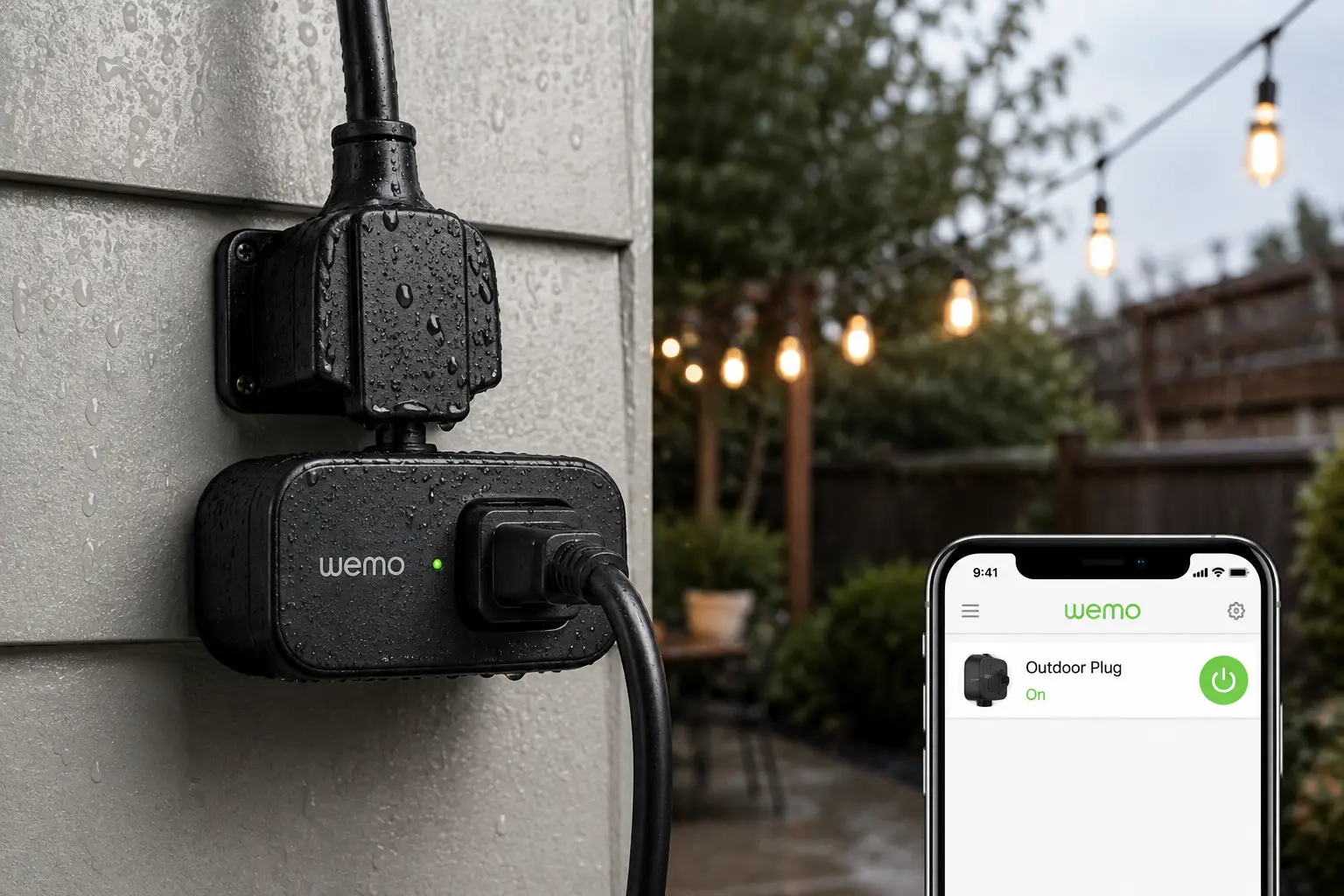
What Is a Wemo Outdoor Smart Plug? A Wemo outdoor smart plug is a weather-resistant Wi-Fi outlet, made by Belkin, that lets you remotely switch outdoor devices like lights, pumps, and decorations on or off from an app, a voice assistant, or a schedule, instead of a manual switch.
Here’s the twist: Belkin announced in mid-2025 that it would shut down Wemo’s cloud services and app for most Wemo devices, and that shutdown took effect on January 31, 2026 — a date that has now passed. That single fact changes how you should shop, and it’s why this guide spends as much time on capable alternatives as it does on the plug that started the conversation. Below, you’ll find seven real, currently available outdoor smart plugs, an honest breakdown of what still works and what doesn’t, and a practical framework for choosing the right one for your yard, porch, or patio.
Quick Comparison: Outdoor Smart Plugs at a Glance
The table below lines up all seven picks by price, connectivity, and weatherproofing so you can narrow things down before reading the full breakdowns.
| Product | Price Range | Outlets | Weather Rating | Hub Required | Best For |
|---|---|---|---|---|---|
| Wemo WiFi Smart Outdoor Plug | $30–$45 (legacy pricing) | 2 (linked, not independent) | IPX4-equivalent | No (app discontinued) | Existing HomeKit users only |
| Kasa Smart Outdoor Plug EP40 | $18–$25 | 2 (independent) | IP64 | No | Most homeowners |
| TP-Link Tapo P400M | $25–$30 | 2 (independent) | IP65 | No | Matter/multi-ecosystem users |
| meross Outdoor Smart Plug | $28–$38 | 2–3 (independent) | IP44 | No | Apple HomeKit households |
| Govee Outdoor Smart Plug | $25–$40 | 3-in-1 | IPX4-equivalent | No | Tightest budgets |
| Ring Outdoor Smart Plug | $30 alone / ~$50 bundled | 2 (independent) | IP66 (idle) | Yes (Ring Bridge) | Ring camera/light owners |
| Lutron Caséta Weatherproof+ Outdoor Plug | $80–$90 (plus hub) | 1 | IP66 | Yes (Caséta Hub) | Whole-home lighting control |
Looking at the table, the split is really between hub-free Wi-Fi plugs (Kasa, Tapo, meross, Govee) that are cheaper and simpler, and hub-based systems (Ring, Lutron Caséta) that trade upfront cost for more reliable range and deeper ecosystem features. The Wemo entry sits in its own category now: it’s technically still on shelves in some places, but it’s the only plug here where the manufacturer has already pulled the plug on ongoing software support.
💬 Bookmark this comparison — it’ll save you from re-reading every review section if you just want to jump straight to a pick.
Top 7 Outdoor Smart Plugs: Full Breakdown
1. Wemo WiFi Smart Outdoor Plug (WSP090) — legacy pick, not recommended for new buyers
The Wemo WiFi Smart Outdoor Plug was, for years, one of the more trusted names in this category, built by Belkin as a weather-resistant extension of its indoor Wemo lineup. It’s a dual-outlet, wall-mountable plug rated for outdoor use, with a pigtail cord designed to hang below an outlet so it doesn’t block the socket above it.
On paper, the WSP090 offers two outlets, HomeKit compatibility, and the same scheduling tools as Belkin’s indoor plugs, but there’s a catch worth understanding before you interpret those specs: both outlets switch together, not independently, so you can’t turn one plug on while leaving the other off. More importantly, Belkin confirmed that as of January 31, 2026, the Wemo app and its cloud services — including remote access and Alexa/Google Assistant integration — were shut down for the vast majority of Wemo products, and the WSP090 is on that affected list because it isn’t one of Belkin’s newer Thread-based devices. If you already configured a unit with Apple HomeKit before that cutoff, it can keep working through the Apple Home app without the Wemo app or cloud. If you didn’t, or if you use Android or Alexa, the plug is now effectively a manual outlet.
Reviews from before the shutdown were mixed even on their own merits: some outlets like TechHive found the connectivity unreliable enough to recommend skipping it, while everyday buyers on retail sites reported smooth holiday-light automation and easy setup, especially for HomeKit households. What most buyers overlook is that “smart” here was always contingent on Belkin’s continued investment, and that bet didn’t pay off long-term.
Pros:
- ✅ Solid, weather-resistant build quality reported by owners
- ✅ Works locally through Apple HomeKit if already configured
- ✅ Simple two-outlet layout fits most outdoor outlets
Cons:
- ❌ Wemo app and cloud features are permanently discontinued
- ❌ Both outlets switch together, not independently
Pricing for the Wemo plug historically sat in the $30 to $45 range, though at the time of writing it’s increasingly hard to find new, and prices on secondary marketplaces vary widely. Given the discontinued software, it’s difficult to call this good value for anyone starting fresh in 2026 — treat it as a “use what you already have” product, not a new purchase.
2. Kasa Smart Outdoor Plug EP40 — best overall replacement
The TP-Link Kasa EP40 is the plug that most reviewers now point to as the default outdoor pick, and the reasoning holds up under scrutiny. It’s a compact, IP64-rated dual-outlet plug that connects directly to 2.4GHz Wi-Fi with no hub, and it’s earned recognition including a PCMag Editor’s Choice nod for smart plugs and power strips.
The two outlets are independently controlled, which matters more than it sounds: you can run string lights on one side and a fountain pump on the other, each on its own schedule. TP-Link built in a power amplifier specifically for long-range Wi-Fi, and the EP40 advertises up to 300 feet of open-air range — reviewers at outlets like PCWorld have independently verified figures in that ballpark, which is meaningfully better than the roughly 60-foot range where budget plugs tend to start dropping connections. The shell is made from UL94-V0 flame-retardant plastic, and the plug is ETL certified, both of which matter more outdoors than in a living room.
Aggregated customer reviews consistently describe the EP40 as reliable and easy to set up within about five minutes using the Kasa app, with the main complaints centering on the right-angle plug shape not fitting every housing exactly as pictured — a cosmetic gripe, not a functional one.
Pros:
- ✅ Independently controlled outlets for separate schedules
- ✅ Long 300-foot Wi-Fi range for detached patios or sheds
- ✅ ETL certified with flame-retardant UL94-V0 housing
Cons:
- ❌ No Apple HomeKit support on the base EP40 model
- ❌ No built-in energy monitoring on this specific version
The Kasa Smart Outdoor Plug EP40 typically runs in the $18 to $25 range, making it one of the most affordable ways to get dual independent outlets with real weatherproofing. For most households replacing a wemo outdoor smart plug, this is the closest like-for-like upgrade.
3. TP-Link Tapo P400M — best for Matter and future-proofing
The Tapo P400M is TP-Link’s answer to a problem the EP40 doesn’t solve: ecosystem lock-in. It’s a Matter-certified outdoor plug, meaning it can be added directly to Apple Home, Google Home, Amazon Alexa, or Samsung SmartThings without needing a brand-specific app to be the source of truth.
Functionally, it mirrors the EP40 in a lot of ways — two independently controlled outlets, a 15A/1800W maximum load, and TP-Link’s dual-antenna long-range Wi-Fi design rated for up to 300 feet in open areas. Where it pulls ahead is weatherproofing (IP65 versus the EP40’s IP64) and setup flexibility: you can pair it via Bluetooth through the Tapo app, or scan the included Matter code directly into whichever smart home app you already use. Reviewers who tested it, including PCWorld, found the build more compact than most competing outdoor plugs and noted its wide temperature tolerance, rated for use from -4°F to 122°F.
Here’s what the spec sheet doesn’t say outright but is worth weighing: because it’s Matter-certified rather than locked to one company’s cloud, the P400M is structurally less exposed to the kind of shutdown that just happened to Wemo — Matter devices route through your local Matter fabric, not solely through a single vendor’s servers, which is a meaningful long-term reliability argument even if it’s not a guarantee.
Pros:
- ✅ Matter certification works across every major smart home app
- ✅ IP65 weatherproofing, slightly better than most rivals here
- ✅ Compact design fits tighter outdoor outlet housings
Cons:
- ❌ Matter setup can be fiddlier than a single-app pairing
- ❌ No energy monitoring or dimming functionality
Expect to pay somewhere between $25 and $30 for the Tapo P400M, occasionally less during retailer promotions. If you want an outdoor plug that isn’t tied to one company’s app surviving long-term, this is the strongest pick on that specific criterion.
4. meross Outdoor Smart Plug (MSS620) — best for Apple HomeKit households
If your outdoor automation needs to live inside Apple’s Home app specifically, the meross MSS620 remains one of the few outdoor plugs that supports HomeKit natively, without requiring Matter as a workaround. It’s available in two- and three-outlet configurations, with each socket independently switchable, and it’s powered by a MediaTek IoT chipset that meross markets specifically for improved Wi-Fi stability and a lower offline rate outdoors.
The IP44 rating is the least aggressive weatherproofing on this list, meaning it’s built to handle splashing rain rather than direct exposure, so placement under an eave or overhang matters more here than with the Kasa or Tapo plugs. HomeKit users should also know that remote control (turning the plug on while away from home) requires an Apple TV, HomePod, or HomePod mini acting as a home hub — a common HomeKit requirement, not a meross-specific limitation.
TechHive’s hands-on testing found the two independently switched outlets responsive, though it flagged some inconsistency in meross’s own product naming and HomeKit compatibility claims between similar-looking SKUs, so double-check the specific listing (MSS620 versus the older MSS620B) before buying. Real owner feedback on Amazon and meross’s own store skews positive, especially from buyers who specifically wanted HomeKit without a Wemo-style cloud dependency.
Pros:
- ✅ Native Apple HomeKit support, no Matter bridge needed
- ✅ Independently controlled outlets on both the 2- and 3-outlet models
- ✅ MediaTek chipset aimed at reducing outdoor Wi-Fi dropouts
Cons:
- ❌ IP44 rating is the lowest weatherproofing tier on this list
- ❌ Product naming across meross SKUs has caused buyer confusion
The meross Outdoor Smart Plug generally sells in the $28 to $38 range depending on the two- or three-outlet configuration. It’s a strong value if HomeKit compatibility is non-negotiable and you can mount it somewhere sheltered.
5. Govee Outdoor Smart Plug — best for tight budgets
The Govee Outdoor Smart Plug takes a different physical approach than the others on this list: a conical, 3-in-1 waterproof housing connected to a three-foot extension cord, designed so the electronics sit away from the outlet itself rather than mounted flush against the wall. It connects over both Wi-Fi and Bluetooth, works with Alexa and Google Assistant, and doesn’t require a hub.
What the spec sheet doesn’t fully convey is how that cord-based design changes the buying calculus: it’s genuinely useful for reaching outlets in awkward spots, like a garage GFCI outlet feeding lights strung across a fence line, but it also means there’s more exposed cable that needs to be routed thoughtfully to avoid pooling water. Aggregated customer reviews are broadly positive on ease of use and app simplicity, with the Govee Home app frequently praised for its minute-by-minute timer controls and sunrise/sunset scheduling. That said, real owner feedback on Amazon also includes a documented case of the unit tripping a GFCI after roughly fourteen months of exposed outdoor use, a reminder that budget-tier outdoor electronics are more sensitive to long-term weather exposure than premium options.
Based on comparing the specs against pricier competitors, the trade-off here is straightforward: you’re getting real smart-plug functionality — timers, remote control, voice integration — at a lower price, in exchange for a build that reviewers and owners suggest benefits from extra care around placement and drainage.
Pros:
- ✅ Among the least expensive genuinely smart outdoor plugs available
- ✅ Extension-cord design reaches awkwardly placed outlets easily
- ✅ Wi-Fi and Bluetooth dual connectivity for flexible pairing
Cons:
- ❌ Long-term weatherproofing durability is less proven than rivals
- ❌ No HomeKit or Matter support
The Govee Outdoor Smart Plug usually lands between $25 and $40, with the price fluctuating based on retailer promotions and coupon offers. Check the current price before buying, since Govee runs frequent discounts through its own storefront and Amazon alike.
6. Ring Outdoor Smart Plug — best for existing Ring ecosystems
The Ring Outdoor Smart Plug takes a fundamentally different connectivity approach: instead of joining your Wi-Fi network directly, it talks to a Ring Bridge, the same hub used by Ring’s smart lighting lineup. That means it’s not a great starting point for someone with zero Ring hardware, but for households that already own Ring cameras, floodlights, or a video doorbell, it slots into existing automations in a way none of the Wi-Fi-only plugs here can match.
The two outlets are independently controlled in both hardware and software, and the build is noticeably heavier and more rugged than the Kasa, Tapo, or meross plugs, with an IP66 rating while idle that steps down to IP64 while a device is actively plugged in and drawing power. What most reviews emphasize, and what’s easy to miss on the spec sheet, is the automation angle: because it shares the Ring Bridge with Ring’s cameras and lights, you can trigger the plug from motion events, such as switching on landscape lighting the instant a Ring Floodlight Cam detects movement, something the standalone Wi-Fi plugs on this list can’t replicate without a third-party automation platform.
Owner reviews on Best Buy and Home Depot are largely positive about reliability and holiday-light scheduling, with the most common complaint being confusion around Ring Bridge compatibility — some buyers have mistakenly purchased an incompatible second-generation bridge, so it’s worth confirming bridge generation compatibility before buying if you don’t already own one.
Pros:
- ✅ Deep integration with existing Ring cameras and lighting
- ✅ Rugged IP66 build rated for severe outdoor exposure
- ✅ Independently controlled outlets in both hardware and app
Cons:
- ❌ Requires a separate Ring Bridge if you don’t already own one
- ❌ Not a practical first purchase outside the Ring ecosystem
The plug alone runs around $30, while the bundle with a Ring Bridge is typically priced around $50. For Ring households, that bundled price is genuinely good value once you factor in the automation you’re unlocking; for everyone else, it’s an unnecessary added cost compared to hub-free alternatives.
7. Lutron Caséta Weatherproof+ Outdoor Smart Plug (PD-15OUT-BL) — best premium, whole-home pick
The Lutron Caséta Weatherproof+ Outdoor Smart Plug is the outlier on this list in almost every way: it’s a single-outlet device, it requires Lutron’s Caséta Smart Hub to unlock app and voice control, and it costs roughly three to four times what most Wi-Fi-only competitors do. It also happens to be, by a meaningful margin, the most robust and reliable option here.
Instead of Wi-Fi, the Caséta system uses Lutron’s proprietary Clear Connect RF protocol, a design choice that avoids the Wi-Fi congestion and dropout issues that outdoor plugs are especially prone to, since they’re often mounted at the edge of a home’s wireless range. It’s rated IP66, built from polycarbonate, and handles up to 15A of lighting load or a half-horsepower motor, which is enough headroom for a pond pump or small fountain that a typical 15A Wi-Fi plug would be pushing the limits on. Lutron backs it with a ten-year warranty when registered, longer than any other product on this list, and it can be paired with a battery-free Lutron Pico remote for local, hub-free manual control even before or without ever adding smart features.
The catch, and it’s a real one: without the Caséta Smart Hub (sold separately), you lose app control, voice assistant integration, and scheduling entirely, leaving just Pico remote control. Reviewers and Lutron’s own product literature are consistent on this point, and it’s the single biggest factor in whether this plug makes financial sense for your situation. If you’re already running a Caséta lighting system indoors, adding this outdoor plug is close to a no-brainer. If you’re starting from zero, the hub cost changes the math considerably.
Pros:
- ✅ Clear Connect RF avoids Wi-Fi congestion and range issues
- ✅ IP66 rating and ten-year warranty lead this entire list
- ✅ Handles heavier loads, including half-horsepower motors
Cons:
- ❌ Requires the separately sold Caséta Smart Hub for smart features
- ❌ Single outlet only, versus dual outlets on most rivals
The plug itself typically costs around $80 to $90, and the Caséta Smart Hub adds roughly another $90 if you don’t already own one. For Lutron Caséta households, or anyone planning a larger smart lighting build-out, this is the best long-term investment on this list; for a single holiday-light timer, it’s overkill.
Wemo Outdoor Smart Plug Discontinued: What to Do With Your Old Unit
If you already own a wemo outdoor smart plug, the January 31, 2026 shutdown doesn’t necessarily mean it’s trash — it depends entirely on which smart home platform you were using. Here’s how to handle it based on your setup.
If you use an iPhone or iPad and had already added the plug to Apple’s Home app before the cutoff date, the good news is that HomeKit control was designed to keep working locally, without needing the Wemo app or Belkin’s cloud servers, according to Belkin’s own support documentation. Scheduling, manual on/off control, and Siri commands through the Home app should all continue functioning. What won’t work anymore is anything that depended on Wemo’s servers specifically, including the standalone Wemo app itself and any remote features tied to Amazon Alexa or Google Assistant integrations, since those routed through Wemo’s now-shuttered cloud.
If you were using Alexa, Google Assistant, or the Wemo app as your primary control method, your outlet has effectively reverted to a non-smart plug: it will still supply power normally, but there’s no supported path to restore remote or voice control on that specific hardware. At that point, the honest, practical move is to treat it as a sunk cost and route the outdoor circuit into one of the seven alternatives above, matched to whichever ecosystem you actually use day to day. Some affected customers have also explored Belkin’s product-replacement channels or manufacturer warranty claims, particularly for units purchased more recently, so it’s worth checking your original retailer’s return policy before buying a replacement outright.
How to Set Up and Weatherproof an Outdoor Smart Plug in 30 Minutes
Whichever outdoor smart plug you land on, the setup process and the mistakes worth avoiding are nearly identical across brands. Here’s a practical walkthrough.
Start by confirming your outlet is GFCI-protected before plugging anything in — this is a safety requirement, not an optional step, and it’s covered in more detail in the safety section below. Next, mount or position the plug so its outlet openings face downward or are shielded by an in-use cover, since most IP ratings on this list (IP44 through IP66) assume water is falling from above, not pooling from below. Download the relevant app — Kasa, Tapo, meross, Govee, Ring, or Lutron — and connect your phone to your home’s 2.4GHz Wi-Fi network specifically, since nearly every plug on this list, including the Wemo alternatives, requires 2.4GHz and won’t appear during setup if your phone is on a 5GHz-only network.
Once paired, set a schedule or sunrise/sunset automation rather than relying on manual toggling, since that’s the entire point of upgrading from a mechanical timer in the first place. Finally, test the plug’s weatherproof cover or gasket seal by closing it fully after plugging in your device, and recheck that seal every season, since UV exposure and temperature swings can degrade rubber gaskets over a few years even on well-built plugs. A common first-30-days mistake is leaving the socket cover propped open “for convenience” after installation — doing that quietly defeats the entire weatherproofing rating you paid for.
✨ Ready to stop walking outside to flip a switch? Compare your top pick against the table above and grab it while today’s price holds.
Which Outdoor Smart Plug Fits Your Life? 3 Real-World Scenarios
Specs only tell part of the story, so here’s how these plugs map onto a few common situations.
If you’re a renter automating string lights on an apartment balcony with a shared budget of under $30, the Govee Outdoor Smart Plug or the Kasa EP40 are the two most sensible starting points — both are hub-free, both are inexpensive enough that losing or leaving one behind at move-out isn’t a major loss, and both handle basic scheduling without any long-term commitment.
If you’re a homeowner with an Apple-only household replacing a wemo outdoor smart plug that just lost app support, the meross Outdoor Smart Plug is the most direct like-for-like swap, since it keeps you inside the Apple Home app you’re already using, without needing to learn a new ecosystem. The Tapo P400M is a close second if you want Matter’s cross-platform flexibility as insurance against another shutdown scenario down the line.
If you’re planning a larger backyard project — think landscape lighting, a fountain pump, and a covered patio all wired to different circuits — the Lutron Caséta system or the Ring Outdoor Smart Plug paired with existing Ring hardware both make more sense than buying three or four cheap Wi-Fi plugs individually. The upfront hub cost gets divided across more devices, and the reliability gains matter more once you’re depending on several plugs working together rather than just one.
How to Choose the Best Outdoor Smart Plug for Your Home
Use this checklist, in order, before you commit to a purchase.
- Confirm your outlet is GFCI-protected first. No smart plug substitutes for basic electrical safety, and this determines whether you need an electrician involved before anything else.
- Match the IP rating to your mounting location. A covered porch can get by with IP44, while a fully exposed post-mount deserves IP65 or higher.
- Decide if independent outlet control matters. If you want lights on one schedule and a pump on another, rule out single-linked designs like the base Wemo unit.
- Pick your ecosystem before your brand. Apple Home, Matter, Alexa, or an existing Ring system should drive the decision more than price alone.
- Weigh hub-free convenience against hub-based reliability. Wi-Fi-only plugs are simpler and cheaper; hub-based systems like Lutron and Ring cost more but resist Wi-Fi congestion better at range.
- Check the amp and wattage rating against your actual load. A fountain pump or space heater needs real headroom, not just enough for a string of LED lights.
- Read recent aggregated reviews, not just the star rating. A 4.5-star average can still hide a recurring weatherproofing complaint if you don’t look at the actual feedback.
Wemo Outdoor Smart Plug Alternatives: Wi-Fi vs. Hub-Based Outdoor Smart Plug
The biggest structural decision in this category isn’t which brand to pick — it’s whether you want a wifi outdoor smart plug that talks directly to your router, or a hub-based system like Ring or Lutron Caséta that routes through a dedicated bridge.
A direct Wi-Fi outdoor smart plug, like the Kasa EP40, Tapo P400M, meross MSS620, or Govee plug, is simpler to set up, cheaper upfront, and doesn’t require any additional hardware. The trade-off is range and congestion: outdoor outlets are frequently at the edge of a home’s Wi-Fi coverage, and a crowded 2.4GHz band shared with dozens of other devices can cause the occasional dropped connection or delayed response, particularly on lower-cost hardware without a dedicated Wi-Fi amplifier. TP-Link addresses this specifically with its long-range antenna design on the EP40 and P400M, which is part of why those two consistently test better at distance than cheaper alternatives.
A hub-based system trades that upfront simplicity for a more resilient connection. Lutron’s Clear Connect RF protocol and Ring’s proprietary bridge network both operate independently of your home Wi-Fi, which means a router outage or a congested wireless network doesn’t take your outdoor lighting down with it. The cost is real, though: you’re paying for a piece of hardware — the Caséta Hub or Ring Bridge — that a Wi-Fi-only plug simply doesn’t need. For a single plug controlling holiday lights, that added cost is hard to justify. For a multi-device outdoor lighting project, it starts to pay for itself.
Common Mistakes to Avoid When Buying a Weatherproof Smart Plug
Even experienced smart home shoppers trip over a handful of recurring mistakes with outdoor gear specifically.
The most common one is confusing “splash-resistant” with genuinely outdoor-rated. Some listings market indoor plugs as suitable for covered patios based on a low IP rating like IPX4, but that rating only protects against light splashing, not driving rain, snow, or ground moisture — which is exactly why every product recommended in this guide is purpose-built and rated for true outdoor exposure. A second frequent error is ignoring outlet orientation during installation; nearly every weatherproof smart plug on the market is only rated correctly when its sockets face downward or are covered when not in use, and mounting one sideways or upward can void the effective protection even if the plug itself is rated IP65.
Buyers also regularly overlook the difference between a plug’s rating “in use” versus “idle” — the Ring Outdoor Smart Plug is a clear example, dropping from IP66 while idle to IP64 while something is actively plugged in, since the socket cover can’t fully seal around a cord. Finally, a subtler mistake specific to 2026: buying based on brand reputation alone, without checking whether that brand’s specific product still has active software support. The wemo outdoor smart plug situation is the clearest recent cautionary tale, but it’s a reminder to briefly check a manufacturer’s support page for any stated end-of-life date before buying into a new ecosystem, especially with smaller or newer smart home brands.
Outdoor Smart Plug vs. Traditional Mechanical Timer
Before smart plugs became affordable, most outdoor lighting ran through simple mechanical or digital timers that plugged directly into the wall. It’s worth being honest about where those still hold an advantage.
| Factor | Outdoor Smart Plug | Mechanical/Digital Timer |
|---|---|---|
| Remote control from phone | Yes | No |
| Survives Daylight Saving Time automatically | Yes (most models) | Rarely, without manual reset |
| Upfront cost | $18–$90+ | $10–$20 |
| Requires Wi-Fi or a hub | Usually | No |
| Voice assistant control | Yes (most models) | No |
| Vulnerable to a manufacturer shutdown | Yes | No |
A basic mechanical timer will never lose app support, and it never depends on your Wi-Fi network staying up, which is a real point in its favor for something as simple as a single porch light. But a smart plug’s ability to adjust automatically for sunrise, sunset, and Daylight Saving Time — combined with remote control if you’re away and forgot to switch something off — is enough added convenience that most buyers researching an outdoor smart plug specifically have already decided a basic timer isn’t sufficient for their needs. The right call generally comes down to how many devices you’re automating: one seasonal light, a timer is fine; several devices on different schedules, a smart plug earns its price difference.
Safety, Regulations, and Standards for Outdoor Smart Plugs
This is the section most buying guides skip, and it matters more than any feature comparison above.
Every outdoor electrical outlet in the United States built or renovated to current code must have Ground Fault Circuit Interrupter, or GFCI, protection — this has been a National Electrical Code requirement for outdoor receptacles since 1973, according to the Consumer Product Safety Commission. A GFCI outlet detects tiny current leaks, the kind that can occur when moisture reaches a connection, and cuts power in a fraction of a second, well before a standard circuit breaker would react to anything. No smart plug on this list, regardless of its own IP rating, is a substitute for that protection; it’s the layer underneath everything else. If your outdoor outlet predates 1973 or you’re unsure whether it’s GFCI-protected, that’s worth confirming with an electrician before installing any of these products, smart or otherwise.
On top of GFCI protection, look for two additional markers on any product listing: an IP rating (Ingress Protection) that specifies dust and water resistance on a standardized international scale, and a safety certification mark like ETL or UL, which confirms the device itself passed independent electrical safety testing rather than just the manufacturer’s own claims. Every product recommended in this guide carries ETL or equivalent certification. Finally, in the U.S., any wireless smart plug must comply with FCC Part 15 rules governing radio frequency interference, which is a baseline all seven products here meet as a condition of being legally sold.
Quick IP Rating Reference for Outdoor Plugs
| IP Rating | Protection Level | Good For |
|---|---|---|
| IP44 | Splashing water from any direction | Covered patios, sheltered porches |
| IP64 | Dust-tight, water jets/splashes | Semi-exposed mounting locations |
| IP65 | Dust-tight, low-pressure water jets | Fully exposed walls, most weather |
| IP66 | Dust-tight, powerful water jets | Severe exposure, coastal or storm-prone areas |
Reading this table alongside the product breakdowns above, the practical takeaway is simple: match the rating to your actual mounting spot rather than always buying the highest number available, since a heavily sealed IP66 plug like the Lutron Caséta offers real value on an exposed post but is overkill — and often costs meaningfully more — for a plug tucked under a covered porch roof.
Best Outdoor Smart Plug for Holiday Lights, Patios, and Everyday Appliances
Not every outdoor smart plug use case has the same requirements, so it’s worth separating seasonal decoration from year-round appliance control.
For holiday and string lights specifically, low continuous wattage and reliable sunset/sunrise scheduling matter more than raw amperage, which makes the Kasa EP40, Tapo P400M, and meross plug all strong fits — each supports automatic sunset-based scheduling so lights turn on consistently as days get shorter without manual reprogramming through winter. For patio and landscape lighting that stays installed year-round, weatherproofing durability becomes the priority, favoring the Tapo P400M’s IP65 rating or the Ring and Lutron options at IP66 for anything mounted somewhere fully exposed to the elements.
For heavier everyday appliances — fountain pumps, small space heaters, or a shop fan in a detached garage — amperage headroom becomes the deciding factor. The Lutron Caséta’s half-horsepower motor rating and the Tapo P400M’s and meross’s shared 1800W/15A ceiling both have real margin for that kind of load, while lighter-duty budget plugs are better reserved for LED lighting rather than motors or heating elements, per each manufacturer’s own usage guidance.
Everyday Performance: What to Expect From an Outdoor Smart Plug
Specs sheets rarely translate cleanly into lived experience, so here’s what actually changes once one of these is installed.
Response time from app tap to physical switch is typically near-instant on a strong connection, generally under a second across the Wi-Fi-only plugs tested by outlets like TechHive and Android Central, though that number climbs noticeably the farther the plug sits from your router — this is exactly why the long-range antenna designs on the Kasa and Tapo plugs translate into a real day-to-day difference, not just a marketing spec. Scheduling features, particularly sunrise/sunset offsetting, tend to be the feature owners report using the most once the novelty of manual app control wears off, since it’s the one capability that meaningfully replaces a task you’d otherwise do by hand every evening.
Where owners across brands report the most friction is initial pairing, especially on households running a mesh Wi-Fi system that defaults to a combined 2.4GHz/5GHz network name; nearly every plug here requires connecting specifically to the 2.4GHz band during setup, and skipping that step is the single most common cause of a failed first pairing attempt reported in customer reviews across every brand covered in this guide.
Long-Term Cost and Maintenance
The sticker price on any of these plugs is only part of the real cost of ownership, so it’s worth running the numbers past the first purchase.
Hub-free Wi-Fi plugs carry effectively zero ongoing cost beyond the initial purchase and your existing electricity usage, since there’s no subscription or hardware to maintain beyond the plug itself and, occasionally, a replacement weatherproof gasket after several years of UV exposure. Hub-based systems like Lutron Caséta and Ring carry a higher upfront cost specifically because that hub is a one-time expense that then supports additional devices at no extra charge — a second or third Caséta plug added later only costs the plug itself, not another hub purchase, which meaningfully improves the value equation for anyone planning to expand their outdoor setup over time rather than buying once.
Longevity is the other half of long-term cost, and it’s where the Wemo situation becomes a useful cautionary data point rather than just a one-off news story: hardware that outlives its manufacturer’s software support effectively has a shorter real lifespan than its physical components would suggest. When comparing total cost of ownership, it’s reasonable to weight a plug’s platform stability — Matter certification, an established company with a long product history, or hardware that still functions locally without cloud dependency — alongside its sticker price, since a cheaper plug that loses support in three years isn’t necessarily the better long-term value than a slightly pricier one that keeps working.
Frequently Asked Questions
❓ Is the Wemo Outdoor Smart Plug still supported in 2026?
❓ What's the best outdoor smart plug to replace a Wemo plug?
❓ Do outdoor smart plugs need Wi-Fi or a hub?
❓ What IP rating do I need for an outdoor smart plug?
❓ Can I use an outdoor smart plug without a GFCI outlet?
Conclusion
The wemo outdoor smart plug earned its reputation the honest way, through years of reliable service for a lot of households, and if you already own one configured through Apple HomeKit, there’s genuinely no urgent need to replace it. But Belkin’s January 2026 shutdown of the Wemo app and cloud services is a real, confirmed event, not a rumor, and it means the plug is no longer a sound purchase for anyone starting fresh — particularly if you use Android, Alexa, or Google Home as your primary control method.
The good news is that the replacement market has matured well past where it was even a couple of years ago. The Kasa EP40 remains the easiest all-around recommendation for most homeowners, the Tapo P400M offers genuine future-proofing through Matter certification, the meross plug is the direct HomeKit successor, and the Lutron Caséta system is worth the added cost if you’re building out a larger outdoor lighting project rather than automating one seasonal display. Whichever one you land on, confirm your outlet is GFCI-protected, match the IP rating to where it’s actually mounted, and pick your smart home ecosystem before you pick a brand — the specs matter less than whether the plug fits into the system you already live in every day.
Recommended for You
- Wall Outlet USB Power Adapter: 7 Best Picks for 2026 (Fast & Safe)
- Receptacle with USB Ports: 7 Best Picks for 2026 (Pros & Cons)
- Plug Size Guide 2026: 7 Best Travel Adapters for Any Country
Disclaimer: This post contains affiliate links. As an Amazon Associate, I earn from qualifying purchases made through these links, at no additional cost to you.
✨ Found this guide helpful? Share it with someone still trying to figure out what happened to their Wemo plug! 💬🤗