
In This Article
What Is a Weatherproof Timer (and Why Does Your Yard Need One)?
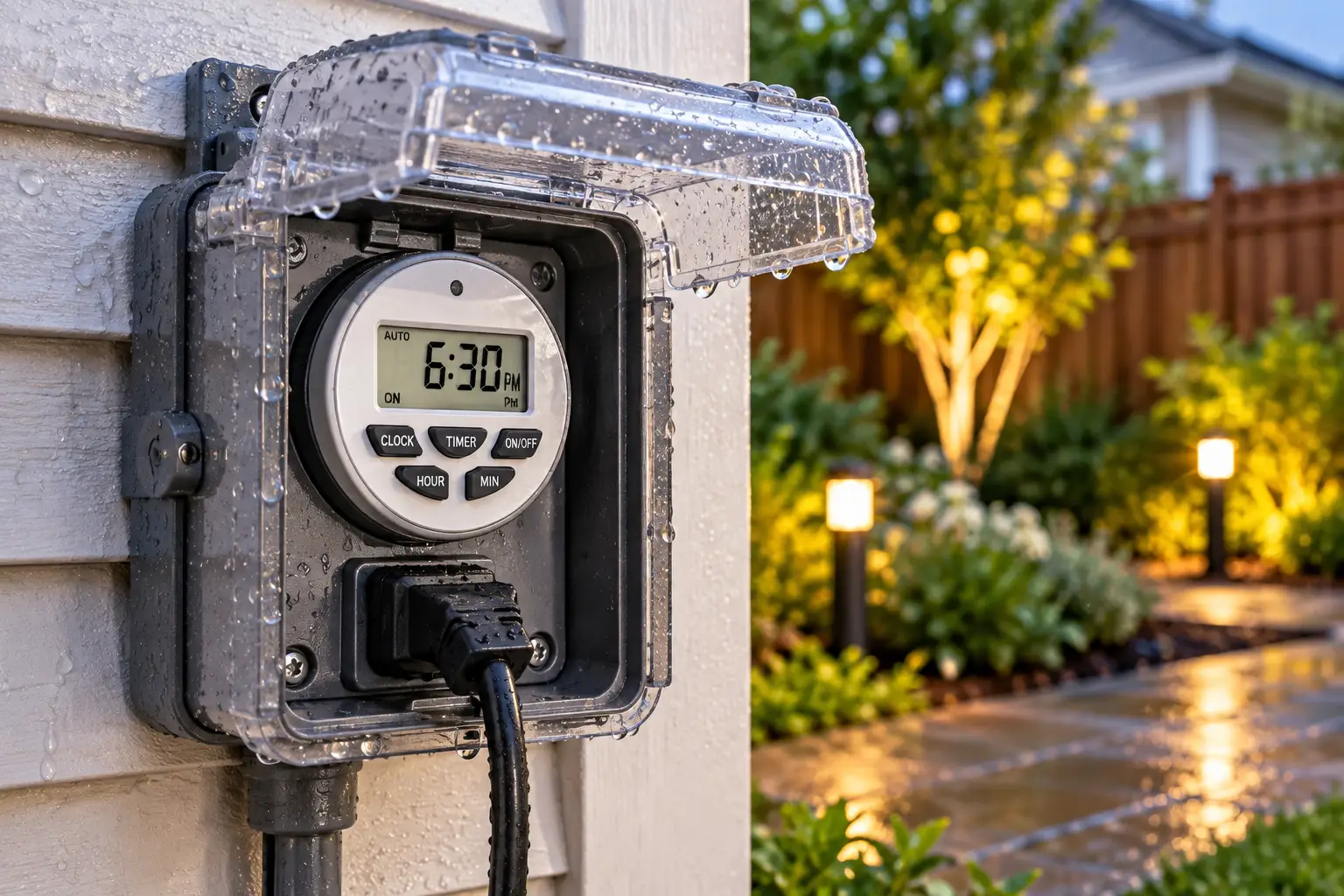
A weatherproof timer is a plug-in switch with a sealed or covered housing that automatically turns outdoor devices—string lights, landscape lighting, fountains, pool pumps—on and off by schedule or at dusk. Unlike indoor timers, it’s built to shrug off rain, snow, dust, and wide temperature swings.
Picture this: it’s 11 p.m. in December, sleet is sideways, and you’re shuffling across the lawn in slippers to unplug the reindeer. A weatherproof timer ends that ritual for good. More importantly, it quietly trims your electric bill. The U.S. Department of Energy points out that timers and photosensors are among the simplest lighting controls for cutting wasted electricity, because they stop lights from burning when nobody needs them.
Here’s the catch, though: the category is surprisingly wide. On one end, you’ll find a basic outdoor plug-in timer with a pin dial that costs about as much as a fast-food lunch. On the other end sit astronomic digital models that calculate sunset for your exact location, plus Wi-Fi plugs you can control from a beach chair three states away. In between are photocell units—the classic dusk to dawn timer—and heavy-duty mechanical boxes rated for 1 HP pool pumps.
So how did we narrow it down? We compared real spec sheets, manufacturer manuals, electrical ratings, and the review themes we could actually verify—no invented “hands-on tests,” no made-up quotes. Wherever solid review data was thin, we said so and leaned harder on the engineering. The result is a guide that helps you match the right outdoor timer for lights, pumps, or holiday displays to your yard, your budget, and your tolerance for fiddly programming.
Quick Comparison: The Best Weatherproof Timer for Each Job
| Product | Type | Outlets | Key Rating | Price Range | Best for |
|---|---|---|---|---|---|
| BN-LINK 24-Hour Outdoor Mechanical Timer | Mechanical, 24-hr dial | 2 grounded | 15A / 1875W, 1/2 HP | ~$10–$18 | BN-LINK 24-Hour Outdoor Mechanical Timer: tight budgets, simple daily schedules |
| DEWENWILS HODT13D Outdoor Light Timer | Photocell + countdown | 3 grounded | 15A / 1875W, 1/2 HP | ~$20–$30 | DEWENWILS HODT13D Outdoor Light Timer: string lights far from the outlet |
| BN-LINK Outdoor Power Stake Timer with Remote | Photocell + RF remote stake | 6 grounded | 15A / 1875W resistive | ~$20–$30 | BN-LINK Outdoor Power Stake Timer with Remote: big holiday displays |
| Intermatic HB11K | Mechanical, 24-hr trippers | 1 grounded | 15A / 1800W, 1 HP | ~$20–$35 | Intermatic HB11K: above-ground pool pumps |
| Woods 50015WD | Digital, 7-day | 2 grounded | 15A / 1875W, 3/4 HP | ~$25–$40 | Woods 50015WD: detailed weekly schedules |
| Kasa Smart Outdoor Plug EP40 | Wi-Fi smart plug, IP64 | 2 independent | 15A / 1875W | ~$20–$35 | Kasa Smart Outdoor Plug EP40: app and voice control |
| Intermatic HB880R | Digital, astronomic 7-day | 2 grounded | 15A resistive | ~$40–$85 | Intermatic HB880R: year-round landscape lighting |
Looking at the table above, the price spread is small—roughly $10 to $85—but the capability gap is huge. The BN-LINK 24-Hour Outdoor Mechanical Timer and the Intermatic HB11K look similar on paper, yet the HB11K’s 1 HP motor rating is the reason it belongs on a pool pump while the BN-LINK belongs on a porch light. Meanwhile, the Kasa Smart Outdoor Plug EP40 is the only pick here with two independently scheduled outlets, which matters more than any other single spec if you’re controlling two different things.
A quick note on prices: outdoor timers are seasonal products, so listings often swing before the holidays and again before pool season. Treat every range here as “at the time of writing” and check the current price before you buy.
💬 One click helps other shoppers make an informed choice too—tap any highlighted product to check today’s price and availability! 😊
Top 7 Weatherproof Timer Picks for 2026: Expert Analysis
1. BN-LINK 24-Hour Outdoor Mechanical Timer — cheapest way to automate two plugs
If your whole plan is “lights on at 5:30, off at 11,” this compact dial delivers set-and-forget automation for the price of a sandwich.
The 24-hour dial is divided into 48 thirty-minute segments with push pins, and it repeats the same schedule every day. Two 3-prong grounded outlets sit under a weatherproof cover, and the unit is rated 125V, 15A, 1875W resistive and 1/2 HP; BN-LINK lists it as ETL listed and conforming to UL Standard 917. In practice, 1875W covers dozens of LED light strings with room to spare, while 1/2 HP handles a small fountain pump—but not a full-size pool pump.
Based on comparing the specs, this is the right weatherproof timer for renters, first-time decorators, and anyone who hates apps. What most buyers overlook is that pin-dial timers stop turning during a power outage, so a two-hour outage pushes your schedule two hours late until you reset the dial. The 30-minute resolution is also coarse; you can’t schedule “off at 10:15.”
We couldn’t verify a large, detailed body of reviews specific to this exact listing, so we won’t pretend to summarize one—lean on the published ratings and the ETL listing instead.
Pros:
- ✅ Lowest cost of entry in this lineup
- ✅ No battery, screen, or app to fail
- ✅ Two grounded outlets under one cover
Cons:
- ❌ Schedule drifts after every power outage
- ❌ Thirty-minute steps limit precise timing
Usually found around $10–$18 (check the current price), it’s outstanding value for simple daily schedules.
2. DEWENWILS HODT13D Outdoor Light Timer — best reach for distant string lights
This photocell model solves two problems at once: it knows when it’s dark, and it reaches where your outlet doesn’t.
A built-in light sensor supports always on, always off, dusk to dawn, or on at dusk and off after 2, 4, 6, or 8 hours, repeating daily unless unplugged. The standout spec is the 12-foot 14/3 SJTW cord—heavier-gauge, outdoor-rated wire that lets you skip a separate extension cord and its extra connection point. Three grounded outlets are spaced 0.85 inches apart, so bulky light-set plugs don’t block each other.
On paper, it’s ideal for backyard string lights, porch garlands, and Halloween displays where “on at dusk, off after four hours” is the whole schedule. DEWENWILS rates it for –40°F to 140°F and lists it as UL Listed, which covers everything from Minnesota winters to Arizona patios. What the spec sheet doesn’t say: a photocell needs an honest view of the sky, so mount it away from porch lights and deep eaves.
Verifiable review detail for this exact model was limited, so we’re grounding this verdict in the published specs and UL listing rather than star counts.
Pros:
- ✅ Twelve-foot cord eliminates an extra extension
- ✅ No clock to set or reset
- ✅ Wide outlet spacing fits bulky plugs
Cons:
- ❌ Countdown options stop at eight hours
- ❌ Nearby lights can confuse the sensor
Typically $20–$30 at the time of writing, it’s excellent value if cord length is your bottleneck.
3. BN-LINK Outdoor Power Stake Timer with Remote — six outlets plus a 100-ft remote
When one outlet has to feed an entire holiday yard, this stake-style timer turns a messy daisy chain into one tidy hub.
You get six grounded outlets (three per side) with individual safety covers, a 6-foot cord, a photocell with dusk-to-dawn and 2/4/6/8-hour modes, and a wireless remote BN-LINK rates for up to 100 feet through walls. Ratings are 15A/1875W resistive or general-purpose, 10A/1250W tungsten, and 1/2 HP. That tungsten number is the one to watch: old-school incandescent C9 strings eat wattage fast, so a big retro display can hit 1250W sooner than you’d think.
Here’s what to weigh: all six outlets switch together, so this is a display controller, not a multi-zone scheduler. For families who want inflatables, a light-wrapped tree, and a lit path to power up at dusk—and who’d like to flip everything on from the couch when guests arrive—it’s a smart consolidation. Staking it into the lawn also keeps the timer off the wet ground, which is exactly where you don’t want connections sitting.
We found no verifiable, model-specific review consensus worth summarizing, so this assessment rests on BN-LINK’s published ratings and its ETL listing.
Pros:
- ✅ Six outlets replace a tangle of splitters
- ✅ Remote allows instant on or off
- ✅ Stake keeps connections off wet ground
Cons:
- ❌ All outlets share one schedule
- ❌ Tungsten limit is lower than resistive rating
Expect roughly $20–$30; for large seasonal displays, it’s strong value per outlet.
4. Intermatic HB11K — muscle for 1 HP pool pumps
This is the heavy-duty mechanical workhorse, and its motor rating is the whole story.
The Intermatic HB11K is rated 15A, 1800W resistive or tungsten, and 1 HP at 120V—specifically 15 full-load amps and 90 locked-rotor amps. That locked-rotor figure describes the surge a motor pulls the instant it starts; a timer that can’t handle it may wear out its contacts fast. It uses two ON and two OFF trippers (extras are sold separately) at 30-minute minimum intervals, with a 13-inch grounded cord and a raintight enclosure under a flip-open cover.
Honestly, this is the pick for above-ground pool owners who currently run the pump 24/7. Two on/off windows per day map neatly onto common filtration routines, and the chunky trippers are easy to adjust with cold, wet hands. However, you get only one receptacle, and—like every mechanical model—the schedule slips after a power outage.
Aggregated owner feedback we could find is positive about straightforward setup for pool pumps, although at least one owner review we found notes the flip cover doesn’t latch shut on its own.
Pros:
- ✅ True 1 HP motor rating for pumps
- ✅ Simple trippers anyone can set
- ✅ Established brand with long outdoor track record
Cons:
- ❌ Only one outlet available
- ❌ Cover may not latch firmly closed
Generally in the $20–$35 range; for pump duty, it’s the best value in this lineup.
5. Woods 50015WD — best 7-day digital value
If your weekday and weekend routines differ, this digital model gives you calendar-level control without Wi-Fi.
The Woods 50015WD offers up to 20 on/off settings per day, weekly repeats, countdown and random modes, a daylight saving time feature, and a manual override button. A self-charging backup battery retains your programs during outages—the single biggest upgrade over mechanical dials. Ratings are 15A, 1875W resistive or tungsten, 8A ballast, and 3/4 HP, with two grounded outlets on a short 6-inch cord and CSA certification.
Based on the specs, it suits homeowners who want porch lights at 6 p.m. on weeknights, later on weekends, and a randomized pattern while traveling. The 3/4 HP rating also covers many fountains and smaller pumps. What most buyers overlook: both outlets follow the same schedule, and the included instructions note that after the backup battery recharges you may need to press the reset button to wake the display—good to know before you assume it’s dead.
Review roundups we checked consistently flag that the two outlets can’t be controlled independently, while praising the programming depth.
Pros:
- ✅ Twenty daily events with minute precision
- ✅ Keeps settings through power outages
- ✅ Random mode helps with vacation security
Cons:
- ❌ Both outlets share one schedule
- ❌ Very short six-inch cord
Usually $25–$40, it’s the strongest programming-per-dollar value here.
6. Kasa Smart Outdoor Plug EP40 — two independent schedules from your phone
This is the pick for anyone who’d rather tap a screen—or ask a speaker—than squint at an LCD in the dark.
The Kasa Smart Outdoor Plug EP40 has two outlets that are controlled independently, IP64 protection against dust and splashing water, and a load capacity of 15A/1875W. It connects over 2.4GHz Wi-Fi with a range TP-Link quotes at up to 300 feet in open areas, works with Alexa and Google Assistant, and supports sunrise/sunset scheduling with offsets plus an Away Mode. The shell is UL94-V0 flame-retardant polycarbonate, and the unit is ETL certified. An EP40A variant adds Apple Home support.
Here’s why independence matters: one plug can run string lights from sunset to midnight while the other runs a fountain from 8 a.m. to 6 p.m. No other pick in this list does that. The trade-off is dependence on your network—if the plug sits beyond your router’s reach, you’ll need a mesh node or extender before you get reliable remote control.
We didn’t find a verifiable review summary we’d stand behind for this model, so this assessment relies on TP-Link’s published specifications.
Pros:
- ✅ Two outlets with separate schedules
- ✅ Sunrise and sunset offsets built in
- ✅ Voice control through Alexa or Google
Cons:
- ❌ Requires a 2.4GHz Wi-Fi network
- ❌ Not rated for heavy motor loads
Found around $20–$35 at the time of writing, it’s excellent value for smart-home households.
7. Intermatic HB880R — astronomic clock that tracks sunset all year
Think of this as a photocell with a brain: it knows when the sun sets without needing to see the sky.
The Intermatic HB880R offers full 7-day programming, an astronomic clock that calculates sunrise and sunset for your location, automatic DST adjustment, and a random mode. You get two grounded receptacles on a 24-inch cord, a weatherproof enclosure, and an included AA battery backup. It’s rated 15A resistive; retailer listings describe lower tungsten and motor ratings, so read the label before connecting incandescent strings or pumps.
The astronomic clock is the real payoff. Because it computes sunset rather than measuring light, snow glare, a porch light, or a passing car can’t fool it, and it adjusts automatically from June’s late evenings to December’s early darkness. That makes it the right weatherproof timer for permanent landscape lighting you never want to think about again.
Reviews are genuinely split on setup: some owners call programming quick and easy, while others describe relying on video tutorials to get through the menus. A few roundups also mention reports of units failing prematurely.
Pros:
- ✅ Astronomic clock follows seasonal sunset automatically
- ✅ Battery backup preserves programs during outages
- ✅ Random mode simulates an occupied home
Cons:
- ❌ Programming has a real learning curve
- ❌ Highest price in this lineup
Typically $40–$85 depending on the seller, it’s premium-priced but worth it for year-round lighting.
✨ Stop Unplugging Lights in the Rain!
🔍 Take your outdoor lighting to the next level with this carefully curated lineup. Click a highlighted product to check current pricing and availability—these picks will help you get a glowing, worry-free yard the whole family will enjoy!
How to Set Up a Weatherproof Timer the Right Way (Your First 30 Days)
Buying the right unit is half the job; installing it correctly is what keeps it alive for years.
Before You Plug In
First, confirm your outdoor outlet is GFCI-protected—press the “Test” button and make sure it trips. Next, add up the wattage of everything you’ll connect and keep it under about 80% of the timer’s rating; that margin reduces heat on the contacts. Then, check whether your loads are LED, incandescent (tungsten), or motor-driven, because each has a different limit on the label.
Day 1: Position and Program
Mount or hang the timer vertically with the outlets facing down whenever possible, so water drains away instead of pooling. BN-LINK, for instance, advises mounting its mechanical outdoor timers vertically at least 2 feet above ground. Leave a “drip loop”—a small downward sag in each cord before it reaches the timer—so rainwater drips off rather than running into the plug. Finally, close every cover, including those over unused outlets.
Week 1: Verify the Schedule
For the first few evenings, glance outside at the programmed times. Mechanical dials are often set a half-segment off, and photocells may react differently than you expect under a porch light. Adjust now, before holiday guests arrive.
Day 30: Quick Maintenance Check
After a month, inspect the cover gasket and cord for cracks, and look for condensation inside clear covers. On digital models like the Woods 50015WD or Intermatic HB880R, confirm the clock still matches real time after any outage. It takes two minutes, and it prevents the classic “why are the lights on at noon?” surprise.
Real-World Scenarios: Picking an Outdoor Timer for Lights, Pumps, and Holiday Displays
Specs make more sense when they’re attached to real yards, so here are four common situations and the reasoning behind each match.
The Renter With Patio String Lights
Budget: under $20. Use: two strands of LED café lights on a balcony, nightly. The BN-LINK 24-Hour Outdoor Mechanical Timer is the obvious fit—cheap, battery-free, and easy to move when the lease ends. However, if the only outlet is 10 feet away, the DEWENWILS HODT13D Outdoor Light Timer earns its slightly higher price by eliminating an extension cord. Either way, this is exactly the job an outdoor timer for lights was invented for.
The Above-Ground Pool Owner
Budget: $20–$35. Use: a 1 HP filter pump running all summer. The Intermatic HB11K is the match because its 1 HP, 90 LRA rating is designed for motor startup surges; a light-duty timer might switch the pump a few hundred times and then fail. Two run windows per day also cover typical morning and afternoon filtration.
The Holiday Maximalist
Budget: $25–$40. Use: inflatables, wrapped trees, and path lights for six weeks. The BN-LINK Outdoor Power Stake Timer with Remote consolidates six plugs into one staked hub, and the remote handles “turn it on now, the neighbors are here” moments.
The Frequent Traveler
Budget: $35–$85. Use: permanent landscape and porch lighting, plus vacation security. The Intermatic HB880R tracks sunset all year, and random mode keeps the house looking occupied. If you’d rather adjust schedules from your phone while away, the Kasa Smart Outdoor Plug EP40 is the flexible alternative—its two independent outlets can run lights and a fountain on separate timetables.
Problem → Solution: Fixing 5 Common Weatherproof Timer Headaches
Even the best weatherproof timer can misbehave. Fortunately, most issues have simple causes.
1. Lights turn on at the wrong time after a storm. Mechanical timers pause during outages, so the dial falls behind. Solution: reset the dial after every outage, or upgrade to a battery-backed digital model like the Woods 50015WD or Intermatic HB880R.
2. The photocell never switches on (or never switches off). A porch light, streetlight, or reflective wall is fooling the sensor. Solution: reposition the timer so its sensor faces open sky and away from artificial light—or switch to an astronomic clock that doesn’t rely on sensing light at all.
3. The GFCI trips after rain. Water is reaching a connection. Solution: add drip loops, keep the timer and all plug connections off the ground, close unused outlet covers, and check any extension cords for damage.
4. The pump hums but won’t start, or the timer dies within a season. The timer’s motor rating is too low for the pump’s startup surge. Solution: choose a unit with an explicit HP rating that meets or exceeds your pump’s, such as the Intermatic HB11K.
5. The digital screen is blank. The backup battery may be depleted after long storage. Solution: plug the timer in to recharge, then press reset as the Woods 50015WD instructions describe, and reprogram if needed.
Head-to-Head: All 7 Weatherproof Timers Compared Feature by Feature
| Product | Schedule Style | Survives Outage? | Independent Outlets? | Motor Rating | Best for |
|---|---|---|---|---|---|
| BN-LINK 24-Hour Outdoor Mechanical Timer | Daily pins, 30-min | No (drifts) | No | 1/2 HP | BN-LINK 24-Hour Outdoor Mechanical Timer: simple nightly lighting |
| DEWENWILS HODT13D Outdoor Light Timer | Photocell + 2–8 hr countdown | Resumes dusk sensing | No | 1/2 HP | DEWENWILS HODT13D Outdoor Light Timer: remote patio corners |
| BN-LINK Outdoor Power Stake Timer with Remote | Photocell + countdown + remote | Resumes dusk sensing | No | 1/2 HP | BN-LINK Outdoor Power Stake Timer with Remote: multi-piece displays |
| Intermatic HB11K | Daily trippers, 2 on/2 off | No (drifts) | Single outlet | 1 HP | Intermatic HB11K: pool and pond pumps |
| Woods 50015WD | 7-day digital, 20 events/day | Yes (backup battery) | No | 3/4 HP | Woods 50015WD: weekday/weekend routines |
| Kasa Smart Outdoor Plug EP40 | App, sunrise/sunset, voice | Depends on Wi-Fi | Yes | Not motor-rated | Kasa Smart Outdoor Plug EP40: two devices, two schedules |
| Intermatic HB880R | 7-day astronomic | Yes (AA backup) | No | Check label | Intermatic HB880R: set-and-forget landscape lighting |
Reading across the “Survives Outage?” column explains most long-term frustration: the mechanical picks are cheapest precisely because they have no memory, so in areas with frequent outages the Woods 50015WD pays for itself in avoided resets. Photocell units sidestep the problem differently—they don’t need a clock at all. And if you need two separate schedules, the Kasa Smart Outdoor Plug EP40 is the only option that avoids buying two timers.
How to Choose a Weatherproof Timer: 7 Steps
- Identify your load type. LED lights, incandescent strings, and motors each have separate ratings, so read the resistive, tungsten, and HP numbers—not just “15A.”
- Total your wattage and leave headroom. Staying around 80% of the rating keeps contacts cooler and extends the timer’s life.
- Decide on your schedule logic. Pick clock-based for fixed hours, photocell for “whenever it’s dark,” or astronomic for both precision and seasonal tracking.
- Count the devices—and the schedules. Multiple outlets on one timer usually share one schedule; only independent-outlet smart plugs split them.
- Check outage behavior. Battery backup or a photocell prevents the drift that plagues mechanical dials.
- Confirm a recognized safety listing. Look for UL, ETL, or CSA marks, plus a clearly stated outdoor or wet-location suitability.
- Match cord length to your layout. A built-in 12-foot cord can replace an extension cord and eliminate an exposed connection.
Weatherproof Timer vs. Manual Switching, In-Wall Timers, and Indoor Timers
It’s fair to ask whether you need a dedicated weatherproof timer at all. Here’s how it stacks up against the usual alternatives.
| Option | Cost | Install Effort | Weather Protection | Best for |
|---|---|---|---|---|
| Weatherproof plug-in timer (e.g., Woods 50015WD) | Low | None—plug and go | Built for outdoor use | Most yards and renters |
| Manual plugging/unplugging | Free | None | Depends on you | People who enjoy standing in sleet |
| Hardwired in-wall timer switch | Moderate plus possible electrician | High | Indoors, controls wired fixtures | Permanent porch fixtures |
| Indoor plug-in timer used outside | Low | None | Not designed for moisture | Nobody—avoid this |
The takeaway is simple: a plug-in outdoor model like the Woods 50015WD or Intermatic HB880R delivers most of the benefits of a hardwired switch without an electrician, while the indoor-timer shortcut is the one option that creates genuine shock and fire risk. Hardwired switches only win when you’re controlling fixtures that are wired directly to the house rather than plugged in.
Beyond cost, there’s a behavioral argument. Manual switching fails the moment you get busy, go on vacation, or simply forget—which is exactly when lights end up burning all day. Automation removes the human error. Meanwhile, a smart option such as the Kasa Smart Outdoor Plug EP40 blurs the line even further by adding remote control, although it trades simplicity for Wi-Fi dependence.
Dusk to Dawn Timer or Clock Schedule? Choosing the Right Logic
This decision shapes your daily experience more than brand or price, so it deserves its own look.
How a Dusk to Dawn Timer Works
A dusk to dawn timer uses a photocell that measures ambient light. When it gets dark, the outlets switch on; depending on the mode, they stay on until sunrise or shut off after a set countdown. The DEWENWILS HODT13D Outdoor Light Timer and BN-LINK Outdoor Power Stake Timer with Remote both follow this approach. The big advantage is zero clock-setting: no drift after outages, no DST adjustments, and automatic tracking of seasonal changes.
Where Photocells Struggle
However, light sensors are literal-minded. A porch light, a streetlight, or heavy snow reflecting moonlight can confuse them. Similarly, a unit tucked under a covered patio may think dusk arrives an hour early. Placement solves most of this, but not always.
Why Clock and Astronomic Schedules Still Win Sometimes
Clock-based timers excel when you need fixed hours—say, a pump that must run from 9 a.m. to 1 p.m. regardless of weather. Astronomic models such as the Intermatic HB880R combine the best of both worlds: they follow sunset like a photocell but calculate it mathematically, so nothing can trick them. Likewise, the Kasa Smart Outdoor Plug EP40 offers sunrise/sunset scheduling through its app.
So which should you choose? For lights, start with dusk-based logic. For pumps and anything tied to specific hours, choose a clock.
Waterproof Outlet Timer Ratings Decoded: IP Codes, Raintight Covers, and Wet Locations
“Weatherproof,” “waterproof,” and “raintight” get tossed around loosely on product listings, so it pays to know what the underlying ratings actually mean before you trust any waterproof outlet timer in a downpour.
IP Codes
The IP (Ingress Protection) code defined in IEC 60529 uses two digits: the first rates protection against solids and dust, the second against water. The Kasa Smart Outdoor Plug EP40‘s IP64 rating, for example, means it’s dust-tight and protected against splashing water from any direction. Crucially, that’s splash protection—not submersion—so no plug-in timer belongs in a puddle.
Raintight and Wet-Location Language
Many US timers skip IP codes and instead use terms like “raintight” or “suitable for wet locations,” backed by testing from a Nationally Recognized Testing Laboratory such as UL, ETL (Intertek), or CSA. BN-LINK, for instance, states that its mechanical timer conforms to UL 917, the standard for clock-operated switches. The Intermatic HB11K‘s label calls it a raintight outdoor timer and instructs you to plug it into an outlet suitable for wet locations.
GFCI Protection Is Non-Negotiable
The U.S. Consumer Product Safety Commission advises that outdoor lights should be plugged only into GFCI-protected receptacles or a portable GFCI. Modern US electrical codes generally require GFCI protection on outdoor residential receptacles, along with “in-use” covers that stay closed while something is plugged in. If your outlet lacks either, fix that before adding any timer—no enclosure rating can compensate for a missing GFCI.
Long-Term Cost and Value: What a Weatherproof Timer Really Costs to Own
The sticker price is the smallest part of the equation. What matters is how much electricity the timer saves and how long it lasts.
| Product | Price Range | Ongoing Costs | Main Savings Lever | Best for |
|---|---|---|---|---|
| BN-LINK 24-Hour Outdoor Mechanical Timer | ~$10–$18 | None | Cuts all-night lighting | BN-LINK 24-Hour Outdoor Mechanical Timer: lowest upfront cost |
| Intermatic HB11K | ~$20–$35 | Extra trippers if needed | Cuts 24/7 pump runtime | Intermatic HB11K: biggest dollar savings on pumps |
| Woods 50015WD | ~$25–$40 | None (self-charging backup) | Precise weekday/weekend control | Woods 50015WD: programming value |
| Intermatic HB880R | ~$40–$85 | AA battery replacement | Sunset tracking, zero waste | Intermatic HB880R: long-term lighting efficiency |
Here’s an illustrative calculation. Suppose a 1 HP pool pump draws roughly 1,100 watts and you cut its runtime from 24 hours to 8 hours a day. That’s about 17.6 kWh saved daily; at a residential rate near 17 cents per kWh (rates vary widely by state), you’d save roughly $3 a day—potentially $90 a month in peak season. Suddenly the Intermatic HB11K pays for itself in about a week.
Lighting savings are smaller but steady. A 100-watt landscape lighting setup left on 12 unnecessary hours a day wastes about 36 kWh a month—roughly $6 at that same rate. Over a few years, even the premium Intermatic HB880R earns back its price. Maintenance is minimal across the board: replace AA batteries where required, inspect covers each season, and store seasonal timers indoors during the off-season to protect gaskets from UV damage.
Common Mistakes to Avoid When Buying an Outdoor Plug-In Timer
Most disappointments with an outdoor plug-in timer trace back to a handful of avoidable errors.
Mistake 1: Reading Only the Amp Rating
“15A” appears on nearly every box, but the resistive, tungsten, and motor ratings underneath differ dramatically. The BN-LINK Outdoor Power Stake Timer with Remote, for example, drops to 1250W for tungsten loads. Always match the specific rating to your specific load.
Mistake 2: Putting a Pump on a Light-Duty Timer
Motors pull a startup surge several times their running current. Without an explicit HP rating that covers your pump, contacts can pit and weld. That’s why the Intermatic HB11K exists.
Mistake 3: Assuming Multiple Outlets Mean Multiple Schedules
Two outlets usually means two devices on one schedule. If you need separate timetables, you need independent control like the Kasa Smart Outdoor Plug EP40—or two timers.
Mistake 4: Ignoring Outage Behavior
In areas with frequent storms, a mechanical dial will drift constantly. Paying a bit more for battery backup, as with the Woods 50015WD, saves repeated resets.
Mistake 5: Buying an Indoor Timer “Just for the Season”
It’s tempting to reuse the lamp timer from the living room. Don’t. Indoor timers aren’t built for moisture, and the savings aren’t worth the risk.
Mistake 6: Forgetting the Cord
A 6-inch cord can leave a bulky timer dangling awkwardly from an in-use cover. If your outlet is recessed or far from your lights, a longer lead like the one on the DEWENWILS HODT13D Outdoor Light Timer makes installation cleaner and safer.
Frequently Asked Questions
❓ Can I leave a weatherproof timer outside all year?
❓ Is a waterproof outlet timer safe to use in the rain?
❓ Will an outdoor timer work with LED Christmas lights?
❓ Do outdoor timers need Wi-Fi to work?
❓ How much does a good outdoor light timer cost in 2026?
Conclusion: Find the Weatherproof Timer That Fits Your Yard
Choosing a weatherproof timer isn’t really about the timer—it’s about the job. For simple nightly lighting on a tight budget, the BN-LINK 24-Hour Outdoor Mechanical Timer is hard to beat. If your lights live far from the outlet, the DEWENWILS HODT13D Outdoor Light Timer and its 12-foot cord make life easier, while the BN-LINK Outdoor Power Stake Timer with Remote tames sprawling holiday displays.
For pumps, the Intermatic HB11K is the responsible choice thanks to its true 1 HP motor rating. For detailed weekly routines without Wi-Fi, the Woods 50015WD offers the best programming value. Smart-home households will appreciate the independent outlets on the Kasa Smart Outdoor Plug EP40, and anyone who wants permanent landscape lighting to simply follow the sun should look hard at the Intermatic HB880R.
Whichever you pick, remember the essentials: match the rating to your load, plug into a GFCI-protected outlet, keep connections off the ground, and leave a drip loop. Do that, and your outdoor timer will quietly save energy—and spare you a lot of cold, wet trips across the lawn—for years to come.
🌟 Your Yard, on Autopilot—Starting Tonight!
🔍 Ready to take your outdoor lighting and pump control to the next level? Click a highlighted product to check current pricing and availability. These picks will help you enjoy a safer, brighter, lower-maintenance yard the whole family will love!
Recommended for You
- Exterior Electrical Plugs: 7 Best Weatherproof Picks for 2026
- Matter Compatible Smart Home Hub: 7 Proven Picks for 2026
- Lutron Caseta Black: 7 Best Smart Picks (Honest 2026 Guide)
Disclaimer: This post contains affiliate links. As an Amazon Associate, I earn from qualifying purchases made through these links, at no additional cost to you.
✨ Found this article helpful? Share it with someone who needs it! 💬🤗