
In This Article
Digital Outdoor Timers: Why They’re Worth It in 2026
Be honest: how many nights have your porch lights burned until sunrise because nobody remembered to switch them off? Or how many December evenings did you step into the cold, in slippers, to plug in the holiday display? Digital outdoor timers exist to end that routine. They take the “did anyone turn off the fountain?” question off your plate and hand it to a small, weather-resistant box that never forgets.
The category has matured a lot. Today’s digital outdoor timers range from $15 plug-in units with a handful of programs to astronomic models that track sunset all year, Wi-Fi plugs you control from your couch, and hardwired metal boxes built for 2 HP pool pumps. That variety is great, but it also makes it easy to buy the wrong one — a timer that can’t handle your pump’s startup surge, or one that keeps turning your lights on in daylight every spring.
This guide cuts through that. It compares seven real models available on amazon.com using published spec sheets and aggregated customer feedback, then translates the numbers into plain answers: which timer suits landscape lighting, which suits a pond pump, and which is overkill.
What Are Digital Outdoor Timers?
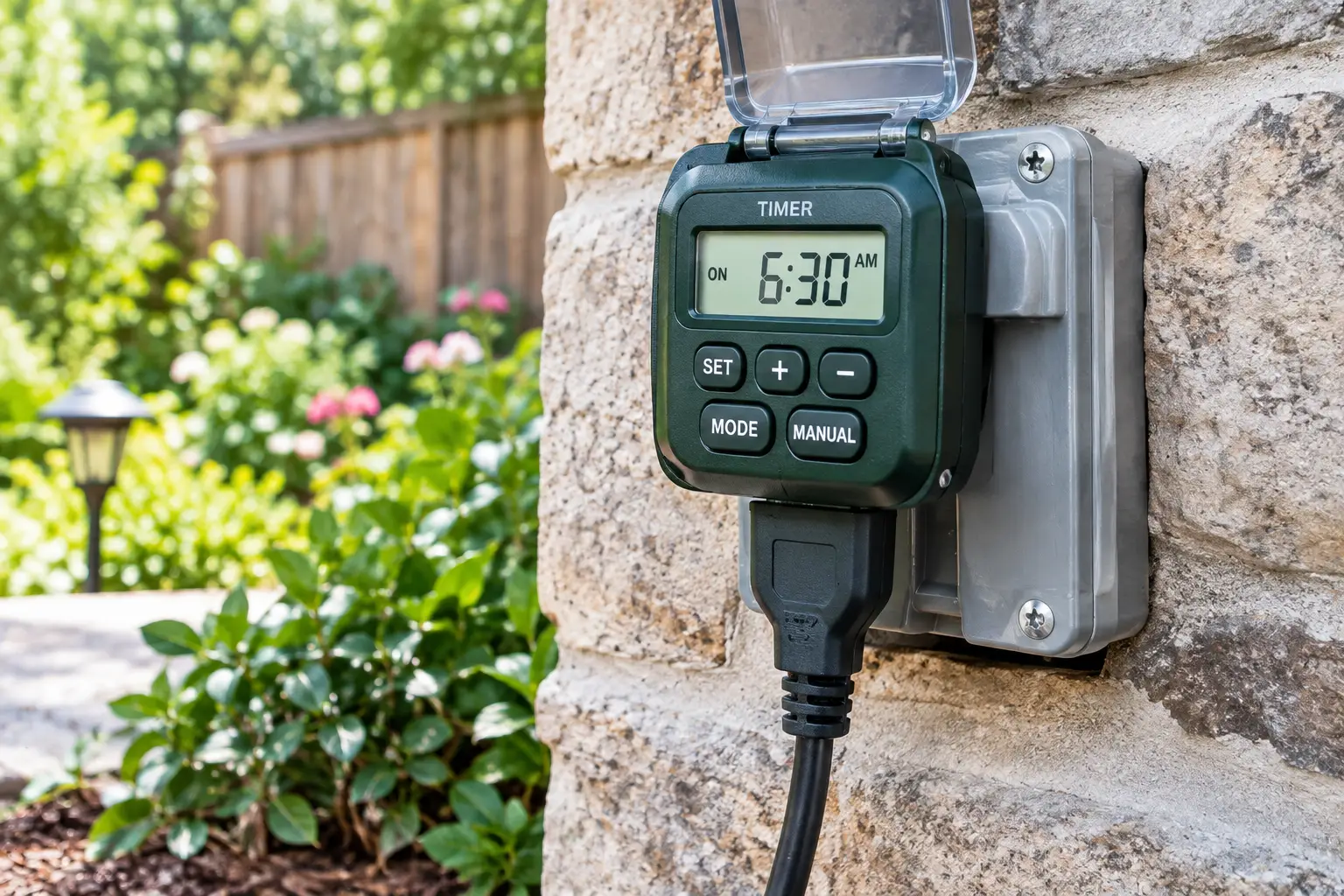
Digital outdoor timers are weather-resistant switching devices with an electronic clock and LCD that turn plugged-in or hardwired equipment on and off on a programmed schedule. Unlike dial timers with pins, they offer minute-level precision, multiple daily programs, battery-backed memory, and features like random, countdown, or sunrise/sunset modes.
The U.S. Department of Energy’s guide to lighting controls notes that a fixed-schedule timer alone can drift out of sync with seasonal night length — which is exactly why astronomic and photocell features matter outdoors, as you’ll see below.
Quick Comparison: 7 Digital Outdoor Timers at a Glance
| Timer | Type | Programs | Max Load | Standout Feature | Best for |
|---|---|---|---|---|---|
| Woods 50015WD | Plug-in, 2 outlets | Up to 20 on/off | 15A, 3/4 HP | Random + countdown modes | Woods 50015WD: pumps and lighting combos |
| BN-LINK BND/U78 | Plug-in, 2 outlets | 8 on/off | 15A, 1/2 HP | Low price, ETL listed | BN-LINK BND/U78: tight budgets |
| Intermatic HB880R | Plug-in, 2 outlets | 14 events | 15A resistive | Astronomic clock | Intermatic HB880R: set-and-forget lighting |
| GE 15142 | Plug-in, 2 outlets | Up to 16 per day | See label | Manual override switch | GE 15142: simple weekly schedules |
| DEWENWILS 6-Outlet Digital Power Stake | Yard stake, 6 outlets | Up to 20 on/off | 15A/1800W | Six outlets on a stake | DEWENWILS 6-Outlet Digital Power Stake: holiday displays |
| Kasa EP40 | Wi-Fi plug, 2 outlets | App schedules | 15A/1875W | Independent outlet control | Kasa EP40: phone and voice control |
| GE 46537 | Hardwired metal box | Up to 9 programs | 40A, 2 HP | NEMA 3R, 120–277V | GE 46537: pool pumps and heaters |
Looking at the table, the real dividing line isn’t price — it’s load and installation. The five plug-in models all live in the 15-amp world, which covers lights, fountains, and small pumps, while the GE 46537 is the only one built for hardwired 240V equipment. Within the plug-in group, the Intermatic HB880R and Kasa EP40 are the two that follow sunset automatically, which matters more for lighting than any extra program slot.
💬 One click helps other shoppers make an informed choice too! 😊
Top 7 Digital Outdoor Timers: Expert Analysis
1. Woods 50015WD — best all-around heavy-duty plug-in
The Woods 50015WD earns the top spot because it pairs a generous program count with the highest motor rating among the plug-in picks.
It offers up to 20 on/off settings that repeat weekly, plus random, countdown, and daylight saving features. In practice, that means you can run landscape lights from dusk to 11 p.m., fire the pond pump twice a day, and still have slots left for weekend-only schedules. Its 3/4 HP rating (15 FLA, 90 LRA) is the spec that matters for pumps: it describes how much motor startup surge the relay can tolerate, and it’s a step above the 1/2 HP ceiling of most budget timers.
Based on comparing the specs, this is the timer for homeowners who run one “heavy” load, like a fountain or aerator, alongside lighting. The two grounded outlets switch together, so plan one schedule per unit rather than two.
Reviews consistently praise its versatility for landscape lighting, while a common complaint is that programming takes a few tries with the instruction sheet. Some long-term owners also report that the built-in rechargeable backup battery eventually fails and isn’t user-replaceable, so the timer loses memory when unplugged.
Pros:
- ✅ Up to 20 programs covers complex weekly routines
- ✅ 3/4 HP rating handles small pumps comfortably
- ✅ Random mode adds a lived-in look for security
Cons:
- ❌ Backup battery is built in, not replaceable
- ❌ Short power cord limits placement options
Usually found in the $20–$35 range at the time of writing, it’s strong value for anyone controlling a motor load.
2. BN-LINK BND/U78 — best value for simple lighting
The BN-LINK BND/U78 proves you don’t need to spend much to get reliable weekly automation.
You get 8 on/off programs, settings as short as one minute, pre-set day combinations, a one-button daylight saving mode, and a random vacation mode. Eight programs sounds limited next to the Woods, but most porch-light or string-light setups need only one or two per day, so this rarely becomes a bottleneck. It’s rated 15A/1875W resistive, 8A/1000W tungsten, and 1/2 HP, and it’s ETL listed.
Here’s what to weigh: the 1/2 HP rating is fine for small fountain pumps, but it’s the lowest motor rating in this lineup. If your pump label lists a high startup current, step up to the Woods 50015WD. Also note that some listings say the backup AA battery isn’t included, so check the box before your first outage.
Customer reviews in the U.S. frequently mention that the setup instructions are clearer than expected, and several owners highlight that the battery backup keeps settings when the timer is moved between outlets. Buyers use it well beyond lights, including seedling grow setups.
Pros:
- ✅ Very affordable for a weatherproof programmable unit
- ✅ Clear instructions, according to many reviewers
- ✅ ETL listed with flame-retardant PC housing
Cons:
- ❌ Only eight programs across the week
- ❌ Both outlets always share one schedule
Typically priced around $15–$20, it’s the easiest recommendation for first-time buyers on a budget.
3. Intermatic HB880R — smartest sunset tracking without Wi-Fi
The Intermatic HB880R solves the biggest weakness of fixed-schedule timers: seasons.
Its astronomic clock calculates sunrise and sunset for your location, so “on at dusk” means 5 p.m. in December and 8:30 p.m. in June without you touching a button. It adds automatic DST adjustment, a random mode, 14 on/off events, two grounded receptacles on a 24-inch cord, and an included AA backup battery. It’s cULus listed and rated 15A resistive at 120 VAC, with a lower ballast rating that’s worth checking for older fixtures.
What most buyers overlook is how much seasonal drift costs. A fixed 6 p.m. start either lights an empty, bright yard in summer or leaves the driveway dark for an hour in winter. The HB880R’s astronomic mode removes that problem, which is why it suits landscape lighting and security lighting better than any non-smart pick here.
Verified review volume for this specific model is smaller than for the budget brands, so there’s limited aggregated sentiment to report. What is verifiable is Intermatic’s long track record in lighting controls and the 1-year limited warranty.
Pros:
- ✅ Astronomic clock follows sunset all year
- ✅ Longer 24-inch cord eases placement
- ✅ AA backup battery is included and replaceable
Cons:
- ❌ Costs noticeably more than basic digital timers
- ❌ Fewer programs than the Woods or DEWENWILS
Expect roughly $40–$65 depending on the seller, a fair premium if lighting is your main job.
4. GE 15142 — straightforward daily scheduling with manual override
The GE 15142 is the no-surprises choice for people who want a familiar brand and a simple interface.
It supports a 7-day programmable schedule with up to 16 settings per day, precise hour-and-minute timing, an override switch, battery backup, and two grounded outlets in a weather-resistant, corrosion-resistant housing. The override switch is more useful than it sounds: when guests stay late on the patio, you flip it rather than reprogramming anything.
On paper, 16 settings per day is more daily flexibility than most people will ever use, so the practical appeal is ease rather than power. It’s compatible with LED and CFL loads, which matters because some older timers misbehave with low-wattage LEDs.
Aggregated review data for this exact model was hard to verify at the time of writing, so check current Amazon reviews before buying. GE-branded timers are made under license by Jasco, which keeps parts and support accessible in U.S. retail.
Pros:
- ✅ Physical override switch for quick manual control
- ✅ Up to 16 settings per day
- ✅ LED and CFL compatible out of the box
Cons:
- ❌ No astronomic or sunset feature
- ❌ Limited verified review data to confirm longevity
Generally under $40, it’s a reasonable middle-ground pick if you value simplicity.
5. DEWENWILS 6-Outlet Digital Power Stake — most outlets for yard displays
The DEWENWILS 6-Outlet Digital Power Stake turns one outdoor receptacle into six timed outlets right where your decorations are.
It offers up to 20 on/off settings, a 24-hour display, a built-in backup battery that the maker says holds settings for up to three months, a 6-foot 14/3 SJTW cord, and overload protection at 15A/1800W. The stake design is the real win: instead of daisy-chaining extension cords across the lawn, you plant the power hub in the middle of the display.
This is the right tool for Halloween and Christmas setups, garden lighting clusters, or a pond with lights and a pump. Two cautions: the display uses military time with no AM/PM, which trips up some first-time users, and all six outlets follow the same program. DEWENWILS also sells photocell and remote-control versions if you prefer dusk-to-dawn behavior over programming.
Owner feedback on the maker’s site is positive about easy installation, though that’s first-party content; check Amazon reviews for the specific variant you’re buying.
Pros:
- ✅ Six grounded outlets reduce extension-cord clutter
- ✅ Heavy 14-gauge cord supports full 15A loads
- ✅ Built-in overload protection adds a safety layer
Cons:
- ❌ 24-hour display without AM/PM confuses some users
- ❌ All outlets share one schedule
Typically $25–$40, it’s excellent value compared with buying a timer plus a separate power stake.
6. Kasa EP40 — best app and voice control
The Kasa EP40 replaces buttons and an LCD with your phone, and adds one thing no other plug-in pick offers: independent control of each outlet.
It’s IP64 rated against dust and splashing water, operates from -4°F to 122°F, and handles 15A/1875W total with a 1/2 HP motor rating. Schedules can follow sunrise or sunset, there’s a countdown timer and an Away Mode, and it works with Alexa and Google Assistant over 2.4 GHz Wi-Fi with no hub. Variants include the EP40A (adds Apple Home) and the EP40M (Matter support).
Here’s the trade-off to weigh: the EP40 is only as reliable as your Wi-Fi at the outlet. If your router signal is weak by the back fence, a standalone digital timer is the safer bet. But if you want string lights on one outlet at sunset and a fountain on the other at 7 a.m., this is the only plug-in here that does it.
Deal listings from past years showed a strong average across thousands of Amazon ratings, making it one of the most widely reviewed outdoor plugs. Read recent reviews for app-related feedback.
Pros:
- ✅ Two outlets with separate schedules
- ✅ Sunrise/sunset scheduling through the app
- ✅ Voice control with major assistants
Cons:
- ❌ Requires steady 2.4 GHz Wi-Fi outdoors
- ❌ No on-device screen for quick checks
Usually $20–$30, it’s the best value if your yard already has good Wi-Fi.
7. GE 46537 — heavy-duty hardwired control for pool equipment
The GE 46537 is in a different league: a lockable metal box timer built for pool pumps, water heaters, and HVAC equipment.
It handles up to 40A and 2 HP, auto-senses 120, 240, or 277 VAC, supports single-pole and double-pole switching, and lives in a NEMA 3R-rated, tamper-resistant enclosure. GE lists up to nine programs across the week, plus an override switch and battery backup. The universal voltage matters because most in-ground pool pumps run on 240V, which no plug-in timer can control.
Based on comparing the specs, this is the digital upgrade for homeowners replacing an old mechanical pool timer with trippers. Digital programming allows more precise run windows, which can trim pump hours during off-peak utility rates. However, it’s hardwired: unless you’re qualified, budget for a licensed electrician.
Verified aggregated review data specific to this model was limited at the time of writing. What stands out in the spec sheet is the combination of NEMA 3R housing and auto-sensing voltage, which simplifies replacement jobs.
Pros:
- ✅ 40A and 2 HP capacity for pool pumps
- ✅ Lockable NEMA 3R metal enclosure
- ✅ Auto-sensing 120–277V universal voltage
Cons:
- ❌ Requires hardwiring, usually by an electrician
- ❌ Fewer programs than plug-in competitors
Expect roughly $60–$100, a worthwhile investment if it replaces a failing pool timer.
Side-by-Side: Top 7 Digital Outdoor Timers Compared
| Timer | Sunset/Astronomic | Backup Memory | Independent Outlets | Price Range | Review Sentiment | Best for |
|---|---|---|---|---|---|---|
| Woods 50015WD | No | Built-in rechargeable | No | $20–$35 | Versatile; setup learning curve | Woods 50015WD: pumps + lights |
| BN-LINK BND/U78 | No | AA battery | No | $15–$20 | Clear instructions praised | BN-LINK BND/U78: budget lighting |
| Intermatic HB880R | Yes | AA (included) | No | $40–$65 | Limited verified data | Intermatic HB880R: year-round lighting |
| GE 15142 | No | Battery backup | No | Under $40 | Limited verified data | GE 15142: simple schedules |
| DEWENWILS 6-Outlet Digital Power Stake | No (photocell variant exists) | Up to 3 months | No | $25–$40 | Positive on installation | DEWENWILS 6-Outlet Digital Power Stake: displays |
| Kasa EP40 | Yes (app) | Cloud/app | Yes | $20–$30 | Widely reviewed, strong | Kasa EP40: smart homes |
| GE 46537 | No | Battery backup | Dual-load options | $60–$100 | Limited verified data | GE 46537: pool pumps |
The table shows a clear pattern: only the Intermatic HB880R and Kasa EP40 eliminate seasonal reprogramming, and only the Kasa EP40 lets two devices run separate schedules. If neither feature matters to you, the BN-LINK BND/U78 delivers most of the everyday value at the lowest price, while the Woods 50015WD is worth the small premium for motor loads.
💬 One click helps other shoppers make an informed choice too! 😊
✨ Don’t miss the right timer for your yard!
🔍 Take your outdoor lighting and equipment to the next level with this carefully curated lineup. Click a highlighted model to check current pricing and availability. These picks will help you get effortless, energy-saving automation the whole family will enjoy!
Getting Started: Setting Up Your Programmable Outdoor Timer the Right Way
A programmable outdoor timer is only as good as its first 30 minutes of setup. Here’s a sequence that avoids the most common headaches.
⚡ Step 1: Charge or power the backup first
Timers with rechargeable backups (like the Woods 50015WD) often need to sit plugged in before the screen responds properly; some manuals tell you to press reset after charging. For AA-backed models such as the BN-LINK BND/U78 and Intermatic HB880R, insert a fresh battery before programming so a brief outage doesn’t wipe your work.
🕐 Step 2: Program indoors, at a table
Set the clock and schedules while sitting comfortably with the manual, then carry the timer outside. It’s faster, and you’re less likely to mistype a program in the cold. On 24-hour displays like the DEWENWILS 6-Outlet Digital Power Stake, remember 7 p.m. is 19:00.
📍 Step 3: Set your location (astronomic and smart models)
The Intermatic HB880R and Kasa EP40 need your location to calculate sunset. Skip this, and “dusk” will be wrong.
🔌 Step 4: Test with the override
Before walking away, use the manual override or app toggle to confirm the load switches on and off.
🛠️ First 30 days: common mistakes
Many owners forget to check whether DST mode is enabled, leave the weather cover open with plugs pinched, or set programs for “every day” when they meant weekdays. Recheck the schedule after one week; it’s the cheapest maintenance you’ll ever do.
Real-World Scenarios: Matching the Right Timer to Your Yard
Specs are abstract, so here are three realistic homeowner profiles and the timer that fits each best.
🏡 Scenario 1: The suburban landscape lighting owner
You have low-voltage path lights running off a plug-in transformer, plus two uplights on the front of the house. You want them on at dusk and off at 11 p.m., every day, forever. Budget: around $50. Frequency: nightly, year-round.
Best match: the Intermatic HB880R. Its astronomic clock handles the dusk trigger automatically, and the fixed 11 p.m. off-time gives you the photosensor-plus-timer combination the DOE recommends for decorative lighting, in one box.
🐟 Scenario 2: The backyard pond keeper
You run a small fountain pump from 7 a.m. to 9 p.m. and pond lights from 8 p.m. to 10 p.m. Budget: under $40. Frequency: daily, spring through fall.
Best match: the Kasa EP40 if your Wi-Fi reaches the pond, because each outlet gets its own schedule. If Wi-Fi is spotty, two BN-LINK BND/U78 units cost about the same and work fully offline.
🎃 Scenario 3: The holiday display enthusiast
You set up inflatables, string lights, and a projector twice a year. You want everything on from 5 p.m. to 11 p.m. Budget: $30–$40. Frequency: seasonal.
Best match: the DEWENWILS 6-Outlet Digital Power Stake. Six outlets at the center of the display means fewer cords across the lawn, and 20 programs is plenty. Just keep the total load under 15A.
Troubleshooting: Common Outdoor Timer Problems and Fixes
Even good timers act up. These are the problems owners run into most, with fixes that work.
❓ The screen is blank or frozen. Rechargeable-backup models may need several minutes (sometimes longer) of charging before the display wakes up; then press the reset button. For AA models, replace the battery. On the Woods 50015WD, the manufacturer’s own guidance mentions pressing “R” to reset after recharging.
❓ Lights turn on in daylight in spring. Your fixed schedule didn’t account for longer days. Either shift the on-time monthly, switch on astronomic mode (Intermatic HB880R), or use sunset scheduling in the Kasa app (Kasa EP40).
❓ The timer clicks, but the pump won’t start. The pump’s startup surge may exceed the timer’s motor rating. Check the pump’s HP and LRA against the timer label. Moving from the BN-LINK BND/U78 (1/2 HP) to the Woods 50015WD (3/4 HP) or, for 240V pumps, the GE 46537 usually fixes it.
❓ The GFCI keeps tripping. Water is probably reaching the plug connections. Point the timer’s outlets downward, close the cover fully, and elevate connections off the ground. If it still trips, have an electrician inspect the circuit rather than bypassing the GFCI.
❓ Wi-Fi plug goes “offline.” Move the router, add a mesh node, or choose a standalone digital timer for that location.
How to Choose Digital Outdoor Timers
Choosing among digital outdoor timers comes down to seven questions, in this order:
- Identify the load type. Lights, pumps, and heaters stress timers differently; motors need an HP rating, not just amps.
- Check the voltage. 120V plug-in loads work with plug-in timers; 240V pool pumps need a hardwired box like the GE 46537.
- Match the ratings. Compare the timer’s resistive, tungsten, and HP ratings with your equipment label, and leave headroom.
- Decide on sunset tracking. For lighting, astronomic or sunrise/sunset scheduling prevents seasonal drift.
- Confirm weather protection. Look for a weatherproof cover and outdoor listing; for smart plugs, check the IP rating. The IP code explains what those two digits mean: IP64, for example, signals dust-tight protection against splashing water, not submersion.
- Count outlets and schedules. Need separate schedules? Only the Kasa EP40 does that among plug-ins.
- Look for backup memory you can service. Replaceable AA backups often outlast built-in rechargeable cells.
Following that order keeps you from paying for features you won’t use while making sure the essentials, load capacity and weather protection, are never compromised.
Digital vs. Mechanical vs. Smart: Which Outdoor Timer for Lights Wins?
Before digital outdoor timers took over store shelves, the classic choice was a mechanical dial with push pins. Smart plugs now sit on the other end of the spectrum. Each approach has a real place.
| Feature | Mechanical Dial | Digital Timer | Smart (Wi-Fi) Plug | Best for |
|---|---|---|---|---|
| Precision | 15–30 min steps | 1 minute | 1 minute | Digital or Kasa EP40 |
| Programs | Limited by pins | 8–20 | App-based | Woods 50015WD |
| Power outage | Clock stops | Battery holds settings | Reconnects to app | Digital |
| Sunset tracking | No | Astronomic models only | Yes | Intermatic HB880R, Kasa EP40 |
| Needs Wi-Fi | No | No | Yes | Digital for remote yards |
As an outdoor timer for lights, a mechanical dial is cheap and dead simple, but it drifts after outages and can’t handle weekday/weekend differences. Digital models like the BN-LINK BND/U78 fix both problems for only a few dollars more, while smart plugs add remote control at the cost of Wi-Fi dependence.
The practical takeaway: if you check your yard from your phone anyway, a smart plug is a natural fit. If you want a device that works even when the router dies, stick with a standalone digital unit. And if it’s a 240V pump, neither plug-in type applies; a box timer like the GE 46537 is the answer.
Features That Actually Matter (and Ones That Don’t)
Marketing copy on timer boxes is loud. Here’s how to separate the useful from the decorative.
✅ Features that matter
- Motor (HP) rating. The single most important number for pumps and aerators. Amps alone don’t tell you about startup surge.
- Astronomic or sunset scheduling. For lighting, this saves more hassle than any other feature. The Intermatic HB880R builds it in; the Kasa EP40 does it through the app.
- Serviceable backup battery. A user-replaceable AA cell means the timer’s memory can outlive its first battery. Built-in rechargeable cells can’t be swapped.
- Random/vacation mode. Varying on and off times makes a home look occupied, a real security benefit when you travel.
- Manual override. A physical button or switch, like on the GE 15142, beats reprogramming for one-off changes.
❌ Features that matter less than they seem
- Very high program counts. Twenty programs sounds impressive, but most yards need two to four. Don’t pay extra only for slot count.
- “Waterproof” claims without an IP rating or listing. Weatherproof covers help, but no plug-in timer should sit in standing water.
- Voice control for fixed schedules. Handy, but if your lights run the same hours nightly, you’ll rarely use it.
Focusing on the first list keeps your money on features that change daily life, not just the packaging.
Weatherproof Digital Timer Ratings, Safety, and Standards
A weatherproof digital timer handles rain and snow far better than an indoor unit, but “weatherproof” isn’t a license to ignore electrical safety.
🔍 Look for a safety listing
Every timer in this guide carries a recognized listing, such as ETL (BN-LINK BND/U78, Kasa EP40), CSA (Woods 50015WD), or cULus (Intermatic HB880R). These marks mean a nationally recognized testing laboratory evaluated the design. Avoid unlisted no-name timers, especially for continuous outdoor loads.
⚡ Plug into GFCI protection
The Electrical Safety Foundation International’s outdoor decoration safety tips recommend plugging outdoor electrical devices into GFCI-protected circuits, matching extension-cord amperage to the load, and keeping cords clear of snow and standing water. A timer sits between the outlet and your load, so the circuit feeding it should be GFCI-protected. If yours isn’t, a portable outdoor GFCI is an easy fix.
🌧️ Mounting and orientation
Position plug-in timers with outlets facing down, keep the weather cover closed, and lift connections off the ground. For stake models like the DEWENWILS 6-Outlet Digital Power Stake, push the stake in firmly so the hub doesn’t tip into puddles.
🔧 Hardwired installs
Box timers like the GE 46537 fall under electrical code requirements. Local rules vary by state and municipality, and pool equipment in particular has strict bonding and GFCI requirements. Hiring a licensed electrician is the safe, code-compliant route.
Digital Outdoor Timers for Holiday Displays
Holiday season is when many homeowners buy their first timer, and it’s also when outdoor electrical risk peaks. The U.S. Consumer Product Safety Commission’s holiday decorating guidance advises using lights certified for outdoor use and plugging them only into GFCI-protected receptacles or a portable GFCI.
🎄 Why a timer makes displays safer
Displays that run all night sit energized for hours when nobody is watching. A timer cuts that window down to the hours you actually enjoy them, reducing both risk and your electric bill. A 6 p.m.-to-11 p.m. schedule, for example, trims seven or more idle hours per night compared with leaving everything on until morning.
🧮 Doing the load math
Add the wattage of everything plugged in. A 15A, 120V circuit supports 1,800 watts in theory, but staying around 80% of that for continuous loads is a widely used rule of thumb. LED strings draw a fraction of old incandescent sets, so most modern displays fit comfortably on one timer. Inflatables with blower motors add up faster than you’d expect, so check their labels.
🎁 Best picks for the season
The DEWENWILS 6-Outlet Digital Power Stake is purpose-built for displays. If you want to trigger the show from the couch or by voice, the Kasa EP40 works well for smaller setups. And if your display shares an outlet with year-round landscape lighting, the Intermatic HB880R keeps both on sunset time.
Long-Term Cost and Maintenance
The sticker price of digital outdoor timers is small; what they save, and how long they last, is the bigger story.
| Timer | Price Range | Backup Type | Expected Upkeep | Value Verdict | Best for |
|---|---|---|---|---|---|
| BN-LINK BND/U78 | $15–$20 | AA | Swap battery yearly | Lowest entry cost | BN-LINK BND/U78: basic lighting |
| Woods 50015WD | $20–$35 | Built-in rechargeable | None until battery fades | Great for motor loads | Woods 50015WD: pumps |
| Intermatic HB880R | $40–$65 | AA (included) | Swap battery yearly | Saves seasonal fiddling | Intermatic HB880R: lighting |
| GE 46537 | $60–$100 | Battery backup | Periodic enclosure check | Replaces pool timers | GE 46537: 240V equipment |
The pattern is clear: AA-backed timers cost a few cents a year in batteries but can keep their memory indefinitely, while built-in rechargeable designs like the Woods 50015WD are maintenance-free until the cell wears out. For pool owners, the GE 46537‘s higher price is quickly offset if tighter run windows reduce pump hours.
💡 Where the savings come from
Savings depend entirely on how long your equipment would otherwise run. Cutting porch lights from 12 hours to 5 hours a night saves roughly 58% of their runtime. With LEDs the dollar amount is modest, but for pumps and heaters, trimmed hours translate into meaningful savings over a season.
🧽 Simple maintenance routine
Every spring and fall: wipe dirt from the cover hinge, check the cord for UV cracking, confirm the clock and DST setting, and replace AA batteries. It takes five minutes and prevents most failures.
Common Mistakes to Avoid When Buying Digital Outdoor Timers
Even careful shoppers make these missteps. Avoiding them saves money and frustration.
❌ Buying for amps and ignoring HP
A pump drawing 6 amps while running can pull far more at startup. If a timer lists only resistive amps, don’t assume it’s pump-ready. Look for an explicit HP rating, like the 3/4 HP on the Woods 50015WD.
❌ Choosing a fixed-schedule timer for dusk lighting
You’ll either reprogram every few weeks or live with lights on in daylight. An astronomic model or a sunset-aware smart plug solves this permanently.
❌ Assuming a smart plug works anywhere
Wi-Fi signals weaken quickly through exterior walls. Test your phone’s signal at the outlet before buying a Kasa EP40.
❌ Buying a plug-in timer for a 240V pump
It physically won’t fit, and adapters are dangerous. Hardwired box timers like the GE 46537 exist for this reason.
❌ Overlooking outlet count and cord length
A timer with a 6-inch cord sitting on a wall outlet may not reach your display. Stake designs and longer cords, like the 24-inch lead on the Intermatic HB880R, can eliminate extra extension cords.
❌ Ignoring the display format
If you dislike military time, avoid 24-hour-only displays, or be ready to convert.
FAQ About Digital Outdoor Timers
❓ Can I leave a digital outdoor timer outside all winter?
❓ Do outdoor digital timers work with LED lights?
❓ Which outdoor timer is best for a pool pump?
❓ Are digital outdoor timers better than photocell timers?
❓ How long does the backup battery last in an outdoor timer?
Conclusion: Choosing the Best Digital Outdoor Timers for Your Home
Digital outdoor timers are one of those small upgrades that quietly improve daily life. They keep lights, fountains, and pumps on a schedule that fits your routine, cut wasted runtime, and give your home a lived-in look when you’re away.
The right pick depends on what you’re controlling. The Woods 50015WD is the best all-rounder for mixed lighting and pump setups, while the BN-LINK BND/U78 covers basic lighting for very little money. If you want your lights to follow the sun without Wi-Fi, the Intermatic HB880R is the standout, and the GE 15142 keeps things simple with an override switch. Holiday decorators will appreciate the six outlets on the DEWENWILS 6-Outlet Digital Power Stake, smart-home fans will love the independent outlets on the Kasa EP40, and pool owners with 240V equipment should look straight at the GE 46537.
Whatever you choose, match the timer’s HP and voltage to your equipment, plug into GFCI protection, and spend five minutes each season checking the settings. Do that, and your timer will run in the background for years, which is exactly the point.
✨ Ready to put your yard on autopilot?
🔍 Take your outdoor setup to the next level with this carefully curated lineup. Click a highlighted timer to check current pricing and availability. These picks will help you get worry-free lighting and equipment control the whole family will enjoy!
Recommended for You
- Exterior Electrical Plugs: 7 Best Weatherproof Picks for 2026
- Matter Compatible Smart Home Hub: 7 Proven Picks for 2026
- Lutron Caseta Black: 7 Best Smart Picks (Honest 2026 Guide)
Disclaimer: This post contains affiliate links. As an Amazon Associate, I earn from qualifying purchases made through these links, at no additional cost to you.
✨ Found this article helpful? Share it with someone who needs it! 💬🤗