
In This Article
Why Exterior Electrical Plugs Deserve More Thought Than You Give Them
Most of us only think about exterior electrical plugs twice a year: once in late November, when we’re untangling string lights on a ladder, and once in July, when the pool pump or patio fan suddenly stops working. The rest of the time, that little box on the side of the house just sits there, taking rain, sun, frost, sprinkler overspray, and the occasional curious dog.
Here’s the thing, though. An outdoor outlet lives a much harder life than anything inside your home. Water, dust, UV exposure, and temperature swings all work against it, and the gear you plug into it (extension cords, timers, smart plugs, power stakes) adds its own points of failure. Get the setup right and you’ll have lights that switch on at dusk, a pump that runs on schedule, and zero surprise tripped breakers. Get it wrong and you’re looking at corroded contacts, nuisance tripping, or, worst case, a genuine shock hazard.
This guide cuts through the marketing to look at seven real products you can find on amazon.com in 2026, from the receptacle in the wall to the smart plug or yard stake you connect to it. You’ll get honest analysis based on published spec sheets and aggregated customer reviews, not invented test stories. We’ll decode what IP64 versus IP65 actually means in a rainstorm, explain why the cover on your outdoor electrical outlet matters as much as the outlet itself, and show you which combination makes sense for holiday lighting, landscape lights, pool equipment, or just a safer backyard.
Whether you’re a first-time homeowner or a DIYer who already owns a voltage tester, you’ll leave knowing exactly which exterior electrical plugs fit your yard, your budget, and your smart home.
What Are Exterior Electrical Plugs?
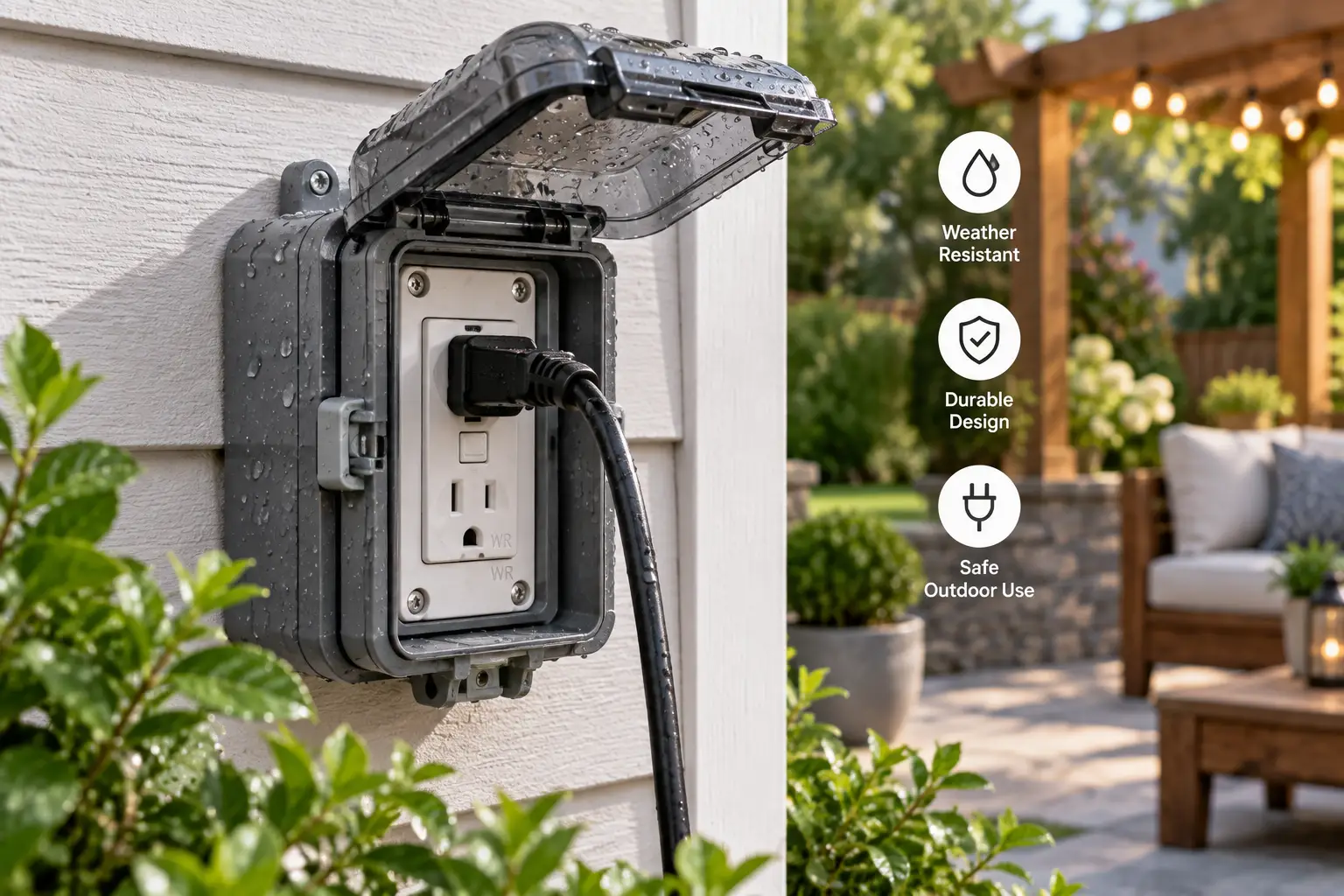
Exterior electrical plugs are outdoor-rated receptacles, covers, and plug-in devices (smart plugs, timers, and power stakes) designed to deliver household power safely outside. They use weather-resistant materials, sealed or covered sockets, and, per the National Electrical Code, ground-fault (GFCI) protection to reduce shock risk in wet conditions.
That last part is the most important. According to the U.S. Consumer Product Safety Commission’s GFCI fact sheet, a GFCI constantly compares outgoing and returning current and cuts power when they differ by as little as about 6 milliamps, which is fast enough to prevent a lethal shock. Outdoors, where damp grass and wet hands make your body a much better path to ground, that protection isn’t a luxury. It’s the foundation everything else sits on.
In practice, a complete outdoor power setup has three layers:
- ✅ The receptacle: a weather-resistant (WR), ideally tamper-resistant (TR), GFCI outlet mounted in the wall or on a post.
- ✅ The enclosure: a “while-in-use” weatherproof outlet cover that stays closed even with a cord plugged in.
- ✅ The plug-in device: an outdoor smart plug, mechanical timer, or outdoor power stake that adds control and extra sockets.
The seven picks below cover all three layers, so you can fix the weak link in your own setup rather than buying one more gadget that doesn’t solve the real problem.
Quick Comparison: 7 Exterior Electrical Plugs at a Glance
| Product | Type | Weather Protection | Control | Price Range | Best for |
|---|---|---|---|---|---|
| Leviton GFWT2 | 20A self-test GFCI receptacle | Weather-resistant (WR/TR) | Manual test/reset | $25–$35 | Upgrading an old outdoor outlet |
| TayMac MM410C | 1-gang in-use cover | NEMA 3R, gasketed | N/A | $10–$20 | Keeping plugs dry while in use |
| Tapo P400M | Dual-outlet smart plug | IP65 | Wi-Fi + Matter | $25–$35 | Mixed smart-home ecosystems |
| Kasa EP40 | Dual-outlet smart plug | IP64 | Wi-Fi app + voice | $20–$30 | Budget smart lighting |
| Wyze Plug Outdoor | Dual-outlet smart plug | IP64 | Wi-Fi + light sensor | $15–$30 | Energy tracking on a budget |
| Woods 13547 | 6-outlet power stake | Covered outlets + timer | Photocell + mechanical timer | $20–$35 | Holiday displays, no Wi-Fi needed |
| Woods 59785 | 6-outlet power stake | Covered outlets | Photocell + wireless remote | $25–$45 | Large displays with remote control |
Looking at the table, the three smart plugs cluster tightly on price, so your decision there comes down to ecosystem and weather rating: the Tapo P400M is the only one here with a dust-tight IP65 enclosure and native Matter support. The Leviton GFWT2 and TayMac MM410C aren’t competitors to the others; they’re the foundation, and if your existing outlet lacks GFCI protection or a proper in-use cover, fixing that should come before buying any plug-in device. The two Woods stakes are the pick when you need lots of sockets and no app at all.
💬 One click helps other shoppers make an informed choice too! 😊
Top 7 Exterior Electrical Plugs: Expert Analysis
Each pick below was selected for real-world availability on amazon.com, verified specs from manufacturer documentation, and consistent patterns in customer and editorial reviews. Prices are ranges at the time of writing; always check the current listing.
1. Leviton GFWT2 — safest foundation for any outdoor outlet
If your outdoor receptacle is older than your car, this is the upgrade that makes everything else on this list safer. The Leviton GFWT2 is a 20-amp, 125-volt duplex GFCI receptacle that’s both weather-resistant and tamper-resistant, with 20A feed-through so it can protect outlets downstream on the same circuit.
Its headline feature is self-test (auto-monitoring): the device periodically checks its own ability to respond to a ground fault, which matters because very few homeowners actually press the TEST button monthly as manufacturers recommend. Leviton’s reset lockout also refuses to reset if the device is miswired or damaged, so a failed GFCI can’t quietly keep passing power without protection. The slim body is a practical bonus, since cramped exterior boxes are exactly where bulky GFCIs become a wrestling match.
This is for homeowners replacing a worn outlet, or anyone who wants to cover a whole run of exterior outlets from one protected point. If you’re not comfortable working inside an electrical box, hire an electrician; the device is only as good as the wiring behind it.
Reviews and distributor listings consistently highlight the easier install thanks to the reduced depth and back-wire clamps, while the status LED gets credit for making troubleshooting obvious.
Pros:
- ✅ Self-test catches failures you’d otherwise miss
- ✅ 20A rating and feed-through protect downstream outlets
- ✅ Slim profile fits shallow outdoor boxes
Cons:
- ❌ Requires wiring work, which isn’t a job for every DIYer
- ❌ Wallplate and in-use cover sold separately
Typically $25–$35 at the time of writing, which is excellent value for the protection it adds.
2. TayMac MM410C — keeps plugs dry while they’re working
The flip-lid cover most older homes have only protects the outlet when nothing is plugged in, which is precisely when it doesn’t matter. The TayMac MM410C is a clear, one-gang “while-in-use” cover that stays closed with cords attached.
It’s built from high-impact polycarbonate, sits 2.75 inches deep, and uses a 16-in-1 universal-fit base with snap-out knockouts, so it adapts to duplex, GFCI, and decorator-style receptacles in either horizontal or vertical orientation. In plain terms: one cover fits nearly any standard outlet you’re likely to have. The listing states it’s NEMA 3R and UL listed, with an attached gasket and a lockable tab, which helps if kids or neighbors might unplug your lights.
This is the cheapest meaningful safety upgrade on this list. Pair it with the Leviton GFWT2, or add it over an existing GFCI, and you’ve addressed the two biggest outdoor failure points.
Aggregated buyer feedback is broadly positive about installation, with many noting it goes on quickly with the included hardware; the most common gripe is that the knockouts can be stubborn and a pair of needle-nose pliers helps. Some buyers also mention that bulky smart plugs can make closing the lid tight, so measure before you commit.
Pros:
- ✅ Meets the in-use requirement for wet locations
- ✅ Universal-fit base adapts to most receptacles
- ✅ Clear lid lets you see status lights
Cons:
- ❌ Knockouts can be fiddly to remove cleanly
- ❌ 2.75-inch depth won’t fit every bulky plug
Usually $10–$20, making it one of the best value-for-money safety buys you can make.
3. Tapo P400M — toughest weather rating with Matter
This is the smart plug to buy if you want something that works with any major ecosystem and shrugs off serious weather. The Tapo P400M is TP-Link’s Matter-certified, dual-outlet outdoor smart plug with an IP65 enclosure.
IP65 means dust-tight and protected against low-pressure water jets, a meaningful step up from the IP64 splash rating on most rivals. TP-Link lists an operating range of -4°F to 122°F, so a Minnesota January or an Arizona July shouldn’t knock it offline. Each outlet is independently controlled and rated 15A, with a maximum of 1,800 watts or a ½-hp motor, which covers most pool pumps, fountains, and holiday light runs. Dual antennas are claimed to reach up to 300 feet in open air and 164 feet through three concrete walls, which addresses the most common complaint with outdoor smart plugs: they’re simply too far from the router.
Matter support means one plug works with Apple Home, Alexa, Google Home, and SmartThings, so you’re not betting on a single ecosystem. In PCWorld’s review of the Tapo P400M, the reviewer recommends mounting it so the outlets face down, advice that echoes TP-Link’s own manual.
Aggregated reviews praise reliable scheduling and easy Matter pairing; the recurring caveat is that the short pigtail cord and mounting clamp need a sensible install position.
Pros:
- ✅ IP65 is the strongest rating among these smart plugs
- ✅ Matter works across Apple, Amazon, Google, SmartThings
- ✅ Long-range dual antennas reduce dropouts
Cons:
- ❌ 2.4GHz Wi-Fi only
- ❌ Short pigtail limits placement options
Around $25–$35, which is strong value for the weather rating and ecosystem flexibility.
4. Kasa EP40 — proven budget pick for string lights
If you just want your patio lights on a schedule without spending much, this is the reliable workhorse. The Kasa EP40 is TP-Link’s longtime dual-outlet outdoor plug, managed through the Kasa app.
It carries an IP64 rating (dust-tight and protected against splashing water) and ETL certification, with a flame-retardant UL94-V0 housing. The two outlets can be controlled independently from the app or from physical buttons on top, so you can run landscape lights on one schedule and a fountain on another. TP-Link claims a built-in amplifier extends Wi-Fi reach to about 300 feet in open areas, useful if your outlet is on a detached garage or far side of the yard.
This is the pick for Alexa and Google Home users who don’t need Matter. If you do, Kasa sells the Kasa EP40 in variants, including the EP40M (Matter) and EP40A (Apple HomeKit), so check the model suffix before buying.
Editorial reviews from TechHive and Android Police rate it as dependable and affordable. The most consistent criticism is that the rubber socket flaps don’t seal very securely and can pop off, so keep unused outlets capped and face the plug downward.
Pros:
- ✅ Independent control of both outlets
- ✅ Long track record and mature app
- ✅ Physical buttons work without your phone
Cons:
- ❌ Socket flaps can loosen over time
- ❌ Base model lacks Matter support
Typically $20–$30, one of the best-value outdoor smart plugs available.
5. Wyze Plug Outdoor — energy monitoring plus a light sensor
This plug does two useful things most budget rivals don’t: it tells you how much power your gear uses, and it can switch on at dusk without Wi-Fi. The Wyze Plug Outdoor is a dual-outlet, IP64-rated smart plug rated for -4°F to 120°F.
The energy monitoring isn’t a gimmick. It lets you see what that heated birdbath or old pond pump actually costs, and you can set alerts when monthly consumption passes a threshold. The built-in light sensor works locally, so your lights still come on at sunset even if your router is down, which is a genuine reliability advantage. Vacation mode randomizes on/off times to make the house look occupied.
This is ideal for budget-minded owners who want data, or anyone with flaky outdoor Wi-Fi who wants a fallback. It works with Alexa, Google Assistant, and IFTTT, but not Matter or Apple Home.
Best Buy’s aggregated review summary highlights easy setup, independent outlet control, and appreciation for energy tracking. One recurring buyer comment is that the plug can make closing an in-use cover difficult. Availability has also been inconsistent at some retailers, so verify the current amazon.com listing and seller before ordering.
Pros:
- ✅ Built-in energy monitoring with usage alerts
- ✅ Light sensor works even when Wi-Fi drops
- ✅ Vacation mode adds simple security value
Cons:
- ❌ No Matter or Apple Home support
- ❌ Bulky shape can crowd in-use covers
Usually $15–$30 depending on seller, making it strong value if you’ll actually use the energy data.
6. Woods 13547 — set-and-forget dusk timer, no app
Not everyone wants another app, and this stake proves you don’t need one. The Woods 13547 is a six-outlet grounded outdoor power stake with a built-in photocell and mechanical timer.
The photocell senses darkness and switches on, then turns off at dawn or after 2, 4, 6, or 8 hours, with always-on and always-off modes rounding out seven settings that repeat daily. Retail listings rate it at 15A/1,875W resistive and 8A/1,000W tungsten, with an SJTW weather-rated cord and flip covers on each outlet. Note that retailers list the cord gauge inconsistently, so confirm it on the product label if you’re pushing near the load limit. Six sockets in a stake means you can position power in the middle of a yard display instead of running six cords back to the house.
This is for holiday decorators, renters, and anyone who wants reliable automation without Wi-Fi. Because it plugs into your GFCI outlet, it inherits that protection rather than replacing it.
Home Depot’s reviews show a clear pattern: buyers love the plug-and-play simplicity and many report years of seasonal use. A minority report the build feels less durable when left out year-round, with one estimating roughly five seasons of holiday-only use.
Pros:
- ✅ No Wi-Fi, app, or account required
- ✅ Six grounded outlets placed right where you need them
- ✅ Photocell adjusts automatically as sunset shifts
Cons:
- ❌ Durability drops with year-round exposure
- ❌ No remote or smartphone control
Around $20–$35, very good value for seasonal displays.
7. Woods 59785 — six outlets with a wireless remote
This is the stake for people who want Woods-style simplicity plus the convenience of switching everything from the porch. The Woods 59785 combines a six-outlet yard stake with a photocell sensor, a programmable timer, and a wireless remote control.
Practically, the remote solves a real annoyance: turning off a display at 10 p.m. without walking across wet grass or opening an app. The photocell handles the dusk-on routine automatically, so the remote becomes an override rather than a chore. I could not verify an official remote range or detailed timer programming options from manufacturer documentation, so check the current listing for those specs before buying if range matters in your yard.
This is best for large holiday displays, backyard parties, and households where not everyone wants to use a smart-home app. Compared with the Woods 13547, you’re paying extra primarily for the remote, so decide whether you’ll actually use it.
I couldn’t find a reliable, sourced summary of customer review sentiment specific to this model, so I won’t characterize it. What’s verifiable is the feature set and that it comes from Southwire’s Woods line, which has decades of history in cords and outdoor timers.
Pros:
- ✅ Wireless remote avoids walking outside to switch off
- ✅ Photocell plus timer covers most routines automatically
- ✅ Six outlets for large displays
Cons:
- ❌ Remote range not clearly published
- ❌ Costs more than the timer-only Woods 13547
Typically $25–$45; worth it only if the remote genuinely saves you trips outside.
Detailed Spec Comparison of the Top 7
| Product | Outlets | Rated Load | Weather Rating | Smart Features | Best for |
|---|---|---|---|---|---|
| Leviton GFWT2 | 2 (duplex) | 20A, 125V | WR/TR, self-test GFCI | None | Code-compliant foundation |
| TayMac MM410C | Cover only | N/A | NEMA 3R in-use | None | Wet-location protection |
| Tapo P400M | 2 | 15A, 1,800W | IP65 | Matter, schedules | Apple/Google/Alexa mixed homes |
| Kasa EP40 | 2 | 15A, 1,875W | IP64 | App, voice, schedules | Budget string lights |
| Wyze Plug Outdoor | 2 | 15A | IP64 | Energy monitoring, light sensor | Tracking running costs |
| Woods 13547 | 6 | 15A, 1,875W resistive | Covered outlets | Photocell, 7-mode timer | App-free holiday displays |
| Woods 59785 | 6 | 15A (check listing) | Covered outlets | Photocell, timer, remote | Large displays with remote |
The pattern here is clear: smart plugs give you precise control over two outlets, while stakes give you volume over six. If your load includes a motor (a pump or fountain), the Tapo P400M‘s explicit ½-hp rating makes it the safest smart choice, and incandescent light strings should stay well under the Woods 13547‘s lower 1,000W tungsten rating. Remember that no plug-in device replaces the GFCI protection provided by the Leviton GFWT2 or an equivalent at the wall.
✨ Build your outdoor power setup the right way!
🔍 Start with a solid foundation, then add smart control. Click a highlighted product to check current pricing and availability, and enjoy a yard that lights itself up right on schedule!
Getting Started: Installing and Using Exterior Electrical Plugs Safely
Great gear still fails when it’s installed carelessly. Here’s a practical first-30-days plan that you won’t find on any product listing.
Day 1: Test before you plug anything in
Press TEST on your outdoor GFCI; the power should cut instantly. Press RESET to restore it. If nothing happens, or if you can’t find which GFCI protects that outlet (it might be in the garage or bathroom), stop and sort that out first. A plug-in voltage tester costs a few dollars and removes guesswork.
Day 2: Fix the cover
If your outlet has a flat flip-lid that can’t close over a cord, swap it for an in-use weatherproof outlet cover like the TayMac MM410C. Mount it so the cord exits from the bottom, never the top, so water runs off rather than in.
Day 3: Mount smart plugs facing down
Both TP-Link’s manual for the Tapo P400M and multiple reviewers recommend outlets pointing downward. Use the included clamp or screw to secure the device so the weight of cords doesn’t lever it out of the receptacle.
Week 1: Check Wi-Fi strength at the outlet
Stand at the outlet with your phone. If you get one bar or less, move the router, add a mesh node near an exterior wall, or choose an app-free option like the Woods 13547 instead.
Weeks 2–4: Avoid the common first-month mistakes
- ❌ Daisy-chaining a power stake into a smart plug into an extension cord. Every connection is a place for water to enter.
- ❌ Leaving unused sockets uncapped on the Kasa EP40 or Wyze Plug Outdoor.
- ❌ Coiling a long extension cord under load, which traps heat.
- ✅ Setting a monthly phone reminder to press TEST on any GFCI without self-test.
Real-World Scenarios: Which Setup Fits Your Home?
Specs are abstract, so let’s apply them to three typical households.
Scenario 1: The first-time holiday decorator
Budget: under $60. Use: six to eight weeks a year, mostly lights and one inflatable.
The smartest play is a Woods 13547 plugged into an existing GFCI outlet under a TayMac MM410C cover. The photocell handles dusk automatically, the six outlets eliminate a messy chain of splitters, and there’s nothing to pair or update. Total spend lands comfortably under budget, and when January comes, the stake goes back in the garage. Why not a smart plug? Because for seasonal use, the extra control rarely justifies another app login.
Scenario 2: The Apple Home user with year-round landscape lighting
Budget: $50–$100. Use: nightly, 365 days.
Here the Tapo P400M earns its place. Matter support means it drops straight into Apple Home alongside Alexa or Google devices a partner might use, and IP65 protection matters when something runs through every season. Pair it with a proper in-use cover and, if the outlet is old, a Leviton GFWT2. Year-round operation is exactly when self-testing GFCI protection pays for itself.
Scenario 3: The pool owner watching the electric bill
Budget: around $30. Use: daily pump cycles in summer.
The Wyze Plug Outdoor is compelling because its energy monitoring shows the real cost of each pump cycle, letting you trim run times with data rather than guesses. Before relying on it, confirm your pump’s rated current is comfortably within the plug’s 15A rating; if the pump is hardwired or larger, a dedicated pool timer installed by an electrician is the correct route instead of any plug-in device.
Problem → Solution: Fixing the Most Common Outdoor Plug Headaches
Problem 1: The GFCI keeps tripping after rain
Solution: Moisture is getting into a connection. Check that cord connectors aren’t sitting in puddles, that your in-use cover actually closes, and that smart plugs face down. A cover like the TayMac MM410C plus elevating cord junctions off the ground solves most cases. If tripping persists with nothing plugged in, the receptacle or wiring needs an electrician.
Problem 2: The smart plug keeps going offline
Solution: Outdoor Wi-Fi range is the usual culprit. The Tapo P400M and Kasa EP40 both advertise extended range, but brick and stucco still eat signal. Add a mesh node near an exterior wall, or use the Wyze Plug Outdoor, whose light sensor keeps lights running on schedule even when Wi-Fi drops.
Problem 3: The lights come on too early or too late
Solution: Photocells read ambient light, so porch lights, streetlights, or shade can fool them. Reposition the Woods 13547 so its sensor faces open sky and away from other lights.
Problem 4: The cover won’t close over the plug
Solution: Measure your plug’s depth before buying a cover. Right-angle plugs, like the one on the Tapo P400M‘s cord, help, and deeper extra-duty covers exist for bulky devices.
Problem 5: The socket flaps keep falling off
Solution: This is a known complaint with the Kasa EP40. Keep spare flaps secure with outlets facing downward, or choose a plug whose covers reviewers describe as thicker, like the Tapo P400M.
How to Choose Exterior Electrical Plugs
Use these seven steps to match the right product to your situation.
- Confirm GFCI protection first. Press TEST at the outlet. If there’s no GFCI anywhere on the circuit, a self-test unit like the Leviton GFWT2 comes before anything else.
- Check your cover. If a cord prevents the lid from closing, you need an in-use cover, not a new gadget.
- Understand the IP rating. The IP code (IEC 60529) uses two digits: the first for dust, the second for water. IP64 resists splashing; IP65 withstands water jets. For exposed walls, IP65 gives more margin.
- Match the load. Add up the wattage of everything you’ll plug in and keep continuous loads well under the rating. Motors like pumps need an explicit horsepower rating.
- Pick your control style. App and voice control suit year-round use; photocell stakes suit seasonal displays and Wi-Fi dead zones.
- Choose your ecosystem. Matter devices like the Tapo P400M work across platforms; otherwise, match your plug to your existing app.
- Look for a safety listing. UL or ETL certification means an independent lab tested the product to relevant safety standards.
Outdoor Smart Plug vs Outdoor Power Stake vs Traditional Timer
These three categories overlap, but they solve different problems, and choosing the wrong one is the most common reason people end up with two devices doing one job.
An outdoor smart plug gives you precise, remote control: schedules to the minute, sunset offsets, voice commands, and in some cases energy data. The trade-off is dependence on Wi-Fi and an app, plus only two outlets. An outdoor power stake puts six outlets exactly where a display needs them, and models with photocells automate the dusk routine without any network. Traditional dial timers are cheap but don’t track changing sunset times, which means readjusting them every few weeks through the fall.
| Feature | Outdoor Smart Plug | Outdoor Power Stake (Photocell) | Traditional Dial Timer | Best for |
|---|---|---|---|---|
| Remote control | ✅ App + voice | Limited (remote on Woods 59785) | ❌ | Smart plug for control |
| Tracks sunset automatically | ✅ Sunset scheduling | ✅ Photocell | ❌ Manual adjusting | Stake for simplicity |
| Number of outlets | 2 | 6 | 1–2 | Stake for big displays |
| Works without Wi-Fi | Partial (light sensor on Wyze Plug Outdoor) | ✅ | ✅ | Stake in dead zones |
| Energy monitoring | Some models | ❌ | ❌ | Wyze Plug Outdoor |
The takeaway: an outdoor smart plug wins on control and data, while an outdoor power stake wins on outlet count and independence from Wi-Fi. Traditional dial timers are the weakest option for lighting because they ignore seasonal sunset shifts, and that’s exactly what photocells and smart schedules fix. Many homes are best served by one of each: a smart plug for year-round landscape lights and a stake for seasonal decor.
Safety, Regulations, and Standards for Outdoor Outlets
This is where outdoor power differs most from indoor, and where cutting corners carries real consequences.
GFCI protection
The National Electrical Code (NEC) requires GFCI protection for outdoor receptacles at dwellings, and recent editions have expanded outdoor GFCI requirements further. A University of Washington environmental health and safety GFCI guide summarizes the practical rule well: electrical equipment used outdoors, including extension cords and decorative lights, should be plugged directly into a GFCI-protected outlet or an adapter intended for outdoor locations. Local code adoption varies by state and municipality, so check with your building department before rewiring.
Weather-resistant receptacles
The NEC also requires receptacles in damp and wet locations to be weather-resistant (marked “WR”). These use corrosion-resistant materials and UV-stable plastics. The Leviton GFWT2 is WR and tamper-resistant (TR), which also keeps small objects out of the slots.
In-use covers
For 15- and 20-amp receptacles in wet locations, the code calls for an enclosure that’s weatherproof whether or not a plug is inserted. That’s what an in-use weatherproof outlet cover like the TayMac MM410C provides.
Product listings
For plug-in devices, look for UL or ETL marks. The Kasa EP40 and Tapo P400M are ETL certified, which means an independent Nationally Recognized Testing Laboratory evaluated them. Avoid unlisted no-name devices; outdoor conditions expose weak construction quickly.
Extension cords
Use only cords marked for outdoor use (a “W” in the jacket code, such as SJTW) and sized for your load. Never run cords through doors or windows where they can be pinched.
Long-Term Cost and Maintenance
The sticker price of exterior electrical plugs is small compared with what they control, so the real question is cost of ownership over several years.
| Product | Upfront Range | Expected Maintenance | Long-Term Value | Best for |
|---|---|---|---|---|
| Leviton GFWT2 | $25–$35 | Minimal; self-tests | Very high (safety + years of service) | Everyone with an old outlet |
| TayMac MM410C | $10–$20 | Check gasket yearly | Very high | Any wet-location outlet |
| Tapo P400M | $25–$35 | Firmware updates | High for year-round use | Nightly automation |
| Kasa EP40 | $20–$30 | Replace lost flaps | High | Budget automation |
| Wyze Plug Outdoor | $15–$30 | Firmware updates | High if you use energy data | Cost-conscious owners |
| Woods 13547 | $20–$35 | Store off-season | Good for seasonal use | Holiday-only displays |
| Woods 59785 | $25–$45 | Replace remote battery | Moderate | Large seasonal displays |
The foundation products deliver the best long-term return: a GFCI and an in-use cover protect every device you’ll ever plug in. Among plug-in devices, the smart plugs earn their keep through daily scheduling and, for the Wyze Plug Outdoor, measurable energy savings, while the stakes deliver the most value when stored indoors between seasons to extend their lifespan.
A simple maintenance schedule
- ✅ Monthly: press TEST on non-self-test GFCIs.
- ✅ Each spring: inspect gaskets and covers for cracks; UV-brittle plastic is the first sign of trouble.
- ✅ Each fall: check cord jackets for cuts before holiday season.
- ✅ After storms: confirm smart plugs reconnected and schedules survived.
Common Mistakes to Avoid When Buying Outdoor Electrical Outlet Gear
Most outdoor power problems trace back to a handful of avoidable buying errors.
1. Buying a smart plug for an unprotected outlet. No outdoor smart plug adds GFCI protection. If the outlet behind it isn’t protected, you’ve automated a hazard.
2. Trusting “weatherproof” on the box. Marketing terms are vague. Look for a specific IP rating on plug-in devices and a WR mark on receptacles.
3. Ignoring motor loads. Pumps and compressors draw surge current at startup. Choose a device with an explicit horsepower rating, like the ½-hp spec on the Tapo P400M.
4. Forgetting the cover depth. A great smart plug that prevents your in-use cover from closing leaves your outdoor electrical outlet exposed. Measure first.
5. Choosing the wrong ecosystem. A HomeKit household buying a non-Matter plug ends up juggling apps. Check compatibility before ordering.
6. Over-buying outlets. Six sockets tempt you to plug in everything. Stay within the device’s rated load, especially with incandescent lights, which draw far more than LEDs.
7. Skipping the listing mark. Unlisted bargain devices might save a few dollars now and cost far more later.
Features That Actually Matter (and Ones That Don’t)
Product listings for exterior electrical plugs are crowded with features. Here’s how to separate substance from noise.
Features that matter
- ✅ GFCI with self-test: it protects you even when you forget to test.
- ✅ A real IP rating: IP65 over IP64 when the device faces open weather.
- ✅ Independent outlet control: lets lights and a fountain run different schedules from one device.
- ✅ Sunset scheduling or photocell: eliminates seasonal readjusting.
- ✅ Local fallback: light sensors or physical buttons that work without Wi-Fi, like on the Wyze Plug Outdoor and Kasa EP40.
- ✅ Safety listing: UL or ETL, non-negotiable outdoors.
Features that matter less than you think
- ❌ Advertised Wi-Fi range figures: “300 feet in open areas” rarely reflects a stucco wall and a router in the basement. Treat it as relative, not absolute.
- ❌ “Weatherproof” without a rating: meaningless on its own.
- ❌ Dozens of timer modes: most people use dusk-to-dawn and dusk-plus-a-few-hours; seven modes on the Woods 13547 are plenty.
- ❌ Voice control for seasonal gear: nice, but for six weeks of holiday lights, a photocell does the job without a login.
The bottom line: invest in protection and reliability first, convenience second.
Frequently Asked Questions About Exterior Electrical Plugs
❓ Can I use an indoor smart plug outside if it's under a cover?
❓ Do exterior electrical plugs need a GFCI in the US?
❓ Can I plug a power stake into an outdoor smart plug?
❓ How much does it cost to add an outdoor electrical outlet?
❓ Are outdoor smart plugs safe to leave out in winter?
Conclusion: Build Your Outdoor Power From the Wall Out
The best exterior electrical plugs aren’t a single product; they’re a system. Start at the wall: a self-testing, weather-resistant GFCI like the Leviton GFWT2 and a true in-use cover like the TayMac MM410C protect everything you’ll ever plug in, and together they usually cost less than a dinner out.
Then add control based on how you actually live. If you want year-round automation that works across Apple, Amazon, and Google platforms, the Tapo P400M is the most weather-hardy smart option here. If you’re on a tighter budget and already use Alexa or Google, the Kasa EP40 is a proven workhorse. Want to see what your outdoor gear really costs to run? The Wyze Plug Outdoor turns guesses into data. And if you’d rather skip apps entirely, the Woods 13547 and Woods 59785 handle big seasonal displays with a photocell doing the thinking.
Whatever you choose, remember the rule that ties this whole guide together: protection first, convenience second. A few minutes of testing, the right cover, and a device matched to your load will keep your yard lit, your pump running, and your family safe for years.
🌟 Light up your yard with confidence!
🛒 Pick the setup that fits your home, click a highlighted product to check current prices and availability, and enjoy an outdoor space that runs itself, safely, every season!
Recommended for You
- Matter Compatible Smart Home Hub: 7 Proven Picks for 2026
- Lutron Caseta Black: 7 Best Smart Picks (Honest 2026 Guide)
- Light Switch That Controls an Outlet: 7 Best Picks for 2026
Disclaimer: This post contains affiliate links. As an Amazon Associate, I earn from qualifying purchases made through these links, at no additional cost to you.
✨ Found this article helpful? Share it with someone who needs it! 💬🤗