
In This Article
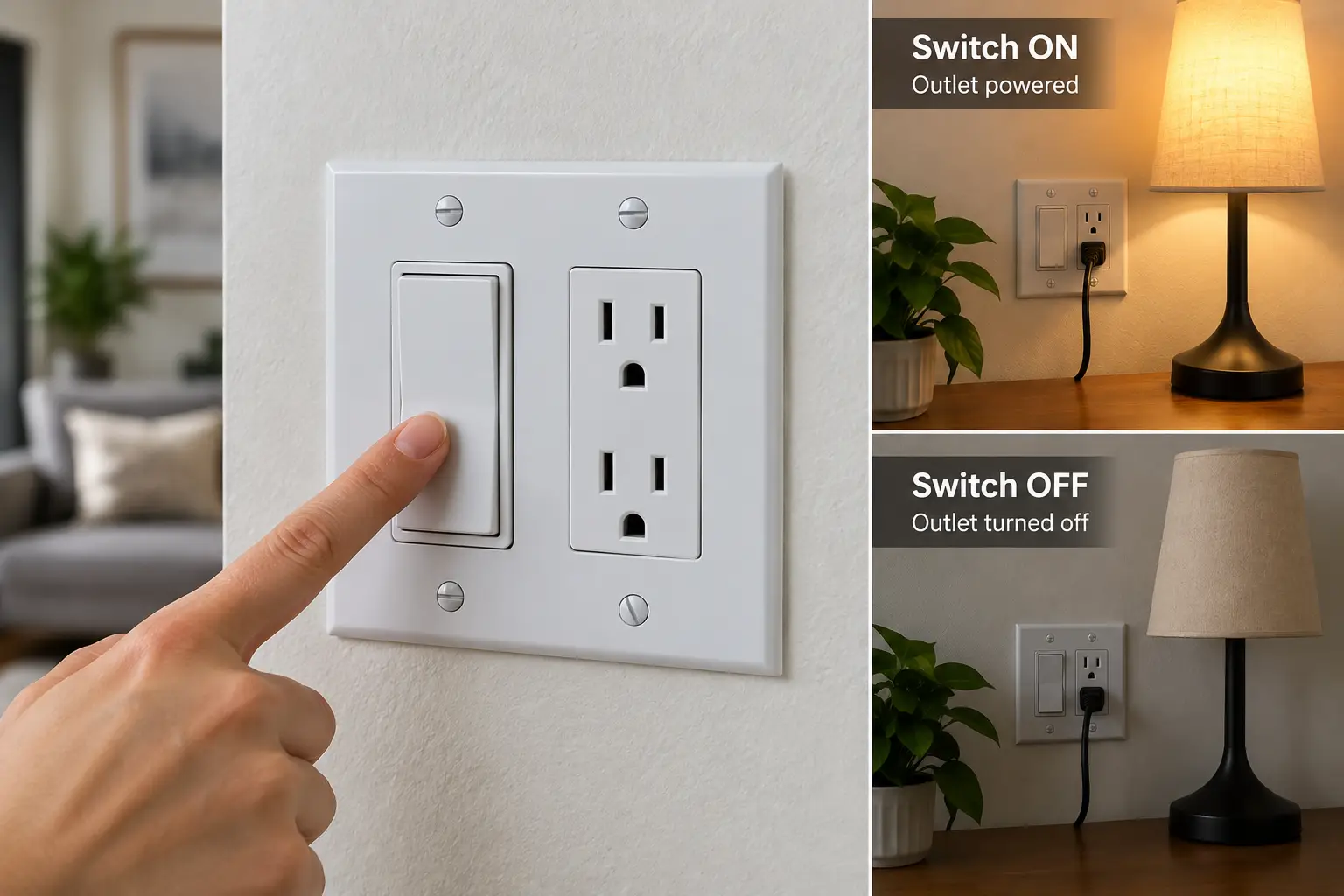
If you’ve ever wished you could flip a switch by the door and have your lamp, string lights, or space heater turn on without fumbling in the dark, you’ve already stumbled onto the appeal of a light switch that controls an outlet. It’s one of those small electrical upgrades that quietly makes a home feel more thought-out — no more crawling behind furniture to find a cord, no more leaving a lamp on all day because it’s a pain to reach.
A light switch that controls an outlet isn’t one single product; it’s a category that spans a handful of very different approaches. You can install a combination device that puts a switch and a receptacle in one wall box, wire an existing duplex outlet so the switch controls just the top or bottom half, or skip rewiring entirely and go wireless with a smart switch and plug-in module. Each path has real trade-offs in cost, code compliance, and how much electrical work is involved.
This guide breaks down seven real, currently available products that cover every version of this setup — from a basic $10 toggle combo to a GFCI-protected safety pick to a no-rewiring smart kit — along with the wiring logic, buying criteria, and common mistakes that separate a switch and outlet combo that works perfectly for years from one that trips a breaker on day one.
What Is a Light Switch That Controls an Outlet?
A light switch that controls an outlet is an electrical setup — either a single combination device or a “half-hot” wired duplex outlet — where flipping a wall switch turns power to a plug-in receptacle on and off, the same way it would turn on an overhead light. It’s most often used to control lamps, since most US homes don’t have ceiling fixtures in living rooms and bedrooms.
There are three ways to get this result, and they’re not interchangeable:
- A combination switch/outlet device — a single-gang unit with a toggle or rocker switch on top and a receptacle below, wired so the switch and outlet either share a feed or are split.
- A half-hot duplex outlet — a standard-looking two-plug outlet where an electrician (or a confident DIYer) breaks the connecting tab so the switch controls only the top or bottom plug, leaving the other always live.
- A wireless smart switch paired with a plug-in module — no rewiring at all; a battery or line-voltage smart switch talks to a device that plugs into any existing outlet.
Every product in this guide falls into one of those three categories, and which one is right for you depends heavily on your wiring, your landlord situation, and how many outlets you actually want on the switched circuit.
Quick Comparison at a Glance
| Product | Type | Best For | Price Range |
|---|---|---|---|
| Leviton T5625-WS | Decora combo switch/outlet | Most homeowners, easy retrofit | $12–$20 |
| Leviton 5225 | Traditional toggle combo | Tightest budget | Under $15 |
| Legrand Pass & Seymour 691W | Grounding combo switch/receptacle | Classic toggle look, durability | $20–$35 |
| ENERLITES 68625-TR-W | Decorator combo, tamper-resistant | Budget multi-packs | Under $12 |
| Hubbell RC108AL | Commercial-grade combo | Rentals, heavy daily use | $20–$30 |
| Legrand radiant 1597SWTTRWCCD4 | Self-test GFCI/switch combo | Bathrooms, garages, outdoor-adjacent rooms | $45–$65 |
| Lutron Caseta Wireless Starter Kit | Smart switch + plug-in module | Renters, no-rewire smart control | $60–$80 |
Looking at the table, the split is really about installation effort versus flexibility: the four toggle-and-rocker combo devices at the top are all wired-in replacements for an existing switch or outlet box, the Legrand radiant 1597SWTTRWCCD4 adds ground-fault protection for wet-adjacent rooms, and the Lutron Caseta Wireless Starter Kit sidesteps wiring altogether. If you already have a single-gang box with a switch leg run to it, any of the first six devices will drop in directly; if you don’t want to touch wiring at all, the Lutron kit is really the only option here.
💬 One click helps other shoppers make an informed choice too! 😊
Top 7 Light Switch and Outlet Combos Worth Buying in 2026
Here’s an honest, spec-driven look at seven real devices that let you control an outlet from a wall switch, ranging from a basic $10 toggle to a fully wireless smart kit. Each one is evaluated on what the hardware actually does, not just what the packaging says.
1. Leviton T5625-WS — best all-around retrofit for most homes
The Decora-style rocker design is the reason this is the most commonly recommended switch and outlet combo for a straightforward retrofit — it matches the flat, modern rocker switches most homes have installed since the early 2000s, so it doesn’t stick out next to your other switches. Underneath the styling, it’s a 15-amp, 120-volt single-pole switch paired with a 15-amp tamper-resistant receptacle, both rated for standard residential loads like lamps, phone chargers, or a small fan.
What that spec sheet means in practice: the tamper-resistant shutters satisfy the 2008 National Electrical Code requirement for new and renovated rooms, so you’re not just getting convenience, you’re getting code-compliant hardware without paying extra for it. Based on comparing this device against the plainer toggle models below, the main thing buyers are paying for here is the matching aesthetic and the two-pole terminal layout that makes it easier to separate the switch’s hot feed from the always-on side of the receptacle.
This is genuinely the pick for anyone replacing an existing Decora-style switch or outlet and wanting the new device to blend in. Home Depot’s own listing for this device shows it holding a 4.6-out-of-5 average across several hundred verified reviews, which is a strong aggregate signal for a $15 part — reviewers commonly flag the snug rocker action and multiple wiring configuration options as standout points, while a smaller number mention that the stamped mounting strap feels thinner than older Leviton devices.
Pros:
- ✅ Rocker style matches modern Decora switches and outlets
- ✅ Tamper-resistant receptacle meets current NEC requirements
- ✅ Strong, verifiable review average from a major retailer
Cons:
- ❌ Costs more than a basic toggle combo for the same function
- ❌ Mounting strap is lighter-gauge than commercial-grade alternatives
At around $12–$20 depending on color and retailer, the Leviton T5625-WS is a fair value pick for anyone prioritizing looks and code compliance over rock-bottom price.
2. Leviton 5225 — lightest on your wallet
There’s no rocker styling here, no screwless wall plate, no frills — just a traditional single-pole toggle switch and a 15-amp receptacle in one impact-resistant thermoplastic body. This is the device electricians reach for when a customer just wants a working switch and outlet combo and doesn’t care what it looks like.
In practice, that simplicity is the selling point. The toggle actuator is a proven mechanism with decades of field use behind it, and because this model skips the tamper-resistant shutter system found in the T5625-WS, it’s priced closer to what a standalone switch alone would cost. What most buyers overlook with a toggle-style combo like this is that the lack of tamper-resistant shutters means it typically isn’t code-legal for new construction or a permitted renovation in rooms covered by NEC 406.12 — it’s really best suited for like-for-like replacement of an existing non-TR device in an older home.
Home Depot doesn’t show a large public review count for this specific catalog number yet, so rather than invent sentiment, it’s fairer to say the verifiable track record here comes from Leviton’s broader toggle-switch line, which has decades of field reliability behind similar mechanisms.
Pros:
- ✅ Lowest price point in this entire lineup
- ✅ Simple toggle mechanism with a long field history
- ✅ Works as a drop-in replacement for old, non-TR combo devices
Cons:
- ❌ No tamper-resistant shutters, so it’s not ideal for new construction
- ❌ Basic thermoplastic body shows wear faster than commercial-grade devices
If your only goal is the lowest possible price for a working switch and outlet combo, the Leviton 5225 gets the job done for under $15.
3. Legrand Pass & Seymour 691W — the classic, grounded workhorse
Pass & Seymour has been making combination switch and receptacle devices for longer than most other brands in this list have existed, and the 691W reflects that: a single-pole, 15-amp toggle switch and a grounding 15-amp receptacle rated for 120/125 volts, with side-wire terminals that accept both 12 and 14 AWG copper.
The practical difference between this and a bargain-bin toggle combo is in the details — a long-life neon pilot lamp option, triple-wipe brass power contacts, and a break-off tab system that lets an electrician configure the switch and outlet to share a feed or run on separate circuits without extra parts. That flexibility matters more than it sounds: it’s the same feature that lets you convert this single device into either a fully switched combo or a half-hot-style setup depending on how the tab is broken.
Because this is a commercial-grade device sold mostly through electrical distributors rather than big-box consumer listings, it doesn’t carry a large public star-rating sample the way Decora products do — but its documented UL 20 and UL 498 listings and decades-long production run are themselves a form of verifiable track record, even without a pile of star ratings attached.
Pros:
- ✅ Break-off feed tab allows flexible switch/outlet wiring configurations
- ✅ Heat-treated brass contacts rated for long-term commercial use
- ✅ Backed by UL 20 and UL 498 safety listings
Cons:
- ❌ Dated toggle look won’t match Decora-style rocker switches nearby
- ❌ Sold mostly through electrical suppliers, so shopping around takes more effort
Expect to pay in the $20–$35 range for the Legrand Pass & Seymour 691W, depending on color and where you buy it.
4. ENERLITES 68625-TR-W — the budget-friendly alternative brand
ENERLITES has built a reputation as the value alternative to the big three electrical brands, and the 68625-TR-W combo switch delivers on that promise: a 15-amp, 120-volt decorator paddle switch paired with a 15-amp, 125-volt tamper-resistant receptacle, UL listed and rated for residential or light commercial use.
What that means for your wallet is real — this device routinely undercuts Leviton and Legrand equivalents while still including the tamper-resistant shutters that keep it code-compliant for most residential applications. The paddle-style switch actuator matches the same rocker aesthetic as pricier Decora devices, so you’re not sacrificing looks for the lower price, just the brand name and, likely, some of the long-term durability testing that goes into the premium lines.
Real aggregated review data is available here: Walmart’s listing for this exact device shows a 4.4-out-of-5 average, based on a modest sample of verified purchases. That’s a smaller sample than the big-brand listings in this roundup, so treat it as a promising early signal rather than a definitive track record — but it’s honest, verifiable sentiment rather than a guess.
Pros:
- ✅ Tamper-resistant shutters included at a below-$12 price point
- ✅ Rocker-style paddle switch matches modern decor
- ✅ Positive early review average from verified buyers
Cons:
- ❌ Smaller brand with a shorter long-term reliability track record
- ❌ Limited color and finish options compared to Leviton or Legrand
For anyone stocking multiple rooms on a tight budget, the ENERLITES 68625-TR-W is one of the better dollar-for-dollar picks in this guide.
5. Hubbell RC108AL — built for heavy daily use
Hubbell’s commercial and industrial wiring devices show up in office buildings, apartment complexes, and hospitals — places where a switch gets flipped dozens of times a day and simply cannot fail. The RC108AL brings that same engineering down to a residential-friendly combination switch and 15-amp receptacle, rated 125 volts and built around a heavier internal contact assembly than typical consumer-grade combos.
In practical terms, that extra durability matters most in situations most homeowners never think about: rental units between tenants, home offices where a lamp gets switched dozens of times a day, or mudrooms and entryways where hands are often full or gloved. Based on comparing spec sheets across this lineup, the RC108AL’s contact rating and mounting strap gauge sit closer to what you’d find in a light-commercial installation than a typical big-box residential switch, which is exactly why property managers and electricians often specify Hubbell for multi-unit buildings.
As with the Legrand 691W, this device is sold primarily through electrical supply channels rather than mass-market retail, so a large public star-rating sample isn’t readily available — its track record is better verified through its UL listing and its established use in commercial specifications than through consumer review counts.
Pros:
- ✅ Commercial-grade contact assembly built for high switch cycles
- ✅ Well-suited to rental turnover and high-traffic rooms
- ✅ Established specification history in multi-unit and commercial buildings
Cons:
- ❌ Costs more than comparable residential-grade combo switches
- ❌ Almond and gray finish options are more limited than consumer lines
Budget around $20–$30 for the Hubbell RC108AL, which is a reasonable premium for hardware built to outlast a typical rental turnover cycle.
6. Legrand Pass & Seymour radiant 1597SWTTRWCCD4 — the safety-first pick
This is the one product in this lineup built for a genuinely different purpose: it combines a 15-amp single-pole switch with a self-testing, tamper-resistant GFCI receptacle in a single decorator-style device. That’s a meaningful upgrade over the other six products here, none of which include ground-fault protection.
In practice, this matters most in half-baths, laundry rooms, garages, and any room within six feet of a water source, where the National Electrical Code requires GFCI protection on receptacles regardless of whether they’re also switch-controlled. The self-test function is worth calling out specifically: older GFCI devices can lose their protective function silently while still passing power, and self-testing models automatically monitor their own circuitry and flag a fault, closing that safety gap without requiring a monthly manual test.
Because this is a specialized safety device rather than a high-volume consumer product, it doesn’t have the kind of large public review sample that the Decora-style combos do. What is verifiable is its compliance profile: it’s built to UL 943 (the GFCI-specific standard) in addition to UL 20 and UL 498, which is the correct certification stack for this application.
Pros:
- ✅ Combines switch control with genuine GFCI ground-fault protection
- ✅ Self-test function catches silent GFCI failures automatically
- ✅ Correct, code-appropriate choice for bathrooms and garages
Cons:
- ❌ Most expensive wired option in this lineup
- ❌ Overkill for a dry living room or bedroom application
Expect to pay in the $45–$65 range for the Legrand Pass & Seymour radiant 1597SWTTRWCCD4 — money well spent in any room that legally requires GFCI protection.
7. Lutron Caseta Wireless Starter Kit — no wiring required
The Lutron Caseta Wireless Starter Kit pairs a battery-free, wireless Pico remote switch with a plug-in lamp module, letting you add a wall switch that controls a plug without opening a single wall box or running any new wire. The plug-in module simply plugs into an existing always-on outlet, controls up to two lamps, and communicates with the Pico switch (which mounts to any wall surface, including over an existing switch plate) using Lutron’s Clear Connect RF protocol.
For renters, older homes with plaster walls, or anyone who doesn’t want to hire an electrician for a small convenience upgrade, this is the only realistic path to a switch that controls an outlet — because nothing about the installation is permanent or requires access to the electrical panel. Reviews and independent testing consistently point to the same strength here: Lutron’s Clear Connect protocol has a stronger reputation for reliability than competing Wi-Fi smart plugs, and Wirecutter has named Lutron’s Caseta line a longtime top pick in the smart lighting category, citing its dependable local (non-cloud-dependent) response time.
The trade-off is functional, not aesthetic: this system only controls what’s plugged into the module, not a hardwired outlet circuit, and adding whole-home smart control (voice assistants, scheduling, geofencing) requires the separately sold Lutron Smart Bridge.
Pros:
- ✅ Zero rewiring — ideal for renters and older homes
- ✅ Clear Connect RF has a stronger reliability reputation than Wi-Fi plugs
- ✅ Pico remote can be relocated or wall-mounted without an electrician
Cons:
- ❌ Only controls what’s plugged into the module, not a wired outlet
- ❌ Full smart home features require the separately sold Smart Bridge
At around $60–$80 for the starter kit, the Lutron Caseta Wireless Starter Kit is the priciest entry here, but it’s also the only one that requires zero electrical work.
Comparing the Top 7 Side by Side
| Product | Switch Type | GFCI Protected | Wiring Required | Best For |
|---|---|---|---|---|
| Leviton T5625-WS | Rocker | No | Yes | Decora-style rooms |
| Leviton 5225 | Toggle | No | Yes | Tightest budgets |
| Legrand Pass & Seymour 691W | Toggle | No | Yes | Classic look, flexible wiring |
| ENERLITES 68625-TR-W | Rocker | No | Yes | Multi-room budget projects |
| Hubbell RC108AL | Toggle | No | Yes | Rentals, high-traffic rooms |
| Legrand radiant 1597SWTTRWCCD4 | Rocker | Yes | Yes | Bathrooms, garages |
| Lutron Caseta Wireless Starter Kit | Wireless | No | No | Renters, no-rewire projects |
The clearest takeaway from this table is that GFCI protection is a specialized need, not a default feature — only the Legrand Pass & Seymour radiant 1597SWTTRWCCD4 offers it, so if your project is in a bathroom, garage, or anywhere near water, that’s the device to start with regardless of price. For everyone else choosing between the wired options, the decision mostly comes down to finish and budget, since the underlying switching function is functionally identical across the Leviton, Legrand, ENERLITES, and Hubbell devices.
⚡ Ready to upgrade your wiring?
🔍 Browse the full lineup above and click through to check current pricing and availability before you commit. Matching the right device to your room — and your comfort level with electrical work — makes this a five-minute upgrade instead of a weekend project gone wrong.
How to Wire and Install a Light Switch That Controls an Outlet
Before you buy anything, it helps to understand what “switched outlet wiring” actually involves, because it changes which product from this list makes sense for your situation.
Turn off the breaker first, every time. This sounds obvious, but the single most common cause of a botched switched-outlet install is skipping this step and working on a “probably dead” circuit. Use a non-contact voltage tester to confirm before touching any wire.
Identify where power enters the circuit. If power comes into the switch box first, the wiring is straightforward: the incoming hot connects to one switch terminal, and a wire runs from the other switch terminal down to the outlet’s hot side. If power enters at the outlet box first, you’ll need to run a switch leg back to the switch — this is the scenario where a half-hot outlet (breaking the tab between the top and bottom receptacle halves) is often simpler than swapping in a combination device.
Decide between a combination device and a half-hot duplex outlet. A combination switch/outlet device (like the seven products above) puts the switch and outlet in the same box, which is ideal when you want a switch physically located where the outlet already is. A half-hot outlet keeps the switch in its existing location and only modifies the outlet, which is more common for controlling a lamp from an existing wall switch across the room.
In the first 30 days, watch for two common issues. First, if the switch does nothing, the most frequent culprit is forgetting to break the connecting tab on the “hot” side of a half-hot outlet — without removing it, both plugs stay live regardless of the switch position. Second, if the switch works but nothing else on that outlet does, check whether the neutral tab was accidentally broken instead of the hot tab; the neutral side must remain intact for either scenario to work correctly.
For a full wiring-diagram walkthrough of both the switch-first and outlet-first scenarios, Ask the Electrician’s switched outlet diagrams lays out the terminal-by-terminal connections in more detail than fits here.
Real-World Scenarios: Who Actually Needs This Upgrade
The renter with no ceiling light. A lot of older apartments and starter homes have bedrooms and living rooms with no overhead fixture at all — just a switch that, frustratingly, does nothing. For this person, the Lutron Caseta Wireless Starter Kit is close to a perfect fit: no permission from a landlord is needed to add a wall switch to a room, since nothing about the plug-in module or the Pico remote requires modifying the building’s wiring.
The homeowner doing a room refresh. If you own your home and you’re already repainting or replacing switch plates in a room, this is the ideal moment to swap a plain outlet for something like the Leviton T5625-WS or the ENERLITES 68625-TR-W, both of which match modern Decora styling. Since the wall is already open or the switch plate is already off, the marginal cost of upgrading to a switch/outlet combo is mostly just the price of the device itself.
The family finishing a bathroom or garage. Anyone doing electrical work in a bathroom, laundry room, or garage needs to think GFCI first, switch-control second — and that’s exactly the situation the Legrand Pass & Seymour radiant 1597SWTTRWCCD4 was designed for. Skipping GFCI protection here isn’t just a missed convenience feature; it’s a genuine safety and code compliance issue.
Problem → Solution: Fixing Common Switch/Outlet Combo Issues
Problem: The switch works, but the outlet is always dead. This is almost always a broken or missing connection on the receptacle’s hot side after the feed tab was removed incorrectly. Solution: turn off the breaker, pull the device, and confirm the hot-side tab is intact if you want the switch to control the outlet at all — it should only be removed if you’re deliberately separating the two circuits.
Problem: Both outlets stay on regardless of the switch. This happens when the connecting tab on a half-hot outlet was never broken in the first place. Solution: with power off, use pliers to wiggle the small brass tab between the top and bottom terminals on the hot (brass) side back and forth until it snaps cleanly.
Problem: The GFCI switch/outlet combo won’t reset. A self-testing GFCI device that repeatedly trips or won’t reset is usually either wired backward (line and load reversed) or has genuinely detected a ground fault downstream. Solution: verify the line-side wires are connected to the terminals marked “LINE,” not “LOAD” — this is the single most common GFCI installation mistake, and it will cause exactly this symptom.
Problem: A wireless smart switch won’t pair with the plug-in module. Solution: confirm the module is plugged into a constantly powered outlet (not one already controlled by another switch) and that both devices are within Lutron’s stated Clear Connect range, typically around 30 feet through interior walls — pairing failures are almost always a range or power issue, not a hardware defect.
Problem: A tamper-resistant receptacle is hard to plug into. Solution: this is a known characteristic of the spring-loaded shutter mechanism required by code, not a defect — pushing the plug in with firm, even pressure (rather than at an angle) typically resolves it.
How to Choose a Combination Switch and Outlet
- Check whether the room requires GFCI protection. Bathrooms, kitchens, garages, and anywhere within six feet of a water source need GFCI, which narrows your choice to a device like the Legrand Pass & Seymour radiant 1597SWTTRWCCD4 rather than a standard combo.
- Confirm your amperage and circuit type. Nearly every residential application uses a standard 15-amp, 120-volt circuit, which every product in this guide is rated for — but always verify against your breaker before buying.
- Decide between rocker and toggle styling. This is purely cosmetic, but it matters for matching the rest of the room; rocker-style devices like the Leviton T5625-WS and ENERLITES 68625-TR-W match newer Decora hardware.
- Weigh DIY comfort against wiring complexity. If you’re not confident working inside a wall box, the Lutron Caseta Wireless Starter Kit avoids the issue entirely.
- Think about how many outlets you actually want switched. A combination device only switches its own single receptacle; if you want an entire multi-outlet circuit switch-controlled, that’s a bigger project involving a dedicated switch leg, not just a device swap.
- Factor in daily use cycles. High-traffic rentals or offices benefit from commercial-grade hardware like the Hubbell RC108AL, which is built for more switch cycles than a standard residential device.
- Set a realistic budget across the whole project. Devices in this guide range from under $12 to around $80, but don’t forget wall plates, wire nuts, and — if you’re not doing it yourself — an electrician’s labor, which typically adds more to the total cost than the device itself.
Common Mistakes to Avoid When Buying a Switch/Outlet Combo
The single most common mistake is buying a non-tamper-resistant device, like the base Leviton 5225, for a room covered by current code requirements — it’ll work fine electrically, but it may not pass inspection on a permitted renovation. Always check your local code before choosing a non-TR toggle device.
A close second is underestimating amperage needs. All seven products here are rated for standard 15-amp household circuits, which is fine for lamps and small electronics but not for anything like a space heater or window air conditioner — those loads need a dedicated, higher-amp circuit regardless of which switch/outlet combo you’re considering.
Buyers also frequently skip GFCI protection in rooms that legally require it, usually because a standard combo device is a few dollars cheaper than the Legrand Pass & Seymour radiant 1597SWTTRWCCD4. That’s a false economy — a failed electrical inspection or, worse, an actual shock hazard costs far more than the price difference between the two devices.
Finally, a lot of renters assume they need permission or professional installation for any switch-related upgrade, missing that the Lutron Caseta Wireless Starter Kit requires neither. It plugs in and mounts with adhesive strips or a screw kit, not a rewire.
Combination Switch and Outlet vs. Separate Devices
| Factor | Combination Switch/Outlet | Separate Switch + Outlet |
|---|---|---|
| Wall space used | One single-gang box | Two boxes (or a two-gang box) |
| Installation | Direct swap of existing device | May require adding a new box |
| Cost | $10–$80 for one device | Two devices, plus possible box/wire work |
| Flexibility | Switch and outlet locked together | Switch can be located anywhere on the circuit |
The core trade-off here is spatial versus flexible: a combination switch and outlet is the better call whenever you want both functions in the exact same wall location — say, replacing an outlet that’s currently unswitched with one that finally is. A separate switch and outlet setup makes more sense when the switch needs to be somewhere else entirely, like by the room’s entry door while the outlet stays where a lamp already sits, since only a half-hot wiring configuration (not a combination device) supports that layout.
Compared to the alternative of simply leaving an outlet unswitched and using an in-line lamp cord switch, either wired approach is meaningfully more convenient and more reliable long-term — cord switches wear out and dangle awkwardly, while a wall-mounted device becomes a permanent, durable part of the room.
Features That Actually Matter (and Ones That Don’t)
What actually matters: tamper-resistant shutters (required by code in most new and renovated residential rooms), correct amperage rating for your circuit, and — critically, if the room is bathroom-, kitchen-, garage-, or outdoor-adjacent — GFCI protection. These aren’t optional nice-to-haves; they’re the difference between a device that’s genuinely safe and legal to install and one that isn’t, regardless of how good it looks.
What doesn’t matter nearly as much as marketing suggests: exact operating-cycle counts printed on commercial-grade spec sheets. Yes, the Hubbell RC108AL is rated for more switch cycles than a basic residential device, but unless you’re installing in a genuinely high-traffic commercial or rental setting, a standard residential-grade device like the Leviton T5625-WS will comfortably outlast typical home use — most switches fail from a loose wire connection or physical damage long before the internal contacts wear out from normal cycling.
Color-matching to existing wall plates is a real consideration for resale value and visual consistency, but it’s aesthetic, not functional — don’t let it override safety or code requirements when choosing between devices.
Safety, Regulations, and Standards
Every device in this guide that isn’t wireless needs to meet UL 498 (the general standard for attachment plugs and receptacles), and any device advertised as tamper-resistant is separately tested against additional probe-insertion requirements under that same standard. The 2008 National Electrical Code introduced the requirement that essentially all 125-volt, 15- and 20-amp receptacles in new residential construction be tamper-resistant — a change driven by Consumer Product Safety Commission data showing thousands of children treated annually in emergency rooms for outlet-related shock and burn injuries. That data and the resulting code change are documented in detail in this ANSI-published case study on tamper-resistant receptacle standards.
GFCI protection is a separate requirement layered on top of tamper resistance in specific rooms — bathrooms, kitchens, garages, unfinished basements, and any location within six feet of a sink or other water source. A university environmental health and safety fact sheet on ground-fault circuit interrupters is a genuinely useful, plain-language explainer if you want to understand exactly how a GFCI device detects a fault and interrupts power before it becomes dangerous: University of Washington’s GFCI focus sheet covers this clearly.
None of the seven devices in this guide are AFCI (arc-fault) devices, which is a separate protection category typically handled at the breaker panel rather than the outlet, and is worth mentioning here only because homeowners sometimes conflate the two acronyms when shopping.
Long-Term Cost and Maintenance
The devices themselves are inexpensive relative to almost any other home improvement category — even the priciest wired option here, the Legrand Pass & Seymour radiant 1597SWTTRWCCD4, costs less than a single hour of most electricians’ labor. That means the real long-term cost consideration isn’t the hardware, it’s whether you’re paying for professional installation.
| Cost Factor | DIY Approach | Professional Installation |
|---|---|---|
| Device cost | $10–$80 (device only) | Same device cost |
| Labor | $0 (your time) | Typically $75–$200+ per device, varies by region |
| Risk if done incorrectly | Potential rework, code issues | Covered by contractor’s workmanship |
Looking at that breakdown, the math clearly favors DIY installation for anyone comfortable working with a de-energized circuit and a voltage tester — the device cost is a small fraction of typical electrician labor rates. That said, GFCI installations and any project involving opening new wall space are exactly the situations where paying for a licensed electrician is worth the premium, both for safety and because incorrect GFCI wiring (reversed line/load) is a common enough mistake that professional installation meaningfully reduces the risk.
Maintenance itself is minimal across every device in this guide: GFCI models should be tested monthly using the built-in test button, and any combination device that starts feeling loose or warm to the touch should be inspected immediately, since a warm switch or outlet is one of the clearer early warning signs of a loose wire connection.
✨ Don’t miss these exclusive deals!
🔍 Take your home’s wiring to the next level with this carefully curated lineup. Click a highlighted item to check current pricing and availability. These picks will help you get a more convenient, better-lit home the whole family will enjoy!
Frequently Asked Questions
❓ Can I convert a regular outlet into a switch and outlet combo myself?
❓ Do all switch/outlet combos need a neutral wire?
❓ Is a switch and outlet combo up to code in every room?
❓ What's the difference between a half-hot outlet and a switch/outlet combo device?
❓ How much does it cost to have an electrician install a switched outlet?
Conclusion
A light switch that controls an outlet is a small upgrade with an outsized payoff — it turns a room with an inconvenient, unswitched lamp into one that works the way you’d expect a modern space to work. The right product for the job depends almost entirely on your situation: the Leviton T5625-WS and ENERLITES 68625-TR-W cover most standard rooms affordably, the Legrand Pass & Seymour radiant 1597SWTTRWCCD4 is the only responsible choice for a bathroom or garage, the Hubbell RC108AL earns its higher price in high-traffic rentals, and the Lutron Caseta Wireless Starter Kit is the answer whenever rewiring isn’t an option at all.
Whichever route fits your home, the underlying advice stays the same: match the device to the room’s code requirements first, your aesthetic preferences second, and don’t let a few dollars of savings push you toward skipping tamper-resistant or GFCI protection where it’s actually required.
🔌 Ready to stop fumbling for lamp cords in the dark?
✨ Check current pricing on the pick that fits your room, and give your space the kind of switch-controlled convenience it should have had from day one.
Recommended for You
- Connect Kasa to Alexa: 7 Best Devices for a Smarter 2026 Home
- Dual Smart Switch: 7 Best Picks for 2026 You Can Trust
- 3 Gang Smart Switch: 7 Best Picks for 2026 (Pros & Cons)
Disclaimer: This post contains affiliate links. As an Amazon Associate, I earn from qualifying purchases made through these links, at no additional cost to you.
✨ Found this article helpful? Share it with someone who needs it! 💬🤗