
In This Article
Introduction: One 240V Outlet, Two Hungry Machines
You finally bought the table saw. Or the second mini-split, the kiln, the server rack, the 240V air compressor. Then you walk into the garage and see it: one lonely 240-volt receptacle on the wall, and two plugs that both want it. Swapping cords every time you change tools gets old fast, and calling an electrician for a new circuit can run into the hundreds of dollars. That’s exactly the moment people start searching for a 220v dual outlet splitter box.
Here’s the honest truth up front: a 220v dual outlet splitter box is a convenience device, not a magic power multiplier. It gives you two places to plug in, but both outlets still share the same breaker and the same wire in your wall. Used correctly — two tools that rarely run at the same time, or two light loads that together stay under the circuit’s limit — it’s one of the cheapest, smartest upgrades for a shop, server closet, or job site. Used carelessly, it’s a tripped breaker (or worse) waiting to happen.
This guide walks you through seven real products available to US buyers on amazon.com, from simple 6-20 Y cords to locking L6-30 power splitters and a DIY duplex option. Every recommendation is based on manufacturer spec sheets and real-world electrical logic — plug type, wire gauge, total wattage, and whether the splitter actually matches the circuit behind your wall. If you’re new to plug codes like 6-20 or L6-30, the NEMA connector reference on Wikipedia is a handy companion while you read.
By the end, you’ll know which 240v outlet splitter fits your setup, which ones to avoid for your circuit, and how to set one up so it runs cool and safe for years. ⚡
What Is a 220v dual outlet splitter box?
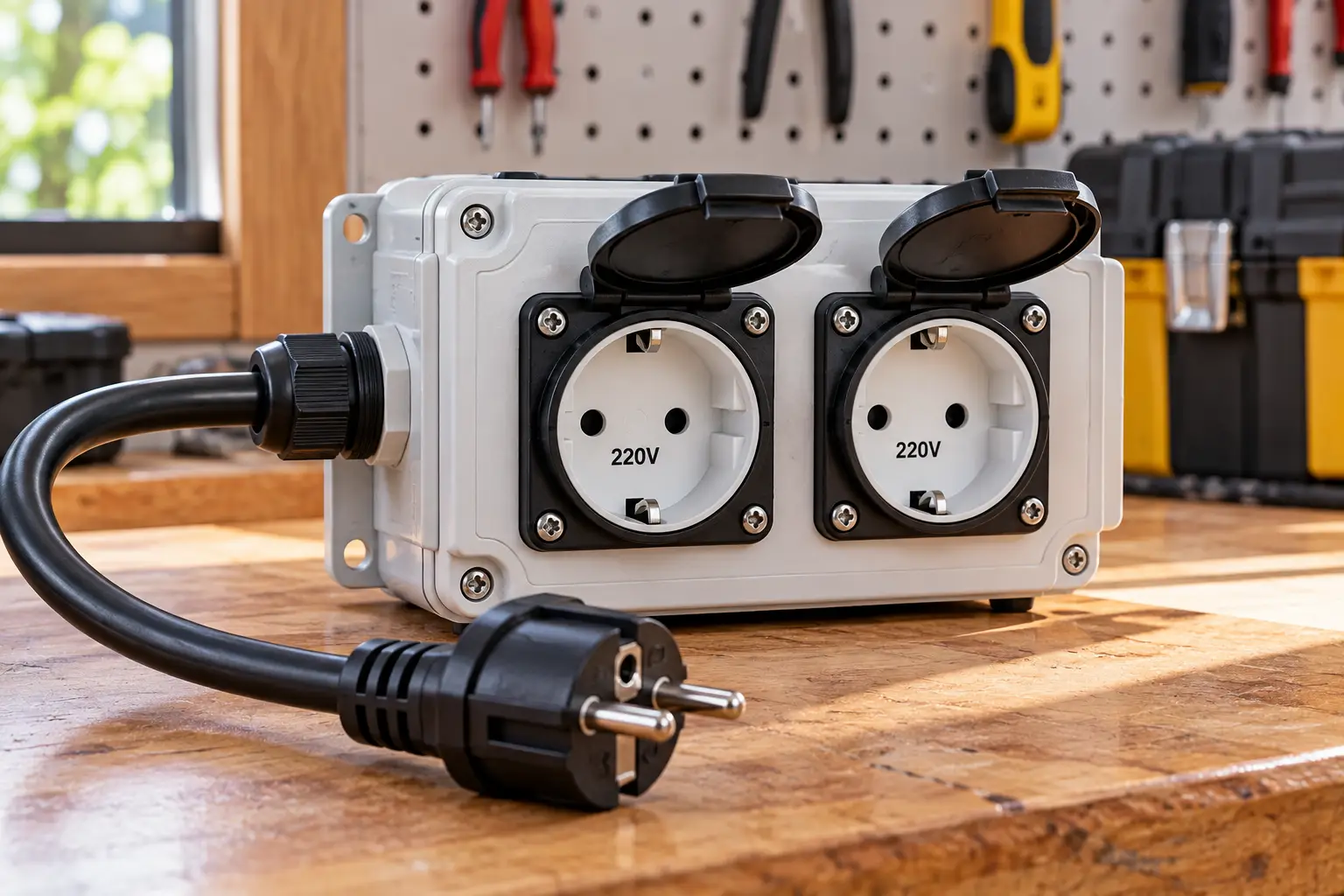
A 220v dual outlet splitter box is an adapter that plugs into a single 220-240V receptacle and provides two 220-240V outlets. It shares one circuit’s capacity between two devices — it doesn’t add power. Common versions include NEMA 6-20 Y cords, locking L6-20 and L6-30 splitters, and hard-wired duplex receptacle boxes.
Why “220V,” “240V,” and “250V” all describe the same thing
You’ll see all three numbers on product pages, and that confuses a lot of shoppers. In most US homes, “220V” is the old nickname, 240V is the nominal voltage your utility actually delivers across two hot legs, and 250V is the maximum rating printed on plugs and receptacles. So a splitter labeled “250V” is designed for your “220V” outlet — no conflict at all.
Where these splitters are most useful
- 🪚 Home woodshops running a 240V table saw and jointer (one at a time)
- 🖥️ Server racks feeding two PDUs or UPS units from one L6-20 or L6-30 outlet
- ❄️ Small 240V window AC units or heaters on a shared circuit
- 🏗️ Job sites distributing generator power to two 240V tools
The key word across all of them is shared. Keep that in mind and every buying decision gets easier.
Quick Comparison: 7 Best 220V Dual Outlet Splitters at a Glance
| Product | Input Plug | Outputs | Rated Load | Best for |
|---|---|---|---|---|
| AC WORKS V-DUO ADVL620L620 | L6-20P (locking) | 2× L6-20R | 20A / 5,000W max | AC WORKS V-DUO ADVL620L620: twist-lock shop and rack gear |
| AC WORKS V-DUO ADVL630620 | L6-30P (locking) | 2× 6-20R | 30A input / 7,500W total | AC WORKS V-DUO ADVL630620: generator or 30A outlet to standard 6-20 tools |
| Parkworld 60509 | 6-20P | 2× 6-20R (accept 6-15P) | 20A, 12/3 cord, 3 ft | Parkworld 60509: budget garage setups |
| Tripp Lite P039-001-2 | L6-20P | 2× L6-20R | 20A, 10 AWG, 1 ft | Tripp Lite P039-001-2: mission-critical server racks |
| Parkworld 885194 | L6-30P | 2× L6-20R | 30A in / 20A outlets | Parkworld 885194: locking 30A-to-20A distribution |
| Parkworld 61520 | 6-30P | 2× 6-30R | 30A, 3 ft | Parkworld 61520: welders and 30A shop tools |
| Leviton 5822 | Hard-wired | Duplex 6-20R | 20A / 250V | Leviton 5822: a permanent DIY two-outlet box |
Looking at this table, the biggest dividing line isn’t brand — it’s plug style. If your wall outlet is a straight-blade 6-20, the Parkworld 60509 is the most direct fit, while twist-lock outlets point you toward the AC WORKS V-DUO ADVL620L620 or Tripp Lite P039-001-2. The 30-amp-input models (AC WORKS V-DUO ADVL630620 and Parkworld 885194) are the most flexible, but they also demand the most care, because their 20A outlets sit downstream of a 30A breaker — something we unpack in the safety section below.
💬 One click helps other shoppers make an informed choice too! 😊
Top 7 220V Dual Outlet Splitters: Expert Analysis
Before diving in, a quick note on how these picks were chosen. None of these products were hands-on tested for this article. Instead, each one was evaluated on published manufacturer specs (plug type, wire gauge, wattage, warranty), how well it matches common US circuits, and whatever genuine buyer feedback could be verified at the time of writing. Where verified review data was thin, we say so plainly.
1. AC WORKS V-DUO ADVL620L620 — best locking splitter for everyday shops
The AC WORKS V-DUO ADVL620L620 turns one twist-lock L6-20 outlet into two, and it’s the most balanced all-rounder in this lineup. According to the manufacturer, it pairs a locking L6-20P plug with two L6-20R connectors, a built-in power indicator light, nickel-plated contacts, and a maximum operating rating of 5,000 watts.
What that means in practice: the twist-lock connection won’t wiggle loose when someone trips over a cord or a vibrating compressor tugs on it — a real advantage over straight-blade splitters in busy shops. The indicator light sounds trivial, but it saves you from troubleshooting a “dead” tool when the problem is actually an upstream breaker. Nickel plating resists corrosion in damp garages, which matters more than most buyers realize.
This is the pick for anyone who already has L6-20 outlets — common in workshops, labs, and small server rooms — and wants a compact, no-fuss way to share them between two devices that won’t run full-tilt simultaneously.
We couldn’t verify a substantial body of amazon.com reviews for this specific model at the time of writing, so check the listing’s current feedback before buying; the 5-year limited warranty from AC WORKS is a reassuring backstop.
Pros:
- ✅ Twist-lock plugs resist accidental disconnection
- ✅ Power indicator light confirms the circuit is live
- ✅ Five-year limited warranty from the manufacturer
Cons:
- ❌ Only works with L6-20 locking outlets
- ❌ Combined load still capped at the 20A circuit
💲 Typically in the $40–$70 range (check the current price) — strong value given the locking hardware and warranty.
2. AC WORKS V-DUO ADVL630620 — most flexible for 30A generators
The AC WORKS V-DUO ADVL630620 takes a 30-amp L6-30 locking outlet — the kind found on many portable generators and in commercial spaces — and splits it into two standard straight-blade 6-20R outlets. AC WORKS lists a total maximum operating power of 7,500 watts and includes a power indicator and a 5-year limited warranty.
Here’s why that’s interesting: most 240V shop tools and some EV chargers ship with 6-20 plugs, not L6-30. This adapter lets you run two of them off a single generator outlet without hunting for a separate adapter for each. The manufacturer also notes it’s compatible with some EVs whose chargers use a 6-20 plug.
However — and this is the part most product pages skip — the 6-20R outlets on this splitter are rated for 20 amps, while the L6-30 outlet feeding it is typically protected by a 30-amp breaker. Our reading of the published specs is that this model does not include its own 20A breaker, so a single overloaded tool could theoretically pull more than 20A before anything trips. That makes it best for experienced users who know their loads. AC WORKS does sell breaker-equipped single-outlet adapters (such as the L630CB620), which tells you the brand takes this concern seriously.
Verified amazon.com review data for this exact model was limited at the time of writing, so read the latest feedback on the listing.
Pros:
- ✅ Converts generator L6-30 power into common 6-20 outlets
- ✅ Highest total wattage rating in this lineup
- ✅ Compact, rugged design with an indicator light
Cons:
- ❌ No built-in 20A breaker protecting each outlet
- ❌ Overkill if your wall outlet is already 6-20
💲 Usually around $40–$65 (prices may vary) — excellent value for generator owners who manage loads carefully.
3. Parkworld 60509 — best budget 6-20 Y splitter
The Parkworld 60509 is the most straightforward answer to the most common search: a 6-20 splitter for a standard straight-blade 240V outlet. It’s a 3-foot Y cord with a NEMA 6-20P plug feeding two 6-20R sockets, built with 12/3 copper wire, and its T-blade receptacles also accept 6-15 plugs.
That 12-gauge wire is the spec that matters most. Twelve-gauge is the standard size for 20-amp circuits, so the cord itself won’t be the weak link when you’re near the circuit limit. The T-slot sockets are a quiet bonus: many smaller 240V tools and window AC units ship with 6-15 plugs, and this splitter takes both without another adapter. Home Depot’s listing for the same model highlights nickel-plated brass pins to resist corrosion.
Think of the Parkworld 60509 as the garage hobbyist’s tool: perfect for sharing one 6-20 outlet between, say, a 240V table saw and a dust collector you switch on together only if their combined amps allow it.
We couldn’t verify a large pool of amazon.com reviews tied to this exact model number at the time of writing, so check the listing for current buyer feedback before ordering.
Pros:
- ✅ Matches the most common 240V shop outlet
- ✅ Heavy 12/3 copper cord sized for 20 amps
- ✅ T-blade sockets also accept 6-15 plugs
Cons:
- ❌ Straight blades can be bumped loose
- ❌ Y-cord format leaves plugs dangling
💲 Generally in the $35–$55 range (check current pricing) — the best value in this roundup.
4. Tripp Lite P039-001-2 — best for server racks and UPS systems
The Tripp Lite P039-001-2 is the data-center pick. Made by Tripp Lite (now part of Eaton), it splits one L6-20 outlet into two L6-20R connectors over a short 1-foot cord, and it uses heavier 10 AWG wire rather than the 12 AWG you’d normally expect on a 20A cord.
That 10-gauge wire is the headline. For a 1-foot cord, voltage drop is negligible either way, but the heavier conductors run cooler under sustained loads — exactly what a rack running two PDUs around the clock needs. Tripp Lite designed it specifically for feeding dual PDUs or UPS units, and the locking connectors protect against the costly downtime of a cord popping out when someone slides equipment in a tight rack. The short length also reduces cable clutter behind the cabinet.
If you’re an IT admin or a homelab enthusiast who values reliability over price, this is the most professional option here. Resellers list a lifetime limited warranty on this part, which is unusual for a cable at any price.
Most verified feedback for this model comes from enterprise resellers rather than amazon.com reviews, so check the Amazon listing for current US buyer comments.
Pros:
- ✅ Heavy 10 AWG wire runs cooler under constant load
- ✅ Locking connectors prevent costly rack downtime
- ✅ Short 1-ft length keeps cabinets tidy
Cons:
- ❌ Noticeably pricier than shop-grade splitters
- ❌ 1-ft length is too short for most garages
💲 Prices vary widely, often from about $90 to well over $150 — worth it for critical equipment, overkill for a hobby shop.
5. Parkworld 885194 — best locking 30A-to-20A splitter
The Parkworld 885194 splits one L6-30 twist-lock outlet into two L6-20 twist-lock outlets, keeping the security of locking plugs on both ends. It’s essentially the all-locking cousin of the AC WORKS V-DUO ADVL630620.
Why choose it? If your equipment already uses L6-20 plugs — common on commercial gear, some rack PDUs, and stage or event equipment — this avoids the “lock on one end, straight blade on the other” compromise. Every connection twists and locks, which matters on job sites, in rental setups, and anywhere cords get stepped on.
The same caution applies here as with any 30A-to-20A splitter: the L6-20 outlets are rated for 20 amps, but the circuit feeding them is usually on a 30-amp breaker. Unless your specific unit includes downstream protection (check the listing carefully), plan your loads so each device stays well under 20A. Experienced users running known, steady loads — like two UPS units — are the ideal audience.
Amazon review data specific to this model number was limited at the time of writing; the same model also appears at other major US retailers, so cross-check feedback before buying.
Pros:
- ✅ Locking connectors on input and both outputs
- ✅ Turns a 30A outlet into two usable 20A outlets
- ✅ Good fit for commercial and event equipment
Cons:
- ❌ Likely no per-outlet breaker protection
- ❌ L6-20 plugs are less common on home tools
💲 Typically around $45–$65 (prices may vary) — fair value for pros who need locking everywhere.
6. Parkworld 61520 — best for welders and 30A tools
The Parkworld 61520 is the heavy hitter. It splits one NEMA 6-30 outlet into two 6-30R outlets on a 3-foot cord, so both outputs carry the same 30-amp rating as the input.
That symmetry is actually its biggest safety advantage. Unlike 30A-to-20A splitters, there’s no mismatch between the breaker and the outlets — the breaker protects everything downstream at the rating each outlet is designed for. In practice, it’s ideal for a small fab shop with a 240V stick welder and a plasma cutter that never run at the same time, or a garage with a 30A compressor and a 30A heater used in different seasons.
The catch: 30A tools pull a lot of current, so running two at once on one 30A circuit will trip the breaker almost immediately. This is a “convenience switch,” not a “run both” solution. Welders in particular can have high duty cycles, so stick to one active machine at a time.
Verified amazon.com reviews for this model were limited at the time of writing — check the listing before ordering.
Pros:
- ✅ Outlet ratings match the 30A input
- ✅ Avoids unplugging heavy welder cords repeatedly
- ✅ Common 6-30 style fits many shop machines
Cons:
- ❌ Two 30A tools can’t realistically run together
- ❌ Bulky, heavy cord heads in tight spaces
💲 Usually in the $45–$60 range (check the current price) — solid value for welding setups.
7. Leviton 5822 — best for a permanent DIY splitter box
The Leviton 5822 isn’t a plug-in splitter at all — it’s a commercial-grade NEMA 6-20R duplex receptacle, meaning two 250V outlets on a single device. Paired with a metal handy box (or installed in an existing wall box), it becomes the cleanest “splitter box” you can build.
Leviton specifies 20 amps at 250 volts, a self-grounding steel strap, side-wire terminals, and a 10-year limited warranty. If your 240V circuit runs on 20A wiring, swapping a single 6-20R for the Leviton 5822 gives you two permanent outlets with no dangling cords, no adapters, and no extra connection points that can loosen over time. Fewer connection points mean less heat and fewer failure risks — a real engineering win.
This is the pick for homeowners who want a permanent, wall-mounted solution and either have electrical experience or will hire a licensed electrician. Note one important limit: it’s a 6-20R device, so it belongs only on a 20A circuit. Some retailers also note that this model isn’t tamper-resistant, so check local code requirements.
We couldn’t verify amazon.com review volume for this specific receptacle; it’s widely stocked by electrical distributors, which speaks to its contractor use.
Pros:
- ✅ Cleanest, permanent two-outlet solution
- ✅ Commercial-grade build with 10-year warranty
- ✅ Lowest cost per outlet in this lineup
Cons:
- ❌ Requires wiring skill or an electrician
- ❌ Only suitable for 20A, 240V circuits
💲 Usually around $10–$20 for the receptacle, plus a box and cover — unbeatable value if installed correctly.
🔌 Ready to share that 240V outlet the smart way?
⚡ Match the splitter to your wall plug first, then click a highlighted product to check current pricing and availability on Amazon. The right pick means fewer unplugging sessions and a tidier, safer shop!
Top 7 Compared: Specs, Price Ranges, and Ideal Users
| Product | Locking? | Wire Gauge | Built-in Breaker | Price Range | Best for |
|---|---|---|---|---|---|
| AC WORKS V-DUO ADVL620L620 | Yes | Not published | No | $40–$70 | AC WORKS V-DUO ADVL620L620: L6-20 shops |
| AC WORKS V-DUO ADVL630620 | Input only | Not published | No | $40–$65 | AC WORKS V-DUO ADVL630620: generators |
| Parkworld 60509 | No | 12 AWG | No | $35–$55 | Parkworld 60509: home garages |
| Tripp Lite P039-001-2 | Yes | 10 AWG | No | $90–$150+ | Tripp Lite P039-001-2: server racks |
| Parkworld 885194 | Yes | Not verified | Check listing | $45–$65 | Parkworld 885194: commercial gear |
| Parkworld 61520 | No | Not verified | No | $45–$60 | Parkworld 61520: welders |
| Leviton 5822 | No | Uses your wiring | Uses panel breaker | $10–$20 | Leviton 5822: permanent DIY |
The data shows a clear trade-off between price and protection. The Parkworld 60509 and Leviton 5822 offer the lowest cost per outlet, while the Tripp Lite P039-001-2 charges a premium for heavier wire and enterprise-grade locking. Notice the “Built-in Breaker” column: none of these splitters is a true circuit breaker, which is exactly why matching the splitter to your circuit rating matters more than any feature on the box.
How to Set Up a 220v dual outlet splitter box (Step-by-Step)
Getting a splitter running safely takes about ten minutes, but those ten minutes prevent most of the problems buyers run into in the first month. 🛠️
Step 1: Read your breaker and your outlet
Open your panel and find the double-pole breaker feeding the outlet. A 20 marked on the handle means a 20A circuit; 30 means 30A. Then match the outlet face to its NEMA code — horizontal blades usually mean 6-series 240V. Write both down.
Step 2: Add up your loads
Check each device’s nameplate for amps. The combined draw of anything running simultaneously should stay at or below 80% of the breaker rating for continuous loads — about 16A on a 20A circuit, 24A on a 30A circuit. This 80% guideline is how electricians size continuous loads under the National Electrical Code (NFPA 70).
Step 3: Inspect before plugging in
Look for bent blades, cracked housings, or discoloration. Plug the splitter fully into the wall — partially seated plugs are a top cause of hot connections.
Step 4: Support the weight
Heavy Y cords and box adapters shouldn’t hang from the receptacle. Use a cable hook or tie to take strain off the outlet, especially with the Parkworld 61520 and its bulky heads.
Step 5: Do a heat check
After 20–30 minutes of normal use, carefully feel the plug and splitter body. Slightly warm is normal; hot is a warning sign to unplug immediately and investigate.
Ongoing maintenance
Every few months, inspect for discoloration or a loose fit, and replace any splitter whose plug no longer grips firmly.
Real-World Scenarios: Which Splitter Fits Your Situation?
Specs are easier to digest when you see them attached to real people. Here are three common profiles and the reasoning behind each match.
Scenario 1: The weekend woodworker 🪚
Mark has a 20A, 240V circuit with a single 6-20R outlet in his garage. He owns a 3HP cabinet saw (about 13A at 240V) and a 1.5HP dust collector (around 7–9A). Run together, they’d hover near or above the 16A continuous guideline — so he runs the dust collector only with lighter tools, or upgrades later. His budget is tight, he uses the shop on weekends, and both tools have 6-20 plugs.
Best match: the Parkworld 60509. It’s the most direct fit, uses 12/3 wire sized for 20A, and costs the least. If Mark later wants a cleaner setup, a Leviton 5822 installed by an electrician would replace the cord entirely.
Scenario 2: The homelab enthusiast 🖥️
Priya runs a home server rack fed by one L6-20 outlet. She wants two PDUs for redundancy, each pulling around 4–6A. Uptime matters to her, and cords getting bumped during maintenance is a real risk.
Best match: the Tripp Lite P039-001-2. The heavier 10 AWG wire handles 24/7 operation comfortably, and locking connectors protect against accidental disconnection. If budget is tighter, the AC WORKS V-DUO ADVL620L620 offers the same locking format for less.
Scenario 3: The generator-powered job site 🏗️
Luis uses a portable generator with an L6-30 outlet to run a 240V tile saw and a 240V heater, one at a time, during remodels.
Best match: the AC WORKS V-DUO ADVL630620, as long as Luis keeps each tool well under 20A — or the Parkworld 885194 if his tools use L6-20 plugs.
Common Problems and How to Fix Them
Even the right 240v outlet splitter can cause headaches if something in the chain doesn’t match. Here are the five most common problems and their fixes.
Problem 1: The breaker trips when both devices start
Why it happens: motors draw a big inrush current at startup — sometimes several times their running amps. Two motors starting at once can spike past the breaker limit. Solution: stagger startups by a few seconds. If tripping continues during normal running, your combined load is simply too high for one circuit; consider a dedicated second circuit.
Problem 2: The plug or splitter feels hot
Why it happens: usually a loose connection, a worn receptacle, or a load near the limit for too long. Solution: unplug immediately. Check whether the wall receptacle still grips the plug firmly; a loose, worn outlet is a common culprit and should be replaced by a qualified person. Reduce the load before reconnecting.
Problem 3: My plug doesn’t fit the splitter
Why it happens: 6-15, 6-20, and L6-20 plugs look similar but aren’t interchangeable. 120V 5-20 plugs also resemble 6-20s. Solution: check the NEMA code on the plug face. The Parkworld 60509 accepts both 6-15 and 6-20 plugs; locking L6 plugs need L6 receptacles like the AC WORKS V-DUO ADVL620L620.
Problem 4: The indicator light is off
Why it happens: no power upstream — a tripped breaker, an off generator, or a partially inserted plug. Solution: reseat the splitter, then check the panel or generator breaker.
Problem 5: The splitter keeps falling out of the wall
Why it happens: a heavy Y cord pulling on a straight-blade outlet. Solution: support the cord with a hook, or switch to a locking setup if your outlet allows it.
How to Choose a 220v dual outlet splitter box
Choosing well comes down to a handful of decisions, made in the right order. Follow these steps, and you’ll rarely go wrong. ✅
- Identify your wall outlet’s NEMA code. This decides everything else — 6-20, 6-30, L6-20, and L6-30 all need different splitters. Guessing here is the most common way buyers end up returning a product.
- Confirm the breaker rating. The breaker, not the splitter, sets your real capacity. A splitter rated for 7,500W doesn’t help if your breaker is 20A.
- Match the outlet rating to the circuit. Ideally, the splitter’s outlets carry the same amp rating as the breaker feeding them, as with the Parkworld 61520. A 30A-to-20A design needs extra caution.
- Check your devices’ plugs. Buy the splitter whose outlets match your tools, so you don’t stack adapters on adapters — every extra connection is another place for heat to build up.
- Consider locking vs. straight blade. Locking connectors are worth the premium wherever cords get bumped or uptime matters.
- Look at wire gauge. For 20A use, 12 AWG is standard; 10 AWG (like the Tripp Lite P039-001-2) runs cooler. Avoid unlisted thin cords.
- Look for safety listings and warranty. UL, cUL, or ETL marks mean the product was evaluated by a recognized lab, and a long warranty signals manufacturer confidence.
Notice that price appears nowhere in the first five steps. That’s deliberate: a cheap splitter that matches your circuit is safer than an expensive one that doesn’t.
Common Mistakes to Avoid When Buying a 240V Splitter
Most splitter problems aren’t product defects — they’re mismatches. Here’s what trips up buyers most often.
Mistake 1: Assuming two outlets means double the power
This is the big one. A 20A circuit delivers 20A total, whether you have one outlet or ten. Splitting it only moves where you plug in. If your two machines need to run simultaneously and together exceed about 16A continuously, you need a second circuit, not a splitter.
Mistake 2: Mixing 120V and 240V plugs
A 5-20 (120V) plug and a 6-20 (240V) plug look nearly identical at a glance. Forcing or adapting a 120V device onto a 240V outlet can destroy the device instantly. Always read the NEMA code.
Mistake 3: Ignoring the 30A-to-20A gap
Splitters like the AC WORKS V-DUO ADVL630620 and Parkworld 885194 put 20A outlets on a 30A circuit. That’s convenient, but the 30A breaker won’t protect a single device that overloads a 20A outlet. Know your loads, or choose a breaker-equipped adapter.
Mistake 4: Daisy-chaining adapters
Stacking a splitter onto an extension cord onto another adapter multiplies connection points — each one a potential hot spot.
Mistake 5: Choosing on price alone
Unlisted no-name splitters may skimp on copper. The few dollars saved are poor insurance for a circuit carrying thousands of watts.
Splitter vs. Installing a Second 240V Circuit
Sooner or later, every serious shop owner faces this question: keep using a 220v y splitter, or bite the bullet and add a dedicated circuit?
When a splitter is the right call
A splitter wins when your devices rarely or never run at the same time, when their combined running load stays comfortably under 80% of the breaker, or when you rent and can’t modify wiring. It’s also the clear choice for temporary setups — job sites, events, or a generator during an outage. Cost-wise, even the premium Tripp Lite P039-001-2 costs a fraction of a new circuit.
When a second circuit is worth it
If you need two heavy machines running together — say, a cabinet saw and a dust collector at full load — no splitter can fix the math. A dedicated circuit gives each machine its own breaker, its own wire, and no shared voltage drop. Your home’s 240V comes from two 120V legs in a split-phase system, and an electrician can tell you whether your panel has room for another double-pole breaker.
The middle ground
A hard-wired duplex like the Leviton 5822 sits in between: permanent like a circuit, but still sharing one breaker like a splitter. For many hobby shops, it’s the sweet spot.
Safety, Regulations, and Standards for 240V Splitters
Here’s where an honest buying guide earns its keep. Working with 240 volts is serious — the voltage is higher, the currents are larger, and mistakes are less forgiving than with standard household outlets.
Look for recognized safety listings
In the US, UL and ETL marks indicate a product was tested by a Nationally Recognized Testing Laboratory. Manufacturer documentation for several AC WORKS components lists cULus file numbers, and Tripp Lite products typically carry similar listings. When a splitter’s listing doesn’t mention any certification at all, treat that as a red flag.
Respect receptacle ratings under the NEC
The National Electrical Code generally requires receptacles to match the circuit’s rating, with specific exceptions. That’s why a permanent installation like the Leviton 5822 belongs on a 20A circuit, and why plug-in 30A-to-20A splitters deserve extra caution. Local codes vary, and some jurisdictions have stricter rules for 240V circuits, so check with your local building department or a licensed electrician before modifying wiring.
Workplace and job-site rules
On job sites, cords and adapters fall under workplace electrical safety rules. The OSHA electrical safety resources explain the basics of grounding, cord inspection, and hazard prevention — worth a read if you’re using a splitter with a generator on a commercial site.
Never bypass grounding
Every splitter in this guide carries a ground conductor. Never use a splitter with a broken or missing ground pin.
Features That Actually Matter (and Ones That Don’t)
Product pages love bullet points. Some matter enormously; others are mostly marketing.
Features that truly matter
- ⚡ Correct NEMA configuration. Nothing else counts if the plug doesn’t fit your outlet.
- 🔌 Wire gauge. Thicker copper (lower AWG number) means less heat. The 12/3 cord on the Parkworld 60509 and the 10 AWG on the Tripp Lite P039-001-2 are both appropriate for 20A use.
- 🔒 Locking connectors. In racks, job sites, and busy shops, twist-lock plugs prevent the most common failure — accidental disconnection.
- ✅ Safety listing. A UL, cUL, or ETL mark is your best evidence the product was built to recognized standards.
- 🛡️ Warranty length. A 5-year (AC WORKS), 10-year (Leviton 5822), or lifetime (resellers list for the Tripp Lite P039-001-2) warranty signals confidence.
Features that matter less than you’d think
- Maximum wattage claims. A 7,500W rating is irrelevant if your breaker is 20A — your circuit sets the real ceiling.
- Cord length beyond your needs. Longer isn’t better; it adds weight and voltage drop.
- Cosmetic color. Bright cords are easier to spot on job sites, but that’s a convenience, not a performance feature.
The one “nice-to-have” worth paying for
Indicator lights, like on the AC WORKS V-DUO ADVL620L620, save real troubleshooting time.
Long-Term Cost and Maintenance
The sticker price of a 220v dual outlet splitter box is only part of the story. Here’s how the total cost of ownership really breaks down.
Upfront cost per outlet
The Leviton 5822 wins on raw cost — often under $20 for two permanent outlets — though you’ll add a box, cover, and possibly an electrician’s fee. Plug-in splitters like the Parkworld 60509 run around $35–$55 with zero installation cost. Premium options like the Tripp Lite P039-001-2 cost more upfront but are designed for years of continuous duty.
The hidden cost: replacing worn outlets
Every time you plug and unplug a heavy 240V cord, you wear the wall receptacle’s contacts. A splitter that stays plugged in actually reduces this wear, potentially extending the life of your outlet — a small but real savings.
Maintenance schedule
| Interval | Task | Why it matters |
|---|---|---|
| Monthly | Visual check for discoloration | Catches overheating early |
| Every 3–6 months | Check plug grip and cord jacket | Loose fits create heat |
| Yearly | Inspect wall receptacle | Worn outlets cause most hot plugs |
| As needed | Replace damaged units | Prevents fire risk |
This schedule shows that maintenance is cheap — mostly a few minutes of attention. The Parkworld 61520 and other heavy cords deserve the closest checks because high-current loads reveal loose connections fastest.
🛠️ Invest once, plug in for years!
🔍 Pick the splitter that matches your circuit, and it can quietly save you hundreds compared to a new circuit. Click a highlighted product above to check current pricing and availability.
220V Splitters for Woodworkers, Homelabbers, and Generator Owners
Different users weigh the same specs very differently. Here’s tailored advice for the three groups that buy 240V splitters most.
For woodworkers 🪵
Shop tools like cabinet saws, planers, and jointers usually run one at a time — perfect splitter territory. Your biggest risk is the dust collector, which often runs alongside a tool. Add both nameplate amps; if they exceed about 16A on a 20A circuit, run the collector on its own circuit. The Parkworld 60509 suits most 6-20 shops, and the Parkworld 61520 handles 30A setups.
For homelab and server owners 🖥️
You care about uptime and constant load. Locking connectors are non-negotiable, and heavier wire is worth the money. The Tripp Lite P039-001-2 is the premium choice; the AC WORKS V-DUO ADVL620L620 is the value option. Keep each PDU’s steady draw low enough that both together stay under 80% of the circuit.
For generator owners ⛽
Generators often provide L6-30 outlets, but your tools may have 6-20 or L6-20 plugs. The AC WORKS V-DUO ADVL630620 and Parkworld 885194 bridge that gap neatly. Since generator output is limited too, check your generator’s running watts — the splitter can’t deliver more than the generator produces. And always follow your generator manufacturer’s grounding instructions.
Frequently Asked Questions
❓ Can I plug a 220v dual outlet splitter box into a dryer outlet?
❓ Is a 240v outlet splitter safe for a mini-split or AC unit?
❓ Can I use a 6-20 splitter to charge an EV?
❓ Which brand of 220v y splitter is most reliable?
❓ Do I need an electrician to install a 220v dual outlet splitter box?
Conclusion: Share Your 240V Outlet Without Sharing the Risk
A 220v dual outlet splitter box is one of the most practical upgrades for any space with more 240V gear than 240V outlets. Just remember the golden rule: it shares capacity, it doesn’t create it.
For most home garages with a 6-20 outlet, the Parkworld 60509 delivers the best value with its 12/3 cord and T-blade sockets. If you run locking L6-20 outlets, the AC WORKS V-DUO ADVL620L620 is the smart all-rounder, while the Tripp Lite P039-001-2 is worth its premium for server racks that can’t afford downtime. Generator owners will appreciate the flexibility of the AC WORKS V-DUO ADVL630620 and Parkworld 885194 — with careful load planning. Welders and 30A tool users should look at the Parkworld 61520, and anyone wanting a permanent, clean installation can’t beat the Leviton 5822 wired by a pro.
Whichever you choose, start with your wall outlet’s NEMA code and your breaker rating, add up your loads honestly, and support the cord’s weight. Do that, and your splitter will quietly save you time, money, and frustration for years. 🔌
🚀 Power up your shop the smart way today!
✨ Find the splitter that fits your outlet, then click a highlighted product to check current pricing and availability. Your two machines — and your patience — will thank you!
Recommended for You
- Low Voltage Smart Switch: 7 Best Picks That Actually Work (2026)
- led light bulbs for outdoor fixtures: 7 Best Picks That Last (2026)
- Outdoor Rated Light Bulbs: 7 Best Weatherproof Picks for 2026
Disclaimer: This post contains affiliate links. As an Amazon Associate, I earn from qualifying purchases made through these links, at no additional cost to you.
✨ Found this article helpful? Share it with someone who needs it! 💬🤗