
In This Article
Outdoor Rated Light Bulbs: Why the Label on the Box Matters
Outdoor rated light bulbs are one of those purchases nobody thinks about until a porch light starts flickering in November rain or a security flood dies the week before a holiday party. And here’s the thing: most “dead bulb” stories outside the house aren’t bad luck. They’re the wrong bulb in the wrong spot. A standard indoor LED can work under a covered porch for a while, but put it in an exposed floodlight that catches sideways rain and freezing nights, and you’re basically running an experiment on your electrical budget. Choosing outdoor rated light bulbs from the start is the cheapest insurance you’ll ever buy for your exterior lighting.
The good news? LED technology has made outdoor lighting dramatically cheaper to run. According to the U.S. Department of Energy’s Energy Saver guide to LED lighting, residential LEDs, especially ENERGY STAR rated ones, use at least 75% less energy and last up to 25 times longer than incandescent bulbs. Outside, where lights often burn for 8 to 12 hours a night, that difference shows up fast on your utility bill.
But “LED” alone doesn’t tell you whether a bulb can handle weather. That’s where wet and damp location ratings, beam shape, color temperature, and built-in sensors come in. In this guide, we compare seven real, widely available weatherproof light bulbs, from budget multi-packs of wet rated PAR38 floods to smart color bulbs and motion-activated security lights. We translate every spec into what it means at your front door, walk through setup and troubleshooting, and break down long-term costs, so you can buy once and stop climbing ladders every spring. 🔦
What Are Outdoor Rated Light Bulbs?
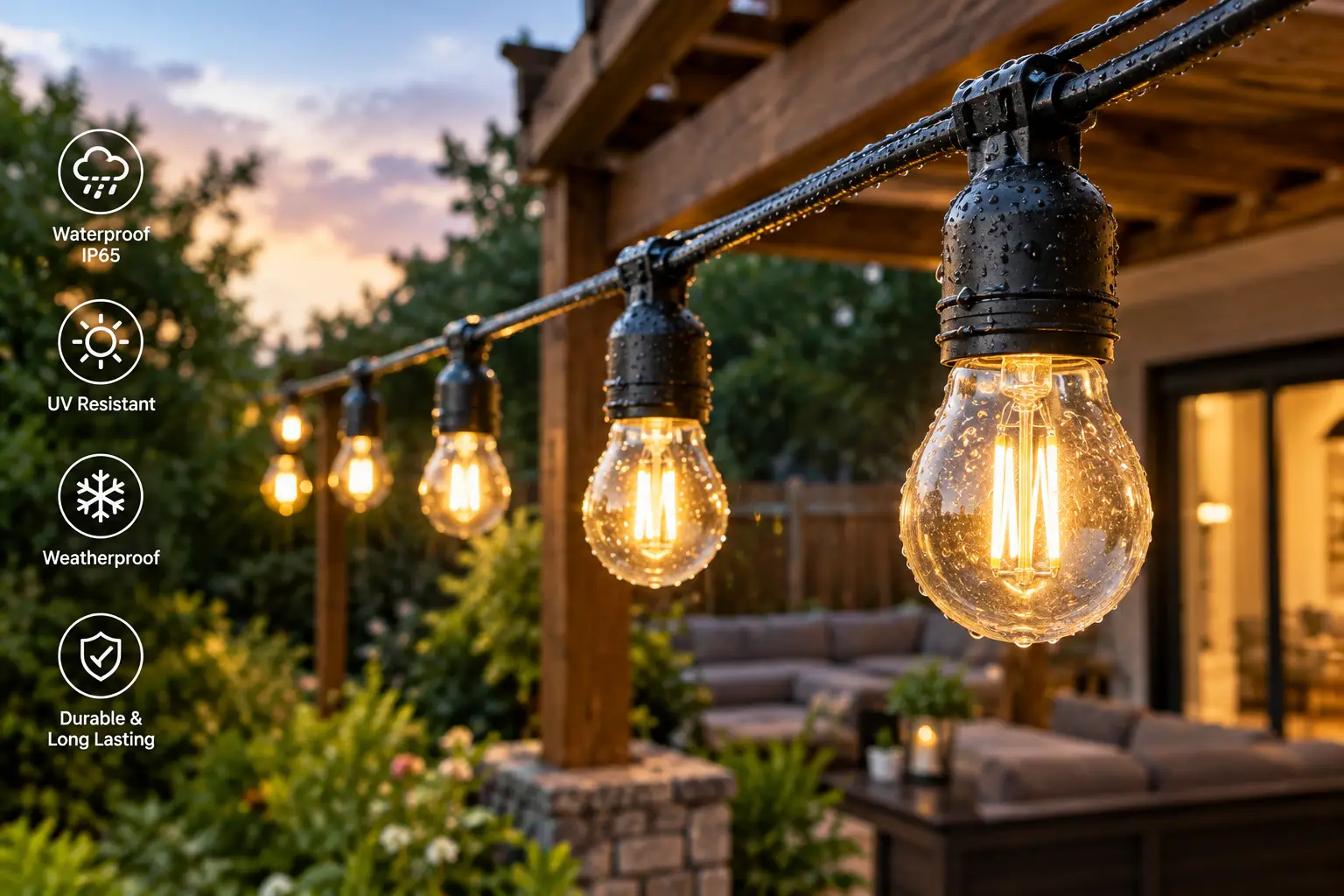
Outdoor rated light bulbs are bulbs certified for use in damp or wet locations. A damp-rated bulb tolerates humidity and condensation under a covered porch or eave; a wet-rated bulb can handle direct rain, snow, and sprinkler spray in exposed fixtures. Look for a UL or ETL “Wet Location” marking on the box.
That two-tier system is the most important thing to understand before you shop. In everyday terms:
- Dry location: indoors only. Your living room lamp. Never outside.
- Damp location: protected from direct water, but exposed to moisture and humidity. Think covered porches, carports, the inside of an enclosed lantern under an eave.
- Wet location: direct exposure to rain, snow, splashing, or hose spray. Think open-faced security floods, landscape spotlights, and uncovered post lights.
A wet-rated bulb can always go in a damp spot, but not the other way around. Many smart and specialty bulbs are only damp rated, which is why reading the fine print matters so much.
You’ll also run into IP ratings on some packaging, especially from brands that sell internationally. IP65, for example, means the bulb is dust-tight and protected against low-pressure water jets, which is roughly the territory a wet-rated U.S. bulb lives in. Finally, most outdoor bulbs for flood fixtures use the PAR38 shape (a 4.75-inch-wide reflector with a standard E26 base), while porch lanterns and post lights typically take A19 bulbs, the familiar “regular” bulb shape. Knowing which shape your fixture takes narrows your search instantly.
Quick Comparison: Outdoor Rated Light Bulbs at a Glance
| Product | Type | Location Rating | Brightness | Best for |
|---|---|---|---|---|
| Feit Electric PAR38 Enhance | PAR38 flood, dimmable | Wet | 1,000 lm | Feit Electric PAR38 Enhance: everyday security floods |
| Sunco Lighting PAR38 LED Flood | PAR38 flood, multi-pack | Wet | 1,050 lm | Sunco Lighting PAR38 LED Flood: whole-house replacements on a budget |
| Luxrite Dusk to Dawn PAR38 | PAR38 with photocell | Wet | 1,250 lm | Luxrite Dusk to Dawn PAR38: set-and-forget all-night lighting |
| Sengled Motion Sensor PAR38 (4th Gen) | PAR38 with motion + photocell | Wet | 1,500 lm | Sengled Motion Sensor PAR38 (4th Gen): driveways and side yards |
| Philips Hue White and Color Ambiance Outdoor PAR38 | Smart color PAR38 | Weatherproof (outdoor-rated) | See current listing | Philips Hue White and Color Ambiance Outdoor PAR38: premium smart homes |
| Feit Electric Smart PAR38 | Wi-Fi color PAR38, no hub | Wet | 1,000 lm | Feit Electric Smart PAR38: affordable smart color |
| GE LED A19 Bug Light | Yellow A19 | Wet | 800 lm | GE LED A19 Bug Light: porches and patios with bug problems |
Looking at the table, the split is clear: four of these bulbs are “dumb” floods that win on reliability and price, while three add intelligence (photocell, motion, or app control). If you simply need brightness in an existing flood fixture, the Sunco Lighting PAR38 LED Flood and Feit Electric PAR38 Enhance cover it cheaply; if you want the light to manage itself, the Luxrite Dusk to Dawn PAR38 and Sengled Motion Sensor PAR38 (4th Gen) remove the switch from the equation entirely.
💬 One click helps other shoppers make an informed choice too! 😊
Top 7 Outdoor Rated Light Bulbs: Expert Analysis
1. Feit Electric PAR38 Enhance (PAR38DM/950CA) — best all-around wet-rated flood
If you want one dependable, no-drama replacement for a burned-out halogen flood, this is the benchmark the others get measured against. Feit rates it at 1,000 lumens from just 11.1 watts, which the company says is up to 88% less energy than a 90-watt incandescent. In practice, that means you can leave a twin-head security fixture on all night for pocket change. It’s wet location rated, dimmable on LED-compatible dimmers, and carries a 25,000-hour rated life, so at 4 hours a night you’re looking at well over a decade between replacements.
The “Enhance” branding refers to Feit’s high-CRI line, marketed as 90+ CRI; one retailer’s spec sheet lists 80 CRI for this SKU, so check the box. Higher CRI matters outdoors more than people expect: red brick, green shrubs, and your house numbers look natural instead of washed out. The roughly 38° beam is on the focused side for a “flood,” which is great for aiming at a driveway apron but less ideal for blanketing a whole yard. It also comes in 3000K (PAR38DM/930CA) and a five-way selectable version (PAR38DM/6WYCA) that switches from 2700K to 5000K.
We couldn’t find a large, consistent body of verified reviews for this exact SKU; retailer ratings we saw ranged from middling to solidly positive depending on the color variant, so lean on the spec sheet and the wet rating.
Pros:
- ✅ Strong efficiency at 1,000 lumens from 11.1 watts
- ✅ Wet rated and dimmable, a rare combination at this price
- ✅ Multiple color temperatures, including a selectable version
Cons:
- ❌ Narrow-ish beam won’t blanket very wide yards
- ❌ Review data varies noticeably between color variants
A two-pack generally runs in the $15–$25 range (check the current price), which makes it a strong value for most homes.
2. Sunco Lighting PAR38 LED Flood — best value for whole-house swaps
The Sunco Lighting PAR38 LED Flood is what you buy when you’re replacing every exterior flood at once and don’t want to pay brand-name prices per bulb. Each one draws 13 watts and produces about 1,050 lumens, marketed as a 100-watt equivalent. It’s wet rated, UL listed, dimmable, and comes in 3000K warm white or 5000K daylight, sold in 6- and 12-packs.
What does that mean in practice? Slightly more light than the Feit Electric PAR38 Enhance, at a slightly higher wattage, and per-bulb pricing that often lands well under it when you buy the bigger packs. The availability of a genuinely warm 3000K wet-rated flood is a bigger deal than it sounds: many big-box shelves lean heavily toward harsh 5000K security bulbs, and warm light is friendlier for patios, neighbors, and wildlife.
This bulb suits homeowners with four or more flood sockets, landlords standardizing multiple units, and anyone who likes keeping spares in the garage. If you only need one or two bulbs, the multi-pack economics fade.
Reviews across Sunco’s PAR38 line consistently highlight brightness, and several buyers mention choosing Sunco specifically because warm-white exterior floods were hard to find locally. That’s aggregated sentiment from retailer listings, not a lab test.
Pros:
- ✅ Low per-bulb cost in 6- and 12-packs
- ✅ True 3000K warm-white option for exterior floods
- ✅ Wet rated, UL listed, and dimmable
Cons:
- ❌ Only sold in multi-packs, overkill for one fixture
- ❌ Slightly less efficient than the Feit per lumen
Expect around $40–$50 for a six-pack and roughly $60–$70 for twelve at the time of writing; for multi-fixture homes, the value is excellent.
3. Luxrite Dusk to Dawn PAR38 — best set-and-forget all-night lighting
The Luxrite Dusk to Dawn PAR38 takes the light switch out of your daily routine. A built-in photocell switches the bulb on at sunset and off at sunrise, as long as the fixture’s wall switch stays on. Luxrite rates it at 1,250 lumens, wet rated, UL listed, with an E26 base, available in 5000K bright white or 3000K soft white.
Practically, 1,250 lumens is noticeably brighter than the 1,000-lumen class, which matters because dusk-to-dawn bulbs usually live on garages, barns, and driveways where you need real coverage. The automation also saves energy in a less obvious way: no more lights accidentally burning all day because someone forgot to flip the switch.
This is the right pick for rural properties, rental units where tenants forget the porch switch, and anyone who wants “always lit at night” without timers. It’s the wrong pick if you want to choose when the light comes on; a photocell bulb only knows “dark” or “light.”
Verified, detailed reviews for the Luxrite model specifically were limited in our research, so we won’t characterize its owner sentiment. Two comparable wet-rated alternatives are worth knowing: the Satco S11476 (14W, 1,250 lumens, 15,000-hour life, rated from -4°F to 104°F, three-year limited warranty) and Sunco’s dusk-to-dawn PAR38 (15W, 1,250 lumens, non-dimmable).
Pros:
- ✅ Automatic on at dusk, off at dawn
- ✅ Bright 1,250 lumens for garages and driveways
- ✅ Choice of warm 3000K or crisp 5000K
Cons:
- ❌ Photocell can cycle if it “sees” its own reflected light
- ❌ Not compatible with dimmers or timer switches
Multi-packs commonly land in the $20–$50 range depending on count; check the current price. The value is very good if your light should be on every night anyway.
4. Sengled Motion Sensor PAR38 (4th Gen) — best motion-activated security upgrade
The Sengled Motion Sensor PAR38 (4th Gen) turns an ordinary flood fixture into a motion-activated security light without rewiring anything. It packs a passive infrared (PIR) motion sensor, a built-in photocell so it stays dark during the day, and 1,500 lumens of 3000K light, the brightest bulb in this lineup. It’s UL wet listed, and it includes an “always on” mode so it can behave like a normal dusk-to-dawn bulb when you want that.
Here’s what that means for you: instead of buying a $60+ motion fixture and hiring an electrician, you screw this into the socket you already have. Sengled’s earlier motion PAR38 models detected movement within about 30 feet across a 100° field and stayed lit for roughly 90 seconds; confirm the exact figures on the 4th Gen listing before buying. The warm 3000K color is a smart choice for a security bulb, bright without the interrogation-room glare.
It’s ideal for side yards, driveways, and back doors where you want light when someone’s there and darkness otherwise. Skip it if your fixture already has its own motion sensor; GearBrain’s hands-on review of Sengled’s earlier motion PAR38 noted that a fixture’s built-in sensor overrides the bulb’s, which defeats the purpose.
Beyond that review, owner sentiment we could verify was limited, so treat the spec sheet as your main guide. Note that this 4th Gen model works standalone; Sengled’s separate smart version requires a compatible Zigbee hub.
Pros:
- ✅ Brightest bulb here at 1,500 lumens
- ✅ Motion, photocell, and always-on modes in one bulb
- ✅ No hub, app, or rewiring needed
Cons:
- ❌ Conflicts with fixtures that have built-in motion sensors
- ❌ Sensor aim depends on how your fixture points the bulb
Two-packs typically fall somewhere in the $30–$50 range at the time of writing; for a security upgrade, that’s strong value.
5. Philips Hue White and Color Ambiance Outdoor PAR38 — best premium smart color
The Philips Hue White and Color Ambiance Outdoor PAR38 is the luxury pick, and it’s priced like one. You get tunable white from a candle-warm 2000K up to 6500K daylight, plus millions of colors, all controlled through the Hue app, schedules, geofencing, and voice assistants including Alexa, Google Assistant, and Apple Home. Philips specs it with a CRI of at least 80, a 25,000-hour nominal lifetime, 50,000 switch cycles, and an operating range of -4°F to 113°F at up to 95% non-condensing humidity.
Why does that matter? The 50,000 switch cycles tell you this bulb was designed for automation, where it might switch on and off several times a day for years. The 2000K floor is genuinely useful: amber-warm light on a patio feels cozier and is friendlier to night skies than the cooler whites most floods default to. And because Hue works as a system, your porch light can fade on when you arrive home or flash red with a door sensor.
The catch: full remote control requires a Hue Bridge, sold separately. Brightness varies by color, so check the current listing for lumen output; Hue’s white-only outdoor PAR38 sibling is rated at 1,300 lumens.
Owner reviews of Hue’s outdoor PAR38 floods consistently praise easy pairing and brightness compared with using regular Hue bulbs outside, while price is the most repeated complaint.
Pros:
- ✅ 2000K–6500K white plus full color control
- ✅ Built for heavy automation with 50,000 switch cycles
- ✅ Deep ecosystem with Alexa, Google, and Apple Home
Cons:
- ❌ Highest price per bulb by a wide margin
- ❌ Hue Bridge required for the full feature set
Expect roughly $70–$90 per bulb (prices may vary), which makes it worth it mainly if you already own Hue gear.
6. Feit Electric Smart PAR38 (PAR38/RGBW/CA/AG) — best budget smart color, no hub
The Feit Electric Smart PAR38 delivers most of the smart-bulb fun for a fraction of the Philips price. It connects straight to your home’s 2.4 GHz Wi-Fi with no hub, works with Alexa and Google Home, and offers tunable white from 2700K to 6500K plus millions of colors. Specs include 11.1 watts, about 1,000 lumens, a 90 CRI rating, a 25,000-hour rated life, and a wet location rating per retailer product data.
In everyday terms, this is the bulb for holiday color on the front of the house, team colors on game night, and simple schedules like “on at 7 p.m., off at midnight.” The 90 CRI rating is a nice surprise at this price, meaning whites look clean rather than greenish. Because it’s Wi-Fi, though, your router’s reach matters: a flood mounted on the far side of a brick garage may struggle to stay connected.
It’s best for renters, first-time smart home buyers, and anyone who wants color without committing to an ecosystem. If you already run a Hue system, stick with Hue for unified control.
We found limited verified owner reviews for this specific SKU, so we’re not summarizing sentiment; the spec sheet and Feit’s long history with PAR38 bulbs are the stronger evidence here.
Pros:
- ✅ No hub needed; connects directly to Wi-Fi
- ✅ Full color plus 2700K–6500K tunable white
- ✅ High 90 CRI at a budget price
Cons:
- ❌ 2.4 GHz Wi-Fi only, with range limits outdoors
- ❌ Smaller ecosystem than Philips Hue
Single bulbs typically sell in the $15–$25 range at the time of writing, which is excellent value for smart color.
7. GE LED A19 Bug Light — best for bug-free porches
The GE LED A19 Bug Light solves a very specific, very annoying problem: the moth party at your front door every summer night. It uses a yellow-tinted A19 LED that most night-flying insects are less sensitive to, so fewer bugs gather around the light. GE rates it at 9 watts and 800 lumens (versus 900 lumens for the incandescent 100-watt bug light it replaces), with a 15,000-hour life, about 13 years at three hours a day, and the packaging marks it suitable for wet locations.
The fine print matters here. GE’s package warnings say it’s not for totally enclosed or recessed fixtures, and not for use with dimmers, timers, or photocells. That rules out sealed glass “jelly jar” lights and many lantern fixtures, so check your fixture before buying.
It’s the right pick for open porch sconces, patio lights, and back-door fixtures where you sit outside on summer evenings. Remember that yellow light reduces bug attraction rather than eliminating it, and color rendering is poor by design.
Across GE’s bug-light line, including older incandescent versions, reviewers consistently report noticeably fewer insects around doors; the heat-related complaints we saw involved incandescent models, which is one more reason the LED version makes sense.
Pros:
- ✅ Noticeably fewer insects gathering at the door
- ✅ Wet location suitable, standard A19 shape
- ✅ Very low running cost at 9 watts
Cons:
- ❌ Not for totally enclosed fixtures, dimmers, or photocells
- ❌ Yellow light makes colors look flat
Single bulbs usually sit around $8–$12 (check the current price), a small cost for a calmer porch.
Side-by-Side Specs: How the Top 7 Compare
| Product | Watts | Lumens | Color Temp | Dimmable | Smart/Sensor | Approx. Price Range | Best for |
|---|---|---|---|---|---|---|---|
| Feit Electric PAR38 Enhance | 11.1W | 1,000 | 3000K/5000K/selectable | Yes | None | $15–$25 (2-pack) | Feit Electric PAR38 Enhance: reliable floods |
| Sunco Lighting PAR38 LED Flood | 13W | 1,050 | 3000K/5000K | Yes | None | $40–$50 (6-pack) | Sunco Lighting PAR38 LED Flood: bulk swaps |
| Luxrite Dusk to Dawn PAR38 | ~15W class | 1,250 | 3000K/5000K | No | Photocell | $20–$50 (multi-pack) | Luxrite Dusk to Dawn PAR38: all-night light |
| Sengled Motion Sensor PAR38 (4th Gen) | Check listing | 1,500 | 3000K | No | Motion + photocell | $30–$50 (2-pack) | Sengled Motion Sensor PAR38 (4th Gen): security |
| Philips Hue White and Color Ambiance Outdoor PAR38 | Check listing | See listing | 2000K–6500K + color | Yes (app) | Hue ecosystem | $70–$90 (1 bulb) | Philips Hue White and Color Ambiance Outdoor PAR38: premium smart |
| Feit Electric Smart PAR38 | 11.1W | 1,000 | 2700K–6500K + color | Yes (app) | Wi-Fi | $15–$25 (1 bulb) | Feit Electric Smart PAR38: budget smart |
| GE LED A19 Bug Light | 9W | 800 | Yellow | No | None | $8–$12 (1 bulb) | GE LED A19 Bug Light: bug control |
The specs reveal a useful pattern: brightness tracks function. Security-focused bulbs like the Sengled Motion Sensor PAR38 (4th Gen) and Luxrite Dusk to Dawn PAR38 push 1,250 to 1,500 lumens, while ambiance bulbs prioritize color over raw output. Note also that none of the sensor bulbs are dimmable; if your outdoor circuit has a dimmer, stick with the Feit Electric PAR38 Enhance or Sunco Lighting PAR38 LED Flood.
✨ Don’t miss these weatherproof upgrades!
🔍 Take your outdoor lighting to the next level with this carefully curated lineup. Click a highlighted bulb to check current pricing and availability. These picks will help you get a brighter, safer, lower-maintenance exterior the whole family will enjoy!
How to Install and Get the Most From Your New Bulbs
Swapping an outdoor bulb looks like a 30-second job, and it mostly is, but a few habits make the difference between a bulb that lasts a decade and one that fails in a year.
Before you climb the ladder
- Turn the power off at the switch, and let old halogens cool. A halogen PAR38 can be painfully hot even minutes after shutoff.
- Check the fixture’s own label. Many fixtures list a maximum wattage and whether they’re rated for wet or damp locations. Your bulb rating should match or exceed the location.
- Inspect the socket. Corrosion or green crust on an outdoor E26 socket causes flicker no bulb can fix. A quick clean with a dry brush, power off, often helps.
Installation tips by bulb type
- Photocell bulbs like the Luxrite Dusk to Dawn PAR38 need the wall switch left on permanently. Tape a small note over the switch if family members habitually flip it off.
- Motion bulbs like the Sengled Motion Sensor PAR38 (4th Gen) work best aimed slightly downward toward the approach path, since PIR sensors detect movement across the field of view more readily than straight toward them.
- Smart bulbs should be paired close to your router or Hue Bridge first, then installed outside. Confirm signal strength at the final location before you put the ladder away.
Common mistakes in the first 30 days
The biggest early mistake is putting a damp-rated bulb in an exposed fixture “just to see.” The second is overtightening: outdoor sockets are often plastic, and cranking the bulb can crack the housing or the socket’s internal contact. Hand-tight is enough. Finally, give sensor bulbs a few nights before judging them; the first week is when you’ll discover a neighbor’s porch light or a reflective wall confusing the photocell, which is easily fixed by re-aiming.
Real-World Scenarios: Matching the Right Bulb to Your Home
Specs are easier to understand when they’re attached to an actual house. Here are three common situations and how we’d reason through each.
Scenario 1: The suburban family with a long driveway
Budget: around $50. Use: lights needed nightly for teens coming home late and package deliveries. The driveway has a twin-head flood on the garage and an uncovered post light at the curb.
The smart move here is the Sengled Motion Sensor PAR38 (4th Gen) in the garage flood. At 1,500 lumens, it covers the parking area when someone pulls in, then turns off, so it isn’t flooding the neighbors’ bedroom windows all night. For the post light, a wet-rated A19 or a small PAR bulb on a photocell keeps the curb visible for delivery drivers. Total spend stays near budget, and nobody has to remember a switch.
Scenario 2: The rural homeowner with a detached barn
Budget: flexible. Use: all-night lighting for security and checking on animals.
Here, the Luxrite Dusk to Dawn PAR38 (or the Satco equivalent) is the natural fit. Barn floods are exposed to weather, and rural nights are genuinely dark, so 1,250 lumens of automatic light is worth having. If there are several fixtures, a multi-pack of the Sunco Lighting PAR38 LED Flood on a separate switch covers occasional bright-as-day tasks.
Scenario 3: The renter who loves hosting
Budget: under $40. Use: patio gatherings, seasonal decorations, no permanent changes allowed.
The Feit Electric Smart PAR38 in the existing patio flood gives warm white for dinners, color for parties, and app schedules, with no hub to buy or leave behind when moving. Add a GE LED A19 Bug Light in the back-door sconce, and summer evenings get noticeably more pleasant.
Problem → Solution: Troubleshooting Outdoor Bulbs
Even the best outdoor rated light bulbs can misbehave. Most issues trace back to the fixture, the switch, or the environment, not the bulb itself.
Problem 1: The dusk-to-dawn bulb flickers or cycles on and off. Solution: The photocell is likely “seeing” its own light reflected off a wall, eave, or light-colored siding, so it thinks it’s daytime and shuts off, then turns back on in the dark. Re-aim the fixture so the bulb’s sensor faces open sky or away from bright surfaces. Nearby streetlights or a neighbor’s flood can cause the same thing.
Problem 2: The motion bulb never turns off, or never turns on. Solution: Check whether your fixture already has a built-in motion sensor; if so, it will override the bulb’s. Also look for heat sources in the sensor’s field of view, such as dryer vents, since PIR sensors react to temperature changes.
Problem 3: Your new LED buzzes or flickers when dimmed. Solution: Older outdoor dimmers were designed for incandescent loads. Swap in an LED-compatible dimmer, or use a dimmable bulb like the Feit Electric PAR38 Enhance or Sunco Lighting PAR38 LED Flood. Never put sensor bulbs on a dimmer.
Problem 4: Bulbs keep burning out early in an enclosed lantern. Solution: Heat buildup is the usual culprit. Many LEDs, including the GE LED A19 Bug Light, are not rated for totally enclosed fixtures. Look for packaging that explicitly allows enclosed fixtures.
Problem 5: The smart bulb keeps dropping offline. Solution: Outdoor walls, especially brick and stucco, weaken Wi-Fi. Add a mesh node near the exterior wall, or choose a Zigbee-based system like Hue, where each bulb strengthens the mesh.
How to Choose Outdoor Rated Light Bulbs
Choosing the right bulb comes down to six questions. Answer them in order, and the field narrows quickly.
- Check the location rating first. Exposed to rain? You need wet rated light bulbs. Under a solid roof? Damp rated is the minimum. This is non-negotiable for safety and lifespan.
- Match the shape and base. Flood fixtures almost always take PAR38 (or the smaller PAR30); lanterns and sconces usually take A19. Nearly all use the standard E26 base.
- Pick brightness by job, not habit. Roughly 400–800 lumens is plenty for a porch or entry; 1,000–1,500 lumens suits driveways and security floods. More isn’t always better, because glare reduces what you can actually see.
- Choose your color temperature. 2700K–3000K feels warm and welcoming; 5000K looks crisp but can feel harsh at night. Warm light is also generally friendlier to wildlife and neighbors.
- Decide how the light should be controlled. Switch, photocell, motion, or app? This determines whether you need a standard bulb or a sensor/smart model.
- Confirm the weather specs. If you live somewhere with hard winters or blazing summers, look up the bulb’s operating temperature range. The IP code system explained on Wikipedia is a handy reference when brands list IP65 instead of a UL wet rating.
The short version: rating, shape, brightness, color, control, climate. Get those six right and you’re already ahead of most buyers.
Safety, Regulations, and Standards for Outdoor Bulbs
Outdoor lighting sits at the intersection of electricity and water, so certifications aren’t just marketing fluff.
UL and ETL listings
In the U.S., UL (Underwriters Laboratories) and ETL (Intertek) are the two most common Nationally Recognized Testing Laboratory marks. A “UL Listed, Wet Location” marking means the product was evaluated for exposure to water. Several bulbs in this guide, including the Sunco Lighting PAR38 LED Flood, Luxrite Dusk to Dawn PAR38, and Sengled Motion Sensor PAR38 (4th Gen), carry UL wet listings according to their product information. If a no-name bulb lacks any recognized mark, that’s a red flag no discount can fix.
FCC compliance
LED drivers and smart radios can emit electrical noise. Bulbs sold legally in the U.S. should be FCC compliant, which matters if you’ve ever had cheap LEDs interfere with AM radio, garage door openers, or wireless doorbells.
Fixture ratings still apply
A wet-rated bulb doesn’t make an indoor fixture safe outside. The fixture itself must be rated for the location. Equally, respect any warnings on the bulb: “not for enclosed fixtures,” “not for use with dimmers,” or “not for use with photocells” exist because heat or incompatible electronics can cause early failure or overheating.
Local rules
Some towns and HOAs have outdoor lighting ordinances limiting glare, light trespass, or upward light. If you’re installing powerful floods, check local codes and aim fixtures down; it keeps you compliant and keeps the peace with neighbors.
Outdoor LED Bulbs vs. Halogen and Incandescent: Is Switching Worth It?
If you still have halogen PAR38 floods outside, switching to outdoor LED flood light bulbs is one of the easiest energy upgrades available. LEDs emit very little heat, start instantly in cold weather, and last many times longer. Look for qualified products on the ENERGY STAR light bulbs page if verified efficiency matters to you.
| Factor | Halogen/Incandescent Flood | Outdoor LED (e.g., Feit Electric PAR38 Enhance) | Best for |
|---|---|---|---|
| Typical wattage for ~1,000 lm | ~90W | ~11–14W | LED for anyone paying the power bill |
| Rated life | ~1,000–3,000 hours | ~15,000–25,000 hours | LED for hard-to-reach fixtures |
| Heat output | Very high | Low | LED near eaves, vinyl, and plastic fixtures |
| Cold-weather start | Instant | Instant | Tie |
| Upfront cost | Lower | Slightly higher | Halogen only if a light is rarely used |
The table makes the case plainly: LED wins nearly every category except sticker price, and that gap closes within the first year for any light used nightly. The heat difference also matters for safety, since a halogen near vinyl siding or a plastic fixture is a real concern; an LED like the Feit Electric PAR38 Enhance runs dramatically cooler.
The one scenario where halogen still makes sense is a fixture you use a few times a year. For everything else, the switch pays for itself.
Features That Actually Matter (and Ones That Don’t)
Bulb boxes are covered in claims. Here’s how to sort signal from noise.
Features worth paying for
- A genuine wet location rating. This is the single most important line on an outdoor bulb box, ahead of every other feature.
- The right control type. A photocell or motion sensor changes how you live with the light every day. The Sengled Motion Sensor PAR38 (4th Gen) and Luxrite Dusk to Dawn PAR38 deliver more practical value than any color feature for most homes.
- Warm color temperature options. Bulbs offering 2700K–3000K give you choices beyond harsh security white.
- Operating temperature range. Critical in Minnesota winters or Arizona summers.
Features that are oversold
- “Equivalent wattage” claims. Compare lumens instead; that’s the actual light output.
- Extreme lifespan numbers. A 25,000-hour rating is a laboratory average. Heat, moisture, and power surges outdoors shorten real-world life, so buy for the rating, but don’t plan your retirement around it.
- Millions of colors. Fun for holidays, but most people use two or three settings. If color is a novelty for you, the Feit Electric Smart PAR38 gives you plenty without premium pricing.
The middle ground
High CRI matters more than you’d think for front-of-house lighting and landscaping, but it’s irrelevant for a back-alley security light. Pay for it where people will actually look.
Long-Term Cost and Maintenance of Outdoor Bulbs
The purchase price is the smallest part of an outdoor bulb’s lifetime cost when it runs every night. Let’s run the numbers using an assumed electricity rate of 17 cents per kWh (your rate may differ; check your utility bill).
A 90-watt halogen flood running 4 hours a night uses about 131 kWh a year, roughly $22. An 11-watt LED like the Feit Electric PAR38 Enhance uses about 16 kWh, roughly $3. That’s around $19 a year saved per bulb, and a twin-head fixture doubles it.
For dusk-to-dawn use, averaging about 12 hours a night across the year, the gap widens dramatically: about $67 a year for the halogen versus around $10 for a 14–15-watt LED like the Luxrite Dusk to Dawn PAR38.
| Bulb | Approx. Upfront Cost (per bulb) | Est. Annual Energy Cost* | Best for |
|---|---|---|---|
| 90W halogen PAR38 | Low | ~$22 (4 hrs/night) | Rarely used fixtures only |
| Feit Electric PAR38 Enhance | ~$8–$13 | ~$3 (4 hrs/night) | Feit Electric PAR38 Enhance: everyday floods |
| Sunco Lighting PAR38 LED Flood | ~$5–$8 | ~$3 (4 hrs/night) | Sunco Lighting PAR38 LED Flood: lowest cost per socket |
| Luxrite Dusk to Dawn PAR38 | ~$7–$12 | ~$10 (12 hrs/night) | Luxrite Dusk to Dawn PAR38: all-night use |
*Estimates at 17¢/kWh; actual costs vary by rate and usage.
The takeaway: even the cheapest LED pays for itself within months compared with halogen when used nightly, and bulk packs like the Sunco Lighting PAR38 LED Flood drive the per-socket cost lower still. Motion bulbs can cost even less to run, since they’re dark most of the night.
Maintenance is simple: wipe dust and spider webs off lenses and sensors each spring and fall, check that fixture gaskets are intact, and look for corrosion in sockets once a year.
Common Mistakes to Avoid When Buying Outdoor Light Bulbs
A few predictable errors account for most outdoor lighting regret.
Mistake 1: Treating “outdoor” and “wet rated” as the same thing. Many bulbs marketed for porches are only damp rated. If the fixture is exposed, confirm a wet rating.
Mistake 2: Buying the brightest bulb available. More lumens often means more glare, which actually makes it harder to see into shadows. The Five Principles for Responsible Outdoor Lighting from DarkSky International recommend lighting that is useful, targeted, low level, controlled, and warm-colored, which is also a practical recipe for better visibility and happier neighbors.
Mistake 3: Ignoring controls. A light burning all night when you need it for 10 minutes wastes money. A motion bulb like the Sengled Motion Sensor PAR38 (4th Gen) often delivers better security, because sudden light draws attention.
Mistake 4: Mixing color temperatures. A 5000K flood beside a 2700K porch light looks mismatched from the street. Pick one family and stick with it.
Mistake 5: Forgetting the fixture’s limits. Enclosed lanterns, dimmers, and existing motion sensors all affect which bulbs will work. The GE LED A19 Bug Light, for example, isn’t meant for totally enclosed fixtures.
Mistake 6: Buying single bulbs for a multi-fixture home. Mismatched replacements bought over years leave uneven color across your exterior. Buying a multi-pack keeps everything consistent and gives you spares.
FAQs
❓ Can I use outdoor rated light bulbs indoors?
❓ Do dusk to dawn light bulbs work in enclosed fixtures?
❓ Are weatherproof light bulbs worth it for a covered porch?
❓ Which outdoor light bulbs are best for security?
❓ Can I put a smart bulb in an outdoor fixture with a switch?
Conclusion: Choosing Your Outdoor Rated Light Bulbs With Confidence
The right outdoor rated light bulbs aren’t about chasing the brightest box on the shelf. They’re about matching the rating to the location, the brightness to the job, and the control to how you actually live.
For most homes, the Feit Electric PAR38 Enhance is the dependable all-rounder, while the Sunco Lighting PAR38 LED Flood wins when you’re replacing every flood at once. If you want lights that manage themselves, the Luxrite Dusk to Dawn PAR38 handles all-night duty, and the Sengled Motion Sensor PAR38 (4th Gen) turns any flood socket into a security light. Smart-home fans get premium polish with the Philips Hue White and Color Ambiance Outdoor PAR38 or budget-friendly color with the Feit Electric Smart PAR38. And for summer evenings on the porch, the GE LED A19 Bug Light quietly earns its keep.
Whatever you choose, check the wet or damp rating first, favor warm color temperatures where you can, and aim light down at the ground where you need it. Do those three things, and your exterior lighting will be safer, cheaper to run, and kinder to the night sky for years to come. 🌙
🏡 Ready to light up your home the smart way?
🔍 Click any highlighted bulb above to check current pricing and availability, and pick the outdoor rated option that fits your space, your budget, and your nights!
Recommended for You
- Does Kasa Work With Alexa? 7 Best Picks + Easy Setup Guide (2026)
- Dual Smart Light Switch: 7 Best Picks That Actually Work in 2026
- ge dimmer switch Guide 2026: 7 Best Picks Honestly Compared
Disclaimer: This post contains affiliate links. As an Amazon Associate, I earn from qualifying purchases made through these links, at no additional cost to you.
✨ Found this article helpful? Share it with someone who needs it! 💬🤗