
In This Article
Introduction: The 30 amp smart plug Problem Nobody Warns You About
Here’s the awkward truth most shopping guides skip: if you search for a 30 amp smart plug, you’ll quickly discover that the tidy little Wi-Fi cube you use for a lamp doesn’t come in a “30A” size. Standard smart plugs top out at 15 amps. The moment you step up to a travel trailer’s TT-30 cord, a dryer outlet, an electric water heater, or a pool pump, you’ve entered heavy-duty territory, where the “smart plug” is really one of three different things wearing the same name.
What Is a 30 amp smart plug?
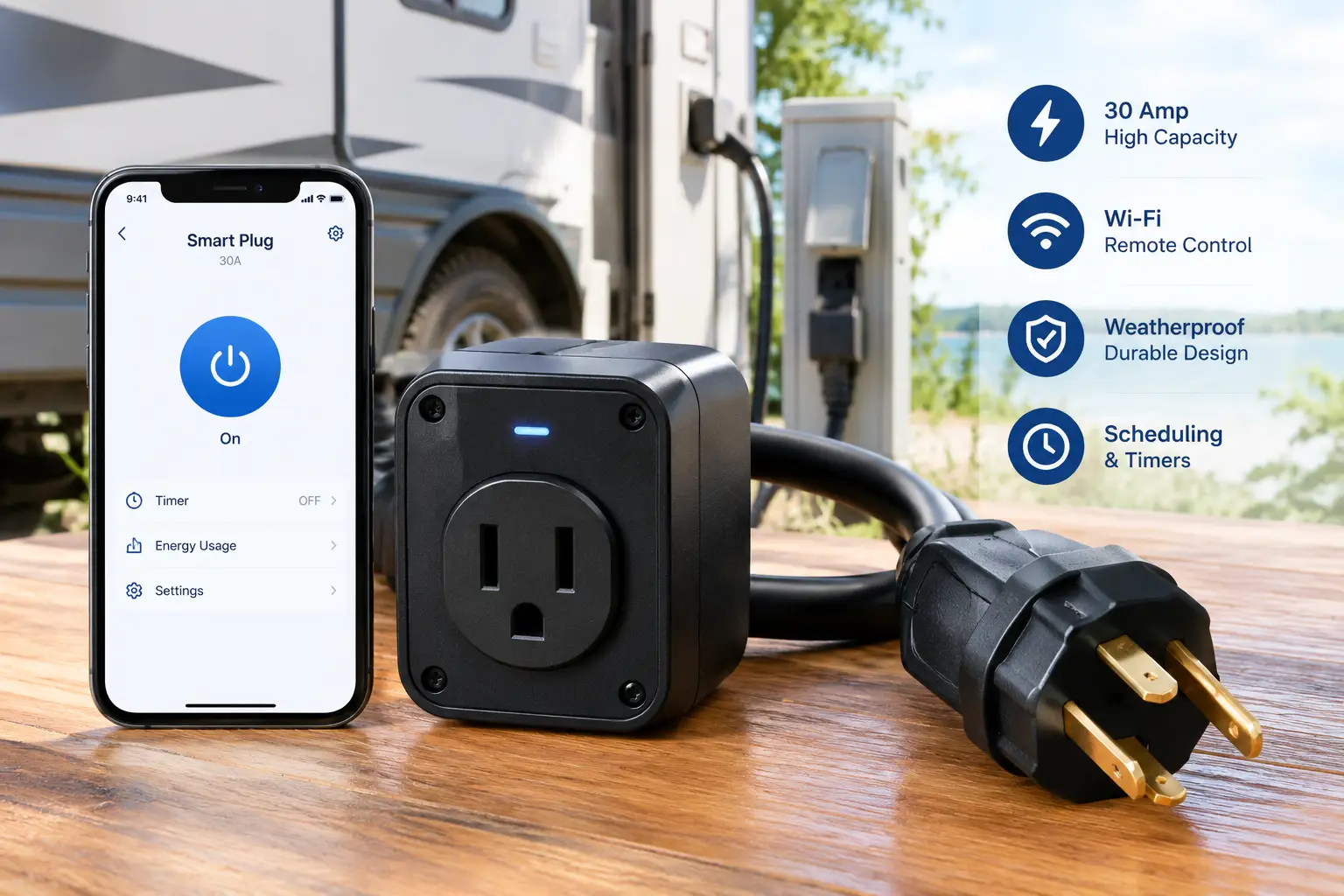
A 30 amp smart plug is any app- or network-controlled device that can safely switch, monitor, or protect a circuit carrying up to 30 amps. In practice, that means a smart RV surge protector (120V, TT-30), a 240V smart splitter for dryer/EV outlets, or a hardwired heavy-duty smart switch rated 30–40 amps.
That distinction matters because the plug shapes are completely different. A 30-amp RV cord uses a TT-30 connector, a modern dryer uses a four-prong NEMA 14-30, and older homes often have the three-prong NEMA 10-30. If you’ve never compared them side by side, the NEMA connector overview on Wikipedia is a genuinely useful five-minute primer before you buy anything.
One more naming trap: there’s a respected RV brand literally called SmartPlug, which makes a clip-in 30-amp inlet and cord replacement for the traditional twist-lock plug. It’s a great connector upgrade, but it has no app, no Wi-Fi, and no monitoring. If you want remote control or live data, you need one of the connected devices below.
In this guide, we compared seven real products across all three categories, drawing on manufacturer spec sheets, retailer listings, and owner discussions in smart-home and RV communities. No invented test results, no made-up star ratings — just honest analysis of what each spec means for your trailer, laundry room, or backyard.
Quick Comparison: 30 amp smart plug Picks at a Glance
| Product | Category | Connectivity | Rated Load | Price Range | Best for |
|---|---|---|---|---|---|
| Power Watchdog PWD30EPOW | RV smart surge protector | Wi-Fi + Bluetooth | 30A / 120V | $200–$300 | RVers who want alerts from anywhere |
| Hughes Autoformers PWD30 | RV smart surge protector | Bluetooth | 30A / 120V | $150–$180 | Budget-aware RV owners |
| GEARGO New-Gen 30A | RV smart surge protector | Bluetooth | 30A / 120V | Under $120 | First-time campers |
| NeoCharge NEMA 14-30 Smart Splitter | 240V smart splitter | Wi-Fi | 30A / 240V | $400–$550 | Sharing a dryer outlet with an EV |
| Enbrighten Z-Wave 14285 | Hardwired smart switch | Z-Wave Plus | 40A / 120–277V | $80–$140 | Pool pumps, outdoor loads |
| Aeotec Heavy Duty Smart Switch Gen5 | Hardwired smart switch | Z-Wave Plus | 40A / 240V | $90–$160 | Water heaters with energy tracking |
| DEWENWILS 40A Wi-Fi Timer Box | Hardwired smart switch | Wi-Fi | 40A / 240V | $50–$100 | No-hub water heater scheduling |
Prices are approximate ranges at the time of writing; check the current price on Amazon.
Reading this table top to bottom, the pattern is clear: the “plug-in” options live almost entirely in the RV world, while home 240V loads are dominated by hardwired switches that an electrician installs once and you control forever. The NeoCharge NEMA 14-30 Smart Splitter is the rare true plug-in 240V device, which explains its higher price. If you’re RVing, compare the top three; if you’re automating a house, focus on the bottom four.
💬 One click helps other shoppers make an informed choice too! 😊
Top 7 30 amp smart plug Options: Expert Analysis
1. Power Watchdog PWD30EPOW — alerts reach you from anywhere
The Power Watchdog PWD30EPOW is the Gen II model, and its headline upgrade is built-in Wi-Fi alongside Bluetooth, so you can check shore power from a restaurant across town rather than only from inside the rig.
Its circuit analysis cuts power automatically when voltage drops below 104V or climbs above 132V, then restores it after 90 seconds of stable conditions. In practice, that 90-second delay protects your air conditioner’s compressor from restarting into a brownout — the single most expensive failure most RVers face. The surge module is replaceable, so one big lightning hit doesn’t mean replacing the whole unit; the manufacturer lists spare modules at around $45.
Based on the specs, this is the pick for full-timers, snowbirds who leave the rig plugged in while away, and anyone with pets inside during summer. The Wi-Fi piece is what separates it: a Bluetooth-only unit can’t warn you about a pedestal failure while you’re at the grocery store.
The Power Watchdog line is one of the most talked-about accessories in RV communities, and the brand itself describes the Gen I as one of the best-selling RV accessories ever. We couldn’t verify a detailed breakdown of Amazon review sentiment specific to the Gen II, so weigh that claim as the maker’s own.
Pros:
- ✅ Wi-Fi monitoring works without being near the RV
- ✅ Automatic shutoff protects AC compressors from low voltage
- ✅ Replaceable surge module lowers long-term cost
Cons:
- ❌ Priciest option in the RV category
- ❌ Requires reliable campground Wi-Fi for remote alerts
Expect to pay in the $200–$300 range; for full-timers, it’s the best value per night of protection.
2. Hughes Autoformers PWD30 — proven Bluetooth monitoring for less
The Hughes Autoformers PWD30 is the original Gen I Power Watchdog, and it still delivers the core “smart” experience: live voltage, amperage, and wattage on your phone.
Its listing specifies 3,000 joules of surge protection, full LED park-power diagnostics, and customizable alert thresholds. Translated into real life, that means you can set a warning at, say, 108V instead of waiting for trouble, and you’ll know within seconds whether a pedestal has an open ground or reversed polarity before you connect your coach. Note that the base PWD30 is a monitor-and-surge unit; if you want automatic shutoff for low or high voltage, the Hughes Autoformers PWD30 has a sibling, the PWD30-EPO, which adds emergency power off.
This is the smart choice for weekend campers who are usually near the rig while it’s plugged in. Bluetooth covers the campsite, the picnic table, and the inside of your trailer — which is where most people actually are when power problems strike.
A widely quoted retailer description positions it as “entry-level” protection. We couldn’t verify aggregated Amazon review themes for this exact model, so rely on its long track record rather than a star count.
Pros:
- ✅ Real-time volts, amps, and watts on your phone
- ✅ Custom alert thresholds catch problems early
- ✅ Established brand with a long product history
Cons:
- ❌ Bluetooth only — no alerts when you’re away
- ❌ Base model lacks automatic voltage shutoff
At roughly $150–$180, it’s solid value if you camp mostly on weekends.
3. GEARGO New-Gen 30A — big screen, small budget
The GEARGO New-Gen 30A undercuts the name brands while still giving you a Bluetooth app and a large LED screen right on the unit.
The listing advertises 15,000 joules of surge protection, IP68 water resistance, a protective cover, and real-time monitoring. Here’s what to weigh: joule ratings are not standardized across brands, so a bigger number on a budget unit doesn’t automatically mean better protection than a 3,000-joule name-brand model. The on-device screen, however, is a genuine convenience — you can read voltage at a glance without opening an app.
Based on the feature set, the GEARGO New-Gen 30A is aimed at new campers who want smart monitoring before committing $150 or more. It’s also a sensible backup unit for people who own a hardwired system in one rig and need something portable for a second trailer.
We could not verify a reliable, consolidated summary of customer review sentiment for this specific model. Treat long-term durability as an open question, and check the warranty terms on the listing before buying.
Pros:
- ✅ Large on-device display for quick readings
- ✅ Bluetooth app monitoring at a lower price
- ✅ IP68 rating suits exposed pedestals
Cons:
- ❌ Joule ratings aren’t comparable to name brands
- ❌ Shorter brand track record than Progressive or Hughes
Generally priced under $120; strong value if you accept a lesser-known brand.
4. NeoCharge NEMA 14-30 Smart Splitter — one dryer outlet, two big loads
The NeoCharge NEMA 14-30 Smart Splitter is the closest thing to a true plug-in 240V smart plug: it plugs into your existing four-prong dryer outlet and gives you two controlled outputs.
Its auto-switching prioritizes the dryer and hands power to your EV charger when the dryer finishes, so you never have to swap plugs by hand. The product is UL-listed, Wi-Fi-connected, and supports app integration with more than a dozen EV brands. The fine print matters: your EV or charger must be set to 24 amps or less, and most chargers need a NEMA 14-30P to 14-50R adapter, sold separately.
This is aimed squarely at EV owners who want Level 2 charging without paying for a new circuit or panel upgrade. It’s also ideal for renters, since there’s nothing to install permanently.
NeoCharge says more than 10,000 EV drivers use its splitters. We didn’t find a verified aggregate of Amazon reviews for this exact SKU, so treat that figure as a manufacturer claim.
Pros:
- ✅ Plug-in install avoids costly panel upgrades
- ✅ Automatic dryer-first switching is hands-free
- ✅ UL listing and Wi-Fi app monitoring
Cons:
- ❌ EV charging capped at 24 amps
- ❌ Adapter often required for non-Tesla chargers
Typically $400–$550; excellent value compared with a new 240V circuit.
5. Enbrighten Z-Wave 14285 — rugged outdoor control for pools and pumps
The Enbrighten Z-Wave 14285 (formerly sold under the GE brand) is a heavy duty smart switch built into a lockable metal NEMA 3R enclosure that shrugs off rain and curious neighbors.
It’s a double-pole, single-throw switch supporting 120–277VAC and up to 40 amps, and it can handle single- or dual-load control of up to two 120V devices. With a compatible hub, it reports watts and kilowatt-hours. In plain English: one box can run a pool pump on a schedule and show you exactly what that pump costs per month. The manual override switch on the front means you can still turn equipment on by hand if your hub goes offline.
This suits homeowners who already run a Z-Wave hub such as Hubitat, SmartThings, or Home Assistant, and want set-and-forget automation for pool, spa, or landscape loads.
In the Hubitat community, one owner described running three of these units to schedule pool filter pumps, cleaning jets, and a spa routine. Early threads also note that driver support on some hubs lagged behind others, so confirm compatibility with yours first.
Pros:
- ✅ Weatherproof lockable metal enclosure
- ✅ Energy monitoring with compatible hubs
- ✅ Manual override for hub outages
Cons:
- ❌ Requires a Z-Wave hub
- ❌ Hardwired install, usually by an electrician
Usually $80–$140; excellent value for outdoor high-draw equipment.
6. Aeotec Heavy Duty Smart Switch Gen5 — detailed energy data for 240V appliances
The Aeotec Heavy Duty Smart Switch Gen5 (model ZW078) targets true two-phase 240V loads like electric water heaters and EV chargers, with energy reporting as a core feature.
It’s rated for 240VAC across L1 and L2, up to 40A resistive, 9,600 watts, and 5HP motor loads, with an IP44 rating and an advertised outdoor range of around 150 meters (roughly 490 feet). It also acts as a Z-Wave repeater. What that means in practice: it can sit in a detached garage or pump house and still reach your hub — and strengthen the mesh for other outdoor devices along the way.
Based on the spec sheet, the Aeotec Heavy Duty Smart Switch Gen5 is ideal for data-minded homeowners on time-of-use electricity plans who want to see water heater kWh in real time and shift heating to off-peak hours.
Retailer listings stress that a certified electrician should install it, and Aeotec’s own manual warns that current must never exceed 40A. We couldn’t verify consolidated review sentiment, so check Aeotec’s gateway compatibility list before buying.
Pros:
- ✅ True two-pole 240V switching up to 40A
- ✅ Real-time watt and kWh reporting
- ✅ Long outdoor range with mesh repeating
Cons:
- ❌ Z-Wave hub required
- ❌ Operating range tops out around 122°F (50°C)
Generally $90–$160; strong value if energy data drives your decisions.
7. DEWENWILS 40A Wi-Fi Timer Box — no hub, no fuss
The DEWENWILS 40A Wi-Fi Timer Box is the simplest path to a 30a smart switch at home: it connects straight to your Wi-Fi and works with Alexa and Google Assistant, no hub required.
The 240VAC version is listed at 40A and 3HP with ETL listing, and a separate variant covers 120–277VAC at 2HP with UL listing. The outdoor box format means it can mount beside a pool pump or water heater, and the app handles schedules and remote on/off. Practically, you can shut your water heater off overnight or during peak-rate hours from your phone, then flip it back on before your morning shower.
This fits renters-turned-owners and anyone who doesn’t want to learn Z-Wave. If you already use Alexa routines, it slots right in.
We couldn’t verify a trustworthy aggregate of customer reviews for this model. As with any budget Wi-Fi device, check that it supports 2.4GHz networks (most do) and consider how you’ll handle outages.
Pros:
- ✅ No hub needed — direct Wi-Fi control
- ✅ ETL or UL listing depending on variant
- ✅ Alexa and Google Assistant voice control
Cons:
- ❌ Cloud-dependent app for remote access
- ❌ Hardwired install still required
Usually $50–$100; the best value for simple scheduling.
Head-to-Head: Specs, Protocols, and Real-World Fit
| Product | Hub Needed? | Auto Shutoff | Energy Data | Install Type | Best for |
|---|---|---|---|---|---|
| Power Watchdog PWD30EPOW | No | Yes (104V/132V) | Volts, amps, watts | Plug-in | Remote RV monitoring |
| Hughes Autoformers PWD30 | No | No (EPO sibling adds it) | Volts, amps, watts | Plug-in | Campsite monitoring |
| GEARGO New-Gen 30A | No | Check listing | Real-time readings | Plug-in | Entry-level RV use |
| NeoCharge NEMA 14-30 Smart Splitter | No | Load-sharing logic | App tracking | Plug-in | EV + dryer sharing |
| Enbrighten Z-Wave 14285 | Yes (Z-Wave) | N/A | Watts, kWh | Hardwired | Pools and pumps |
| Aeotec Heavy Duty Smart Switch Gen5 | Yes (Z-Wave) | N/A | Watts, kWh | Hardwired | Water heaters, EVSE |
| DEWENWILS 40A Wi-Fi Timer Box | No | N/A | Limited | Hardwired | Simple schedules |
The key takeaway is the “Hub Needed?” column. The two Z-Wave switches deliver the best energy data and work locally even when your internet drops, but they’re only worth it if you already run a hub or plan to. Meanwhile, the Power Watchdog PWD30EPOW is the only device in the lineup that both monitors and protects without anyone watching, which is why it earns its premium.
How to Set Up a 30 amp rv smart plug the Right Way (Your First 30 Days)
A smart surge protector only protects you if it’s used consistently. Here’s a practical routine for your first month.
Day 1: Pair before you travel. Install the app and pair your Hughes Autoformers PWD30, Power Watchdog PWD30EPOW, or GEARGO New-Gen 30A at home, where you have good signal and no time pressure. Rename the device so you recognize it instantly.
Every arrival: Plug in the protector first, the RV second. Connect the protector to the pedestal with the breaker off, flip the breaker on, and read the diagnostics. Only connect your RV cord once the unit shows a clean pedestal. This order means a miswired post never reaches your coach.
Set sensible alert thresholds. Normal U.S. power sits around 120V. Many RVers set a low-voltage alert a few volts above the shutoff point, so they get a warning in time to turn off the air conditioner before the unit cuts power.
Lock it down. Use a cable lock through the unit’s handle or bracket. Smart protectors are expensive and easy to walk off with.
Weekly check: Look at the history. Most apps log events. A pattern of evening voltage sags tells you to run the microwave and AC at different times.
Common first-month mistakes: plugging the RV in first “just to check,” running the cord through standing water, forgetting to update firmware, and assuming Bluetooth range covers the campground bathhouse (it won’t). Finally, if you’ve swapped to a SmartPlug inlet, remember it’s a connector upgrade — you still need a protector upstream.
Real-World Scenarios: Matching the Right Device to Your Life
Scenario 1: The weekend camper. Jenna tows a 22-foot travel trailer about 15 weekends a year and spends most of her time at the campsite. Her budget is under $200. The Hughes Autoformers PWD30 fits perfectly: Bluetooth covers her site, and custom alerts warn her about sketchy pedestals. If she wants to spend less, the GEARGO New-Gen 30A gives her a big readable screen.
Scenario 2: The snowbird with a dog. Mark and Lisa spend four winter months in Arizona and leave their dog inside with the AC running while they explore. For them, remote alerts aren’t a luxury — they’re a safety issue. The Power Watchdog PWD30EPOW earns its price because Wi-Fi alerts and automatic low-voltage shutoff protect both the compressor and the pet.
Scenario 3: The new EV owner renting a townhouse. Carlos drives about 40 miles a day and has only a NEMA 14-30 dryer outlet in his garage. A new 240V circuit could cost far more than a plug-in device, and his landlord won’t approve panel work. The NeoCharge NEMA 14-30 Smart Splitter lets him charge overnight while the dryer always gets priority.
Scenario 4: The pool owner on time-of-use rates. Priya already runs Home Assistant with Z-Wave. She uses the Enbrighten Z-Wave 14285 on her pool pump and the Aeotec Heavy Duty Smart Switch Gen5 on her water heater, shifting both to off-peak windows.
✨ Don’t miss these smart power picks!
🔍 Take control of your heavy-duty power with this carefully curated lineup. Click a highlighted product to check current pricing and availability — the right pick can protect your RV, cut your energy bill, and give you real peace of mind! ⚡
Problem → Solution: Fixing the Most Common Headaches
Problem 1: “My RV protector keeps cutting power at the campground.” Solution: That’s usually the protector doing its job. Low voltage at busy parks, especially in the evening, is common. Stagger high-draw appliances, and if the Power Watchdog PWD30EPOW keeps shutting off, ask to change sites or report the pedestal.
Problem 2: “The app won’t connect.” Solution: Bluetooth units need you nearby; move within range and close other apps using Bluetooth. For Wi-Fi devices such as the DEWENWILS 40A Wi-Fi Timer Box, confirm you’re on a 2.4GHz network, since many smart switches don’t support 5GHz.
Problem 3: “My Z-Wave switch paired but won’t report energy.” Solution: Energy reporting depends on your hub’s driver. Owners of the Enbrighten Z-Wave 14285 on Hubitat reported driver gaps in early firmware. Update your hub, then re-include the device with the correct driver.
Problem 4: “My EV charges slowly through the splitter.” Solution: That’s expected. The NeoCharge NEMA 14-30 Smart Splitter requires your charger to be set to 24 amps or less, and it pauses charging while the dryer runs. Schedule laundry earlier in the evening.
Problem 5: “My water heater schedule saves nothing.” Solution: Timers help most on time-of-use plans and with older, less-insulated tanks. Use energy data from the Aeotec Heavy Duty Smart Switch Gen5 to see real kWh before and after.
How to Choose a 30 amp smart plug
Follow these steps in order — skipping step one is the most expensive mistake buyers make.
- Identify your outlet or connection. TT-30 means an RV protector; NEMA 14-30 or 10-30 means a 240V plug-in device; a hardwired appliance means a smart switch. Mismatched connectors can’t be fixed with confidence.
- Confirm the voltage. A 30-amp RV service is 120V, roughly 3,600 watts. Dryers and water heaters are usually 240V. A 120V-only device on a 240V circuit is a hazard.
- Respect the 80% rule for continuous loads. A 30-amp circuit should carry about 24 amps continuously, which is why EV splitters cap charging there.
- Pick your protocol. Wi-Fi is easiest; Bluetooth is local only; Z-Wave needs a hub but works locally and reliably.
- Decide whether you need protection or just control. RVers need surge and voltage protection; homeowners usually just need switching and scheduling.
- Check for a safety listing. Look for UL, ETL, or CSA marks from a nationally recognized testing lab.
- Budget for installation. Hardwired switches typically need a licensed electrician, which can exceed the device price.
30 amp rv smart plug vs. a Standard Surge Protector
Plenty of RVers still use a basic, non-connected unit such as the Progressive Industries SSP-30XL, and it’s a respectable product: open-ground, open-neutral, and reverse-polarity detection, a surge failure indicator, UL certification, and a 30A/120V/3,600W rating. So why pay more for a smart surge protector 30 amp model?
| Factor | Standard Surge Protector | Smart Surge Protector 30 amp | Best for |
|---|---|---|---|
| Pedestal wiring check | LED lights | LEDs plus app diagnostics | Both are fine |
| Live voltage/amp readout | No | Yes | Smart model |
| Custom alerts | No | Yes | Smart model |
| Remote notifications | No | Wi-Fi models only (Power Watchdog PWD30EPOW) | Pet owners, full-timers |
| Price | Lower | Higher | Standard for occasional use |
The table shows that a standard unit handles the “is this pedestal safe?” question well, but it’s silent about what happens after you plug in. Voltage sagging to 105V at 7 p.m. is exactly the slow-burn problem that damages air conditioners, and only a smart unit shows it or alerts you. For occasional campers, a quality standard protector is reasonable; for anyone who stays plugged in for days, the smart upgrade pays for itself quickly.
240v smart plug Options for Dryers, Water Heaters, and EV Charging
If you searched for a 240v smart plug hoping for a simple plug-in cube for your dryer, here’s the honest answer: those are rare. The home 240V world splits into two realistic paths.
Path 1: Plug-in splitters. Devices like the NeoCharge NEMA 14-30 Smart Splitter plug into an existing dryer outlet. A competing option, the Splitvolt Splitter Switch, offers a similar dryer-and-EV arrangement with an internal breaker and a real-time power display. These are the only mainstream “plug-and-play” 30-amp 240V options, and they’re designed around load sharing rather than simple on/off control.
Path 2: Hardwired heavy duty smart switch installs. For water heaters, pool pumps, and well pumps, the Aeotec Heavy Duty Smart Switch Gen5, Enbrighten Z-Wave 14285, and DEWENWILS 40A Wi-Fi Timer Box sit between the breaker and the appliance.
Why does the water heater matter so much? The U.S. Department of Energy’s guide to choosing a water heater notes that simply lowering the thermostat to 120°F can save a meaningful amount each year. Smart scheduling stacks on top of that by avoiding heating during expensive peak hours.
A word of caution: some forum builders pair a regular smart plug with a relay or contactor rated for 30 amps at 240V. It works in skilled hands, but it’s a DIY electrical project, not a consumer product, and it should involve an electrician.
Features That Actually Matter (and Ones That Don’t)
Features that matter:
- ✅ Automatic low/high voltage shutoff (RV). The Power Watchdog PWD30EPOW cuts power outside 104–132V. That single feature prevents the costliest RV failures.
- ✅ Restart delay. A 90-second delay prevents compressors from hard-starting into bad power.
- ✅ Replaceable surge modules. Replacing a module is far cheaper than replacing the whole device.
- ✅ Energy monitoring in kWh. Watts tell you “now”; kWh tells you “this month,” which is what your bill charges.
- ✅ Manual override. The switch on the Enbrighten Z-Wave 14285 keeps you in control during hub outages.
- ✅ Safety listings. UL, ETL, or CSA marks matter more than any marketing claim.
Features that matter less than they seem:
- ❌ Giant joule numbers. As with the GEARGO New-Gen 30A, big joule claims aren’t standardized across brands, so a higher number doesn’t guarantee better protection.
- ❌ Voice control for RV protectors. You’ll rarely ask Alexa about pedestal voltage.
- ❌ Fancy LED colors. A clear readout beats rainbow lighting every time.
Common Mistakes to Avoid When Buying a 30a smart switch or Smart Plug
Buying a 15-amp smart plug with an adapter. Adapting a TT-30 or dryer outlet down to a standard smart plug doesn’t make it 30-amp capable. The smallest-rated component sets the limit, and exceeding it creates heat.
Ignoring the neutral wire. Several budget Wi-Fi switches, including many 40A water heater switches, require a neutral wire. Older 240V water heater circuits often don’t have one at the switch location.
Confusing brand names with features. The SmartPlug connector is excellent for reducing plug overheating, but it isn’t an app-connected device.
Forgetting motor ratings. Pumps and compressors draw a surge on startup. The Aeotec Heavy Duty Smart Switch Gen5 lists a 5HP motor rating; always match horsepower, not just amps.
Skipping hub compatibility checks. Z-Wave devices are standardized, but hub support for energy reporting varies.
Assuming Wi-Fi works everywhere. Pump houses and detached garages often have weak signal. The Aeotec Heavy Duty Smart Switch Gen5‘s long-range mesh is a real advantage there.
Overlooking 24-amp EV caps. A 30-amp dryer circuit won’t deliver 30 amps continuously to your EV — plan charging around roughly 5.7 kW.
Long-Term Cost and Maintenance
The sticker price is only part of the story. Here’s how total cost of ownership shakes out.
| Product | Upfront Range | Likely Extra Costs | Long-Term Value Driver | Best for |
|---|---|---|---|---|
| Power Watchdog PWD30EPOW | $200–$300 | Replacement surge module (~$45) | Protects AC and electronics | Full-timers |
| Hughes Autoformers PWD30 | $150–$180 | Minimal | Early warnings at campsites | Weekend RVers |
| NeoCharge NEMA 14-30 Smart Splitter | $400–$550 | Adapter | Avoids new circuit costs | EV owners |
| Aeotec Heavy Duty Smart Switch Gen5 | $90–$160 | Electrician + hub | Off-peak water heating | Data-driven homeowners |
| DEWENWILS 40A Wi-Fi Timer Box | $50–$100 | Electrician | Simple schedule savings | Budget homeowners |
The standout insight is that the cheapest device isn’t always the cheapest outcome. For RVers, one saved air conditioner can cover the cost of a Power Watchdog PWD30EPOW several times over. For EV owners, the NeoCharge NEMA 14-30 Smart Splitter looks expensive until you compare it with a panel upgrade, which can run into the thousands.
Maintenance checklist:
- Inspect RV plug blades for discoloration or pitting every few trips. Heat marks mean a loose connection.
- Keep firmware updated on all connected devices.
- For outdoor boxes, check gaskets annually and clear insects from enclosures.
- Test manual overrides twice a year so you know they work before you need them.
- For water heaters, review monthly kWh data and adjust schedules seasonally. ENERGY STAR points out that your water heater uses more energy than several major appliances combined, so small schedule tweaks add up.
Safety, Regulations, and Standards
High-amperage circuits are unforgiving, so safety isn’t a side note here.
Look for NRTL listings. UL, ETL (Intertek), and CSA marks show that a device was tested by a nationally recognized testing laboratory. The NeoCharge NEMA 14-30 Smart Splitter is UL-listed, the Progressive Industries SSP-30XL carries UL/CSA approval, and the DEWENWILS 40A Wi-Fi Timer Box variants list ETL or UL.
Follow the National Electrical Code. A 30-amp circuit typically uses 10 AWG copper wire and a dedicated 30-amp breaker. Continuous loads such as EV charging should stay at 80% of the rating, or 24 amps.
Hire a licensed electrician for hardwired switches. The Aeotec Heavy Duty Smart Switch Gen5, Enbrighten Z-Wave 14285, and DEWENWILS 40A Wi-Fi Timer Box all connect directly to 240V wiring. Many jurisdictions require permits for this work.
Understand surge protection limits. A surge protector diverts short voltage spikes, but it doesn’t fix sustained low voltage. That’s why RV units with automatic shutoff — an Electrical Management System function — offer broader protection.
Mind the weather. The Enbrighten Z-Wave 14285‘s NEMA 3R enclosure is built for outdoor mounting, while the Aeotec Heavy Duty Smart Switch Gen5 is rated IP44 and should be sheltered from direct spray.
Check FCC compliance. Any Wi-Fi, Bluetooth, or Z-Wave device sold in the U.S. should carry FCC identification, a quick sign you’re buying a legitimate product.
FAQ: 30 amp smart plug Questions Answered
❓ Is there a 30 amp smart plug for an RV?
❓ Can I use a regular smart plug with a 30 amp adapter?
❓ What is the best 240v smart plug for a dryer?
❓ Do I need a hub for a heavy duty smart switch?
❓ Is a smart surge protector 30 amp worth the extra cost?
Conclusion: Picking Your 30 amp smart plug with Confidence
The biggest takeaway? A 30 amp smart plug isn’t one product — it’s a decision about where your power comes from and what you want to do with it.
If you’re an RVer, the Power Watchdog PWD30EPOW is the standout for anyone who leaves the rig unattended, while the Hughes Autoformers PWD30 delivers proven Bluetooth monitoring for weekend trips. New campers on a tight budget can start with the GEARGO New-Gen 30A.
At home, the NeoCharge NEMA 14-30 Smart Splitter solves the “one dryer outlet, one new EV” dilemma without a panel upgrade. Z-Wave users will get the richest data from the Aeotec Heavy Duty Smart Switch Gen5 and the toughest outdoor build from the Enbrighten Z-Wave 14285. And if you just want simple Wi-Fi scheduling with no hub, the DEWENWILS 40A Wi-Fi Timer Box keeps things refreshingly easy.
Whatever you choose, match the connector first, respect the 80% rule, look for a UL or ETL mark, and bring in a licensed electrician for anything hardwired. Get those basics right, and your heavy-duty power becomes safer, smarter, and cheaper to run.
🚀 Ready to power up smarter?
⚡ Click any highlighted product above to check current pricing and availability on Amazon. Whether you’re protecting your RV, charging your EV, or taming your water heater bill, the right pick is just one click away! 🔌
Recommended for You
- Power Loss Alarm Guide 2026: 7 Best Picks That Save Your Freezer
- Outlet Energy Meter: 7 Best Picks That Expose Wasted Power (2026)
- Digital Outdoor Timers: 7 Best Weatherproof Picks for 2026
Disclaimer: This post contains affiliate links. As an Amazon Associate, I earn from qualifying purchases made through these links, at no additional cost to you.
✨ Found this article helpful? Share it with someone who needs it! 💬🤗