
In This Article
What Is a Receptacle Switch? The Quick Answer (and Why It Matters)
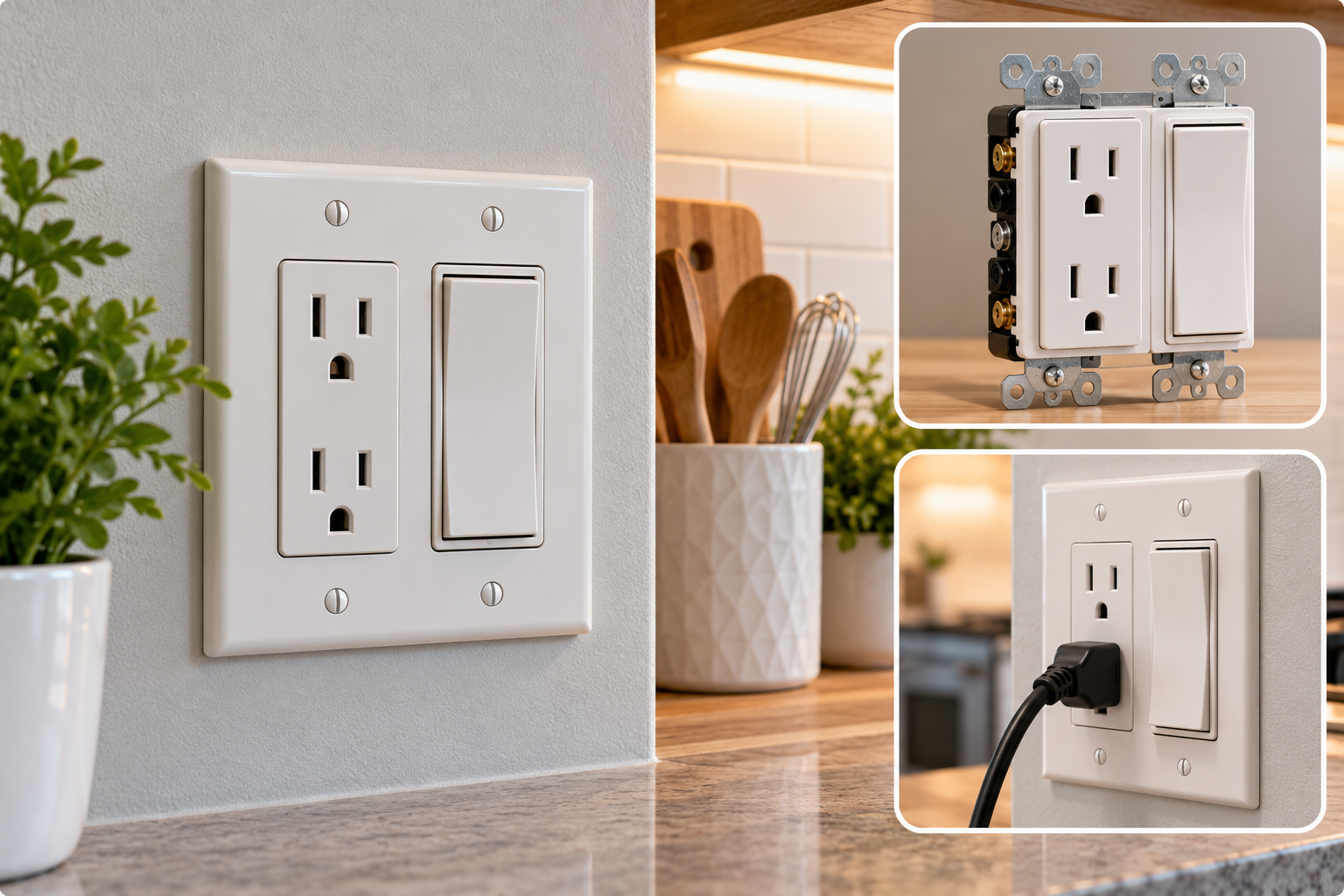
A receptacle switch is a combination wiring device that mounts a light switch and an electrical outlet on a single strap, so both fit inside one single-gang wall box. Depending on how it’s wired, the switch can control a light, the outlet itself, or both — making it a clever space-saver for tight walls.
Here’s the scenario that sends most people searching for a receptacle switch: you’re standing in a small bathroom, closet, or laundry nook with exactly one switch box on the wall, and you need an outlet right there. Cutting drywall for a second box means patching, painting, and a lot of muttering. A combination switch and outlet solves that problem in the footprint you already have.
But “just grab any switch outlet combo” is where things go sideways. These devices differ in ways that genuinely matter: toggle vs. decorator rocker styling, tamper-resistant shutters, built-in GFCI protection, pilot lights, wiring methods, and whether the device is rated as residential or commercial grade. Pick the wrong one, and you could end up with a device that doesn’t meet your local code, won’t fit your wall plate, or simply can’t be wired the way you need — especially if the box behind your existing switch has no neutral wire.
In the U.S., installations are governed by the National Electrical Code (NFPA 70), which states and cities adopt on their own schedules, often with local amendments. That’s why this guide doesn’t just list products. You’ll get an honest, spec-based comparison of seven real devices you can find on amazon.com, plain-English explanations of what each feature means at your wall, a buyer decision framework, and the code basics you need to avoid a failed inspection. Wherever verified customer review data was thin, we say so — and lean on the spec sheets instead.
Quick Comparison: The 7 Best Receptacle Switch Options at a Glance
| Product | Style | Key Safety Feature | Price Range* | Best for |
|---|---|---|---|---|
| Leviton T5225-W | Toggle | Tamper-resistant (TR) | $10–$20 | Leviton T5225-W: classic-look replacements |
| Leviton T5625-W | Decora rocker | TR | $10–$20 | Leviton T5625-W: modern Decora rooms |
| Leviton GFSW1-W | Decora rocker + GFCI | Self-test GFCI + TR | $25–$45 | Leviton GFSW1-W: bathrooms and wet areas |
| ENERLITES 68625-TR-W | Decorator paddle | TR | Around $10 | ENERLITES 68625-TR-W: budget remodels |
| Eaton TR274W | Toggle + pilot light | TR, heavy-duty | $12–$20 | Eaton TR274W: garages, disposals, fans |
| Eaton TR7730W | Decorator rocker | TR, auto-ground | $10–$20 | Eaton TR7730W: rental units and heavy use |
| Pass & Seymour 691TR | Toggle | Dual-shutter TR | $15–$40 | Pass & Seymour 691TR: separate-feed wiring |
*Prices are approximate ranges at the time of writing and vary by seller, color, and pack size — check the current price on Amazon.
Reading the table above, the pattern is clear: most of these devices cluster in the same low price band, so price alone shouldn’t decide your purchase. The real fork in the road is style (toggle vs. decorator) and protection level. If the location needs GFCI protection, the Leviton GFSW1-W is the only pick here that delivers it in one device; everything else assumes ground-fault protection is already upstream.
💬 One click helps other shoppers make an informed choice too! 😊
Top 7 Receptacle Switch Picks for 2026: Expert Analysis
Every device below is a real model with published specifications. We compared spec sheets and distributor data rather than claiming hands-on testing, and we flag where review evidence is limited.
1. Leviton T5225-W — the classic toggle, done safely
The Leviton T5225-W is the “if it isn’t broken, don’t fix it” receptacle switch: a traditional toggle stacked above a single tamper-resistant outlet, in the familiar duplex footprint.
Distributor spec sheets list it as a commercial-grade, side-wired device with a steel strap, rated 15A with a 120V switch and a 125V NEMA 5-15R receptacle, and UL/CSA listed. In practice, “commercial grade” usually signals a sturdier body than bargain residential parts, and side-wiring means you wrap conductors around screw terminals — slower than push-in wiring, but far more forgiving over decades of thermal cycling.
Honestly, this is the safest bet for homeowners replacing an older toggle-style combo, because it drops into a standard duplex wall plate without any visual change to the room. It’s less ideal if the rest of your home uses rocker switches.
Verified, product-specific review data for this exact SKU was thin at the time of writing, so treat its long Leviton lineage and published ratings as the main evidence rather than review volume.
Pros:
- ✅ Fits standard duplex wall plates you already own
- ✅ Tamper-resistant receptacle meets current NEC requirements
- ✅ Side-wire screw terminals give secure, inspectable connections
Cons:
- ❌ Toggle styling clashes with all-rocker interiors
- ❌ Side-wire only, so installation takes a bit longer
Typically found in the $10–$20 range, it’s fair value for a commercial-grade, code-current device.
2. Leviton T5625-W — the Decora look in one gang
The Leviton T5625-W gives you the same switch-plus-outlet concept in Leviton’s Decora rocker style, so it matches the flat paddle switches found in most homes built in the last couple of decades.
It pairs a 15A, 120V single-pole rocker with a 15A, 125V tamper-resistant receptacle, and the non-TR sibling (5625) is listed by Leviton as commercial grade, grounding, and side-wired. What that means for you: it uses a standard Decora (rectangular) wall plate, and the rocker’s wider surface is easier to hit with an elbow when your hands are full — a small but real win in kitchens and laundry rooms.
This is the pick for anyone who cares about a consistent look across the room. If you’re mixing it into a gang box next to other Decora switches, it will line up cleanly under a multi-gang Decora plate.
Product-specific reviews for the T5625-W were limited in what we could verify, so lean on its published ratings and the Decora ecosystem’s broad availability.
Pros:
- ✅ Matches modern Decora rocker switches and plates
- ✅ Wide rocker is easy to operate hands-free
- ✅ Tamper-resistant outlet for homes with kids
Cons:
- ❌ Needs a Decora plate, not a duplex plate
- ❌ No GFCI protection built in
Expect roughly $10–$20, which makes it the best-value styling upgrade on this list.
3. Leviton GFSW1-W — GFCI protection without a second box
The Leviton GFSW1-W is the problem-solver of the group: a self-testing SmartlockPro GFCI receptacle combined with a single-pole switch, which is exactly what a bathroom vanity wall often needs.
Distributor listings describe automatic self-testing (it tests the GFCI within about three seconds of power-up), a status LED that also flags line/load reversal, and a lockout that prevents reset if the GFCI can no longer protect you. It accepts 14 to 10 AWG wire with back-wire clamps and side terminals, and its slim body is designed to fit shallow boxes. Translation: fewer wiring mistakes, clear feedback when something’s wrong, and room left in a crowded box.
One genuinely useful detail from Leviton’s application note: the standard diagrams don’t GFCI-protect the switched load, but an alternate wiring method does — relevant if the light fixture itself has an outlet.
We couldn’t verify a substantial pool of product reviews, so this assessment rests on the published feature set.
Pros:
- ✅ GFCI and switch share one single-gang box
- ✅ Self-test and lockout reduce silent protection failures
- ✅ Accepts up to 10 AWG with back-wire clamps
Cons:
- ❌ Only one receptacle instead of a duplex
- ❌ Costs roughly double a standard combo device
At around $25–$45, it’s pricier, but cheaper than adding a second box and a separate GFCI.
4. ENERLITES 68625-TR-W — the budget decorator that still checks the boxes
The ENERLITES 68625-TR-W proves you don’t need a big-brand premium to get a code-current switch outlet combo: a decorator paddle switch over a tamper-resistant outlet, at the lowest price point here.
The switch is rated 15A at 120–277VAC and the outlet 15A at 125VAC, with tamper resistance that ENERLITES says complies with NEC 406.12. It supports both push-in and side wiring for 12–14 AWG copper, uses a shallow body, and comes in white, black, brown, gray, and ivory. The 277V switch rating won’t matter in a typical home; it simply signals a switch built for commercial lighting circuits. One flag: the listing notes a UL 94 V-2 flammability rating, while the Eaton models below advertise the stricter V-0.
On Walmart’s listing, a small sample of nine reviews averaged 4.4 stars, with buyers mentioning bathroom remodels with limited wall space and closets that previously had only a light switch.
Pros:
- ✅ Lowest price among tamper-resistant decorator combos
- ✅ Push-in and side wiring options
- ✅ Five color choices for matching existing trim
Cons:
- ❌ Residential grade, with a less strict V-2 flammability rating
- ❌ Small review sample makes long-term durability unproven
Usually around $10, it’s the clear value pick for budget remodels.
5. Eaton TR274W — the heavy-duty toggle with a pilot light
The Eaton TR274W is built for workhorse locations: a heavy-duty toggle combo with a tamper-resistant receptacle and a neon pilot light that glows when the switch is on.
Eaton rates the switch for motor loads per UL 20, uses ultrasonic welding to integrate the strap and body for ground integrity, and specifies UL 94 V-0 flammability-rated housings plus tri-combo screw heads. In plain terms, this device is designed to handle a garbage disposal, exhaust fan, or well pump without stress, and the pilot light tells you at a glance whether something out of sight is running.
That pilot light is also the catch. Reviews of this model (as aggregated on retailer pages mirroring the Amazon listing) consistently praise the solid, high-quality switch feel, but a recurring complaint is that no wiring diagram came in the box — and one buyer found the light stayed on regardless of switch position after wiring it incorrectly. Download Eaton’s instructions before you start.
Pros:
- ✅ Horsepower-rated switch handles motor loads
- ✅ Pilot light confirms out-of-sight equipment is running
- ✅ Reviewers consistently praise the switch’s solid feel
Cons:
- ❌ Wiring diagram reportedly missing from some packages
- ❌ Pilot light complicates wiring compared with basic combos
Typically $12–$20, it’s excellent value for garages and kitchens.
6. Eaton TR7730W — the commercial-grade decorator for heavy use
The Eaton TR7730W brings Eaton’s heavy-duty construction to a decorator rocker, making it a strong pick for rentals, kids’ rooms, and high-traffic spaces where switches get abused.
Spec sheets list a 15A single-pole rocker rated 120/277V, a tamper-resistant, auto-grounding 5-15R receptacle, back- and side-wiring for #14–#12 AWG, a zinc-plated steel strap for corrosion resistance, and a built-in wire stripper. The auto-ground feature bonds the strap to a metal box through the mounting screws, simplifying ground continuity, while back-wiring clamps speed installation without the reliability concerns of cheap push-in holes.
Like the Eaton TR274W, its switch is horsepower-rated per UL 20 and its housing uses UL 94 V-0 material. If you’re a landlord standardizing on one decorator combo across units, this is the most robust option on paper.
One retailer listing we found showed zero reviews, so there’s no meaningful review sentiment to report — the spec sheet is the main evidence.
Pros:
- ✅ Back-wire clamps plus side terminals for flexible installs
- ✅ Corrosion-resistant strap and stricter V-0 housing
- ✅ Horsepower-rated switch for fans and motors
Cons:
- ❌ Limited review history to confirm long-term reliability
- ❌ Black and white stocked more widely than other colors
At roughly $10–$20, it offers commercial durability for a residential price.
7. Pass & Seymour 691TR — the wiring-flexibility specialist
The Pass & Seymour 691TR from Legrand is a traditional toggle combo whose standout trait is an easily accessible break-off tab for separate or common feed — the feature you need when the switch and outlet must be on different circuits or controlled independently.
Legrand lists one-piece, heat-treated, triple-wipe brass power contacts, a dual mechanical shutter tamper-resistant system, side wiring for #12 and #14 AWG, and a 30,000-cycle operating rating. Triple-wipe contacts grip plug blades on more surfaces, which helps plugs stay seated in outlets that get used daily. The 30,000-cycle rating means roughly 16 years even if you flip it five times a day.
This is a smart choice for electricians and confident DIYers who need flexible circuit configurations. It comes in brown (691TR), ivory (691TRI), and other colors.
We couldn’t verify a meaningful set of consumer reviews; availability on Amazon can also be spotty, with pricing often reflecting distributor listings.
Pros:
- ✅ Break-off tab supports separate or common feed
- ✅ Triple-wipe brass contacts hold plugs firmly
- ✅ Published 30,000-cycle switch rating
Cons:
- ❌ Side-wire only, no back-wire clamps
- ❌ Pricing and availability vary widely between sellers
Listings range roughly $15–$40, so compare sellers carefully before buying.
Side-by-Side: How the Top 7 Compare on Specs
| Product | Grade | Wiring Method | Flammability Rating | Extra Feature | Verified Review Signal | Best for |
|---|---|---|---|---|---|---|
| Leviton T5225-W | Commercial | Side wire | Not specified in listing | Steel strap | Limited | Leviton T5225-W: toggle replacements |
| Leviton T5625-W | Commercial (per 5625 listing) | Side wire | Not specified in listing | Decora styling | Limited | Leviton T5625-W: Decora homes |
| Leviton GFSW1-W | Commercial | Back clamp + side | Not specified in listing | Self-test GFCI, LED | Limited | Leviton GFSW1-W: wet locations |
| ENERLITES 68625-TR-W | Residential | Push-in + side | UL 94 V-2 | 5 colors | Small sample, positive | ENERLITES 68625-TR-W: tight budgets |
| Eaton TR274W | Heavy-duty | Side wire | UL 94 V-0 | Pilot light, HP-rated | Moderate, mostly positive | Eaton TR274W: motor loads |
| Eaton TR7730W | Heavy-duty | Back clamp + side | UL 94 V-0 | Auto-ground, wire stripper | None found | Eaton TR7730W: rentals |
| Pass & Seymour 691TR | Residential/commercial | Side wire | Not specified in listing | Break-off tab, 30k cycles | Limited | Pass & Seymour 691TR: separate feeds |
The spec table exposes the trade-off behind the similar price tags: the ENERLITES 68625-TR-W wins on cost and installation speed, but the two Eaton models are the only ones that advertise the stricter V-0 flammability rating and horsepower-rated switches. If your switch will control a motor — a disposal, fan, or pump — the Eaton TR274W or Eaton TR7730W is the more defensible choice. For everything else, style and wall-plate compatibility should drive the decision.
✨ Don’t miss these space-saving picks!
🔍 Take your wiring project to the next level with this carefully curated lineup. Click a highlighted product to check current pricing and availability. These picks will help you add an outlet without cutting a new box — a cleaner, safer upgrade the whole family will appreciate!
How to Install a Receptacle Switch: A First-Timer’s Practical Guide
Before anything else: electrical work can kill, and many jurisdictions require permits or a licensed electrician. If you’re unsure, hire a pro. If you’re qualified and local rules allow it, here’s the sequence that prevents most first-install headaches.
Step 1: Confirm you have a neutral
Turn off the breaker, remove the old device, and look in the box. A receptacle needs a neutral (usually a white conductor). Many older switch boxes contain only a “switch loop” — a hot and a switched leg, no neutral. If there’s no neutral, a receptacle switch can’t legally or functionally power the outlet, full stop.
Step 2: Verify power is truly off
Use a non-contact voltage tester on every conductor, then confirm the tester works on a known live outlet. Boxes sometimes contain more than one circuit.
Step 3: Decide your configuration
Most combination devices support three setups: switch controls a light while the outlet is always hot; switch controls the outlet; or switch and outlet on separate circuits (which typically requires breaking the device’s connecting tab, as on the Pass & Seymour 691TR). Follow the diagram for your exact model — the Eaton TR274W reviews show how easily a pilot-light model can be miswired.
Step 4: Wire, orient, and check box fill
Combo devices count as a single yoke for box-fill calculations, but a box that’s already crowded may still be too small. Keep the switch on top unless instructions say otherwise.
Step 5: Test before you close up
Restore power, test the switch, plug in a lamp, and use a plug-in receptacle tester. For the Leviton GFSW1-W, press TEST and RESET and watch the LED. Then mount the plate — and recheck in 30 days for any warmth or loosening.
Real-World Scenarios: Matching the Right Switch Outlet Combo to Your Room
Specs only mean something in context, so here are three common profiles and the device that fits each best.
🛁 Profile 1: The bathroom remodeler
Budget: around $25–$45 for the device. Use: daily, wet location.
You have one box next to the vanity controlling the light, and you want an outlet for a hair dryer or toothbrush charger. Bathroom receptacles require GFCI protection under the NEC. If nothing upstream already provides it, the Leviton GFSW1-W is the natural fit, combining GFCI protection and a switch in the same gang. If the circuit is already GFCI-protected (check for a GFCI breaker or an upstream GFCI outlet), a cheaper Leviton T5625-W can do the job — but verify that protection first rather than assuming.
🔧 Profile 2: The garage tinkerer
Budget: $12–$20. Use: several times a week, motor loads.
You need a switched outlet for a shop vac or an exhaust fan near the door, plus visual confirmation it’s running. The Eaton TR274W is purpose-built for this: horsepower-rated switch, pilot light, heavy-duty body. Garages generally require GFCI protection too, so pair it with an upstream GFCI breaker or outlet.
🏠 Profile 3: The landlord standardizing units
Budget: under $20 per device, buying in volume. Use: heavy, unpredictable tenant use.
Durability and consistency beat style. The Eaton TR7730W offers back-wire clamps for faster installs across many units, a corrosion-resistant strap, and a stricter flammability-rated housing. If budget is tighter than durability concerns, the ENERLITES 68625-TR-W gets you a code-current tamper-resistant decorator at the lowest cost — just accept a less proven track record.
Problem → Solution: Fixing Common Combination Switch and Outlet Headaches
Even good devices run into predictable trouble. Here are the most common issues and how to resolve them.
Problem 1: “The outlet only works when the light is on.”
Solution: The device was wired so the switch controls both. If you want an always-hot outlet, the incoming hot must feed the receptacle side directly, with the switch feeding only the light. Re-check the manufacturer’s diagram for your model.
Problem 2: “The pilot light stays on no matter what.”
Solution: This is a classic miswire on pilot-light models like the Eaton TR274W, as one reviewer discovered. The pilot light needs to sit across the switched leg and neutral. Download the official instructions instead of guessing.
Problem 3: “My plug won’t go in — the outlet feels jammed.”
Solution: Tamper-resistant shutters only open when both blades push in at once with equal pressure. Insert plugs straight, not at an angle. Bent or out-of-spec plug blades are the usual culprit, not the outlet.
Problem 4: “The GFCI won’t reset.”
Solution: On the Leviton GFSW1-W, a lockout blocks reset if there’s no power, a line/load reversal, or the GFCI can’t protect. Confirm the breaker is on, verify LINE and LOAD terminals, and replace the device if the LED indicates an end-of-life fault.
Problem 5: “The device runs warm or the switch feels loose.”
Solution: Turn off power immediately. Warmth usually points to a loose terminal or an overloaded circuit. Re-torque screw terminals to spec and avoid push-in connections on heavily used circuits.
How to Choose a Receptacle Switch: 7 Steps
- Confirm a neutral is present. Without one, the outlet portion can’t work — this rules out many old switch-loop boxes.
- Match the style to your wall plates. Toggle combos use duplex plates; decorator/rocker combos need Decora-style plates.
- Require tamper resistance. NEC 406.12 calls for TR receptacles in dwellings, and it’s the right call even where local enforcement lags.
- Decide whether you need GFCI. Bathrooms, garages, kitchens, and other wet areas usually do; a GFCI combo avoids a second box.
- Check the load type. Motors (fans, disposals, pumps) favor a horsepower-rated switch like the Eaton devices.
- Pick your wiring method. Back-wire clamps and side terminals beat push-in holes for long-term reliability.
- Look for listing marks. Insist on UL or ETL listing — never buy an unlisted device to save a dollar.
These steps work in order because each one eliminates options. The neutral check alone can end the project before you spend anything, and the style decision usually narrows seven products down to three or four.
Tamper Resistant Switch Receptacle Basics: Safety, Regulations, and Standards
Tamper resistance isn’t a marketing extra — for most U.S. homes, it’s a code requirement. According to the Electrical Safety Foundation International (ESFI), roughly 2,400 children a year suffer shocks and burns from pushing objects into outlet slots — about seven a day — and nearly a third of those injuries involve household items like keys, pins, or paperclips.
How the shutters work
TR receptacles look like ordinary outlets but contain spring-loaded shutters behind the slots. The shutters only open when both plug blades press in simultaneously; a single object pushed into one slot meets a closed barrier. Unlike plastic outlet caps, which young children can remove and which can pose a choking hazard, TR shutters are permanent.
What the NEC requires
The NEC adopted TR receptacles in 2008 for 15A and 20A, 125V receptacles in new residential construction, and Section 406.12 covers the details. ESFI reported that, as of its publication, 46 states required TRRs for new residential construction. Adoption is state-by-state, so always check with your local building department.
Other marks worth knowing
- NEMA 5-15R: the standard three-prong 15A, 125V receptacle configuration you’ll see on every device in this guide. The NEMA connector standards define these shapes so any standard plug fits.
- UL/ETL listing: confirms independent testing by a Nationally Recognized Testing Laboratory.
- UL 94 V-0 vs. V-2: V-0 materials self-extinguish faster without dripping flaming particles, a meaningful difference inside a wall.
Every product in our lineup offers a tamper-resistant receptacle, so you won’t trade safety for convenience with any of them.
GFCI Switch Combo: When You Need One (and When You Don’t)
A GFCI switch combo like the Leviton GFSW1-W monitors current flowing out on the hot conductor and back on the neutral. If even a small amount leaks elsewhere — say, through a person standing on a wet floor — it cuts power in a fraction of a second.
Where GFCI protection is typically required
The NEC requires GFCI protection for receptacles in many locations, including bathrooms, garages, outdoors, crawl spaces, unfinished basements, kitchen countertops, laundry areas, and within six feet of sinks. Requirements expand with newer code editions, so your local adopted edition is what counts.
When a standard combo is enough
GFCI protection doesn’t have to live in the device itself. If the circuit is already protected by a GFCI breaker or an upstream GFCI outlet wired to protect downstream loads, a standard combo such as the Leviton T5625-W or Eaton TR7730W is fine. Doubling up protection on the same circuit adds cost and can make troubleshooting confusing.
The trade-off to weigh
A GFCI combo gives you only one receptacle, while standard combos also give you one in most designs — so you aren’t actually losing outlet count. The real cost is price: roughly double. The win is eliminating a second box and having self-test monitoring right where you can see the LED.
Receptacle Switch vs. Two Separate Devices: Which Makes More Sense?
When you need both a switch and an outlet in the same spot, you have two paths: a combination device in one gang, or a separate switch and outlet in a two-gang box. Neither is universally better.
| Factor | Combination Receptacle Switch | Separate Switch + Outlet (2-gang) | Plastic Outlet Caps on Old Outlets | Best for |
|---|---|---|---|---|
| Wall space | One gang | Two gangs | N/A | Combo: tight walls |
| Drywall work | None if box exists | Cut and patch | None | Combo: finished rooms |
| Outlet count | Usually 1 | 2 (duplex) | Unchanged | Separate: high plug demand |
| Child safety | Permanent TR shutters | Permanent TR shutters | Removable, choking risk | Combo or separate with TR |
| Replacement cost | One device | Two devices + plate | Cheapest, least safe | Combo: simple swaps |
The table makes the decision fairly simple: if you have an existing single-gang box with a neutral and need one extra outlet, a combo device is cheaper, faster, and cleaner. If you’ll plug in several things — a kitchen counter, a workbench — the extra drywall work for a two-gang box with a full duplex outlet pays off. Plastic caps are the weakest option on safety; ESFI’s own survey found that every two-to-four-year-old in one Temple University study removed a type of cap within ten seconds.
Features That Actually Matter (and Ones That Don’t)
Manufacturers pile on specs, but only a few change your day-to-day experience.
✅ Features that matter
- Tamper resistance: a code requirement and a genuine safety feature. Non-negotiable.
- Wiring method: back-wire clamps (on the Eaton TR7730W and Leviton GFSW1-W) combine speed with reliable pressure contact. Push-in holes are fast but have a weaker long-term reputation among electricians.
- Horsepower rating: matters only if the switch will run a motor, but then it matters a lot.
- Break-off tab access: if you need separate circuits, an easy-to-reach tab like on the Pass & Seymour 691TR saves frustration.
- Wall-plate style: the difference between a clean finish and a trip back to the store.
❌ Features that matter less than marketing suggests
- 277V switch rating: irrelevant in a typical 120V home circuit.
- “Commercial grade” alone: a useful durability signal, but a residential device installed correctly will serve most homes fine.
- Color variety: nice for matching, but it never outweighs safety or fit.
- Built-in wire strippers: handy, but any real installer already owns a stripper.
Common Mistakes to Avoid When Buying a Receptacle Switch
Mistake 1: Assuming any switch box can host an outlet. This is the big one. No neutral, no outlet. Check before you buy, not after.
Mistake 2: Ignoring the GFCI requirement. Installing a standard combo in a bathroom without upstream GFCI protection may fail inspection and leaves you exposed to shock risk. If unsure, choose the Leviton GFSW1-W or confirm upstream protection.
Mistake 3: Buying the wrong style for your plates. A toggle-style Leviton T5225-W won’t fit a Decora plate, and a decorator ENERLITES 68625-TR-W won’t fit a duplex plate.
Mistake 4: Choosing a non-TR device to save a dollar. Some listings, like an ivory variant of the ENERLITES line, are explicitly not tamper-resistant. Read variant names carefully.
Mistake 5: Overloading the outlet. A 15A combo on a 15A circuit can’t magically power a space heater and a hair dryer at once. Combos add convenience, not capacity.
Mistake 6: Skipping the instructions on pilot-light models. As reviews of the Eaton TR274W show, guessing the wiring leads to a light that never turns off — or worse.
Long-Term Cost and Maintenance
A receptacle switch is one of the cheapest electrical upgrades you can make, but total cost of ownership still varies.
| Option | Device Cost (approx.) | Extra Materials | Expected Value Over Time | Best for |
|---|---|---|---|---|
| ENERLITES 68625-TR-W | Around $10 | Decorator plate | Good; durability less proven | Lowest upfront cost |
| Leviton T5625-W | $10–$20 | Decora plate | Strong; widely available replacements | Balanced value |
| Eaton TR7730W | $10–$20 | Decora plate | Strong; heavy-duty build | Lowest cost per year of service |
| Leviton GFSW1-W | $25–$45 | Decora plate | Highest; replaces two devices | Wet areas |
The table shows why upfront price misleads: the Leviton GFSW1-W looks expensive until you factor in the second box, separate GFCI, labor, and drywall patching it eliminates. For dry locations, the Eaton TR7730W offers the best long-run value because its heavy-duty construction is designed for years of hard use at a mid-range price.
Simple maintenance schedule
- Monthly (GFCI models): press TEST and RESET, even with self-test, as a habit check.
- Every year: feel the cover plate under load — any warmth means investigate.
- Every few years: check that plugs still grip firmly; loose outlets cause arcing.
- Anytime: replace a cracked device immediately rather than taping it.
FAQ: Receptacle Switch Questions Answered
❓ Can I replace a regular light switch with a receptacle switch?
❓ Do I need a tamper resistant switch receptacle?
❓ Is a light switch and outlet combo safe for a bathroom?
❓ Can the switch on a combination device control the outlet?
❓ What's the difference between toggle and decorator combo devices?
Conclusion: Choosing Your Receptacle Switch With Confidence
A receptacle switch is one of those small upgrades that makes a room work better — an outlet exactly where you need it, without a second box or a drywall patch. The key is matching the device to the wall, the wiring, and the location.
For most homes with modern rocker switches, the Leviton T5625-W is the balanced choice: tamper-resistant, Decora-styled, and easy to find. If you prefer a traditional toggle, the Leviton T5225-W or Pass & Seymour 691TR fits right in, with the Pass & Seymour 691TR shining when you need separate circuits. Bathrooms and other wet areas without upstream protection call for the Leviton GFSW1-W. Garages and motor loads point to the Eaton TR274W, rentals and heavy use to the Eaton TR7730W, and tight budgets to the ENERLITES 68625-TR-W.
Whichever you pick, confirm a neutral, verify GFCI requirements, check your local code edition, and follow the manufacturer’s diagram. When in doubt, a licensed electrician is a small expense compared with the cost of getting electrical work wrong. For more on keeping kids safe around outlets, ESFI’s tamper-resistant receptacle survey findings are worth a read.
🚀 Ready to upgrade your wall the smart way?
⚡ Pick the combination device that fits your room, your wiring, and your budget. Click a highlighted product above to check current pricing and availability — and enjoy a safer, more convenient space your whole household will notice!
Recommended for You
- Power Outage Sensor: 7 Best Picks That Actually Alert You (2026)
- Outdoor Digital Timer for Lights: 7 Best, Most Reliable Picks (2026)
- Outdoor Smart Light Switch: 7 Best Picks That Actually Last (2026)
Disclaimer: This post contains affiliate links. As an Amazon Associate, I earn from qualifying purchases made through these links, at no additional cost to you.
✨ Found this article helpful? Share it with someone who needs it! 💬🤗