
In This Article
Introduction: Why an Electrical Fire Prevention Sensor Belongs in Your Home in 2026
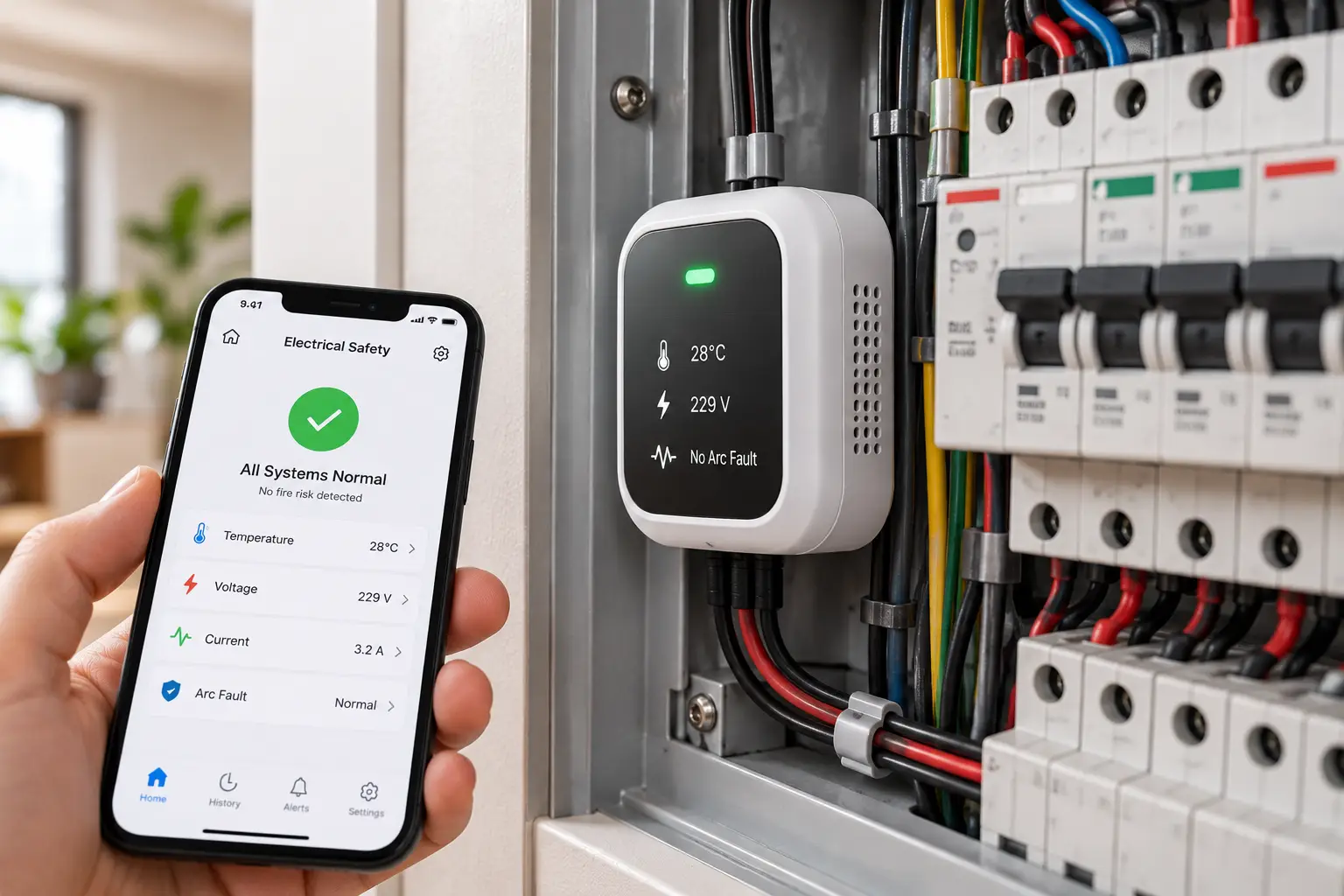
Most house fires announce themselves with smoke. Electrical fires are sneakier. They often start inside a wall, behind an outlet, or deep in the breaker panel, where a loose connection or a nicked wire has been arcing quietly for weeks. By the time a smoke alarm sounds, the damage is already underway. That’s exactly the gap an electrical fire prevention sensor is designed to close: it catches the warning signs before there’s anything to smell.
The numbers explain why this matters. According to NFPA research covering 2015-2019, electrical problems were behind roughly 13% of U.S. home structure fires but about 21% of the property damage, which tells you these fires tend to be costly once they get going. The U.S. Fire Administration’s residential electrical fire data tracks the same stubborn trend year after year. And here’s the twist most people don’t expect: NFPA analysis indicates that arcing, not simple overheating, accounts for most home electrical fires.
So what should you actually buy? The answer isn’t one gadget. An electrical fire prevention sensor can be a plug-in smart monitor that “listens” to your whole wiring system, an arc-fault device built into a breaker or outlet, or a dedicated heat alarm for garages and attics where smoke alarms misbehave. Each layer catches a different failure.
In this guide, you’ll get an honest breakdown of seven real products available on amazon.com, based on spec sheets, standards, and aggregated customer feedback. No invented test stories, no fake ratings, just clear analysis of what each device does, who it’s for, and where it falls short.
What Is an Electrical Fire Prevention Sensor?
An electrical fire prevention sensor is a device that detects early electrical hazards, such as arcing, faulty wiring, or abnormal heat, and either alerts you or cuts power before a fire ignites. Common types include whole-home smart arc monitors, AFCI breakers and receptacles, and heat alarms for spaces where smoke alarms aren’t suitable.
Quick Comparison: 7 Electrical Fire Detector Options at a Glance
| Product | Type | What It Detects | Install | Approx. Price Range | Best For |
|---|---|---|---|---|---|
| Ting Sensor (Whisker Labs) | Smart plug-in monitor | Micro-arcing across the whole home + utility power issues | DIY, plugs into any outlet | Around $100 first year, then ~$49/yr service | Ting Sensor for whole-home early warning |
| Sense Energy Monitor | In-panel energy monitor | Abnormal power usage and device behavior (not a fire alarm) | Electrician recommended | Around $300 | Sense Energy Monitor for data-driven owners |
| Leviton AFTR1-W | AFCI receptacle | Arc faults at and downstream of the outlet | Outlet swap | Roughly $30-$45 | Leviton AFTR1-W for older-home upgrades |
| Leviton AGTR1 | Dual AFCI/GFCI receptacle | Arc faults + ground faults (shock) | Outlet swap | Roughly $40-$60 | Leviton AGTR1 for kitchens and laundry |
| Square D QO115CAFIC | Combination AFCI breaker | Series + parallel arcs on the full branch circuit | Panel install (electrician) | Roughly $60-$90 | Square D QO115CAFIC for QO panels |
| Kidde HD135F | Hardwired heat alarm | Ambient heat above 135°F | Hardwired, interconnects | Roughly $30-$45 | Kidde HD135F for Kidde-wired homes |
| First Alert HD6135FB | Hardwired heat alarm | 135°F fixed + rapid temperature rise | Hardwired, interconnects | Roughly $25-$40 | First Alert HD6135FB for garages and attics |
Looking at the table, the split is clear: the Ting Sensor and the Sense Energy Monitor watch the whole house from one device, while the Leviton AFTR1-W, Leviton AGTR1, and Square D QO115CAFIC protect individual circuits by cutting power when they detect arcing. The two heat alarms, the Kidde HD135F and First Alert HD6135FB, sit at the end of the chain as a last line of warning when heat is already building. The smartest setups combine at least two of these layers rather than betting on one.
💬 One click helps other shoppers make an informed choice too! 😊
Top 7 Electrical Fire Prevention Sensor Picks: Expert Analysis
1. Ting Sensor (Whisker Labs) — whole-home arc detection from one outlet
The Ting Sensor is the closest thing to a true “set it and forget it” electrical fire prevention sensor, because it monitors your entire wiring system from a single plug-in device.
According to Whisker Labs, Ting analyzes about 30 million electrical signals per second, hunting for the tiny micro-arcs that tend to precede electrical fires. In practice, that means it can flag a failing connection in a bedroom wall even though it’s plugged in down the hall. It also watches incoming utility power, so it can alert you to grid problems that might damage your electronics.
Based on comparing what it does with traditional devices, the Ting Sensor suits owners of older homes most: Whisker Labs’ own hazard data found that roughly 81% of hazards turned up in homes more than 20 years old. It doesn’t cut power, though. It alerts you through an app, and Whisker Labs’ team helps coordinate a fix. Reviews consistently praise the easy setup, while a common complaint is the ongoing annual service fee.
Pros:
- ✅ Covers the whole home from one outlet
- ✅ Five-minute DIY setup with app alerts
- ✅ Often free through participating home insurers
Cons:
- ❌ Requires an annual service subscription after year one
- ❌ Alerts only; it won’t shut off a circuit
The bundle runs around $100 including the first year of service, then roughly $49 per year, which is strong value if your insurer doesn’t already cover it.
2. Sense Energy Monitor — deep data, not a dedicated fire alarm
The Sense Energy Monitor gives you an unusually detailed view of how electricity moves through your home, which can surface early hints of trouble.
Installed inside your breaker panel with two current clamps, Sense samples current and voltage roughly a million times per second and uses machine learning to recognize individual appliances. Practically, that means you can spot a dryer or well pump suddenly drawing more power than normal, often a sign of a failing motor or element. It’s ETL/Intertek listed for safety.
Here’s what to weigh: the Sense Energy Monitor is an energy monitor first. It isn’t marketed as an arc-fault or fire detector, so treat any safety insight as a bonus rather than a guarantee. It’s best for data-minded owners, solar households, and anyone who wants to cut wasted “always on” power. Customer reviews consistently report that device detection is imperfect and can take weeks to learn, with some users seeing only a handful of devices at first.
Pros:
- ✅ Real-time, whole-home power data in a polished app
- ✅ Helps uncover abnormal appliance behavior
- ✅ Expandable and solar-compatible
Cons:
- ❌ Not a purpose-built fire detection device
- ❌ Panel installation usually needs an electrician
At around $300 before installation, it’s good value for energy savings, and fair value if fire safety is your only goal.
3. Leviton AFTR1-W — the easiest arc-fault upgrade for older homes
The Leviton AFTR1-W brings arc-fault protection to homes whose panels predate modern AFCI breakers, simply by replacing a standard outlet.
It’s a 15A, 125V outlet branch circuit (OBC) AFCI receptacle with tamper-resistant shutters, an LED status light, and 20A feed-through. In plain terms, it protects the outlet itself and anything wired downstream of it, then trips if it detects dangerous arcing. It also self-tests when you press Reset and refuses to reset if the protection isn’t working, and a line-load reversal feature stops it from powering up if it’s wired backward.
Based on the specs, the Leviton AFTR1-W is ideal for renters with landlord approval, older homes, and remodels where swapping a breaker isn’t practical. Note that it only protects from the outlet onward, not the wire running back to the panel. Aggregated reviews are generally positive on build quality, while some buyers mention the device is bulkier than a standard outlet in a crowded box.
Pros:
- ✅ Adds AFCI protection without touching the panel
- ✅ Self-test and wiring-error safeguards built in
- ✅ Tamper-resistant for homes with kids
Cons:
- ❌ Doesn’t protect wiring upstream of the outlet
- ❌ Deeper body can be tight in small boxes
Typically between $30 and $45, it’s excellent value per protected circuit.
4. Leviton AGTR1 — two protections in one kitchen-ready outlet
The Leviton AGTR1 combines arc-fault and ground-fault protection, so one outlet guards against both fire and shock.
This 15A dual-function AFCI/GFCI receptacle with 20A feed-through detects arcing and ground faults, cutting power fast in either case. That matters because kitchens and laundry areas need both protections under current NEC rules, and Leviton positions it as a compliant option for those rooms. It’s also useful as a replacement for ungrounded two-prong outlets, where code allows GFCI protection as a safer alternative.
Here’s the practical angle: instead of buying a GFCI outlet and an AFCI breaker separately, the Leviton AGTR1 handles both at the point of use. It’s the right pick for kitchen remodels, laundry rooms, and older homes with ungrounded wiring. Verifiable review volume for this exact model on amazon.com is limited, so we’re relying on the spec sheet here, but buyers of Leviton’s SmartlockPro line generally report solid build quality and occasional sensitivity to certain motors.
Pros:
- ✅ AFCI and GFCI protection in one device
- ✅ Code-friendly option for kitchens and laundry areas
- ✅ Good fix for ungrounded two-prong outlets
Cons:
- ❌ Costs more than single-function outlets
- ❌ Possible nuisance trips with some older motors
Usually in the $40 to $60 range, it’s fair value given you’re buying two protections.
5. Square D QO115CAFIC — full-circuit protection right at the panel
The Square D QO115CAFIC protects the entire branch circuit, from the panel to every outlet, which no receptacle-level device can match.
This 15A, single-pole combination AFCI breaker detects both series arcs (like a loose terminal) and parallel arcs (like a nail through a cable), with a 10kA interrupt rating and a pigtail neutral. Square D’s Time Saver Diagnostics help an electrician figure out why it tripped, which saves real troubleshooting time. It’s UL listed and HACR rated.
Based on comparing coverage, the Square D QO115CAFIC is the gold standard for bedrooms and living areas, provided you have a Square D QO panel, because it only fits QO load centers. Homeline panels need a different breaker. Reviews consistently describe it as reliable and well made, with the main frustrations being price and the occasional nuisance trip from vacuums or treadmills.
Pros:
- ✅ Protects the whole branch circuit, including in-wall wiring
- ✅ Detects both series and parallel arc faults
- ✅ Diagnostics speed up troubleshooting
Cons:
- ❌ Fits Square D QO panels only
- ❌ Panel work should be done by a licensed electrician
Often between $60 and $90, it’s strong value for whole-circuit coverage.
6. Kidde HD135F — dependable heat warning for Kidde-wired homes
The Kidde HD135F is a hardwired heat alarm that triggers on temperature, not smoke, making it ideal for spaces where smoke alarms false-alarm constantly.
It runs on 120V AC with a 9V battery backup and sounds when the surrounding air rises above 135°F. It can interconnect with up to 24 Kidde devices, so a heat event in the garage sets off alarms throughout the house. It meets UL 539 and carries a 5-year limited warranty. Kidde lists an operating range of -20°F to 100°F.
Here’s what most buyers overlook: the Kidde HD135F is fixed-temperature only, with no rate-of-rise sensing, so it responds once the space actually reaches the threshold. That’s fine as a backstop near an electrical panel or EV charger in the garage, but it’s slower to react than rate-of-rise models. Aggregated reviews highlight easy installation with the quick-connect harness, while some note its basic styling.
Pros:
- ✅ Interconnects with up to 24 Kidde alarms
- ✅ Works in cold garages and attics
- ✅ 5-year limited warranty and UL 539 listing
Cons:
- ❌ No rate-of-rise detection
- ❌ Supplements, but never replaces, smoke alarms
Generally $30 to $45, it’s good value if your home already uses Kidde hardwired alarms.
7. First Alert HD6135FB — faster response with rate-of-rise sensing
The First Alert HD6135FB reacts earlier than fixed-temperature alarms because it watches how quickly heat climbs.
Its thermistor and microprocessor sound the 85-decibel alarm at 135°F or when temperatures rise by about 15°F per minute. Practically, a fast-growing fire in a garage or utility room triggers it before the ceiling hits 135°F. It includes a 9V backup, a latching indicator showing which unit started the alarm, and interconnects with up to 18 First Alert or BRK alarms. It meets UL 539 and NFPA 72.
Based on the specs, the First Alert HD6135FB is the better heat alarm for most homes on First Alert or BRK systems. One caveat: its listed operating range starts at 40°F, so it’s less suited to unheated garages in cold states, where the Kidde HD135F has an edge. Reviews consistently mention straightforward installation and fewer false alarms than smoke alarms in garages.
Pros:
- ✅ Rate-of-rise sensing catches fast fires sooner
- ✅ Latching indicator pinpoints the source alarm
- ✅ Budget-friendly hardwired option
Cons:
- ❌ 40°F minimum limits use in cold garages
- ❌ Requires existing hardwired interconnect wiring
Usually $25 to $40, it’s arguably the best value heat alarm in this lineup.
Getting Started: Your First 30 Days With a Smart Electrical Fire Sensor
Buying the device is the easy part. Getting real protection out of it takes a little setup discipline, and most mistakes happen in the first month.
Week 1: Install and baseline ⚡
- ✅ Ting Sensor: plug it into an outlet that’s directly wired (not a power strip or surge protector), ideally near the center of the home, then finish Wi-Fi setup in the app. Whisker Labs notes the sensor monitors circuits fed by the main breaker panel it’s connected to, so homes with a detached garage subpanel may need to ask whether a second sensor is required.
- ✅ Sense Energy Monitor: have an electrician mount it in the panel, then run your major appliances one at a time over the first few days so you know what “normal” looks like.
- ✅ AFCI outlets and breakers: press TEST right after installation. If the device doesn’t trip, stop and call an electrician.
Weeks 2-3: Learn what an alert means 🔔
A smart electrical fire sensor alert is a prompt to investigate, not a reason to panic. Note the time, what was running, and whether lights flickered. If an AFCI trips repeatedly on the same circuit, unplug everything on that circuit and reset. If it trips with nothing plugged in, the problem is likely in the wiring itself.
Week 4: Build the habit 🗓️
Set a monthly phone reminder to press TEST on every AFCI and heat alarm, and twice a year replace 9V backup batteries in the Kidde HD135F or First Alert HD6135FB (many people pair this with daylight saving time changes). Check that the Ting Sensor still shows “online” in the app; a sensor that quietly dropped off Wi-Fi protects nothing.
Real-World Scenarios: Matching the Right Electrical Fire Prevention Sensor to Your Home
The best electrical fire prevention sensor depends on your home’s age, your panel, and what you’re willing to install. Here are three common profiles.
🏡 The 1970s ranch house owner (budget: $150-$300)
An older home with original wiring and no AFCI breakers is exactly where hidden arcing hides. Start with the Ting Sensor for whole-home monitoring (check your insurer first, since many offer it free), then swap bedroom outlets for the Leviton AFTR1-W. Add a First Alert HD6135FB in the attached garage if it’s heated.
🏢 The renter in an apartment (budget: under $150)
You usually can’t touch the panel. The Ting Sensor is the natural fit because it simply plugs in and comes with you when you move. Ask your landlord before replacing any outlet with a Leviton AGTR1, especially in the kitchen.
🔌 The EV owner with a busy garage (budget: $300+)
An EV charger, freezer, and power tools put heavy loads on garage circuits. Pair the Sense Energy Monitor for load visibility with an interconnected Kidde HD135F (better in cold garages) and have an electrician confirm your charger circuit is correctly sized.
✨ Don’t wait for the smoke alarm to tell you something’s wrong!
🔍 Build your layered electrical fire protection with these carefully researched picks. Click any highlighted product to check current pricing and availability on Amazon, and give your family the early warning they deserve! 🛡️
Problem → Solution: Common Electrical Fire Sensor Headaches
Even good devices create friction. Here are the issues buyers report most, with practical fixes.
- AFCI keeps nuisance-tripping. Older vacuums, treadmills, and some brushed motors can confuse arc detection. Try the appliance on another circuit; if only that device trips it, the device may be failing. If the Square D QO115CAFIC trips with nothing plugged in, its diagnostics can help an electrician locate the fault.
- The new AFCI outlet won’t reset. On the Leviton AFTR1-W, this often means line and load wires are reversed, which the device deliberately blocks. Rewire per the instructions or call a pro.
- Ting sends an alert and you can’t find anything. That’s normal; arcing is invisible. Follow the app’s guidance and contact Whisker Labs, who can help arrange an electrician visit.
- Heat alarm false alarms in summer. A garage attic can approach high temperatures in hot climates. Mount the alarm on the ceiling away from direct sun and vents, and confirm the space stays inside the model’s operating range.
- The breaker doesn’t fit. The Square D QO115CAFIC only works in QO panels. Read the panel label before you buy; Homeline, Eaton, and Siemens panels need their own AFCI breakers.
How to Choose an Electrical Fire Prevention Sensor
Use these seven steps to narrow the field quickly.
- Identify your weakest link. Older homes with original wiring benefit most from whole-home arc monitoring; newer homes usually already have AFCI breakers in bedrooms.
- Check your panel brand. Breaker-based protection must match your panel. A Square D QO115CAFIC fits only QO load centers.
- Decide: alert or interrupt? Smart monitors like the Ting Sensor warn you; AFCIs physically cut power. Ideally, you want both.
- Map your rooms. Kitchens and laundry areas need ground-fault protection too, which points to a dual-function device like the Leviton AGTR1.
- Cover the “smoke-alarm-unfriendly” spaces. Garages, attics, and utility rooms are heat alarm territory.
- Confirm listings. Look for UL 1699 for AFCIs and UL 539 for heat alarms, plus a recognized testing mark.
- Ask your insurer. Several carriers offer Ting free to eligible policyholders, which changes the math entirely.
The U.S. Consumer Product Safety Commission has long backed arc-fault technology; its consumer guide on preventing home fires with arc fault circuit interrupters explains how wiring problems like arcing and sparking start fires. That’s the core reason AFCIs appear in so many of the picks above.
Electrical Fire Sensor vs Traditional Smoke Alarm: What’s the Difference?
This is the most common point of confusion, so it’s worth spelling out. A smoke alarm is a detection device: it reacts after combustion begins. An electrical fire sensor is a prevention device: it reacts to the electrical conditions that come before a fire. You need both, and neither replaces the other.
| Feature | Smart Arc Monitor (Ting Sensor) | AFCI Device (Square D QO115CAFIC) | Heat Alarm (First Alert HD6135FB) | Standard Smoke Alarm |
|---|---|---|---|---|
| Acts before ignition | Yes | Yes | No | No |
| Cuts power | No | Yes | No | No |
| Whole-home coverage | Yes (one panel) | One circuit | One room | One room |
| Works in garages/attics | Yes | Yes | Yes | Often false-alarms |
| Best for | Early warning | Automatic shutoff | Hot, dusty spaces | Life safety everywhere |
The table shows why layering works: the Ting Sensor sees the most but can’t act, the Square D QO115CAFIC acts but only on its circuit, and the First Alert HD6135FB covers rooms where smoke alarms misbehave. Smoke alarms remain the non-negotiable foundation, so treat every product here as an addition, never a substitute.
Common Mistakes to Avoid When Buying an Arc Fault Detection Device
- ❌ Assuming one device covers everything. A single AFCI outlet protects downstream wiring only, not the run back to the panel.
- ❌ Buying the wrong breaker type. Breakers are brand- and panel-specific; a “close enough” fit is a real hazard.
- ❌ Ignoring the subscription. A smart home electrical fire monitor like Ting is a service, so factor in the yearly fee if your insurer doesn’t cover it.
- ❌ Treating Sense as a fire alarm. The Sense Energy Monitor is excellent for energy insight, but it isn’t designed or marketed for arc-fault detection.
- ❌ DIY panel work. Installing a breaker means working inside a live panel. Hire a licensed electrician; many jurisdictions require a permit anyway.
- ❌ Using smoke alarms in garages. Exhaust and dust trigger false alarms, so people disable them. A heat alarm avoids that trap.
Safety, Regulations, and Standards You Should Know
In the U.S., arc-fault protection is driven by the National Electrical Code. AFCI protection first appeared in the 1999 NEC, and Section 210.12 has since expanded it to most 120V, 15A and 20A circuits feeding living spaces in new construction, including bedrooms, living rooms, kitchens, and laundry areas. Your state or city adopts a specific NEC edition, so local rules may differ.
The key product standards are straightforward. AFCIs are evaluated to UL 1699, breakers to UL 489, and residential heat alarms to UL 539. The First Alert HD6135FB also lists NFPA 72 compliance. For a plain-English overview of outlet-style protection, the Electrical Safety Foundation International’s AFCI receptacle resource is a reliable starting point.
Two practical notes: when you replace an outlet in a room that now requires AFCI protection, code often requires bringing it up to current standards, which is where the Leviton AFTR1-W shines. And for homes with ungrounded two-prong outlets, a GFCI-capable device like the Leviton AGTR1 is one of the code-recognized upgrade paths.
Long-Term Cost and Maintenance: Is a Home Electrical Fire Monitor Worth It?
| Product | Upfront Cost Range | Ongoing Cost | Lifespan/Warranty Notes | Best Value For |
|---|---|---|---|---|
| Ting Sensor | Around $100 (often free via insurer) | ~$49/yr after year one | Service-based | Ting Sensor for whole-home coverage |
| Sense Energy Monitor | Around $300 + install | None required | Panel-mounted hardware | Sense Energy Monitor for energy savings |
| Leviton AFTR1-W | $30-$45 each | None | 2-year limited warranty | Leviton AFTR1-W for per-room upgrades |
| Square D QO115CAFIC | $60-$90 + electrician | None | UL 489 breaker | Square D QO115CAFIC for full circuits |
| Kidde HD135F | $30-$45 | 9V battery | 5-year limited warranty | Kidde HD135F for cold garages |
Over five years, the Ting Sensor bought outright costs roughly $300 in total, similar to the Sense Energy Monitor before installation. AFCIs cost more upfront per circuit once labor is included but have no recurring fees. If your insurer offers Ting free, it becomes the obvious first step.
There’s also independent-ish evidence on value. A Triple-I and Whisker Labs claims study reported 0.39 fewer fire claims per 1,000 home-years among Ting homes, worth about $81 per home per year in reduced fire damage claims. Keep in mind that Whisker Labs co-authored it, so read it as promising rather than definitive.
Features That Actually Matter (and Ones That Don’t)
Matter: combination (series + parallel) arc detection, self-testing, interconnection between alarms, rate-of-rise heat sensing, and human follow-up when a smart electrical fire alarm flags something. Ting’s support team helping you get an electrician is genuinely valuable, because an alert you don’t act on is worthless.
Matter less: flashy app dashboards, appliance-recognition gimmicks, and “AI” marketing that isn’t tied to a clear action. The question to ask of every feature is simple: does it make a fire less likely, or does it just make a nicer graph?
FAQ: Electrical Fire Prevention Sensor Questions Answered
❓ Can I get an electrical fire prevention sensor free through insurance?
❓ Is the Ting sensor worth it without an insurance discount?
❓ Do I need an electrician to install an electrical fire detector?
❓ Which is better for an old house: AFCI breakers or a smart sensor?
❓ Can a heat alarm replace a smoke alarm in my garage?
Conclusion: Build Layers, Not Hope
Electrical fires rarely come out of nowhere. They usually build quietly, through a loose terminal, a chewed cable, or a tired outlet, and that slow buildup is your opportunity. An electrical fire prevention sensor turns those hidden warning signs into something you can see and fix.
If you want one move that covers the most ground, the Ting Sensor is the standout: whole-home monitoring, five-minute setup, and a real chance your insurer pays for it. For automatic shutoff, pair it with AFCI protection, either the Square D QO115CAFIC at the panel (QO owners) or the Leviton AFTR1-W and Leviton AGTR1 at the outlet. Data lovers can add the Sense Energy Monitor, keeping in mind it’s an energy tool first. Finally, close the gaps in garages and attics with the First Alert HD6135FB for its faster rate-of-rise response, or the Kidde HD135F if your space gets cold or your home already runs Kidde alarms.
Whatever you choose, keep your smoke alarms working, test your devices monthly, and call a licensed electrician the moment something trips or alerts more than once. Prevention only works when someone acts on the warning.
🔥 Protect your home before the first spark!
🛒 Your family’s safety deserves more than luck. Click any highlighted product above to check current pricing and availability, and start building smarter, layered electrical fire protection today! 🏡✨
Recommended for You
- Best Automatic Power Strip: 7 Options for a Smarter Home
- Wireless Power Strip Guide 2026: 7 Smart Picks That Kill Clutter
- Dimming Smart Plug: 7 Best Picks for 2026 (Flicker-Free Guide)
Disclaimer: This post contains affiliate links. As an Amazon Associate, I earn from qualifying purchases made through these links, at no additional cost to you.
✨ Found this article helpful? Share it with someone who needs it! 💬🤗