
In This Article
Qatar Electrical Plug Type: What Every US Traveler Should Know in 2026
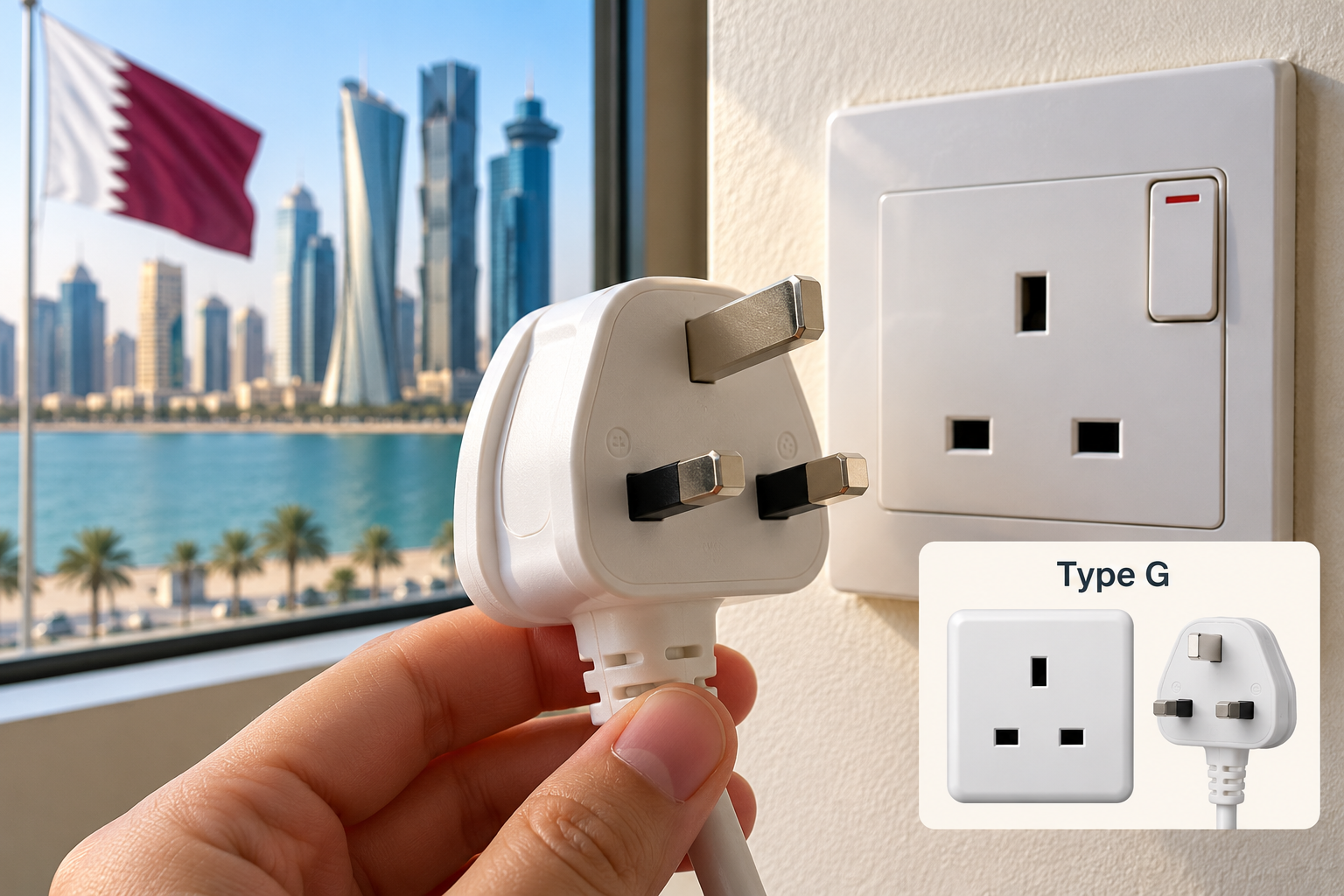
The Qatar electrical plug type is Type G—the same chunky, three-rectangular-pin plug used in the United Kingdom—running on 240 volts at 50 Hz. That’s double the 120 volts you get at home in the US, and the pins look nothing like your flat American prongs. Translation: your phone charger won’t fit the wall, and some of your gear may not survive the voltage.
Picture it. You land at Hamad International after a 14-hour flight, check into your Doha hotel, pull out your phone at 4% battery… and stare at a wall socket with three slots shaped like a little triangle. It’s a small problem that feels enormous at midnight.
The good news? Solving the Qatar electrical plug type puzzle costs less than an airport coffee if you plan ahead. The official CIA World Factbook travel facts for Qatar lists Qatar’s electricity as 240 V / 50 Hz with Type G plugs, and that matches what Gulf standards bodies publish. Some older buildings may still have the round-pin Type D socket, which we’ll cover later.
In this guide, you’ll get a plain-English explanation of Qatar voltage, a breakdown of the difference between an adapter and a converter, and an honest analysis of seven real products you can order on Amazon—from a three-pack of basic Type G plugs to a 200-watt voltage converter. Every pick is judged on spec sheets and aggregated customer feedback, not hype. Let’s get you charged.
What Is the Qatar Electrical Plug Type?
The Qatar electrical plug type is the British-standard Type G (BS 1363): three rectangular pins arranged in a triangle, with a fuse inside the plug and usually a switch on the wall socket. Qatar’s grid supplies 240 volts at 50 Hz, so US travelers need a plug adapter and, for single-voltage devices, a voltage converter.
Quick Comparison: The Best Qatar Plug Adapters at a Glance
If you only have 30 seconds before your Uber arrives, this table is for you.
| Product | Type | Outlets/Ports | Converts Voltage? | Best For |
|---|---|---|---|---|
| Ceptics CT-7 (3-Pack) | Single-country Type G | 2 US inputs each | No | Ceptics CT-7 (3-Pack): families and budget travelers |
| TESSAN TS-161-UK-C | Type G power strip | 4 AC + 3 USB | No | TESSAN TS-161-UK-C: gadget-heavy hotel rooms |
| Anker Nano Travel Adapter (A9215) | Universal | 1 AC + 4 USB | No | Anker Nano Travel Adapter (A9215): multi-country trips |
| EPICKA TA-105 Pro | Universal GaN | 1 AC + 5 USB (70W) | No | EPICKA TA-105 Pro: laptop users and remote workers |
| BESTEK 200W Voltage Converter | Converter + adapters | 3 AC + 4 USB | Yes (to 110V) | BESTEK 200W Voltage Converter: single-voltage US gear |
Looking at the table, the split is clear: four of these five products only change the plug shape, while the BESTEK 200W Voltage Converter is the lone tool that actually steps 240V down to US-friendly 110V. If everything you pack is dual voltage (most phones and laptops are), a simple adapter like the Ceptics CT-7 (3-Pack) solves the problem for the price of a sandwich. Spend more only when you need more ports, faster USB-C charging, or true voltage conversion.
💬 One click helps other shoppers make an informed choice too! 😊
Top 7 Picks for the Qatar Electrical Plug Type: Expert Analysis
Every product below fits Qatar’s Type G sockets, either natively or through an included plug. We’ve compared spec sheets, warranty terms, and the themes that show up repeatedly in customer reviews. Where verified review data is thin, we say so.
1. Ceptics CT-7 (3-Pack) — the no-brainer budget pick
The Ceptics CT-7 (3-Pack) is the simplest possible answer to the Qatar electrical plug type: a fixed Type G plug on one side, US sockets on the other, and nothing to fold, slide, or lose.
Each adapter accepts both a polarized two-prong US plug and a grounded three-prong plug, rated at 10A/250V. In practice, that means your laptop’s three-prong power brick stays grounded instead of being forced into a two-pin workaround—a small but real safety advantage. Buying three means one for the nightstand, one for the desk, and one for your travel partner.
Based on comparing the specs, this is the pick for families, couples, and anyone staying in one Gulf country. It has no USB ports and no surge protection, so it’s a pure plug-shape changer. If your charger already has USB built in, you won’t miss anything.
Customer reviews consistently describe the CT-7 as a dependable, low-cost option for phone and laptop chargers, and several reviewers note that three single-country adapters cost less than one all-in-one universal unit. A recurring reminder in feedback: these don’t convert voltage, so check your devices first.
Pros:
- ✅ Accepts grounded three-prong US plugs safely
- ✅ Three adapters cover a whole family
- ✅ Tiny and nearly impossible to break
Cons:
- ❌ No USB ports for direct charging
- ❌ Works only with Type G sockets
Expect to pay roughly $10 to $15 for the three-pack (check the current price)—outstanding value per adapter.
2. OREI US-7 — lifetime warranty on a simple adapter
The OREI US-7 competes head-to-head with the Ceptics pick, but OREI leans on a lifetime limited warranty as its tiebreaker.
The listing specifies a BS 1363 Type G output, 10A maximum current, and up to 250V, along with CE certification and RoHS compliance. It accepts US two-prong and three-prong (NEMA 5-15) plugs, so grounded laptop chargers fit without fuss. What that means for you: same safety profile as the Ceptics, in a compact body that slips into a toiletry bag.
Here’s what to weigh. OREI’s own product copy describes the US-7 slightly differently across pages—once as two grounded outlets, once as a single socket—so read the photos on the specific Amazon listing (and pack size) before ordering. The warranty is the real draw for travelers who visit the Gulf repeatedly.
Verified, detailed customer reviews for this exact model are harder to find than for the Ceptics, so we can’t summarize broad sentiment with confidence. What is verifiable: the manufacturer clearly states it’s a plug adapter only and works only with dual-voltage products.
Pros:
- ✅ Lifetime limited warranty from the manufacturer
- ✅ Grounded input suits laptop power bricks
- ✅ Covers Qatar, UAE, Saudi Arabia, and the UK
Cons:
- ❌ Listing details vary between product pages
- ❌ Fewer verified reviews than bigger brands
Usually sold in the $10–$20 range depending on pack size—fair value, especially for warranty-minded buyers.
3. TESSAN TS-161-UK-C — turns one socket into seven
The TESSAN TS-161-UK-C solves the classic Doha hotel problem: one usable socket near the bed and five devices begging for power.
It converts a single Type G socket into four US outlets plus three USB ports (two USB-A at up to 12W each, one USB-C at up to 15W). Weighing about 4.07 ounces, it’s still pocket-friendly. The fine print matters, though: when all three USB ports run at once, they share 15W total. In practice, that’s fine for overnight phone and earbud charging, but it won’t fast-charge a modern iPhone or Galaxy.
This is the right tool for couples, business travelers with a laptop plus a phone plus a watch, or anyone who hates unplugging one thing to charge another. TESSAN notes it has no surge protection, which keeps it slim—but means it’s not a power conditioner.
We couldn’t verify a large pool of US reviews for this specific model number, so we’re relying on the published specs. TESSAN’s broader line of travel adapters is widely sold on Amazon, and the company is upfront that this is not a voltage converter.
Pros:
- ✅ Four AC outlets from one wall socket
- ✅ Built-in USB-C and USB-A ports
- ✅ Light enough for a jacket pocket
Cons:
- ❌ USB ports share only 15W combined
- ❌ No surge protection built in
Typically in the $15–$30 range (prices vary by seller)—strong value if you carry lots of gadgets.
4. Anker Nano Travel Adapter (A9215) — the smallest multi-country option
The Anker Nano Travel Adapter (A9215) is what you buy when Qatar is just one stop on a longer itinerary.
It packs four plug types—Type A, Type I, Type G, and Type C—behind retractable pins, plus one AC outlet, two USB-A ports, and two USB-C ports. The primary USB-C port delivers up to 20W, which Anker says takes an iPhone 16 to 50% in about 28 minutes. Total USB output caps at 20W, and the unit supports a maximum of 6A with 300J of surge protection.
What most buyers overlook: the AC outlet accepts Type A (two-flat-prong) and Type C plugs only. Your grounded three-prong laptop cord won’t fit. That’s a dealbreaker for some MacBook and Windows power bricks with a long grounded cable—though most travelers use the short two-prong “duckhead” instead. Anker backs it with an 18-month warranty.
Detailed review aggregates for the A9215 specifically are still building, so we won’t overstate sentiment. Anker’s reputation for charging hardware is well established, and the spec sheet is unusually transparent about limits.
Pros:
- ✅ Covers Qatar plus Europe, Asia, and Australia
- ✅ 20W USB-C fast charging for phones
- ✅ 300J surge protection included
Cons:
- ❌ No grounded three-prong US outlet
- ❌ USB output capped at 20W total
Generally sold around $25–$40 (check the current price)—good value for multi-country travelers.
5. EPICKA TA-105 — the classic universal workhorse
The EPICKA TA-105 is the universal adapter that shows up in nearly every packing list, and it earns that spot through sheer port count.
It has one AC socket, four USB-A ports (2.4A), and one USB-C port (3A), and it slides between US, EU, UK, and AU plugs. It weighs about 6.7 ounces and measures 2.8 × 1.97 × 2.05 inches, with an 8A fuse protecting your devices. Practically speaking, that’s six simultaneous charging points from one Type G wall socket.
Here’s the honest trade-off. EPICKA states the TA-105 covers more than 150 countries but excludes South Africa and India—relevant because those regions use the round-pin Type D/M plugs you might bump into in older Qatari buildings. It’s also not meant for hair dryers or other high-wattage gear.
Reviews consistently praise the convenience of charging a whole family’s devices at once. A common complaint in customer feedback, echoed by travel-gear site Pack Hacker, is that it’s bulky once plugged in and can sag in loose sockets.
Pros:
- ✅ Six charging points in one unit
- ✅ Replaceable fuse protects connected gear
- ✅ Works across four major plug regions
Cons:
- ❌ Bulky and heavy when plugged in
- ❌ No Type D plug for older sockets
Usually around $20–$25—reliable mid-range value.
6. EPICKA TA-105 Pro — fast charging for laptop users
The EPICKA TA-105 Pro is the upgrade for anyone traveling with a USB-C laptop.
It uses GaN (gallium nitride) charging circuitry to deliver up to 70W across three USB-C PD ports and two USB-A ports, alongside the familiar universal AC outlet and slide-out plugs. GaN matters because it lets a charger push laptop-level wattage without being the size of a brick. In practice, a 70W USB-C port can fully power many 13- and 14-inch laptops, meaning you can leave the laptop’s own charger at home.
Based on comparing the specs, this is the remote worker’s or digital nomad’s choice—one device replaces your laptop charger, phone charger, and plug adapter. EPICKA uses replaceable fuses across this family and recommends sticking with its own matching replacements.
Hands-on, independent review data for the Pro version is thinner than for the standard TA-105, so we’re leaning on specs. What’s clear from the original model’s feedback is that the design is bulky in the wall, and that likely carries over.
Pros:
- ✅ 70W GaN charging handles many laptops
- ✅ Three USB-C PD ports for modern gear
- ✅ Replaces multiple chargers in your bag
Cons:
- ❌ Pricier than basic Type G adapters
- ❌ Bulky profile in tight wall sockets
Generally in the $35–$55 range at the time of writing—worth it if it replaces your laptop charger.
7. BESTEK 200W Voltage Converter — for gear that isn’t dual voltage
The BESTEK 200W Voltage Converter is the only product on this list that changes the electricity itself, not just the plug shape.
It accepts 90–260V input and outputs 110V AC, rated at 200W (230W max), with three US outlets and four USB ports sharing about 6A. A five-foot detachable cord plus UK, AU, and US adapters (and an EU cable) let it plug into a Qatari Type G socket. BESTEK says the unit is NRTL safety tested, with over-current, over-load, over-heat, and short-circuit protection and a 24-month warranty.
This is for travelers bringing single-voltage US gear: an older electric shaver, a CPAP humidifier, a small camera battery charger, or a kid’s 120V-only device. It is not for hair dryers or straighteners—200W is a fraction of the 1,500–1,800W those pull.
Customer feedback is long-running and generally positive. One recurring theme: early versions had a noisy cooling fan, and long-time buyers report later revisions are quieter and restored the third AC outlet.
Pros:
- ✅ Actually converts 240V down to 110V
- ✅ Includes the UK plug needed in Qatar
- ✅ Multiple safety protections and two-year warranty
Cons:
- ❌ 200W limit rules out hair tools
- ❌ Larger than any plug-only adapter
Usually in the $30–$45 range—excellent insurance for single-voltage gear.
Side-by-Side: All 7 Qatar Adapters Compared
| Product | USB Ports | Max USB Output | Grounded US Input | Voltage Conversion | Price Range | Best For |
|---|---|---|---|---|---|---|
| Ceptics CT-7 (3-Pack) | None | — | Yes | No | ~$10–$15 (3-pack) | Ceptics CT-7 (3-Pack): families |
| OREI US-7 | None | — | Yes | No | ~$10–$20 | OREI US-7: warranty seekers |
| TESSAN TS-161-UK-C | 3 (1 USB-C) | 15W shared | Yes | No | ~$15–$30 | TESSAN TS-161-UK-C: many gadgets |
| Anker Nano Travel Adapter (A9215) | 4 (2 USB-C) | 20W | No | No | ~$25–$40 | Anker Nano Travel Adapter (A9215): multi-country |
| EPICKA TA-105 | 5 (1 USB-C) | Standard | Limited | No | ~$20–$25 | EPICKA TA-105: all-rounders |
| EPICKA TA-105 Pro | 5 (3 USB-C) | 70W | Limited | No | ~$35–$55 | EPICKA TA-105 Pro: laptop users |
| BESTEK 200W Voltage Converter | 4 | ~6A shared | Yes | Yes (200W) | ~$30–$45 | BESTEK 200W Voltage Converter: 120V-only gear |
The full table shows a pattern most buyers miss: the universal adapters win on ports but lose on grounding, while the single-country Type G adapters win on grounding but offer zero USB. If you travel with a three-prong laptop cord, the Ceptics CT-7 (3-Pack) or TESSAN TS-161-UK-C is safer than a universal unit. If you want one device to replace your laptop charger, the EPICKA TA-105 Pro is the only realistic pick here.
✨ Don’t get stuck with a dead phone in Doha!
🔍 Power up your Qatar trip with this carefully curated lineup. Click a highlighted product to check current pricing and availability—these picks will keep every device charged from the moment you land! ⚡
How to Set Up Your Qatar Plug Adapter on Night One
You’ve got the right adapter. Now let’s make sure it actually works when you’re jet-lagged and cranky.
Step 1: Check every label before you leave home. Flip over each charger and look for “INPUT: 100–240V ~ 50/60Hz.” If you see that, the device is dual voltage and only needs a plug adapter. If it says “120V” only, it needs a converter like the BESTEK 200W Voltage Converter.
Step 2: Find the switch. Type G sockets in Qatar almost always have a small rocker switch beside them. New arrivals constantly think an outlet is dead when it’s simply switched off. Flip it to “on” (often a red mark shows).
Step 3: Push firmly—the earth pin opens the shutters. British-style sockets have internal shutters that only open when the longer top pin goes in first. A wobbly, angled insertion won’t make contact. Press straight in.
Step 4: Mind the weight. Heavy universal adapters like the EPICKA TA-105 can sag in loose hotel sockets. If yours droops, plug a lighter cable into it or use the socket closest to the floor so gravity helps.
Step 5: Don’t daisy-chain. Plugging an adapter into another adapter into a power strip creates loose contacts and heat. One adapter, one socket.
Step 6: Test on day one, not day three. Plug in your phone and laptop the first evening and confirm both are charging. If something fails, Doha’s malls carry Type G adapters, but you’ll pay a convenience premium.
Maintenance tip for frequent flyers: check fused adapters for a spare fuse before each trip, and store adapters in a pouch so pins don’t scratch your laptop. A 30-second check saves a dead-battery morning.
Real-World Scenarios: Which Adapter Fits Your Trip?
Specs are abstract. Here’s how the picks map onto actual travelers.
The family of four on a winter break in Doha
Budget: tight. Devices: four phones, two tablets, one laptop, a kid’s handheld game console. Use: nightly charging.
Recommendation: two TESSAN TS-161-UK-C units or one TESSAN plus the Ceptics CT-7 (3-Pack). The TESSAN turns a single bedside socket into four outlets and three USB ports, and the Ceptics covers the second room. Total spend stays modest, and the grounded inputs keep the laptop safe. Because nobody needs fast charging overnight, the TESSAN’s 15W shared USB limit doesn’t matter.
The consultant on a two-week project in West Bay
Budget: flexible. Devices: USB-C laptop, phone, earbuds, smartwatch. Use: all-day, every day.
Recommendation: the EPICKA TA-105 Pro. Its 70W USB-C output can replace the laptop charger for many machines, which frees bag space and simplifies the desk setup. Pair it with one Ceptics CT-7 (3-Pack) adapter as a backup in case the hotel desk socket is awkward.
The backpacker doing Qatar, Turkey, and Thailand
Budget: moderate. Devices: phone, camera, power bank. Use: hostels and guesthouses.
Recommendation: the Anker Nano Travel Adapter (A9215). Four plug types cover all three countries, the retractable pins protect your pack, and the 300J surge protection is welcome in older buildings. Just remember it won’t take a grounded three-prong plug.
The retiree with a 120V-only CPAP accessory
Recommendation: the BESTEK 200W Voltage Converter, after confirming the device’s wattage is under 200W. Check with your device manufacturer first—many modern CPAP power supplies are already dual voltage.
Problem → Solution: Fixing Common Power Hiccups in Qatar
Even with the right gear, things go sideways. Here are the five issues travelers report most often, and how to fix them.
Problem 1: “The outlet is dead.” Solution: look for the wall switch beside the socket and flip it on. If there’s no switch, check whether the room requires the key card in the slot by the door to activate power—common in Doha hotels.
Problem 2: “My adapter won’t go in.” Solution: Type G sockets use safety shutters opened by the top (earth) pin. Push straight in, top pin first. If your universal adapter’s slide mechanism didn’t fully lock the UK pins, retract and redeploy them.
Problem 3: “My hair dryer blew a fuse (or smells hot).” Solution: unplug immediately. US hair dryers are typically 120V-only, and a 240V supply can destroy them. Plug adapters such as the EPICKA TA-105 don’t convert voltage, and the BESTEK 200W Voltage Converter can’t handle hair-tool wattage. Use the hotel’s dryer or buy a dual-voltage travel dryer.
Problem 4: “My adapter keeps falling out of the wall.” Solution: heavy universal units sag. Switch to a lighter single-country adapter like the Ceptics CT-7 (3-Pack), or unplug the heaviest cable from the adapter’s AC outlet.
Problem 5: “My older apartment has round-pin sockets.” Solution: you’ve likely found a legacy Type D socket. A Type G adapter won’t fit; you’ll need a Type D adapter. Most hotels and newer buildings use Type G, so this mainly affects long-term renters in older properties.
What Plug Does Qatar Use? Type G and the Older Type D
What plug does Qatar use? The short answer is Type G, the official standard across Qatar and most of the Arabian Peninsula. It’s defined by the British standard BS 1363, which you can read about in detail in Wikipedia’s overview of British and related plug types.
Anatomy of a Type G plug
A Type G plug has three rectangular pins forming a triangle: live, neutral, and a longer earth pin on top. The live and neutral pins have insulated sleeves so you can’t touch a live contact while the plug is half inserted. Inside every Type G plug sits a cartridge fuse—typically 3A for small electronics and 13A for heavier appliances. That fuse is the reason British-style wiring is considered among the safest in the world.
Where Type D still shows up
Several international references—including GCC certification bodies and some university welcome guides in Qatar—list both Type D and Type G. Type D is an older round-pin design (three round pins in a triangle) inherited from pre-1950s British standards. You’re unlikely to see it in a modern hotel, mall, or the Hamad airport, but it can appear in older villas or industrial settings.
What this means for your packing list
For 95% of visitors, a Type G adapter is all you need for the Qatar electrical plug type. If you’re relocating for work or renting an older property, add a cheap Type D adapter to your kit as a backup. Note that universal adapters such as the EPICKA TA-105 explicitly exclude India and South Africa—the regions that use round-pin Type D/M—so they won’t cover that edge case either.
Qatar Voltage Explained: Adapter, Converter, or Neither?
Qatar voltage is 240V at 50 Hz—and that number matters far more than the plug shape. According to the United Nations conference guide for Qatar, appliances from 220–240V countries work as-is, while travelers from 100–120V countries need a step-down converter for devices that aren’t dual voltage.
Why US devices care about voltage
US outlets supply 120V at 60 Hz. A 120V-only device plugged into 240V receives roughly double its designed voltage. Best case, it trips its internal protection. Worst case, it overheats, melts, or starts a fire. A plug adapter does nothing to prevent this—it only changes the pin shape.
The good news: most electronics are dual voltage
Phone chargers, laptop power bricks, tablet chargers, camera battery chargers, and most electric toothbrush bases are built for 100–240V, 50/60Hz. They adapt automatically. For these, any Type G plug adapter is enough.
The 50 Hz vs. 60 Hz question
Frequency rarely matters for chargers. It can matter for devices with motors or timing circuits—older clocks, some kitchen appliances—which may run slower or warmer at 50 Hz.
| Solution | What It Does | Handles 240V→120V? | Typical Use | Best For |
|---|---|---|---|---|
| Plug adapter (e.g., Ceptics CT-7 (3-Pack)) | Changes plug shape only | No | Dual-voltage chargers | Phones, laptops, tablets |
| Universal adapter (e.g., Anker Nano Travel Adapter (A9215)) | Changes plug shape for many countries + USB | No | Multi-country trips | Light electronics |
| Voltage converter (e.g., BESTEK 200W Voltage Converter) | Steps 240V down to 110V | Yes, up to 200W | Single-voltage gear | Shavers, small chargers |
| Dual-voltage appliance | Adapts internally | Built in | Hair tools, travel kettles | Anyone replacing old gear |
Compared with the traditional approach of hauling a heavy transformer, a simple adapter plus dual-voltage gear is lighter, cheaper, and safer. The BESTEK 200W Voltage Converter fills the narrow gap for low-wattage, single-voltage devices, but for anything with a heating element, buying a dual-voltage version is the smarter long-term move.
How to Choose a Qatar Plug Adapter
Choosing a Qatar plug adapter comes down to seven quick questions. Answer them in order and the right product picks itself.
- Check your device labels. If every charger says 100–240V, you only need an adapter. If not, you need a converter too.
- Count your devices. One or two? A basic adapter like the OREI US-7 works. Five or more? Look at the TESSAN TS-161-UK-C or EPICKA TA-105.
- Decide on grounding. If you use a three-prong laptop cord, choose an adapter with a grounded US input. The Anker Nano Travel Adapter (A9215) won’t accept one.
- Map your itinerary. Qatar only? Buy single-country Type G. Multiple regions? Go universal.
- Consider USB-C wattage. Phones need 20W for fast charging; laptops need 45–70W. Match the adapter to your most demanding device.
- Look for a fuse or surge protection. Replaceable fuses (EPICKA) and surge protection (Anker) add a safety margin.
- Think about weight. Heavy universal adapters sag in loose sockets. Compact single-country plugs stay put.
The key insight: there’s no single “best” adapter—there’s the best one for your device list. A solo traveler with a phone and a MacBook needs something very different from a family of five.
Type G Plug Adapter vs. Universal Travel Adapter
This is the decision most US shoppers agonize over, so let’s break it down honestly.
The case for a dedicated Type G plug adapter
A dedicated Type G plug adapter like the Ceptics CT-7 (3-Pack) or OREI US-7 has one job and does it well. There are no moving parts, so nothing to break. The pins are fixed and solid, giving a firm fit in Qatar’s sockets. Most importantly, they typically accept grounded three-prong US plugs, which universal designs often can’t. And they’re cheap enough to buy several.
The downside: they’re useless the moment you fly to Paris or Tokyo. And most basic models have no USB ports.
The case for a universal travel adapter
A universal adapter like the EPICKA TA-105 or Anker Nano Travel Adapter (A9215) is a Swiss Army knife. One device covers Qatar, Europe, the UK, Australia, and much of Asia, and it adds multiple USB ports so you can skip packing separate chargers.
The trade-offs are real, though. Sliding mechanisms add bulk and can wear out. Grounding is often limited or absent. And they’re heavier, which matters in British-style sockets that hold plugs by friction.
Our verdict
If Qatar is your only destination—or you visit the Gulf repeatedly for work—buy a Type G plug adapter. If you’re stringing together several countries, buy a universal. If you’re a laptop-heavy traveler, the EPICKA TA-105 Pro blends both worlds by replacing your laptop charger entirely.
Features That Actually Matter (and Ones That Don’t)
Marketing copy for travel adapters is full of noise. Here’s how to cut through it.
Features that matter
Grounded input. If your laptop charger uses a three-prong cord, a grounded adapter preserves its safety design. This is the most underrated feature on the market.
Honest USB wattage. Look for per-port and shared totals. The TESSAN TS-161-UK-C shares 15W across three ports; the EPICKA TA-105 Pro offers 70W. That’s the difference between topping off earbuds and running a laptop.
Replaceable fuse. A blown fuse in a cheap adapter means a dead adapter. A replaceable one (with a spare) means a 30-second fix.
Surge protection. Not essential in modern Doha hotels, but valuable in older buildings. The Anker Nano Travel Adapter (A9215) offers 300J.
Warranty. Lifetime (OREI), 24 months (BESTEK), and 18 months (Anker) tell you how much the brand trusts its build.
Features that don’t
“Works in 200+ countries.” Nobody visits 200 countries in one trip. Check that your actual destinations are covered.
LED indicator lights. Nice to have, irrelevant to performance—and annoying in a dark hotel room.
“Converter” in the product title. Many listings use “converter” loosely. If the specs don’t list a voltage output (like 110V), it’s an adapter, period.
Huge AC wattage ratings. A 2,500W rating on a plug adapter only describes what the pins can carry—it doesn’t make your 120V hair dryer safe on 240V.
Common Mistakes to Avoid When Buying a Travel Adapter for Qatar
Buying a travel adapter for Qatar seems foolproof. It isn’t. These are the mistakes that most often turn into ruined gadgets or wasted money.
Mistake 1: Assuming an adapter converts voltage. It doesn’t. This is the number one cause of fried hair dryers and curling irons in Gulf hotels.
Mistake 2: Buying a European (Type C) adapter by accident. Many “international” adapters sold in airport kiosks are Type C (two round pins) for continental Europe. They won’t fit Qatar’s Type G sockets. Confirm the product explicitly lists Type G or “UK.”
Mistake 3: Ignoring the grounding pin. Forcing a three-prong laptop plug into a two-pin adapter with a cheater plug removes its ground. Choose an adapter like the Ceptics CT-7 (3-Pack) instead.
Mistake 4: Packing one adapter for two people. Hotel rooms often have sockets on opposite walls. A three-pack costs barely more than a single.
Mistake 5: Plugging a converter into a high-wattage appliance. The BESTEK 200W Voltage Converter handles 200W. A 1,800W hair dryer will trip it—or worse.
Mistake 6: Waiting until arrival. Adapters exist in Doha, but airport and hotel shops often charge much more, and late-night options are limited. Buy before you fly.
Mistake 7: Choosing based on port count alone. Ten ports sharing 15W charges slower than two ports delivering 20W each. Read the total output, not just the number of holes.
Safety, Regulations, and Standards
Electrical safety in Qatar is built around the British model, and understanding it will help you avoid accidents.
The BS 1363 standard
Qatar’s Type G sockets follow the British BS 1363 design: a 13A system with fused plugs, insulated pins, and shuttered sockets. The shutters block the live and neutral holes until the longer earth pin opens them—a deliberate child-safety feature. Never force anything into the earth slot to “open” a socket.
Gulf product certification
Qatar is a member of the Gulf Standardization Organization, and low-voltage electrical products sold in GSO countries are subject to G-Mark conformity requirements. Qatar’s regulators have also required certificates of conformity for appliances such as heaters, ovens, and water heaters, with mains supply specified at 240V (or 220–240V) single-phase, 50 Hz. For visitors, the takeaway is simple: locally sold appliances are built for 240V; your US gear generally isn’t unless it says so.
What to look for on US-sold adapters
Products sold to US consumers often carry CE, FCC, and RoHS marks, and some converters (like the BESTEK 200W Voltage Converter) advertise NRTL safety testing—the category of labs, such as UL, recognized by OSHA. These marks don’t guarantee perfection, but unmarked no-name adapters deserve extra suspicion.
Practical safety habits
Never leave high-draw devices running unattended on an adapter, never cover adapters with bedding while charging, and unplug anything that feels hot. Also, keep power banks in your carry-on rather than checked luggage—airlines and US regulators restrict lithium batteries in the hold.
Long-Term Cost and Value: Is a Premium Adapter Worth It?
A travel adapter feels like a $10 problem, but the long-term math is more interesting.
Cost per trip
A Ceptics CT-7 (3-Pack) at roughly $10–$15 that lasts a decade of Gulf and UK trips costs pennies per trip. A universal adapter around $20–$25 like the EPICKA TA-105 covers far more destinations, so its cost per trip drops even faster for frequent flyers.
The “replace your charger” calculation
The EPICKA TA-105 Pro looks expensive next to a basic plug adapter. But if its 70W USB-C output replaces a laptop charger, a phone charger, and an adapter, you’re consolidating three items into one. For a frequent business traveler, that convenience—and the reduced risk of forgetting a charger—often justifies the higher price.
Hidden costs of cheap gear
The real expense isn’t the adapter; it’s what you plug into it. A fried $150 hair straightener or a damaged laptop port dwarfs any adapter savings.
| Product | Price Range | Coverage | Lifespan Value | Best For |
|---|---|---|---|---|
| Ceptics CT-7 (3-Pack) | ~$10–$15 | Type G only | Very high | Ceptics CT-7 (3-Pack): Gulf/UK repeat travelers |
| EPICKA TA-105 | ~$20–$25 | 150+ countries | High | EPICKA TA-105: frequent multi-country flyers |
| EPICKA TA-105 Pro | ~$35–$55 | 150+ countries | High if it replaces chargers | EPICKA TA-105 Pro: laptop-centric travelers |
| BESTEK 200W Voltage Converter | ~$30–$45 | Worldwide | Situational | BESTEK 200W Voltage Converter: 120V-only devices |
The value table shows that the cheapest option is also the best value for Gulf-focused travelers, while the EPICKA TA-105 Pro only pays off if it truly replaces other chargers. The BESTEK 200W Voltage Converter is a niche purchase—valuable only if you own specific single-voltage gear you can’t replace.
FAQ: Qatar Plugs, Adapters, and Voltage
❓ Do I need a travel adapter for Qatar if I'm from the US?
❓ Can I buy a Type G adapter at Hamad International Airport?
❓ Will my iPhone charger work in Qatar?
❓ Is a universal adapter or a UK adapter better for Qatar?
❓ Can I use my US hair dryer in Qatar with a converter?
Conclusion: Master the Qatar Electrical Plug Type Before You Fly
The Qatar electrical plug type isn’t complicated once you know the two numbers that matter: Type G and 240V. Everything else is choosing the right tool for your device list.
If your gear is dual voltage—and most phones and laptops are—a basic Type G adapter like the Ceptics CT-7 (3-Pack) or OREI US-7 is all you need. If you’re powering a hotel room full of gadgets, the TESSAN TS-161-UK-C turns one socket into seven charging points. Heading to several countries? The Anker Nano Travel Adapter (A9215) or EPICKA TA-105 keeps things simple. Working from your laptop? The EPICKA TA-105 Pro can replace your laptop charger. And if you’re bringing a 120V-only device, the BESTEK 200W Voltage Converter is the safe bridge.
Before you go, check the US State Department’s travel page for Qatar for entry requirements and safety updates, then do a quick label check on every charger. Five minutes of prep beats a midnight scramble in a Doha hotel room.
Pack smart, plug in confidently, and enjoy everything from the Corniche to the Museum of Islamic Art with a fully charged phone.
⚡ Ready to power up your Qatar trip?
🛒 Pick the adapter that matches your devices, tap a highlighted product to check current pricing and availability, and land in Doha fully prepared. Your future jet-lagged self will thank you! ✈️🔋
Recommended for You
- Power Outage Sensor: 7 Best Picks That Actually Alert You (2026)
- Outdoor Digital Timer for Lights: 7 Best, Most Reliable Picks (2026)
- Outdoor Smart Light Switch: 7 Best Picks That Actually Last (2026)
Disclaimer: This post contains affiliate links. As an Amazon Associate, I earn from qualifying purchases made through these links, at no additional cost to you.
✨ Found this article helpful? Share it with someone who needs it! 💬🤗