
In This Article
Introduction: Why Your Porch Light Deserves Better Than a Random Bulb
Transparency note: this article contains affiliate links. If you buy through them, we may earn a commission at no extra cost to you.
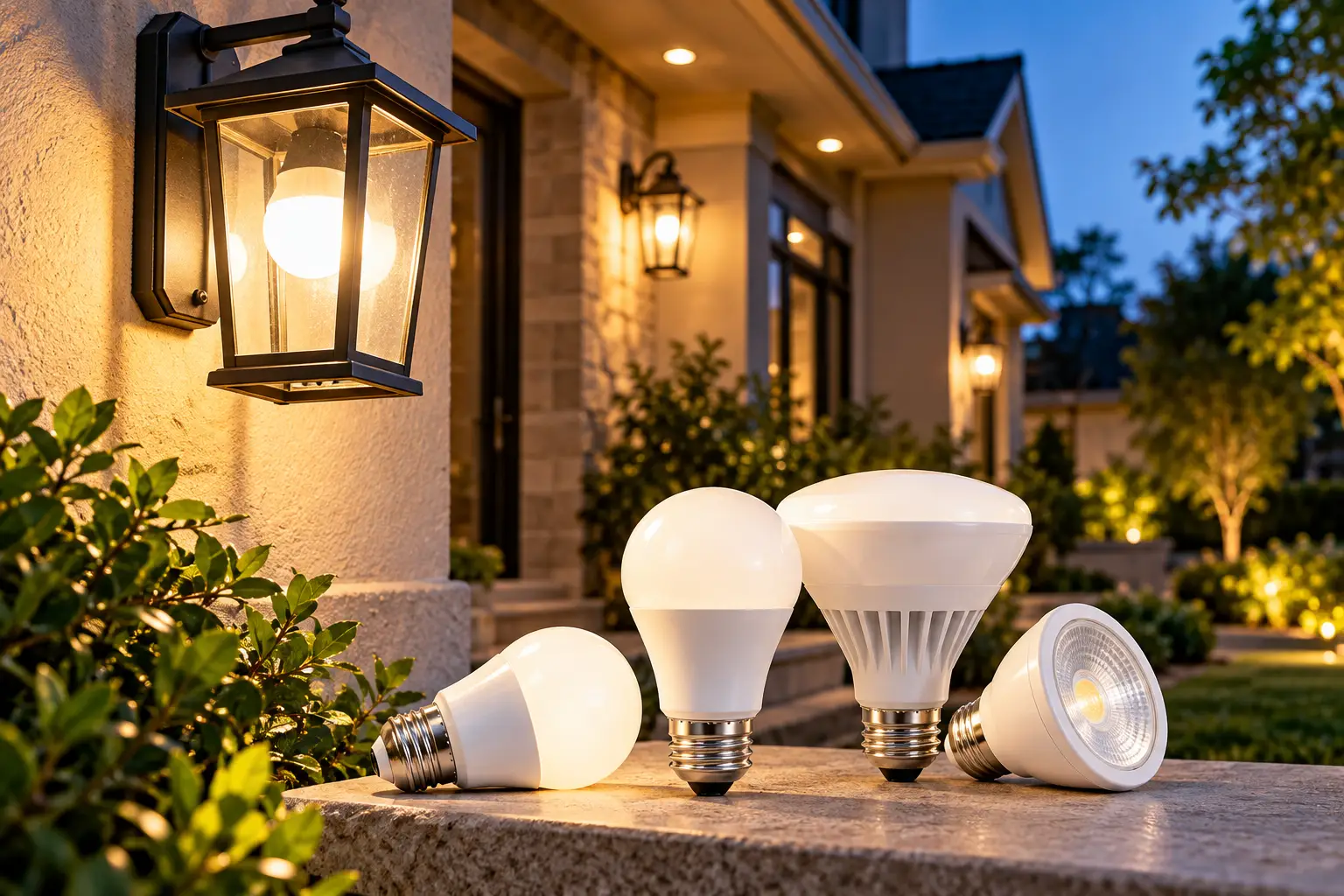
Picture this: it’s 9 p.m., it’s raining sideways, and the porch light you replaced four months ago is blinking like a lighthouse with a nervous tic. Sound familiar? Outdoor fixtures are brutal environments for a bulb — moisture, freezing nights, summer heat trapped inside a glass lantern, and bugs that treat every glowing surface like a nightclub. That’s exactly why choosing led light bulbs for outdoor fixtures is a different decision than grabbing a four-pack for your living room lamps.
What Are led light bulbs for outdoor fixtures?
led light bulbs for outdoor fixtures are LED lamps designed or rated to work safely in exterior luminaires — porch sconces, coach lights, lanterns, and floodlight housings. The best ones carry a damp or wet location rating, handle enclosed fixtures, and often add dusk-to-dawn sensors, motion detection, or smart controls.
The efficiency case is already settled. According to the U.S. Department of Energy, residential LED lighting uses at least 75% less energy and lasts up to 25 times longer than incandescent bulbs — a gap that matters most outdoors, where lights often run all night, every night.
What isn’t settled is which outdoor LED light bulbs actually fit your fixture, your climate, and your patience level. In this guide, we compare seven real products available on amazon.com — from budget dusk-to-dawn A19s to a 2,650-lumen floodlight and a color-changing smart PAR38 — using manufacturer spec sheets, retailer listings, and aggregated customer review sentiment. You’ll get honest analysis (no invented test stories), practical setup advice, and a clear framework for picking the right bulb the first time.
Quick Comparison: The Best led light bulbs for outdoor fixtures at a Glance
| Product | Shape / Type | Brightness | Key Feature | Best for |
|---|---|---|---|---|
| Feit Electric IntelliBulb Dusk to Dawn A19 | A19 | 800 lm | 90+ CRI sensor bulb | Covered porch lights on a budget |
| GE LED+ Dusk to Dawn A19 | A19 | 800 lm | 25,000-hr rated life | Set-and-forget entry lights |
| Sylvania Dusk to Dawn PAR38 | PAR38 flood | 1,250 lm | Sensor + 40° beam | Garage and side-yard floods |
| Philips LED PAR38 Indoor & Outdoor Flood | PAR38 flood | 900 lm | UL wet rated, dimmable | Exposed fixtures, warm glow |
| Sylvania Night Chaser LED PAR38 | PAR38 flood | 2,650 lm | 250W-equivalent output | Long driveways, big yards |
| Sunco Lighting ST64 Edison LED | ST64 filament | 800 lm | Vintage look, IP65 rating | Decorative lanterns |
| Philips Hue White and Color Ambiance Outdoor PAR38 | PAR38 smart | ~1,300 lm | App, voice, 16M colors | Smart-home households |
Looking at this table, the split is clear: the three dusk-to-dawn bulbs (Feit Electric IntelliBulb Dusk to Dawn A19, GE LED+ Dusk to Dawn A19, Sylvania Dusk to Dawn PAR38) solve the “I forgot to turn the light on” problem for very little money. The flood options trade automation for raw output or weatherproofing, while the Philips Hue White and Color Ambiance Outdoor PAR38 is the only one that gives you schedules, app control, and color — at a noticeably higher price.
💬 One click helps other shoppers make an informed choice too! 😊
Top 7 led light bulbs for outdoor fixtures: Expert Analysis
1. Feit Electric IntelliBulb Dusk to Dawn A19 — best color quality on a budget
The Feit Electric IntelliBulb Dusk to Dawn A19 stands out because it pairs an automatic light sensor with unusually good color rendering for a budget bulb.
It draws 8.8 watts to produce 800 lumens — the same light as a classic 60W incandescent — and it’s offered in Soft White 2700K (model A800/927CA/DD/LEDI) and Daylight 5000K (A800/950CA/DD/LEDI). The 90+ CRI rating means your house numbers, brick, and landscaping look like themselves rather than a washed-out gray, which most cheap sensor bulbs at 80 CRI can’t promise. Feit rates it for 15,000 hours and positions it for covered outdoor fixtures.
Based on comparing the specs, this is the bulb for anyone with a covered front porch who wants “always on at night” behavior without buying a new fixture. Choose 2700K if you want a welcoming glow; choose 5000K only if security visibility matters more than ambiance.
Retailer listings for this model carry thousands of ratings, and the overall sentiment is positive about the set-and-forget convenience. The most recurring question on retailer Q&A pages, though, involves the bulb flashing on and off — usually a sign that the sensor is “seeing” its own reflected light inside the fixture.
Pros:
- ✅ 90+ CRI makes outdoor colors look natural
- ✅ Very low 8.8W draw for all-night use
- ✅ Two color temperatures for mood or security
Cons:
- ❌ Non-dimmable, so no dimmer-switch control
- ❌ Sensor can cycle inside reflective glass fixtures
Typically found in the low-to-mid teens per multi-pack range at the time of writing (check the current price), it’s excellent value for covered porches.
2. GE LED+ Dusk to Dawn A19 — simplest long-life sensor bulb
The GE LED+ Dusk to Dawn A19 is about as close to “screw it in and forget it exists” as outdoor lighting gets.
Depending on the version, it uses 8.5 to 9 watts for 800 lumens, comes in Soft White (2700K) or Daylight (5000K), and carries a 25,000-hour rated life. Some versions are listed with 80 CRI and newer Title 20-compliant versions with 90 CRI, so check the box if color accuracy matters to you. Lowe’s lists the daylight version as enclosed-fixture rated — a big deal for sealed coach lights that cook ordinary LEDs.
Here’s what to weigh: GE’s packaging math (“lasts 22 years”) assumes 3 hours of use per day. A dusk-to-dawn bulb runs closer to 10-14 hours a night, so realistic life is roughly 5-7 years. That’s still excellent — just not two decades.
Aggregated retailer reviews skew strongly positive, with buyers repeatedly praising the fact that it requires no app, hub, or Wi-Fi. Complaints tend to center on brightness expectations — 800 lumens lights an entryway, not a driveway.
Pros:
- ✅ No app, hub, or wiring required
- ✅ Long 25,000-hour rated life
- ✅ Enclosed-fixture rating on key versions
Cons:
- ❌ Too dim for large driveways or yards
- ❌ CRI varies between versions on the shelf
Expect a price in the roughly $10-$25 range for a two-pack depending on version (prices may vary) — strong value for entry lights.
3. Sylvania Dusk to Dawn PAR38 — smartest automatic floodlight
The Sylvania Dusk to Dawn PAR38 brings the automatic sensor concept to floodlight housings, where most people need it most.
It uses 14 watts to deliver 1,250 lumens (a 120W-incandescent equivalent) through a 40° beam on a standard E26 base. Available in 2700K, 3000K, and 5000K, it has an 80 CRI and a 15,000-hour rated life (Sylvania part LED14PAR38DTD830 for 3000K, LED14PAR38DTD850 for 5000K). A thoughtful detail: there’s a 40-second delay before the bulb turns off after detecting light, which reduces flicker when headlights sweep across the sensor.
On paper, this means the Sylvania Dusk to Dawn PAR38 suits garage corners, side yards, and the back of the house — places where you want light all night but don’t need stadium output. It’s also a solid upgrade for old halogen flood fixtures that used to run hot and expensive.
Reviews consistently report that buyers were surprised by how bright it is for the wattage and that the sensor reliably switches at dusk and dawn. The main caveat in user feedback is that a small sensor window must face open sky, not a wall.
Pros:
- ✅ 1,250 lumens from only 14 watts
- ✅ 40-second off-delay prevents nuisance switching
- ✅ Three color temperatures available
Cons:
- ❌ Non-dimmable, so no dimmer control
- ❌ Sensor needs a clear view of daylight
Usually priced around the low-to-mid teens per bulb (check the current price), it’s one of the best values for flood fixtures.
4. Philips LED PAR38 Indoor & Outdoor Flood — warmest, most refined flood
The Philips LED PAR38 Indoor & Outdoor Flood is the pick for exposed fixtures where rain hits the bulb directly and you want warm, high-quality light.
This 90W-equivalent bulb delivers 900 lumens of 3000K warm white while drawing only about 10 watts. It’s UL wet rated, dimmable, ENERGY STAR certified, and rated at 90 CRI with a 25,000-hour life. The glass PAR38 body throws a wide beam, which works well for washing a garage door or a patio wall rather than spotlighting one point.
Based on comparing the specs, this is the most “architectural” bulb in the lineup. The Philips LED PAR38 Indoor & Outdoor Flood won’t blast your yard like the Sylvania Night Chaser LED PAR38, but its warm color and dimmability make it ideal for patios, decks, and homeowners who care about curb appeal.
Retailer review pools for this exact listing are smaller than for the dusk-to-dawn bulbs, but the available sentiment highlights sturdy construction and the value of dimmability outdoors. We couldn’t verify a large volume of long-term failure reports either way, so treat the 25,000-hour rating as a manufacturer claim.
Pros:
- ✅ UL wet rated for exposed fixtures
- ✅ Dimmable with compatible LED dimmers
- ✅ 90 CRI warm white looks premium
Cons:
- ❌ No built-in sensor or motion feature
- ❌ 900 lumens is modest for big yards
Generally found in the $15-$30 range for a two-pack (prices may vary), it’s fair value for quality-focused buyers.
5. Sylvania Night Chaser LED PAR38 — brightest flood in the lineup
The Sylvania Night Chaser LED PAR38 exists for one job: turning a dark yard into a well-lit one.
It produces 2,650 lumens from 25 watts — Sylvania pitches it as a 250W incandescent equivalent — through a 40° beam. It’s dimmable, comes in Daylight (5000K) and Neutral White, and is marketed with a 13-year life. That combination of output and a focused beam lets it reach far down a long driveway or deep into a backyard from a second-story eave.
What most buyers overlook with this model is that more light isn’t always better. At 2,650 lumens, aim matters: point it down and away from neighbors’ windows. For large rural properties, barns, and long driveways, though, nothing else in this list comes close.
Customer reviews consistently describe it as dramatically brighter than standard LED floods, with several buyers comparing their backyard to a ballpark at night. Some users pair it with Wi-Fi dimmer switches, which takes advantage of its dimmability to tone it down when full blast isn’t needed.
Pros:
- ✅ 2,650 lumens reaches deep into large yards
- ✅ Dimmable for flexible brightness control
- ✅ Huge energy savings versus halogen floods
Cons:
- ❌ Easy to create glare and light trespass
- ❌ Overkill for small porches or patios
Typically in the $20-$30 range per bulb (check the current price), it’s excellent value per lumen.
6. Sunco Lighting ST64 Edison LED — best vintage look for lanterns
The Sunco Lighting ST64 Edison LED is for fixtures where the bulb is part of the design — clear-glass lanterns, farmhouse sconces, and pergola pendants.
It delivers 800 lumens through visible LED filaments on an E26 base, dims from 10% to 100% on compatible dimmers, and Sunco’s documentation lists an IP65 waterproof rating and UL certification, backed by a 5-year warranty. Sunco also sells a dusk-to-dawn ST64 variant (7W, 3000K) if you want the vintage look plus automatic operation.
Here’s what to weigh: Edison-style filament bulbs are often a compromise — pretty, but dim. At 800 lumens, the Sunco Lighting ST64 Edison LED is a genuine 60W replacement, so you don’t sacrifice usable light for style. Pick 2700K for classic amber warmth; the 5000K version looks clinical in a vintage fixture.
We couldn’t verify a large, detailed body of outdoor-specific reviews for each Sunco variant, so treat durability claims as manufacturer specs. Third-party roundups commonly feature it as a top “vintage look” pick for porches.
Pros:
- ✅ True 800-lumen output in a filament style
- ✅ IP65 rating per manufacturer documentation
- ✅ Dusk-to-dawn variant available
Cons:
- ❌ Clear glass can cause glare at eye level
- ❌ Multi-packs are bulky if you need few
Usually sold in multi-packs in the $20-$45 range (prices may vary), it’s good value per bulb for lantern-heavy homes.
7. Philips Hue White and Color Ambiance Outdoor PAR38 — most flexible smart control
The Philips Hue White and Color Ambiance Outdoor PAR38 turns an ordinary flood fixture into a programmable, color-capable light.
It’s wet rated, uses an E26 base, and retailer spec sheets list around 1,300 lumens with tunable white from 2000K to 6500K plus 16 million colors. Full features — away-from-home control, geofencing, automations — require the Hue Bridge, and it works with Alexa and Google Assistant. That means you can schedule warm white at sunset, switch to bright 5000K for security after midnight, and go orange for Halloween.
Based on comparing the specs, the Philips Hue White and Color Ambiance Outdoor PAR38 makes the most sense if you already own a Hue Bridge. Buying it as a standalone outdoor bulb is hard to justify on cost alone, since a single bulb costs as much as a multi-pack of sensor bulbs.
We couldn’t verify a large volume of outdoor-specific reviews for this exact SKU, so we’re cautious here. What’s clear from listings: the wall switch must stay on for smart control to work, and the Bridge requirement is the obvious hurdle for non-Hue households.
Pros:
- ✅ Schedules, geofencing, and voice control
- ✅ Tunable white plus full color range
- ✅ Wet rated for exposed fixtures
Cons:
- ❌ Premium price per bulb
- ❌ Full features require a Hue Bridge
Expect roughly $70-$90 per bulb at the time of writing (check the current price) — worth it mainly inside an existing Hue ecosystem.
✨ Don’t miss these top-rated outdoor picks!
🔍 Take your outdoor lighting to the next level with this carefully curated lineup. Click a highlighted bulb to check current pricing and availability. These picks will help you get a safer, brighter, more welcoming home the whole family will enjoy!
Detailed Comparison of the Top 7 Outdoor LED Light Bulbs
| Product | Watts | Lumens | Color Temp | Dimmable | Rated Life | Price Range | Best for |
|---|---|---|---|---|---|---|---|
| Feit Electric IntelliBulb Dusk to Dawn A19 | 8.8W | 800 | 2700K / 5000K | No | 15,000 hrs | Budget | Feit Electric IntelliBulb Dusk to Dawn A19: covered porches |
| GE LED+ Dusk to Dawn A19 | 8.5-9W | 800 | 2700K / 5000K | No | 25,000 hrs | Budget | GE LED+ Dusk to Dawn A19: enclosed coach lights |
| Sylvania Dusk to Dawn PAR38 | 14W | 1,250 | 2700K-5000K | No | 15,000 hrs | Budget-mid | Sylvania Dusk to Dawn PAR38: garage floods |
| Philips LED PAR38 Indoor & Outdoor Flood | ~10W | 900 | 3000K | Yes | 25,000 hrs | Mid | Philips LED PAR38 Indoor & Outdoor Flood: patios |
| Sylvania Night Chaser LED PAR38 | 25W | 2,650 | 5000K / Neutral | Yes | 13 yrs (claimed) | Mid | Sylvania Night Chaser LED PAR38: big yards |
| Sunco Lighting ST64 Edison LED | ~7-8W | 800 | 2700K-5000K | Yes | Mfr. rated | Mid (multi-pack) | Sunco Lighting ST64 Edison LED: lanterns |
| Philips Hue White and Color Ambiance Outdoor PAR38 | Varies | ~1,300 | 2000K-6500K + color | Yes (app) | Mfr. rated | Premium | Philips Hue White and Color Ambiance Outdoor PAR38: smart homes |
The numbers reveal an important pattern: lumens per dollar is wildly different from lumens per watt. The Sylvania Night Chaser LED PAR38 dominates raw output, but the dusk-to-dawn A19s win on hands-off convenience at the lowest running cost. If dimmability matters, your shortlist shrinks to the Philips LED PAR38 Indoor & Outdoor Flood, the Sylvania Night Chaser LED PAR38, the Sunco Lighting ST64 Edison LED, and the Hue bulb.
Getting Started: Installing Outdoor LED Bulbs the Right Way (Your First 30 Days)
Installing a bulb sounds trivial, but outdoor fixtures add a few traps that cause most early failures.
Before you screw anything in
- ✅ Turn the fixture off at the switch and let any old incandescent or halogen bulb cool — PAR38 halogens get hot enough to burn.
- ✅ Check the socket for corrosion. A green or crusty E26 socket causes flicker no bulb can fix; a little contact cleaner and a dry cloth usually help.
- ✅ Confirm the gasket on enclosed fixtures is intact. A cracked seal lets water pool around the base.
Placing dusk-to-dawn bulbs
Dusk to dawn LED bulbs have a tiny photocell, usually on the side or bottom of the bulb. Orient it toward open sky, away from the fixture’s own reflective glass and away from other light sources like a neighbor’s floodlight or a streetlight. If the fixture lets you rotate the bulb a quarter-turn without loosening it, that small adjustment often fixes cycling problems.
Days 1-7: watch the behavior
Check the light at dusk and again around sunrise for the first week. You’re looking for three things: it turns on at a sensible time, it doesn’t flicker, and it switches off in daylight. Smart bulbs need a firmware update and a schedule during this window.
Days 8-30: fine-tune
If you went with a dimmable flood like the Philips LED PAR38 Indoor & Outdoor Flood or the Sylvania Night Chaser LED PAR38, test the dimmer across its range — older incandescent dimmers can buzz. Finally, wipe dust and cobwebs off lenses monthly; insect buildup alone can noticeably cut usable light.
Real-World Scenarios: Matching the Right Bulb to the Right Home
Specs are abstract. Here’s how the lineup maps to three common situations.
Scenario 1: The renter with a covered front porch
Budget: under $20. Use: every night, 10-14 hours. Fixture: a single enclosed glass sconce by the door.
The best match is the GE LED+ Dusk to Dawn A19 in a version marked enclosed-fixture rated, or the Feit Electric IntelliBulb Dusk to Dawn A19 if the fixture is open at the bottom. Neither requires rewiring — valuable when you can’t modify the property — and both take the bulb with you when you move. Choose 2700K so the entry feels welcoming rather than like a parking lot.
Scenario 2: The suburban family with a detached garage
Budget: $40-$80. Use: security lighting all night, occasional evening barbecues. Fixtures: two twin-head floods and a patio wall light.
Put the Sylvania Dusk to Dawn PAR38 in the garage floods for automatic all-night coverage, and the dimmable Philips LED PAR38 Indoor & Outdoor Flood on the patio, where warm, adjustable light matters more than automation. This split keeps running costs low while giving the family a pleasant space for summer evenings.
Scenario 3: The rural homeowner with a 300-foot driveway
Budget: flexible. Use: arrival lighting and visibility for pets and livestock.
The Sylvania Night Chaser LED PAR38 is the only bulb here with enough output to reach that far. Mount it high, aim it downward along the drive, and pair it with a motion-sensing fixture or smart switch so it isn’t burning 25 watts all night when nobody’s coming home.
Problem → Solution: Fixing the Most Common Outdoor LED Headaches
Problem 1: The dusk-to-dawn bulb flickers or cycles on and off
Cause: the photocell sees its own light reflected off the fixture glass, so it thinks it’s daytime, shuts off, then sees darkness and turns on again. Solution: rotate the bulb so the sensor faces outward, use frosted rather than mirrored glass, or switch to a fixture with an open bottom. If cycling persists, a non-sensor bulb on a timer or smart switch is the cleaner fix.
Problem 2: The bulb dies within months in a sealed lantern
Cause: heat. LED drivers hate trapped heat, and fully enclosed fixtures in summer sun can get surprisingly hot. Solution: buy bulbs explicitly marked “suitable for enclosed fixtures,” like the enclosed-rated versions of the GE LED+ Dusk to Dawn A19.
Problem 3: The light never turns on
Cause: a dusk-to-dawn bulb inside a fixture that already has its own photocell — the two sensors fight each other. Solution: use a standard bulb in sensor-equipped fixtures, or bypass one of the sensors.
Problem 4: Bugs swarm the porch every night
Cause: cooler, bluer light tends to attract more insects. Solution: switch to 2700K, or lower. Warm bulbs like the 2700K Feit Electric IntelliBulb Dusk to Dawn A19 are a simple first step.
Problem 5: The smart bulb goes “unresponsive”
Cause: someone flipped the wall switch. Solution: cover the switch with a guard plate, or use the Hue app’s power-on behavior setting so the Philips Hue White and Color Ambiance Outdoor PAR38 restores its last state.
How to Choose led light bulbs for outdoor fixtures
Follow these steps in order and you’ll avoid nearly every bad purchase.
- Check the location rating first. Damp-rated works under a covered porch; wet-rated is required wherever rain or snow hits the bulb directly. This single spec matters more than brightness.
- Confirm the fixture type. Fully enclosed glass globes and sealed lanterns need bulbs marked for enclosed fixtures, or heat will shorten their life dramatically.
- Match the shape and base. Most porch lights take A19 bulbs; most floodlight housings take PAR38. Nearly all U.S. outdoor fixtures use the E26 medium base, but some decorative lanterns use E12 candelabra.
- Pick brightness by purpose. About 800 lumens suits an entryway; 1,000-1,300 lumens suits a garage or side yard; 2,000+ lumens is for long driveways and large lots.
- Choose color temperature deliberately. 2700K-3000K feels welcoming and attracts fewer bugs; 4000K-5000K maximizes visibility for security cameras and tasks.
- Look at color rendering. A higher color rendering index (CRI) means colors look more natural — 90+ CRI makes landscaping, paint, and faces look right, while 80 CRI is acceptable for pure utility lighting.
- Decide on control. Dusk-to-dawn sensors are cheapest; dimmable floods add flexibility; smart bulbs add schedules and app control at a premium.
The order matters. Plenty of shoppers start at step 4 (brightness), buy a bright bulb, and discover it fails quickly in a sealed fixture or flickers on a dimmer — problems steps 1-3 would have prevented.
Wet-Rated vs Damp-Rated vs Enclosed-Rated: Features That Actually Matter
Marketing copy loves words like “weatherproof” and “rugged,” but three specific ratings are what count for outdoor LED light bulbs.
Damp-rated
A damp location is one protected from direct rain but exposed to humidity and condensation — think a covered porch ceiling or a recessed soffit light. Most dusk-to-dawn A19 bulbs are designed for these covered locations, which is why manufacturers like Feit describe their sensor bulbs as ideal for covered outdoor fixtures.
Wet-rated
Wet rated LED bulbs can handle direct exposure to rain, snow, and sprinklers. This is non-negotiable for open flood housings that hold a bulb pointing at the sky with no glass cover. The Philips LED PAR38 Indoor & Outdoor Flood and the Philips Hue White and Color Ambiance Outdoor PAR38 are explicitly listed as wet rated.
Enclosed-fixture rated
This rating has nothing to do with water — it’s about heat. Inside a sealed glass lantern, there’s no airflow to carry heat away from the LED driver. Bulbs not rated for this environment often flicker, dim, or fail early.
Features that don’t matter as much
- ❌ “Wattage equivalent” claims beyond a rough guide — compare lumens instead.
- ❌ Ultra-long life claims on cheap no-name bulbs without a recognizable certification.
- ❌ Smart features you’ll never configure. If you won’t use the app, buy a sensor bulb.
The takeaway: read the rating label before the brightness label. A 1,300-lumen bulb that dies in four months is far less useful than an 800-lumen bulb that lasts five years.
Dusk to Dawn LED Bulbs vs Motion-Sensor and Smart Bulbs
These three approaches solve different problems, so the “best” one depends on how you want your outdoor light to behave.
Dusk-to-dawn bulbs
They turn on when it gets dark and off when it gets light — period. The appeal is simplicity: no app, no hub, no programming. The downside is that they burn all night, which means 10-14 hours of use daily. With an 8.8W bulb like the Feit Electric IntelliBulb Dusk to Dawn A19, that’s a trivial energy cost, but it shortens the bulb’s lifespan compared with marketing claims based on 3 hours per day. They’re best for entrances, garage corners, and any spot where constant low-level light deters intruders.
Motion-sensor bulbs and fixtures
Motion lighting stays dark until someone approaches, then snaps on. That sudden change can be more startling to an intruder than constant light, and it saves energy. The trade-off: false triggers from cats, cars, and wind-blown branches, plus no ambient “someone’s home” glow.
Smart bulbs
Smart options like the Philips Hue White and Color Ambiance Outdoor PAR38 combine schedules, sunrise/sunset timing, geofencing, and voice control. They can mimic dusk-to-dawn behavior and do far more — but they cost several times as much and depend on the wall switch staying on and your network staying up.
The verdict
For most homes, a hybrid works best: dusk-to-dawn bulbs at entrances, a bright motion-controlled flood like the Sylvania Night Chaser LED PAR38 over the driveway, and smart bulbs only where you’ll genuinely use schedules or color.
Outdoor LED Light Bulbs vs Traditional Bulbs
| Factor | LED | Incandescent | Halogen PAR38 | CFL |
|---|---|---|---|---|
| Energy for ~800 lm | ~8-9W | ~60W | ~45-55W (approx.) | ~13-15W |
| Typical rated life | 15,000-25,000 hrs | ~1,000 hrs | ~1,500-3,000 hrs | ~8,000-10,000 hrs |
| Cold-weather start | Instant | Instant | Instant | Slow, dim warm-up |
| Heat output | Low | Very high | Very high | Moderate |
| Contains mercury | No | No | No | Yes |
| Best for | Every outdoor use | Nothing new | Legacy fixtures only | Not recommended outdoors |
The table shows why the debate is over: LEDs beat every alternative on energy, lifespan, and cold-weather performance. CFLs are particularly poor outdoors because they start dim in freezing weather, and halogen floods waste most of their energy as heat. The only real decision left is which LED — not whether to switch.
Long-Term Cost and Maintenance: What Outdoor LEDs Really Cost
The sticker price is the smallest number in outdoor lighting. Running hours are what matter, and dusk-to-dawn use multiplies them.
The math for a typical porch light
Assume 12 hours a night, 365 nights a year (4,380 hours) and roughly 17 cents per kWh — around the recent U.S. residential average; your utility’s rate may differ.
| Bulb | Watts | Annual kWh | Approx. Annual Cost | Best for |
|---|---|---|---|---|
| 60W incandescent | 60W | ~263 | ~$45 | Nothing — replace it |
| GE LED+ Dusk to Dawn A19 | 9W | ~39 | ~$7 | Long-term savings |
| Feit Electric IntelliBulb Dusk to Dawn A19 | 8.8W | ~39 | ~$7 | Color quality + savings |
| Sylvania Night Chaser LED PAR38 | 25W | ~110 | ~$19 | Max coverage per dollar of power |
Switching one all-night porch light from incandescent to LED saves roughly $35-$40 per year, so even a mid-priced LED pays for itself within months. The Sylvania Night Chaser LED PAR38 looks expensive to run in isolation, but compared with the 250W-class halogen floods it replaces, it uses about a tenth of the energy. This is why ENERGY STAR notes that certified bulbs use up to 90% less energy than standard bulbs — outdoors, those savings compound because the lights run so long.
Maintenance schedule
- Monthly: wipe lenses and remove insect buildup.
- Seasonally: check gaskets, look for water inside fixtures, and tighten loose bulbs that vibrate in wind.
- Every few years: replace dusk-to-dawn bulbs proactively before winter if they’re past ~5 years of all-night use.
Common Mistakes to Avoid When Buying Outdoor LED Bulbs
Even experienced DIYers trip over these.
Mistake 1: Buying by “wattage equivalent” alone
“60W equivalent” is a rough marketing translation. Compare lumens directly — the Philips LED PAR38 Indoor & Outdoor Flood (900 lm) and the Sylvania Dusk to Dawn PAR38 (1,250 lm) are both PAR38 floods, yet one is nearly 40% brighter.
Mistake 2: Ignoring the enclosed-fixture warning
It’s the single most common cause of early failure in coach lights and sealed lanterns.
Mistake 3: Putting a sensor bulb in a sensor fixture
Two photocells or a photocell plus a motion detector often produce a light that never turns on, or one that strobes.
Mistake 4: Going too cold or too bright
5000K at 2,650 lumens over a small backyard feels like a gas station. Many homeowners end up happier with 3000K and moderate output on patios, saving the high-output bulbs for driveways and barns.
Mistake 5: Using an old incandescent dimmer
Dimmable LEDs need LED-compatible dimmers. Older dimmers can cause buzzing, flicker, or a dimming range that cuts out at the bottom.
Mistake 6: Forgetting about neighbors
Floodlights aimed horizontally spill into neighboring yards and bedrooms. Aim downward — your neighbors and your local ordinance will thank you.
Safety, Regulations, and Standards for Outdoor LED Bulbs
Outdoor lighting sits at the intersection of electrical safety, energy rules, and increasingly, local light-pollution ordinances.
Electrical safety certifications
Look for a UL or ETL listing on the bulb or packaging. Self-ballasted LED lamps sold in the U.S. are commonly certified to UL 1993, and outdoor-ready products should also state their damp or wet location rating. A bulb with no recognizable safety mark is a gamble in an environment that combines electricity and water.
FCC compliance
LED drivers are electronic devices, and poorly designed ones can emit radio interference that affects AM radio or garage door openers. Reputable bulbs state FCC compliance on the packaging.
Energy standards
ENERGY STAR certification indicates third-party-tested performance. In California and some other states, Title 20 rules restrict which general-service bulbs can be sold — which is why certain GE and Feit variants are labeled “CA Title 20 compliant” and others are marked as restricted in California.
Light pollution and local ordinances
A growing number of cities and counties limit outdoor lighting brightness, direction, or color. DarkSky International and the Illuminating Engineering Society publish five principles for responsible outdoor lighting: use light only when useful, target it, keep it low-level, control it with timers or sensors, and favor warmer colors. In practice, that means downward-aimed floods, warm 2700K-3000K bulbs where possible, and automation such as dusk-to-dawn sensors or motion controls. Following these principles also tends to look better and cost less.
FAQ: led light bulbs for outdoor fixtures
❓ Can I use regular LED bulbs in outdoor fixtures?
❓ What color temperature is best for outdoor lights?
❓ Do dusk to dawn LED bulbs work in enclosed fixtures?
❓ How many lumens do I need for a porch light?
❓ Are outdoor smart LED bulbs worth the extra cost?
Conclusion: The Right Bulb Is the One That Fits Your Fixture
Choosing led light bulbs for outdoor fixtures comes down to a simple order of operations: location rating first, fixture type second, then brightness, color, and control.
For most covered porches, the Feit Electric IntelliBulb Dusk to Dawn A19 is the smartest all-round pick thanks to its 90+ CRI and tiny power draw, while the GE LED+ Dusk to Dawn A19 is the safest bet for enclosed coach lights in its enclosed-rated versions. For flood housings, the Sylvania Dusk to Dawn PAR38 delivers automatic security lighting on a budget, and the Philips LED PAR38 Indoor & Outdoor Flood brings warm, dimmable, wet-rated quality to patios.
Need serious reach? The Sylvania Night Chaser LED PAR38 is in a league of its own — just aim it responsibly. Decorating with clear lanterns? The Sunco Lighting ST64 Edison LED gives you the vintage look without sacrificing usable light. And if your home already runs on Hue, the Philips Hue White and Color Ambiance Outdoor PAR38 turns your exterior into a programmable canvas.
Whichever you choose, you’ll cut outdoor lighting costs dramatically compared with incandescent or halogen, and you’ll spend far less time on a ladder in the rain. Start with your most-used fixture — usually the front door — and upgrade the rest as old bulbs fail.
🌙 Light up your nights the smart way!
💡 Ready to upgrade your porch, garage, or garden? Click any highlighted bulb above to check current pricing and availability on Amazon, and pick the one that matches your fixture. A brighter, safer, more welcoming home is just one screw-in away!
Recommended for You
- Does Kasa Work With Alexa? 7 Best Picks + Easy Setup Guide (2026)
- Dual Smart Light Switch: 7 Best Picks That Actually Work in 2026
- ge dimmer switch Guide 2026: 7 Best Picks Honestly Compared
Disclaimer: This post contains affiliate links. As an Amazon Associate, I earn from qualifying purchases made through these links, at no additional cost to you.
✨ Found this article helpful? Share it with someone who needs it! 💬🤗