
In This Article
Why Remote Control Sockets Still Earn a Spot in Your Home
Picture this: it’s 10 p.m., you’re finally horizontal on the couch, and the floor lamp in the far corner is still blazing. Or it’s December, it’s 28°F outside, and the string lights on the porch need switching off. Remote control sockets solve exactly this kind of small, daily annoyance, and they do it without an app, a Wi-Fi password, or a firmware update.
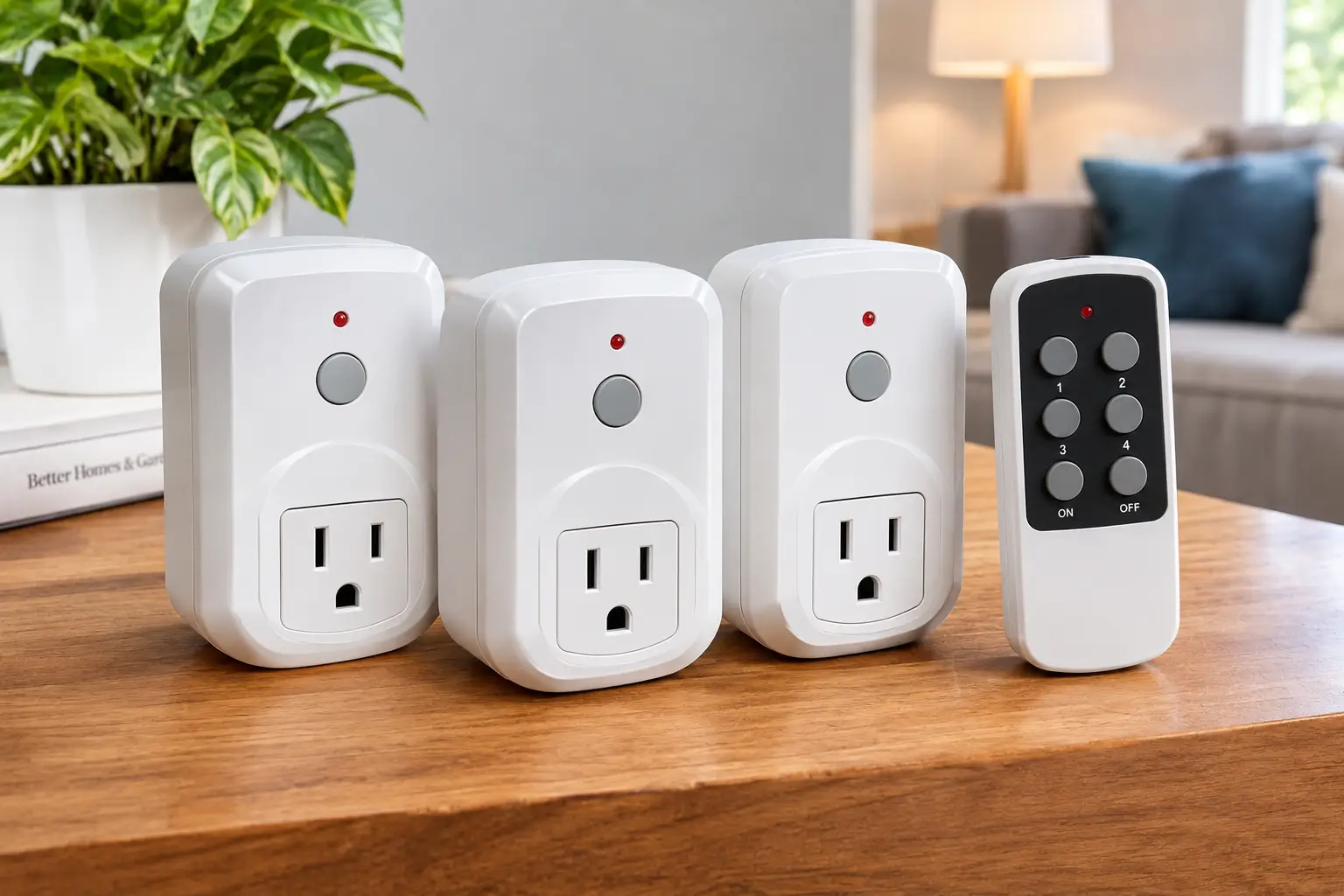
Here’s the short version of how they work. You plug a small receiver into a wall outlet, plug your device into the receiver, and press a button on a handheld remote. The remote sends a radio signal (almost always on the 433.92 MHz band) that tells a relay inside the receiver to open or close. That’s it. No cloud server, no account, no subscription.
That simplicity is exactly why remote control sockets are still selling strong in 2026, even with smart plugs everywhere. They’re cheaper per outlet, they work when your router is down, and your parents or grandparents can use them on day one. For people with limited mobility, a keychain remote that reaches a lamp through two walls is a genuine quality-of-life upgrade, not a gadget.
In this guide, you’ll find seven real models available on amazon.com, from bargain five-packs to a long-range unit that claims up to 1,000 feet in open space. Each pick comes with honest analysis grounded in published specs and aggregated customer feedback, plus practical setup tips, a troubleshooting guide, and a clear explanation of the load ratings that trip up so many buyers. By the end, you’ll know exactly which remote outlet fits your lamp, your fountain pump, or your holiday display, and which ones to skip.
What Is a Remote Control Socket?
A remote control socket is a plug-in adapter that sits between a wall outlet and an electrical device, letting you switch that device on or off with a wireless handheld remote. Most use radio frequency (RF) signals on 433.92 MHz, which pass through walls and doors, so you don’t need line of sight to the receiver.
Beyond convenience, remote control sockets can also help you cut standby power, the electricity many devices draw while “off” but still plugged in. Switching a TV setup, a coffee maker, or a charger station off at the socket stops that trickle completely.
There are three broad families. Indoor kits are compact, usually rated at 10A/1,200W, and often sold in packs of three or five. Outdoor models add a weather-resistant shell, a short grounded cord, and typically a 15A rating for string lights and pumps. Long-range units push RF range far beyond the usual 100 feet, which matters for barns, detached garages, and big yards.
Quick Comparison: Remote Control Sockets at a Glance
| Model | Type | Claimed Range | Max Load | Outlets / Remotes | Price Range | Best for |
|---|---|---|---|---|---|---|
| DEWENWILS SHORS11H | Indoor/outdoor, single | 100 ft | 15A / 1,875W | 1 / 1 | Under $20 | DEWENWILS SHORS11H: one heavy-duty outdoor device |
| DEWENWILS HRS103F2 Outdoor Kit | Outdoor kit | 100 ft | 15A / 1,875W each | 3 / 1 | Around $30–$40 | DEWENWILS HRS103F2 Outdoor Kit: multi-zone yard lighting |
| Etekcity ZAP 5LX | Indoor kit | 100 ft | 10A / 1,200W | 5 / 2 | Around $25–$35 | Etekcity ZAP 5LX: whole-house lamps |
| Etekcity ZAP 1FX | Outdoor, dual socket | 150 ft (line of sight) | 10A / 1,200W | 1 (2 plugs) / 1 | Around $20–$30 | Etekcity ZAP 1FX: two devices that switch together |
| BN-LINK ES1513-5-2 | Indoor kit | 100 ft (line of sight) | 10A / 1,200W | 5 / 2 | Around $20–$30 | BN-LINK ES1513-5-2: best value per outlet |
| TOVEENEN RC12515N | Indoor, long range | 500–1,000 ft | 15A | 1 / 1–2 | Around $25–$40 | TOVEENEN RC12515N: barns, shops, big properties |
| Woods 13569 | Indoor kit | 66 ft | See label | 3 / 1 | Around $20–$35 | Woods 13569: small rooms, simple needs |
Prices are approximate ranges at the time of writing and change often; check the current price on Amazon.
Reading the table from left to right, the biggest split is load capacity: the 10A indoor kits from Etekcity ZAP 5LX and BN-LINK ES1513-5-2 are perfect for lamps and fans but not for space heaters or shop vacs. If you need to switch anything with a motor or a big heating element outdoors, the 15A DEWENWILS SHORS11H and DEWENWILS HRS103F2 Outdoor Kit are the safer bets. The TOVEENEN RC12515N is the outlier, built for distance rather than weather.
💬 One click helps other shoppers make an informed choice too! 😊
Top 7 Remote Control Sockets for 2026: Expert Analysis
1. DEWENWILS SHORS11H — best single heavy-duty outdoor outlet
This is the model to reach for when one device needs serious power and weather protection. The DEWENWILS SHORS11H is rated at 15A/1,875W resistive, 1,000W tungsten, and 1/2 HP, which in practice means it can handle a fountain pump or a long run of string lights, not just a lamp. The short 7-inch cord and waterproof cap keep the connection away from puddles, and the keychain remote runs on a CR2032 coin cell, so it’s slim enough to live on your house keys.
Based on the spec sheet, this is the pick for anyone with a single outdoor job: a porch light, a pond pump, or a Christmas tree on the patio. The 1/2 HP rating is the detail most buyers overlook; plenty of cheap remote outlets say nothing about motor loads at all. It’s also pre-programmed out of the box and expandable with extra DEWENWILS remotes of the same model line.
Customer reviews consistently praise the quick setup and the reliability of the signal through exterior walls, while the recurring complaint is that the remote is small enough to misplace.
Pros:
- ✅ 15A rating handles pumps and long light strings
- ✅ Waterproof cap and short grounded cord
- ✅ Pre-paired and ready in seconds
Cons:
- ❌ Tiny keychain remote is easy to lose
- ❌ Only one device per receiver
Usually under $20, it delivers heavy-duty capability at a light-duty price, which makes it the strongest overall value here.
2. DEWENWILS HRS103F2 Outdoor Kit — three independent outdoor zones
The DEWENWILS HRS103F2 Outdoor Kit takes the heavy-duty formula above and triples it, with three receivers controlled independently from one remote. Each receiver carries the same 15A/1,875W resistive, 1,000W tungsten, and 1/2 HP rating, with a thick SJTW 14/3 grounded cord, a jacket type rated for outdoor use. DEWENWILS lists an operating range of -4°F to 113°F, which covers most of the continental US for most of the year.
Here’s what to weigh: independent control is the whole point. You can run the front-yard lights on button one, the backyard string lights on button two, and the fountain on button three, then switch them in any combination. Compared with buying three single units, you carry one remote instead of three, which sounds minor until you’re fumbling in the dark.
Reviews commonly highlight how practical it is for holiday displays and patio lighting; the most frequent gripe is that the 100-foot range shrinks noticeably through brick or stucco walls.
Pros:
- ✅ Three separately controlled outdoor receivers
- ✅ Heavy 14-gauge SJTW cords on each unit
- ✅ Motor-rated for pumps up to 1/2 HP
Cons:
- ❌ Range drops through masonry exterior walls
- ❌ Receivers are bulkier than indoor models
Typically around $30–$40, it’s excellent value if you have two or more outdoor loads to manage.
3. Etekcity ZAP 5LX — the classic whole-house indoor kit
Few remote control sockets have a longer track record than the Etekcity ZAP 5LX, sold as a 5-receiver, 2-remote kit. Each receiver is rated at 10A/1,200W on 120V, transmits on 433.92 MHz, and draws about 0.6W in standby. The learning-code system lets you assign any receiver to any button, or pair one receiver to multiple remotes.
On paper, that flexibility is the real feature. Put the living room lamp on button 1 of both remotes, then keep one remote on the nightstand and one on the coffee table. Receivers also stay off after a power outage, which prevents a space fan from surprising you at 3 a.m. when the power returns. The 1,200W ceiling means no space heaters, and that’s a hard line, not a suggestion.
Aggregated reviews describe it as reliable over years of use, with the main complaint being that the remotes use 12V 23A batteries that aren’t always in the kitchen junk drawer.
Pros:
- ✅ Five receivers and two remotes in one box
- ✅ Flexible learning-code pairing across buttons
- ✅ Stays off after power outages
Cons:
- ❌ 1,200W cap rules out heaters
- ❌ Remote uses less common 23A batteries
Around $25–$35, it works out to roughly $5–$7 per outlet, which is hard to beat for brand-name reliability.
4. Etekcity ZAP 1FX — longest-reaching weatherproof dual socket
The Etekcity ZAP 1FX stands out for its 150-foot line-of-sight range and weather-hardened shell. It carries an IP44 rating, meaning protection against splashing water from any direction, plus UV-resistant coating and recoverable overload protection. It has two grounded sockets on one receiver, rated together at 10A/1,200W.
What the spec sheet doesn’t spell out clearly, but the product notes confirm, is that both sockets switch together; you can’t control them individually. That makes it ideal for pairs that belong together, such as two strands of porch lights or a pond pump plus its underwater light. Etekcity also lists a very low 0.07W standby draw, far below its indoor kits, which is a nice detail for a device that stays plugged in year-round.
Reviews commonly praise the range and weatherproofing for patio setups; the frequent caution is that users expecting two independent outlets are disappointed, and that the 10A limit is lower than DEWENWILS’ outdoor units.
Pros:
- ✅ 150-foot line-of-sight range
- ✅ IP44 and UV-coated for outdoor life
- ✅ Extremely low 0.07W standby draw
Cons:
- ❌ Both sockets switch together only
- ❌ 10A rating limits heavier outdoor loads
Usually around $20–$30, it’s a fair price for range and durability, as long as linked sockets suit your setup.
5. BN-LINK ES1513-5-2 — best value per outlet
The BN-LINK ES1513-5-2 is the budget champion of indoor remote control sockets: five receivers, two remotes, and batteries included. Each receiver is rated at 120V, 10A, 1,200W, measures about 3.5 x 2 x 1 inches, and, like Etekcity’s kit, stays off after a power outage. BN-LINK specifically warns that it isn’t compatible with shop vacs, a refreshingly honest note about motor inrush current.
Based on comparing the specs, this kit and the Etekcity ZAP 5LX are near twins in capability. The compact receiver is the practical difference: it leaves the second outlet on a duplex wall plate usable, which matters behind a crowded TV stand. For renters, first apartments, or anyone who wants to automate five lamps on a tight budget, this is the sweet spot.
It’s one of the most reviewed products in the category, and aggregated sentiment is broadly positive about setup and reliability. Recurring complaints include the occasional dead receiver out of the box and the fact that it won’t pair with older Etekcity ZAP units, despite similar frequencies.
Pros:
- ✅ Lowest cost per outlet in this lineup
- ✅ Compact receivers free up the second outlet
- ✅ Two remotes and batteries included
Cons:
- ❌ Not cross-compatible with Etekcity remotes
- ❌ Occasional dead-on-arrival receiver reported
Around $20–$30 for five outlets, it’s the best pure value buy if your loads stay under 1,200W.
6. TOVEENEN RC12515N — extreme range for big properties
When 100 feet won’t cut it, the TOVEENEN RC12515N is the specialist. TOVEENEN rates it at over 500 feet in typical conditions and up to 1,000 feet in open space, with claimed ability to reach through concrete walls and floors. It’s rated at 15A, lists 3,000W resistive and 1,000W inductive capacity, and one receiver can pair with up to three remotes. An LED on the receiver shows red for on, green for off.
Here’s the important nuance: the 3,000W figure applies to the unit’s wide 85–265V input range. On a standard US 120V, 15A circuit, the practical ceiling is about 1,800W, so treat it as a solid 15A switch, not a 3,000W one. Also note the manual clearly marks it as non-waterproof, so it belongs in a garage, barn, or basement, not on a fence post.
Reviews commonly confirm that the long range is real; the recurring criticism is that the remote feels lightweight and its own LED doesn’t confirm on/off status from afar.
Pros:
- ✅ Genuine long range for outbuildings
- ✅ 15A rating suits pumps and shop tools
- ✅ Status LED on the receiver
Cons:
- ❌ Not waterproof; indoor or sheltered use only
- ❌ Remote build quality feels light
Around $25–$40 depending on remote count, it’s worth it only if distance is your real problem.
7. Woods 13569 — simple indoor kit from a legacy brand
The Woods 13569, now sold under the Southwire Woods name on Amazon, is a three-receiver, one-remote indoor kit from one of the most established names in extension cords. Retail listings cite a 66-foot range, grounded 3-prong receivers, and compatibility with CFL and LED bulbs. Some retailers list it as a 13-amp kit; confirm the rating printed on your unit before planning heavier loads.
On paper, the 66-foot range is the shortest in this roundup, which sounds like a drawback until you consider its purpose. For a single living room, a bedroom, or a holiday tree across the room, you’ll never come close to that limit. The one-remote, three-button layout is also simpler than learning-code kits, which suits older relatives who just want “button one turns on the lamp.”
We couldn’t verify a large, recent pool of aggregated reviews for this exact listing, so weigh its long retail history rather than any headline rating. Check the most recent Amazon reviews before buying.
Pros:
- ✅ Straightforward three-button, three-outlet layout
- ✅ Established brand with long retail history
- ✅ Works with LED and CFL bulbs
Cons:
- ❌ Shortest range in this roundup
- ❌ Limited recent review data to verify
Around $20–$35, it’s reasonable for simple indoor use, though the BN-LINK ES1513-5-2 gives you more outlets for similar money.
✨ Found your match? Don’t let that lamp win another night!
🔍 Take your home setup to the next level with this carefully curated lineup of remote control sockets. Click a highlighted product name to check current pricing and availability, and start switching things on and off from the couch tonight!
Getting Started: Setup, Pairing, and Your First 30 Days
Most remote control sockets ship pre-paired, so the first test is simple: plug in the receiver, plug in a lamp, press “on.” If nothing happens, pull the plastic battery tab from the remote; it’s the number-one reason a brand-new kit “doesn’t work.”
Pairing a new remote or re-mapping buttons follows a similar pattern across brands. On learning-code kits like the Etekcity ZAP 5LX, you hold the receiver’s programming button until its LED flashes, then press the remote button you want to assign. On the TOVEENEN RC12515N, you hold the receiver button for about five seconds, then hold the remote’s “on” button until you hear a click. Always check your specific manual, since timing differs.
Label everything on day one. A strip of masking tape on the remote (“1 = tree, 2 = porch”) saves endless trial and error, especially when guests or kids use it.
Plan receiver placement. RF signals weaken through metal, brick, and appliances. If a receiver sits behind a refrigerator or inside a metal cabinet, expect range to fall well below the box claim.
Common first-month mistakes:
- ✅ Plugging a 1,500W space heater into a 1,200W receiver
- ✅ Leaving an indoor receiver exposed on a porch
- ✅ Forgetting that receivers stay off after an outage (by design)
- ✅ Stacking receivers on a single overloaded power strip
Maintenance is minimal. Replace the remote battery once a year or whenever range suddenly shrinks, wipe outdoor caps clean before the holiday season, and inspect cords for cracks each fall. That’s the entire maintenance schedule.
Real-World Scenarios: Matching the Right Socket to Your Life
The budget apartment dweller. Maya rents a one-bedroom and wants to control three lamps and a fan without drilling anything. Her budget is under $30. The BN-LINK ES1513-5-2 fits perfectly: five receivers cover every lamp plus a spare, and the compact bodies leave her second wall outlet free. She’ll use it daily, and since nothing she owns exceeds 1,200W, the 10A rating is a non-issue.
The holiday-display family. The Garcias run front-yard lights, a lit reindeer, and backyard string lights from November through early January. They want independent control and outdoor protection, with a budget around $40. The DEWENWILS HRS103F2 Outdoor Kit gives them three separately switched zones on one remote, each with heavy 14-gauge cords and a 15A rating. Frequency of use: nightly for about eight weeks, then storage.
The rural property owner. Tom has a well-pump heater and shop lights in a barn roughly 400 feet from the house. Standard 100-foot kits won’t reach, and he doesn’t want to run Wi-Fi out there. The TOVEENEN RC12515N is built for this distance, and its 15A rating covers his shop lights comfortably. Because the receiver isn’t waterproof, it stays inside the barn, plugged into a GFCI-protected outlet.
The caregiver. An adult daughter setting up her father’s home wants the simplest possible control for his bedroom lamp and TV. The Woods 13569 three-button remote is easy to explain, and a second remote isn’t needed. If she wanted a spare remote for the nightstand, the Etekcity ZAP 5LX two-remote kit would be the better fit.
Troubleshooting Remote Control Sockets: Problem → Solution
Problem 1: The remote works only up close. This is almost always a weak battery. Swap in a fresh 12V 23A (for Etekcity ZAP 5LX, BN-LINK ES1513-5-2, and TOVEENEN RC12515N) or a CR2032 (for DEWENWILS remotes). If range stays short, move the receiver away from metal objects and large appliances.
Problem 2: One button controls the wrong device. Learning-code receivers can pick up an accidental pairing during setup. Clear the receiver’s memory following the manual’s reset steps, then re-pair only the button you want.
Problem 3: The receiver clicks but the device stays off. Check the device’s own power switch; many lamps and fans must be left in the “on” position so the socket can do the switching. Some electronics with soft-touch power buttons won’t turn back on by themselves after power is restored, which makes them poor candidates for remote control sockets.
Problem 4: The receiver shuts off or feels warm under load. You’re likely near or above its rating. Add up the wattage (volts × amps if only amps are listed) and compare it with the receiver’s label. Move heaters, compressors, and shop vacs to a 15A unit or skip the remote outlet entirely.
Problem 5: A neighbor’s remote seems to trigger your lights. It’s rare with learning-code kits, but possible with fixed-code units on the same frequency. Re-pair your receivers to a new code, or choose a model with independent coding, which TOVEENEN advertises for the TOVEENEN RC12515N.
How to Choose Remote Control Sockets
- Add up your load first. Check the wattage label on the device. Lamps and chargers are fine on 10A units; heaters, pumps, and tools need 15A.
- Match the environment. Outdoor use requires a weather-resistant receiver like the DEWENWILS SHORS11H, never an indoor kit under a porch roof.
- Measure your real distance. Box ranges assume open air. Through two interior walls, plan on roughly half the claim; through brick, even less.
- Decide on independent control. If three devices need separate switching, buy a kit with multi-button remotes, not a dual socket that switches together.
- Count remotes, not just outlets. Two remotes (one per room) often matter more than a sixth receiver.
- Look for a recognized safety mark. ETL or UL listing and FCC compliance indicate the product has been evaluated by a testing lab.
- Check expandability. Staying within one brand lets you add receivers later; mixing brands rarely works.
Features That Actually Matter (and Ones That Don’t)
Marketing copy for remote control sockets loves big numbers. Here’s how to read them.
Load ratings matter most. “Resistive” load means simple heating elements and incandescent bulbs. “Tungsten” is the limit for traditional filament bulbs, which draw a surge at switch-on. “Horsepower” (HP) covers motors like pumps and fans, which pull high inrush current. A receiver rated 15A resistive but with no HP rating is guessing when it comes to a sump pump.
Range claims matter, but with salt. The 150-foot figure on the Etekcity ZAP 1FX is line of sight; the 500–1,000-foot claim on the TOVEENEN RC12515N is split between typical and open-space conditions. Both are honest if you read the fine print.
Standby draw matters a little. The receivers themselves consume power: about 0.6W for the Etekcity ZAP 5LX versus 0.07W for the Etekcity ZAP 1FX.
| Feature | Why it matters | Who handles it best | Best for |
|---|---|---|---|
| 15A + 1/2 HP rating | Safe for pumps and long light runs | DEWENWILS SHORS11H, DEWENWILS HRS103F2 Outdoor Kit | Outdoor motors |
| Independent multi-zone control | Switch devices separately | DEWENWILS HRS103F2 Outdoor Kit, BN-LINK ES1513-5-2 | Multiple rooms or zones |
| Ultra-low standby | Negligible phantom draw | Etekcity ZAP 1FX | Year-round plugged-in use |
| Extreme range | Reaches outbuildings | TOVEENEN RC12515N | Rural properties |
The table makes one thing clear: no single model wins every feature. The DEWENWILS pair own the heavy-duty outdoor category, while the Etekcity ZAP 1FX wins on efficiency and the TOVEENEN RC12515N on distance. Choose the one feature your situation can’t live without, then pick the model that leads in it.
Features that don’t matter much: “Unlimited connections” claims (you’ll never use more than a handful), and glossy finishes on indoor receivers that sit behind furniture.
Wireless Remote Control Outlet vs. Smart Wi-Fi Plug
It’s the question most shoppers ask in 2026: why buy a wireless remote control outlet when smart plugs exist? The honest answer is that they solve different problems.
| Factor | RF Remote Control Socket | Wi-Fi Smart Plug | Mechanical/Digital Timer |
|---|---|---|---|
| Setup | Plug in, press button | App, account, Wi-Fi pairing | Set dial or program |
| Works without internet | Yes | Usually not remotely | Yes |
| Control from away from home | No | Yes | No |
| Scheduling | Rarely | Yes | Yes |
| Ease for non-tech users | Excellent | Moderate | Good |
| Best for | Instant local control | Automation and away-from-home control | Fixed daily routines |
Looking at the comparison, RF remote control sockets win on simplicity and reliability, especially where Wi-Fi is weak, like a detached garage or backyard. Smart plugs win if you need schedules, voice assistants, or control from your phone at work. Timers are the cheapest automation but can’t respond to changing plans.
There’s also a privacy angle. A remote outlet collects no data and connects to no server, so there’s nothing to hack remotely and nothing to break if a company discontinues its app. On the flip side, you can’t check from the office whether you left the porch light on.
Many households end up using both: smart plugs for scheduled lamps and remote control sockets for holiday lights, outdoor pumps, and anything a guest or relative needs to operate without instructions. If you’re choosing only one, go with RF when simplicity and local control come first, and with Wi-Fi when automation matters more.
Outdoor Remote Control Outlet Safety, Regulations, and Standards
An outdoor remote control outlet is still an electrical device sitting in rain, frost, and sunlight, so safety isn’t optional.
Use GFCI protection. The US Consumer Product Safety Commission advises plugging outdoor lights into a GFCI-protected outlet or a portable GFCI, and to check lights for outdoor certification labels (CPSC holiday decorating safety guidance). A remote outlet doesn’t replace GFCI protection; it sits downstream of it.
Look for recognized listings. UL or ETL marks indicate testing by a nationally recognized lab. Every outdoor pick in this guide advertises ETL or UL listing, plus FCC compliance for the radio transmitter under Part 15 rules, which limits interference with other electronics.
Respect the IP rating. IP44 on the Etekcity ZAP 1FX means protection against splashing water, not submersion. Mount receivers off the ground, with the cord drooping below the connection (a “drip loop”) so water runs away from the plug.
Use outdoor-rated cords. SJTW-rated cords, like those on the DEWENWILS HRS103F2 Outdoor Kit, are designed for outdoor exposure. Don’t plug an indoor extension cord into an outdoor receiver.
Never exceed ratings. Overloaded outlets and faulty wiring are among the causes fire-safety experts link to decoration fires. The National Fire Protection Association also notes that fake listing labels occasionally appear on holiday lighting, so buy from reputable sellers (NFPA holiday lighting guidance).
Long-Term Cost and Standby Power Savings
Remote control sockets are cheap to buy, but the more interesting math is what they cost, and save, over years.
The receiver’s own draw. Each watt of continuous standby adds up to about 9 kWh per year. At 17 cents per kWh (substitute your own rate), a 0.6W receiver like those in the Etekcity ZAP 5LX costs under $1 a year to leave plugged in. The Etekcity ZAP 1FX at 0.07W costs pennies.
The savings side. The Ohio Consumers’ Counsel notes that devices with remotes, clocks, or indicator lights can add 5–10% to a typical home’s electric bill through vampire power. If a TV, soundbar, and game console together idle at 15W, cutting them at the socket overnight and during work hours can save roughly 100 kWh a year, which is more than the kit costs within a couple of years.
| Model | Approx. cost per outlet | Standby draw | Value verdict | Best for |
|---|---|---|---|---|
| BN-LINK ES1513-5-2 | ~$4–$6 | Low | Top value | BN-LINK ES1513-5-2: bulk indoor use |
| Etekcity ZAP 5LX | ~$5–$7 | ~0.6W | Strong value | Etekcity ZAP 5LX: reliable daily use |
| DEWENWILS HRS103F2 Outdoor Kit | ~$10–$13 | Low | Worth it outdoors | DEWENWILS HRS103F2 Outdoor Kit: multi-zone outdoor |
| TOVEENEN RC12515N | ~$25–$40 | Low | Niche value | TOVEENEN RC12515N: long distance only |
The value table shows that indoor kits pay for themselves fastest, since they’re cheap per outlet and often cut phantom loads daily. Outdoor units cost more per outlet, but the real payoff there is convenience and safety, not energy savings. The TOVEENEN RC12515N is only good value if distance is a genuine problem.
Replacement budget. Expect a remote battery once a year (a few dollars) and, for outdoor units, replacement after several seasons of UV and weather exposure.
Common Mistakes to Avoid When Buying Remote Control Sockets
Buying on range alone. A 1,000-foot remote is pointless if your lamp is 20 feet away, and the long-range TOVEENEN RC12515N isn’t weatherproof. Buy for the environment first, range second.
Ignoring motor loads. Pumps, compressors, and vacuums draw a surge on startup that can weld relay contacts in underrated receivers. If a product lists no HP rating, don’t use it for motors.
Assuming dual sockets are independent. The Etekcity ZAP 1FX switches both outlets together. If you need separate control, buy two receivers or a multi-zone kit.
Mixing brands. Many buyers assume 433 MHz means universal compatibility. Reviews of the BN-LINK ES1513-5-2 specifically note it doesn’t pair with older Etekcity units. Stay within one brand’s ecosystem.
Using indoor units outside “just for the holidays.” A covered porch still gets humidity, condensation, and blown rain. Indoor receivers aren’t sealed and can fail or become a shock hazard.
Plugging electronics that don’t auto-restart. Some TVs, printers, and coffee makers with electronic buttons won’t turn back on when power returns. Test a device before counting on remote control.
Skipping the safety mark. Unbranded, unlisted receivers are cheap for a reason. Stick with ETL- or UL-listed units carrying FCC compliance.
FAQ About Remote Control Sockets
❓ Can remote control sockets handle a space heater?
❓ Do remote control sockets work through walls?
❓ Are outdoor remote control outlets safe in the rain?
❓ Can one remote control multiple outlets?
❓ Is a remote control socket better than a smart plug?
Conclusion: The Right Remote Control Sockets for Your Home
Remote control sockets are one of those rare home upgrades that are cheap, instantly useful, and nearly impossible to mess up, as long as you respect load ratings and match the receiver to its environment.
If you want the best all-around value for one tough job, the DEWENWILS SHORS11H delivers 15A capacity and weatherproofing for under $20. For multi-zone outdoor lighting, the DEWENWILS HRS103F2 Outdoor Kit gives you three independent zones on one remote. Indoors, the BN-LINK ES1513-5-2 offers the lowest cost per outlet, while the Etekcity ZAP 5LX brings a long, reliable track record and flexible pairing. The Etekcity ZAP 1FX is the efficiency and range pick for paired outdoor devices, the TOVEENEN RC12515N is the answer when distance is your real obstacle, and the Woods 13569 keeps things simple for small rooms.
Start by writing down every device you want to control, its wattage, and where it lives. That list will point to your model faster than any spec sheet. And whichever you choose, pair outdoor units with GFCI protection and a little common sense; your lamps, lights, and electric bill will thank you.
🚀 Ready to ditch the late-night lamp walk?
💡 Pick the remote control socket that fits your space, click the highlighted product name to check current pricing and availability, and enjoy one-button control of your home, from the couch, the bed, or the back porch!
Recommended for You
- Power Loss Alarm Guide 2026: 7 Best Picks That Save Your Freezer
- Outlet Energy Meter: 7 Best Picks That Expose Wasted Power (2026)
- Digital Outdoor Timers: 7 Best Weatherproof Picks for 2026
Disclaimer: This post contains affiliate links. As an Amazon Associate, I earn from qualifying purchases made through these links, at no additional cost to you.
✨ Found this article helpful? Share it with someone who needs it! 💬🤗