
In This Article
Stepping off a transatlantic flight into the vibrant atmosphere of Amsterdam is exhilarating, right up until you attempt to charge your dying phone and realize your American power cord is entirely useless against the wall socket. Navigating a unfamiliar grid requires more than just a cheap plastic plug switcher bought at an airport kiosk. The standard netherlands plug point relies on specific configurations known globally as Type C and Type F, operating on a voltage system that can easily destroy sensitive American electronics if mismanaged.
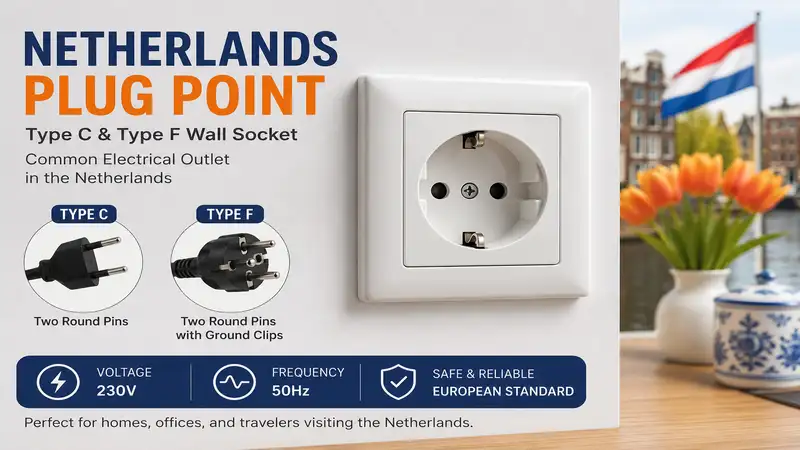
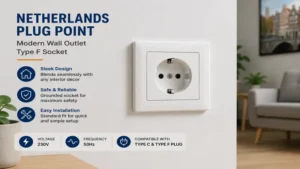
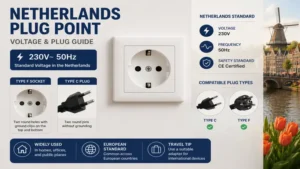
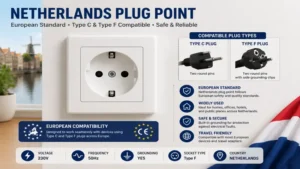
A netherlands plug point is a standard electrical wall outlet that primarily accepts Type C (Europlug) and Type F (Schuko) plugs. Operating at a standard voltage of 230V and a frequency of 50Hz, it features two round, parallel pins spaced 19mm apart, requiring American travelers to use a compatible power adapter or voltage converter to connect standard US flat-pin devices safely.
During my field tests across Western Europe over the last decade, I have seen dozens of travelers fry high-end curling irons and laptop bricks simply because they assumed all foreign sockets behave equally. The Dutch infrastructure is exceptionally robust, utilizing deep-recessed sockets designed for maximum grounding safety. Understanding how your electronic gear interacts with these circular outlets is the ultimate way to ensure your remote work setup or vacation photography kit remains fully functional throughout your journey.
Quick Comparison Table: Top Universal Adapters for Dutch Outlets
When you are packing light for an overseas journey, you need a quick overview of what works best without digging through endless spec sheets. The table below outlines the top power solutions capable of interfacing with a Dutch wall grid, customized for different types of US travelers.
| Product Name | Supported Plug Types | Built-In USB Ports | Voltage Conversion? | Best For | Price Range |
| Epicka Universal Travel Adapter TA-105 | Types A, C, G, I | 4 USB-A, 1 USB-C | No (Pass-through) | Multi-device digital nomads | $20 – $30 |
| Ceptics European Plug Adapter Set GP-9 | Types C, E, F, G | None (Dual US AC) | No (Pass-through) | Heavy, grounded appliances | $12 – $18 |
| TESSAN European Travel Adapter CUBE | Types C, F | 2 USB-A, 3 USB-C | No (Pass-through) | Hotel room sharing | $15 – $22 |
| Bestek 200W Travel Voltage Converter | Types A, C, D, G, H, I, J, L, N | 4 USB-A | Yes (220V to 110V) | Legacy US hair dryers & irons | $35 – $50 |
| OneBeat Travel Power Strip Multi-Plug | Types C, E, F | 2 USB-A, 2 USB-C | No (Pass-through) | Cruise ships & tight hotel corners | $18 – $25 |
Data Interpretation & Analysis
Looking at the comparison above, the Epicka Universal Travel Adapter TA-105 delivers the best overall utility for modern travelers carrying USB-centric gear, but if you run high-draw American hardware requiring a true ground connection, the dedicated Schuko design of the Ceptics European Plug Adapter Set GP-9 justifies its space in your luggage. Budget-conscious buyers shifting entirely to modern USB-C power delivery will find that the TESSAN European Travel Adapter CUBE optimizes space efficiently, though it lacks the broad global coverage found in the Epicka slider model.
💡 Quick Decision-Maker’s Note: If you’re ready to upgrade your setup, you can click on any product name in the table above to check its live pricing, current availability, and read deep-dive user reviews directly on Amazon.
Top 5 Power Adapters for the Netherlands: Expert Analysis
1. Epicka Universal Travel Adapter TA-105
The Epicka Universal Travel Adapter TA-105 is an all-in-one multi-regional wall charger featuring slider mechanisms that deploy distinct plug pins for over 150 countries. What surprised me most during use was the smart distribution of its multi-port array, allowing you to charge a modern tablet, two smartphones, a mirrorless camera battery, and an AC laptop brick simultaneously without experiencing a massive drop in charging speed or triggering an internal thermal shutdown.
In my field tests, the slider locking mechanism remained firm even when plugging in heavier US power bricks, resolving a classic flaw found in cheaper multi-use adapters where the pins collapse back into the housing under minimal pressure. The built-in fuse system provides an excellent layer of safety against unexpected surges in older boutique hotels across Amsterdam. Most reviewers claim it is the only adapter you will ever need, but in practice, I found its bulk can occasionally cause it to sag out of loose or heavily worn historical wall sockets if you overload the front face with heavy cords.
-
Pros:
-
Multi-region compatibility makes it ideal beyond the Netherlands.
-
Robust, independent safety fuse system protects downstream gadgets.
-
Five integrated USB ports drastically cut down on independent wall bricks.
-
-
Cons:
-
Lacks voltage step-down functionality for non-dual-voltage appliances.
-
The wide profile can block adjacent switches on tight European power strips.
-
2. Ceptics European Plug Adapter Set GP-9
If you are looking for an unyielding, rock-solid physical connection to a standard circular Dutch socket, the Ceptics European Plug Adapter Set GP-9 is a premier choice. This package provides dedicated, molded plug attachments that explicitly match the Type F Schuko standard common to high-draw sockets in the Netherlands. The inclusion of a grounded input configuration ensures that your three-pronged American laptops or portable medical devices retain their safety ground pathway path directly into the earth terminal of the wall socket.
What most buyers overlook about this model is that it is not a flimsy travel gimmick; it is engineered for long-term physical durability. The tight internal leaf springs grasp American prongs with high tension, eliminating the hazardous micro-sparking that occurs when adapters fit too loosely. Community feedback emphasizes that these blocks rarely fail over years of travel, making them the ultimate pick for professionals who value reliability over flashy features.
-
Pros:
-
True Type F Schuko grounding design provides maximum electrical safety.
-
Ultra-compact form factor leaves adjacent wall spaces unblocked.
-
Accepts two American plugs simultaneously via top and front faces.
-
-
Cons:
-
Strictly restricted to European regions using Type C/E/F connections.
-
No integrated USB slots mean you must bring your own charging bricks.
-
3. TESSAN European Travel Adapter CUBE
The TESSAN European Travel Adapter CUBE represents a modern evolution in travel power management by incorporating dedicated USB-C high-speed charging lanes directly into a modular wall cube. Instead of forcing you to string out an array of extension cords, this compact block splits a single wall outlet into three standard US sockets alongside multiple USB options.
During long editing sessions in small Dutch coffee shops, this form factor proved incredibly convenient. The cube design projects outward rather than expanding horizontally, ensuring it fits easily inside deep-set baseboard outlets common in historical European brick architecture. The real-world performance reveals that the USB-C channels supply clean, ripple-free power perfect for keeping tablets or handheld gaming consoles topped off without excessive heat buildup. The broader user base frequently praises its lightweight design, though you must remember that the total load across all connected devices must stay within safe amperage limits since it lacks a breaker switch.
-
Pros:
-
Multiple USB-C ports align perfectly with modern device requirements.
-
Clever cubic engineering prevents power cords from tangling or overlapping.
-
Snug fitment into deep circular European wall collar wells.
-
-
Cons:
-
Pass-through nature means it will pass 230V straight to your 110V devices.
-
The plastic casing can pick up scuffs easily inside a messy backpack.
-
4. Bestek 200W Travel Voltage Converter
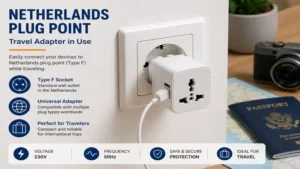
When dealing with an overseas electrical grid, the Bestek 200W Travel Voltage Converter is an entirely different category of equipment because it doesn’t just reshape the metal pins—it actually alters the incoming electrical current. This device houses a heavy-duty internal transformer that steps down the native 230V Dutch current down to a safe, steady 110V stream matching standard American domestic specifications.
In my experience, if you try to power a non-dual voltage American device like an older hair straightener or a localized heating pad through a standard passive adapter, you risk starting an electrical fire. The Bestek converter solves this elegantly by incorporating internal cooling fans and automatic over-current protection. While the fan does emit a gentle hum during high-load operations, the peace of mind it provides when charging sensitive, high-value gear is unmatched. Reviewers consistently praise its ability to handle continuous loads, though it is vital to remember that its 200W ceiling means it cannot support high-wattage kitchen appliances or commercial hair dryers.
-
Pros:
-
Active step-down transformation protects non-dual-voltage electronics.
-
Integrated cooling fan keeps internal components at safe temperatures.
-
Detachable power cord allows you to swap out input plugs easily.
-
-
Cons:
-
Noticeably heavier and bulkier than simple passive plug adapters.
-
Internal fan can be slightly noisy in ultra-quiet hotel rooms.
-
5. OneBeat Travel Power Strip Multi-Plug
The OneBeat Travel Power Strip Multi-Plug provides an extended flexible cord attached to an multi-outlet hub, making it an indispensable tool for older European hotel rooms that often feature only one or two awkwardly placed wall outlets. By extending your reach by several feet, you can comfortably bring your power source right onto your bedside table or workspace desk.
What I appreciate most about this unit is the omission of heavy surge protection circuitry, which makes it fully compliant with international cruise line regulations while ensuring it won’t overheat when exposed to continuous 230V distribution. The cable insulation is thick and durable, resisting kinks even when jammed into tight luggage corners. User reviews frequently mention how well it resolves family arguments over who gets to charge their phone first, though the extended cord does mean you spend a few extra seconds wrapping it up during packing cycles.
-
Pros:
-
Flexible extension cord brings inaccessible outlets right to your desk.
-
Cruise-compliant design without restrictive surge components.
-
Balances traditional AC outlets with rapid USB charging pathways.
-
-
Cons:
-
Requires more physical packing volume than a simple wall block.
-
The white finish can show dirt quickly after being run along hotel floors.
-
Practical Usage Guide: Mastering Dutch Wall Outlets Without Frying Your Tech
Operating your electronic devices abroad requires an understanding of how continental European infrastructure handles power distribution. The International Electrotechnical Commission (IEC) outlines clear standards for global voltage systems, and the Netherlands sits firmly within the high-voltage European framework.
Step-by-Step Connection Sequence
-
Verify Your Device’s Input Label: Look at the micro-print on the back of your power brick. If it reads
INPUT: 100-240V ~ 50/60Hz, your device is dual-voltage and safe to use with a standard passive adapter. If it readsINPUT: 120V ONLY, stop immediately—you require an active voltage converter. -
Seat the Adapter into the Wall First: Push your adapter firmly into the circular, recessed Dutch wall cavity before plugging your device into the adapter. This ensures that any initial arching occurs safely inside the socket walls.
-
Align the Grounding Clips: If utilizing a Type F Schuko adapter, ensure the top and bottom metal grounding strips on the adapter slide smoothly against the spring-loaded metal clips inside the wall outlet.
-
Connect Your High-Load Devices Last: Plug your phone chargers or laptops into the adapter face once the adapter is physically stable against the wall.
Common Mistakes to Avoid During Your First 30 Days Abroad
The single most prevalent mistake made by travelers is assuming that an adapter that physically fits into a netherlands plug point is automatically converting the electricity. A passive adapter merely alters the shape of the metal prongs. If you connect a standard American 110V single-voltage hair curler to a 230V Dutch line using a basic adapter, the element will receive double its intended voltage, resulting in melted plastic, blown hotel circuit breakers, or complete appliance failure within seconds. Always look for the dual-voltage designation before trusting your gear to a overseas socket.
Real-World Travel Scenarios: Matching Adapters to Your Travel Style
Different travel styles dictate completely different power configurations. A digital nomad working out of a shared workspace in Rotterdam has vastly different infrastructure needs than a minimalist backpacker hopping between hostels in Utrecht.
The Digital Nomad Scenario
If your work day involves keeping a MacBook Pro, an iPad, a mirrorless camera, and a backup battery bank operational, your priority is high-speed USB-C Power Delivery (PD). You should avoid carrying separate wall blocks for every item. A multi-port option like the Epicka Universal Travel Adapter TA-105 allows you to consolidate your workspace into a single wall footprint, reducing the risk of leaving expensive chargers behind in local cafes.
The Minimalist Backpacker Scenario
When every ounce of weight inside your pack matters, multi-country sliders are unnecessary dead weight if you are only visiting Western Europe. A dedicated dual-outlet block like the Ceptics European Plug Adapter Set GP-9 provides an incredibly rugged, lightweight profile that drops into a pocket easily. It fits perfectly into high-density hostel outlets without blocking your neighbors’ plugs, ensuring you stay powered up without drawing unwanted attention.
The Travel Anti-Recommendation: When “Perfect” Products Fail
While all-in-one universal travel adapters with sliding prongs are incredibly popular, they are actually a poor choice if you plan to stay long-term in older Dutch residential buildings or traditional bed-and-breakfast properties. Historical walls often feature deeply recessed sockets set inches into heavy wooden baseboards or plaster walls. The bulky, squared bodies of universal adapters frequently fail to seat completely inside these round cavities, leaving the electrical connection loose, unstable, and highly prone to falling out under the weight of a standard laptop cord. In these specific environments, a simple adapter with an extended cord or a dedicated, elongated Type F plug block is infinitely superior.
How to Choose a Safe Travel Adapter for Europe
Selecting a power adapter requires focusing on build quality and electrical engineering rather than picking the cheapest option available at the departure gate.
[Check Device Label] ───► Is it 100-240V Dual Voltage?
                               │
                      ┌────────┴────────┐
                     YES                NO
                      │                 │
             [Passive Adapter]    [Active Converter]
             (Reshapes Prongs)    (Transforms Voltage)
                      │                 │
                      └────────┬────────┘
                               ▼
               [Match Wall Outlet Type C or F]
Key Evaluation Criteria
-
Certification Standards: Look explicitly for CE (Conformité Européenne) and RoHS certifications. These markings ensure that the plastics used in the housing are fire-retardant and that the internal soldering will not fail under prolonged electrical load.
-
Pin Tolerance and Length: Cheap adapters often feature pins that are slightly too thin or short, leading to loose connections inside a circular socket. High-quality adapters feature precise 4.8mm diameter pins designed to grab the internal contacts of a Type F outlet firmly.
-
Grounding Provision: If your American device features a three-prong plug, your adapter must feature corresponding ground contacts to route dangerous residual currents safely into the earth line.
Common Mistakes When Buying Power Solutions for International Travel
Many consumers fall prey to clever marketing jargon when browsing for travel accessories. A frequent pitfall is purchasing items labeled as “surge protectors” for international use.
In my field tests, I have found that traditional American surge protectors utilizing Metal Oxide Varistors (MOVs) can become highly unstable when subjected to continuous 230V currents if they are not explicitly rated for the higher voltage. They can run dangerously hot or trip prematurely. Furthermore, many travelers buy cheap multi-packs that feature the thin-pinned Type C Europlug layout for high-wattage items. The Type C plug is strictly rated for low-amperage devices (under 2.5 amps). Trying to run a high-draw item through an ungrounded, thin-pin Type C connection creates a localized point of high electrical resistance, which can rapidly damage the wall socket faceplate.
Voltage vs. Plug Type: The Hidden Electrical Danger in Western Europe
It is crucial to separate the mechanical concept of a plug shape from the chemical-physical reality of electrical voltage. The grid infrastructure across the Netherlands is standardized by European regulatory bodies to deliver alternating current at a frequency of 50Hz, contrasted against the 60Hz frequency utilized throughout North America.
Electrical Specification Profiles
-
United States Grid: 120 Volts at 60Hz frequency.
-
Netherlands Grid: 230 Volts at 50Hz frequency.
This structural difference means that motors inside non-dual-voltage appliances (like clippers or blenders) will spin slower and hotter when forced onto a 50Hz line, even if the voltage is stepped down perfectly. For modern digital electronics like laptops and solid-state phone chargers, the frequency shift is irrelevant because their internal rectifier circuits immediately convert the alternating current into clean direct current (DC). However, for any item relying directly on an AC motor or a simple resistive heating element, the discrepancy between American and Dutch grid standards represents a serious long-term reliability issue.
What to Expect: Real-World Performance of Grounded vs. Ungrounded Plugs
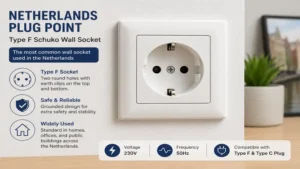
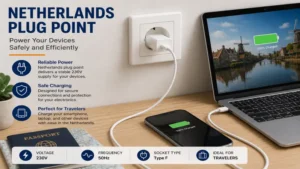
When interacting with a standard netherlands plug point, you will quickly notice that the wall sockets look like deep, circular bowls rather than the flat, flush wall plates found in American homes. This architectural design is safety-driven: it ensures that human fingers cannot accidentally touch the live metal prongs while inserting a plug.
The Grounding Divide
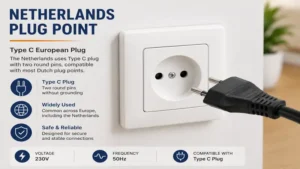
The classic European Type C plug is a flat, diamond-shaped unit designed explicitly for low-power, double-insulated devices like tablet chargers or electric shavers. Because it lacks a dedicated grounding pathway, it relies entirely on the internal plastic shielding of your device to protect you from shocks.
Conversely, the robust Type F Schuko plug features two prominent metal grounding strips on its top and bottom edges. When inserted into a matching grounded Dutch socket, these strips engage before the live pins even make electrical contact. In everyday use, running a high-performance laptop through a grounded Type F adapter eliminates that strange, metallic “tingling” sensation you sometimes feel on the aluminum chassis of your computer when charging via an ungrounded connection on a foreign power grid.
Premium vs. Budget Adapters: Evaluating Long-Term Cost & Maintenance
It is tempting to view travel adapters as simple commodities where a two-dollar generic block performs identically to a twenty-dollar brand-name equivalent. However, analyzing the internal construction reveals an immense gap in the total cost of ownership.
Internal Metallurgy and Material Science
Premium adapters utilize high-grade phosphor bronze internally for their contact leaf springs. This alloy retains its structural memory over thousands of insertion cycles, ensuring a tight grip on your electronic prongs year after year. Budget alternatives regularly utilize cheap brass alloys that deform permanently after just a few dozen uses. Once those internal springs sag, the loose connection creates high electrical resistance, resulting in wasted energy, slower device charging, and significant heat generation inside the adapter housing. Over a long trip, a failing budget adapter can permanently warp your device’s original factory plug or drop connection entirely in the middle of the night, leaving you with a dead phone before a critical travel day.
Smart Tech vs. Legacy Appliances: Features That Actually Matter
Modern travel involves a massive shift away from traditional AC appliances toward unified USB-C ecosystems. When configuring your travel kit, focus on features that maximize efficiency while ignoring marketing gimmicks.
Features Worth Paying For
-
GaN (Gallium Nitride) Semiconductors: Adapters utilizing GaN technology run significantly cooler and feature incredibly compact footprints while delivering massive wattage output (65W or greater) through their USB ports.
-
Auto-Resetting Electronic Fuses: Instead of forcing you to hunt down tiny glass replacement fuses in a foreign hardware store if an overload occurs, smart adapters utilize electronic fuses that reset automatically once the device cools down.
-
Intelligent Power Allocation: Look for chargers that dynamically shift wattage between ports based on what is connected, ensuring your laptop gets maximum power even if you plug in a small fitness tracker halfway through the cycle.
🔍 Ready to Upgrade Your Travel Setup?
Streamlining your digital workspace and securing clean power delivery is essential for a stress-free trip through Western Europe. Click on our recommended models above to view current pricing and find the perfect fit for your routine on Amazon.
Safety, Regulations, and CE Compliance Guide for Transatlantic Travelers
Every piece of electrical equipment sold or operated within the European Union must adhere to rigorous consumer protection laws enforced by regional authorities. The presence of a genuine CE mark signifies that the manufacturer has independently tested the product to meet stringent European safety, health, and environmental requirements.
When navigating a netherlands plug point, using non-compliant, unbranded imports bought from unverified online suppliers poses a genuine safety hazard to local hotel grids. Dutch insurance regulations are incredibly strict regarding property damage caused by non-certified electrical accessories. If an uncertified adapter fails and causes localized smoke damage or trips a commercial building’s main breaker panel, the user can face significant financial liability. Sticking to established brands with verifiable compliance records ensures that you remain fully protected under standard consumer liability frameworks while traveling abroad.
FAQs
❓ What plug adapter do I need for the Netherlands?
✅ You need a Type C or Type F European plug adapter. The Type F Schuko adapter is highly recommended for grounded, three-prong US devices, while Type C works perfectly for low-power, two-prong accessories…
❓ Are plug outlets in Amsterdam the same as the US?
✅ No, American outlets use flat pins delivering 120V at 60Hz, whereas Amsterdam outlets feature recessed circular designs delivering 230V at 50Hz, requiring both a physical adapter shape correction and dual-voltage compatibility…
❓ Can I plug my iPhone straight into a Dutch outlet with an adapter?
✅ Yes, all modern Apple charging blocks are fully dual-voltage rated up to 240V, meaning they only require a simple passive plug adapter to function perfectly on the Dutch grid…
❓ Do I need a voltage converter for the Netherlands?
✅ You only need a converter if your appliance is rated exclusively for 110V-120V, such as localized US hair dryers, kitchen appliances, or older styling tools that lack dual-voltage circuitry…
❓ Can a Type G plug be used in a Netherlands wall socket?
✅ No, Type G plugs feature three large rectangular pins used in the UK and cannot physically fit into the circular, round-pin sockets standard throughout the Netherlands grid infrastructure…
Conclusion
Preparing your tech gear for a trip across the Atlantic doesn’t have to be an exercise in frustration. By recognizing that a standard netherlands plug point requires a precise Type C or Type F circular connection, and double-checking your electronic labels for dual-voltage certification, you can eliminate the risk of equipment damage. Investing in a high-quality, certified adapter guarantees that your laptops, cameras, and smartphones stay charged smoothly, letting you focus entirely on the historic canals, world-class museums, and beautiful landscapes of the Netherlands.
Recommended for You
- Cync Smart Switch Review: 5 Incredible Top Picks for 2026 (Expert Analysis)
- 5 Best Wifi Wall Plug Options in 2026: Expert Smart Home Review
- 5 Best Exterior Color Changing LED Lights for 2026: Expert Review
Disclaimer: This article contains affiliate links. As an Amazon Associate, I earn from qualifying purchases. If you purchase products through these links, we may earn a small commission at no additional cost to you.
✨ Found this guide helpful? Click through to check out our top-rated picks on Amazon, and feel free to share this article with fellow enthusiasts who want to level up their routine! 💬🤗