
In This Article
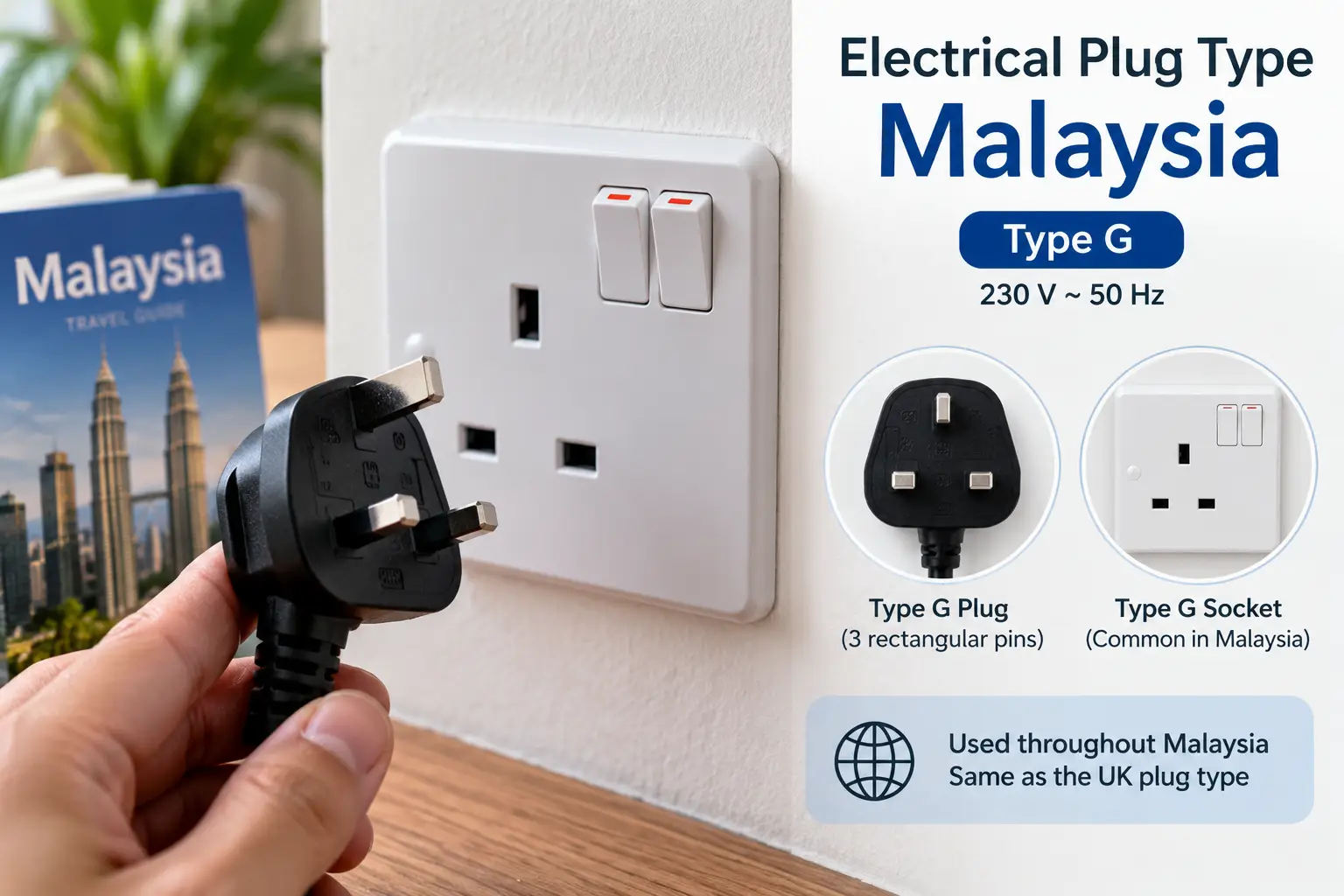
You’ve booked the flight, mapped out the hawker stalls in Penang, and packed your favorite gadgets — and then it hits you: will your phone charger even work once you land? That question is exactly why so many US travelers search for the electrical plug type malaysia uses before they zip up their suitcase. The short answer is Type G, the same three-pin, rectangular-prong design used across the United Kingdom, and it is nothing like the flat two-prong outlets you have at home.
Malaysia runs on 230-240 volts at 50 Hz, roughly double the standard American 120V supply, which means a plug adapter alone won’t always be enough. Some devices need a genuine voltage converter, while others — most modern phones, laptops, and cameras — are dual-voltage and only need a shape-changing adapter. Getting this distinction wrong is how people end up with a fried hair straightener or a dead camera battery on day one of vacation.
This guide breaks down exactly what the electrical plug type malaysia requires, walks through seven real, current products available on amazon.com that solve the problem at different budgets, and answers the practical questions travelers actually ask — from whether you need a converter to how to avoid the most common packing mistakes. According to the <cite index=”53-1″>technical standard governing this plug family, distinctive characteristics of the system include shutters on the neutral and line contacts</cite>, a safety feature worth understanding before you buy.
Quick Comparison: Best Travel Adapters for Malaysia at a Glance
| Product | Best For | Outlets/Ports | Price Range |
|---|---|---|---|
| Ceptics 2-in-1 UK Travel Adapters (3-Pack) | Families, best value | 2 grounded inputs each | Under $20 |
| OREI DB-7 4-Pack Type G Adapter | Reliability, long trips | 2 grounded inputs each | Under $20 |
| TESSAN UK Adapter with 3 USB Ports | Charging several gadgets at once | 3 outlets + 3 USB | Around $15-$20 |
| BESTEK 7-in-1 UK Plug Adapter | Power users, hotel rooms | 3 AC + 4 USB | Around $15-$20 |
| EPICKA TA-105 Pro Universal Adapter | Multi-country trips | 1 AC + 5 USB (GaN) | Around $25-$35 |
| HANYCONY Compact UK Travel Adapter | Lightest carry-on pick | 2 outlets + 3 USB | Under $15 |
| FOVAL 230W Step-Down Voltage Converter | Hair tools, single-voltage devices | 2 AC + USB | In the $30-$45 range |
Looking at the table above, the Ceptics 2-in-1 UK Travel Adapters and OREI DB-7 4-Pack win on pure value if you just need reliable, grounded plug shape conversion for a family’s worth of chargers. If you’re bringing a single-voltage American hair straightener or a CPAP machine, though, none of the plain adapters will protect that device — only the FOVAL 230W Step-Down Voltage Converter actually changes the voltage rather than just the plug shape. Buyers juggling a laptop, phone, and camera all at once should lean toward the TESSAN UK Adapter with 3 USB Ports or the BESTEK 7-in-1 UK Plug Adapter, since both let you skip packing three separate bricks.
💬 One click helps other shoppers make an informed choice too! 😊
What Is the Electrical Plug Type in Malaysia?
The electrical plug type in Malaysia is Type G — a grounded, three-pin plug with rectangular prongs arranged in a triangle, identical to the plug used throughout the United Kingdom. Malaysian outlets run at 230-240 volts, 50 Hz, so American devices built for 120V typically need both a plug adapter and, in some cases, a separate voltage converter.
This standard isn’t unique to Malaysia. As former British territories, <cite index=”4-1″>Malaysia has one associated plug type, Type G, with a standard voltage of 230V (officially, but in practice often 240V) at a frequency of 50Hz</cite>. You’ll find the identical outlet whether you’re charging a phone in a Kuala Lumpur hotel, a beach bungalow in Langkawi, or a jungle lodge in Sabah — the infrastructure is consistent across Peninsular Malaysia and Malaysian Borneo alike, so one well-chosen adapter covers the entire trip. For a deeper technical breakdown of how this plug family evolved from earlier British standards, the Wikipedia entry on British-type AC power plugs and sockets is a solid, citable reference.
One quirk worth flagging: some older buildings in Malaysia still have Type C (two round pins) outlets left over from before the country fully standardized, so a universal adapter that covers both Type G and Type C gives you a small margin of safety in older hotels or shophouses.
Top 7 Best Travel Adapters and Voltage Converters for Malaysia’s Type G Outlets
Picking the right adapter isn’t just about whether the prongs fit the wall. It’s about how many devices you’re charging, whether any of them are single-voltage, and how much you’re willing to carry. The seven picks below cover entry-level, mid-range, and specialty needs, based on real spec sheets and aggregated customer feedback from Amazon listings.
1. Ceptics 2-in-1 UK Travel Adapters (3-Pack) — best value for families
If you’re traveling with a partner or kids and everyone has a phone, this multi-pack solves the “who gets the outlet” argument before it starts. Each adapter accepts two American plug styles — 2-prong and 3-prong — and grounds them safely into a Type G Malaysian outlet, and coming in a 3-pack means you’re not fighting over a single unit at breakfast while everyone’s phone is at 12%.
The dual USA input on each adapter means one Type G unit effectively serves two American devices simultaneously, which in practice means a family of four can travel with just two of these instead of four separate single-input adapters. Reviews consistently report that the grounded pins feel snug in UK-style sockets rather than wobbly, which matters because a loose adapter is one of the most common causes of intermittent charging on trips.
This is the pick for buyers who want dependable, no-frills plug conversion at the lowest per-unit cost, not the buyer who needs USB fast charging built in. A common complaint in customer reviews is that the housing is entirely plastic with no surge protection, so it’s not the adapter to leave a laptop charger plugged into overnight unattended.
Pros:
- ✅ Three adapters cover a whole family’s devices
- ✅ Grounded 3-prong output fits snugly in Type G sockets
- ✅ Genuinely budget-friendly per-unit cost
Cons:
- ❌ No USB ports built in
- ❌ No surge protection for sensitive electronics
Pricing sits under $20 for the full 3-pack, at the time of writing, which makes the Ceptics 2-in-1 UK Travel Adapters one of the better cost-per-device values in this lineup.
2. OREI DB-7 4-Pack Type G Adapter — most reliable grounded pick
OREI has built its reputation specifically on travel electronics rather than treating adapters as an afterthought product line, and the DB-7 shows it: a simple, grounded, dual-input Type G adapter backed by a lifetime warranty. The distinguishing benefit here isn’t flashy features — it’s that OREI stands behind the product indefinitely if it fails.
Each unit in the 4-pack accepts American 2-prong or 3-prong plugs and steps them into a Type G-compatible grounded output, rated up to 13A at 250V, which comfortably covers phone chargers, laptop bricks, and small electronics. What the spec sheet doesn’t say, but reviews reveal, is that OREI’s internal metal contacts tend to stay snug longer than cheaper alternatives, reducing the annoying “the plug fell halfway out overnight” problem some travelers report with off-brand adapters.
This is the adapter for someone who travels internationally often enough to want a proven brand rather than a gamble on an unfamiliar name, and who values a lifetime warranty over a slightly lower price. Reviews aggregate around strong reliability for basic charging tasks, with occasional notes that the plug body runs a bit larger than ultra-compact competitors.
Pros:
- ✅ Backed by an OREI lifetime limited warranty
- ✅ Four-pack means spares for lost or forgotten adapters
- ✅ Grounded design rated up to 13A/250V
Cons:
- ❌ Bulkier than slim USB-focused competitors
- ❌ No built-in USB charging ports
Expect to pay in the same under-$20 range as the Ceptics option, at the time of writing, making the OREI DB-7 4-Pack an easy pick when warranty coverage matters more than compact size.
3. TESSAN UK Adapter with 3 USB Ports (2-Pack) — best for charging multiple gadgets
The TESSAN UK Adapter earns its spot by solving a problem the plain adapters above don’t: modern travelers rarely carry just one device. This model packs three AC-style outlets and three USB ports — including one USB-C at 20W Power Delivery — into a single compact brick, so a phone, tablet, and portable charger can all top off from one Type G wall socket.
The practical upside of PD 20W USB-C charging is real-world speed — it’s roughly triple the output of the old 5W USB-A ports still found on cheaper adapters, meaning a modern phone can hit 50% charge in well under 30 minutes instead of nearly an hour. Based on comparing the specs against basic adapters like the Ceptics and OREI picks above, the tradeoff is size: this unit is noticeably chunkier because it’s doing more work in one housing.
This is the adapter for solo travelers or couples who want to minimize how many bricks they pack while still fast-charging modern devices. Reviews consistently report that the fold-out UK prongs feel sturdy, though a handful of buyers note the unit runs warm under heavy multi-device load, which is normal for adapters handling this much simultaneous output but worth monitoring.
Pros:
- ✅ Charges three devices from one wall outlet
- ✅ USB-C port delivers fast 20W charging
- ✅ Two-pack covers two travelers independently
Cons:
- ❌ Bulkier profile than basic single-purpose adapters
- ❌ Runs warm when all ports are used simultaneously
Priced in the $15-$20 range for the pair, at the time of writing, the TESSAN UK Adapter offers strong value-for-money if device count, not price, is your main constraint.
4. BESTEK 7-in-1 UK Plug Adapter — most outlets in one brick
For travelers who turn a single hotel outlet into a mini charging station, the <cite index=”17-1″>BESTEK adapter features a 7-in-1 design with 3 AC outlets, 3 USB-A ports, and 1 USB-C PD 20W fast charging port, with a maximum capacity of up to 3250 watts</cite>. That combination means you could genuinely run a laptop charger, a phone, a camera battery charger, and a portable fan all from one Type G wall socket — a real advantage in older Malaysian hotel rooms that sometimes have just one accessible outlet near the bed.
What most buyers overlook with adapters like this is that more outlets means more simultaneous draw, so it’s worth checking your total wattage against the rated capacity before plugging in space heaters or hair dryers alongside smaller electronics. The <cite index=”17-1″>ultra-slim 0.9-inch profile</cite> helps offset the bulk you’d expect from packing seven charging points into one unit, making it reasonably suitcase-friendly despite doing the work of several separate adapters.
This is the pick for a family sharing one hotel room, or a solo traveler who simply hates hunting for outlets. Aggregated reviews describe the build as solid for the price point, with occasional feedback that the AC outlets themselves are snug enough that oversized US plugs (like grounded kitchen appliance plugs) may not fit comfortably.
Pros:
- ✅ Charges up to seven devices at once
- ✅ Slim 0.9-inch profile despite the outlet count
- ✅ USB-C PD 20W port for fast modern charging
Cons:
- ❌ AC outlet slots can be snug for oversized US plugs
- ❌ Overkill for a solo traveler with only a phone
The BESTEK 7-in-1 UK Plug Adapter typically runs in the $15-$20 range, at the time of writing, which is a strong value-for-money proposition given the sheer number of simultaneous charging points.
5. EPICKA TA-105 Pro Universal Adapter — best if Malaysia is one stop on a bigger trip
Not every trip to Malaysia stays in Malaysia. If your itinerary also swings through Thailand, Singapore, or a layover in Europe, a Malaysia-only Type G adapter becomes dead weight the moment you cross a border. The EPICKA TA-105 Pro is built around GaN (gallium nitride) charging technology, which lets it pack 70W of USB-C Power Delivery output into a housing barely larger than a deck of cards, alongside slide-out prongs that reconfigure for well over 200 countries.
Here’s what to weigh: GaN chargers run cooler and more efficiently than older silicon-based chargers at the same wattage, which is why a 70W GaN adapter can be meaningfully smaller than a 45W adapter built on older tech. Reviews consistently report that the slide-out mechanism for switching plug types feels durable rather than flimsy, a common failure point on cheaper universal adapters. The tradeoff is price — this is the most expensive plug adapter on this list, though it replaces what would otherwise be two or three country-specific adapters for a multi-stop trip.
This is the adapter for the traveler who values one universal tool over a drawer full of country-specific bricks, and who’s charging a laptop or tablet alongside a phone. It is explicitly not a voltage converter, so single-voltage appliances still need a separate solution — see pick #7 below.
Pros:
- ✅ Works across 200+ countries with slide-out prongs
- ✅ GaN tech delivers fast 70W charging in a small size
- ✅ Durable build reported across aggregated reviews
Cons:
- ❌ Priciest plug adapter in this lineup
- ❌ Does not convert voltage for single-voltage devices
Expect to pay in the $25-$35 range, at the time of writing, for the EPICKA TA-105 Pro Universal Adapter — a reasonable trade if it replaces multiple single-country adapters you’d otherwise be buying separately.
6. HANYCONY Compact UK Travel Adapter — lightest option for carry-on packing
Sometimes the best feature an adapter can have is simply disappearing into your bag. The HANYCONY adapter strips the concept down to two AC-style outputs and three USB ports (two of them USB-C) in a housing built for minimalist packers who resent every extra ounce in a carry-on.
The 2-outlet, 3-USB configuration means it still covers the realistic middle ground most solo travelers need — a phone, a set of earbuds, and maybe a lightweight camera charger — without the bulk of the 7-in-1 options above. Based on comparing the specs against the BESTEK and TESSAN picks, this is a deliberate tradeoff: less simultaneous capacity in exchange for noticeably less size and weight, which matters if you’re traveling with only a backpack through multiple Malaysian cities.
This is the pick for the light packer, the digital nomad hopping between Kuala Lumpur co-working spaces, or anyone who’s tired of adapters that take up half a packing cube. A common theme in aggregated reviews is praise for the compact footprint, paired with occasional notes that the plastic housing feels less rugged than metal-reinforced competitors like OREI.
Pros:
- ✅ Noticeably smaller and lighter than multi-outlet rivals
- ✅ Dual USB-C ports suit modern device charging
- ✅ Reasonable price for the port count offered
Cons:
- ❌ Housing feels less rugged than metal-reinforced adapters
- ❌ Only two AC-style outputs limit simultaneous charging
Priced under $15, at the time of writing, the HANYCONY Compact UK Travel Adapter is one of the better lightweight, budget-conscious picks in this roundup.
7. FOVAL 230W Step-Down Voltage Converter — the only pick that actually converts voltage
This is the product most people searching for the electrical plug type malaysia actually need but don’t realize it. Every adapter above changes plug shape only — none of them change voltage. If you’re bringing a single-voltage American hair straightener, curling iron, or older electric shaver not rated for 220-240V, plugging it into a Malaysian outlet through a plain adapter can destroy the device or pose a fire risk.
<cite index=”34-1″>The FOVAL 230W converter steps down all countries’ voltage from 100-240V, 50/60Hz to US/Japan voltage of 110V, 60Hz, and comes equipped with a EU power cable and international adapters (US/UK/AU/IT), letting American electronics work across more than 200 countries</cite>. In practice, this means you can finally pack that flat iron without gambling on whether “dual voltage” printed somewhere on the box is actually true. What the spec sheet doesn’t say plainly enough is the wattage ceiling: <cite index=”36-1″>this converter is only rated for devices under 230W and is explicitly not intended for hair dryers or electric heaters</cite>, which draw far more power than that limit allows.
This is the pick for anyone bringing genuinely single-voltage grooming tools, not for anyone assuming it will safely run a high-wattage hair dryer — that requires a much larger, heavier transformer that most travelers won’t want to pack anyway. Reviews aggregate around solid short-term performance for its rated wattage class, with some buyers noting the internal fan and components are built for occasional travel use rather than daily heavy-duty operation.
Pros:
- ✅ Genuinely converts voltage, not just plug shape
- ✅ Comes with international adapters for 200+ countries
- ✅ USB ports included for simultaneous device charging
Cons:
- ❌ Not rated for hair dryers or other high-wattage tools
- ❌ Heavier and bulkier than plain plug adapters
Pricing lands in the $30-$45 range, at the time of writing, making the FOVAL 230W Step-Down Voltage Converter a worthwhile add-on specifically for travelers packing single-voltage grooming or medical devices.
How to Choose the Right Travel Adapter for Malaysia
Picking between seven solid options gets easier once you break it down into a short checklist. Work through these steps in order, and you’ll land on the right pick in a few minutes rather than an hour of scrolling reviews.
- Check every device’s voltage label first. Look for “INPUT: 100-240V” printed on the charger brick itself — if you see that range, you need only a plug adapter, not a converter.
- Count your simultaneous devices. A solo traveler with just a phone is fine with a basic 2-outlet adapter; a family or power user benefits from a 6-7 port model like the BESTEK.
- Decide if this is a one-country or multi-country trip. A Malaysia-only visit doesn’t need universal coverage — a dedicated Type G adapter is cheaper and often more compact.
- Flag any single-voltage appliances separately. Hair straighteners, curling irons, and older electric shavers need a genuine voltage converter, not just a plug adapter.
- Weigh grounding for sensitive electronics. Laptops and camera equipment benefit from a grounded 3-prong adapter rather than a two-pin substitute.
- Consider USB port count over extra AC outlets. Most modern devices charge via USB anyway, so ports often matter more than raw outlet count.
- Factor in warranty and brand reputation for repeat travelers. If you fly internationally often, a lifetime-warranty brand like OREI pays for itself over several trips.
Real-World Scenarios: Which Adapter Fits Your Trip?
Reading specs is one thing — seeing how they map to an actual itinerary makes the decision concrete.
The solo backpacker hopping between hostels in Kuala Lumpur and Georgetown. Traveling light with just a phone, a Kindle, and wireless earbuds, this traveler doesn’t need seven outlets. The HANYCONY Compact UK Travel Adapter covers the charging load without adding bulk to an already-full daypack, and its price keeps the budget intact for street food and transport instead.
The family of four staying in a KLCC condo for two weeks. With four phones, a tablet, and a laptop all needing power at once, splitting charging duties matters. Two units of the Ceptics 2-in-1 UK Travel Adapters plus one TESSAN UK Adapter with 3 USB Ports gives every family member their own outlet without a nightly scramble, at a combined cost still under $40.
The remote worker based in Malaysia for a month who also has a work trip to Bangkok. Since this itinerary crosses borders, a Malaysia-only adapter creates a second purchase later. The EPICKA TA-105 Pro Universal Adapter covers both Type G in Malaysia and Type A/C outlets in Thailand from a single device, and its 70W GaN output comfortably charges a work laptop overnight.
The traveler packing a hair straightener they refuse to leave behind. No adapter alone protects that appliance. Pairing any plug adapter above with the FOVAL 230W Step-Down Voltage Converter is the only combination that lets a single-voltage American styling tool run safely on Malaysia’s 240V supply.
✨ Don’t miss these exclusive deals! 🔍 Check current pricing on the adapter that matches your trip, and pack with confidence knowing every device you’re bringing will actually charge.
Common Mistakes to Avoid When Buying a Malaysia Travel Adapter
Even seasoned travelers trip over a handful of predictable errors when shopping for this category.
Assuming “universal” means voltage conversion. The single most common mistake is treating a universal plug adapter as if it also converts voltage. It doesn’t — a universal adapter changes prong shape only, and plugging a single-voltage 120V device into 240V through one of these adapters can permanently damage it.
Buying a non-grounded adapter for a laptop. Two-pin, ungrounded adapters are cheaper, but laptops and other sensitive electronics benefit from the grounded 3-prong connection a proper Type G adapter provides — skipping it trades a few dollars of savings for real risk to expensive equipment.
Ignoring wattage limits on voltage converters. As the FOVAL product above illustrates, converters have hard wattage ceilings. Plugging a 1,800W hair dryer into a 230W-rated converter is a fire risk, not just an inconvenience.
Packing only one adapter for a multi-device household. One adapter for four travelers means someone’s phone dies waiting for an outlet — multi-packs or multi-port models solve this for a marginal cost difference.
Waiting to buy at the airport. <cite index=”13-1″>Prices at airport shops can run two to three times higher than buying the same adapter online beforehand</cite>, so last-minute convenience comes with a real markup.
Type G Adapter vs Universal Travel Adapter: Which Should You Pack?
This comparison comes up constantly because the two categories solve overlapping but distinct problems.
| Factor | Dedicated Type G Adapter | Universal Travel Adapter |
|---|---|---|
| Best for | Single-country trips to Malaysia/UK-standard countries | Multi-country itineraries |
| Typical price | Under $20 | $25-$35 |
| Size/weight | Usually smaller and lighter | Slightly bulkier due to versatility |
| Best for | Ceptics, OREI, HANYCONY | EPICKA TA-105 Pro |
A dedicated Type G adapter, like the Ceptics or OREI picks above, is almost always the better choice if Malaysia is your only international stop — it’s cheaper, lighter, and there’s nothing to fumble with. On the other hand, the EPICKA TA-105 Pro earns its higher price the moment your itinerary adds a second country with a different plug standard, since one device replaces what would otherwise be two separate purchases. Buyers who travel internationally more than once or twice a year tend to find the universal option pays for itself in convenience alone, even on trips that don’t strictly require it.
What to Expect: Everyday Performance in Malaysia
On paper, spec sheets all look similar — grounded, 13A, CE certified. In everyday use, the differences show up in small but real ways. Type G outlets in Malaysian hotels, malls, and condos are almost always switched, meaning there’s a small rocker switch next to the socket that needs to be flipped on before power flows — a detail that trips up first-time visitors who assume a plugged-in device should just work.
Older buildings, especially in historic parts of Georgetown or older Kuala Lumpur shophouses, occasionally still carry the Type C round-pin sockets mentioned earlier, so an adapter that only handles Type G rectangular pins could leave you stuck in a small subset of accommodations. Newer condos, hotels, and malls are uniformly Type G with no surprises.
Malaysia’s power grid is generally stable in urban centers, but the occasional voltage fluctuation is a real reason grounded adapters with some surge tolerance are worth the small premium over the cheapest bare-bones options. Everyday charging speed also depends more on your adapter’s USB wattage than on Malaysia’s power supply itself — a modern USB-C PD adapter like the one built into the TESSAN or BESTEK picks will charge a phone meaningfully faster than a basic 5W USB-A port, regardless of which country you’re in.
Do You Need a Voltage Converter for Malaysia?
Most travelers don’t — but the ones who do really do. <cite index=”7-1″>American travelers to Malaysia may need a voltage converter or transformer as the local voltage, 240V, is outside the normal US range of 120V plus or minus 5 percent, though many US appliances are dual voltage and will operate safely if marked “100-240V” or similar</cite>. The practical test is simple: flip over the charger or appliance and read the fine print. If it says something like “INPUT: 100-240V, 50/60Hz,” a plain plug adapter is all you need.
If it lists only a single voltage — commonly “120V” with no range — that device needs a converter or should stay home. This typically affects older hair dryers, curling irons, some electric shavers, and certain medical devices like older CPAP machines. Modern laptops, phone chargers, camera battery chargers, and most electric toothbrushes are dual-voltage by default because manufacturers build for a global market. <cite index=”10-1″>Devices such as laptops, smartphones, and cameras often have built-in voltage converters, but double-checking the label is always worth the thirty seconds it takes</cite>.
Long-Term Cost and Value: Is a Universal Adapter Worth It If You Travel Often?
For a single trip to Malaysia, a dedicated Type G adapter is the clear value winner — there’s no reason to pay a premium for versatility you won’t use. The math changes for frequent international travelers.
| Scenario | One-Time Cost | Long-Term Value |
|---|---|---|
| Single trip to Malaysia only | Ceptics or OREI (under $20) | Best ROI for this specific trip |
| 2-3 international trips per year | EPICKA TA-105 Pro ($25-$35) | Pays for itself by trip two or three |
| Frequent flyer, 5+ countries per year | EPICKA TA-105 Pro + spare adapter | Avoids repeat purchases across regions |
Buying a Malaysia-specific adapter for every new destination adds up fast — three or four single-country adapters purchased separately over a year often cost more than one universal adapter that handles all of them. The EPICKA TA-105 Pro Universal Adapter is the clearest example of this long-term math: its higher upfront price is offset within two or three trips for anyone who travels to more than one plug-type region per year. For the occasional traveler making a single Malaysia trip, though, that same versatility is money spent on capability you’ll never use.
Features That Actually Matter (and Ones That Don’t)
Marketing copy on adapter listings tends to pile on features that sound impressive but rarely move the needle for a real trip.
What actually matters: grounded 3-prong output for laptops and cameras; USB-C Power Delivery for meaningfully faster charging; a stated wattage rating you can check against your devices; and a clear, honest label about whether the unit converts voltage or just plug shape.
What doesn’t matter as much as it sounds: LED charging indicator lights (nice, not essential); the total number of USB-A ports beyond two or three, since most travelers aren’t charging five devices simultaneously; and cosmetic color options, which add nothing to function. Surge protection is a genuinely useful feature on paper, but note that many cruise lines explicitly restrict adapters with surge protection or multi-outlet power strips, so it’s worth checking your specific carrier’s policy if part of your Malaysia trip involves a cruise leg.
Safety, Regulations, and Standards for Travel Adapters
Travel adapters look simple, but they’re still electrical products, and not all of them are built to the same standard. Look for CE certification and RoHS compliance on the packaging — both indicate the product has been tested against recognized electrical safety benchmarks, which every product featured in this guide carries.
Safety recalls in this category aren’t hypothetical. <cite index=”47-1″>The U.S. Consumer Product Safety Commission has previously recalled three-prong AC wall plug adapters — including units made specifically for the United Kingdom, Singapore, and Hong Kong — after the adapters broke and exposed live metal parts, posing an electric shock risk</cite>. You can check current CPSC recall listings for travel and power adapters before a trip, especially if you’re reusing an older adapter you already own rather than buying new.
A few practical safety habits apply regardless of which adapter you choose: never force a two-pin plug into a Type G socket without a proper adapter, unplug adapters when not actively charging something rather than leaving them live overnight, and avoid stacking multiple adapters or extension leads into a single outlet, which increases fire risk. If you’re traveling with young children, note that Type G sockets are shuttered by design specifically to prevent small objects from being inserted into live contacts, which is one reason this plug standard is often described as one of the safer designs in global use.
For broader country-specific travel planning, including current safety guidance, the CIA World Factbook’s Malaysia travel facts page is a useful, regularly updated US government reference to check alongside your packing list.
First 30 Days With a New Adapter: Getting the Most Out of It
Once your adapter arrives, a few habits in the first few uses set you up for a smoother trip.
Test every adapter at home before you fly, not after you land — plug in your actual devices and confirm the fit and charging speed rather than assuming compatibility from the listing photos. Label multi-packs if you’re traveling with a group, since identical adapters have a way of migrating into the wrong person’s bag by day three. Keep the original packaging or a small pouch specifically for your adapter; loose adapters tumbling around the bottom of a backpack are a leading cause of a bent or cracked prong right when you need it most.
If you’re using a USB-C PD adapter for the first time, pair it with a certified cable rather than an old cable inherited from a previous phone — mismatched or worn cables are a common, overlooked reason travelers report “the adapter isn’t charging fast” complaints that are actually a cable problem, not an adapter problem. Finally, if your itinerary includes both a converter and a plug adapter — say, the FOVAL converter for a hair tool plus a separate adapter for everything else — keep them visually distinct or labeled, since plugging a laptop charger into a voltage converter meant for a hair straightener wastes capacity and adds unnecessary heat.
Frequently Asked Questions
❓ What plug type do I need for Malaysia coming from the US?
❓ Can I use my phone charger in Malaysia without an adapter?
❓ Do hair dryers work in Malaysia with just an adapter?
❓ Is Malaysia's voltage the same as the UK's?
❓ Where can I buy a Malaysia travel adapter before my trip?
Conclusion
Sorting out the electrical plug type malaysia uses doesn’t need to eat into your trip-planning time once you know the basics: Type G plugs, 230-240V power, and a clear distinction between a plug adapter and a genuine voltage converter. For most travelers bringing modern, dual-voltage electronics, a solid grounded adapter like the Ceptics 2-in-1 UK Travel Adapters or OREI DB-7 4-Pack handles everything without extra cost. Families and power users juggling multiple gadgets get more mileage from the multi-port TESSAN or BESTEK options, frequent international travelers benefit from the flexibility of the EPICKA TA-105 Pro, ultralight packers can lean on the HANYCONY, and anyone bringing single-voltage grooming tools needs the FOVAL 230W Step-Down Voltage Converter specifically — no plug adapter alone will protect that device.
Whichever combination fits your trip, buying before you fly rather than at the airport saves money and guarantees you land in Kuala Lumpur, Penang, or Borneo ready to charge everything from day one.
✨ Pack smart, charge easy, and enjoy Malaysia without a dead phone battery. 💬🤗
Recommended for You
- Does Canada Use Same Plugs as US? 7 Shocking Facts Every Traveler Must Know
- Brilliance Smart Socket: 7 Best Outdoor Smart Plugs for 2026
- Bn Link Smart Plug Setup: 7 Best Picks & No-Fail Guide (2026)
Disclaimer: This post contains affiliate links. As an Amazon Associate, I earn from qualifying purchases made through these links, at no additional cost to you.
✨ Found this article helpful? Share it with someone who needs it! 💬🤗