
In This Article
If you’ve ever come home to a pitch-black porch because a photocell failed, or you’ve fumbled with a mechanical timer that resets itself every time the power blinks, you already understand the appeal of a brilliance smart socket. Landscape lighting, irrigation transformers, and outdoor décor have traditionally relied on dumb hardware — timers, photocells, and manual switches — that can’t be adjusted from your phone or synced to sunrise and sunset. A modern Wi-Fi smart socket changes that equation, and it’s why this category has quietly become one of the fastest-growing corners of home automation.
This guide takes an honest, spec-first look at the brilliance smart socket lineup and stacks it against six real competitors you can buy today — from budget-friendly plugs under $20 to weatherproof, Matter-certified options built for whole-yard automation. Rather than repeating a manufacturer’s marketing copy, we dug into real spec sheets, verified certifications (ETL, IP ratings, wattage limits), and aggregated customer sentiment to explain what actually matters when you’re trying to keep landscape lighting, pool pumps, or holiday displays running reliably through a New England winter or a Phoenix summer.
You’ll find a quick comparison table, in-depth breakdowns of all seven products, practical setup and troubleshooting advice, and answers to the buying questions people search for most. Whether you’re replacing a single failing photocell or planning smart control for an entire backyard, this article gives you the real-world context Amazon listings leave out.
Disclosure: This post contains affiliate links. As an Amazon Associate, I may earn from qualifying purchases made through these links, at no additional cost to you.
Quick Comparison: Brilliance Smart Socket and Its Top Rivals at a Glance
Before diving into full reviews, here’s a snapshot of how the seven products stack up on the specs that matter most for outdoor and landscape lighting control.
| Product | Weatherproof Rating | Max Load | Ecosystem Support | Best For |
|---|---|---|---|---|
| Brilliance Smart Socket (Wi-Fi Smart Socket 3.0) | IP61 | 10A / 120VAC | Alexa, Google | Landscape transformer retrofits |
| Tapo P400M | IP65 | 15A / 1800W | Alexa, Google, Apple Home, Matter | Multi-ecosystem households |
| Kasa KP400 | IP64 | 15A / 1.875kW | Alexa, Google | Reliable no-hub simplicity |
| Wyze Plug Outdoor | IP64 | 15A | Alexa, Google | Energy monitoring on a budget |
| Meross MSS620 | IP44 | 10A per socket | Alexa, Google, Apple Home, SmartThings | Widest voice-assistant support |
| BN-LINK Smart Outdoor Wi-Fi Plug | IP44 | 15A / 1875W | Alexa, Google | Powering multiple devices at once |
| Amazon Basics Outdoor Smart Plug | IP65 | 15A (rated) | Alexa only | Lowest-cost Alexa households |
Looking at the table, the Brilliance Smart Socket stands apart because it isn’t a general-purpose outdoor plug at all — it’s engineered to slot directly into a landscape lighting transformer, which none of the other six products are designed to do. If broad ecosystem support matters more than a transformer-specific fit, the Tapo P400M‘s Matter certification makes it the most future-proof pick, while the Amazon Basics Outdoor Smart Plug wins on pure price for Alexa-only households. Buyers juggling a pool pump or multiple holiday-light strings should pay close attention to the max load column, since the Meross MSS620 caps out lower than the rest.
💬 One click helps you compare specs and current prices before you decide — check today’s availability below! 😊
The 7 Best Smart Sockets for Landscape and Outdoor Lighting in 2026
We researched real, currently available products spanning specialty landscape-lighting hardware, mainstream outdoor smart plugs, and budget options, so you can match the right device to your yard, your budget, and your smart home ecosystem.
1. Brilliance Smart Socket — built specifically for landscape transformers
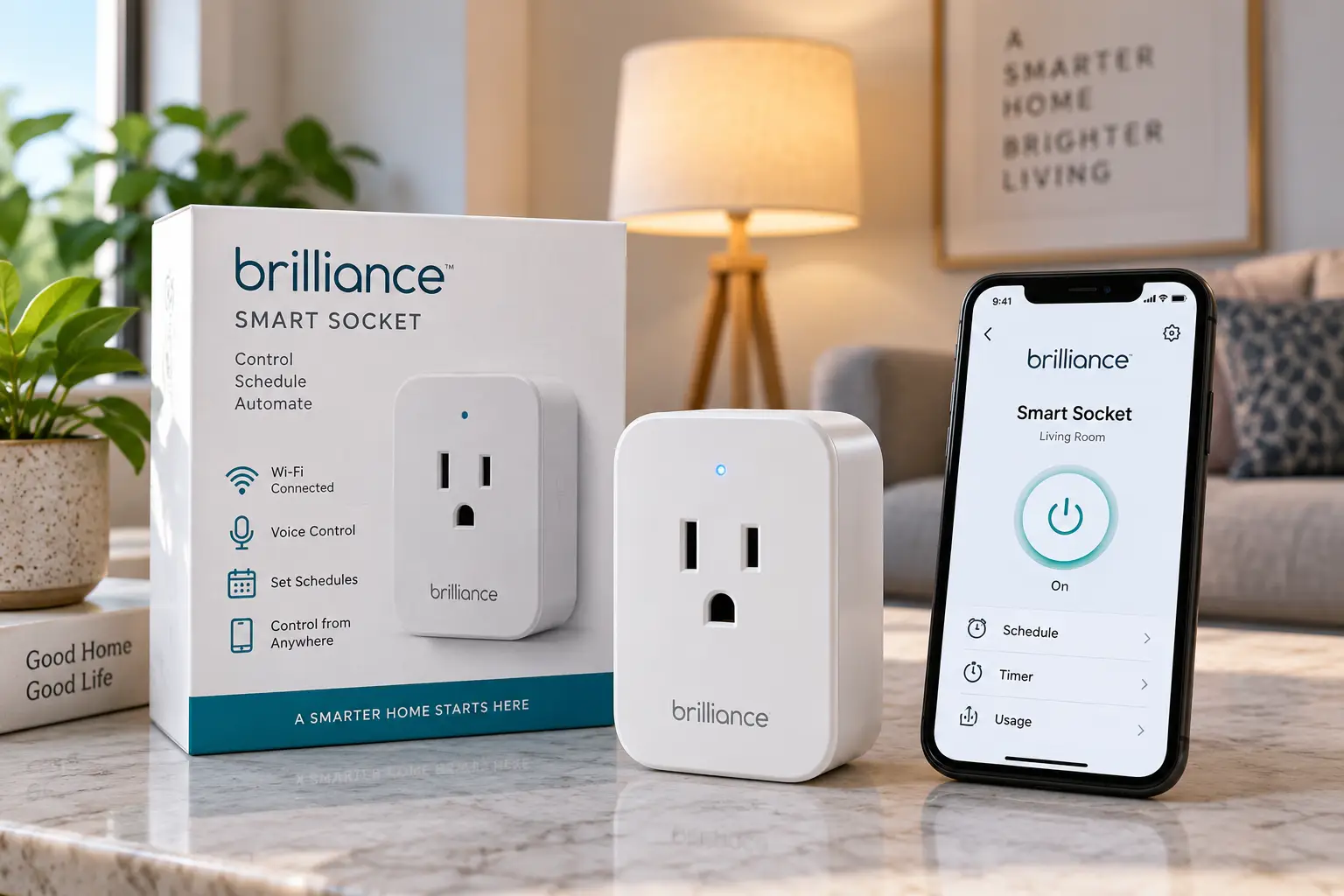
Unlike every other product on this list, the Brilliance Wi-Fi Smart Socket 3.0 isn’t a general household outdoor plug — it’s designed from the ground up to replace the photocell inside a landscape lighting transformer. The socket plugs into a standard 120VAC outlet or directly into a compatible transformer’s plug-in opening, and its improved antenna design is built to fit standard half-inch knockouts common on transformer housings.
Key features translate into real advantages: the device carries ETL listing and an IP61 rating with conformal-coated circuits, meaning the internal electronics resist humidity even when mounted inside a sealed transformer enclosure — something a typical outdoor smart plug isn’t engineered for. It supports astronomical (sunset-to-sunrise) scheduling through the Brilliance Smart app, which is exactly the kind of automation landscape lighting has traditionally relied on photocells for, minus the light-sensor drift that makes old photocells trigger lights at the wrong time.
Who is this for? Anyone replacing a failed photocell on an existing landscape transformer, or anyone installing new low-voltage landscape lighting who wants app-based control instead of a mechanical timer. It’s a poor fit if you just want to control a patio lamp or a fan — general-purpose outdoor plugs handle that job more cheaply.
Because this is a specialty product sold primarily through irrigation and landscape supply retailers rather than high-volume marketplaces, verifiable review volume is thinner than for mass-market smart plugs; based on available product documentation, buyers should expect a straightforward transformer retrofit rather than a plug-and-play experience for typical patio devices.
Pros:
- ✅ Purpose-built to fit landscape lighting transformer knockouts
- ✅ Astronomical scheduling replaces unreliable mechanical photocells
- ✅ Conformal-coated circuits resist humidity inside enclosures
Cons:
- ❌ IP61 rating is lower than dedicated outdoor plugs like the Tapo P400M
- ❌ Requires a strong 2.4GHz signal (-70dBm or better) near metal transformer housings
The Brilliance Smart Socket typically runs in the $35–$45 range through landscape supply retailers — a premium over generic outdoor plugs, but it’s solving a different, more specific problem. For anyone standardizing a transformer-based landscape system, that price reflects genuine value rather than markup for its own sake.
2. Tapo P400M — best Matter-certified all-rounder
The Tapo P400M is TP-Link’s flagship outdoor smart plug, and it earns that title with genuine engineering: dual antennas extend Wi-Fi range up to roughly 300 feet in open areas, and Matter certification means the plug works natively with Amazon Alexa, Google Home, Apple Home, and Samsung SmartThings without needing brand-specific skills or hubs.
In practice, that Matter support matters more than it sounds. If your household mixes an Echo Show in the kitchen with an iPhone-owning family member who prefers Apple Home, the P400M is one device both apps can control directly — something the Brilliance Smart Socket, Kasa KP400, and Amazon Basics Outdoor Smart Plug can’t offer. Its IP65 rating is the highest weatherproofing rating in this roundup, built to withstand direct water jets rather than just splashes, with a wide -4°F to 122°F operating range.
A hands-on review from Matter Alpha, which tested the P400M over several weeks, reported rock-solid reliability and fast response times, while noting the one meaningful gap: it lacks built-in energy monitoring, a feature the cheaper Wyze Plug Outdoor actually includes.
Pros:
- ✅ Matter certification works across Alexa, Google, and Apple Home
- ✅ IP65 rating is the strongest weatherproofing here
- ✅ Dual antennas extend range in tricky Wi-Fi spots
Cons:
- ❌ No built-in energy monitoring
- ❌ Priced higher than most other outdoor plugs in this list
Expect the Tapo P400M to sit between $30 and $40 at the time of writing. For a household running more than one smart home app, that premium buys genuine cross-platform flexibility you won’t find in single-ecosystem plugs.
3. Kasa KP400 — trusted ecosystem, no-hub simplicity
TP-Link’s Kasa Smart Wi-Fi Outdoor Plug has been a staple recommendation across smart-plug buying guides for years, and the spec sheet explains why: 15A/1.875kW maximum output, IP64 weather resistance, ETL certification, and a built-in power amplifier that extends Wi-Fi reach to roughly 300 feet without requiring a separate hub.
What that means day-to-day is dependable performance for the most common outdoor use cases — landscape lighting, pool pumps, and holiday displays — through the well-established Kasa Smart app, which supports device grouping so multiple outlets can be scheduled or triggered together. The Kasa KP400 controls two outlets independently, so a porch light and a fountain pump plugged into the same unit can run on entirely different schedules.
One important caveat for accuracy: TP-Link’s own product page lists the KP400 as end-of-life. That doesn’t mean it has vanished from retail shelves, but buyers should confirm current stock and consider whether a newer Kasa outdoor model (like the KP401 or EP40) might be a better long-term bet if the KP400 becomes hard to find or gets replaced by updated firmware support.
Pros:
- ✅ Well-established app ecosystem with strong reliability reputation
- ✅ ETL certified with a fire-resistant UL94-V0 shell
- ✅ Independent control of two outlets from one plug
Cons:
- ❌ Officially marked end-of-life by TP-Link, so long-term support is uncertain
- ❌ No Matter support, unlike the newer Tapo P400M
Pricing for the Kasa KP400 generally falls in the $25–$35 range while stock lasts. It remains a solid value pick, but shoppers planning for the next five years should weigh its end-of-life status against the P400M’s newer platform.
4. Wyze Plug Outdoor — best energy monitoring on a budget
The Wyze Plug Outdoor (model WLPPO1-1) undercuts most of its rivals on price while including a feature usually reserved for pricier plugs: built-in energy monitoring, letting you track historical usage and set consumption alerts right in the Wyze app. Rated IP64 with a 15A maximum and an operating range of -4°F to 120°F, it’s built to handle real seasonal extremes.
The practical upside of energy monitoring here isn’t just curiosity — it lets you catch a failing pool pump or a landscape transformer drawing more current than it should before it becomes a bigger problem. Wyze also includes a built-in light sensor and a vacation mode that mimics normal on/off patterns while you’re away, a feature CNN Underscored’s testing specifically called out as an advantage over competing plugs like the Wemo.
That said, the same CNN Underscored comparison found the Wyze Plug Outdoor is not HomeKit compatible, and noted that HomeKit support has changed on past Wyze listings — so Apple Home households should verify current compatibility before buying rather than assuming it will work.
Pros:
- ✅ Built-in energy monitoring at a budget price point
- ✅ Vacation mode automatically varies on/off timing while you’re away
- ✅ Dual Wi-Fi and Bluetooth connectivity simplifies setup
Cons:
- ❌ Not Apple HomeKit compatible, and compatibility has shifted before
- ❌ No Matter support, unlike the Tapo P400M
The Wyze Plug Outdoor typically lists in the $18–$25 range, making its energy-monitoring feature set one of the better value propositions in this entire lineup.
5. Meross MSS620 — widest voice-assistant compatibility
The Meross MSS620 covers more smart home ecosystems out of the box than any other product here: Apple HomeKit, Amazon Alexa, Google Assistant, and Samsung SmartThings, all without a hub. Each of its two outlets is independently controllable through the Meross app, and a physical on/off button offers manual override without a phone in hand.
That broad compatibility is genuinely useful for mixed-ecosystem households, but it comes with trade-offs worth knowing about. TechHive’s side-by-side testing against Ring’s and Wyze’s outdoor plugs found the MSS620 “doesn’t feel as well built” as its rivals, attributing this partly to its lighter housing, and noted its IP44 rating offers meaningfully less water protection than the IP64-rated Wyze Plug Outdoor or the IP65-rated Tapo P400M and Amazon Basics plug. Meross’s own manual is explicit that connected devices shouldn’t exceed 10A/1200W, a lower ceiling than the 15A most competitors here support.
Who should buy this? Homeowners who specifically need Apple HomeKit support in a sub-$25 outdoor plug, and who plan to install it somewhere reasonably sheltered — a covered patio or porch — rather than fully exposed to driving rain.
Pros:
- ✅ Native support for HomeKit, Alexa, Google, and SmartThings
- ✅ Independent per-socket control with a manual override button
- ✅ Among the most affordable HomeKit-compatible outdoor plugs available
Cons:
- ❌ IP44 rating offers less water protection than most rivals here
- ❌ Lower 10A/1200W load limit than competing 15A plugs
Expect the Meross MSS620 to run around $20–$25. It’s a smart pick for HomeKit households prioritizing compatibility over ruggedness.
6. BN-LINK Smart Outdoor Wi-Fi Plug — best for powering multiple devices at once
BN-LINK’s outdoor smart plug line stands out for sheer load capacity: rated for 15A/1875W with a 1/2 HP motor rating, and available in one, two, or three-outlet configurations, it’s built to handle heavier draws like sprinkler pumps, fountains, or several strings of holiday lights simultaneously. It carries an IP44 weatherproof rating and connects through the Smart Life or Tuya smart home app, with compatibility for Alexa and Google Assistant voice control.
The motor rating is the standout detail here: a 1/2 HP rating specifically signals the plug can handle the current inrush from small motors — like a garden fountain pump — that resistive-only-rated plugs can struggle with. That’s a meaningful practical distinction most Amazon listings gloss over. The trade-off is control granularity: on the three-outlet version, BN-LINK’s own product listing confirms all three outlets are controlled together rather than independently, so you can’t schedule one outlet differently from the others on that model.
Pros:
- ✅ 1/2 HP motor rating handles pump-driven devices reliably
- ✅ Multi-outlet configurations (1, 2, or 3 gang) for bigger yards
- ✅ Countdown timer and dusk-to-dawn scheduling built into the app
Cons:
- ❌ Three-outlet version controls all outlets together, not independently
- ❌ Relies on the generic Tuya/Smart Life app rather than a dedicated first-party app
The BN-LINK Smart Outdoor Wi-Fi Plug typically runs between $20 and $30 depending on the outlet configuration, making it one of the better per-outlet values here for anyone running several outdoor devices off one circuit.
7. Amazon Basics Outdoor Smart Plug — lowest price for Alexa-only homes
For shoppers who just want the cheapest reliable way to add voice control to outdoor lights, the Amazon Basics Outdoor Smart Plug is hard to beat on price. It carries a genuinely strong IP65 weatherproof rating — matching the pricier Tapo P400M — with two individually controlled outlets, and its “zero-touch” setup lets Alexa-linked Amazon accounts get the plug online in minutes without a separate app download.
The practical trade-off for that low price is ecosystem lock-in: this plug works with Alexa only, with no Google Assistant, Apple Home, or Matter support listed anywhere in its documentation. For a household fully committed to Echo devices, that’s a non-issue. For anyone who might switch platforms down the road, or who already has a mixed-ecosystem home, it’s a dead end that the Matter-certified Tapo P400M avoids entirely.
Pros:
- ✅ IP65 weatherproofing rivals plugs costing twice as much
- ✅ Fastest, simplest setup for existing Alexa households
- ✅ Typically the lowest price point in this comparison
Cons:
- ❌ Alexa-only, with no Google, Apple Home, or Matter support
- ❌ No energy monitoring or advanced scheduling beyond basic Alexa routines
Pricing generally sits under $20, sometimes closer to $15 during promotions — genuinely good value as long as you’re committed to the Alexa ecosystem long-term.
How to Set Up and Get the Most From Your Smart Socket
Getting a new outdoor smart socket running reliably comes down to a handful of details most quick-start guides skim past.
Start by confirming your router broadcasts a dedicated 2.4GHz network — nearly every plug in this roundup, including the Brilliance Smart Socket, the Kasa KP400, and the Meross MSS620, only supports 2.4GHz, not 5GHz. If your router uses a combined SSID, temporarily splitting the bands during setup avoids the single most common pairing failure. Second, mount the plug with its face pointed downward and, where the manufacturer specifies it (as with the Tapo P400M), at least 12 inches off the ground — this keeps water from pooling against the seal even on IP65-rated units.
For transformer-based installs like the Brilliance Smart Socket, verify Wi-Fi signal strength at the actual transformer location before finalizing the install; metal transformer enclosures can attenuate signal enough to drop below the recommended -70dBm threshold. In the first 30 days, the most common mistake is skipping firmware updates — most apps prompt for these automatically, and outdoor plugs in particular benefit from bug fixes addressing Wi-Fi reconnection after power outages. Finally, set a maintenance reminder every six months to inspect outlet covers and gaskets for cracking from UV exposure, since a compromised seal quietly erodes the weatherproof rating you paid for.
Real-World Scenarios: Which Smart Socket Fits Your Yard?
The transformer retrofit: You have an aging landscape lighting transformer with a failing photocell that’s started turning lights on at odd hours. Your priority is a drop-in replacement, not a general-purpose gadget. The Brilliance Smart Socket is built exactly for this job, fitting the transformer’s knockout and replacing astronomical timing without rewiring anything.
The mixed-ecosystem household: One partner uses an iPhone and Apple Home, the other runs Alexa on an Android phone, and you want one plug that both apps can control without arguing about which ecosystem “wins.” The Tapo P400M‘s Matter certification solves this cleanly, as does the Meross MSS620 for a lower budget, provided you can tolerate its lighter IP44 rating.
The budget-conscious Echo household: You already have three Echo devices, no interest in switching platforms, and just want your patio string lights on a schedule without spending much. The Amazon Basics Outdoor Smart Plug or the Wyze Plug Outdoor (if you also want energy tracking) both fit this use case well below $25.
The pump-and-pool owner: You’re running a garden fountain or small pool pump alongside holiday lighting and need higher amperage and motor-rated tolerance. The BN-LINK Smart Outdoor Wi-Fi Plug‘s 1/2 HP motor rating and multi-outlet configurations are the practical fit here, not a plug rated for resistive loads only.
Common Smart Socket Problems and How to Fix Them
Problem: The plug won’t connect during setup. This is almost always a Wi-Fi band mismatch. Confirm your phone is connected to a 2.4GHz network (not 5GHz) during pairing, and move the plug closer to the router temporarily if the signal is weak.
Problem: The plug goes offline after a power outage. This is common with budget plugs that don’t reconnect automatically. Check for a firmware update in the app, and consider a smart plug with a stronger built-in antenna, like the dual-antenna Tapo P400M, if outages are frequent in your area.
Problem: The device trips a GFCI outlet. Outdoor circuits are almost always GFCI-protected for good reason, and a genuine ground fault (often from a compromised seal letting in moisture) will trip it regardless of which smart plug you use. Inspect the plug’s gasket and outlet covers before assuming the smart plug itself is defective.
Problem: Voice commands work inconsistently. This is frequently a naming conflict in the assistant app rather than a hardware issue — duplicate or similarly named devices confuse voice recognition. Rename devices with clear, distinct labels in the Alexa, Google Home, or Apple Home app.
Problem: The transformer-mounted socket loses signal intermittently. Metal transformer housings can shield Wi-Fi signal. For a device like the Brilliance Smart Socket, routing the antenna externally rather than fully enclosing it, where the manufacturer allows, often resolves this.
✨ Ready to Automate Your Outdoor Lighting?
🔍 Take your landscape and patio setup to the next level with this carefully researched lineup. Click a highlighted product above to check current pricing and availability. These picks will help you get reliable, weatherproof automation the whole household will actually use.
What Is a Smart Socket?
A smart socket is a Wi-Fi or Matter-connected electrical outlet or plug adapter that lets you turn devices on or off, schedule automation, and monitor usage remotely through a smartphone app or voice assistant, rather than relying on a manual switch or mechanical timer. Outdoor-rated versions add weatherproofing and higher amperage tolerance for landscape lighting, pumps, and seasonal displays.
How to Choose the Right Outdoor Smart Socket
- Match the weatherproof rating to your installation. A covered porch can tolerate an IP44 rating like the Meross MSS620; a fully exposed yard fixture warrants IP64 or higher, like the Wyze Plug Outdoor or Tapo P400M.
- Check the amperage and wattage against your actual load. A garden pump draws differently than an LED string; motor-rated plugs like the BN-LINK avoid inrush-current nuisance trips.
- Confirm your smart home ecosystem before buying. An Alexa-only plug like the Amazon Basics model is a dead end if you later add an Apple Home device.
- Consider Matter certification for future flexibility. It’s the only option here, the Tapo P400M, that guarantees cross-platform support without waiting on brand-specific updates.
- Look for independent outlet control if you need different schedules. Multi-outlet units don’t always control each socket separately — verify this before buying a multi-gang plug.
- Factor in energy monitoring if you want visibility into usage. The Wyze Plug Outdoor includes it standard at a lower price than most rivals.
- Verify current stock and support status. Some older, well-reviewed models, like the Kasa KP400, may be marked end-of-life, so check for a current-generation replacement if long-term firmware support matters to you.
Smart Socket vs. Traditional Photocell: Which Wins for Landscape Lighting?
Traditional photocells and mechanical timers have controlled landscape lighting for decades, but they come with well-known limitations: photocells drift out of calibration as their sensors age, and mechanical timers reset after every power blink, silently throwing off your schedule until you notice lights are on at noon.
| Factor | Traditional Photocell/Timer | Smart Socket |
|---|---|---|
| Schedule accuracy | Drifts as sensor ages | Astronomical scheduling stays accurate |
| Power outage recovery | Often needs manual reset | Reconnects automatically via Wi-Fi |
| Remote control | None | Full app and voice control |
| Upfront cost | Lower | Moderate |
| Setup complexity | Simple, no app needed | Requires Wi-Fi and app pairing |
The table makes the trade-off clear: a smart socket costs more upfront and asks a little more of you during setup, but it eliminates the two most common landscape-lighting complaints — schedule drift and post-outage resets — without any ongoing effort. For anyone who has repeatedly reset a mechanical timer after a storm, a device like the Brilliance Smart Socket or the Tapo P400M pays for itself in frustration avoided alone.
Common Mistakes to Avoid When Buying a Smart Socket
The most frequent mistake is buying based on price alone and overlooking the weatherproof rating for the actual installation location — an IP44-rated plug like the Meross MSS620 simply isn’t built for a fixture exposed to direct rain. A close second is ignoring amperage limits when powering motor-driven devices; plugging a fountain pump into a plug rated only for resistive loads can trip the device or shorten its life. Buyers also commonly overlook ecosystem lock-in, choosing an Alexa-only plug like the Amazon Basics model without considering whether a future device purchase might require Google or Apple Home support instead.
Finally, many shoppers skip checking a product’s support and firmware status entirely. As the Kasa KP400’s end-of-life listing shows, even well-reviewed, popular models eventually get sunset in favor of newer hardware — worth a quick check before committing to any single-ecosystem plug for a long-term installation like landscape lighting.
Everyday Performance: What to Expect From a Wi-Fi Smart Socket
On paper, every plug in this roundup promises remote control and scheduling, but day-to-day performance varies more than spec sheets suggest. Response time between tapping the app and the device switching is generally near-instant on well-reviewed models, though PCWorld’s testing across multiple outdoor plugs noted that manufacturers frequently bury maximum wattage ratings in fine print — meaning the real-world limiting factor is often what you plug in, not the app’s responsiveness. Wi-Fi range claims of “300 feet” assume open, obstruction-free conditions; expect meaningfully less through exterior walls, stucco, or when a plug is tucked inside a transformer enclosure, which is exactly the environment the Brilliance Smart Socket is designed to operate in with its improved antenna.
Voice control performance is generally consistent across Alexa and Google Assistant once setup is complete, though Matter-certified devices like the Tapo P400M tend to show a modest edge in cross-platform reliability since they aren’t dependent on a single brand’s cloud skill staying updated.
Safety, Regulations, and Standards for Outdoor Smart Plugs
Outdoor electrical safety isn’t just a nice-to-have with these devices — it’s the reason certifications like ETL and IP ratings exist in the first place. Look for ETL listing (a recognized third-party safety certification in the U.S. and Canada), present on the Kasa KP400, Tapo P400M, and Brilliance Smart Socket, which confirms the device has been independently tested against recognized safety standards. The CPSC specifically recommends plugging outdoor electronics into GFCI-protected outlets, and that guidance applies just as much to smart plugs as it does to any other outdoor device — a smart socket doesn’t replace the need for GFCI protection on the circuit itself.
IP ratings (Ingress Protection) are worth understanding rather than skimming: the first digit measures protection against solids like dust, the second against water. An IP44 rating, like the Meross MSS620 carries, tolerates splashes but not direct jets, while IP65, found on the Tapo P400M and Amazon Basics plug, withstands low-pressure water jets from any direction. Matching that rating honestly to your installation location — covered versus fully exposed — is a genuine safety decision, not just a spec to compare.
Long-Term Cost and Maintenance of Smart Sockets
Most smart sockets in this roundup have no ongoing subscription cost — the app and core scheduling features are free, which is a meaningful advantage over some smart home categories that gate automation behind a paid tier. The real long-term cost consideration is durability: outdoor gaskets and covers degrade under UV exposure over several years regardless of brand, so budget for eventual replacement rather than assuming a five-year lifespan from any single unit.
Higher-IP-rated devices like the Tapo P400M and Amazon Basics Outdoor Smart Plug generally hold up longer in fully exposed installations, which can offset their higher upfront price compared to an IP44 unit that might need replacing sooner in the same conditions. For transformer-based installs, the Brilliance Smart Socket‘s conformal coating is specifically aimed at extending component life inside a sealed, humid enclosure — a maintenance consideration general-purpose outdoor plugs aren’t engineered to address.
Frequently Asked Questions
❓ Is the brilliance smart socket compatible with Alexa and Google Assistant?
❓ What's the difference between an outdoor smart plug and a smart socket for landscape lighting?
❓ Do smart plugs work during a power outage?
❓ Can I use an indoor smart plug outdoors instead of an outdoor-rated one?
❓ How much does a good outdoor smart plug cost in 2026?
Conclusion
Choosing between the brilliance smart socket and its six competitors ultimately comes down to what you’re actually trying to control. If you’re retrofitting a landscape lighting transformer, nothing else on this list fits the job as directly as the Brilliance Smart Socket. If you want the broadest cross-platform flexibility for years to come, the Matter-certified Tapo P400M is the strongest overall pick despite its higher price. Budget-focused Alexa households will get real value from the Amazon Basics Outdoor Smart Plug, while anyone running a pump or multiple heavy devices should look closely at the BN-LINK Smart Outdoor Wi-Fi Plug‘s motor rating before anything else.
Whichever direction you go, match the weatherproof rating to where the device will actually live, confirm your smart home ecosystem before buying, and don’t assume every “outdoor” plug is built for the same level of exposure — the specs, not the marketing photos, tell you what a device can really handle season after season.
Recommended for You
- Bn Link Smart Plug Setup: 7 Best Picks & No-Fail Guide (2026)
- Best Apple HomeKit Shades: 7 Smart Options to Consider 7 Apple HomeKit Shades for Privacy, Comfort, and Automation
- Belgium Electrical Plug Type: 7 Best Adapters So You’re Never Powerless (2026)
Disclaimer: This post contains affiliate links. As an Amazon Associate, I earn from qualifying purchases made through these links, at no additional cost to you.
✨ Found this article helpful? Share it with someone who needs it! 💬🤗