
In This Article
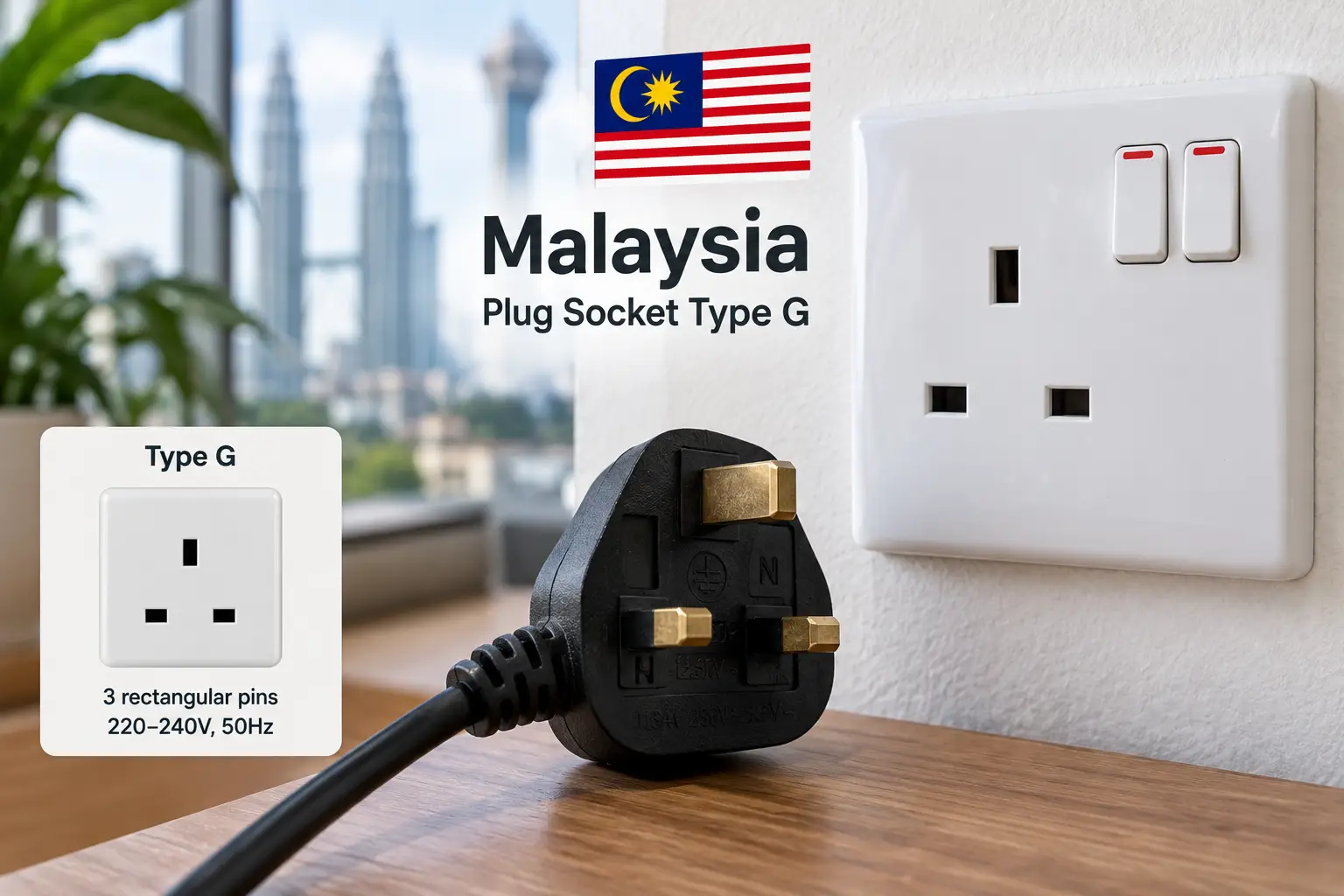
If you’re packing for Kuala Lumpur, Penang, or Langkawi, the malaysia plug socket type is probably the last thing on your mind — until your phone charger doesn’t fit the wall. Here’s the short answer: Malaysia uses the Type G plug and socket, the same three-rectangular-pin system found in the United Kingdom, running on 230-240V at 50Hz. That’s a very different setup from the two-flat-pin, 120V outlets you’re used to at home in the US, which means every American traveler needs some kind of adapter before landing.
The good news is that solving this is cheap and simple once you understand what you’re actually shopping for. This guide breaks down the malaysia electrical outlet type in plain English, walks through what plug type does malaysia use and why, and then gets practical: seven real, currently available travel adapters and converters, chosen to cover everything from a one-week beach trip to a multi-country business itinerary. We’ll also flag the one mistake that trips up more travelers than any other — assuming an adapter and a voltage converter are the same thing (they’re not, and mixing them up can fry a hair dryer or worse).
As an Amazon Associate, this post contains affiliate links, and we may earn a commission on qualifying purchases at no extra cost to you — full disclosure is at the bottom of this article. Every recommendation below is based on real product specifications and genuinely aggregated customer feedback, not fabricated reviews, so you can shop with confidence.
What Is the Malaysia Plug Socket Type?
The malaysia plug socket type is Type G: a grounded, three-pin rectangular plug standard inherited from the United Kingdom, running on 230-240V at 50Hz. It’s the same connector used across the UK, Ireland, Singapore, Hong Kong, and most Gulf states. US travelers (Type A/B, 120V) need a physical plug adapter for every outlet, and possibly a voltage converter for single-voltage appliances.
Malaysia standardized on the British BS 1363 system because it gained independence after Type G had already become the UK standard, so — like Singapore, Hong Kong, and the UAE — it simply kept the system rather than switching to something else later. You’ll occasionally spot a two-round-pin Type C socket wired into older audio/video setups, but Type G is what you’ll be plugging into at hotels, Airbnbs, cafes, and airports throughout Peninsular and East Malaysia alike. For a deeper technical breakdown of how Type G compares with the roughly dozen other plug standards used worldwide, the Wikipedia entry on AC power plugs and sockets is a genuinely useful reference.
One quirk worth knowing: Malaysian wall sockets almost always have a physical on/off switch built into the outlet itself, a British-system safety feature that doesn’t exist on US outlets. If your adapter is plugged in but nothing is charging, check that switch before you assume the adapter is broken.
Quick Comparison: Best Travel Adapters for Malaysia’s Type G Sockets
Before the full breakdown, here’s a fast-scan view of how the top picks stack up if you just need a quick answer.
| Adapter | Best For | Ports | Price Range |
|---|---|---|---|
| EPICKA Universal Travel Adapter | Most travelers, best all-around value | 3 USB-C, 2 USB-A, AC socket | around $20-30 |
| Ceptics 2-in-1 Type G Adapter (3-Pack) | Budget travelers, families needing multiples | 2 US inputs | under $20 for 3 |
| Zendure Passport III | Safety-conscious travelers, families with kids | 4 USB-C, 1 USB-A, AC socket | in the $50-65 range |
| FOVAL 220V to 110V Voltage Converter | Hair dryers, straighteners, single-voltage devices | 4 USB ports + 2 AC | in the $30-45 range |
Looking at this table, the pattern that jumps out is that price doesn’t map neatly to usefulness — the cheapest option here, the Ceptics 2-in-1 Type G Adapter, is genuinely the right call for anyone who just needs a phone and laptop charged, while the FOVAL converter is a completely different category of product that only a narrow slice of travelers actually need. The Zendure Passport III sits at the top of the price range specifically because of its safety engineering, not because it charges faster than cheaper alternatives.
💬 Ready to stop guessing and just grab the right one? Scroll down to see the full lineup and lock in your pick before your trip.
7 Best Travel Adapters and Plug Solutions for Malaysia
Every product below is a real, currently listed item you can find on Amazon. We’ve grouped them from budget-friendly to premium, and included dedicated Type G-only adapters alongside universal models for travelers who bounce between multiple countries.
1. Ceptics 2-in-1 Type G Travel Adapter (3-Pack) — cheapest way to cover the whole family
If your only goal is getting a US plug into a Malaysian wall socket without any frills, this is the adapter to buy. It’s a dedicated, grounded Type G adapter — not a bulky universal model — designed specifically for the UK-style system used across Malaysia, Hong Kong, and the Gulf.
Each unit accepts a standard two- or three-prong US plug and outputs a grounded Type G plug, and because it ships as a three-pack, one order covers a couple traveling together or a solo traveler who wants a backup in a separate bag. The compact 1.6 x 1.6 x 2-inch footprint means it won’t hog space in a packing cube, and the grounded third prong matters more than it sounds — a lot of budget adapters skip grounding entirely, which is a real shock risk with older Malaysian wiring.
Reviewers consistently describe these as reliable for phones, laptops, and cameras, with the recurring caveat that this is strictly a plug adapter — it does not convert voltage, so it only works safely with dual-voltage electronics (anything labeled “INPUT: 100-240V”). Buyers repeatedly flag that single-voltage US appliances like hair clippers or curling irons will not work through it and can be damaged.
Pros:
- ✅ Grounded Type G output, safer than ungrounded budget clones
- ✅ Three-pack means no scrambling for a spare
- ✅ Compact enough to disappear into a carry-on pocket
Cons:
- ❌ No USB ports, so you’ll still need your own charging cables
- ❌ Not a voltage converter — single-voltage appliances won’t work
At under $20 for three units, the Ceptics 2-in-1 Type G Travel Adapter is one of the best value-per-dollar picks in this whole roundup, especially for travelers who just need reliable, no-nonsense plug conversion.
2. BESTEK UK Travel Plug Adapter with 3 AC Outlets and 4 USB Ports — best for charging a whole hotel room at once
This one solves a problem the simple Ceptics adapter doesn’t: hotel rooms in Malaysia, especially older properties, often have exactly one usable Type G outlet within reach of the bed or desk. The BESTEK adapter turns that single outlet into a small charging station.
It combines a Type G plug adapter with a built-in power strip — three AC outlets plus four USB ports, including one 20W USB-C PD port for fast phone charging. In practice, that means a couple can charge two phones, a laptop, a tablet, and a camera battery from one wall outlet, which matters a lot when your Airbnb only has two plugs total in the whole bedroom. The 20W PD port in particular is a meaningful upgrade over older BESTEK models, since it can push a modern iPhone or Android flagship to a substantial charge in well under an hour.
Aggregated customer ratings sit around 4.5 out of 5 across hundreds of reviews, and the most common praise points to the multi-outlet design saving travelers from packing a separate power strip. The most repeated complaint, consistent with every adapter in this category, is that it does not step down voltage — buyers who tried running a US hair dryer through it without checking the label reported it simply not working.
Pros:
- ✅ Three AC outlets plus four USB ports from one wall socket
- ✅ 20W USB-C PD port fast-charges modern phones
- ✅ Compact power-strip design saves packing space
Cons:
- ❌ Bulkier than a simple single-plug adapter
- ❌ Not rated for single-voltage, high-wattage appliances
In the $15-25 range, the BESTEK UK Travel Plug Adapter earns its spot for anyone traveling with a partner or family who needs to charge several devices from a single Malaysian outlet.
3. EPICKA Universal Travel Adapter (TA-105) — best all-around pick for most travelers
For travelers who aren’t only going to Malaysia — say, a Southeast Asia swing through Singapore, Thailand, and Bali — a dedicated Type G adapter becomes a liability the moment you cross a border. This is where a genuinely universal adapter earns its keep, and the EPICKA TA-105 is consistently rated among the most reliable all-rounders on the market.
It uses slide-out prong sets rather than swappable pieces you can lose, covering Type G along with the plug standards used in over 200 countries, and pairs that with modern GaN-based charging: three USB-C ports and two USB-A ports delivering up to 45W combined, enough to fast-charge a phone and tablet simultaneously without a separate wall brick. The slide mechanism is the detail that matters most in practice — swappable-prong adapters are notorious for travelers losing a piece in an airport seat pocket, and a slide-out design physically can’t be lost the same way.
Travel-focused review roundups consistently name the EPICKA line a top overall pick for exactly this reason: it balances broad country coverage, fast USB-C output, and a form factor small enough to actually carry daily rather than leave in the hotel room. Customer feedback echoes that assessment, with the main critique being that it runs warm under sustained high-wattage laptop charging — a limitation the brand’s own higher-wattage model (below) was built to fix.
Pros:
- ✅ Slide-out plugs cover 200+ countries, can’t be lost like swappable pins
- ✅ Three USB-C plus two USB-A ports, up to 45W combined
- ✅ GaN design stays compact despite the extra ports
Cons:
- ❌ Runs noticeably warm when laptop-charging for long stretches
- ❌ Costs more than a dedicated single-country adapter
Priced around $20-30, the EPICKA Universal Travel Adapter is the single best default pick if you want one adapter that works everywhere, not just in Malaysia.
4. EPICKA TA-105 Max — best for charging a laptop directly
If you’re traveling with a work laptop and don’t want to pack a separate laptop charger on top of a travel adapter, this is the upgrade that solves it. The EPICKA TA-105 Max steps the same slide-out, 200-plus-country design up to 75W of GaN output.
That 75W ceiling is the whole story here: it’s enough to directly power most ultrabooks and MacBooks (though not the largest 16-inch MacBook Pro at full charging speed), meaning business travelers can leave a bulky laptop brick at home entirely and charge everything — laptop, phone, earbuds — from this single unit plugged into a Malaysian Type G outlet. The tradeoff for that extra power delivery is a slightly larger housing than the standard TA-105, though it’s still small enough for a laptop bag’s front pocket.
Reviewers who specifically bought this model for laptop charging report it reliably handles ultrabook-class devices, with the consistent piece of practical advice being to check your laptop’s actual charger wattage rating before assuming 75W covers it — some gaming laptops and older MacBook Pros need more.
Pros:
- ✅ 75W output can replace a separate laptop charger entirely
- ✅ Same reliable slide-out, 200+ country coverage as the standard model
- ✅ Reduces the number of chargers you pack to one
Cons:
- ❌ Larger and heavier than the standard 45W EPICKA model
- ❌ 75W won’t fully fast-charge the largest 16-inch laptops
At roughly $35-45, the EPICKA TA-105 Max is worth the upgrade specifically for anyone trying to travel with a single charger for every device they own.
5. TESSAN GM-636 Universal Travel Adapter — most ports, most power
For travelers who charge a genuinely large stack of gear — think a family of four, or a content creator carrying a phone, drone, camera, and laptop — the TESSAN GM-636 is built around sheer capacity. It’s a GaN universal adapter pushing up to 100W through its main USB-C port, with an AC outlet and four additional USB ports, letting six devices charge simultaneously from one Malaysian wall socket.
The slide-out plugs cover Type A, C, G, and I, with the Type G and Type I prongs grounded — a detail worth calling out because plenty of competing “universal” adapters skip grounding on at least one plug type to save cost. TESSAN backs the 100W port with three stacked safety systems: a double fuse, shutter-protected AC outlet, and a thermal-monitoring chip that throttles output if the unit runs hot, which matters more than it might seem given how many cheap universal adapters on Amazon have no thermal protection at all.
Independent gadget-review coverage from 2026 specifically singles out the GM-636 for combining the highest USB-C wattage in its class with genuinely six-device simultaneous charging, calling it a strong fit for frequent international travelers who prioritize build quality. Aggregated buyer feedback echoes that the six-port capacity is the standout feature, with the main tradeoff being that it’s noticeably larger than single-purpose adapters.
Pros:
- ✅ Six devices can charge simultaneously from one outlet
- ✅ 100W USB-C port handles laptops as well as phones
- ✅ Triple safety system: double fuse, shutters, and thermal chip
Cons:
- ❌ Larger footprint than adapters built for minimalist packing
- ❌ Higher price reflects the extra ports you may not need on a short trip
In the $35-45 range, the TESSAN GM-636 is the pick for travelers whose real problem is running out of outlets, not just plug shape.
6. Zendure Passport III — safest pick for families and cautious travelers
Where the TESSAN GM-636 competes on capacity, the Zendure Passport III competes on safety engineering, and that focus shows up in details other adapters skip. It’s a GaN universal adapter with a 65W USB-C PD main port, three additional USB-C ports, one USB-A port, and an AC socket — solid but not class-leading specs on paper.
What sets it apart is what happens when something goes wrong. It uses a self-resetting fuse rather than a one-time blow fuse, meaning a power surge trips the protection and the adapter recovers on its own rather than becoming permanently dead mid-trip — a meaningful difference if you’re relying on it to charge a phone you need for boarding passes and maps. It also uses child-safe sliding prong covers, a feature that matters more than it might sound if you’re traveling with kids who are curious about outlets in an unfamiliar hotel room.
Review coverage from 2026 gadget roundups specifically calls out the Passport III’s safety features as its differentiator against faster but less protected competitors, and this tracks with the broader shift the industry made this year: as GaN adapters have become commoditized around the 65-100W range, brands have started competing on protection circuitry rather than raw wattage.
Pros:
- ✅ Self-resetting fuse survives surges instead of dying permanently
- ✅ Child-safe sliding prong covers, genuinely useful for family trips
- ✅ 65W USB-C PD handles most phones and ultrabooks
Cons:
- ❌ Lower peak wattage than the TESSAN GM-636’s 100W port
- ❌ Premium safety features come at a premium price
Priced around $50-65, the Zendure Passport III is the adapter to buy if peace of mind matters more to you than squeezing out every last watt.
7. FOVAL 220V to 110V Travel Voltage Converter — the one you need for hair dryers and single-voltage gear
Every product above solves plug shape, not voltage — and that distinction trips up more travelers than anything else on this list. If you’re packing a single-voltage US appliance (most hair dryers, some straighteners, older CPAP machines without dual-voltage labeling), none of the adapters above will actually make it work safely in Malaysia. That’s what the FOVAL step-down converter is for.
It steps Malaysia’s 230-240V supply down to the 110V US appliances expect, built around two power zones: a 2000W section for high-draw devices like hair dryers and kettles, and a separate 200W section for lower-draw electronics like laptops or curling irons. It ships with a Type B power cord plus a set of international plug adapters (including Type G), so it doubles as your plug adapter and your voltage converter in one unit. FOVAL is explicit that the 2000W zone is only rated for simple mechanical-switch appliances, not electronically controlled ones like a Dyson-style hair dryer — a distinction worth checking on your specific device before you pack it.
Buyer feedback is consistent that this solves a real, specific problem — running a US hair dryer or straightener abroad — but reviewers who tried using it with electronically controlled high-end appliances reported it tripping its own overload protection, which tracks with the brand’s own stated limitation.
Pros:
- ✅ Actually converts voltage, unlike every plug-only adapter
- ✅ Dual power zones cover both high-draw and low-draw devices
- ✅ Includes international plug adapters, doubling as a Type G converter
Cons:
- ❌ Won’t work with electronically controlled appliances like Dyson dryers
- ❌ Bulkier and pricier than a simple plug-only adapter
At roughly $30-45, the FOVAL 220V to 110V Travel Voltage Converter earns its place as the specialty pick for the specific — but common — problem the other six products on this list can’t solve.
Full Product Comparison: All 7 Picks Side by Side
| # | Product | Type | Ports/Zones | Best For | Price Range |
|---|---|---|---|---|---|
| 1 | Ceptics 2-in-1 Type G Adapter | Dedicated Type G | 2 US inputs | Budget, families needing multiples | under $20 (3-pack) |
| 2 | BESTEK UK Travel Plug Adapter | Dedicated Type G + power strip | 3 AC, 4 USB | One-outlet hotel rooms | $15-25 |
| 3 | EPICKA Universal (TA-105) | Universal, slide-out | 3 USB-C, 2 USB-A | Multi-country trips | $20-30 |
| 4 | EPICKA TA-105 Max | Universal, slide-out | 75W USB-C | Laptop-only charging | $35-45 |
| 5 | TESSAN GM-636 | Universal, slide-out | 100W + 4 USB | Large gear stacks, families | $35-45 |
| 6 | Zendure Passport III | Universal, slide-out | 65W + 4 ports | Safety-first, families | $50-65 |
| 7 | FOVAL Voltage Converter | Converter + adapter | 2000W/200W zones | Single-voltage appliances | $30-45 |
The clearest takeaway from this table is that “best” depends entirely on whether you’re solving a plug-shape problem or a voltage problem — the FOVAL occupies a category by itself, while the other six compete on ports, wattage, and how many countries they cover beyond Malaysia. If your trip is Malaysia-only and short, the Ceptics or BESTEK picks are genuinely all you need; the universal models only start earning their higher price once your itinerary crosses borders.
💬 One click helps other shoppers make an informed choice too! 😊
Dedicated Type G Adapter vs. Universal Travel Adapter: Which Should You Buy?
This is the single most common fork in the road for anyone shopping this category, and the honest answer is: it depends on your itinerary, not on which adapter is objectively “better.”
A dedicated Type G adapter like the Ceptics or BESTEK picks is smaller, usually cheaper, and has one job it does well. If Malaysia is your only international stop this year, there’s no real advantage to paying more for a universal model you’ll use once. The tradeoff is that it’s useless the moment you land somewhere with a different outlet — Thailand and Vietnam use Type A/C/O, for instance, so a dedicated Type G adapter becomes dead weight on a regional Southeast Asia trip.
A universal adapter like the EPICKA or TESSAN GM-636 costs more upfront but removes that risk entirely. The slide-out mechanism means one device works in Malaysia, then Bangkok, then Bali, without buying a new adapter at each stop. For travelers who take more than one international trip a year, the math tends to favor universal models — you’re paying a premium once instead of buying a new single-country adapter every trip.
| Factor | Dedicated Type G Adapter | Universal Adapter |
|---|---|---|
| Upfront cost | Lower | Higher |
| Works outside Malaysia | No | Yes, 150-200+ countries |
| Size | Smaller, simpler | Slightly larger |
| Best for | Single-destination trips | Frequent or multi-country travel |
Reading this table against your own travel calendar is really the whole decision: one Malaysia trip this year points toward the Ceptics or BESTEK, while a broader pattern of international travel points toward the EPICKA or TESSAN GM-636 paying for itself within two or three trips.
How to Use a Type G Adapter in Malaysia: First-Time Setup Guide
Getting this right the first time avoids the most common first-day frustration travelers report: plugging in and nothing happening.
1. Check every device label before you pack. Look for “INPUT: 100-240V, 50/60Hz” on your charger — most modern phones, laptops, and cameras qualify, and only need a plug adapter, not a converter.
2. Separate your dual-voltage gear from your single-voltage gear. Hair dryers, some straighteners, and older electronics are the usual single-voltage offenders. Anything without the 100-240V label needs the FOVAL converter, not just a plug adapter.
3. Seat the adapter firmly. Malaysian Type G outlets have a physical switch — after plugging in, flip that switch to “on,” since a surprising number of “broken adapter” complaints turn out to be an unswitched outlet.
4. Test with a low-stakes device first. Charge a phone or power bank before trusting the adapter with an expensive laptop, just to confirm the outlet and adapter are both behaving normally.
5. Pack a backup. A three-pack of simple adapters, like the Ceptics pick, means one lost or dropped adapter doesn’t leave you stranded without power for the rest of the trip.
Real-World Scenarios: Matching the Right Adapter to Your Trip
The solo backpacker on a Southeast Asia loop: Malaysia is one stop among Thailand, Vietnam, and Indonesia over three weeks. A universal slide-out model like the EPICKA Universal Travel Adapter makes the most sense here — one device covers every border crossing without repacking.
The couple on a one-week Langkawi beach trip: Malaysia is the only stop, budget matters, and charging needs are simple (two phones, one camera). The Ceptics 2-in-1 Type G Adapter three-pack covers this completely for under $20, with a spare left over.
The business traveler working from a KL hotel room: Laptop, phone, and tablet all need reliable power, often from a single outlet near a desk. The BESTEK UK Travel Plug Adapter‘s built-in power strip or the higher-wattage EPICKA TA-105 Max both solve this — the Max is the better pick if the laptop charger itself can be left at home.
The family of four with kids and a stack of devices: Six-plus devices, curious toddlers around hotel outlets, and a preference for safety margin. The Zendure Passport III‘s child-safe covers and self-resetting fuse make it the standout here, while the TESSAN GM-636 is the fallback if raw port count matters more than the safety extras.
How to Choose the Right Travel Adapter for Malaysia
- Confirm the plug type first. Malaysia is Type G — don’t assume a “European” adapter labeled for Type C will work, since it physically won’t fit.
- Check every device for dual-voltage support. This single step prevents 90% of the “my adapter isn’t working” problems travelers report.
- Count your devices, then round up. If you’re charging more than two things at once, a multi-port model like the BESTEK or TESSAN GM-636 saves you from outlet-hunting in a hotel room.
- Decide if you need a converter, not just an adapter. Single-voltage appliances (mainly hair tools) need the FOVAL or an equivalent step-down converter — a plug adapter alone won’t protect the device.
- Weigh single-trip versus frequent-travel value. A dedicated Type G adapter is cheaper for one trip; a universal model pays off if you travel internationally more than once a year.
- Look for grounding and safety certification. A missing ground pin or absent fuse protection is a real fire and shock risk, not just a spec-sheet formality — check for CE, FCC, or UL-adjacent certification markings on the listing.
- Match wattage to what you actually charge. A phone-and-earbuds trip doesn’t need a 100W port; a laptop-heavy business trip does.
Common Mistakes to Avoid When Buying a Travel Adapter
Most complaints in the review sections for this entire product category trace back to a handful of repeated, avoidable mistakes.
Buying a plug adapter and assuming it converts voltage is by far the most common one — it doesn’t, and running a single-voltage 120V hair dryer through a plug-only adapter into Malaysia’s 230-240V supply can destroy the appliance or trip a breaker. Another frequent misstep is buying the cheapest ungrounded adapter available, which skips the safety ground pin entirely; it’ll technically fit the outlet, but it removes a real layer of shock protection that grounded models like the Ceptics or Zendure Passport III include by default.
Travelers also commonly under-pack, bringing exactly one adapter for a trip with multiple people or multiple devices, then scrambling when it’s misplaced or another person needs it at the same time — a three-pack solves this for a few extra dollars. Finally, a surprising number of buyers skip checking their laptop’s actual charger wattage before assuming a 45W or 65W adapter port will fast-charge it, when some laptops genuinely need 75-100W to charge at full speed.
What to Expect: Everyday Charging Performance in Malaysia
On paper, wattage numbers can be hard to translate into how a trip actually feels. In practice, a 45W USB-C port (like the standard EPICKA Universal) will take a modern smartphone from roughly 20% to 80% in about 30-40 minutes, which is plenty for a quick top-up before heading out for the day. Step up to 65-75W (the Zendure Passport III or EPICKA TA-105 Max) and you cross the threshold where most ultrabooks charge at a normal, non-frustrating pace rather than trickling.
Malaysia’s power grid itself is generally stable in cities and tourist areas, so the performance you get is almost entirely a function of the adapter you bring, not the local supply. The exception is more rural areas or smaller islands, where brief outages are more common — worth keeping in mind if you’re relying on a device charging overnight for the next day’s plans.
Travel Adapters for Different Kinds of Travelers
Beginners heading overseas for the first time genuinely don’t need to overthink this: a simple, grounded, dedicated Type G adapter like the Ceptics pick covers phones, cameras, and laptops without any research into wattage specs. Frequent international travelers, by contrast, get real ongoing value from investing once in a high-quality universal model like the EPICKA Universal Travel Adapter, since the cost amortizes across every future trip regardless of destination. Content creators and remote workers carrying multiple power-hungry devices should prioritize port count and total wattage, which is exactly where the TESSAN GM-636‘s six simultaneous ports and 100W ceiling earn their higher price tag. Parents traveling with young kids should weight safety features more heavily than raw specs, making the Zendure Passport III‘s child-safe prong covers and self-resetting fuse worth the premium over a marginally cheaper alternative.
Long-Term Cost and Value: Is a Universal Adapter Worth It?
A single dedicated Type G adapter costs less upfront, but the math changes for anyone who travels internationally more than once. Buying a new country-specific adapter for every trip adds up faster than it seems — two or three trips to different regions, and you’ve already spent more than a single quality universal adapter like the EPICKA Universal or TESSAN GM-636 would have cost. There’s also a durability angle worth weighing: the review data across this category consistently shows that adapters with reinforced housings and proper fuse protection, like the Zendure Passport III, tend to survive years of repeated packing and unpacking better than the cheapest ungrounded models, which several buyers report failing within a single trip.
Safety, Regulations, and Standards for Travel Adapters
Electrical safety around adapters, converters, and power strips isn’t just a formality — the U.S. Consumer Product Safety Commission has documented real fire and shock incidents tied specifically to substandard extension cords, power strips, and adapters with undersized wiring or missing grounding. That history is exactly why the certification markings on a listing — CE, RoHS, FCC — matter more than they might seem to a first-time buyer; they indicate the product has actually been tested against recognized safety benchmarks rather than just claimed to be safe.
For Malaysia specifically, sticking with a grounded Type G output (all seven products above include this) and never forcing a plug into an outlet it wasn’t designed for are the two habits that eliminate most real-world risk. It’s also worth noting that none of the plug adapters in this guide are rated for continuous, high-draw use the way a permanently installed outlet is — they’re built for the intermittent, moderate loads of phone and laptop charging, not for running a space heater or full-size appliance for hours at a stretch.
Features That Actually Matter (and Ones That Don’t)
Marketing copy on adapter listings tends to bury the features that genuinely affect your trip under ones that mostly affect the box art. Grounding, fuse protection, and a firm physical fit in the outlet matter enormously — these are the difference between a safe device and a real shock or fire risk, and they’re exactly what separates the Zendure Passport III and Ceptics picks from the cheapest no-name alternatives. USB-C PD wattage matters if you’re charging a laptop or a modern flagship phone, but is largely irrelevant if you’re only charging earbuds and a basic phone.
On the other hand, claims about “covers 200+ countries” matter far less if you’re only ever visiting Malaysia and the UK — that’s marketing breadth you’ll never use. Similarly, a huge number of total ports sounds impressive but is wasted capacity for a solo traveler; the TESSAN GM-636‘s six ports are a genuine advantage for a family, and dead weight for one person charging a single phone.
Frequently Asked Questions
❓ What plug type does Malaysia use?
❓ Do I need a voltage converter for Malaysia, or just an adapter?
❓ Can I buy a travel adapter after I land in Malaysia?
❓ Will a UK travel adapter work in Malaysia?
❓ Is Malaysia's electrical voltage safe for US electronics?
Conclusion
The malaysia plug socket type itself isn’t complicated — Type G, 230-240V, the same system as the UK — but picking the right tool to deal with it depends entirely on your specific trip. A short, Malaysia-only visit with light charging needs is genuinely well served by a cheap, grounded, dedicated Type G adapter like the Ceptics three-pack. A packed multi-country itinerary or a family hauling a stack of devices justifies stepping up to a universal model like the EPICKA Universal Travel Adapter, the TESSAN GM-636, or the safety-focused Zendure Passport III. And if a hair dryer or straightener is coming with you, none of the plug-only adapters will actually protect it — that’s the one scenario where the FOVAL voltage converter earns its spot in your bag.
Whichever direction fits your trip, the underlying advice is the same: check your device labels before you fly, buy grounded and certified products rather than the cheapest unbranded listing, and pack a backup if more than one person is relying on the same adapter. Get that right, and the only thing you’ll need to think about once you land in Malaysia is where to go for dinner.
✨ Don’t miss these exclusive deals! 🔍 Take your Malaysia trip planning to the next level with this carefully curated adapter lineup. Click a highlighted pick above to check current pricing and availability, and travel with power in every outlet — hassle-free charging the whole trip long!
Recommended for You
- Does Canada Use Same Plugs as US? 7 Shocking Facts Every Traveler Must Know
- Brilliance Smart Socket: 7 Best Outdoor Smart Plugs for 2026
- Bn Link Smart Plug Setup: 7 Best Picks & No-Fail Guide (2026)
Disclaimer: This post contains affiliate links. As an Amazon Associate, I earn from qualifying purchases made through these links, at no additional cost to you.
✨ Found this article helpful? Share it with someone who needs it! 💬🤗