
In This Article
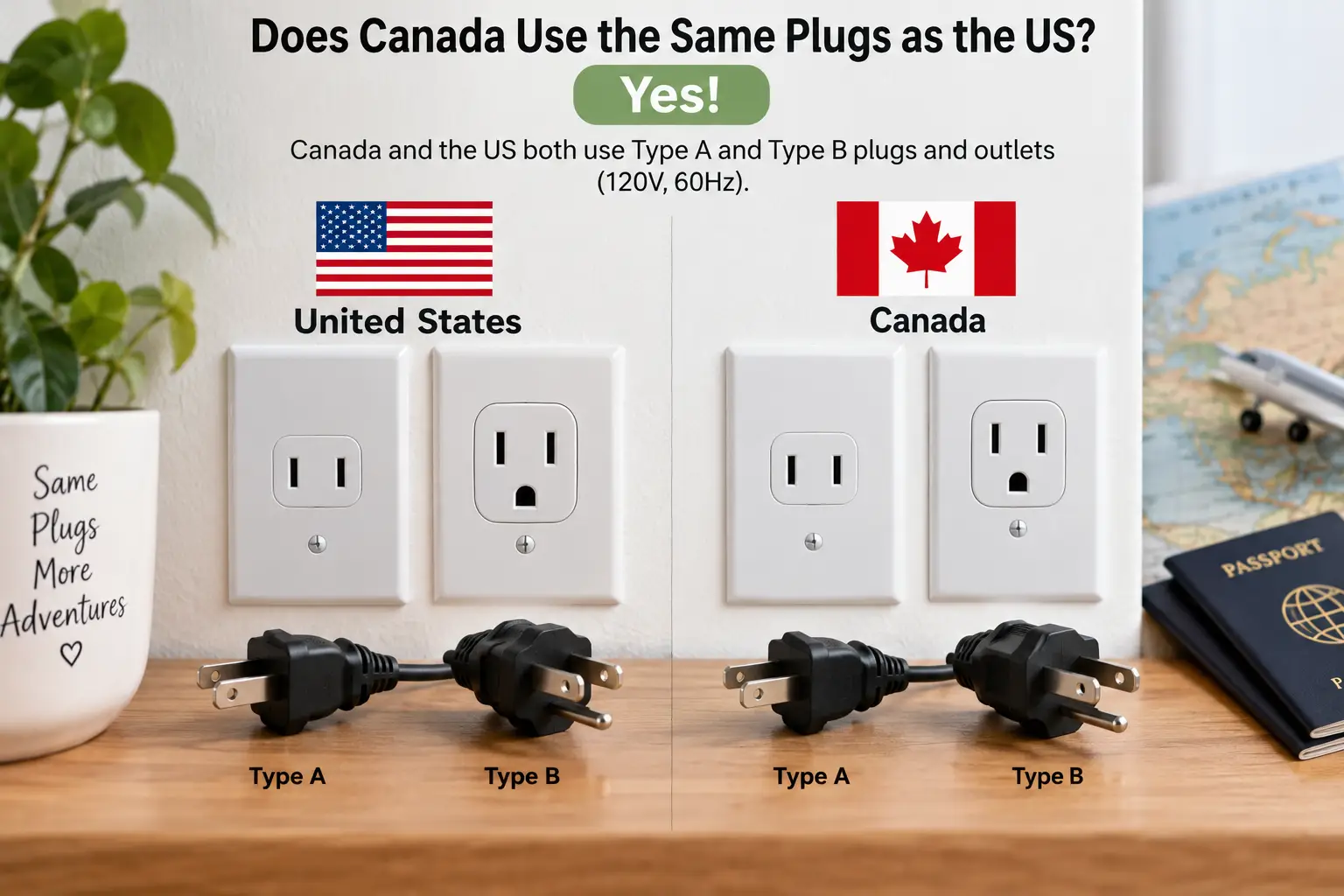
If you’re crossing the border soon, you’ve probably typed “does canada use same plugs as us” into a search bar at some point while packing. Here’s the short answer: Canada uses Type A (two flat parallel prongs) and Type B (the same, plus a round grounding pin) outlets, running on 120 volts at 60 Hz — identical to the United States. In practice, that means a phone charger, laptop brick, or hair straightener bought in Dallas will plug directly into a wall outlet in Toronto without a single adapter. Type A and Type B outlets are the official standard across Canada, and that shared standard is a legacy of a continent-wide electrical grid built to the same specifications on both sides of the 49th parallel.
That said, “no adapter needed” isn’t the whole story. Older buildings in both countries sometimes still have ungrounded two-prong outlets. Travelers arriving from Europe, the UK, or Asia on their way through Canada or the US absolutely do need a plug adapter and often a voltage converter. And if you’re the type who packs a power strip, a surge protector, or a voltage-sensitive appliance, there’s genuine value in knowing which accessory actually solves your problem instead of grabbing the wrong one at the airport kiosk. This guide breaks down canada us plug compatibility in plain English, then walks through seven real products — from budget-friendly universal adapters to voltage converters and grounding adapters — so you pack exactly what you need and nothing you don’t.
Quick Comparison: Canada vs. US Electrical Systems
| Feature | United States | Canada |
|---|---|---|
| Plug types | Type A, Type B | Type A, Type B |
| Standard voltage | 120V | 120V |
| Frequency | 60 Hz | 60 Hz |
| Outlet standard-setter | NEMA / NEC | CSA |
| Adapter needed for US travelers? | — | No |
Looking at the table above, the takeaway is simple: if you’re traveling between the US and Canada only, you don’t need a us to canada travel adapter for standard plug compatibility. Where the two countries diverge is in code enforcement — Canada’s electrical code is written by the Canadian Standards Association rather than the US National Electrical Code, which occasionally changes how outlets are installed in kitchens, bathrooms, or older housing stock. That regulatory gap matters more for electricians and homeowners than for someone simply charging a phone overnight.
💬 One click helps other travelers pack smarter too! 😊
Top 7 Travel Power Picks for North America
Even though canada us plug compatibility means you likely won’t need an adapter for cross-border domestic travel, most trips aren’t purely domestic. You might be connecting through a country with different sockets, bringing a 220V appliance home, or dealing with a decades-old outlet in a rental cabin. These seven picks cover every one of those real-world situations.
1. EPICKA Universal Travel Adapter (TA-105) — best budget all-rounder
The EPICKA TA-105 is the adapter most travelers grab first, and the reason is simple: it’s cheap, it’s reliable, and it covers the plug shapes you’ll actually encounter. Four USB-A ports rated at 2.4A each mean you can charge a phone, a tablet, a power bank, and a pair of wireless earbuds simultaneously, for a combined 5.6A of USB output. The adapter body physically reconfigures to fit Type A, C, G, and I sockets, which covers North America, most of Europe, the UK, and Australia in a single unit — a built-in safety fuse and child-resistant shutters are the kind of detail that separates a reputable adapter from a no-name knockoff. This is the pick for casual travelers who mainly need to keep phones and small electronics charged rather than power a laptop. Aggregated reviews consistently point to the fuse and shutters as genuine differentiators, and owners report it holding up across dozens of trips without failure. One thing it doesn’t do: convert voltage, so a 230V hair tool from Europe still needs a separate step-down converter. Priced in the $20-$30 range, it’s a strong value pick for anyone who wants one dependable brick rather than a drawer full of mismatched adapters.
Pros:
- ✅ Built-in fuse and child-resistant shutters
- ✅ Covers four plug types in one compact unit
- ✅ Reliable across repeated international trips
Cons:
- ❌ No USB-C port for newer fast-charging cables
- ❌ Does not convert voltage on its own
2. TESSAN GaN 65W Travel Adapter (WTA07) — best for charging a laptop
If your carry-on includes a laptop, the TESSAN WTA07 is worth the upgrade. Its GaN (gallium nitride) internals allow it to deliver a genuine 65W of fast-charging power while staying noticeably cooler and smaller than older silicon-based chargers — that’s the practical payoff of GaN technology: less heat means the compact housing doesn’t need bulky ventilation, so the whole unit stays pocket-sized. It works across 150-plus countries and pairs a universal AC outlet with USB-C Power Delivery, meaning you can retire your laptop’s factory brick entirely and travel with one charger for everything. This is the adapter for business travelers and digital nomads who need to top off a MacBook or ThinkPad and two phones from a single hotel outlet overnight. Reviews highlight the GaN design’s cooler operation during extended laptop charging sessions compared to older-style adapters, which matters if you’re running it for hours on end. The trade-off is price and size relative to a phone-only adapter, and the universal AC socket is a two-pin design, so a laptop with a grounded three-prong brick may need the Ceptics option below instead. Expect to pay in the $35-$45 range for the added charging headroom.
Pros:
- ✅ True 65W GaN fast charging for laptops
- ✅ Runs cooler than older adapter designs
- ✅ One charger replaces multiple device bricks
Cons:
- ❌ Costs more than basic phone-only adapters
- ❌ AC outlet is two-pin, not grounded
3. Ceptics 45W Travel Adapter Kit (11-KU) — best for grounded devices
Grounding is the detail most travel-adapter shopping guides skip, and it’s exactly where the Ceptics 45W kit earns its spot on this list. Unlike two-pin-only universal adapters, the Ceptics supports grounded three-prong plugs, which matters if your laptop charger, camera battery dock, or medical device uses a grounded brick for safety. It pairs Power Delivery and Quick Charge 3.0 across dual USB-C ports with built-in surge protection and ETL testing, covering Type I, C, G, and A outlets for use across North America, Europe, the UK, and Asia-Pacific. In practice, that surge protection is the feature that matters most on older or less-stable hotel wiring abroad, where a voltage spike can otherwise fry a laptop charger in seconds. This adapter is built for travelers who specifically need grounded-plug compatibility and fast charging in the same unit — a narrower use case than the EPICKA or TESSAN, but a critical one if it applies to you. Reviewers frequently cite the surge protection and grounded-plug support as the reason they chose Ceptics over cheaper alternatives, especially fliers who’ve had a charger damaged in the past. It runs $30-$40, a reasonable premium for the added safety margin.
Pros:
- ✅ Supports grounded three-prong plugs
- ✅ Built-in surge protection, ETL tested
- ✅ Dual USB-C with PD and Quick Charge 3.0
Cons:
- ❌ Bulkier than two-pin-only adapters
- ❌ Premium price versus basic models
4. Anker Nano Travel Adapter (5-Port) — most compact everyday option
Anker’s Nano Travel Adapter is built for the traveler who wants the smallest possible footprint and trusts a brand with a long charging-hardware track record. It packs a two-pin AC outlet, two USB-A ports, and two USB-C ports rated at 20W total into a housing barely larger than a phone charger, with smart temperature control that throttles output if the unit senses it’s overheating — a quiet safety feature that matters more than it sounds on long charging sessions in a hot hotel room. It’s explicitly built for plug-shape compatibility across 200-plus countries rather than voltage conversion, so pair it with a separate converter if you’re bringing a non-dual-voltage appliance. This is the pick for minimalist packers who mainly charge phones, earbuds, and small gadgets and don’t want to think about their adapter beyond plugging it in. The Anker name carries real weight in aggregated customer sentiment — reviewers consistently mention trusting the brand’s safety engineering more than lesser-known alternatives, even at a similar price point. At around $20-$25, it undercuts the Ceptics and TESSAN while still covering the plug shapes most travelers actually need.
Pros:
- ✅ Extremely compact, pocket-friendly size
- ✅ Smart temperature control for safety
- ✅ Trusted brand with strong reliability reputation
Cons:
- ❌ 20W total output is modest for laptops
- ❌ Two-pin AC outlet, not grounded
5. FOVAL 220V to 110V Travel Voltage Converter — best for true voltage conversion
Here’s a distinction that trips up a lot of travelers: a plug adapter changes the shape of a plug, but it does nothing to the actual voltage running through it. If you’re bringing a 220V appliance from abroad and plugging it into a 120V Canadian or US outlet without conversion, you risk permanently damaging the device or worse. The FOVAL converter actually steps voltage down from a range of 90-220V to the 110-120V standard used across North America, rated for loads up to 230 watts, and it bundles US, UK, and AU plug adapters along with four USB charging ports into one unit. That 230W ceiling is the number to memorize: it’s plenty for phone chargers, curling irons, and small electronics, but FOVAL explicitly warns against using it for hair dryers or space heaters, which draw far more power than a portable converter can safely handle. This is the product for people relocating temporarily, visiting family, or bringing sentimental grooming appliances that were never designed for North American voltage. Reviewers describe it as dependable for its rated wattage range, with the built-in overvoltage protection light flagging when a connected device exceeds the safe threshold. Expect to spend $35-$50, more than a basic adapter, but it’s solving a genuinely different problem.
Pros:
- ✅ Actually converts voltage, not just plug shape
- ✅ Includes US, UK, and AU adapter heads
- ✅ Built-in overvoltage protection warning light
Cons:
- ❌ Capped at 230W — not for hair dryers or heaters
- ❌ Bulkier than a plug-only travel adapter
6. TESSAN Flat Plug Surge Protector Power Strip — best for extended stays
Once you’re actually settled in — a dorm room, a short-term rental, or a home office in either country — the challenge shifts from plug shape to outlet capacity. The TESSAN flat-plug power strip solves that with eight AC outlets and three USB ports (including one USB-C) on a five-foot cord, backed by 900 joules of surge protection and a 1,250-watt rating. The flat plug head is the detail that matters most in practice: it lets the strip sit flush against furniture pushed up against a wall, instead of jutting out the way a standard bulky plug does. This is squarely a domestic-use product — since Canada us plug compatibility means both countries share the same Type A/B system, this strip works identically whether you’re in Chicago or Calgary, with zero adapter needed. It’s built for students, remote workers, and anyone juggling a laptop, monitor, lamp, and phone charger from a single limited outlet. Aggregated reviews frequently praise the flat-plug design and generous surge-joule rating for the price point, particularly from renters dealing with older apartments that only have one or two outlets per room. At $20-$30, it’s an easy addition to a packing list for anyone settling in for more than a weekend.
Pros:
- ✅ Flat plug fits flush behind furniture
- ✅ Eight outlets plus USB-C for one plug point
- ✅ 900-joule surge protection rating
Cons:
- ❌ US/Canada domestic use only, no voltage conversion
- ❌ Cord length adds bulk versus a plug-only adapter
7. 3-Prong to 2-Prong Grounding Adapter — cheapest fix for older outlets
Not every outlet in Canada or the US has kept up with modern code. Older homes, cabins, and some rental units still have the ungrounded two-slot Type A outlet rather than the three-slot grounded Type B version, and that mismatch is where a basic grounding adapter earns its spot on this list. These small, inexpensive adapters let a modern three-prong grounded plug physically fit into an older two-slot outlet, typically including a metal grounding tab or a short pigtail wire meant to be screwed into the outlet’s center screw plate for an actual ground connection. It’s the lowest-stakes item on this list — most units cost well under $10 — but it solves a specific, common annoyance: a grounded laptop charger or kitchen appliance that simply won’t physically plug into an old outlet. Honest caveat worth flagging: screwing the tab into the plate is what actually grounds the device; skip that step and you get physical compatibility without electrical grounding, which matters for higher-draw appliances. It’s best suited for low-power electronics — lamps, phone chargers, small kitchen gadgets — not power tools or space heaters. At $5-$10, it’s the cheapest problem-solver in this roundup, and worth tossing in a bag as a just-in-case.
Pros:
- ✅ Extremely cheap, easy backup to pack
- ✅ Lets grounded plugs fit older two-slot outlets
- ✅ Lightweight, takes up almost no space
Cons:
- ❌ Only grounds properly if the tab is screwed in
- ❌ Not rated for high-draw appliances
Top 7 Comparison Table
| Product | Best For | Voltage Conversion | Price Range |
|---|---|---|---|
| EPICKA Universal Travel Adapter (TA-105) | Budget-friendly all-rounder | No | $20-$30 |
| TESSAN GaN 65W Travel Adapter (WTA07) | Laptop fast charging | No | $35-$45 |
| Ceptics 45W Travel Adapter Kit (11-KU) | Grounded devices | No | $30-$40 |
| Anker Nano Travel Adapter (5-Port) | Compact everyday carry | No | $20-$25 |
| FOVAL 220V to 110V Voltage Converter | Bringing 220V appliances | Yes | $35-$50 |
| TESSAN Flat Plug Surge Protector Power Strip | Extended domestic stays | No | $20-$30 |
| 3-Prong to 2-Prong Grounding Adapter | Older ungrounded outlets | No | $5-$10 |
Scanning the table, only one product here — the FOVAL 220V to 110V Voltage Converter — actually changes voltage; everything else changes plug shape, adds ports, or solves a grounding mismatch. If your only concern is charging North American devices while moving between the US and Canada, you likely don’t need any of these; they earn their keep on the edges of that trip, like a layover country, an older rental, or an appliance you’re bringing from home.
✨ Don’t miss these travel-power essentials! 🔍 Whichever scenario matches your trip, pick the adapter, converter, or strip that solves your actual problem instead of grabbing the first “universal” box you see. Tap through to check current pricing and availability before you pack.
How to Prep Your Power Gear Before You Cross the Border
Since canada us plug compatibility means most travelers between the two countries skip adapters entirely, prep time is better spent elsewhere. Start by checking every device’s label for “100-240V” — that phrase means it’s dual voltage and safe to plug in directly anywhere in North America. Next, if you’re staying somewhere with older wiring (cabins, older apartments, some Airbnbs), pack a grounding adapter just in case a three-prong plug won’t fit. If you’re connecting through a third country on either leg of the trip, pack a universal adapter matched to that country’s outlet type, not Canada’s or the US’s. Finally, if you’re bringing a 220V appliance from abroad into either country, don’t guess — use a rated voltage converter and respect its wattage ceiling; overloading a converter is the single most common way travelers damage both the converter and the device plugged into it.
Who Actually Needs an Adapter for a US-Canada Trip?
Picture three travelers. First, a Chicago resident driving to Toronto for a weekend — no adapter needed at all, since both outlets and voltage match exactly. Second, a family flying from London to Vancouver with a UK-plugged hair straightener — they need a plug adapter at minimum, and ideally a voltage converter if the straightener isn’t dual voltage. Third, a remote worker renting a 1970s-era cabin in rural Quebec for a month — their laptop charger is grounded, but the cabin’s outlets are the older two-slot type, so a simple grounding adapter solves it in seconds. The common thread: the need isn’t about crossing the US-Canada border itself, it’s about the age of the building you’re staying in or the country your gear was originally purchased in.
Common Power Problems and Their Fixes
A few recurring headaches show up again and again for travelers dealing with North American power. If a grounded plug won’t fit an outlet, the fix is a 3-prong to 2-prong grounding adapter, screwed into the plate for a true ground. If a device runs hot or shuts off unexpectedly on a converter, it’s almost always because the appliance’s wattage exceeds the converter’s rating — check the label before plugging in. If USB charging feels slow from a hotel outlet, the adapter itself may be capping output; a GaN-based unit like the TESSAN WTA07 solves that with genuine higher wattage. And if a power strip trips or shuts off after a storm, that’s the surge protection doing its job — replace the strip rather than bypassing the protection circuit.
How to Choose the Right Travel Power Accessory
- Identify the actual mismatch. Is it plug shape, voltage, grounding, or simply not enough outlets? Each has a different product solution.
- Check every device label for dual voltage. “100-240V, 50/60Hz” means no converter is needed anywhere in North America.
- Prioritize grounded support if you travel with electronics that use it. Laptops, cameras, and some kitchen gear often need a grounded three-prong plug.
- Match wattage to your heaviest device. A 20W adapter won’t fast-charge a laptop; a 230W converter won’t run a hair dryer.
- Weigh surge protection for unstable wiring. Older buildings and storm-prone regions both benefit from a strip or adapter with a real joule rating.
- Pack for the whole itinerary, not just the US-Canada leg. A layover or connecting country often has different requirements than either destination.
Common Mistakes to Avoid When Buying Travel Power Gear
The most frequent mistake is buying a voltage converter you don’t actually need — since Canada and the US already share 120V, a converter only matters for gear brought in from a 220-240V country. The second is assuming “universal” means “does everything,” when most universal adapters change plug shape only, not voltage. A third mistake is ignoring wattage ratings entirely and plugging a hair dryer into a 230W-rated converter, which risks tripping the unit or damaging the appliance. Finally, travelers sometimes skip grounding entirely on a 3-prong-to-2-prong adapter by not screwing in the tab, leaving the device physically connected but not actually grounded — a shortcut that defeats the safety purpose of the adapter in the first place.
US vs. Canada Electrical Outlets: What’s Actually Different
On paper, the systems are close to identical, which is exactly why Type A and Type B plugs are described as the standard across both the US and Canada. Where the two diverge is in code enforcement rather than the plugs themselves: Canada’s outlets are governed by the Canadian Standards Association, while the US relies on the National Electrical Code, and those bodies occasionally set different requirements for tamper-resistant outlets, kitchen and bathroom placement, or GFCI protection near water sources.
| Category | United States | Canada |
|---|---|---|
| Plug hardware | Type A / Type B | Type A / Type B |
| Code body | NEC | CSA |
| New-construction grounding | Required | Required |
| Older ungrounded outlets | Still found in older homes | Still found in older homes |
The practical upshot from this table: hardware compatibility is essentially 100%, but code compliance can differ subtly by province or state, which matters far more to an electrician doing a renovation than to a traveler plugging in a phone charger. For most visitors, the honest advice is to stop worrying about “advantages” of one system over the other, since there effectively aren’t any — the real planning should go toward the age of the specific building you’re staying in.
What to Expect: Everyday Performance
In day-to-day use, the shared US-Canada system means charging behavior feels identical on both sides of the border. A phone plugged into a standard wall outlet in Boston will charge at the same rate as the identical outlet in Ottawa, because the voltage, frequency, and plug geometry are the same. Where you’ll notice a difference is purely building-dependent: a newer hotel or apartment building will have tamper-resistant, grounded outlets everywhere, while a decades-old cottage might only have two-slot outlets in half the rooms. USB-equipped power strips and GaN adapters perform consistently across both countries too, since they’re reading the same 120V/60Hz input regardless of which side of the border they’re plugged into.
Safety, Regulations, and Standards
Look for ETL, UL, or CSA certification marks on any adapter, converter, or power strip before buying — these indicate the product has been independently tested against North American electrical safety standards, rather than just claiming compliance on the packaging. The Consumer Product Safety Commission publishes guidance on outlet and extension cord safety that’s worth a skim if you’re buying gear for an older home with two-slot outlets, since overloaded or improperly grounded circuits remain a leading cause of home electrical fires. Surge protectors specifically carry a joule rating — higher numbers mean more absorbed energy before the protection circuit needs replacing — and most manufacturers recommend swapping a surge protector after a major storm or power event rather than assuming it’s still protecting your gear.
Long-Term Cost and Maintenance
A one-time $10 grounding adapter or $25 compact adapter is effectively disposable — if it breaks, replace it. Higher-wattage converters and surge-protected power strips are a different calculation: a $40 converter that protects a $1,000 laptop charger and a favorite grooming appliance pays for itself the first time it prevents a voltage-related failure. Surge protectors specifically have a shelf life tied to use, not time — every surge event slowly depletes the protection circuit, so a strip that’s absorbed a major spike should be replaced even if it still technically powers your devices. Budgeting $20-$50 every few years for a fresh, properly rated power strip is cheap insurance against a much larger replacement bill for whatever’s plugged into it.
Price and Value at a Glance
| Product | Price Range | Value Verdict |
|---|---|---|
| 3-Prong to 2-Prong Grounding Adapter | $5-$10 | Best value for older outlets |
| Anker Nano Travel Adapter (5-Port) | $20-$25 | Best value for daily carry |
| EPICKA Universal Travel Adapter (TA-105) | $20-$30 | Best value for multi-country trips |
| TESSAN Flat Plug Surge Protector Power Strip | $20-$30 | Best value for extended stays |
| Ceptics 45W Travel Adapter Kit (11-KU) | $30-$40 | Worth it for grounded gear |
| TESSAN GaN 65W Travel Adapter (WTA07) | $35-$45 | Worth it for laptop travel |
| FOVAL 220V to 110V Voltage Converter | $35-$50 | Worth it only if you need real conversion |
Reading the value column left to right, the cheapest fixes solve the narrowest problems, while the pricier converters and GaN adapters earn their cost only if your specific situation actually calls for them — there’s little point paying for voltage conversion you don’t need just because it sounds like the “safest” option.
Frequently Asked Questions
❓ Does Canada use same plugs as US outlets?
❓ Do I need a voltage converter to bring my laptop from the US to Canada?
❓ What plug type does Canada use — Type A or Type B?
❓ Is a travel adapter necessary for Canada if I'm coming from the US?
❓ Can I use a US power strip in Canada without any modification?
Conclusion
The short answer to does canada use same plugs as us is a confident yes — Type A and Type B outlets, 120V, 60 Hz, on both sides of the border, with no adapter required for standard cross-border travel. Where the real planning comes in is everything adjacent to that fact: older buildings that still have two-slot outlets, devices brought in from a 220V country, laptops that need grounded charging, or simply not having enough outlets in a rental for everyone’s gadgets. Match the product to the actual problem — a cheap grounding adapter for an old cabin, a real voltage converter for a 220V appliance, a GaN adapter for laptop-heavy travel — and you’ll spend less and pack lighter than reaching for one “universal” box that tries to solve everything at once.
✨ Ready to pack the right power gear for your trip? 🔌 Check the picks above, match one to your actual situation, and tap through to see current pricing and availability before you head to the airport.
Recommended for You
- Bn Link Smart Plug Setup: 7 Best Picks & No-Fail Guide (2026)
- Best Apple HomeKit Shades: 7 Smart Options to Consider 7 Apple HomeKit Shades for Privacy, Comfort, and Automation
- Belgium Electrical Plug Type: 7 Best Adapters So You’re Never Powerless (2026)
Disclaimer: This post contains affiliate links. As an Amazon Associate, I earn from qualifying purchases made through these links, at no additional cost to you.
✨ Found this article helpful? Share it with someone who needs it! 💬🤗