
In This Article
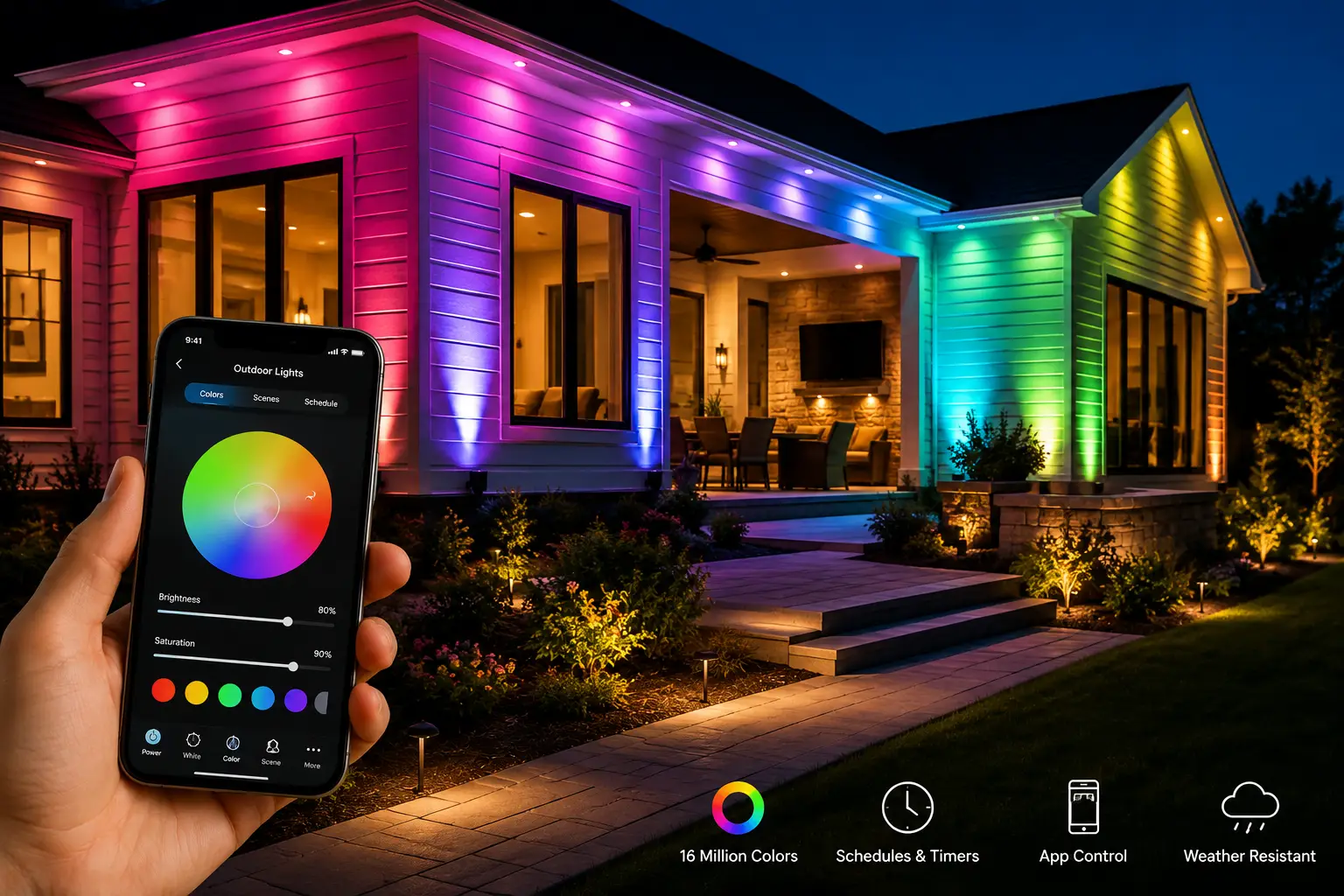
Stringing up the same warm-white bulbs every October and every December gets old fast. programmable color changing outdoor lights solve a problem plain string lights never could: one fixture, dozens of looks, controlled from a phone instead of a ladder. Flip from a soft amber porch glow on a Tuesday night to a full-on orange-and-purple Halloween display, then to red-and-green for the holidays — without ever touching a bulb.
That flexibility is exactly why this category has exploded over the past two years. Brands like Govee, Philips Hue, and Twinkly have pushed RGBIC (individually addressable, multi-color) technology from indoor strip lights onto eaves, fences, and garden beds, with weatherproofing tough enough for real winters and real thunderstorms. But “smart” and “outdoor-rated” don’t automatically mean “worth your money” — some models skimp on waterproofing, some apps are frustrating, and a few systems require a hub you didn’t know you needed.
This guide breaks down seven real, currently available products spanning entry-level string lights to premium permanent installations, with honest analysis of what each one gets right and where it falls short — based on published specs and aggregated owner feedback, not a marketing sheet. You’ll also get a buyer’s framework, common installation mistakes, and a look at long-term costs so you’re not surprised six months in.
Affiliate Disclosure: This post contains affiliate links. As an Amazon Associate, I earn from qualifying purchases at no additional cost to you.
Quick Comparison: Programmable Color Changing Outdoor Lights at a Glance
| Product | Type | Waterproof Rating | Best For |
|---|---|---|---|
| Govee Permanent Outdoor Lights 2 | Permanent eave system | IP67 | Year-round hands-off decor |
| Philips Hue Festavia Permanent Outdoor Lights | Permanent eave system | IP65 | Existing Hue smart-home users |
| Twinkly Strings 400 RGB+W | Addressable string | IP44 | Animated, mapped light shows |
| Govee Smart Outdoor String Lights 2 | Bulb string | IP65 | Budget-friendly seasonal swaps |
| Govee Outdoor Spot Lights 2 | Landscape spotlight | IP67 | Uplighting trees and facades |
| Govee Outdoor Pathway Lights 2 Lite | Pathway/ground light | IP67 | Walkways and garden borders |
| Philips Hue Festavia Globe String | Globe bulb string | IP65 | Patio ambiance with a classic look |
Looking at the table, the split really comes down to installation style: the two permanent systems (Govee Permanent Outdoor Lights 2 and Philips Hue Festavia Permanent Outdoor Lights) are mounted once and left up year-round, while the string, spotlight, and pathway options are more flexible but need seasonal handling. IP67-rated products can handle direct rain and submersion in shallow puddles, while the IP44-rated Twinkly Strings 400 RGB+W is better suited to a covered porch than an exposed roofline. If your priority is “install it once and forget it,” start with the top two rows; if you want to experiment with layouts each season, the string and accent lights offer more freedom.
💬 Ready to see these lighting effects in your own yard? Tap any highlighted pick above to check current availability and pricing.
The 7 Best Programmable Color Changing Outdoor Lights for 2026
Coverage below spans entry-level string lights, mid-range permanent systems, and premium ecosystem-locked options, along with accent lighting for pathways and landscaping. Every price mentioned is a range, since Amazon pricing shifts frequently — always check the current price before buying.
1. Govee Permanent Outdoor Lights 2 — best all-around permanent system
The pitch here is simple: mount it once on your eaves and never climb a ladder for holiday lights again. The Govee Permanent Outdoor Lights 2 uses RGBWIC technology, which means the string can display multiple colors at once rather than washing the whole run in a single hue — that’s what makes a gradient sunset effect or a marching rainbow pattern look smooth instead of choppy.
Key features translate directly into everyday usefulness. The 100 preset scene modes and AI-generated light show (built from a text prompt in the Govee Home app) mean you’re not stuck manually designing a Halloween look from scratch, and the 16 million-color RGBWIC beads pair with a dedicated 40-lumen white channel bright enough to double as functional security lighting. IP67 waterproofing and a tested operating range of -4°F to 140°F address the two biggest fears with permanent installs: leaking housings and cracking plastic in a hard freeze.
Reviewers who’ve lived with the system through a full season consistently note that the triangular lens design throws a wider, more even wash across siding than typical round-bulb string lights, though a handful mention the app’s AI scene generator can be hit-or-miss on the first try.
Pros:
- ✅ Genuinely “set and forget” — no seasonal takedown
- ✅ AI light-show generation from simple text prompts
- ✅ Rated for extreme heat and sub-zero cold
Cons:
- ❌ This version isn’t cuttable to custom lengths
- ❌ Requires a dedicated control box mounted near an outlet
Pricing typically falls between $250 and $330 depending on the length you choose (50ft, 100ft, or 150ft) and whether it’s on sale — for a permanent installation you’ll only buy once, that’s a reasonable value if you actually decorate for multiple occasions each year.
2. Philips Hue Festavia Permanent Outdoor Lights — best for existing smart-home ecosystems
If your house already runs on Hue bulbs and routines, the Philips Hue Festavia Permanent Outdoor Lights slot into that same app and automation logic instead of forcing you into a second smart-home platform. That’s the distinguishing benefit: one dashboard, one set of routines, indoor and outdoor lighting synced together.
Hue’s Chromasync precision color engine is the standout feature — it’s designed to render more accurate, less washed-out color than typical RGB LEDs, which matters most when you’re trying to nail a specific holiday palette rather than “close enough” red and green. The string is cuttable to a custom length (a genuine advantage over the Govee permanent system above) and ships with a low-voltage power supply for safer installation than line-voltage alternatives.
The tradeoff, and it’s a real one: Festavia requires a Hue Bridge to unlock full scheduling, voice control, and app-based color mapping, which is an added cost if you’re starting from zero. Owner feedback is largely positive on build quality and color accuracy, though several buyers flagged the price premium relative to Govee as a sticking point for anyone not already invested in the ecosystem.
Pros:
- ✅ Cuttable string for a custom, exact-fit install
- ✅ More accurate, true-to-life color rendering
- ✅ Integrates with existing Hue routines and Matter
Cons:
- ❌ Requires a separate Hue Bridge for full functionality
- ❌ Meaningfully pricier than comparable Govee systems
Expect to pay somewhere between $280 and $400 for the string itself, plus roughly $100 for a bridge if you don’t already own one — worthwhile if you’re deep into the Hue ecosystem, harder to justify if you’re starting from scratch.
3. Twinkly Strings App-Controlled 400 RGB+W LEDs — best for animated, mapped light shows
Where most competitors treat each string as one dimmable unit, Twinkly Strings App-Controlled 400 RGB+W LEDs individually maps all 400 LEDs through your phone’s camera, so effects actually chase, ripple, and animate across the exact shape you hung — not just a generic strand.
That per-pixel mapping is the feature worth understanding: after a 30-second camera scan, the Twinkly app knows precisely where each LED sits in physical space, which is what allows synchronized “falling snow” or music-reactive animations to look intentional rather than random. Add-on music sync (via a separately sold sensor) turns the display into a genuine light show for parties, not just static color.
Analysts and owners who’ve used the 400-LED, 105-foot version describe it as the strongest pick for hobbyists who want animation depth over raw brightness, and independent testing has rated it a solid value for a per-pixel string of this length. The catch is the IP44 rating — splash-resistant, not storm-proof — so it’s a better fit under a covered porch or eave than fully exposed to driving rain.
Pros:
- ✅ True per-pixel animation and mapping via the app
- ✅ Music-reactive light shows with the add-on sensor
- ✅ Works with Alexa, Google Assistant, and Matter
Cons:
- ❌ IP44 rating is lower than most permanent systems
- ❌ Music sync sensor is sold separately
Pricing generally lands between $180 and $220 for the 105-foot, 400-LED version, which is fair value for a string built specifically around animation rather than simple color-changing.
4. Govee Smart Outdoor String Lights 2 — best budget entry point
Not everyone wants a permanent install or a premium ecosystem — sometimes you just want programmable color for the holidays without spending $300. The Govee Smart Outdoor String Lights 2 is built for exactly that: a seasonal string you hang, program, and take down without a big financial commitment.
Each bulb in the 144-foot run can be individually assigned a color through the RGBIC-style controller, and the 47 built-in scene modes cover most common holidays and everyday moods without needing to DIY a pattern from scratch. IP65 waterproofing is a step down from the IP67 rating on Govee’s permanent lineup, but it’s still rated for direct exposure to rain, which matters if you’re stringing it along an open fence line rather than under an eave.
Owner sentiment on this string is mixed in an instructive way: buyers who’ve kept it under partial cover report years of reliable use, while a smaller group who left it fully exposed to standing water at connection points have reported failures — a good reminder that IP65 protects against jets of water, not submersion.
Pros:
- ✅ Lowest price of entry for true color-changing bulbs
- ✅ 144ft covers most yards or rooflines in one run
- ✅ Dimmable warm white for a non-holiday everyday mode
Cons:
- ❌ IP65 rating means it shouldn’t sit in standing water
- ❌ Build quality feels noticeably lighter-duty than pricier options
Sale pricing frequently brings this down into the $100 to $180 range, making it one of the better dollar-per-foot values in this whole roundup — just budget for a shorter realistic lifespan than the permanent options above.
5. Govee Outdoor Spot Lights 2 — best for uplighting trees and facades
String lights outline a roofline; spotlights change how the whole house or yard reads at night. The Govee Outdoor Spot Lights 2 is designed for uplighting — aimed at a tree trunk, a stone facade, or an architectural feature — rather than tracing an edge.
The 16-bit LuminBlend control system is the feature that actually matters here: it allows finer, smoother color transitions between the RGBWIC LEDs than older-generation spotlights, which is the difference between a light that visibly “steps” through colors and one that glides. The aluminum housing and IP67 rating are built for direct, unsheltered outdoor exposure — accurate given these fixtures typically sit in open garden beds, not under eaves.
Landscape-lighting buyers consistently praise the even, wide throw from each unit and the simplicity of aiming them, while a recurring critique in aggregated feedback is that the included stakes can loosen in soft or sandy soil over a season, requiring occasional re-seating.
Pros:
- ✅ IP67-rated for fully exposed garden placement
- ✅ Smooth 16-bit color transitions, not visible steps
- ✅ Matter, Alexa, and Google Assistant compatible
Cons:
- ❌ Included ground stakes can loosen in loose soil
- ❌ Four-pack coverage is limited for larger properties
A four-pack typically runs somewhere in the $80 to $110 range, which is a reasonable entry price for adding architectural uplighting without a full landscape-lighting contractor.
6. Govee Outdoor Pathway Lights 2 Lite — best value for walkways and borders
Not every yard needs eave lighting or spotlights — sometimes the highest-impact upgrade is simply a well-lit, color-capable path to the front door. The Govee Outdoor Pathway Lights 2 Lite is the budget-friendly way to get there, an 8-pack built specifically for ground-level, path-adjacent installation.
At 190 lumens per fixture, these aren’t meant to flood a whole lawn — they’re meant to mark a route, which is exactly the practical job most buyers need solved. The 60-plus scene modes and 16-million-color range let you match a pathway to whatever’s happening on the main string lights above, so a full-property look stays coordinated rather than mismatched. IP67 waterproofing here is appropriate, since ground-level fixtures are the most exposed to pooling water after rain.
Feedback from owners who’ve run these through a wet season is largely favorable on waterproof performance, with the most common complaint being that the stake depth is shallow enough that they can tilt in loosely packed mulch beds until firmly seated.
Pros:
- ✅ Budget-friendly way to add color to walkways
- ✅ IP67-rated for ground-level water exposure
- ✅ Syncs scene modes with other Govee fixtures
Cons:
- ❌ 190 lumens is modest — not a security-lighting replacement
- ❌ Shallow stakes need firm seating in soft soil
An 8-pack generally falls in the $60 to $90 range, making this one of the most affordable ways to extend programmable color beyond the roofline and into the landscape itself.
7. Philips Hue Festavia Globe Bulb String Lights — best classic-bulb aesthetic
Not everyone wants the flush, modern look of a pixel string — some homeowners specifically want the warm, retro glow of globe bulbs, just with smart color control built in. The Philips Hue Festavia Globe Bulb String Lights delivers that classic patio-string aesthetic without giving up programmability.
Each of the 16 shatterproof globe bulbs on the 45-foot run is individually replaceable, a practical feature most string lights skip entirely — instead of tossing the whole strand when one bulb fails years down the line, you swap a $10 bulb. The full-spectrum 1000–20000K range covers everything from a cozy candlelight amber to a crisp daylight white, in addition to the standard color palette, and built-in music sync adds a party-ready mode.
Owners tend to highlight the build quality and bulb brightness (50 lumens each) as standout strengths, while the most common critique is that, like the Festavia eave system above, unlocking scheduling and full smart-home integration benefits most from owning a Hue Bridge.
Pros:
- ✅ Individually replaceable bulbs extend usable lifespan
- ✅ Full-spectrum white range plus 16 million colors
- ✅ Classic globe-bulb look with modern smart control
Cons:
- ❌ Best features are gated behind a Hue Bridge purchase
- ❌ Shorter run length than most competitors at this price
Expect a price in the $220 to $240 range for the 45-foot string — a fair ask for patio-specific ambiance if the globe-bulb look is what you’re after over a flush LED strip.
How to Install and Program Your Color Changing Outdoor Lights
Most first-time buyers overcomplicate installation. The practical order is: mount the physical hardware first, connect power second, and only then open the app to configure colors — trying to program scenes before the lights are securely mounted just means redoing work. For eave-mounted permanent systems like the Govee Permanent Outdoor Lights 2 or Philips Hue Festavia Permanent Outdoor Lights, use the included adhesive clips at roughly 12-inch intervals rather than stretching the string taut between two anchor points — the extra slack prevents wind stress on connectors during storms.
Once mounted, connect to a dedicated 2.4GHz WiFi network if your router broadcasts a separate band, since nearly every smart outdoor light in this category — including the Govee Outdoor Spot Lights 2 and Govee Outdoor Pathway Lights 2 Lite — only supports 2.4GHz, not 5GHz. This single step causes more setup failures than any hardware issue. After connecting, build two or three saved scenes (a daily white mode, a holiday mode, a party mode) rather than relying on live manual control — most owners who stick with these systems long-term say scheduled scenes are what makes the lights feel effortless rather than like a chore.
For maintenance, a quarterly check of connector points for corrosion or loosened stakes takes under ten minutes and meaningfully extends fixture life, especially on ground-level products where soil moisture is a constant factor.
Real-World Scenarios: Matching the Right Lights to Your Home
Consider three common buyer profiles. A renter in an apartment with a small balcony, working with a tight budget and no permission for permanent mounting, is generally best served by the Twinkly Strings App-Controlled 400 RGB+W LEDs or the budget Govee Smart Outdoor String Lights 2 — both hang temporarily via removable hooks and pack away easily at move-out. A homeowner who decorates heavily for at least three holidays a year and wants to stop climbing a ladder each season is the ideal match for the Govee Permanent Outdoor Lights 2, since the upfront cost pays for itself in avoided seasonal labor within a year or two.
A third profile — a family focused on curb appeal and everyday ambiance rather than seasonal switching — often gets the most value from combining the Govee Outdoor Spot Lights 2 for architectural uplighting with the Govee Outdoor Pathway Lights 2 Lite along the front walk, using color sparingly and leaning on the warm-white daily mode most nights. Each of these profiles reflects a different frequency of use, and matching that frequency to installation permanence — rather than just chasing the flashiest feature list — is the single biggest factor in long-term satisfaction with any programmable outdoor system.
✨ Not sure which setup fits your space? Compare current pricing on the picks above before you commit to a layout.
Common Problems With Smart Outdoor Lights (and How to Fix Them)
Even well-reviewed systems run into predictable snags. Connectivity drops are the most frequent complaint across every brand in this roundup, and the fix is almost always the same: move the router closer, switch to a 2.4GHz-only network name, or add a WiFi extender near the install point rather than assuming the light itself is defective. Color banding or visible “steps” between hues usually points to an older, non-RGBIC product rather than a fixture malfunction — the RGBIC and RGBWIC models featured above are specifically built to avoid this.
Water intrusion at connector points is the most damage-causing issue and the easiest to prevent: seal every connection with dielectric grease or a purpose-made cap, keep splices elevated off standing water where possible, and never plug outdoor lighting into a non-GFCI outlet. Finally, buyers who complain about “dim” color modes have often left brightness on a default 50% setting — nearly every app in this category defaults to a conservative brightness to save energy, and a manual bump to 80–100% resolves the complaint entirely.
How to Choose Programmable Color Changing Outdoor Lights
Programmable color changing outdoor lights are LED fixtures — strings, spotlights, or ground lights — that use app or hub-based control to shift between millions of colors and preset scenes, rather than staying fixed at a single color like traditional holiday lights…
Working through these criteria in order will save you from buying twice:
- Match the waterproof rating to the install location. IP67 fixtures handle direct rain and brief submersion; IP44 fixtures belong under cover.
- Decide between permanent and seasonal before comparing brands. A permanent system costs more upfront but eliminates yearly labor.
- Check for RGBIC or RGBWIC, not just “RGB.” Individually addressable segments produce smoother gradients and better holiday-specific looks.
- Confirm the WiFi band requirement. Most budget and mid-range models require 2.4GHz only.
- Factor in hub costs for ecosystem-locked brands. Hue’s Bridge requirement adds roughly $100 to the true cost.
- Look for individually replaceable bulbs if longevity matters most. It’s rare, but it meaningfully extends usable life.
- Read aggregated review sentiment for the exact length and generation you’re buying, not just the product line in general — smart lighting hardware iterates quickly, and a two-year-old review may describe a different revision.
Common Mistakes to Avoid When Buying Color Changing Outdoor Lights
The single most common mistake is buying based on the highest advertised lumen count without checking waterproof rating — a bright IP44 string exposed to a full storm season will fail well before a dimmer IP67 fixture. A close second is underestimating power draw: stacking multiple long runs on one outdoor outlet can trip a circuit or void a warranty, so check the manufacturer’s maximum daisy-chain length before assuming “more is better.”
Buyers also frequently skip verifying UL or ETL safety-lab certification, assuming any lights sold on Amazon are automatically compliant. They aren’t — the Consumer Product Safety Commission requires seasonal lighting products to meet observable safety characteristics like minimum wire gauge and overcurrent protection, and looking for a UL or ETL mark on the packaging is the fastest way to confirm a product has actually been tested against that standard, rather than simply claiming compliance in a listing.
Programmable Outdoor Lights vs Traditional Holiday Lights
| Factor | Programmable Color Changing | Traditional Fixed-Color Lights |
|---|---|---|
| Colors available | Millions, app-controlled | Fixed at purchase (usually 1–2) |
| Reusability across holidays | High — reprogram instantly | Low — often swapped seasonally |
| Upfront cost | Higher | Lower |
| Smart home integration | Yes (Alexa, Google, Matter) | No |
| Typical waterproof rating | IP44–IP67, varies by model | Usually lower-grade, seasonal use only |
The comparison above makes the tradeoff explicit: traditional lights win on upfront price, but programmable systems like the Govee Permanent Outdoor Lights 2 or Twinkly Strings App-Controlled 400 RGB+W LEDs win decisively on cost-per-occasion once you factor in that one purchase replaces separate Halloween, Christmas, and everyday-string light sets. For anyone who currently owns three or four different seasonal light sets, the total spend on replacing them all with fixed-color strings over five years frequently exceeds the cost of one quality programmable system.
What to Expect: Everyday Performance
Spec sheets rarely translate directly into how these lights actually feel to live with. In practice, RGBIC and RGBWIC systems like the Govee Permanent Outdoor Lights 2 produce visibly smoother color transitions than older single-zone RGB strings — instead of the whole run snapping from red to blue, colors flow across the string, which reads as noticeably more premium in person than in a product photo. App responsiveness is generally good on a stable 2.4GHz connection, with most brands reporting color changes registering in under two seconds; Matter-enabled products tend to respond fastest, since local commands don’t always need to round-trip to the cloud.
Brightness in direct daylight is the one area where most of these systems underdeliver relative to expectations — even a “bright” 50-lumen bulb is primarily a nighttime and dusk feature, not a functional daytime security light, so buyers expecting daytime visibility should look specifically at the dedicated white-light lumen rating rather than the marketing headline number.
Choosing a Smart Outdoor Lighting System for Your Household
A smart outdoor lighting system means something different depending on who’s using it. For a household that entertains frequently, prioritizing music-sync and scene-switching speed — strengths of the Twinkly Strings App-Controlled 400 RGB+W LEDs — matters more than raw brightness. For an older or less tech-comfortable household, a simpler app with fewer configuration steps, like Govee’s more straightforward interface across the Govee Smart Outdoor String Lights 2 and Govee Outdoor Spot Lights 2, tends to produce higher long-term satisfaction than a feature-dense but complex alternative.
Multi-generational households juggling shared control also benefit from Matter compatibility, since it lets multiple family members control the same lights from whichever smart-home app they already use — Apple Home, Google Home, or Amazon Alexa — instead of forcing everyone onto one manufacturer’s app.
Long-Term Cost and Maintenance
The sticker price is only part of the real cost. LED fixtures in this category are rated for 20,000 to 50,000 hours of use, which at a typical 5–6 hours of nightly runtime works out to roughly 10 to 25 years before the LEDs themselves degrade meaningfully — in practice, connectors, control boxes, and weatherproofing usually fail first. Budget an average of one $15–$25 replacement part (a control box, an adapter, or a short extension) every two to three years for permanent systems, and factor that into total cost of ownership rather than comparing only sticker prices.
Electricity cost is negligible: a typical 100-foot RGBIC string draws well under the power of a single traditional incandescent floodlight, so running it nightly adds only a few dollars a year to a utility bill. The real long-term savings show up in avoided repurchases — buyers who previously bought separate Halloween, Christmas, and patio-string sets each year typically break even on a single programmable permanent system within two to three seasons.
Features That Actually Matter (and Ones That Don’t)
Cut through the marketing, and a short list of features consistently separates a satisfying purchase from a frustrating one: true individually addressable segments (RGBIC/RGBWIC), an appropriate IP rating for the actual install location, and 2.4GHz WiFi reliability. Those three predict day-to-day happiness far more than headline specs like total lumens or “16 million colors,” a number every competitor in this roundup shares and that stops being meaningful past a certain point.
Features that generate excitement but rarely change real-world satisfaction include ultra-high scene-mode counts (most owners settle into three or four favorites regardless of whether the app offers 47 or 100) and AI-generated light shows, which are a fun novelty but, per aggregated owner comments, get used heavily in month one and then largely ignored. If a listing leads with a feature you can’t clearly explain the practical benefit of, treat that as a flag to look closer at the fundamentals instead — a pattern the FTC’s guidance on endorsements and reviews specifically warns shoppers to watch for for when evaluating marketing claims dressed up as reviews.
Safety, Regulations, and Standards for Outdoor Electric Lighting
Outdoor electrical safety isn’t optional, and it isn’t the same as indoor lighting safety. Every product in this roundup should only be plugged into a GFCI-protected outdoor outlet — the CPSC specifically warns that outdoor holiday and decorative lighting should only connect to ground-fault circuit interrupter outlets, since GFCI protection is what prevents a damaged cord from becoming a shock hazard in wet conditions. Look for a UL or ETL mark on the packaging as confirmation of independent lab testing, check the manufacturer’s maximum daisy-chain length before connecting multiple runs, and inspect connectors for cracking each spring before the first seasonal use.
For fixtures rated below IP65 (like the IP44-rated Twinkly Strings App-Controlled 400 RGB+W LEDs), sheltered placement under an eave or overhang isn’t a suggestion — it’s the difference between a multi-year fixture and one that fails after a single wet season.
Frequently Asked Questions
❓ What are the best programmable color changing outdoor lights for a whole-house display?
❓ How much do programmable color changing outdoor lights cost?
❓ Do programmable color changing outdoor lights work with Alexa and Google Assistant?
❓ Are programmable color changing outdoor lights safe to leave on during rain?
❓ Can I install programmable color changing outdoor lights myself?
Conclusion
Programmable color changing outdoor lights have moved well past the novelty phase — the RGBIC and RGBWIC technology behind picks like the Govee Permanent Outdoor Lights 2 and Philips Hue Festavia Permanent Outdoor Lights genuinely changes how often and how easily a home’s exterior can shift moods, from a quiet weeknight glow to a full holiday production, without a single extra purchase. The right choice really does come down to matching install permanence and waterproof rating to how you actually plan to use the lights, rather than chasing the biggest color-count number on the box.
Budget-conscious buyers get real value from the Govee Smart Outdoor String Lights 2, animation-focused shoppers should look hardest at the Twinkly Strings App-Controlled 400 RGB+W LEDs, and anyone already living in the Hue ecosystem will get the smoothest experience from the Philips Hue Festavia Permanent Outdoor Lights or its globe-bulb sibling. Whichever route you take, prioritize the IP rating and WiFi band requirements covered above before you check out — they matter more to long-term satisfaction than any single flashy feature.
Recommended for You
- USB C Charger Outlet: 7 Best Picks to Buy in 2026
- Best USB Outlet Guide 2026: 7 Top Picks for Safer, Faster Charging
- Surge Protectors With USB Ports: 7 Best Picks for 2026
Disclaimer: This post contains affiliate links. As an Amazon Associate, I earn from qualifying purchases made through these links, at no additional cost to you.
✨ Found this article helpful? Share it with someone who needs it! 💬🤗