
In This Article
Why a Radio Controlled Switch Beats Tearing Open Your Walls
Picture this: the only switch for your garage light sits at the far end of the garage, behind the lawn mower, next to a rake that’s been waiting to ambush your shin since 2019. You could hire an electrician to fish a new cable through the drywall. Or you could stick a radio controlled switch on the wall by the door, wire a small receiver at the fixture, and be done before lunch. 💡
A radio controlled switch is one of those quietly brilliant upgrades that solves real-world annoyances: pull-chain ceiling lights, lamps tucked behind sofas, holiday lights on the far side of the yard, a 12V gate motor that needs a key fob. The category is bigger than most shoppers realize. It ranges from $15 plug-in outlet kits all the way to hub-ready dimmers built by a lighting company that has been making switches for decades.
That range is exactly why choosing one gets confusing. Some kits run on a coin cell that lasts years; others need no battery at all because your finger press generates the power. Some handle a 15-amp space heater; others top out at 5 amps. Range claims vary from a sober 30 feet through walls to marketing numbers north of 1,000 feet.
This guide cuts through that noise. Every pick below is a real product sold to US buyers, analyzed using manufacturer spec sheets, published load ratings, and the aggregated sentiment in customer reviews, not invented test stories. You’ll get a quick comparison, seven in-depth breakdowns, setup advice, troubleshooting, and a plain-English look at FCC rules and safety, so the radio controlled switch you buy actually fits the job you have. ⚡
What Is a Radio Controlled Switch?
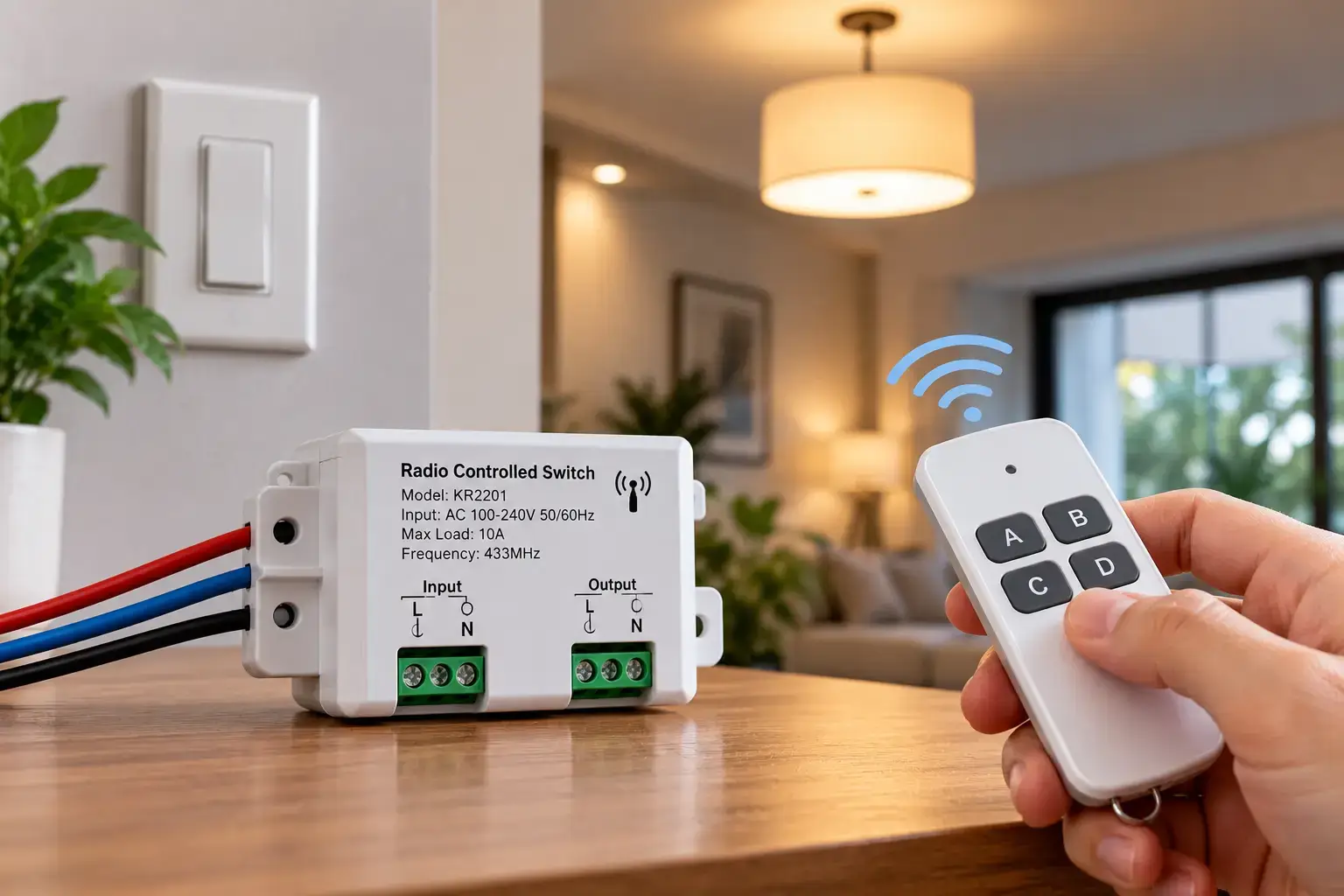
A radio controlled switch is a two-part system: a handheld or wall-mounted transmitter sends a low-power radio signal, and a receiver wired to a light, outlet, or motor opens or closes a relay in response. No control wire runs between them, so you can place the button almost anywhere.
Most consumer kits in the US transmit on 433.92 MHz or 434 MHz, a crowded but practical band that passes through drywall and wood framing reasonably well. A few battery-free designs use the EnOcean protocol on 315 MHz or 902 MHz instead. Either way, these are unlicensed, low-power transmitters, and the FCC’s own primer on low-power, non-licensed transmitters under Part 15 explains why they can operate without a license but must accept interference from other devices.
That last point matters more than it sounds. Because every wireless doorbell, weather station, and garage remote in your neighborhood may share the same slice of spectrum, the smarter kits use learning codes or unique IDs so your neighbor’s remote can’t flip your porch light. When you see “learning code” or “EV1527” on a listing, that’s what it signals.
The three families you’ll meet
- 🔌 Plug-in remote outlets: the receiver is the outlet itself. No tools, ideal for lamps, fans, and holiday lights.
- 🧱 Wall-switch kits: a stick-on switch talks to a receiver wired at the fixture or in the old switch box.
- 🔧 Relay boards: bare 12V or 24V receivers for DIY projects, gates, pumps, and low-voltage LED strips.
Knowing which family fits your problem is half the decision. The other half is load rating, range, and how the transmitter is powered.
Quick Comparison: 7 Radio Controlled Switch Picks at a Glance
| Product | Type | Transmitter power | Rated range | Price range | Best for |
|---|---|---|---|---|---|
| Lutron Caseta P-PKG1W-WH Dimmer + Pico Kit | In-wall dimmer + remote | CR2032 coin cell (~10-yr life) | 30 ft through walls / 60 ft line of sight | $65–$90 | Lutron Caseta P-PKG1W-WH Dimmer + Pico Kit: homeowners who may go smart later |
| Lutron Caseta P-PKG1P-WH Lamp Dimmer + Pico Kit | Plug-in lamp dimmer + remote | CR2032 coin cell (~10-yr life) | 30 ft through walls / 60 ft line of sight | $50–$80 | Lutron Caseta P-PKG1P-WH Lamp Dimmer + Pico Kit: renters who want dimming |
| RunLessWire RW9-SKWH Single Pole Kit | Wall switch + 5A receiver | Kinetic (no battery) | Up to 150 ft | $80–$150 | RunLessWire RW9-SKWH Single Pole Kit: old houses, plaster walls |
| Thinkbee Self-Powered Wireless Switch Kit | Wall switch + receiver | Kinetic (no battery) | Long-range claims; verify in your home | $15–$30 | Thinkbee Self-Powered Wireless Switch Kit: budget battery-free installs |
| Etekcity ZAP 5LX Remote Outlet Kit | 5 plug-in outlets + 2 remotes | 12V A23 battery | 100 ft | $25–$40 | Etekcity ZAP 5LX Remote Outlet Kit: whole-room lamp control |
| DEWENWILS Outdoor Remote Control Outlet | Weatherproof plug-in outlet | 12V A23 battery | 100 ft | $14–$25 | DEWENWILS Outdoor Remote Control Outlet: holiday and patio lights |
| DieseRC 433MHz 12V 1-Channel Relay Switch | 12V DC relay board + fob | Battery-powered key fob | Long open-air claims; varies | $15–$30 | DieseRC 433MHz 12V 1-Channel Relay Switch: DIY, gates, 12V gear |
Prices are approximate ranges at the time of writing and change often; check the current price on Amazon.
Looking at the table, the split is less about brand and more about where the receiver lives. The Etekcity ZAP 5LX Remote Outlet Kit and DEWENWILS Outdoor Remote Control Outlet need zero tools, while the RunLessWire RW9-SKWH Single Pole Kit and Lutron Caseta P-PKG1W-WH Dimmer + Pico Kit reward a 20-minute wiring job with a cleaner, permanent result. Notice too that Lutron publishes the most conservative range figure; a smaller, honest number usually beats a giant one you’ll never see indoors.
💬 One click helps other shoppers make an informed choice too! 😊
Top 7 Radio Controlled Switch Picks: Expert Analysis
Each pick below is judged on what the spec sheet means in a real home, not on how the box reads. Here’s how they stack up.
1. Lutron Caseta P-PKG1W-WH Dimmer + Pico Kit — most reliable signal in the lineup
If you want a radio controlled switch that simply works every single time, this is the benchmark the rest of the category gets measured against.
The kit pairs a PD-6WCL in-wall dimmer with a 3-button Pico remote and a Claro wall plate. The dimmer handles up to 150W of dimmable LED or 600W of incandescent/halogen, and it needs no neutral wire, which is a big deal in older homes where the switch box often has only two conductors. The Pico talks over Lutron’s Clear Connect Type A signal at 434 MHz, rated for 30 feet through walls and 60 feet line of sight, and runs on a CR2032 cell rated for roughly 10 years.
Based on comparing the specs, the modest range figure is the point: Lutron rates conservatively, and that honesty shows up in daily use. It works out of the box without a hub; add the Smart Hub later for app, voice, and scheduling. Consumer Reports’ Caseta review also notes that installation is no harder than a standard switch swap.
Customer reviews consistently praise responsiveness and reliability; a recurring complaint is the premium price compared with Wi-Fi switches.
Pros:
- ✅ No neutral wire required for the dimmer
- ✅ Pico battery life rated around 10 years
- ✅ Upgrades to app and voice control later
Cons:
- ❌ Costs more than basic 433 MHz kits
- ❌ Requires wiring at the switch box
💲 Usually between $65 and $90; strong long-term value for a fixture you’ll use daily.
2. Lutron Caseta P-PKG1P-WH Lamp Dimmer + Pico Kit — renter-friendly dimming, zero tools
This is the same reliable radio link as pick #1, packaged for people who can’t (or won’t) touch household wiring.
The PD-3PCL lamp dimmer plugs into any outlet and accepts up to two lamps, rated for 100W of dimmable LED/CFL or 300W of incandescent/halogen. That LED figure translates to roughly ten typical 9–10W bulbs, more than enough for two table lamps. The included Pico gives on, off, brighter, dimmer, and a “favorite” preset you save by holding the center button for about six seconds.
What most buyers overlook is the Pico wall bracket: mount the remote on a wall plate and you’ve added a real-looking wall switch to a room that never had one, with no drywall cut. It’s not rated for low-voltage track or landscape lighting, so keep it to ordinary plug-in lamps.
Aggregated reviews on retailer sites lean strongly positive, with buyers highlighting smooth dimming and easy pairing; the main gripe is the price of a single-outlet device.
Pros:
- ✅ Plug-and-play, ideal for renters
- ✅ Controls up to two lamps together
- ✅ Saved favorite light level on the remote
Cons:
- ❌ Lower wattage ceiling than the in-wall dimmer
- ❌ Dimmable bulbs required for smooth results
💲 Roughly $50 to $80; worth it if dimming matters more to you than raw outlet count.
3. RunLessWire RW9-SKWH Single Pole Kit — battery-free switch for plaster walls
This kit is the one to beat when you want a wall switch that never needs a battery and never needs Wi-Fi.
The switch uses EnOcean energy-harvesting technology: pressing the rocker drives a tiny generator that powers the radio burst, so there’s nothing to replace, ever. The 5A, 120V receiver installs at the fixture or old switch location, and the rocker fits standard Decora plates or mounts with screws or adhesive strips. RunLessWire rates range at up to 150 feet.
Here’s what to weigh: 5 amps covers lighting circuits comfortably (about 600W at 120V), but not a space heater. The installation guide also specifies indoor, dry locations and recommends a plastic junction box, since a metal box can choke the signal.
Retailer reviews repeatedly come from owners of older homes who avoided opening plaster or lath walls, and several mention appreciating that it isn’t a “smart” device that depends on an app.
Pros:
- ✅ Never needs batteries or a hub
- ✅ Generous 150-foot rated range
- ✅ Fits standard Decora wall plates
Cons:
- ❌ Indoor, dry locations only
- ❌ Expensive compared with 433 MHz kinetic kits
💲 Typically $80 to $150 depending on kit size; justified if you value maintenance-free reliability.
4. Thinkbee Self-Powered Wireless Switch Kit — cheapest way into battery-free switching
This budget kit delivers the kinetic, no-battery concept at a fraction of the premium-brand price.
The switch converts the force of your press into a short 433 MHz signal, and Thinkbee states each receiver can be paired with up to five of its switch panels, while one switch can drive multiple receivers. In practice, that means you can build a wireless three-way setup for a hallway or staircase without pulling a traveler wire. Thinkbee also advertises a 3-year warranty on its listings.
On paper, this is a fantastic value, but treat the very long range claims on some Thinkbee listings as open-field marketing figures. Walls, appliances, and metal boxes cut real range sharply. Check the specific receiver’s wattage rating before wiring it to a fixture, since Thinkbee sells several receiver variants.
Verified, aggregated review data for this exact kit is thinner than for the bigger brands, so we can’t summarize long-term durability with confidence; available ratings on retailer pages trend positive.
Pros:
- ✅ No batteries, no Wi-Fi, no app
- ✅ Easy multi-switch setups for stairways
- ✅ Very affordable entry price
Cons:
- ❌ Range claims look optimistic for indoor use
- ❌ Less long-term review history to rely on
💲 Usually $15 to $30; excellent value for a garage, closet, or pull-chain fix.
5. Etekcity ZAP 5LX Remote Outlet Kit — whole-room control for under $40
Five outlets and two remotes in one box make this the most efficient way to put an entire living room on buttons.
Each outlet is rated for 120V, 10A, and 1,200W maximum, and the remotes transmit at 433.92 MHz with a rated 100-foot range. In practice, 1,200W covers lamps, a fan, a coffee maker, or a string of LED holiday lights, but not a 1,500W space heater. The outlets use learning code, so you can reassign buttons, give one button control of several outlets, or add a third remote later.
The spec sheet doesn’t say this, but the manual’s operating range of 32–95°F effectively makes it an indoor product; use the outdoor pick below for porches. Also note the remote runs on a 12V A23 battery, which is easy to find but drains faster than a coin cell in a Pico remote.
The kit carries thousands of Amazon ratings averaging in the mid-4-star range. Reviews consistently report reliable switching through interior walls; a common complaint is that each outlet’s bulky body can block the neighboring socket.
Pros:
- ✅ Five outlets and two remotes included
- ✅ Learning code lets you reassign buttons
- ✅ Huge, long-running review base
Cons:
- ❌ Not rated for outdoor use
- ❌ Bulky outlet can block the second socket
💲 Usually $25 to $40; arguably the best cost-per-outlet in this guide.
6. DEWENWILS Outdoor Remote Control Outlet — weatherproof muscle for holiday lights
This is the one to buy when the thing you want to control lives outside and draws real power.
It’s rated for 15A, 1,875W resistive, 1,000W tungsten, and 1/2 HP, carries ETL and FCC listings, and uses a 433.92 MHz remote with a rated 100-foot range. That 15-amp rating is the headline: it can run a full run of incandescent holiday lights, a pond pump, or a heated bird bath, which overwhelms most indoor kits.
The manufacturer’s own weatherproofing instructions are worth following to the letter: mount the plug at least two feet above the ground with the plug end facing down so water can’t pool in it. It ships pre-programmed and you can add more units of the same model to one remote.
A deal-tracker summary of the Amazon listing showed about 4.7 out of 5 across roughly 6,670 reviews at the time of writing. Reviews often mention reliable operation through cold weather; occasional complaints involve the remote’s range dropping when the outlet sits behind brick or stucco.
Pros:
- ✅ True 15A rating for heavy outdoor loads
- ✅ Weatherproof housing, ETL listed
- ✅ Pre-programmed and expandable
Cons:
- ❌ Range drops behind masonry walls
- ❌ Remote uses a less common A23 battery
💲 Typically $14 to $25; outstanding value for seasonal and patio use.
7. DieseRC 433MHz 12V 1-Channel Relay Switch — the DIY builder’s 433MHz remote relay switch
This bare relay board is for projects that aren’t household outlets at all: gates, pumps, 12V LED strips, or an RV accessory.
The receiver runs on a 12V DC supply, switches a 10A relay, and pairs with its key-fob transmitter using EV1527 learning code at 433 MHz. Learning code means the board memorizes the fob’s unique ID, so a neighbor’s 433 MHz gadget won’t trigger it. DieseRC also sells 12–30V and multi-channel versions with several operating modes, such as momentary or toggle, which is useful for door strikes versus lights.
On paper, this is the most flexible pick here, but it assumes basic wiring skill. The board is not weatherproof, so outdoor projects need a sealed enclosure, and the 10A relay rating applies to the contacts, not to your 12V power supply.
We could not verify a large body of aggregated reviews for this exact model, so we won’t characterize its long-term reliability; treat it as a component, and buy a spare.
Pros:
- ✅ Works with 12V systems, not just outlets
- ✅ Learning-code security against stray signals
- ✅ Cheap enough to experiment with
Cons:
- ❌ Needs wiring knowledge and an enclosure
- ❌ Limited verifiable long-term review data
💲 Generally $15 to $30; excellent value for DIY and automation projects.
Side-by-Side Spec Comparison of All 7 Picks
| Product | Frequency / protocol | Max load | Install | Outdoor-rated | Review signal | Best for |
|---|---|---|---|---|---|---|
| Lutron Caseta P-PKG1W-WH Dimmer + Pico Kit | 434 MHz Clear Connect | 150W LED / 600W incandescent | In-wall wiring | No | Large, strongly positive | Permanent dimming |
| Lutron Caseta P-PKG1P-WH Lamp Dimmer + Pico Kit | 434 MHz Clear Connect | 100W LED / 300W incandescent | Plug-in | No | Strongly positive | Renters |
| RunLessWire RW9-SKWH Single Pole Kit | EnOcean kinetic | 5A at 120V | Fixture wiring | No (dry only) | Positive, smaller base | Plaster walls |
| Thinkbee Self-Powered Wireless Switch Kit | 433 MHz kinetic | Varies by receiver | Fixture wiring | Check model | Positive, limited | Budget installs |
| Etekcity ZAP 5LX Remote Outlet Kit | 433.92 MHz learning code | 10A / 1,200W | Plug-in | No | Thousands, mid-4 stars | Whole room |
| DEWENWILS Outdoor Remote Control Outlet | 433.92 MHz | 15A / 1,875W | Plug-in | Yes | ~4.7 on ~6,670 reviews | Outdoor loads |
| DieseRC 433MHz 12V 1-Channel Relay Switch | 433 MHz EV1527 | 10A relay, 12V DC | DIY wiring | Needs enclosure | Not verifiable | 12V projects |
The load column is where most buying mistakes happen. If your device draws more than 10A, only the DEWENWILS Outdoor Remote Control Outlet is rated for it here, while the Lutron Caseta P-PKG1W-WH Dimmer + Pico Kit wins whenever dimming quality and long-term reliability matter more than raw amperage. The RunLessWire RW9-SKWH Single Pole Kit and Thinkbee Self-Powered Wireless Switch Kit trade higher loads for never touching a battery.
✨ Don’t miss the right fit for your home!
🔍 Take your lighting control to the next level with this carefully curated lineup. Click a highlighted product name to check current pricing and availability. These picks will help you get light and power exactly where you need it, without opening a single wall!
How to Set Up a Radio Controlled Switch: Your First 30 Days
Most frustration with a radio controlled switch happens in the first week, and almost all of it is avoidable. Follow this sequence.
Day 1: test before you mount anything
Pair the transmitter and receiver on a table first. Plug-in kits like the Etekcity ZAP 5LX Remote Outlet Kit arrive pre-programmed, but confirming each button now saves you from peeling adhesive off a wall later. For hardwired kits, turn off the breaker, connect the receiver at the fixture, restore power, and press the switch while standing next to the receiver.
Day 2: walk the range
Carry the transmitter to the exact spot where you plan to mount it and press it ten times. If even one press fails, move it a foot or two. Mirrors, refrigerators, metal studs, and metal junction boxes are the usual culprits. This is why the RunLessWire RW9-SKWH Single Pole Kit instructions recommend a plastic box.
Week 1: mount and label
Use screws on textured walls; adhesive strips fail faster on painted drywall in humid bathrooms and garages. Label multi-button remotes with a fine-tip marker so guests don’t play “guess the outlet.”
Weeks 2–4: watch for these early warnings
- 🔋 Shrinking range on battery remotes usually means a weak cell. Swap it before it dies completely.
- 🌡️ A warm receiver means the load is too close to its rating. Move the device to a higher-rated kit.
- 🔁 Random toggling can signal a pairing conflict. Clear all codes and re-pair from scratch.
Common mistakes in the first 30 days
The big three: mounting before testing, exceeding the load rating, and installing an indoor kit in a damp space. Avoid those and a wireless remote switch should be essentially maintenance-free.
Which Remote Control Light Switch Fits You? Three Real-World Scenarios
Specs only mean something when they meet a real house. Here’s how three common buyers should choose.
🏠 The renter with a dark living room
Maya rents a 1970s apartment where the only switched outlet is behind the couch, and her lease forbids electrical work. Budget: under $80. She uses lamps every evening.
The Lutron Caseta P-PKG1P-WH Lamp Dimmer + Pico Kit is the fit. It plugs in, dims two lamps, and the Pico can live on a wall bracket by the door so the room behaves as though it has a real switch. If she’d rather control five lamps with no dimming, the Etekcity ZAP 5LX Remote Outlet Kit gives more outlets for less money.
🔨 The homeowner with a pull-chain closet light
Dan owns a 1920s house with plaster walls. He wants a wall switch at the closet door, not a chain. Budget: flexible, but he hates changing batteries.
The RunLessWire RW9-SKWH Single Pole Kit suits him: the receiver goes in the fixture’s box, the kinetic rocker sticks beside the door, and nothing ever needs a battery. If the budget is tight, the Thinkbee Self-Powered Wireless Switch Kit offers the same idea for far less, with less long-term review history.
🎄 The holiday decorator
Priya runs about 1,200W of outdoor lights and a heated birdbath through winter. Budget: under $30.
Only the DEWENWILS Outdoor Remote Control Outlet is weatherproof and rated for 15A here. Mount it two feet off the ground, plug facing down, and she can switch everything from the kitchen.
RF Remote Control Switch Problems and How to Fix Them
When an RF remote control switch misbehaves, the cause is usually one of five predictable problems. Here’s the fix for each.
Problem 1: The switch works next to the receiver but not across the house
Your signal is being absorbed. Metal junction boxes, foil-backed insulation, brick, and stucco all eat 433 MHz signals. Move the transmitter, swap a metal box for a plastic one, or choose a kit with a longer, honestly rated range. The DEWENWILS Outdoor Remote Control Outlet, for example, can lose range behind masonry.
Problem 2: Lights turn on by themselves
Another device on the same frequency may share a code. Clear the receiver’s memory (most have a press-and-hold reset) and re-pair. Learning-code models like the DieseRC 433MHz 12V 1-Channel Relay Switch and Etekcity ZAP 5LX Remote Outlet Kit let you do this in under a minute.
Problem 3: LED bulbs flicker or buzz when dimmed
That’s a bulb-dimmer compatibility issue, not a radio issue. Use bulbs labeled dimmable, and keep total LED wattage under the dimmer’s rating, which is 150W on the Lutron Caseta P-PKG1W-WH Dimmer + Pico Kit.
Problem 4: The receiver feels hot
You’re near or over the load rating. A 5A receiver tops out around 600W at 120V. Move heavier loads to a 15A unit.
Problem 5: Range slowly shrinks over months
On battery remotes, that’s the cell weakening. Replace the A23 or CR2032 before it fails entirely, and keep one spare in a drawer.
How to Choose a Radio Controlled Switch
Choosing a radio controlled switch comes down to seven questions, asked in this order.
- What are you switching? A lamp, a ceiling fixture, an outdoor load, or a 12V device each points to a different family: plug-in outlet, wall kit, or relay board.
- How much power does it draw? Add up the wattage and leave 20% headroom. A 5A receiver suits lighting; heaters and pumps need 15A.
- Indoor or outdoor? Only buy outdoor-rated hardware for porches and yards; indoor kits list operating temperatures that rule out winter.
- Do you need dimming? Dimming requires a true dimmer and dimmable bulbs, not an on/off relay.
- Battery, coin cell, or kinetic? Coin cells last years, A23 cells less, and kinetic switches never need one.
- How far, through what? Treat range claims as open-air maximums. Halve them for drywall, and expect less through brick.
- Will you expand later? Learning-code and hub-ready systems grow with you; fixed-code bargains often don’t.
Run your project through these steps and the shortlist usually shrinks to one or two picks within minutes.
Battery-Free Wireless Light Switch vs Battery-Powered Remotes
A battery-free wireless light switch sounds like an obvious win, but the trade-offs are real.
Kinetic switches, like the RunLessWire RW9-SKWH Single Pole Kit and Thinkbee Self-Powered Wireless Switch Kit, generate a burst of energy each time you press the rocker. That means no dead remote at 2 a.m. and nothing to recycle. The cost is a firmer, clicky press, and on/off control only: there’s no energy reserve for holding a button to dim.
Battery remotes flip that equation. The Pico remote in the Lutron Caseta P-PKG1W-WH Dimmer + Pico Kit uses a coin cell rated for about ten years, which is long enough that many owners will move house before replacing it, and it supports raise/lower dimming plus a favorite preset. The A23 remotes with the Etekcity ZAP 5LX Remote Outlet Kit and DEWENWILS Outdoor Remote Control Outlet are cheaper but need fresh cells more often, and A23s are less common at the corner store.
Here’s the practical rule: for a set-and-forget wall switch in a hallway or closet, kinetic is hard to beat. For a remote you carry around the living room, or anywhere you want dimming, a long-life coin-cell remote is the better experience.
Radio Controlled Switch vs Wi-Fi Smart Switch vs Running New Wire
Shoppers often compare a radio controlled switch against two alternatives: a Wi-Fi smart switch, or hiring someone to run a new switch leg.
| Factor | Radio controlled switch | Wi-Fi smart switch | New hardwired switch |
|---|---|---|---|
| Needs home internet | No | Yes, for most features | No |
| Needs neutral wire | Often no | Usually yes | No |
| Typical hardware cost | $15–$150 | $15–$70 | Low parts cost, plus labor |
| Wall repair needed | None | None | Often |
| Works during router outage | Yes | Often no | Yes |
| Best for | Adding or moving switches | App and voice automation | Permanent new circuits |
The table shows why RF kits remain popular: they solve the “switch in the wrong place” problem without internet, apps, or drywall patching. Wi-Fi switches win when you want schedules and voice control, though many require a neutral wire older boxes lack. Notably, the Lutron Caseta P-PKG1W-WH Dimmer + Pico Kit straddles both worlds, working locally out of the box and adding app control once you buy the hub.
Using a 433MHz Remote Relay Switch for 12V and DIY Projects
Not every radio controlled switch belongs on a wall. A 433MHz remote relay switch is the go-to part for makers, RV owners, and anyone automating low-voltage gear.
The DieseRC 433MHz 12V 1-Channel Relay Switch is typical of the category: a 12V DC board, a 10A relay, and a key fob that pairs by learning code. Wire your power supply to the input terminals and your device through the relay’s normally open contacts, and the fob now controls a winch, a water pump, a 12V LED strip, or a gate actuator.
Three tips help these projects go smoothly. First, match the relay mode to the job: toggle mode for lights, momentary for door strikes or garage-style openers. Second, fuse the circuit close to the battery, because a relay rating says nothing about your wiring’s ampacity. Third, mount the board in a sealed enclosure outdoors, with the antenna kept away from metal.
If you outgrow one channel, multi-channel versions let a single fob run several devices independently.
Safety, Regulations, and Standards
A radio controlled switch is still an electrical device, and a few certifications separate safe products from risky ones.
Look for a safety listing
UL and ETL marks indicate testing by a Nationally Recognized Testing Laboratory. The DEWENWILS Outdoor Remote Control Outlet advertises ETL and FCC listings, and the Etekcity ZAP 5LX Remote Outlet Kit listing references FCC and ETL as well. Be cautious with unbranded relay boards that list no certifications; they’re fine for low-voltage projects but shouldn’t control household 120V loads unattended.
Check the FCC ID
Every transmitter sold legally in the US needs FCC authorization under Part 15. The FCC ID on the label can be looked up in the FCC’s equipment database, which is a quick way to confirm you’re buying a real, tested product.
Respect wet-location and temperature ratings
Indoor kits are not “mostly fine” outdoors. Moisture in a receiver can cause shorts, and cold can shrink battery range. The RunLessWire RW9-SKWH Single Pole Kit guide, for instance, limits use to indoor, dry locations.
Know when to call an electrician
Plug-in kits need no permits. Hardwired receivers mean working inside fixture or switch boxes; always cut power at the breaker, and check local rules, since some jurisdictions require permits or a licensed electrician for this work.
Long-Term Cost and Maintenance
The sticker price is only part of what a radio controlled switch costs over its life.
| Product | Upfront range | Ongoing cost | Value verdict |
|---|---|---|---|
| Etekcity ZAP 5LX Remote Outlet Kit | $25–$40 | Occasional A23 cells | Lowest cost per outlet |
| DEWENWILS Outdoor Remote Control Outlet | $14–$25 | Occasional A23 cell | Best outdoor value |
| Thinkbee Self-Powered Wireless Switch Kit | $15–$30 | None (kinetic) | Best budget wall switch |
| Lutron Caseta P-PKG1W-WH Dimmer + Pico Kit | $65–$90 | CR2032 about once a decade | Best long-term reliability |
| RunLessWire RW9-SKWH Single Pole Kit | $80–$150 | None (kinetic) | Best maintenance-free premium |
The cheapest kit isn’t automatically the cheapest to own. An electrician visit to run a new switch leg often costs far more than any kit here, so even the RunLessWire RW9-SKWH Single Pole Kit can pay for itself on the first install. Meanwhile, the Etekcity ZAP 5LX Remote Outlet Kit can actually trim your bill: the U.S. Department of Energy notes that standby power can account for 5–10% of residential energy use, and a remote outlet makes it painless to cut power to a TV setup or printer overnight.
Maintenance is minimal across the board: test remotes seasonally, replace cells when range shrinks, and wipe outdoor units before storing them for summer.
Common Mistakes to Avoid When Buying a Wireless Remote Switch
The same handful of errors shows up again and again in negative reviews, and most are buyer mismatches rather than product defects.
- ❌ Buying on range claims alone. A box promising 1,000+ feet describes an empty field, not a house with a refrigerator in the way.
- ❌ Ignoring load ratings. A 10A outlet under a 1,500W heater will run hot, and many manuals warn against it.
- ❌ Assuming every kit dims. On/off relays and kinetic switches don’t dim; only true dimmers like the Lutron Caseta P-PKG1P-WH Lamp Dimmer + Pico Kit do.
- ❌ Mixing models. Most brands only pair with the same model. Expanding the DEWENWILS Outdoor Remote Control Outlet setup, for example, means buying the same model.
- ❌ Installing in metal boxes without testing. Metal shields RF; test placement before you close anything up.
- ❌ Skipping certifications. For 120V household use, prefer UL- or ETL-listed products with a visible FCC ID.
Avoid these six and your wireless remote switch is far more likely to become the kind of upgrade you forget about, because it simply works.
FAQ: Radio Controlled Switch Questions Shoppers Ask Before Buying
❓ Will a radio controlled switch work with LED lights?
❓ Can one remote control several radio controlled switches at once?
❓ Can I use a radio controlled switch with a ceiling fan?
❓ Is it safe to leave a remote control outlet plugged in all the time?
❓ Can a remote control light switch replace a 3-way switch setup?
Conclusion: The Best Radio Controlled Switch for Your Home
A radio controlled switch is one of the rare home upgrades that saves money, time, and drywall all at once. The trick is matching the hardware to the job instead of chasing the biggest number on the box.
If you want the most dependable everyday experience, the Lutron Caseta P-PKG1W-WH Dimmer + Pico Kit is the benchmark, and the Lutron Caseta P-PKG1P-WH Lamp Dimmer + Pico Kit brings that same reliability to renters. For battery-free wall switches, the RunLessWire RW9-SKWH Single Pole Kit is the premium choice, while the Thinkbee Self-Powered Wireless Switch Kit proves the idea on a tight budget. Need to control a room full of lamps cheaply? The Etekcity ZAP 5LX Remote Outlet Kit is hard to beat on cost per outlet. Outdoors, the 15-amp DEWENWILS Outdoor Remote Control Outlet handles loads that would overwhelm indoor kits. And for 12V tinkering, the DieseRC 433MHz 12V 1-Channel Relay Switch opens up gates, pumps, and LED projects.
Whichever you choose, run through the seven-step checklist above, respect the load and location ratings, and test placement before mounting. Do that, and your new switch will be the kind of upgrade you stop noticing, because it simply does its job every time you press it.
✨ Ready to put the light switch where it belongs?
🔍 Take your home’s lighting control to the next level with this carefully curated lineup. Click a highlighted product name to check current pricing and availability. These picks will help you get convenience, safety, and comfort the whole family will enjoy!
Recommended for You
- Receptacle Switch: 7 Smart Combo Picks That Save Space in 2026
- Qatar Electrical Plug Type: 7 Best Adapters That Actually Work (2026)
- Power Outage Sensor: 7 Best Picks That Actually Alert You (2026)
Disclaimer: This post contains affiliate links. As an Amazon Associate, I earn from qualifying purchases made through these links, at no additional cost to you.
✨ Found this article helpful? Share it with someone who needs it! 💬🤗