
In This Article
Why an Indoor Outlet Remote Control Is the Easiest Upgrade You’ll Make This Year
Picture the floor lamp wedged behind your sectional, the Christmas tree whose plug lives somewhere under a skirt of tinsel, or the box fan in the corner that only has a power switch on its back. Every one of those devices has the same flaw: the off button is in the most awkward spot in the room. An indoor outlet remote control fixes that for the price of a takeout dinner, with zero wiring and zero electrician.
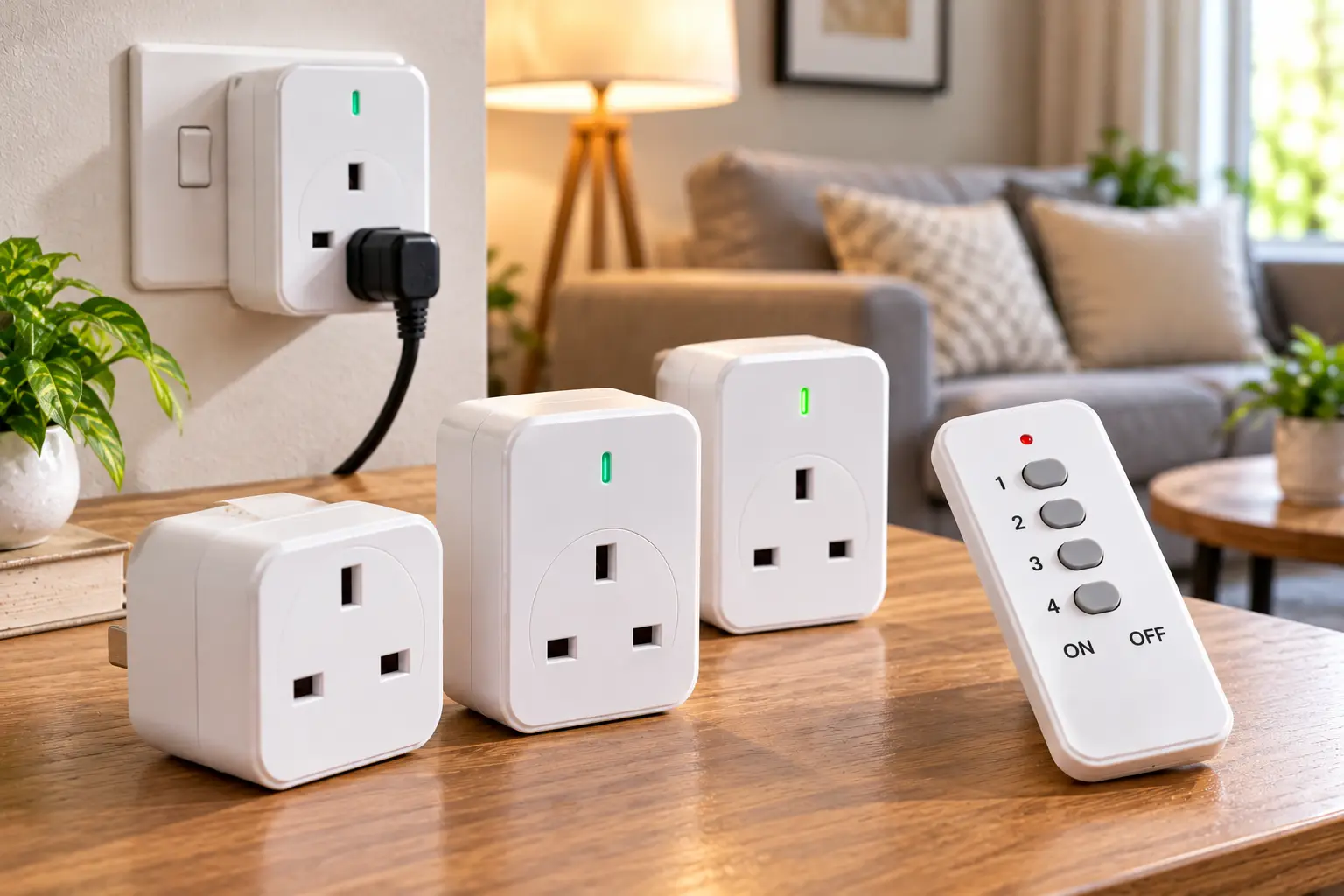
The idea is almost comically simple. You plug a small receiver into the wall, plug your device into the receiver, and press a button on a handheld (or wall-mounted) remote. Click — the lamp comes on from across the room, or even from the next room. 💡
What makes 2026 a good moment to buy is how mature the category has become. Most kits now ship pre-paired, use “learning code” technology so your remote won’t switch your neighbor’s lights, and come rated for 10 to 15 amps. Meanwhile, Wi-Fi smart plugs have dropped to near-impulse-buy prices, which gives you a real choice between radio-frequency simplicity and app-based automation.
There’s also a quiet money angle. Many electronics keep sipping electricity in “off” mode — what engineers call standby power — and a remote outlet makes cutting that power genuinely convenient instead of a chore you’ll forget.
In this guide, you’ll find seven real indoor outlet remote control options available on amazon.com, compared on load rating, range, features, and long-term value. You’ll also get a setup walkthrough, troubleshooting fixes, safety rules that matter (space heaters, we’re looking at you), and a decision framework so you buy once and buy right. ⚡
What Is an Indoor Outlet Remote Control?
An indoor outlet remote control is a plug-in receiver that sits between a wall outlet and a device, paired with a wireless remote that cuts or restores power on command. Most use radio frequency (RF) signals that pass through walls, so you can switch lamps, fans, or holiday lights without bending, unplugging, or rewiring anything.
That definition hides a few useful details. First, the receiver is the part doing the real work: it contains a relay rated for a maximum electrical load, typically 10 amps (around 1,200 watts) or 15 amps (around 1,800–1,875 watts) on a standard US 120-volt circuit. Second, the remote is usually powered by a small 12V 23A or CR2032 coin battery, which is why it can live on your nightstand or stick to the fridge for a year or more between battery swaps.
Third, there are two families in this category. Classic RF kits need no Wi-Fi, no app, and no account — you press a button and that’s the whole user manual. Wi-Fi smart plugs replace the physical remote with your phone and a voice assistant, adding schedules and away-from-home control. Both count as remote-controlled outlets; they simply suit different people. Throughout this guide, you’ll see exactly where each one wins.
Quick Comparison: 7 Best Indoor Outlet Remote Control Picks at a Glance
| Product | Control Type | Max Load (per listing) | Range (open area) | Standout Feature | Best for |
|---|---|---|---|---|---|
| DEWENWILS Indoor Remote Control Outlet | RF remote | 15A / 1,875W | Up to 100 ft | 5 outlets + 2 remotes, learning code | Whole-room lamp control |
| DEWENWILS Remote Control Outlet with Timer | RF remote + countdown | 15A / 1,875W | Up to 100 ft | 6 auto-off timer settings | Heaters’ neighbors: kettles, blankets, chargers |
| GE mySelectSmart 36240 | RF remote + countdown | 12A / 1,440W resistive | Up to 150 ft | Wall-mountable remote, longest range | Multi-room homes and renters |
| Etekcity Wireless Remote Control Outlet Kit | RF remote | Check label (lower than 15A models) | Up to 100 ft | Mix-and-match learning system | Expanding a system over time |
| BN-LINK Wireless Remote Control Outlet | RF remote | 10A / 1,200W | Up to 100 ft (line of sight) | ETL & FCC listed, manual button | Budget multi-packs |
| TESSAN Remote Control Outlet | RF remote | 15A / 1,875W | Up to 100 ft | Magnetic remote back plate | Never losing the remote |
| Kasa Smart Plug Mini EP10 | Wi-Fi app + voice | 15A / 1,800W | Wherever your Wi-Fi reaches | Alexa/Google, schedules, away mode | Automation fans |
Reading across the table, the biggest split isn’t brand — it’s load rating. The DEWENWILS Indoor Remote Control Outlet, DEWENWILS Remote Control Outlet with Timer, and TESSAN Remote Control Outlet give you the most headroom at 15 amps, while the BN-LINK Wireless Remote Control Outlet tops out at 10 amps, which is plenty for lamps but tight for high-draw appliances. If range is your problem, the GE mySelectSmart 36240 is the only RF pick here rated to 150 feet, and the Kasa Smart Plug Mini EP10 sidesteps range entirely by riding your Wi-Fi.
💬 One click helps other shoppers make an informed choice too! 😊
Top 7 Indoor Outlet Remote Control Picks: Expert Analysis
Every pick below is a real product listed for the US market, assessed on its published specs and on the aggregated sentiment in customer reviews. Nothing here is a hands-on lab test; instead, you get the reasoning behind each recommendation so you can weigh it against your own home.
1. DEWENWILS Indoor Remote Control Outlet — best all-around whole-room kit
The DEWENWILS Indoor Remote Control Outlet earns the top spot because it pairs a full 15-amp rating with an expandable, interference-resistant system. The popular kit bundles five receivers with two remotes, and each receiver is rated 15A/1,875W resistive — so you aren’t limited to lamps; a fan or vacuum is fair game. DEWENWILS uses variable learning codes, meaning the code changes each time you re-program, which matters in apartments where a neighbor might own the same cheap kit. The compact body occupies only one socket, leaving the second outlet free.
Based on the specs, this is the kit for anyone who wants to wire up a whole living room at once: two remotes let one live by the couch and the other by the door, and the “ALL” button kills every outlet in one press at bedtime. A notable plus for safety-minded buyers is that DEWENWILS says its outlets stay off after a power outage instead of switching back on unexpectedly.
Customer reviews consistently describe setup as plug-and-play in well under a minute, though a minority report occasional unresponsive presses, and opinions on real-world range vary by home construction.
Pros:
- ✅ Full 15A/1,875W rating covers most household devices
- ✅ Two remotes with an all-off button for bedtime
- ✅ Learning codes reduce interference with neighbors’ kits
Cons:
- ❌ Some users report occasional missed button presses
- ❌ Range drops noticeably through several interior walls
Typically priced in the $20–$35 range depending on pack size, it’s one of the strongest value-per-outlet buys in the category — check the current price before ordering.
2. DEWENWILS Remote Control Outlet with Timer — auto-off insurance for forgetful days
The DEWENWILS Remote Control Outlet with Timer adds something most RF kits lack: a built-in countdown that shuts power off on its own. The remote offers six settings — 5, 15, 30, and 60 minutes, plus 2 and 4 hours — on top of normal on/off control. In practice, that means you can tap “30 minutes” on a curling iron or electric blanket and stop wondering whether you left it running. The outlet keeps the same 15A/1,875W rating and compact one-socket footprint as the standard DEWENWILS kit.
The remote’s magnetic design is clever: depending on the version, it either snaps onto a detachable base so it behaves like a wall switch, or it rides on a keychain. Based on the feature set, this is the pick for anyone controlling devices that don’t have their own auto shut-off, or for parents who want the kids’ bedroom fan to quit after they fall asleep.
Review sentiment on DEWENWILS timer models is broadly positive about the simplicity, but the countdown runs from the remote’s command, so check the listing for your specific variant’s timer behavior.
Pros:
- ✅ Six countdown presets prevent devices running all night
- ✅ Magnetic remote doubles as a wall switch
- ✅ No app, Wi-Fi, or account needed
Cons:
- ❌ Usually sold as a single outlet and remote
- ❌ Fixed presets only, no custom daily schedules
Expect roughly $12–$25 depending on configuration; for set-it-and-forget-it peace of mind, it’s excellent value.
3. GE mySelectSmart 36240 — longest range and the cleanest wall-switch look
The GE mySelectSmart 36240 (sold as the mySelectSmart Wireless Remote with Countdown) stands out for its 150-foot rated range, roughly 50% more than most rivals. Its remote offers on/off plus 30-minute, 1-hour, 2-hour, and 4-hour countdowns, runs on a CR2032 coin battery, and can be wall-mounted as a standalone switch or fit into a multi-gang plate. Jasco, which makes GE-branded lighting controls, lists the receiver at 120VAC, 12A, with a 1,440W resistive maximum and a 360W tungsten (incandescent) maximum.
That last number is the one most buyers overlook. It means the GE mySelectSmart 36240 is comfortable with LED and CFL lamps but not built for a bank of old-school halogen bulbs. Also note that the receiver’s single outlet is described as polarized, so confirm your device’s plug type before buying. The upside is a whole-home network: every mySelectSmart remote, motion sensor, and add-on receiver can pair together without a hub.
Public US retailer reviews are positive, but many visible reviews are labeled as collected through a promotion, so weigh them cautiously.
Pros:
- ✅ 150-foot rated range suits larger homes
- ✅ Remote mounts like a real wall switch
- ✅ Expandable mySelectSmart ecosystem without a hub
Cons:
- ❌ Lower tungsten rating limits incandescent loads
- ❌ Only one receiver in the box
At around $20–$30, you pay a little more per outlet, but the range and wall-switch finish justify it for multi-room homes.
4. Etekcity Wireless Remote Control Outlet Kit — the flexible mix-and-match veteran
The Etekcity Wireless Remote Control Outlet Kit has been a fixture on Amazon for years, and its learning system is the reason. Kits come in three- or five-outlet bundles with one or two remotes powered by 12V batteries, and Etekcity says its learning remotes and outlets sync together regardless of frequency differences. Practically, that lets you program one button to fire several outlets — a living-room “scene” — or let two remotes control the same lamp from opposite ends of a hallway.
Based on its design, this is the kit for tinkerers who expect their setup to grow: buy a five-pack now, add a remote later, and re-teach buttons whenever you rearrange furniture. One honest caveat: Etekcity’s listings for this kit are generally rated below the 15-amp competitors, so read the receiver label before plugging in anything heavier than lamps, chargers, or decorations.
Aggregated review analysis is overwhelmingly positive about how easy programming is, though a small number of customers couldn’t get remotes to pair, and one noted limitation is mapping outlets across different remotes.
Pros:
- ✅ Learning remotes allow multi-outlet scenes
- ✅ Long track record and wide availability
- ✅ Five-pack bundles keep per-outlet cost low
Cons:
- ❌ Lower load rating than 15A rivals
- ❌ Occasional pairing hiccups reported by reviewers
Generally found in the $20–$40 range by pack size, it’s a solid value if your loads stay light.
5. BN-LINK Wireless Remote Control Outlet — budget multi-pack with safety listings
The BN-LINK Wireless Remote Control Outlet is the no-nonsense budget pick, sold in configurations like three outlets with one remote or five outlets with two remotes (model ES1513-5-2). Each receiver is rated 10A/1,200W and carries ETL and FCC certification, per the listing. Learning code lets you pair extra BN-LINK units, and the outlets have their own physical button, so a guest can switch a lamp even when the remote has vanished into the couch.
That 1,200-watt ceiling is the key trade-off. It’s ample for lamps, string lights, aquarium lights, or a media cabinet, but it means you should skip high-draw appliances entirely. Based on the specs, this is the pick for holiday decorators and anyone outfitting several low-wattage devices on a tight budget.
Across US marketplace reviews, buyers praise the instant setup, the separate on and off buttons, and a reset button that some competitors lack; a few reports mention signal reaching through several walls, while BN-LINK itself quotes 100 feet in line of sight.
Pros:
- ✅ ETL and FCC listings per the manufacturer
- ✅ Physical button on every receiver
- ✅ Low cost per outlet in multi-packs
Cons:
- ❌ 10A rating rules out heavier appliances
- ❌ Range quoted in line of sight only
Usually available between $15 and $30 depending on pack size, it’s among the cheapest ways to control many lamps — check current pricing.
6. TESSAN Remote Control Outlet — the remote you’ll never lose
The TESSAN Remote Control Outlet solves the most common real-world annoyance with these kits: misplacing the remote. Its remote has a magnetic back plate, and TESSAN includes an adhesive iron piece so you can mount it anywhere, not just on the fridge. Under the hood, the receivers are rated 15A/1,875W, the common bundle includes three outlets with one remote, and TESSAN says outlets stay off after a power outage.
TESSAN is refreshingly candid that its 100-foot RF range shrinks through doors and walls, which matches what physics predicts. Based on the specs, this is a strong choice for families, dorm rooms, and anyone who wants a 15-amp rating at a mid-budget price. The pre-paired receivers work out of the box, and TESSAN notes a quick re-pairing usually solves an initially unresponsive remote.
We couldn’t verify a large, consistent body of US reviews for this specific model, so treat review averages on resale sites with caution and lean on the published specs.
Pros:
- ✅ Magnetic remote with included mounting plate
- ✅ 15A/1,875W rating at a mid-range price
- ✅ Stays off after outages for safety
Cons:
- ❌ Smaller verified review base than rivals
- ❌ One remote only in the common bundle
Typically in the $15–$30 range, it’s good value if remote-wrangling has burned you before.
7. Kasa Smart Plug Mini EP10 — the Wi-Fi alternative for automation lovers
The Kasa Smart Plug Mini EP10 from TP-Link swaps the physical remote for your phone and voice assistant. It connects directly to 2.4GHz Wi-Fi (no hub), supports a 15A/1,800W load, and works with Amazon Alexa, Google Assistant, and Samsung SmartThings, plus IFTTT. Schedules, countdown timers, and an “Away Mode” that randomizes lights while you travel all come through the Kasa app.
That means the Kasa Smart Plug Mini EP10 can do things no RF kit can: turn the porch-side lamp on at sunset from another state, or respond to “Alexa, turn off the fan.” The trade-offs are real, though. You depend on your router and the app, it won’t join a 5GHz-only network, and TechHive’s review notes the app reports on-time but not actual power consumption.
Professional and customer reviews align on the same theme: simple, affordable, and reliable, with minimal frills. Because it’s compact, two units fit side by side in a standard duplex outlet.
Pros:
- ✅ Control from anywhere plus voice assistants
- ✅ Real schedules and away mode built in
- ✅ 15A rating in a mini footprint
Cons:
- ❌ Requires 2.4GHz Wi-Fi and an app
- ❌ No energy monitoring on this model
Often found around $10 for one or $25–$35 for a four-pack, it’s terrific value if you’re comfortable with apps.
Head-to-Head: Specs, Price Ranges, and Value
| Product | Outlets / Remotes (common bundle) | Typical Price Range* | Approx. Cost per Outlet | Timer | Best for |
|---|---|---|---|---|---|
| DEWENWILS Indoor Remote Control Outlet | 5 / 2 | $20–$35 | $4–$7 | No | Whole-room setups |
| DEWENWILS Remote Control Outlet with Timer | 1 / 1 | $12–$25 | $12–$25 | 6 presets | Auto-off safety |
| GE mySelectSmart 36240 | 1 / 1 | $20–$30 | $20–$30 | 4 presets | Long range, wall look |
| Etekcity Wireless Remote Control Outlet Kit | 5 / 2 | $20–$40 | $4–$8 | No | Growing systems |
| BN-LINK Wireless Remote Control Outlet | 5 / 2 | $15–$30 | $3–$6 | No | Lamp-heavy budgets |
| TESSAN Remote Control Outlet | 3 / 1 | $15–$30 | $5–$10 | No | Remote-losers |
| Kasa Smart Plug Mini EP10 | 4-pack, app | $25–$35 | $6–$9 | App schedules | Automation |
*Price ranges at the time of writing; prices change often, so check the current price on Amazon.
The per-outlet column tells a different story than sticker prices. Multi-packs from BN-LINK Wireless Remote Control Outlet, DEWENWILS Indoor Remote Control Outlet, and Etekcity Wireless Remote Control Outlet Kit cost a fraction per device compared with single-outlet kits like the GE mySelectSmart 36240, which you’re really buying for range and finish. The Kasa Smart Plug Mini EP10 four-pack lands surprisingly close to RF multi-packs per outlet, so the choice there comes down to whether you want an app at all.
✨ Ready to stop crawling behind furniture? 🛋️
🔍 Take your home’s convenience to the next level with this carefully curated lineup. Click a highlighted product to check current pricing and availability — one of these kits will have your lamps, fans, and holiday lights answering to a button tonight!
Getting Started: Setup, Pairing, and Your First 30 Days
Most kits work out of the box, but a few minutes of planning prevents the classic “why won’t this button work?” moment. 🔧
Day 1 — Setup in five steps:
- Pull the battery tab. Most remotes ship with a plastic strip protecting the battery. No tab removed, no signal.
- Plug the receiver directly into the wall, then plug your device into the receiver. Avoid stacking it on an extension cord where possible.
- Leave the device’s own switch ON. The receiver only cuts or restores power; if the lamp’s switch is off, the remote can’t help.
- Test each button while standing next to the outlet, then again from where you’ll actually use it.
- Label the remote. A strip of masking tape reading “tree / lamp / fan” saves endless guessing.
Re-pairing (learning code kits): On most DEWENWILS, BN-LINK, and Etekcity units, you hold the receiver’s button until its light blinks, then press the remote button you want to assign. The exact sequence varies, so keep the manual.
Week 1 — Optimize placement. Mount the remote where your hand naturally goes: by the bedroom door, on the nightstand, or on the fridge with a magnetic model like the TESSAN Remote Control Outlet.
First 30 days — Common mistakes:
- ❌ Plugging a space heater or window AC into a remote outlet (see the safety section below)
- ❌ Ignoring the receiver’s watt rating when adding a second device with a splitter
- ❌ Forgetting that remote batteries in a cold garage drain faster
After a month, note which outlet you use most. That’s usually the signal to add a second kit — or upgrade that spot to a timer model.
Real-World Scenarios: Matching the Right Kit to Your Home
Specs only matter in context, so here are three realistic household profiles and the reasoning behind each match. 🏠
The apartment renter with a lamp problem
Maya lives in a 700-square-foot one-bedroom with no overhead lighting in the living room, which is common in older US apartments. She has three floor lamps, a budget around $25, and a landlord who won’t approve new wiring. The BN-LINK Wireless Remote Control Outlet five-pack or the DEWENWILS Indoor Remote Control Outlet kit fits perfectly: low cost per outlet, no wiring, and enough receivers left over for a bedroom lamp. Because she uses them daily, the second remote by the front door effectively becomes her “light switch.”
The two-story family home
The Johnsons want to switch the upstairs hallway lamp from the downstairs kitchen and turn off the kids’ room fan after bedtime. Range and timers drive this decision. The GE mySelectSmart 36240 handles the distance with its 150-foot rating and wall-mount remote, while a DEWENWILS Remote Control Outlet with Timer on the fan quietly shuts it off after two hours. Budget lands around $40–$55 for both.
The smart-home enthusiast who travels
Dev is away on business twice a month and wants lights to look lived-in. An RF remote can’t help him from a hotel room, so the Kasa Smart Plug Mini EP10 four-pack wins: Away Mode randomizes lamps, schedules handle sunset, and Alexa covers voice control at home. Budget: roughly $25–$35.
The pattern is clear: pick RF for simplicity and lowest cost, timers for safety and forgetfulness, and Wi-Fi when you need control from outside the house.
Troubleshooting: 5 Common Problems and How to Fix Them
Even the best indoor outlet remote control occasionally misbehaves. Here’s what usually causes it — and the fix. 🛠️
1. The remote suddenly stopped working
Start with the battery: 12V 23A and CR2032 cells fade without warning. Swap it, then try again within a few feet of the receiver. If that fails, re-pair using the learning procedure; a power surge or accidental long-press can wipe the code.
2. It works in the same room but not upstairs
Rated ranges like “100 feet” assume open space. Brick, plaster with metal lath, appliances, and mirrors all absorb or reflect RF signals. Move the remote’s mounting spot a few feet, raise it higher, or step up to a longer-range system like the GE mySelectSmart 36240.
3. One button turns on two outlets
You’ve likely paired both receivers to the same channel. Clear the code on one receiver (often a 5-second hold) and re-teach it to a different button.
4. The outlet clicks but the device stays off
Check the device’s own switch, and confirm the plug is fully seated. Lamps with a pull chain or rotary switch must be left in the “on” position.
5. The Wi-Fi plug won’t connect
The Kasa Smart Plug Mini EP10 joins only 2.4GHz networks. If your router merges 2.4GHz and 5GHz under one name, temporarily separate the bands during setup or move closer to the router.
How to Choose an Indoor Outlet Remote Control
Choosing well comes down to seven checks, in this order:
- Match the load rating to the device. Read the wattage on your appliance’s label. Lamps and string lights rarely exceed 100–300W, so a 10A kit works; fans and vacuums are safer on 15A receivers.
- Check the load type, not just watts. Some receivers list separate limits for resistive, tungsten (incandescent), and LED/CFL loads. The tungsten number is often far lower.
- Look for a safety certification mark. UL, ETL, or CSA marks come from labs recognized under OSHA’s Nationally Recognized Testing Laboratory program, which means the product was tested against US safety standards.
- Be realistic about range. Halve the advertised figure if signals must cross two or more interior walls.
- Decide RF or Wi-Fi. RF is instant and app-free; Wi-Fi adds schedules, voice, and away-from-home control.
- Count outlets and remotes. A five-plus-two kit costs far less per device than buying singles later.
- Check the plug shape and footprint. Make sure the receiver accepts three-prong plugs if your device has one, and that it won’t block the second socket.
Get steps 1 through 3 right and the rest is preference. Skip them, and even a premium kit becomes a fire-safety question mark.
Wireless Remote Control Outlet vs Wi-Fi Smart Plug vs Traditional Options
A wireless remote control outlet isn’t the only way to switch hard-to-reach devices, so here’s how it stacks up against the alternatives.
| Option | Setup Effort | Works Without Internet | Away-From-Home Control | Typical Cost | Best for |
|---|---|---|---|---|---|
| RF remote outlet (e.g., DEWENWILS Indoor Remote Control Outlet) | Plug in, done | Yes | No | Low | Simplicity, seniors, renters |
| Wi-Fi smart plug (e.g., Kasa Smart Plug Mini EP10) | App + Wi-Fi setup | No (app control) | Yes | Low | Automation, travel |
| Hardwired smart or switched outlet | Electrician or advanced DIY | Varies | Varies | High | Homeowners renovating |
| Unplugging by hand | None | Yes | No | Free | Patience and flexible knees |
The RF kit wins on reliability and simplicity: there’s no router, no firmware update, and no account that can be discontinued. A Wi-Fi plug wins anywhere you need schedules or control from your phone. Hardwiring makes sense only during a renovation, when an electrician is already opening walls. For most renters and seniors, the wireless remote control outlet remains the lowest-friction answer — and nothing stops you from mixing both technologies in one home.
Remote Control Outlet With Timer: When a Countdown Earns Its Keep
A remote control outlet with timer adds a single, powerful idea: the device turns itself off even if you forget. That matters more than it sounds, because forgetting is the main reason electronics run all night. ⏱️
The best uses are devices without their own auto shut-off: electric blankets, curling irons, phone and tablet chargers, aquarium lights, bedroom fans, and holiday displays. The DEWENWILS Remote Control Outlet with Timer offers six presets from 5 minutes to 4 hours, while the GE mySelectSmart 36240 offers four presets from 30 minutes to 4 hours with a longer range.
What a remote control outlet with timer does not do is replace a true schedule. If you want lamps to switch on at 6 p.m. every weekday, you need a programmable plug-in timer or a Wi-Fi option like the Kasa Smart Plug Mini EP10. Think of countdown remotes as “sleep timers” for the whole house, not as calendars.
One honest limitation: a timer won’t make an unsafe appliance safe. Never use it as an excuse to leave a heat-producing device running unattended in an empty room.
Remote Control Plug for Lamps: Load Types and Features That Actually Matter
Lamps are the number-one reason people buy a remote control plug for lamps, and they’re also where marketing and reality drift apart. 💡
Features that matter:
- ✅ Load type ratings. LED bulbs draw a fraction of incandescent wattage, so almost any receiver handles a modern lamp. Incandescent and halogen floor lamps are where tungsten limits — like the 360W tungsten cap on the GE mySelectSmart 36240 — come into play.
- ✅ Side or compact outlets. A low-profile receiver lets you push the couch flush to the wall.
- ✅ State after a power outage. Models that stay off, like the TESSAN Remote Control Outlet, avoid lamps blazing at 3 a.m. after a brownie-baking power blip.
Features that matter less than advertised:
- ❌ Huge range claims you’ll never use in a single-floor apartment
- ❌ Dozens of buttons on one remote when you control two lamps
One more nuance: a basic remote control plug for lamps cannot dim. If you want brightness control, GE’s separate mySelectSmart dimming model handles that, but it requires dimmable bulbs and has a much lower 300W ceiling.
Safety, Regulations, and Standards
An indoor outlet remote control is a low-risk device, but only when it’s used within its limits. ⚠️
Space heaters are the big one. The US Department of Energy advises plugging space heaters directly into a wall outlet, and safety organizations warn against extension cords and power strips because they can overheat under a heater’s sustained current. A remote outlet sits in that same in-between position, so the conservative rule is simple: don’t put a space heater, window air conditioner, or similar heavy, continuous load on any plug-in remote receiver unless its manufacturer explicitly approves that use.
Certification marks. Look for UL, ETL, or CSA on the product itself, not just in the listing title. ETL and UL listings mean a recognized lab tested the device against the relevant US safety standards.
FCC compliance. RF remotes operate in unlicensed bands under FCC Part 15 rules, which is why reputable kits note FCC certification. It’s also why they must accept interference from other devices — one reason range varies.
Children and pets. Remotes make it easier to keep cords and outlets hidden behind furniture, but store remotes out of reach of toddlers, and keep coin-cell batteries (CR2032) locked away; they’re a serious swallowing hazard.
Long-Term Cost and Standby Power Savings
The purchase price is only half the math. The other half is what the remote saves — and what it costs to run. 💵
Many TVs, game consoles, soundbars, and chargers draw a few watts around the clock even when “off.” Suppose your entertainment center idles at 15 watts. Over a year, that’s 15W × 8,760 hours ≈ 131 kWh. At roughly 17 cents per kWh (check your utility bill for your real rate), that’s around $22 a year — from one cabinet. Cutting power with a $20–$35 kit can pay for itself in about a year or two on that outlet alone.
Running costs are minimal but not zero. Each receiver draws a small amount of standby power itself to listen for the remote, though manufacturers rarely publish the exact figure. Remote batteries typically last many months to a couple of years depending on use, and replacements cost a few dollars.
Durability is the hidden variable. Relays wear with switching cycles, so a cheap receiver you click 10 times a day may fail sooner than one controlling holiday lights for six weeks a year. Buying from brands with accessible support and replacement receivers — DEWENWILS, BN-LINK, Etekcity, and GE all sell add-on units — protects your investment.
Indoor Outlet Remote Control for Seniors and Limited Mobility
For older adults or anyone with back pain, arthritis, or limited mobility, an indoor outlet remote control is less a gadget than a fall-prevention tool. Bending behind furniture or reaching under a bed to unplug a lamp is exactly the kind of awkward movement that causes trips. 👵
The best setup prioritizes simplicity:
- ✅ Choose RF over Wi-Fi. No app, no password, no updates. The DEWENWILS Indoor Remote Control Outlet and BN-LINK Wireless Remote Control Outlet both offer clear on/off buttons.
- ✅ Mount a remote where it’s always found. The GE mySelectSmart 36240 mounts like a wall switch by the bedroom door; the TESSAN Remote Control Outlet sticks to a fridge or bed frame.
- ✅ Light the path first. Put a receiver on the lamp closest to the bedroom door so the room is lit before anyone walks in.
- ✅ Label large. Use high-contrast labels for each button.
Caregivers can keep the second remote in a family member’s room or by the main entrance. Avoid overcomplicating things: two or three clearly labeled outlets beat a five-channel system nobody remembers.
Common Mistakes to Avoid When Buying an Indoor Outlet Remote Control
A few avoidable errors account for most disappointed buyers. 🚫
- Buying on range alone. A 150-foot rating means little if your device draws more than the receiver’s watt limit.
- Ignoring three-prong plugs. Check that the receiver accepts your device’s plug before you buy.
- Using it for heaters. As fire safety agencies such as the US Fire Administration stress in their space heater safety guidance, heaters belong directly in a wall outlet.
- Mixing brands and expecting them to pair. Learning codes almost never cross brands; plan your system around one ecosystem.
- Buying singles instead of a multi-pack. If you’ll eventually want three outlets, a three- or five-pack is cheaper now.
- Choosing Wi-Fi for someone who hates apps. The Kasa Smart Plug Mini EP10 is excellent, but not for a grandparent who just wants a button.
- Overloading with splitters. Plugging a multi-tap into one receiver adds loads together — total wattage must stay under the rating.
Avoid these, and almost any reputable kit on this list will serve you for years.
FAQ: Indoor Outlet Remote Control Questions Shoppers Ask
❓ Can I use an indoor outlet remote control outside?
❓ Do remote control outlets work with Alexa or Google Home?
❓ How many outlets can one remote control?
❓ Will my neighbor's remote turn on my lamps?
❓ Is a remote control outlet worth it for Christmas lights?
Conclusion: The Best Indoor Outlet Remote Control for Your Home
An indoor outlet remote control is one of those rare upgrades that costs little, installs in seconds, and changes a daily habit for good. No more crawling behind the couch, no more hunting under the tree, and no more lights left burning because the switch was too annoying to reach. 🙌
If you want one answer, the DEWENWILS Indoor Remote Control Outlet is the best all-around pick, thanks to its 15-amp rating, two remotes, and learning-code system. Budget shoppers lighting several lamps will be happy with the BN-LINK Wireless Remote Control Outlet, while the Etekcity Wireless Remote Control Outlet Kit suits anyone planning to expand over time. Need auto-off insurance? Choose the DEWENWILS Remote Control Outlet with Timer. Larger homes benefit from the 150-foot range of the GE mySelectSmart 36240, and the TESSAN Remote Control Outlet is ideal if remotes tend to disappear in your house. Finally, if you want schedules and voice control, the Kasa Smart Plug Mini EP10 is the smart move.
Whichever you pick, match the load rating to your device, look for a safety certification mark, and keep heavy heaters plugged straight into the wall. Do that, and your new remote will quietly earn its keep every single day.
✨ Don’t miss these top-rated picks!
🔍 Take your home’s comfort to the next level with this carefully curated lineup. Click a highlighted product to check current pricing and availability. These picks will help you enjoy easier, safer, more convenient living the whole family will love!
Recommended for You
- Receptacle Switch: 7 Smart Combo Picks That Save Space in 2026
- Qatar Electrical Plug Type: 7 Best Adapters That Actually Work (2026)
- Power Outage Sensor: 7 Best Picks That Actually Alert You (2026)
Disclaimer: This post contains affiliate links. As an Amazon Associate, I earn from qualifying purchases made through these links, at no additional cost to you.
✨ Found this article helpful? Share it with someone who needs it! 💬🤗