
In This Article
Why a Remote Control Mains Socket Belongs in Your Home in 2026
Heads-up: this post contains affiliate links. If you buy through them, I may earn a small commission at no extra cost to you.
Picture this: you’re finally comfortable on the couch, blanket tucked in, and the floor lamp in the far corner is still blazing. The switch? Somewhere behind the bookshelf, on a cord you can only reach by doing yoga. A remote control mains socket solves that problem in about thirty seconds, and it solves a surprising number of others along the way. 🛋️
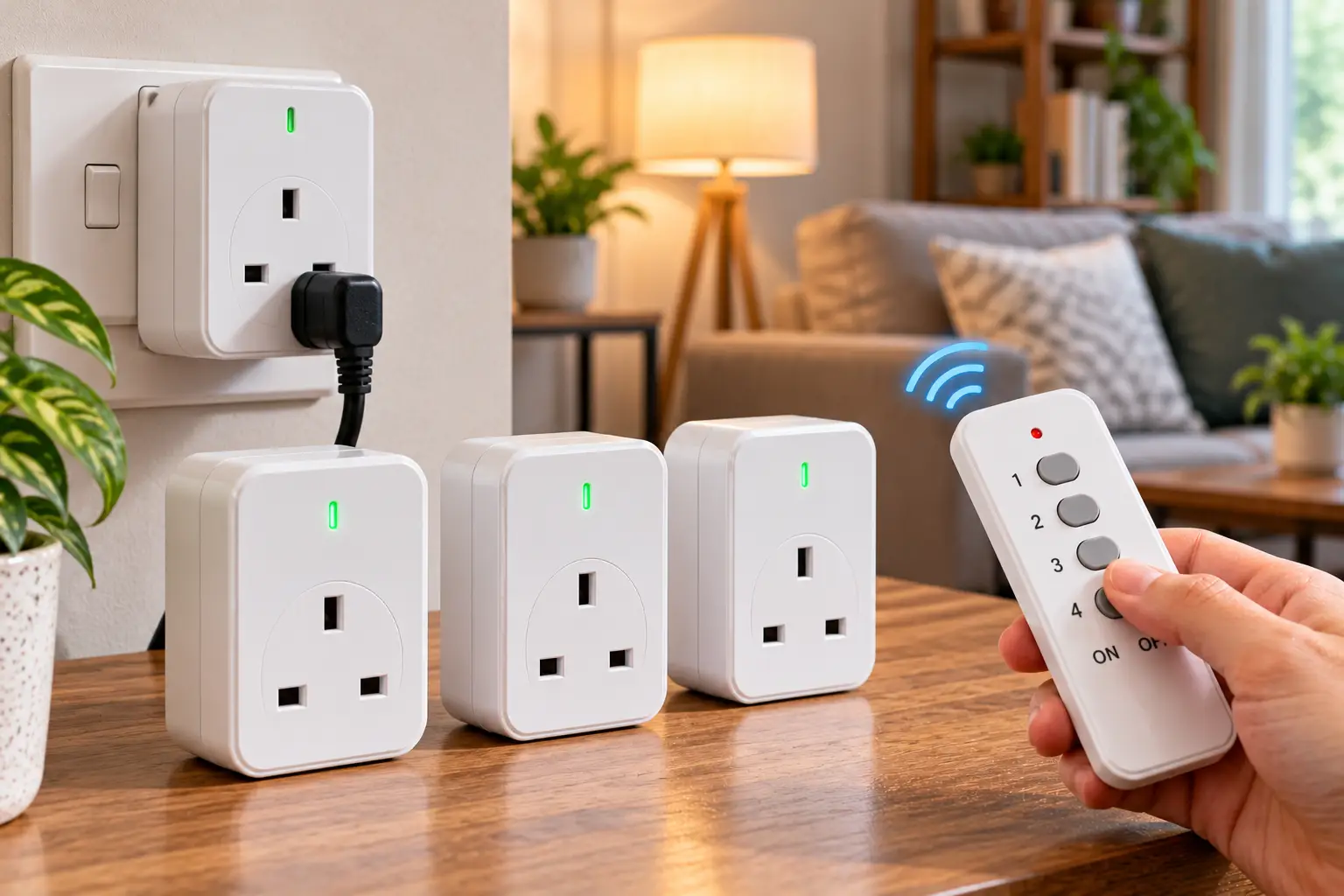
“Mains socket” is the British way of saying wall outlet, so here in the US you’ll mostly see these sold as a remote control outlet or wireless remote outlet switch. Whatever the label, the idea is identical: a small adapter plugs into your existing outlet, your lamp, fan, or string lights plug into the adapter, and a handheld or wall-mounted remote flips the power on and off by radio signal. No wiring, no electrician, and — unlike Wi-Fi smart plugs — usually no app, no account, and no router headaches.
That simplicity is exactly why this category is still booming in 2026. It’s the easiest way to tame hard-to-reach switches, to give an older relative one-button control over the lights, or to fire up holiday decorations from the warmth of the living room. It can even help you cut standby power — the electricity your electronics quietly sip while “off.”
In this guide, you’ll find seven real, currently sold kits, interpreted through their actual spec sheets and the review feedback we could verify. More importantly, you’ll learn which load ratings matter, which “features” are marketing fluff, and how to set up a remote control mains socket safely so it lasts for years, not months. Let’s dig in. ⚡
What Is a Remote Control Mains Socket?
A remote control mains socket is a plug-in adapter with a built-in relay and radio receiver that sits between a wall outlet and any electrical device. Pressing a button on its paired remote sends a radio-frequency (RF) signal that switches power to the plugged-in device on or off, without wiring, Wi-Fi, or an app.
Most US kits work on 120V household current and talk over low-power radio bands, typically around 433 MHz or 915 MHz. The receiver “listens” for a specific code, so your neighbor’s remote won’t flip your lamp. Some kits are pre-paired out of the box; others use a “learning code” system that lets you assign any button to any outlet, or group several outlets under one button.
What separates a great wireless remote control outlet from a frustrating one comes down to three numbers: the maximum load (amps and watts), the real-world range through walls, and whether the hardware carries a recognized safety listing such as ETL or UL. We’ll break all three down in the sections ahead.
Quick Comparison: The 7 Best Remote Control Mains Socket Kits
| Product | Kit Contents | Max Load | Claimed Range | Indoor/Outdoor | Price Range | Best For |
|---|---|---|---|---|---|---|
| Etekcity ZAP 5LX | 5 outlets + 2 remotes | 10A / 1200W | 100 ft (open area) | Indoor | $25–$40 | Etekcity ZAP 5LX: whole-home starter kit |
| BN-LINK ES1513-5-2 | 5 outlets + 2 remotes | 10A / 1200W | 100 ft (line of sight) | Indoor | $25–$40 | BN-LINK ES1513-5-2: lighting groups on a budget |
| LoraTap Mini Remote Outlet | 1 outlet + magnetic remote | 10A / 1100W | 100 ft indoor / 656 ft outdoor | Indoor | $15–$25 | LoraTap Mini Remote Outlet: “fake” wall switch |
| DEWENWILS HRS103F2 | 3-outlet weatherproof strip + remote | 15A / 1875W | 100 ft | Indoor/Outdoor | $15–$30 | DEWENWILS HRS103F2: holiday & patio lights |
| Syantek Outdoor Light Timer | 3-outlet weatherproof block + remote | 15A | 100 ft | Indoor/Outdoor | $15–$25 | Syantek Outdoor Light Timer: dusk-to-dawn automation |
| BN-LINK Remote Control Power Strip | 3 switched outlets + USB ports | 15A | 100 ft | Indoor | $25–$40 | BN-LINK Remote Control Power Strip: desks & media centers |
| Lutron Caséta P-PKG1P-WH | Plug-in dimmer + Pico remote | 100W LED / 300W incandescent | Room-scale, through walls | Indoor | $50–$75 | Lutron Caséta P-PKG1P-WH: dimmable lamps |
Prices are approximate at the time of writing; check the current price on Amazon, as prices may vary.
Looking at the table, the dividing line is load capacity: the Etekcity ZAP 5LX, BN-LINK ES1513-5-2, and LoraTap Mini Remote Outlet top out between 1100W and 1200W, which is plenty for lamps, fans, and electronics but not for heavy appliances. If you’re running long strands of outdoor lights or anything near the 15-amp mark, the DEWENWILS HRS103F2 and Syantek Outdoor Light Timer give you more headroom and weatherproofing. And if you want to dim rather than just switch, the Lutron Caséta P-PKG1P-WH is in a class of its own.
💬 One click helps other shoppers make an informed choice too! 😊
Top 7 Remote Control Mains Socket Picks: Expert Analysis
1. Etekcity ZAP 5LX — best whole-home starter kit
The Etekcity ZAP 5LX earns the top spot because it gives you five receivers and two remotes in a single box, enough to automate an entire living area on day one.
Each outlet is rated for 10A, roughly 1200W, which comfortably covers lamps, box fans, aquarium lights, and entertainment gear. Etekcity’s manuals list a remote range of up to 100 feet in open areas, powered by a 12V 23A battery. In practice, that means you can control the den from the kitchen, though thick walls and other electronics will shorten the reach.
What most buyers overlook is the learning-code flexibility: you can assign one button to several outlets (all the lamps at once) or pair one outlet to both remotes (one by the bed, one by the door). That makes the Etekcity ZAP 5LX ideal for families and anyone with limited mobility who wants one button for “lights out.” Note that the manuals warn these outlets aren’t compatible with Etekcity’s older ZAP 3VX line, so don’t mix generations.
Retailer listings and roundups consistently describe the kit as pre-programmed and plug-and-play, and the manual itself flags weak remote batteries as the first suspect when range drops.
Pros:
- ✅ Five outlets and two remotes cover a whole room
- ✅ Flexible pairing lets one button control several devices
- ✅ Pre-programmed, so setup takes minutes
Cons:
- ❌ 1200W ceiling rules out heaters and big appliances
- ❌ Uses a less common 12V 23A remote battery
Expect roughly $25–$40 for the five-pack; at about $5–$8 per controlled outlet, it’s one of the best values in the category.
2. BN-LINK ES1513-5-2 — best budget lighting groups
The BN-LINK ES1513-5-2 is the closest rival to Etekcity, matching it with five receivers and two transmitters but adding a manual button on each outlet.
That on-outlet button matters more than it sounds: if the remote goes missing in the couch cushions, you can still switch devices by hand. BN-LINK rates each receiver at 120V, 10A, 1200W, for indoor use only, with a signal range of up to 100 feet in line of sight. The outlets also stay off after a power outage, which is a quiet safety win — a space-heater-style surprise at 3 a.m. isn’t possible when nothing auto-restarts.
Based on the specs, this is the pick for basements, garages with plug-in LED shop fixtures, and anyone building “scenes” of several lamps. BN-LINK’s own listing also specifically warns it isn’t compatible with shop vacs, a refreshingly honest note about motor loads.
In verifiable customer feedback, one long-term owner reported the remote seemed to fail after about a year and traced the issue elsewhere rather than to the remote itself — a reminder to check batteries and outlet placement before assuming hardware failure.
Pros:
- ✅ Manual on/off button on every outlet
- ✅ Stays off after outages for safety
- ✅ ETL and FCC certified, batteries included
Cons:
- ❌ Indoor use only
- ❌ Line-of-sight range figure is optimistic through walls
Typically around $25–$40 for the five-outlet kit, which makes it a strong value for multi-lamp setups.
3. LoraTap Mini Remote Outlet — longest range, wall-switch style
The LoraTap Mini Remote Outlet turns a plug-in lamp into something that behaves like a real wall-switched light, thanks to a remote that docks on a magnetic wall plate.
LoraTap uses a 915MHz signal and claims up to 100 feet indoors and 656 feet outdoors — the longest open-air figure in this roundup. The outlet itself is tiny (about 1.8 inches across) and handles 10A, 1100W for resistive loads. The remote runs on a common CR2032 coin cell, so replacements are cheap and everywhere.
Here’s what to weigh: the magnetic plate can mount with screws-free adhesive or stick directly to a fridge, so renters can add a “light switch” at the bedroom door without touching drywall. That’s the real value — it fixes rooms built without switched outlets. LoraTap pre-pairs each kit at the factory, making it a smart gift for seniors who’d rather not fiddle with programming.
Retailer roundups we reviewed repeatedly highlight its range and app-free simplicity; detailed long-term review data was limited, so treat durability claims cautiously.
Pros:
- ✅ Magnetic remote doubles as a wall switch
- ✅ Longest claimed range in this lineup
- ✅ Common CR2032 battery is easy to replace
Cons:
- ❌ Controls only one outlet per basic kit
- ❌ 1100W limit is the lowest here
Usually in the $15–$25 range, it’s a great value if you need one perfectly placed “switch” rather than a whole system.
4. DEWENWILS HRS103F2 — heavy-duty outdoor workhorse
The DEWENWILS HRS103F2 is built for the job most people actually buy a remote outlet for in October: outdoor string lights and holiday displays.
It packs three grounded outlets into a weatherproof housing with a 15A, 1875W rating and a claimed 100-foot range. DEWENWILS rates its outdoor remote outlets for up to 1000W of tungsten (incandescent) lighting, which tells you the brand has accounted for the inrush current of old-school bulbs. The CR2032-powered remote works through walls and doors without needing line of sight, according to the listing.
Based on the specs, this is the one to choose if you run multiple strands, a fountain pump, or landscape lighting from a single exterior outlet. DEWENWILS also gives a practical installation tip worth following: mount the unit at least two feet above the ground with the plug facing downward, so rain runs off instead of pooling.
Roundups commonly point to it as a go-to outdoor pick; individual verified long-term reviews were harder to confirm, so follow the mounting advice to protect your investment.
Pros:
- ✅ 15A rating handles big holiday displays
- ✅ Three grounded outlets on one remote
- ✅ ETL and FCC certified for peace of mind
Cons:
- ❌ All three outlets switch together
- ❌ Bulkier than indoor plug-in receivers
Generally $15–$30, it offers excellent value per amp for outdoor use.
5. Syantek Outdoor Light Timer — smartest hands-off automation
The Syantek Outdoor Light Timer adds brains to brawn: it’s a remote control outlet that can also run itself.
Beyond the remote, it combines a dusk-to-dawn light sensor with a countdown timer, three grounded outlets, a 15A rating, and a 100-foot range, all in a waterproof housing. In practice, that means your porch lights turn on at sunset and switch off after a set number of hours, while the remote lets you override the schedule for a late-night party.
What most buyers overlook is that a photocell beats a clock timer for outdoor lighting: it automatically adjusts as sunset shifts from 8:30 p.m. in July to around 4:45 p.m. in December, so you never reprogram anything. That makes the Syantek Outdoor Light Timer ideal for busy households and vacation-home owners who want a “lived-in” look.
Detailed verified review sentiment was limited at the time of writing, so we’ve leaned on the spec sheet; make sure the photocell faces open sky, not a porch light.
Pros:
- ✅ Dusk-to-dawn sensor removes seasonal reprogramming
- ✅ Countdown timer prevents all-night waste
- ✅ Three grounded outlets with 15A capacity
Cons:
- ❌ Sensor placement needs some trial and error
- ❌ Less proven track record than bigger brands
Typically $15–$25, which is excellent value given you’re getting a timer, sensor, and remote in one.
6. BN-LINK Remote Control Power Strip — best for desks and media centers
The BN-LINK Remote Control Power Strip brings remote switching to the places where cables multiply: home offices and TV stands.
It offers three independently controlled outlets plus always-on USB charging, including USB-C, on a 3.9-foot cord with a 15A ETL-listed rating and a 100-foot range. The independent control is the headline: you can shut off the game console and soundbar while leaving the router plugged into a different outlet entirely.
Based on comparing the specs, this is the most practical tool for fighting phantom load at a desk. Rather than crawling under furniture to flip a strip, you kill power to idle monitors, speakers, and printers from your chair. The always-on USB ports mean phones keep charging even when everything else is off.
Verifiable review data was limited, so we’re relying on the published specs here. Keep in mind that a power strip should never feed space heaters or other high-draw appliances.
Pros:
- ✅ Three outlets switch independently
- ✅ USB-C charging stays on when outlets are off
- ✅ ETL listed with 15A capacity
Cons:
- ❌ Short 3.9-foot cord limits placement
- ❌ Not rated for outdoor use
Expect around $25–$40, a fair value if it replaces both a power strip and a charging brick.
7. Lutron Caséta P-PKG1P-WH — premium dimming with a pro-grade remote
The Lutron Caséta P-PKG1P-WH is the luxury option: instead of simply cutting power, it smoothly dims up to two plug-in lamps.
The kit pairs Lutron’s plug-in lamp dimmer with a Pico remote. It handles up to 100W of dimmable LED or CFL bulbs, or 300W incandescent or halogen, on 120V. Lutron’s Clear Connect RF works through walls and floors, and the hardware carries UL, cUL, and FCC marks. Add a Smart Bridge (sold separately) and you unlock schedules, the Lutron app, and voice assistants.
Here’s the honest trade-off: the wattage limit is far lower than a basic remote control mains socket, so this is strictly for lighting — never fans or appliances. But for reading nooks and movie nights, dimming is a genuine upgrade, and the Pico can be wall-mounted to look like a real switch.
Owner feedback we could find praises the Pico remote and app scheduling; it’s widely seen as the reliable, if pricier, choice among lighting enthusiasts.
Pros:
- ✅ True dimming, not just on/off
- ✅ Expandable into a full smart-lighting system
- ✅ UL, cUL, and FCC compliant hardware
Cons:
- ❌ Lighting only, with a 100W LED limit
- ❌ Costs several times more than basic kits
Usually $50–$75 for the kit; worth it if you’ll actually use dimming, overkill if you won’t.
Top 7 Side-by-Side: Specs That Drive Real-World Results
| Product | Radio/Tech | Manual Button | Power-Outage Behavior | Certification | Best For |
|---|---|---|---|---|---|
| Etekcity ZAP 5LX | RF, learning code | No | Check manual | Listed per retailer | Etekcity ZAP 5LX: multi-room control |
| BN-LINK ES1513-5-2 | RF, learning code | Yes | Stays off | ETL, FCC | BN-LINK ES1513-5-2: safety-minded households |
| LoraTap Mini Remote Outlet | 915MHz RF | Yes (on outlet) | Memory function (varies by kit) | FCC | LoraTap Mini Remote Outlet: switchless rooms |
| DEWENWILS HRS103F2 | RF, no line of sight | No | Check manual | ETL, FCC | DEWENWILS HRS103F2: heavy outdoor loads |
| Syantek Outdoor Light Timer | RF + photocell + timer | Yes | Resumes sensor mode | Check listing | Syantek Outdoor Light Timer: automatic porch lights |
| BN-LINK Remote Control Power Strip | RF, 3 channels | Yes | Check manual | ETL | BN-LINK Remote Control Power Strip: desks & TV stands |
| Lutron Caséta P-PKG1P-WH | Clear Connect RF (434 MHz) | Yes (dimmer) | Restores last level | UL, cUL, FCC | Lutron Caséta P-PKG1P-WH: dimmable lamps |
The pattern is clear: budget RF kits like the Etekcity ZAP 5LX win on quantity, while the BN-LINK ES1513-5-2 and Lutron Caséta P-PKG1P-WH win on thoughtful behavior details like manual buttons and predictable outage recovery. Where a cell says “check manual,” the spec simply wasn’t published clearly in the listings we reviewed, so confirm it before relying on it for anything safety-critical.
✨ Don’t miss these smart-home upgrades!
🔍 Take your lighting control to the next level with this carefully curated lineup. Click a highlighted product to check current pricing and availability. These picks will help you enjoy one-button comfort the whole family will love! 💡
Getting Started: Setup, Pairing, and Your First 30 Days
Most kits are plug-and-play, but a few minutes of planning prevents nearly every common complaint. 🛠️
Day 1: Plan before you plug
Make a quick list of every device and its wattage (it’s on the label or power brick). Anything near or above your outlet’s rating doesn’t go on a remote control mains socket — full stop. Then decide which devices belong together on one button: “all living room lamps,” for example.
Day 1: Pair in a logical order
For pre-paired kits like the LoraTap Mini Remote Outlet, just plug in and test. For learning-code kits like the Etekcity ZAP 5LX and BN-LINK ES1513-5-2, pair one outlet at a time, close to the remote, then move it into position. Label each receiver with a small sticker matching its button number — future you will be grateful.
Day 1: Leave the device’s own switch ON
This trips up a lot of first-timers. The remote outlet controls power, so the lamp’s own switch must stay in the “on” position. Some electronics with soft-touch buttons won’t wake up automatically when power returns; test each one.
Week 1: Map your range
Walk the house and test from every spot you’ll realistically press the button. If a corner is flaky, move the receiver to a different outlet or raise it off the floor.
Month 1: Set a battery reminder
Most remotes run for many months, but a fading battery is the number-one cause of shrinking range. Add a calendar reminder to swap batteries yearly, and keep a spare 12V 23A or CR2032 in the junk drawer.
Real-World Scenarios: Matching the Right Kit to Your Home
Specs only matter in context, so here are three common profiles and the reasoning behind each match. 🏡
Profile 1: The renter with a switchless bedroom
Maria rents a 1990s apartment where the bedroom has no switched outlet, so she crosses a dark room every night to reach a floor lamp. Budget: under $25. The best fit is the LoraTap Mini Remote Outlet, because its magnetic wall plate mounts by the door without screws, recreating a real light switch. One outlet is all she needs, and the CR2032 battery is easy to find.
Profile 2: The holiday decorator
The Johnsons run three strands of incandescent C9 lights, an inflatable, and a wreath light every December, all from one exterior GFCI outlet. Budget: $30 or less, used about six weeks a year. The DEWENWILS HRS103F2 fits best thanks to its 15A rating, weatherproof shell, and three grounded outlets. If they’d rather never touch a button, the Syantek Outdoor Light Timer automates everything with its dusk sensor.
Profile 3: The caregiver for an aging parent
Tom’s father has arthritis and struggles with lamp knobs and tiny smartphone apps. Budget: around $40, used daily. The BN-LINK ES1513-5-2 is the strongest match: five outlets cover the living room and bedroom, the buttons are large, there’s no app, and outlets stay off after a power outage. A second remote lives on the nightstand, so his father never has to get up in the dark. If dimming would help him read, adding the Lutron Caséta P-PKG1P-WH to one lamp is a worthwhile upgrade.
Troubleshooting: Common Problems and Practical Fixes
Even the best wireless remote control outlet can act up. Here are the five problems owners run into most, with fixes that actually work. 🔧
Problem 1: Range suddenly shrinks
Solution: Replace the remote battery first. Etekcity’s own manual notes that low battery power decreases usable range. If that doesn’t help, move the receiver away from Wi-Fi routers, metal furniture, and refrigerators, which can block or reflect RF signals.
Problem 2: An outlet ignores the remote completely
Solution: Reset and re-pair. Most learning-code kits, including the Etekcity ZAP 5LX, have a reset routine in the manual that wipes all pairings so you can start fresh. Pair the outlet within a few feet of the remote, then move it back.
Problem 3: The device doesn’t turn on even though the outlet clicks
Solution: Check the device’s own switch. Many modern fans, TVs, and LED lamps with electronic controls default to “standby” when power returns. Choose devices with mechanical rocker switches for remote control use.
Problem 4: Outlet clicks off by itself or feels warm
Solution: Unplug immediately and check your load. You’re likely near or above the rated capacity, or using an inductive load (like a compressor) that the outlet wasn’t designed for. Move that device to a direct wall connection.
Problem 5: Outdoor unit stops working after rain
Solution: Let it dry completely, then remount it at least two feet off the ground with the plug pointing down, as DEWENWILS recommends. Always use a GFCI-protected exterior outlet with an in-use weatherproof cover.
How to Choose a Remote Control Mains Socket
Use these seven steps to narrow down your options in minutes.
- Add up the wattage. Pick an outlet rated at least 20% above your device’s draw, so you’re never running it at its limit.
- Decide indoor or outdoor. Outdoor use needs a weatherproof housing and a GFCI-protected outlet; indoor-only kits will fail (or worse) in the rain.
- Count your devices. One device needs a single-outlet kit; three or more makes a multi-outlet bundle cheaper per outlet.
- Check the radio band and range. Most kits operate in the 433 MHz or 915 MHz range; 915 MHz sits in the ISM radio band used across the Americas and often penetrates walls well.
- Look for a safety listing. Prioritize ETL, UL, or cUL marks, which mean an independent lab tested the product to US safety standards.
- Consider power-outage behavior. “Stays off after outage” is safer for heaters and irons; “memory” mode is handier for lamps.
- Think about the remote style. Keychain remotes are portable, while wall-mountable remotes are easier for guests and seniors.
If you only remember one step, make it the first: load rating decides whether a remote control mains socket is a convenience or a hazard.
Remote Control Outlet vs Wi-Fi Smart Plug: Which Wins?
It’s the most common question shoppers ask, and the honest answer is “it depends on who’s pressing the button.”
A remote control outlet uses a dedicated radio remote. There’s no app, no account, no Wi-Fi password, and nothing to update. It works the instant you plug it in and keeps working even when your internet goes down. The trade-offs: no control from outside the house, no voice assistant (unless you add something like Lutron’s bridge), and usually no energy monitoring.
A Wi-Fi smart plug flips that equation. You get schedules, away-from-home control, voice commands, and sometimes energy tracking — but you also get app setup, firmware updates, and dependence on your router and the manufacturer’s cloud service.
| Feature | RF Remote Outlet | Wi-Fi Smart Plug | Hardwired Smart Switch |
|---|---|---|---|
| Setup difficulty | Plug and press | App + Wi-Fi pairing | Electrical wiring |
| Works without internet | Yes | Often limited | Varies |
| Control from away | No | Yes | Yes |
| Physical remote | Included | Usually not | Wall switch |
| Renter-friendly | Yes | Yes | Usually no |
| Best for | Seniors, simplicity, outdoor lights | Tech fans, scheduling | Homeowners, permanent installs |
The table shows why both categories coexist: an RF remote control mains socket wins on simplicity, reliability, and accessibility, while smart plugs win on remote access and automation. For many homes, the sweet spot is a mix — RF remotes for the people who live there, smart plugs for the gadgets you want to schedule.
Outdoor Remote Control Outlet: Getting Weatherproofing Right
An outdoor remote control outlet faces rain, ice, UV, and the occasional lawnmower. Choosing the right one — and installing it correctly — matters more here than anywhere else. 🌧️
What “weatherproof” actually means
Look for a sealed housing, outlets that face downward or have covers, and a heavy-gauge cord. DEWENWILS’s outdoor line, for example, uses a 3-prong design and a weather-resistant shell built to resist moisture, cold, and sunlight. Indoor kits like the BN-LINK ES1513-5-2 say “indoor use only” for good reason — don’t stretch that.
Placement is half the protection
Mount the unit off the ground, ideally on a stake or fence post, with plugs pointing down so water drips away. Never leave a receiver lying in a puddle or buried under snow. Use an in-use (“bubble”) cover on the wall outlet so the connection stays dry while plugged in.
Mind the GFCI
US electrical code requires ground-fault protection for outdoor receptacles. If your outlet trips the GFCI when it rains, that’s the GFCI doing its job — it’s telling you water is getting in somewhere. Dry everything, find the leak, and don’t simply plug into an unprotected circuit instead.
Range through exterior walls
Brick, stucco, and foil-backed insulation absorb RF signals. If your outdoor unit is flaky from the couch, test from a window, or choose a longer-range model like the LoraTap Mini Remote Outlet for indoor-to-porch applications where the load is light.
Remote Control Plug for Lamps and Seniors: Accessibility Matters
For many families, a remote control plug isn’t about convenience — it’s about independence and safety. 👵
Falls are a serious risk for older adults, and one of the riskiest moments is crossing a dark room to reach a lamp. A remote on the nightstand removes that walk entirely. That’s why a simple remote control mains socket can be one of the most meaningful low-cost upgrades in an aging parent’s home.
What makes a kit senior-friendly
- ✅ Large, clearly labeled buttons with tactile feedback
- ✅ No app, account, or smartphone required
- ✅ A wall-mountable remote that works like a normal switch
- ✅ Predictable behavior after power outages
The BN-LINK ES1513-5-2 and Etekcity ZAP 5LX both include two remotes, so one can live by the bed and one by the favorite chair. The LoraTap Mini Remote Outlet and Lutron Caséta P-PKG1P-WH mount on the wall, which feels instantly familiar to anyone who grew up with ordinary light switches.
A small but important tip
Label each remote button with large-print stickers (“BEDROOM LAMP,” “LIVING ROOM”). It takes five minutes and eliminates nearly all confusion. And keep the setup consistent — once a button is assigned, don’t move it around.
Features That Actually Matter (and Ones That Don’t)
Product listings love bullet points. Here’s an expert cut through the marketing. 🎯
Features that genuinely matter
- Load rating with load type. “15A / 1875W resistive, 1000W tungsten, 1/2 HP” tells you far more than “heavy duty.” Resistive covers heaters and incandescent bulbs, tungsten accounts for bulb inrush, and horsepower covers motors.
- Safety listing. ETL, UL, or cUL means an independent lab verified the product. A logo-free listing is a red flag.
- Manual override button. Saves the day when the remote disappears.
- Grounded (3-prong) outlets. Essential for devices with grounded plugs.
- Power-outage behavior. Know whether the outlet stays off or restores its last state.
Features that matter less than you’d think
- Huge range claims. “656 feet” is measured outdoors in open space. Indoors, nearly every kit lands in the same practical range, so walls matter more than the headline number.
- “No interference” promises. Modern RF kits use codes that rarely conflict anyway; this isn’t a meaningful differentiator.
- Extra remotes you won’t use. A two-remote kit only adds value if you’ll actually place both in different rooms.
- Fancy LED indicators. Nice for troubleshooting, but they also draw a small amount of standby power.
The takeaway: buy on load rating and safety listing first, and treat everything else as a tiebreaker.
Safety, Regulations, and Standards
Because a remote control mains socket switches real household current, safety deserves its own section. ⚠️
Certifications to look for
In the US, ETL (from Intertek) and UL marks indicate a product was tested by a Nationally Recognized Testing Laboratory. FCC marks confirm the radio transmitter meets federal rules for low-power devices, so it won’t interfere with other electronics. Most of the kits in this guide carry ETL and FCC marks, while Lutron’s hardware lists UL, cUL, and FCC.
Never put space heaters on a remote outlet
This is the most important rule in the article. The Electrical Safety Foundation International (ESFI) advises plugging space heaters directly into a wall outlet, never into an extension cord or power strip, and not plugging other devices into the same outlet. A remote outlet adds another connection point that can overheat under a sustained 1500W load. Besides, switching a heater on from another room — when you can’t see what’s near it — defeats one of the most basic fire-safety principles.
Other loads to avoid
- Refrigerators, freezers, and window AC units (compressor surge)
- Shop vacs and power tools (BN-LINK specifically excludes shop vacs)
- Medical equipment or anything life-critical
- Anything that’s unsafe if it turns on unattended (irons, hair tools, heat lamps)
Never daisy-chain
Plug the receiver directly into a wall outlet, not into another strip or extension cord, and never stack one remote outlet on top of another.
Long-Term Cost and Value: Is It Worth It?
A remote control mains socket is cheap to buy, but the real value shows up over years of use. 💵
Upfront cost per controlled outlet
Multi-packs dramatically lower the per-outlet cost, which is why the Etekcity ZAP 5LX and BN-LINK ES1513-5-2 look so attractive. Single kits like the LoraTap Mini Remote Outlet cost more per outlet but solve a specific problem precisely.
| Product | Approx. Kit Price | Outlets Controlled | Approx. Cost per Outlet | Ongoing Cost | Best For |
|---|---|---|---|---|---|
| Etekcity ZAP 5LX | $25–$40 | 5 | $5–$8 | 12V 23A batteries | Etekcity ZAP 5LX: lowest per-outlet cost |
| BN-LINK ES1513-5-2 | $25–$40 | 5 | $5–$8 | 12V 23A batteries | BN-LINK ES1513-5-2: value plus safety features |
| DEWENWILS HRS103F2 | $15–$30 | 3 (switched together) | $5–$10 | CR2032 battery | DEWENWILS HRS103F2: outdoor value |
| Lutron Caséta P-PKG1P-WH | $50–$75 | Up to 2 lamps | $25–$38 | CR2032 battery | Lutron Caséta P-PKG1P-WH: premium lighting |
The table makes the trade-off obvious: multi-outlet RF kits are by far the cheapest way to add remote switching, while the Lutron Caséta P-PKG1P-WH costs several times more per lamp because you’re paying for dimming and system expandability. For pure on/off control, the Etekcity ZAP 5LX and BN-LINK ES1513-5-2 deliver the most outlets per dollar.
Energy savings: realistic expectations
Cutting power to idle electronics does reduce standby draw, but savings depend heavily on what you switch. A media center with a game console, soundbar, and subwoofer can make a noticeable dent; a single LED lamp saves almost nothing. Think of energy savings as a bonus, and convenience and safety as the main payoff.
Lifespan and maintenance
Expect to replace remote batteries roughly once a year with regular use. Mechanical relays eventually wear out, so a receiver that clicks inconsistently or feels warm should be retired — they’re inexpensive to replace.
Common Mistakes to Avoid When Buying a Remote Control Outlet
Most bad experiences come from a handful of avoidable errors. 🚫
1. Ignoring the load rating
Plugging a 1500W heater into a 1200W-rated receiver isn’t a gamble — it’s a guaranteed overload. Always check the label on both the device and the outlet.
2. Using an indoor kit outdoors
“It’s under the porch roof” isn’t the same as weatherproof. Humidity, dew, and blowing rain will reach an indoor receiver eventually.
3. Trusting the range number blindly
That 100-foot or 656-foot figure assumes open air. Plan for half that through interior walls, and test before you commit to a layout.
4. Forgetting about soft-touch devices
Electronics with touch buttons often won’t restart when power returns. Check that your device “remembers” being on before buying a remote outlet for it.
5. Mixing incompatible generations
Etekcity explicitly notes its current ZAP outlets aren’t compatible with the older ZAP 3VX line. Buy expansion outlets from the same product family to avoid pairing headaches.
6. Skipping the safety listing
An unlisted, no-name receiver might save a few dollars, but it’s handling the same current as your wall outlet. Prioritize ETL, UL, or cUL marks every time.
FAQ: Remote Control Mains Socket Questions Answered
❓ Can I control a remote control mains socket with Alexa or Google?
❓ Do remote control outlets work with LED Christmas lights?
❓ Can I buy extra outlets for my existing remote?
❓ Will a remote control outlet work during a power outage?
❓ Are remote control outlets safe for a window air conditioner?
Conclusion: Find the Right Remote Control Mains Socket for Your Home
A remote control mains socket is one of those rare home upgrades that’s cheap, renter-friendly, and genuinely life-improving. It fixes switchless rooms, makes holiday lights effortless, and gives older relatives one-button independence — all without an app or an electrician.
If you want the best overall value, the Etekcity ZAP 5LX or BN-LINK ES1513-5-2 will cover an entire living space for the price of a takeout dinner, with the BN-LINK’s manual buttons and outage behavior giving it a slight safety edge. Need a “real” light switch in a room that doesn’t have one? The LoraTap Mini Remote Outlet is your answer. For the outdoors, the DEWENWILS HRS103F2 handles heavy displays, while the Syantek Outdoor Light Timer runs your porch lights on autopilot. Desk warriors will love the BN-LINK Remote Control Power Strip, and if dimming matters, the Lutron Caséta P-PKG1P-WH is worth every extra dollar.
Whatever you choose, follow the golden rules: respect the load rating, keep outdoor units weatherproofed and off the ground, and never route a space heater through any switching device. The U.S. Fire Administration’s space heater safety guidance is a good final reminder of why that matters.
🎄 Ready to take control with one click?
🔍 Upgrade your home with the remote outlet that fits your space and your routine. Click a highlighted product above to check current pricing and availability — and enjoy lights that answer to you, not the other way around! ✨
Recommended for You
- Power Outage Sensor: 7 Best Picks That Actually Alert You (2026)
- Outdoor Digital Timer for Lights: 7 Best, Most Reliable Picks (2026)
- Outdoor Smart Light Switch: 7 Best Picks That Actually Last (2026)
Disclaimer: This post contains affiliate links. As an Amazon Associate, I earn from qualifying purchases made through these links, at no additional cost to you.
✨ Found this article helpful? Share it with someone who needs it! 💬🤗