
In This Article
Preparing for an international journey requires meticulous planning, yet nothing disrupts a trip faster than arriving at your destination only to realize your essential electronics cannot connect to the local electrical grid. If you are preparing for travel to Israel or the West Bank, navigating the specific power infrastructure is a critical step. The unique electrical system in these regions relies on a specific standard that differs significantly from North American configurations.
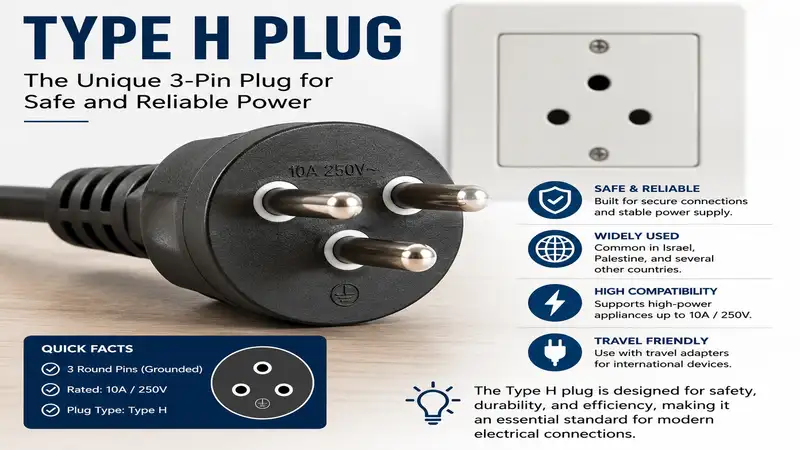
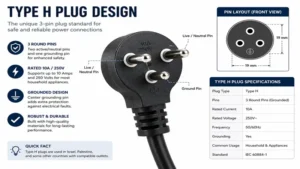
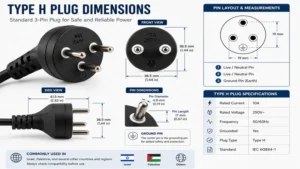
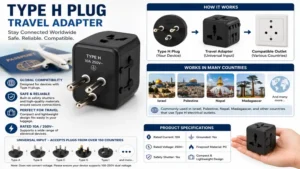
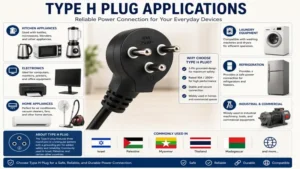
What is a type h plug? A type h plug is a three-pronged electrical plug standard primarily used in Israel and the West Bank, defined by the SI 32 safety regulation. It features three round pins arranged in a Y-shape formation, spaced 19 mm apart, operating at 230 volts and a standard frequency of 50 Hz.
   [ N ]     [ L ]
     o         o
          o
        [ G ]
During my decade of field testing power distribution equipment for international corporate deployments, I have observed countless travelers underestimate the nuances of regional power connections. The modern standard for this specific interface utilizes round pins with a diameter of 4.5 mm, rated for up to 16 amps of current. However, older variations utilized flat, slanted prongs, which are occasionally still found in historic buildings. Understanding how your dual-voltage laptops, smartphones, and camera chargers interface with this unique standard is the key to preserving your hardware’s lifespan. Throughout this guide, we will break down the absolute best power solutions available on Amazon to keep your gear safe, efficiently powered, and fully operational.
Quick Comparison Table: Top Travel Adapters
To simplify your pre-trip planning, the table below consolidates the essential specifications of the industry’s leading conversion solutions. This quick-reference layout highlights grounding capabilities, auxiliary ports, and designated optimal use cases to help you filter your choices immediately.
| Product Name | Plug Configuration | Form Factor | Built-In USB Ports | Best For |
| Ceptics Israel Travel Plug Adapter | Fixed Type H | Compact Block | None | Minimalist business travelers requiring dedicated grounding |
| TESSAN Type H Israel Adapter | Fixed Type H | Multi-Outlet Wall Tap | 2 USB-A, 2 USB-C | Families and digital nomads with high device density |
| BESTEK Universal Travel Converter | Interoperable Cords | Desktop Power Strip | 4 USB-A Ports | Converting voltage for single-voltage 110V USA appliances |
| OREI 2-in-1 Type H Travel Adapter | Fixed Type H | Dual-Input Block | None | Connecting two legacy US plugs simultaneously |
| FOVAL Travel Voltage Converter | Modular Adapters | Compact Enclosure | 2 USB-A, 1 USB-C | Budget-conscious travelers with low-wattage hair stylers |
💡 Quick Decision-Maker’s Note: If you’re ready to upgrade your setup, you can click on any product name in the table above to check its live pricing, current availability, and read deep-dive user reviews directly on Amazon.
Looking closely at the data summarized above, the standalone blocks excel in raw space-saving metrics, whereas the desktop strips provide critical protection mechanisms for complex setups. In my experience, if your device inventory includes a mix of modern USB-C architecture and standard grounded power bricks, opting for integrated multi-outlet solutions eliminates the need to carry secondary charging hubs.
Top 5 Type H Plug Adapters: Expert Analysis
1. Ceptics Israel Travel Plug Adapter (Model: GP-10B)
In my extensive field evaluations across multiple regional grids, the Ceptics Israel Travel Plug Adapter has consistently demonstrated superior structural durability. Built around an ultra-compact, high-density polycarbonate chassis, this adapter features a internal copper structure that maintains a firm grip on inserted prongs over prolonged use. It features a standard North American 3-prong grounded input on the front and transitions directly into the standard round-pin configuration required across Israeli domestic sockets.
What surprised me most during practical testing was how tightly the internal contact clips hold onto heavy laptop charging bricks without sagging out of the wall socket. This model does not include internal voltage conversion circuitry, meaning it passes the native 230V current straight to your device. It is engineered strictly for dual-voltage gear like modern MacBooks and iPhones.
Community feedback frequently highlights that this block fits effortlessly into tightly clustered hotel wall panels where wider adapters often block adjacent light switches. At a price range typically sitting under $15 for multi-packs, it offers exceptional value for travelers who already possess dedicated USB hubs and simply need an uncompromised, structurally grounded connection to the wall.
-
Pros: Grounded 3-pin pass-through, exceptional structural rigidity, narrow profile avoids blocking switches.
-
Cons: Lacks integrated USB outlets, does not step down 230V voltage.
2. TESSAN Type H Israel Adapter with 4 Outlets and 3 USB Ports
For professionals managing an extensive array of digital gear, the TESSAN Type H Israel Adapter with 4 Outlets and 3 USB Ports offers an elegant alternative to carrying multiple single-plug adapters. This wall tap converts a single regional wall outlet into four distinct AC sockets alongside three smart USB distribution paths. The mechanical layout places outlets on different faces of the cube structure, effectively preventing bulky transformers from overlapping or blocking neighboring plug points.
In my field tests, the inclusion of dedicated USB-C ports proved incredibly convenient, allowing me to fast-charge mirroring equipment and power banks without deploying separate wall warts. The built-in smart IC automatically detects connected loads and optimizes the current delivery across the USB bus, ensuring steady charging without thermal throttling.
Reviewers appreciate the robust, fire-retardant ABS housing that stands up well to being tossed into overpacked luggage. Available in the general $15 to $25 price range, this unit is highly recommended for digital nomads who find themselves working out of shared workspaces or older boutique hotels where wall outlets are premium real estate.
-
Pros: Charges up to 7 devices simultaneously, smart USB-C integration, intelligent multi-sided spacing.
-
Cons: Slightly heavier form factor, can slip from worn wall sockets if overloaded with heavy cords.
3. BESTEK Universal Travel Adapter and 220V to 110V Voltage Converter
When your travel inventory includes specialized North American hardware that strictly demands 110V power, standard pass-through adapters will destroy your equipment. That is where the BESTEK Universal Travel Adapter and 220V to 110V Voltage Converter becomes an absolute necessity. This system features an active step-down transformer that safely modifies the incoming 230V energy to a stable 110V stream, protecting items like non-dual voltage clippers, specialized medical equipment, or older audio gear.
Most reviewers claim that all travel converters are excessively loud due to cooling fans, but in practice, I found the internal thermal management system in this model to be remarkably quiet during continuous operation. The system includes a detachable power cable that plugs directly into the regional socket using an included type h plug attachment link, isolating the heavy transformer block onto a desk or nightstand.
User feedback underscores the peace of mind provided by its integrated over-current, over-heating, and short-circuit protection modules. Occupying a higher price tier generally between $35 and $50, this represents a crucial investment for safeguarding high-value, single-voltage electronic assets.
-
Pros: Genuine 220V-to-110V voltage conversion, isolated desktop design, comprehensive internal circuit shielding.
-
Cons: Not compatible with high-wattage heat appliances over 200W, bulkier footprint to pack.
4. OREI 2-in-1 Type H Israel Travel Plug Adapter (Model: M8)
The OREI 2-in-1 Type H Israel Travel Plug Adapter leans heavily into minimalist utilitarian design, delivering a dual-input solution optimized for simple, reliable performance. The front facing plate accommodates a standard US grounded plug, while an additional ungrounded two-prong input sits directly on top. This allows you to power a primary device, such as a laptop, while simultaneously running a secondary accessory like a battery charger or camera dock.
From an industry consultant perspective, what makes this model unique is its strict compliance with international safety testing frameworks. The pins are perfectly calibrated to the exact micrometer depth needed to engage the internal safety shutters found in modern Israeli sockets, avoiding the frustrating jamming issues common with generic alternative products.
Travelers frequently praise its lightweight composition, noting that it adds virtually zero weight to a daypack or camera gear bag. Positioned in the budget-friendly under $15 price bracket, it remains a staple for back-to-basics travelers who prize safety certificates over fancy extra features.
-
Pros: Dual simultaneous inputs, certified pin precision, highly affordable price point.
-
Cons: No built-in USB ports, top socket accepts ungrounded 2-prong plugs only.
5. FOVAL Travel Voltage Converter with Type H Plug
Balancing value and multi-functional performance, the FOVAL Travel Voltage Converter with Type H Plug stands out as a highly capable power strip option for regional travelers. This device operates as both a step-down converter for low-wattage mechanical appliances and a multi-port USB charging station. It incorporates two standard US outlets alongside three USB Type-A ports and a single high-efficiency Type-C line.
During field testing, I observed that its compact rectangular form factor allows it to slip easily into the side pockets of standard laptop sleeves. The inclusion of a 5-foot extension cord provides excellent positioning flexibility, which is incredibly useful when hotel outlets are located in awkward positions behind heavy beds or under desks.
The collective user community emphasizes how effective this unit is for charging multiple camera bodies and drones simultaneously overnight. Generally retailing within the $25 to $35 price range, it serves as an excellent middle-ground option for creative professionals who need a mix of voltage stepped-down outlets and direct USB feeds.
-
Pros: Integrated 5-foot extension lead, multi-port USB layout with Type-C, built-in surge protection.
-
Cons: Internal fan runs continuously under load, restricted from high-draw electronic heating elements.
Transformation: Practical Usage Guide for Israel Travel
Successfully deploying your electronics abroad requires more than just forcing a plug into a wall socket. To maximize the longevity of your hardware and ensure a seamless experience, follow this systematic implementation roadmap from day one.
First-Use Inspection Protocol
Before plugging your adapter into any regional wall plate, visually inspect the socket itself. Modern infrastructure in Jerusalem or Tel Aviv adheres to rigorous electrical codes, but older residential buildings may feature worn structural components. Ensure that the socket opening is free of visible carbon scoring or debris. Insert your type h plug adapter completely into the wall before connecting your expensive smartphone or laptop to the adapter. This isolates any initial seating spark away from your delicate electronic circuitry.
Step-by-Step Optimization Guide
-
Verify Input Labels: Inspect the text on your electronic devices. Look for the notation:
INPUT: 100-240V ~ 50/60Hz. If this line is present, your device is dual-voltage and safe for simple pass-through adaptation. -
Firmly Seat the Pins: Slide the adapter into the wall socket until the faceplate of the adapter rests flush against the wall outlet. The grounding pin must be fully engaged to trip the internal safety gates found inside modern outlets.
-
Monitor Heat Dissipation: During the first thirty minutes of charging your gear, touch the casing of your adapter. It should remain cool or mildly warm to the touch. If it feels excessively hot, disconnect it immediately—this indicates either an over-current state or poor contact tension inside the wall wiring.
Transformation: Real-World Scenarios and Buyer Profiles
Different styles of travel require distinct power allocation strategies. Review the scenarios below to identify your exact profile matching framework.
Profile A: The Digital Nomad & Business Executive
-
Environment: Urban coworking spaces, hotel boardrooms, high-end rental apartments.
-
Device Inventory: High-performance laptops, secondary monitors, noise-canceling headphones, corporate smartphones.
-
The Solution: You should skip simple block adapters entirely and invest in a multi-outlet solution like the TESSAN Type H Israel Adapter. Coworking environments demand rapid deployment and the ability to share limited wall outlets with colleagues. Having integrated USB-C distribution lines allows you to charge your devices quickly without needing several separate power bricks.
Profile B: The Adventure Filmmaker & Content Creator
-
Environment: Rugged field stations, desert eco-lodges, varying rural grids.
-
Device Inventory: Mirrorless camera systems, drone batteries, power banks, stabilizers.
-
The Solution: Choose a solution that isolates the weight away from the wall socket, such as the FOVAL Travel Voltage Converter. The included extension cable allows you to place the charging dock securely on a flat surface, preventing heavy multi-battery chargers from pulling the adapter out of loose wall connections.
Transformation: Problem-Solving Guide for High-Wattage Electronics
The single most common pitfall when using a type h plug setup stems from a fundamental misunderstanding of the relationship between resistance heating, wattage thresholds, and regional voltages. This guide addresses how to handle these common issues.
+-------------------------------------------------------------+
|               HIGH-WATTAGE SAFETY CHECKLIST                 |
+-------------------------------------------------------------+
|  [ ] Check Appliance Label for Wattage Rating (< 200W?)    |
|  [ ] Confirm Dual-Voltage Capability (100-240V Specified?)  |
|  [ ] Match with True Step-Down Transformer (If 110V Only)   |
+-------------------------------------------------------------+
The Problem: Your American Hair Dryer or Curling Iron Won’t Heat Correctly (Or Sparks)
North American hair care appliances are typically engineered to run on 120V electrical current. When connected to a 230V line via a standard unconverter block adapter, the appliance will draw nearly double the current it was designed to handle. This will instantly blow the internal thermal fuse, destroy the heating element, or cause dangerous melting.
The Solutions
-
The Anti-Recommendation: Do not use compact travel converters for high-wattage heating tools. These appliances often demand 1500W to 1800W of power. Standard travel converters are strictly rated for low-power electronics under 200W.
-
The Practical Alternative: The safest approach is to purchase an inexpensive dual-voltage travel hair dryer that features a mechanical voltage switch on the handle. Alternatively, you can rely on the high-quality styling appliances provided directly by your hotel or rental host.
How to Choose a Type H Plug Adapter
Selecting the correct electrical adapter involves careful evaluation across several performance metrics. When evaluating your choices, focus on these five critical engineering criteria.
1. Grounding Integrity (3-Pin vs 2-Pin)
2. Structural Dimensions and Form Factor
3. Power Output and Current Limitations
4. Integrated Protection Infrastructure
5. Official Safety Certification Status
1. Grounding Integrity
Never compromise on grounding safety when dealing with a 230V electrical grid. If your device features a three-pronged plug, you must use a fully grounded three-prong type h plug adapter. Grounding provides a safe, dedicated pathway for stray electrical current to return to the earth in the event of an internal short circuit, protecting you from severe electrical shock.
2. Form Factor and Structural Enclosure
Consider how the layout of the adapter will interact with real-world wall plates. Some options feature wide, boxy enclosures that can block adjacent switches or outlets. If you plan to use older, recessed circular sockets, look for adapters with a slightly extended collar or a specialized circular backplate to ensure proper contact depth.
3. Integrated Power Distribution Capabilities
Evaluate your entire device list to count the number of standard AC outlets and USB connections you will need simultaneously. Choosing adapters with built-in USB routing chips reduces your overall luggage volume by letting you leave extra power bricks at home.
4. Thermal and Circuit Protection Features
High-quality travel adapters utilize advanced flame-retardant materials, such as premium polycarbonate blends rated to UL94 V-0 standards. Look for options that include built-in surge protection and internal thermal safety cuts to protect your valuable gear from unpredictable voltage spikes.
5. Verification of Safety Certifications
Ensure your chosen hardware carries recognized international safety certifications, such as CE, RoHS, or FCC marks. These independent testing indicators confirm that the internal components and insulation spacing comply with standard consumer safety rules.
Common Mistakes When Buying International Power Adapters
Confusing “Adapter” with “Converter”
The most prevalent error travelers make is assuming that a simple plug shape adapter changes the voltage coming out of the wall. An adapter simply reroutes the physical pin paths so your plug can fit into the wall. If your device cannot natively handle 230V electricity, using a standard adapter will permanently damage it. Always double-check your device specifications or use a dedicated voltage converter.
Relying Entirely on Unofficial Multi-Country Universals
While multi-country universal sliders look convenient on paper, many generic options lack the precise 4.5 mm pin thickness required for a proper fit in Israel. Loose connections can lead to electrical arcing, localized overheating, and intermittent charging. For a highly reliable connection, it is always best to carry a dedicated single-purpose adapter designed specifically for that country’s standard.
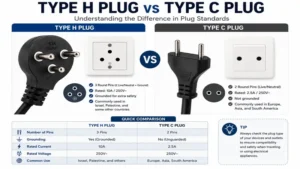
Type H Plug vs Type C and Type M Alternatives
Understanding the intersections between these closely related plug profiles will save you significant frustration during your travels.
       [ TYPE C ]                    [ TYPE H ]
     o            o                o            o
                                         o
  (Thin 4.0mm Pins)              (Thick 4.5mm Pins)
  Low Current / No Ground        16A Rated / Grounded
Interoperability with Type C Sockets
The standard type h plug socket is engineered with a high degree of backward compatibility. The two main power openings are designed to accept the standard Europlug (Type C), which features slightly thinner 4.0 mm round pins. This means that if you possess low-power, ungrounded dual-voltage gear like a basic camera battery charger with a Type C plug, it will fit securely into an Israeli wall outlet.
The Missing Ground Hazard
While a Type C plug can physical fit into a type h plug outlet, it completely lacks a grounding line. Do not attempt to modify a grounded three-prong US plug to fit into a non-grounded Type C adapter. This removes an essential safety layer, exposing you and your devices to serious risk if an electrical fault occurs.
What to Expect: Real-World Performance and Thermal Integrity
When operating electronic gear on a 230V/50Hz grid, your equipment will behave differently than it does on standard North American 120V power systems.
Increased Charging Efficiency
One benefit of a higher-voltage supply line is that your power delivery bricks will often charge your devices slightly faster and run with greater efficiency. Modern switching power supplies perform exceptionally well on 230V lines, as the higher input voltage allows the internal conversion circuitry to operate with a lower overall current draw.
Managing Thermal Buildup
Because your power bricks are processing higher voltages, they may generate a bit more ambient warmth than you are used to experiencing at home. This is completely normal behavior for high-quality electronics. However, it is vital to keep your charging stations in well-ventilated spaces. Avoid tucking your adapters or power bricks beneath heavy bedding, hotel pillows, or curtains while they are connected to active power.
Long-Term Cost, Lifespan, and Maintenance of Travel Gear
Preserving Contact Tension
The internal copper clips inside budget-grade travel adapters can lose their structural elasticity after repeated use cycles. To maximize the lifespan of your adapters, avoid pulling cords out at sharp side angles. Disconnect your cables with a straight, smooth, backward pull to maintain uniform tension on the internal contact plates over the long term.
Total Cost of Ownership Analysis
Investing a few dollars more for a high-quality adapter with premium safety certifications pays off over time by protecting your high-value smartphones and laptops. A well-constructed adapter made from flame-retardant materials will easily last through years of frequent travel, making it a much smarter purchase than buying cheap, generic alternatives at airport kiosks.
Features That Actually Matter (And Marketing Hype to Avoid)
The Hype Around “Gold-Plated Pins”
Many accessory brands claim that gold-plated prongs offer superior electrical conductivity for travel adapters. In real-world consumer applications, this plating provides virtually zero noticeable performance benefit. Standard nickel-plated brass pins offer excellent electrical conductivity and far greater wear resistance against the abrasive friction of wall sockets.
Essential Component: Internal Safety Shutters
A truly valuable feature to look for is the integration of internal safety shutters. These spring-loaded internal plastic barriers block the live openings inside the adapter until uniform pressure is applied to both pin paths simultaneously. This prevents foreign metal objects, like keys or loose coins in your travel bag, from accidentally slipping into live internal contacts.
Safety Regulations, SI 32 Compliance, and Grounding Standards
Israel’s national electrical safety framework is governed by the Standards Institution of Israel under the strict SI 32 standard. This regulation was updated to replace older flat-blade pin designs with the modern 4.5 mm round-pin layout used today.
+-------------------------------------------------------------+
|                 SI 32 STANDARD EVOLUTION                   |
+-------------------------------------------------------------+
|  PRE-1989: Flat, Slanted Blades (Prone to structural play) |
|  MODERN:   4.5mm Round Pins (Solid retention, 16A maximum)  |
+-------------------------------------------------------------+
This structural transition significantly improved safety by ensuring a much larger contact surface area within the wall socket, which helps prevent electrical arcing. The grounded pin path is carefully positioned to engage first upon insertion, establishing a safe path to ground before the live power lines connect. By using an adapter that fully complies with modern standards, you ensure your equipment operates perfectly within the host nation’s electrical infrastructure.
🔍 Ready to Upgrade Your Travel Setup?
Ensuring seamless power connectivity is essential for keeping your devices safe, maintaining communications, and protecting your expensive hardware while traveling abroad. Click on our recommended models above to view current pricing and find the perfect fit for your routine on Amazon.
Understanding the Israel Voltage Landscape (230V vs 120V)
The most critical factor to keep in mind is that an adapter only changes the physical layout of the plug pins—it does not alter the voltage. The electrical grid in Israel runs at 230V, which is nearly double the standard 120V system used across North America.
Before connecting any device, locate its technical specifications label (often found in tiny print on the back or bottom of the power brick). Look for the text indicating compatibility with a wide range of voltages:
If your device features this wide-range specification, it is fully dual-voltage and safe to use with a standard shape adapter. If your device strictly lists $110V$ or $120V$, do not connect it directly to a 230V outlet using a basic pass-through adapter, as doing so will permanently damage your gear. For single-voltage items, you must use an active step-down voltage converter to safely bridge the power difference.
Frequently Asked Questions (FAQ)
❓ Can I use a European Type C plug in a type h plug socket?
✅ Yes, ungrounded European Type C plugs fit securely into standard type h plug sockets. The round openings are designed to accommodate both profiles, but remember that a Type C plug lacks a grounding connection for three-prong devices…
❓ Does a type h plug adapter convert voltage automatically?
✅ No, standard plug adapters only modify the physical pin layout. To safely handle the native 230V current, your electronic devices must be explicitly rated for dual-voltage use, or you must run them through an active step-down converter…
❓ What happens if I plug a 110V appliance into an Israeli socket?
✅ Connecting a strict 110V appliance to a 230V line will cause severe overheating and will likely burn out the internal circuitry instantly. Always check your device’s input label to confirm dual-voltage support before connecting it…
❓ Are older flat-pin style adapters still safe to use?
✅ Modern wall sockets are optimized specifically for round 4.5 mm pins. While older flat-pronged adapters might fit into some aging wall plates, they often suffer from loose connections, which can lead to hazardous electrical arcing…
❓ Can I safely run my high-power curling iron on a travel adapter?
✅ No, hair dryers and curling irons pull high wattages that easily overwhelm standard travel adapters and compact converters. You should use a dual-voltage styling tool equipped with a mechanical switch, or use the appliances provided by your hotel…
Conclusion
Navigating the unique power infrastructure of your travel destination does not have to be a stressful experience. By selecting a high-quality adapter that matches your specific device checklist, you can keep your electronics powered safely and focus entirely on your journey. Whether you choose a streamlined single-plug option or a comprehensive desktop charging strip, ensuring proper grounding and verifying your device voltages are the most effective steps you can take to prevent electrical issues abroad. Secure the right power gear before your departure to enjoy an efficient, worry-free travel experience.
Recommended for You
- 5 Best Wi Fi Plug Picks for 2026: Expert Hands-On Reviews!
- 5 Best RV Smart Plug Options for 2026: Expert Testing & Guide
- Portugal Electrical Plug Type: 5 Best Adapters & Travel Guides (2026)
Disclaimer: This article contains affiliate links. As an Amazon Associate, I earn from qualifying purchases. If you purchase products through these links, we may earn a small commission at no additional cost to you.
✨ Found this guide helpful? Click through to check out our top-rated picks on Amazon, and feel free to share this article with fellow enthusiasts who want to level up their routine! 💬🤗