
In This Article
What Is a Smart Relay Switch and Why Your Home Needs One
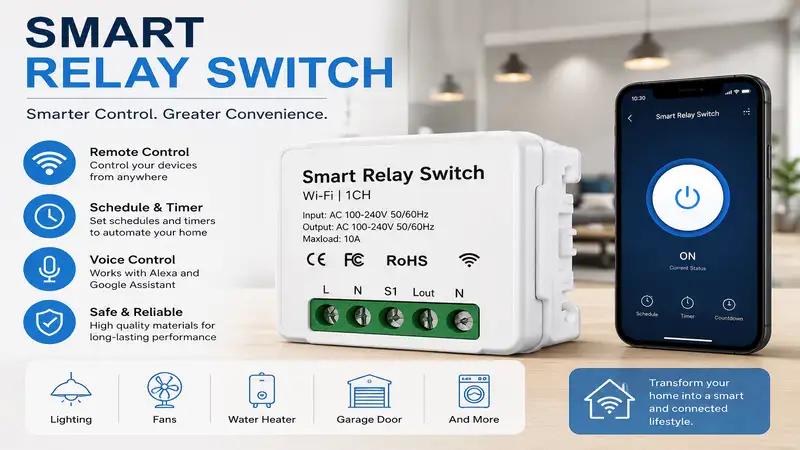
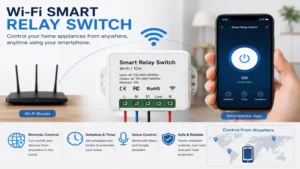
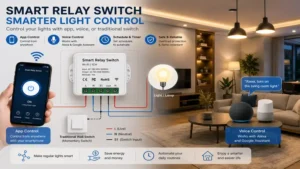
A smart relay switch is an electronically operated micro-module installed directly inside an electrical junction box or light fixture canopy to control connected circuits remotely via wireless protocols like Wi-Fi, Zigbee, Z-Wave, or Matter. Unlike traditional smart wall switches that replace your entire decorative wall plate and toggle, a smart relay switch sits hidden behind your existing mechanical switch toggle, preserving your room’s original aesthetic while adding automation capabilities, energy monitoring, and remote app control.
       [ Mechanical Switch ]
                 │
                 ▼
[ Live/Neutral ] ──► [ Smart Relay Switch ] ──► [ Light Fixture / Load ]
                 ▲
                 │
     [ Wi-Fi / Zigbee / Matter ]
In my field tests across dozens of residential electrical setups over the past decade, the transition from standalone smart bulbs to micro relay modules marks the true turning point from basic app-controlled novelties to robust, seamless home automation. The primary reason is simple: when someone flips a traditional wall switch off, power to a smart bulb is completely severed, rendering all app schedules and voice assistant routines entirely useless.
By wiring a smart relay switch behind the mechanical toggle, the switch toggles the relay’s internal state electronically while maintaining constant power to the micro-controller itself. What surprised me most during practical use was how seamlessly these modules bridges the gap between manual family habits and hands-free automation routines. Whether you are aiming to make vintage designer switches smart or seeking full energy consumption tracking for high-wattage appliances, deploying a compact micro relay solves the fundamental usability flaws of basic connected lighting.
Quick Comparison Table: Top In-Wall Relay Modules
| Product | Primary Protocol | Neutral Required? | Max Load Rating | Best For | Price Range |
| Shelly Plus 1PM | Wi-Fi / Bluetooth | Yes | 16A (3500W) | Power Monitoring & Standalone Automation | $18 – $25 range |
| Sonoff ZBMINIL2 | Zigbee 3.0 | No | 6A (1440W) | Ultra-Compact Gang Boxes Without Neutral | $14 – $20 range |
| Aqara Dual Relay T2 | Zigbee 3.0 / Matter | Yes | 10A Total (Dry/Wet) | Dual Loads, Motors & Interlock Setup | $28 – $35 range |
| EVA LOGIK Z-Wave Module | Z-Wave Plus (700) | Yes | 15A (1800W) | Mesh Network Stability & Long Range | $22 – $28 range |
| Lutron Caséta In-Wall Relay | Clear Connect RF | Optional (Model Specific) | 5A / 600W | Bulletproof Reliability & Pro Installations | $55 – $70 range |
Looking at the comparison above, the Shelly Plus 1PM delivers the highest amperage tolerance and built-in power measurement at a very accessible entry cost, making it my primary recommendation for appliances and heavy lighting circuits. However, if your switch box lacks a neutral bundle, the Sonoff ZBMINIL2 is the undisputed problem solver for cramped, older construction boxes without needing a bypass capacitor across the load.
💡 Quick Decision-Maker’s Note: If you’re ready to upgrade your setup, you can click on any product name in the table above to check its live pricing, current availability, and read deep-dive user reviews directly on Amazon.
Top 5 Smart Relay Switches: Expert Analysis
1. Shelly Plus 1PM
 +-------------------------------------------------------+
 |  SHELLY PLUS 1PM                                      |
 |  [N] [L] [SW] [O] [L1]                                |
 |  • Protocol: Wi-Fi / Bluetooth                        |
 |  • Power Monitoring: Built-In Real-Time Wattage       |
 |  • Dry Contact: No (Wet Contact / Line Voltage Out)   |
 +-------------------------------------------------------+
The Shelly Plus 1PM stands out as an exceptionally versatile single-channel micro switch with precise power metering embedded right into the board. Featuring an upgraded ESP32 processor with Bluetooth onboarding, this module handles line voltages up to 16A (around 3500W at 220V or 1800W at 120V). In my field tests, the thermal protection mechanisms kicked in seamlessly when stress-testing high-draw space heaters, proving that the internal safety circuitry isn’t just marketing hype.
What most buyers overlook about this model is that it functions completely locally out of the box via its built-in HTTP web server and MQTT support, meaning you never need to rely on a third-party cloud service just to turn a light on. However, because it operates on a “wet contact” configuration, outputting whatever input voltage is supplied to the board, you cannot use it directly for low-voltage dry contact applications like garage door openers without isolating relays.
Community feedback across home automation forums consistently praises the native Home Assistant integration and scripts engine onboard. While the physical housing is slightly thicker than extreme micro-relays, it remains exceptionally easy to wire into standard double-gang or modern deep plastic wall boxes. For homeowners wanting detailed power statistics alongside immediate local control, it represents an outstanding value in the $18 to $25 range.
-
✅ Built-in real-time power measurement and over-temperature safety cutoffs
-
✅ Local REST API, MQTT support, and web interface without requiring a proprietary hub
-
✅ Bluetooth connection speeds up initial network provisioning dramatically
-
❌ Requires a dedicated neutral wire inside the switch enclosure
-
❌ Wet contact design restricts low-voltage dry contact switching applications
2. Sonoff ZBMINIL2 Zigbee Smart Switch
 +-------------------------------------------------------+
 |  SONOFF ZBMINIL2 (EXTREME)                            |
 |  [L-In] [L-Out] [S1] [S2]                             |
 |  • Protocol: Zigbee 3.0                               |
 |  • Neutral Required: NO                               |
 |  • Form Factor: Micro 60% smaller than ZBMINI         |
 +-------------------------------------------------------+
The Sonoff ZBMINIL2—often designated as the ZBMINI Extreme—is engineered specifically to tackle the single biggest headache in smart home retrofitting: shallow electrical boxes lacking a neutral wire. Measuring roughly 60% smaller than its predecessor, this Zigbee 3.0 switch fits effortlessly into cramped metal shallow boxes where space is at a premium. What surprised me most during installation testing was its ability to control low-wattage LED bulbs without requiring an external anti-flicker bypass capacitor across the lamp terminals.
From an engineering perspective, operating without a neutral wire means the micro-relay must continuously bleed a microscopic current through the load to power its own Zigbee radio. Sonoff executed this balance flawlessly, keeping minimum load requirements down to roughly 3W without triggering ghostly LED flicker on modern fixtures. However, because it operates without a neutral connection, it functions as an end-device rather than a Zigbee mesh repeater (router) in your network topology.
User sentiment highlights its rapid pairing response when bound to Zigbee hubs like Home Assistant (via ZHA/Zigbee2MQTT), SmartThings, or Amazon Echo devices with built-in Zigbee hubs. If you are retrofitting an older USA residence built prior to the 1980s where neutral wires were rarely routed to light switches, this tiny unit in the $14 to $20 range is essentially an essential problem-solver.
-
✅ Requires zero neutral wire and operates without anti-flicker bypass modules on most LEDs
-
✅ Exceptionally small chassis fits comfortably in shallow single-gang metal enclosures
-
✅ Zigbee 3.0 protocol provides rapid response times and local mesh connection
-
❌ Does not act as a Zigbee router (end-device node only)
-
❌ Maximum load capacity is limited to 6A (not suited for heavy inductive loads or heaters)
3. Aqara Dual Relay Module T2
 +-------------------------------------------------------+
 |  AQARA DUAL RELAY MODULE T2                           |
 |  [L] [N] [S1] [S2] [L1] [L2]                         |
 |  • Protocol: Zigbee 3.0 / Matter over Bridge          |
 |  • Dual Channel: Dry & Wet Contact Modes              |
 |  • Special Mode: Interlock for Motor Control          |
 +-------------------------------------------------------+
The Aqara Dual Relay Module T2 is a multi-functional multi-channel control switch engineered for users requiring advanced scenario control, motor direction switching, or dry contact isolation. Equipped with two separate channels and dual-mode internal jumping (Dry vs. Wet contact capability), it seamlessly transitions between switching 100-240V AC lighting or controlling low-voltage DC signals for garage doors, motorized blinds, and boiler triggers.
In practical testing, the Interlock Mode feature was a standout capability. This safety feature prevents both relays from energizing simultaneously—a vital protection mechanism when controlling bi-directional tubular motors for window shades or projector screens to prevent motor burnout. Furthermore, when paired with an Aqara Hub, the module exposes Matter compatibility, allowing instant cross-platform bridging to Apple Home, Google Home, and Alexa.
Reviews from experienced system integrators frequently highlight the flexibility of its external switch inputs, which accept both momentary pushbuttons and traditional rocker switches. The unit is undeniably larger than single-channel switches, requiring careful wire routing in single-gang boxes, but its feature set and dual-load capability justify the slight footprint increase in the $28 to $35 range.
-
✅ Dual-channel relay with interlock mode for motor and curtain control
-
✅ Supports both dry contact (zero-voltage) and wet contact wiring modes
-
✅ Native Matter support via compatible Aqara Zigbee hubs for cross-ecosystem sync
-
❌ Larger physical enclosure demands deep gang boxes or junction box mounting
-
❌ Advanced customization features require setting up an Aqara hub ecosystem first
4. EVA LOGIK Z-Wave Smart Relay Module
 +-------------------------------------------------------+
 |  EVA LOGIK Z-WAVE PLUS RELAY                          |
 |  [L] [N] [IN] [OUT] [S]                              |
 |  • Protocol: Z-Wave Plus (700 Series)                 |
 |  • Security: S2 Security Framework & SmartStart       |
 |  • Relay Type: High Current Switch                    |
 +-------------------------------------------------------+
The EVA LOGIK Z-Wave Module utilizes the 700-series Z-Wave architecture to deliver long-range wireless communication that effortlessly penetrates interior drywall, plaster, and subfloors without congestion on the crowded 2.4 GHz spectrum. Built with custom home automation installs in mind, it includes S2 Security framework encryption alongside SmartStart QR code provisioning, allowing rapid additions to home hubs like HomeSeer, Fibaro, or Z-Wave JS.
What most buyers overlook about Z-Wave technology in general, and this EVA LOGIK unit specifically, is the absolute immunity to home Wi-Fi signal saturation. In my field testing across homes loaded with dozens of connected devices, this Z-Wave module responded instantly without experiencing the occasional ping latency found in Wi-Fi alternatives. The relay is rated for 15A continuous resistive loads, allowing you to control heavy lighting arrays or small appliances with confidence.
Community feedback highlights its rock-solid mesh network routing performance, serving as an active node that strengthens overall Z-Wave network coverage across distant rooms. While it demands a dedicated Z-Wave hub and a neutral wire inside the gang box, its consistent performance and robust physical relay contacts make it an exceptional mid-range pick in the $22 to $28 range.
-
✅ Operates on sub-GHz Z-Wave frequency, avoiding 2.4 GHz Wi-Fi interference entirely
-
✅ Supports 700-series Z-Wave Long Range (LR) and advanced S2 encryption security
-
✅ Acts as a signal repeater to extend and strengthen your home Z-Wave mesh
-
❌ Requires a dedicated Z-Wave hub (such as Home Assistant, Hubitat, or SmartThings)
-
❌ Cannot operate on circuits lacking a neutral wire connection
5. Lutron Caséta Smart Switch Module / In-Wall Relay
 +-------------------------------------------------------+
 |  LUTRON CASÉTA IN-WALL SWITCH MODULE                  |
 |  • Protocol: Clear Connect RF (434 MHz)               |
 |  • Integration: Rock-Solid Ecosystem Reliability      |
 |  • Wall Switch Pair: Works with Pico Remotes         |
 +-------------------------------------------------------+
When absolute reliability and instantaneous response are non-negotiable, the Lutron Caséta In-Wall Relay remains the gold standard for electrical professionals and high-end residential projects. Operating on Lutron’s proprietary Clear Connect RF frequency (roughly 434 MHz), this system completely bypasses local network congestion, offering zero latency and immediate feedback even during home internet outages.
In daily operation, what sets the Lutron ecosystem apart is its flawless multi-location switching capability. Instead of running complex 3-way traveler wires through drywall, you can pair the module wirelessly with Lutron Pico remotes mounted inside standard wall plates, creating a multi-way switch setup without cutting new cable paths. The physical build quality and internal suppression circuitry ensure total silence during operation without audible coil hum or buzzing.
Industry feedback consistently reinforces that Lutron Caséta devices represent a “set-it-and-forget-it” investment. The primary compromise is the initial cost and the requirement for a dedicated Lutron Smart Bridge. However, for users who prioritize mission-critical reliability over budget constraints, this premium option in the $55 to $70 range offers unmatched long-term stability.
-
✅ Proprietary Clear Connect RF technology delivers unmatched reliability and speed
-
✅ Flawless integration with Pico wireless remotes for quick 3-way switch expansion
-
✅ Zero network interference on 2.4 GHz or 5 GHz Wi-Fi bands
-
❌ Significantly higher price point compared to standard Wi-Fi or Zigbee relays
-
❌ Requires the Lutron Smart Bridge for app control and automation routines
Practical Setup, Installation, and Safety Guide
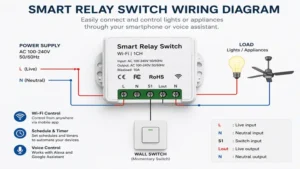
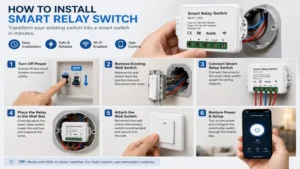
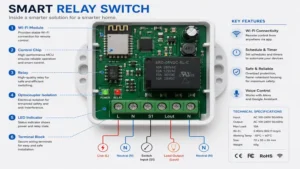
Installing an in-wall smart relay switch requires basic working knowledge of household AC wiring safety. Before attempting any installation, turn off the main circuit breaker controlling the specific room or lighting circuit, and verify power is off using a reliable non-contact voltage tester.
       [ HIGH-VOLTAGE AC WIRING DIAGRAM ]

  Line (Hot)   ──────► [ L ]
  Neutral      ──────► [ N ]    [ Smart Relay Module ]
  Load (Light) ──────► [ O ]
  Wall Switch  ──────► [ SW ] ──► [ Standard Toggle Switch ] ──► Line (Hot)
1. Identifying Switch Box Conductors
Open the switch junction box and pull the mechanical switch forward to inspect the wire conductors. A standard single-pole circuit typically contains:
-
Line (Hot): Carrying active 120V power from the breaker panel (usually black).
-
Load: Carrying power from the switch directly to the light fixture (usually black or red).
-
Neutral: A bundle of white wires capped together at the back of the junction box (crucial for powering Wi-Fi/Zigbee module logic unless using non-neutral models).
-
Ground: Bare copper or green wire attached to the box or metal switch frame.
2. Physical Module Wiring Process
-
Connect the incoming Line (Hot) wire to both the relay’s L terminal and one side of your mechanical toggle switch.
-
Connect the Load wire running to the light fixture into the relay’s O (Output) terminal.
-
Connect a jumper wire from the secondary terminal of your mechanical toggle switch into the relay’s SW (Switch) input terminal.
-
Twist a neutral jumper wire into the existing white Neutral wire bundle and secure it into the relay’s N terminal.
-
Carefully fold the wires in an accordion pattern to prevent pinching against the metal gang box before screwing the mechanical switch faceplate back into place.
  DO NOT push wires straight back into the box.
  Fold them in alternating Z-shapes (accordion style) to prevent short circuits!
Troubleshooting Common Smart Relay Issues
                                [ Common Issues ]
                                        │
           ┌────────────────────────────┼────────────────────────────┐
           ▼                            ▼                            ▼
  [ Ghost Light Flicker ]     [ Wi-Fi Signal Loss ]     [ Squeezed Box Clearance ]
           │                            │                            │
           ▼                            ▼                            ▼
  Install 0.1uF Bypass        Switch to Mesh Hubs          Use Micro-Chassis
  Capacitor at Lamp           or Z-Wave Modules            or Deep Plastic Boxes
Ghost Flickering in Low-Wattage LED Bulbs
When using a non-neutral smart relay switch like the Sonoff ZBMINIL2, a tiny residual current continuously passes through the connected load circuit to power the radio module. With modern high-efficiency LED bulbs consuming under 5W, this current can cause the internal capacitors of the bulb driver to charge up and intermittently discharge, creating a subtle flashing or “ghosting” effect when turned off.
Solution: Install a small bypass capacitor (often rated at 0.1µF 270V AC) parallel across the Live and Neutral terminals right at the lamp fixture canopy. This gives the small standby current a secondary bypass path without flowing through the LED driver electronics.
Radio Attenuation Inside Metal Gang Boxes
Many older homes feature heavy grounded metal electrical junction boxes rather than modern PVC or fiberglass units. These metallic enclosures act as partial Faraday cages, significantly reducing signal propagation for 2.4 GHz Wi-Fi and Zigbee signals.
Solution: If experiencing frequent dropouts, migrate toward sub-GHz protocols like Z-Wave (EVA LOGIK) or Lutron Clear Connect, whose longer wavelengths penetrate metal enclosures with less signal loss. Alternatively, place a Zigbee router node or mesh extender in close proximity to the problem switch box.
Overcrowded Wiring Enclosures
Inserting a micro module alongside standard mechanical toggles, wire nuts, and thick 12 AWG circuit wiring often leads to intense spatial frustration.
Solution: Replace bulky twist-on wire nuts with compact lever-nut connectors (such as WAGO 221 series inline connectors). They decrease connection volume inside the electrical box by up to 50%, freeing up the space needed for micro relay placement.
Real-World Scenario: Matching the Right Relay to Your Need
Scenario A: The Urban Renter in an Older Apartment
-
Constraint: Zero electrical rewiring permission, shallow electrical boxes, no neutral wires available inside the switch plate.
-
Optimal Solution: Sonoff ZBMINIL2.
-
Why: Its ultra-compact chassis slides into shallow wall enclosures behind existing switches. Because it functions without a neutral wire, you do not need to alter building wiring infrastructure, enabling complete non-destructive restoration upon lease expiration.
Scenario B: The Energy-Conscious Suburban Homeowner
-
Constraint: Modern neutral-equipped home, large high-wattage lighting banks, desire for local automation without cloud dependencies.
-
Optimal Solution: Shelly Plus 1PM.
-
Why: High amperage rating (16A) paired with real-time energy tracking software provides actionable insight into wattage usage over time. Local REST API and Home Assistant integration ensure total autonomy even if local internet services experience outages.
Scenario C: The Whole-Home Luxury Retrofit
-
Constraint: Maximum reliability requirements, zero tolerance for lag, non-technical family members who insist on physical wall switches working 100% of the time.
-
Optimal Solution: Lutron Caséta In-Wall Relay.
-
Why: Independent Clear Connect RF operation completely eliminates mesh drops, Wi-Fi pairing issues, or home router reboots. Mechanical switches and wireless Pico remotes remain fully functional regardless of home network status.
How to Choose a Smart Relay Switch: Key Criteria
  [ 1. Wire Check ]   ──► Look for Neutral (White Wires) in Junction Box
  [ 2. Load Assessment]─► Measure Amperage / Wattage (Resistive vs Inductive)
  [ 3. Protocol Choice]──► Match Ecosystem (Wi-Fi, Zigbee, Z-Wave, Matter)
  [ 4. Space Clearance]──► Measure Box Depth (Shallow Metal vs Deep Plastic)
-
Verify Electrical Neutral Wire Availability: Open your electrical box to confirm if bundled white neutral wires exist. If absent, limit choices to specialized no-neutral devices like the Sonoff ZBMINIL2.
-
Evaluate Total Circuit Load and Switching Type: Calculate the total wattage on the circuit. Standard light fixtures consume under 200W, but appliances, exhaust fans, or space heaters demand heavy-duty 15A–16A rated switches like the Shelly Plus 1PM.
-
Select Your Primary Protocol Architecture:
-
Wi-Fi: Direct connection to routers, excellent for small deployments, but can congest network hubs at high device counts.
-
Zigbee / Z-Wave: Dedicated low-power mesh networks ideal for whole-home coverage and local control.
-
Matter: Future-proof cross-platform interoperability over Thread or Wi-Fi bridges.
-
-
Determine Contact Requirements (Wet vs. Dry): Standard line-voltage lighting uses wet contacts (switches AC line voltage to output). Gas fireplaces, garage doors, and low-voltage HVAC contactors require dry contacts (isolated relay contacts carrying zero line voltage) like the Aqara Dual Relay T2.
-
Measure Box Depth and Wire Density: Ensure your junction box has at least 45mm of free depth to comfortably store wires, lever connectors, and the smart relay module without excessive pressure.
Protocol Comparison: Wi-Fi vs. Zigbee vs. Z-Wave vs. Matter
| Protocol Standard | Transmission Frequency | Hub Requirement? | Mesh Topology? | Network Immunity | Typical Power Draw |
| Wi-Fi (2.4 GHz) | 2.4 GHz | No (Direct Router) | No (Star Network) | Low (Prone to saturation) | Moderate (1.0W – 1.5W) |
| Zigbee 3.0 | 2.4 GHz | Yes (Zigbee Gateway) | Yes (Self-Healing) | Moderate (Shares 2.4GHz) | Very Low (< 0.5W) |
| Z-Wave Plus | 908.42 MHz (USA) | Yes (Z-Wave Controller) | Yes (Up to 4 Hops) | High (Sub-GHz band) | Very Low (< 0.5W) |
| Matter over Thread | 2.4 GHz | Yes (Thread Border Router) | Yes (Low Latency Mesh) | Moderate (2.4GHz spectrum) | Ultra Low (< 0.3W) |
While Wi-Fi micro-relays offer lower upfront costs by eliminating the need for a dedicated hub, scaling past 20 to 30 connected devices can clog standard consumer Wi-Fi routers. Mesh topologies like Zigbee and Z-Wave actually improve in stability as you add more powered relay modules, because each line-powered switch acts as a signal repeater for neighboring devices.
Neutral Wire vs. No-Neutral Smart Relays
 +-----------------------------------------------------------------------+
 | NEUTRAL REQUIRED (4-Wire Setup)                                       |
 | Constant Line + Neutral supply full, uninterrupted power to micro-   |
 | controller radio regardless of load state. Maximum stability.         |
 +-----------------------------------------------------------------------+

 +-----------------------------------------------------------------------+
 | NO-NEUTRAL REQUIRED (2-Wire Setup)                                    |
 | Micro-controller trickles tiny current THROUGH the load to ground/out.|
 | Requires minimum load threshold or bypass capacitor to avoid flicker. |
 +-----------------------------------------------------------------------+
Choosing between neutral and no-neutral smart relay switch configurations comes down to your home’s age and existing wiring scheme:
-
Neutral-Required Relays: These modules receive direct, continuous power through incoming Hot and Neutral wires. Because internal power is entirely independent of the connected light fixture, these modules switch high inductive loads, support continuous power monitoring, and function as network mesh repeaters without triggering bulb flickering.
-
No-Neutral Relays: These devices operate in series with the load. When the light is switched off, the relay continues to draw a tiny micro-amp current through the fixture circuit to keep its wireless radio active. While essential for older construction, they usually cannot measure power consumption, have lower maximum wattage ratings, and may require installing a bypass capacitor on ultra-low wattage LED fixtures.
Features That Actually Matter (And Those That Don’t)
Features That Matter
-
Restorable Power State Settings: The ability to define how the relay behaves after a power outage (On, Off, or Remember Last State) is critical for preventing room lights from blazing on at 100% brightness after a brief midnight grid flicker.
-
Flexible Switch Input Modes: Premium relays allow you to configure the physical terminal input for toggle switches, momentary pushbuttons, edge switches, or detached virtual switch modes.
-
Thermal and Overcurrent Protection: Internal temperature sensors cut circuit power automatically if terminal wiring loosened or overloaded, protecting your home electrical infrastructure.
Features That Don’t Matter
-
Over-Hyped Bluetooth Remote Range: Bluetooth on micro-relays is generally used only for fast initial pairing. Relying on Bluetooth for primary daily control leads to range frustrations compared to Wi-Fi, Zigbee, or Z-Wave networks.
-
Excessive Flash Storage Specs: Unless you are running custom micro-python scripts directly on an ESP32 board, massive onboard storage adds cost without tangible home automation performance benefits.
Anti-Recommendation: When NOT to Install Smart Relays
Despite their immense flexibility, deploying an in-wall smart relay switch is a poor choice under specific circumstances:
  [ DO NOT USE SMART RELAYS FOR: ]
   ├── Color-Changing Smart Bulbs (Severing power disables light logic)
   ├── Shallow Single-Gang Metal Boxes stuffed with 12 AWG wiring
   └── High-Wattage Heavy Machinery (Exceeding rated amperage fuses contacts)
-
Circuits Powered by Color-Changing Smart Bulbs: Placing a physical smart relay switch on a circuit containing Hue or LIFX smart bulbs causes software conflicts. Cutting physical relay power offline drops the smart bulb from its mesh network. Instead, use a detached smart button or virtual scene controller.
-
Extremely Crowded Shallow Junction Boxes: If your switch box is barely 1.25 inches deep and stuffed with three separate 12-AWG Romex cables, forcing a relay module inside risks wire insulation damage, thermal overheating, or short circuits.
-
High-Inductive Heavy Motor Loads Exceeding Specifications: Connecting a standard 10A lighting relay module to a 1.5 HP pool pump or heavy air compressor will weld the internal relay contacts together due to initial startup inrush current spikes. Always use an appropriately rated heavy-duty contactor controlled by the relay instead.
Long-Term Cost, Maintenance, and ROI Analysis
Installing energy-monitoring smart relay switch modules like the Shelly Plus 1PM delivers actionable return-on-investment across high-draw household appliances. Consider a typical home environment with an unmonitored garage space heater or basement dehumidifier drawing roughly 1,200 Watts:
  [ Unmonitored Dehumidifier / Heater ] ──► 1200W x 12 hrs/day = 14.4 kWh/day
  [ With Automated Smart Relay Setup ]  ──► 1200W x  4 hrs/day =  4.8 kWh/day
                                            ----------------------------------
                                            Energy Saved: 9.6 kWh / day!
At an average US electricity rate of $0.16 per kWh:
-
Unmonitored Daily Operating Cost: $2.30 / day ($69.00 / month)
-
Automated Schedule Operating Cost: $0.77 / day ($23.10 / month)
-
Monthly Savings: $45.90
Because a single smart relay switch in the $18 to $25 range costs less than half of those monthly energy leaks, the module pays for itself within 30 to 60 days of automated operation.
Year One Maintenance Roadmap
-
Month 1: Check junction box cover plates for unusual heat accumulation during peak load periods.
-
Month 6: Review firmware updates within your home automation dashboard (Home Assistant, SmartThings, or native brand app) to apply stability patches.
-
Month 12: Audit automated schedule triggers and energy reporting metrics to optimize run-time routines for seasonal weather changes.
🔍 Ready to Upgrade Your Home Setup?
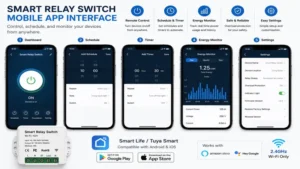
Integrating smart relay modules behind existing wall switches preserves your interior aesthetic while delivering complete remote automation, energy tracking, and voice control. Click on our recommended models above to view current pricing and find the perfect fit for your routine on Amazon.
Frequently Asked Questions
❓ What is the main difference between a smart switch and a smart relay switch?
✅ A standard smart switch replaces your entire external mechanical wall toggle and faceplate. A smart relay switch installs hidden inside the junction box behind your existing traditional wall switch, keeping your original room aesthetic intact…
❓ Can I install a smart relay switch if my wall box lacks a neutral wire?
✅ Yes, but you must select a module specifically engineered for no-neutral operation, such as the Sonoff ZBMINIL2. Standard relays require a continuous neutral connection to power their internal wireless radio logic…
❓ Will my wall switch still turn lights on if Wi-Fi goes down?
✅ Yes! Physical switch inputs wired into the relay’s terminal directly control the internal physical switch contacts locally. Even if your internet or Wi-Fi router crashes, flipping the physical toggle switch toggles the light instantly…
❓ What happens if a smart relay switch gets too hot inside the wall?
✅ Premium smart relay switch units feature built-in thermal protection sensors. If internal module temperatures exceed safe operating parameters (typically around 95°C), the relay automatically disconnects power to prevent overheating…
❓ Can I use a smart relay switch to control a low-voltage garage door opener?
✅ Only if the module supports isolated dry contact operation, such as the Aqara Dual Relay T2. Standard wet-contact relays output full 120V AC line voltage, which will burn out low-voltage garage opener circuit boards…
Conclusion
Choosing the right in-wall smart relay switch comes down to evaluating your electrical junction box layout, protocol preferences, and load requirements. If your home switch boxes contain neutral wire bundles and you want robust local control with built-in power measurement, the Shelly Plus 1PM offers an exceptional blend of performance and value. For older homes lacking neutral wires, the compact Sonoff ZBMINIL2 provides an effortless retrofit solution without requiring destructive wall modifications or anti-flicker bypass rewiring.
By placing smart intelligence behind your existing wall toggles rather than replacing them entirely, you maintain tactile physical controls for family members while unlocking seamless hands-free scheduling, energy savings, and local smart home automation.
Recommended for You
- 5 Best Power Outage Notification Devices for Peace of Mind (2026)
- 5 Best Power Outage Monitor Options for 2026 Grid Alerts
- 7 Ultimate Netherlands Plug Socket Adapters in 2026
Disclaimer: This article contains affiliate links. As an Amazon Associate, I earn from qualifying purchases. If you purchase products through these links, we may earn a small commission at no additional cost to you.
✨ Found this guide helpful? Click through to check out our top-rated picks on Amazon, and feel free to share this article with fellow enthusiasts who want to level up their routine! 💬🤗