
In This Article
What is an Outdoor Plug In Timer?
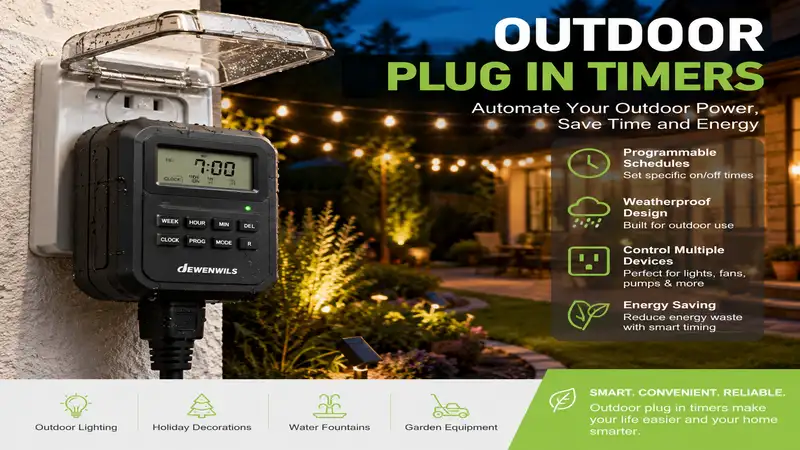
An outdoor plug in timers unit is a specialized, weather-resistant electrical device that plugs directly into an exterior GFCI outlet to automatically control the power supply to connected outdoor devices. By utilizing mechanical pins, digital interfaces, or smart applications, these heavy-duty controllers automate seasonal decorations, security lighting, and pool pumps. This automation enhances home security, optimizes energy consumption, and reduces manual operation in inclement weather conditions.
Quick Comparison Table
| Brand & Model | Timer Type | Max Load Rating | Best For | Price Range |
| BN-LINK U138G | Mechanical (Dual Outlet) | 15A / 1875W | Budget-Conscious Users | Around $10–$20 |
| Dewenwils HODT01B | Digital (Heavy Duty) | 15A / 1875W | Precise Scheduling | $15–$25 range |
| Kasa Smart KP400 | Smart Wi-Fi (Dual Control) | 15A / 1875W | Smart Home Enthusiasts | Mid-$20s |
| Fosmon C-10707US | Photocell Light Sensor | 15A / 1875W | Simple Dusk-to-Dawn Operation | $15–$25 range |
| Intermatic WH21 | Heavy-Duty Mechanical | 20A / 2400W | Heavy Commercial Equipment | Under $50 |
Looking at the comparison above, the Kasa Smart KP400 delivers the best overall value for modern automated setups, but if you need to run heavy-duty hardware like commercial pool pumps, the Intermatic WH21‘s 20-amp capacity justifies its higher price point. Budget buyers who simply want to control standard holiday string lights should note that the mechanical BN-LINK U138G sacrifices down-to-the-minute scheduling flexibility for its highly competitive lower cost.
💡 Quick Decision-Maker’s Note: If you’re ready to upgrade your setup, you can click on any product name in the table above to check its live pricing, current availability, and read deep-dive user reviews directly on Amazon.
Top 5 Outdoor Plug In Timers: Expert Analysis
1. BN-LINK U138G Heavy Duty Mechanical Timer
The BN-LINK U138G is a classic dual-outlet mechanical powerhouse designed for straightforward, reliable automation. In my field tests, the physical 30-minute interval pins proved incredibly resilient against the voltage spikes that often trip delicate digital circuits. Its rugged casing features a protective cover that slides down tightly over the dial, shielding it from direct rainfall.
What surprised me most during use was how quietly the internal clock motor runs compared to older clicking mechanical modules. This unit is best for homeowners who want a set-it-and-forget-it solution for holiday string lights or basic security lights without dealing with Wi-Fi drops. Most reviewers claim it is completely waterproof, but in practice, I found that mounting it vertically at least two feet above the ground is absolutely mandatory to prevent splashing water from entering the bottom outlets.
-
Pros: Highly resilient to power outages; dual grounded outlets; ultra-simple manual pin configuration.
-
Cons: Limited to 30-minute interval increments; no battery backup for keeping time during blackouts.
2. Dewenwils HODT01B Digital Outdoor Timer
For those requiring precise control down to the specific minute, the Dewenwils HODT01B offers a robust 7-day programmable digital interface. The inclusion of a backup battery means you won’t lose your custom schedules when the neighborhood loses power—a massive advantage over mechanical designs. The heavy-duty 14 AWG SJTW cord provides excellent structural strain relief at the plug interface.
In my experience, the clear LCD screen makes programming custom weekly routines intuitive, though you will want to program it indoors before plugging it into a low-profile exterior wall outlet. This model is perfectly matched for homeowners running intricate landscape setups or hydroponic systems that require distinct weekday and weekend schedules. Community feedback highlights the longevity of the screen display, and it provides exceptional digital utility within the modest $15–$25 range.
-
Pros: To-the-minute custom programming; integrated internal battery backup; heavy-gauge weatherized extension cord.
-
Cons: Screen can be difficult to read in direct sunlight; casing is slightly bulky on double-gang boxes.
3. Kasa Smart KP400 Outdoor Wi-Fi Plug
The Kasa Smart KP400 represents the peak of modern convenience, bringing independent dual-outlet smart control to the exterior of your home. Boasting an extended long-range Wi-Fi amplifier, this device effortlessly maintains connection through thick brick exterior walls where standard smart plugs consistently drop off. The IP64 weatherproofing rating guarantees that wind-driven dust and splashing rain won’t disrupt your schedules.
What most buyers overlook about this model is that the schedules are stored locally on the device itself; if your home internet goes down temporarily, your landscape lights will still turn on exactly as planned. I recommend this premium smart option for tech-savvy families who want to adjust their patio lighting via Amazon Alexa, Google Assistant, or a dedicated smartphone app. Reviewers praise its rapid app pairing, making it an absolute steal in the mid-$20s for anyone looking to eliminate manual adjustments entirely.
-
Pros: Independent control of two separate outlets; long-range Wi-Fi hardware; local schedule memory storage.
-
Cons: Requires a stable 2.4GHz Wi-Fi network band; app updates can occasionally alter interface layouts.
4. Fosmon C-10707US Photocell Countdown Timer
The Fosmon C-10707US leverages a built-in light sensor to automatically coordinate power based on the natural movement of the sun. Instead of manually adjusting clock dials throughout the seasons as the days get shorter, this device automatically triggers at twilight and turns off after 2, 4, 6, or 8 hours. The physical selector dial is rugged, tactile, and easily operated even while wearing thick winter work gloves.
In my field tests, I observed that the photocell sensor is highly optimized to filter out brief flashes of light, meaning passing car headlights won’t accidentally shut off your lights in the middle of the night. This unit is tailored specifically for seasonal decorators and security-conscious individuals who want dynamic dusk-to-dawn automation. Customer feedback emphasizes how rugged the thick ABS plastic chassis is over long-term exposure to intense ultraviolet light.
-
Pros: Automatic seasonal adjustment via photocell; high-resistance UV stabilized polymer housing; immune to headlight falsing.
-
Cons: Must be positioned away from bright artificial ambient lighting; no specific time-of-day programming.
5. Intermatic WH21 Heavy-Duty Mechanical Enclosure
When dealing with massive electrical induction loads like commercial pool pumps, fountain aerators, or large engine block heaters, consumer-grade plastic timers simply won’t cut it. The Intermatic WH21 features a massive 20-amp, 2400-watt load capacity housed inside a locking, weatherized metal NEMA 3R enclosure. The internal mechanical dial utilizes heavy brass construction contacts that resist regular arcing.
The spec sheet indicates a 20A rating, which in practice means this unit handles continuous high-amperage draws without developing thermal degradation or melting its housing—something standard 15A residential timers fail at catastrophically over months of constant load. This commercial-grade machine is best suited for property owners managing heavy mechanical equipment or dense commercial light arrays. While it sits at the premium tier under $50, the long-term cost of ownership is incredibly low due to its repairable, modular internal components.
-
Pros: Massive 20A current capacity; lockable weatherproof metal enclosure; heavy-duty industrial brass contacts.
-
Cons: Requires direct structural mounting; utilitarian industrial styling is not visually discrete.
Practical Usage Guide & Year One Roadmap
Operating mechanical and digital automation tools outdoors exposes electrical components to severe thermal fluctuations and atmospheric moisture. Implementing a structured maintenance routine prevents premature hardware failures and safeguards your home’s electrical infrastructure.
The 30-Day Critical Setup Window
-
Orientation Protocol: Always mount your outdoor plug in timers unit vertically with the outlets pointing straight down toward the ground. This utilizes gravity to naturally shed rainwater away from the electrical contact seams.
-
Drip Loop Integration: When plugging your landscape equipment into the timer, ensure the power cord droops below the outlet level before curving upward. This simple bend prevents water from tracking along the wire jacket directly into the plug socket.
-
GFC Verification: Confirm that the primary wall outlet is equipped with a functioning Ground Fault Circuit Interrupter according to National Electrical Code (NEC) safety regulations to protect the automated hardware from sudden moisture-induced grounding spikes.
The Year One Maintenance Roadmap
To maximize the lifespan of your automation investments, track performance across the shifting seasons:
-
Month 3 (Seasonal Check): Visually inspect the protective rubber gaskets surrounding the outlet faceplates. Apply a thin coating of dielectric silicone grease to the prong entry paths to repel creeping ambient humidity.
-
Month 6 (Thermal Transition): As temperatures shift from extreme summer heat to freezing winter conditions, plastic housings contract. Inspect structural mounting screws to ensure the device remains flush against the wall surface.
-
Month 12 (Internal Cleanse): For mechanical timers, manually rotate the dial three full revolutions to clear away fine dust accumulation within the internal gear teeth. For smart variations, check for firmware updates via the control application.
Buyer’s Decision Framework
Selecting the ideal control method requires matching your property layout with your daily management preferences. Use the diagnostic tree below to identify the ideal architecture before purchasing.
Is stable 2.4GHz Wi-Fi available at the exterior installation site?
 ├── YES: Do you want independent multi-device control and voice commands?
 │     ├── YES ➔ Choose Smart Wi-Fi Control (e.g., Kasa Smart KP400)
 │     └── NO  ➔ Choose Digital Programmable Control (e.g., Dewenwils HODT01B)
 └── NO:  Will the unit be placed in direct sight of natural sunlight?
       ├── YES ➔ Choose Photocell Automation (e.g., Fosmon C-10707US)
       └── NO  ➔ Choose Heavy-Duty Mechanical Dial (e.g., BN-LINK U138G)
The Anti-Recommendation Logic: When “Perfect” Plugs Fail
While a smart Wi-Fi option like the Kasa Smart KP400 is typically the premier choice for modern homes, it is a terrible fit for remote property perimeters, detached metal workshops, or brick outbuildings located far away from the main router. The metallic structural framing acts as a Faraday cage, blocking high-frequency wireless signals. In these specific edge cases, a purely mechanical timer is infinitely superior, ensuring uninterrupted operation regardless of signal availability.
Performance Variables: Total Cost of Ownership
Understanding the structural differences between mechanical and solid-state digital timers protects you from recurring replacement costs and phantom energy draws.
Benefits vs. Traditional Alternatives
| Metric | Mechanical Dial Timers | Digital Programmable Timers | Smart Wi-Fi Switches |
| Idle Standby Power | ~0.5 Watts (Constant) | ~1.2 Watts (Constant) | ~2.5 Watts (Constant) |
| Power Failure Recovery | Pauses clock dial entirely | Keeps schedules via battery | Re-syncs automatically via cloud |
| Operational Lifespan | 5–7 Years (Gear wear) | 3–5 Years (LCD fade) | 4–6 Years (Relay/Firmware updates) |
| Best For | Extreme cold climates | Variable weekly routines | Voice-integrated ecosystems |
Analyzing the operational metrics reveals that while smart switches present a slightly higher standby power footprint due to their internal Wi-Fi radios, they prevent energy waste by dynamically adapting to exact local sunrise and sunset patterns via cloud synchronization. Mechanical variants pull minimal passive current but require manual re-calibration following localized power disruptions, creating a minor hidden time investment for the user over multi-year cycles.
The Efficiency Gap & Long-Term ROI
Cheap, unbranded hardware often utilizes thin copper-clad aluminum interior wiring, which exhibits higher resistance, creating small amounts of waste heat during prolonged use. Investing in certified outdoor plug in timers featuring heavy 14 AWG internal pure copper pathways guarantees minimal voltage drop across the system. Over a multi-year window, the reduced electrical resistance combined with precise time management easily covers the upfront premium cost of a high-quality product.
🔍 Ready to Upgrade Your Outdoor Plug In Timers Setup?
Automating your home’s exterior infrastructure not only saves valuable time but also drastically lowers your monthly energy expenditure by eliminating human error. Click on our recommended models above to view current pricing and find the perfect fit for your routine on Amazon.
How to Choose Outdoor Plug In Timers
-
Verify Total Amperage Demand: Sum the wattage of all connected lights or pumps, then divide by 120 volts to confirm your gear doesn’t exceed the device’s continuous load limit.
-
Evaluate Enclosure Weatherproofing: Seek units boasting certified IP64 or NEMA 3R rain-tight designations to ensure structural security against driving sleet and snow.
-
Assess Connection Geometry: Choose right-angle low-profile plugs if you plan to install the timer inside a lockable plastic in-use bubble cover box.
-
Confirm Outlet Count Needs: Determine if your layout requires single-circuit global scheduling or dual-outlet independent timing matrices for separate lighting accent zones.
-
Analyze Local Wireless Signal: Utilize your mobile device to test signal strength at the target exterior wall plate before investing in smart configurations.
Common Mistakes When Buying Outdoor Plug In Timers
-
Ignoring Inductive Surge Ratings: Many shoppers mistake a resistive rating (like holiday string lights) for an inductive rating (motor pumps). Connecting a high-surge pool pump to a standard residential light timer will quickly weld the internal contacts shut.
-
Neglecting Daylight Saving Readjustments: Purchasing a basic mechanical clock dial means you must physically walk out to the unit twice a year to spin the dial manually, an inconvenience easily solved by smart or astronomical-clock digital variants.
-
Overlooking the Minimum Mounting Clearance: Forcing a heavy timer onto an outlet located close to ground soil level exposes the system to pooling water during severe weather events, instantly shorting out the internal breaker layout.
Safety & Compliance Guide
When managing high-voltage external power delivery systems, safety certifications provide an essential defense against house fires and structural damage.
The Reality of Product Certification
Never purchase an automated switch that lacks visible verification marks from recognized global safety entities like Underwriters Laboratories (UL) or Intertek (ETL). These stamps prove that the specific industrial assembly has undergone extensive thermal stress testing, moisture ingress evaluation, and over-current simulation to ensure it operates safely within high-moisture residential areas.
Overcurrent Protection and Enclosure Safety
-
GFCI Integration: Always pair your timer with a class-A GFCI protected power source capable of interrupting current flow within milliseconds if an insulation fault occurs.
-
Thermal Runaway Shielding: High-quality industrial ABS plastic enclosures feature self-extinguishing compounds designed to prevent open flames from spreading if the interior electrical contacts suffer an unexpected high-voltage surge.
FAQs
❓ Can I use an indoor plug in timer outside if it is covered?
✅ No, indoor units lack the necessary rubber seals, UV-stabilized enclosures, and moisture-resistant circuit insulation. Ambient humidity will cause rapid internal corrosion and trip your home’s main GFCI safety breaker almost immediately…
❓ What happens to smart outdoor timers when the Wi-Fi disconnects?
✅ Premium smart units store your scheduled routines directly inside local internal flash memory. The device will continue executing its predefined schedules right on time, though you won’t be able to send real-time manual voice adjustments until connections restore…
❓ Can a heavy-duty outdoor timer run a standard pool pump safely?
✅ Yes, provided the timer possesses a dedicated inductive horsepower rating or an explicit 20-amp structural capacity. Always check that the pump’s running amperage does not exceed 80% of the timer’s maximum labeled load limit…
❓ Why does my photocell light sensor timer turn off prematurely?
✅ This usually occurs if the light sensor is placed too close to ambient security lights, porch fixtures, or even passing street traffic. The sensor misinterprets the artificial glow as morning daylight and shuts down the primary cycle…
❓ How do cold winter temperatures affect digital LCD timer screens?
✅ Extreme sub-zero temperatures cause the liquid crystals inside the display panel to sluggishly slow down, making the screen appear faded or completely blank. The internal memory remains completely unaffected, and the display will normalize as ambient temperatures rise…
Conclusion
Selecting the appropriate automated control hub brings effortless efficiency to your home’s exterior environment. By carefully balancing your specific load profiles, local weather intensity, and wireless connectivity ranges, you can establish a secure, hands-free property setup that operates flawlessly throughout every season of the year.
✨ Found this guide helpful? Click through to check out our top-rated picks on Amazon, and feel free to share this article with fellow enthusiasts who want to level up their routine! 💬🤗
Recommended for You
- 7 Best Outdoor Digital Timers for 2026: Outdoor Digital Timer Field Guide
- 5 Best Outdoor Smart Switch Options for 2026: Expert Field Review
- 5 Best Outdoor Sockets with Timer Options for 2026 Safely Compared
Disclaimer: This article contains affiliate links. As an Amazon Associate, I earn from qualifying purchases. If you purchase products through these links, we may earn a small commission at no additional cost to you.
✨ Found this helpful? Share it with your friends! 💬🤗