
In This Article
Why the Right LED Light Bulbs for Outside Fixtures Matter More Than You Think
Your porch light is the first thing a delivery driver, a dinner guest, or a would-be intruder notices about your house after dark. Yet most of us grab whatever bulb is in the junk drawer, screw it in, and forget about it until it dies — or until it starts flickering like a horror-movie set. Choosing LED light bulbs for outside fixtures deliberately changes that story: you get light that turns on by itself, survives rain and frost, and costs pennies a month to run.
Here’s the catch. Outdoor sockets are a tougher environment than any lamp in your living room. A sealed glass lantern traps heat. A floodlight holder under the eaves gets sideways rain. A post light at the end of the driveway might sit at 10°F in January and 105°F in July. LED light bulbs for outside fixtures have to handle all of that, and the ratings printed on the box — damp, wet, enclosed — are not marketing fluff. They’re the difference between a bulb that lasts a decade and one that fails before next summer.
In this guide, we compare seven real bulbs you can order on amazon.com, from budget dusk to dawn light bulbs to a full-color smart floodlight. Our analysis is based on manufacturer spec sheets, published ratings, and the patterns that show up in retailer and roundup reviews — not invented test stories. You’ll also get a buyer’s framework, a troubleshooting guide, real-world scenarios, and a breakdown of the long-term cost so you can pick once and stop thinking about it.
What Are LED Light Bulbs for Outside Fixtures?
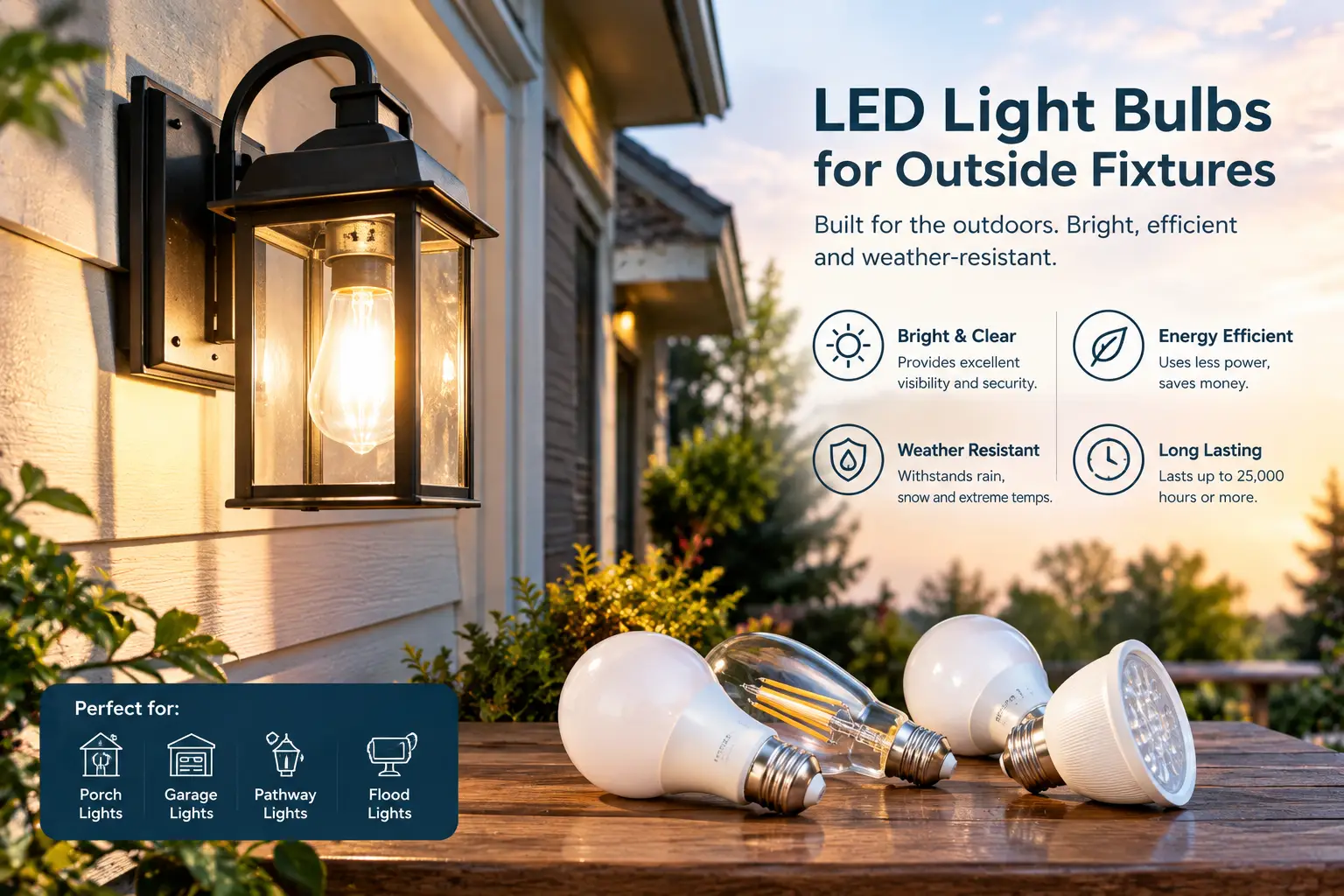
LED light bulbs for outside fixtures are energy-efficient bulbs designed to work safely in porch lights, lanterns, post lamps, and floodlight holders. They’re rated for damp or wet locations, tolerate temperature swings, and often add extras like dusk-to-dawn sensors, insect-resistant yellow light, or smart controls — all while using a fraction of an incandescent’s power.
That efficiency is the headline. According to the U.S. Department of Energy’s guide to LED lighting, residential LEDs — especially ENERGY STAR-rated products — use far less energy and last much longer than incandescent bulbs. Outdoors, where a fixture may burn 10 to 12 hours a night in winter, that gap compounds fast.
But outdoor LEDs aren’t all the same. They split into four broad families:
- ✅ Standard A19 bulbs for everyday porch sconces and coach lights.
- ✅ Dusk-to-dawn A19 bulbs with a built-in photocell that switches the light automatically.
- ✅ PAR38 reflector floods that throw a focused beam across driveways and yards.
- ✅ Specialty bulbs — yellow “bug” lights, vintage filament styles, and app-controlled smart bulbs.
Knowing which family your fixture needs is half the battle; the other half is matching the bulb’s rating to how exposed the fixture is. We’ll cover both.
Quick Comparison: The 7 Best Outdoor LED Light Bulbs at a Glance
| Product | Bulb Type | Brightness | Key Feature | Best for |
|---|---|---|---|---|
| Philips LED Dusk to Dawn A19 | A19, photocell | 800 lm, soft white | 10-year warranty when registered | Philips LED Dusk to Dawn A19: warm, worry-free porch lights |
| TORCHSTAR Dusk to Dawn A19 | A19, photocell | 800 lm, 5000K or 2700K | Multipack value | TORCHSTAR Dusk to Dawn A19: outfitting many fixtures cheaply |
| Luxrite A19 LED Dusk to Dawn | A19, photocell | 800 lm, 3000K or 5000K | Enclosed-fixture rated | Luxrite A19 LED Dusk to Dawn: sealed lanterns and jelly jars |
| Feit Electric PAR38 LED Flood | PAR38 flood | 1,600 lm, selectable color | Wet rated, 90 CRI | Feit Electric PAR38 LED Flood: exposed security floods |
| Sylvania Dusk to Dawn PAR38 | PAR38, photocell | 1,250 lm | 40-second off delay | Sylvania Dusk to Dawn PAR38: automatic flood lighting |
| GE LED Bug Light A19 | A19, yellow | 800 lm | Less attractive to insects | GE LED Bug Light A19: patios and back doors |
| Philips Hue White and Color Ambiance PAR38 | PAR38, smart | Tunable 2000–6500K + color | App, voice, schedules | Philips Hue White and Color Ambiance PAR38: smart-home yards |
Looking at the table, the first three picks solve the most common job — a single porch or garage light that should turn itself on — but they differ in where they can safely live: the Luxrite A19 LED Dusk to Dawn is the one built for fully enclosed glass. If your fixture is a floodlight holder, skip the A19s entirely and choose between the manual-control Feit Electric PAR38 LED Flood and the automatic Sylvania Dusk to Dawn PAR38. The Philips Hue White and Color Ambiance PAR38 costs several times more than anything else here, so it only makes sense if you already live in the Hue ecosystem.
💬 Tap any highlighted bulb name to check current pricing and availability — one click helps other shoppers make an informed choice too! 😊
Top 7 LED Light Bulbs for Outside Fixtures: Expert Analysis
1. Philips LED Dusk to Dawn A19 — the name-brand set-and-forget pick
If you want a bulb that quietly does its job every evening without an app, a timer, or a second thought, this is the familiar, safe choice. A built-in light sensor switches the bulb on as daylight fades and off when the sun comes up, so the porch is lit whether you’re home, traveling, or simply forgot.
It produces 800 lumens of soft white light — the brightness of a classic 60-watt incandescent — while Philips says it uses about 75% less energy. In practical terms, 800 lumens is the sweet spot for one porch sconce or a coach light beside the garage door: bright enough to find your keys and see who’s on the step, not so bright that it floods your neighbor’s bedroom. The standard E26 base fits nearly every residential outdoor fixture.
Based on the spec sheet, this bulb is best for homeowners who want warm, welcoming light rather than a security-camera glare. Soft white flatters brick, wood, and painted siding, and Philips’ flicker-free claim matters if a video doorbell is pointed at your porch. The real differentiator is the warranty: Philips offers 10 years of coverage when you register the bulb, which is rare among dusk to dawn light bulbs.
Press coverage of this bulb tends to make one point: it handles the “on at sunset, off at sunrise” job of a smart bulb without Wi-Fi. We couldn’t verify a large, consistent pattern of individual Amazon complaints, so skim recent reviews for the exact pack size you buy.
Pros:
- ✅ Automatic on/off with no app or hub
- ✅ Warm soft white suits most home exteriors
- ✅ 10-year warranty when registered with Philips
Cons:
- ❌ Not dimmable, like most photocell bulbs
- ❌ Sensor needs ambient daylight to work properly
Expect roughly $15–$35 depending on pack size (check the current price) — strong value once you factor in that warranty.
2. TORCHSTAR Dusk to Dawn A19 — best multipack value for crisp daylight
When you have six or eight fixtures to fill — porch, garage, side gate, back steps — price per bulb starts to matter, and that’s where the TORCHSTAR Dusk to Dawn A19 earns its spot.
Each 9-watt bulb delivers 800 lumens with a wide 240° beam, in either 5000K daylight or 2700K soft white. TORCHSTAR lists UL, FCC, and DOE compliance, and some listings note ENERGY STAR certification, plus a 3-year warranty. One detail worth knowing: the bulb turns on instantly at dusk but waits about three minutes before switching off when light returns. That delay keeps a passing car’s headlights from making it blink off and on all night.
On paper, this is the bulb for practical households that prioritize visibility and value over ambiance. The 5000K version reads as clean and bright — great over a garage or driveway where you want to see clearly — but it can look stark on a front porch next to warm interior lighting. If curb appeal matters, order the 2700K version.
Roundup reviewers consistently rank it at or near the top for value, and user comments cited in those roundups say the sensor isn’t easily fooled by streetlights. The brand itself notes the sensor responds to sunlight, so a bulb used indoors or in a dark, covered corner may stay on all day.
Pros:
- ✅ Low cost per bulb in multipacks
- ✅ Choice of daylight or soft white
- ✅ Off-delay prevents headlight flicker
Cons:
- ❌ 5000K can look harsh on a front porch
- ❌ Needs real daylight exposure to switch off
Usually around $20 for a 4-pack at the time of writing (prices may vary) — excellent value for whole-house coverage.
3. Luxrite A19 LED Dusk to Dawn — built for fully enclosed lanterns
Many outdoor fixtures — jelly-jar wall lights, sealed coach lanterns, flush “boob” lights on a covered porch — trap heat inside the glass. The Luxrite A19 LED Dusk to Dawn is specifically rated for totally enclosed fixtures, and that rating is the whole reason to buy it.
It outputs 800 lumens in 3000K soft white or 5000K bright white, carries a UL listing, and is damp rated, meaning it’s approved for covered outdoor spots shielded from direct rain. Why does the enclosed rating matter? Heat is the enemy of an LED’s driver electronics. A standard bulb sealed in glass can run hot enough to shorten its life dramatically, and an enclosed-rated bulb is engineered for that environment.
Here’s what to weigh: if your fixture has a closed glass globe and you’ve burned through “long-life” LEDs in a year or two, heat is the likely culprit — and this is the fix. It’s ideal for covered porches, breezeways, and carports. For a fixture that takes direct rain, though, damp rating isn’t enough; look for a wet-rated bulb instead.
Retailer listings for this bulb carry a large volume of reviews, and Luxrite backs it with a 3-year warranty. We couldn’t verify a consistent theme of specific complaints, so the honest takeaway is that the enclosed rating is its proven advantage on paper.
Pros:
- ✅ Rated for totally enclosed fixtures
- ✅ UL listed and damp rated for covered areas
- ✅ Two color temperatures to match your exterior
Cons:
- ❌ Damp rated only, not for exposed sockets
- ❌ Less brand recognition than Philips or GE
Typically in the $15–$30 range depending on pack size — the smart buy for sealed fixtures.
4. Feit Electric PAR38 LED Flood — wet-rated muscle for floodlight holders
When the job is lighting a driveway, side yard, or barn door, you need a directional reflector bulb, and Feit’s PAR38 line is one of the easiest to find in the U.S.
Our pick is the adjustable-white model (PAR38150DM5CCTCA): 17.7 watts, 1,600 lumens, replacing a 150-watt incandescent flood. A switch lets you choose 2700K, 3000K, 3500K, 4000K, or 5000K, and its 90+ CRI renders colors more naturally than the typical 80 CRI bulb. It’s wet-location rated, which means it can take direct rain, and it’s dimmable with LED-compatible dimmers. Feit rates it for up to 25,000 hours.
Based on comparing the specs, this is the most flexible flood in the lineup. Selectable color temperature means you buy one SKU for every fixture: warm 2700K under a pergola, neutral 4000K at the back door, crisp 5000K on the security flood. High CRI also helps security cameras capture more accurate colors at night. If you just need a basic replacement, Feit’s simpler non-dimmable 14-watt version (PAR3890/850/10KLED/2) gives 1,000 lumens with an 11,000-hour rating.
Feit’s PAR38 bulbs are rated for enclosed fixtures as well, a useful bonus for covered lantern-style floods. Retailer reviews generally reflect that reliability, though we didn’t find a large, uniform dataset for this exact SKU.
Pros:
- ✅ Wet rated for fully exposed fixtures
- ✅ Five selectable color temperatures in one bulb
- ✅ High 90+ CRI for truer colors
Cons:
- ❌ No built-in dusk-to-dawn sensor
- ❌ Dimming needs an LED-compatible dimmer
Generally around $10–$25 per bulb at the time of writing — great value for its versatility.
5. Sylvania Dusk to Dawn PAR38 — floodlight reach with automatic control
Want a flood that behaves like a dusk-to-dawn porch bulb? The Sylvania Dusk to Dawn PAR38 puts a photocell inside a reflector bulb, so your driveway lights itself every night.
Spec sheets for models LED14PAR38DTD830 and LED14PAR38DTD850 list 14 watts, 1,250 lumens, and a 120-watt incandescent equivalent, in 3000K warm white or 5000K bright white, with 80 CRI and a cULus listing. Its smartest detail is a 40-second delay before turning off once light is detected — long enough that headlights sweeping across the sensor won’t trigger an annoying on-off cycle.
Who is it for? Homeowners with a garage flood or side-yard holder that’s currently on a switch nobody remembers to flip. Because it automates the brightest light on your property, it’s a strong, low-effort security upgrade. One honest caveat: the spec sheets we found don’t clearly state a wet-location rating, so check the box before installing it in a fully exposed, upward-facing holder. Under eaves or in a hooded fixture, it’s in its element.
Retailer listings show steady sales and solid ratings, but we couldn’t verify a detailed theme of complaints. If you need more punch without a sensor, Sylvania’s Night Chaser PAR38 offers 2,650 lumens with a 40° beam.
Pros:
- ✅ Built-in photocell in a flood format
- ✅ 40-second delay ignores passing headlights
- ✅ Warm or bright white versions available
Cons:
- ❌ Wet rating not confirmed on spec sheets
- ❌ Non-dimmable and 80 CRI only
Usually around $10–$30 depending on pack size (check the current price) — solid value for automated flood coverage.
6. GE LED Bug Light A19 — yellow light that bugs largely ignore
Summer evenings on the patio lose their charm fast when every moth in the county circles the back-door light. The GE LED Bug Light A19 uses a yellow coating that most night-flying insects are less sensitive to — and less attracted by.
The 9-watt model (LED9A19M/BUG-OT) delivers 800 lumens, which GE says is nearly the light output of a 100-watt incandescent bug light. It’s suitable for wet locations, starts in temperatures as low as -4°F, and is rated for about 13.7 years at three hours of use per day. A smaller 7-watt, 400-lumen version suits dim accent fixtures.
Let’s be precise about what “bug light” means: it doesn’t repel insects or kill them. It simply makes your fixture far less of a beacon, so fewer bugs congregate by the door. That makes it ideal for back doors, patios, and decks where people sit outside. The yellow color isn’t great for security cameras or for judging true colors, so pair it with a white flood elsewhere if security is a priority.
Read the packaging closely. GE’s own warnings on some packages state the bulb isn’t intended for use with photocells, timers, or dimmers, and some versions say it’s not for totally enclosed fixtures. Product listings range from that caution to recommending it for enclosed post lights — so check the box for your specific version.
Pros:
- ✅ Draws noticeably fewer insects to the door
- ✅ Wet location rated with cold-weather starting
- ✅ Long rated life of 15,000 hours
Cons:
- ❌ Not for photocell, timer, or dimmer circuits
- ❌ Yellow light hurts camera color accuracy
Typically around $10–$15 per bulb (prices may vary) — inexpensive peace for mosquito-season evenings.
7. Philips Hue White and Color Ambiance PAR38 — smart color and schedules for the whole yard
For homeowners already running a Hue system indoors, the Philips Hue White and Color Ambiance PAR38 extends that control to floodlight holders outside — with full color thrown in.
It covers tunable white from 2000K to 6500K plus color, with CRI of 80 or higher. Philips lists it as weatherproof, with an operating range of roughly -4°F to 113°F, a 25,000-hour nominal life, 50,000 switch cycles, and a 2-year warranty. Full smart control requires a Hue Bridge. For connectivity, Philips advises keeping your first outdoor Hue light within about 30 feet of the bridge or the nearest Hue light.
In practice, this unlocks things no photocell can do: schedules tied to sunset, geofencing that lights the driveway as you approach, routines that simulate occupancy while you’re away, and color themes for holidays or game day. The operating range is a real consideration, though — in the hottest desert climates, a sun-baked fixture can exceed 113°F. If you want white light only, the Hue White PAR38 (3000K, about 1,300 lumens) is the simpler sibling.
Reviews and listings generally praise integration with Alexa, Google Assistant, and Apple Home, while the most common friction is the extra cost and setup of the bridge. We couldn’t verify a broader complaint trend for this specific outdoor SKU.
Pros:
- ✅ Full color plus tunable warm-to-cool white
- ✅ Schedules, geofencing, and voice control
- ✅ Long 25,000-hour nominal lifespan
Cons:
- ❌ Requires a Hue Bridge for full features
- ❌ Costs several times more than standard floods
Around $80 per bulb at the time of writing, plus a bridge if you don’t own one — worth it only for committed smart-home households.
✨ Don’t miss these top-rated outdoor bulbs!
🔍 Take your outdoor lighting to the next level with this carefully curated lineup. Click a highlighted bulb to check current pricing and availability. These picks will help you get a safer, brighter, more welcoming home the whole family will enjoy!
Head-to-Head: Comparing the Top 7 on the Specs That Matter
| Product | Lumens | Color Temp | Location Rating | Auto On/Off | Approx. Price | Best for |
|---|---|---|---|---|---|---|
| Philips LED Dusk to Dawn A19 | 800 | Soft white | Indoor/outdoor | Yes | $15–$35 (pack) | Philips LED Dusk to Dawn A19: front porches |
| TORCHSTAR Dusk to Dawn A19 | 800 | 2700K / 5000K | Outdoor, UL listed | Yes | Around $20 (4-pack) | TORCHSTAR Dusk to Dawn A19: many fixtures |
| Luxrite A19 LED Dusk to Dawn | 800 | 3000K / 5000K | Damp, enclosed | Yes | $15–$30 (pack) | Luxrite A19 LED Dusk to Dawn: sealed globes |
| Feit Electric PAR38 LED Flood | 1,600 | 2700–5000K selectable | Wet, enclosed | No | $10–$25 | Feit Electric PAR38 LED Flood: exposed floods |
| Sylvania Dusk to Dawn PAR38 | 1,250 | 3000K / 5000K | Check packaging | Yes | $10–$30 | Sylvania Dusk to Dawn PAR38: hooded floods |
| GE LED Bug Light A19 | 800 | Yellow | Wet | No (no photocells) | $10–$15 | GE LED Bug Light A19: patios |
| Philips Hue White and Color Ambiance PAR38 | Varies by setting | 2000–6500K + color | Weatherproof | Via app | Around $80 | Philips Hue White and Color Ambiance PAR38: smart homes |
The pattern here is clear: if you need light that survives direct rain, the Feit Electric PAR38 LED Flood and the GE LED Bug Light A19 carry confirmed wet ratings, while the A19 dusk-to-dawn bulbs are best kept under a roof. Brightness jumps meaningfully when you move to PAR38s, so don’t expect an A19 to light a 40-foot driveway. And for the money, the TORCHSTAR Dusk to Dawn A19 still delivers the lowest cost per automated fixture.
How to Choose LED Light Bulbs for Outside Fixtures
Picking the right bulb comes down to a few decisions made in the right order. Follow these steps and you’ll avoid most returns.
- Check the fixture’s base and shape. Most U.S. porch lights take an E26 medium base; small coach lights and candle fixtures often use E12 candelabra. Floodlight holders usually take PAR38 or PAR30 — measure before you buy.
- Match the location rating to exposure. A covered porch needs damp rated or better; anything that takes direct rain needs a wet-rated bulb. This is a safety issue, not a preference.
- Look for an enclosed-fixture rating if the glass is sealed. Heat buildup is the top killer of outdoor LEDs, and an enclosed rating means the driver is designed for it.
- Choose brightness by job. Around 450–800 lumens suits a porch or entry; 1,000–1,600 lumens suits a garage flood; more is rarely needed at home.
- Pick a color temperature you’ll like at 10 p.m. Warm 2700–3000K feels welcoming and is gentler on wildlife; 5000K reads as bright and clinical. Color temperature is measured in kelvins, and lower numbers look warmer.
- Decide how the light should switch. Photocell bulbs automate a single fixture; smart bulbs add schedules and remote control; plain bulbs work with your existing switch, timer, or motion sensor.
- Confirm compatibility with your controls. Never put a photocell bulb in a fixture that already has a photocell or motion sensor, and use dimmable bulbs only with LED-compatible dimmers.
The order matters. A beautiful 2700K bulb is useless if it isn’t rated for your sealed, rain-soaked lantern — so ratings first, aesthetics second.
Matching the Bulb to Your Home: Three Real-World Scenarios
Specs are easier to apply when you can picture the house. Here are three common setups and the bulbs that fit them best.
Scenario 1: The busy commuter with a covered front porch
You leave before sunrise, get home after dark, and your porch has one jelly-jar wall light under the roof. Budget: under $30. You want light that’s always on when you arrive, without remembering a switch. The Luxrite A19 LED Dusk to Dawn in 3000K is the right call: it’s rated for the sealed glass, damp rated for the covered spot, and automatic. Leave the wall switch on permanently and let the photocell handle the rest.
Scenario 2: The family with a deck, a back door, and a garage flood
Summer means evenings on the deck, so moths at the back door are a real nuisance. The garage has a twin-head flood holder, and the side gate has a small sconce. Budget: around $60–$80 total. Put a GE LED Bug Light A19 at the back door, a pair of Sylvania Dusk to Dawn PAR38 bulbs in the hooded garage flood for automatic security light, and a TORCHSTAR Dusk to Dawn A19 in the side-gate sconce. Each fixture gets the bulb that matches its job.
Scenario 3: The smart-home enthusiast with landscape floods
You already run a Hue Bridge indoors and want the yard to light up as your car turns onto the street, plus color for holidays. Use the Philips Hue White and Color Ambiance PAR38 in the floods closest to the house, staying within roughly 30 feet of the bridge or another Hue light. For distant, fully exposed holders, the wet-rated Feit Electric PAR38 LED Flood on a smart switch or timer is the more durable, budget-friendly complement.
Installation and Your First 30 Days: Getting It Right
Swapping a bulb sounds trivial, but outdoor installs have a few quirks that decide whether your new LED lasts two years or twenty.
Before you install
- ✅ Turn off the fixture at the switch and let any old incandescent cool for a few minutes — they run hot enough to burn fingers.
- ✅ Inspect the socket for rust, corrosion, or a cracked gasket. Moisture in the socket is a common reason outdoor bulbs flicker or fail early.
- ✅ If the fixture has its own photocell or motion sensor, use a standard bulb, not a dusk-to-dawn bulb.
During installation
Screw the bulb in snugly but don’t crank it — overtightening can deform the socket tab and cause intermittent contact. For dusk-to-dawn bulbs, rotate the bulb so the sensor faces open sky rather than the wall or the fixture’s metal cap. Then leave the wall switch in the “on” position permanently; the photocell can’t work if the circuit is off.
Your first 30 days
Watch the bulb’s behavior at dusk and dawn for the first week. If a photocell bulb cycles on and off at twilight, it may be seeing its own light reflected off nearby glass or siding — rotate it or move it to a more open fixture. Note what time it turns on in your season; that baseline helps you spot sensor problems later. Finally, replace any cracked fixture gaskets now. Keeping water out of the socket is the single best maintenance step for long-term reliability.
Problem → Solution: Fixing Common Dusk to Dawn and Outdoor Bulb Headaches
Even good outdoor LED light bulbs can misbehave in the wrong setup. Here are the problems homeowners run into most, and the fixes that work.
Problem 1: The dusk to dawn bulb stays on all day. ✅ The sensor isn’t getting enough daylight. Covered porches, frosted globes, and fixtures facing a wall can all keep it “in the dark.” Try a fixture with clear glass, rotate the sensor outward, or switch to a standard bulb on a timer. TORCHSTAR notes its sensor responds to sunlight specifically, which is why indoor or deeply shaded use fails.
Problem 2: The bulb blinks on and off at twilight. ✅ It’s likely reacting to its own reflected light. Bulbs with a built-in off-delay — like the roughly three-minute delay on the TORCHSTAR Dusk to Dawn A19 or the 40-second delay on the Sylvania Dusk to Dawn PAR38 — resist this better. Clear, reflective glass can still cause it, so try a different fixture position.
Problem 3: The LED buzzes or flickers. ✅ Check for a non-LED dimmer or a fixture with a built-in photocell or motion sensor. Many LEDs aren’t designed for those controls — GE explicitly warns against using its bug light with photocells, timers, or dimmers.
Problem 4: “Long-life” LEDs keep dying in a year. ✅ Heat or moisture is the usual cause. In sealed fixtures, switch to an enclosed-rated bulb like the Luxrite A19 LED Dusk to Dawn; in exposed fixtures, move to a wet-rated option like the Feit Electric PAR38 LED Flood.
Problem 5: The neighbors complain about glare. ✅ Lower the brightness, warm the color, and aim the light down. The DarkSky and Illuminating Engineering Society’s Five Principles for Responsible Outdoor Lighting recommend outdoor light that’s useful, targeted, low level, controlled, and warm-colored — a great checklist for any porch.
Wet Rated LED Bulbs vs. Damp Rated: Safety, Regulations, and Standards
This is the section most buyers skip and the one that matters most for safety. Outdoor bulbs and fixtures in the U.S. are typically certified by recognized testing labs such as UL or ETL, and their location ratings tell you where they can safely go.
Damp location rating
A damp-rated bulb or fixture can handle moisture and condensation but not direct water exposure. Think covered porches, carports, and the underside of a deep roof overhang. The Luxrite A19 LED Dusk to Dawn falls in this category — perfect under a roof, wrong for an open post lamp.
Wet location rating
Wet rated LED bulbs can be exposed directly to rain, snow, and sprinklers. That’s what you need in uncovered floodlight holders, landscape spotlights, and post lights without a cap. Feit states its PAR38 bulbs are wet-location rated and weather-resistant for year-round outdoor use, and GE lists its LED bug light as suitable for wet locations.
Enclosed fixture rating
This is separate from moisture ratings. It certifies that the bulb’s electronics can handle the heat trapped inside a sealed fixture. A bulb can be wet rated but not enclosed rated, or vice versa — check for both if your fixture is sealed and exposed.
Other labels worth knowing
- ✅ FCC compliance means the bulb’s electronics meet limits on radio interference — relevant if a cheap LED ever makes your garage-door remote or AM radio act up.
- ✅ ENERGY STAR certification indicates efficiency and performance testing beyond the minimum.
- ✅ Federal efficiency rules that took full effect in 2023 have largely pushed traditional incandescent general-service bulbs off U.S. shelves, which is why LED is now the default choice for most sockets.
The bottom line: the fixture’s rating and the bulb’s rating should both match the location. A wet-rated bulb in a damp-only fixture doesn’t make the fixture safe for rain.
Outdoor LED Light Bulbs vs. Incandescent and Halogen
If you’re still running an old incandescent or halogen flood outside, the case for switching is overwhelming — and it’s not just about electricity.
| Factor | LED (e.g., Feit Electric PAR38 LED Flood) | Halogen PAR38 | Incandescent A19 | Best for |
|---|---|---|---|---|
| Power for similar light | About 14–18W | About 90–150W | About 60–100W | LED: every outdoor socket |
| Rated life | 11,000–25,000 hours | Typically a few thousand hours | Around 1,000 hours | LED: hard-to-reach fixtures |
| Heat output | Low | Very high | High | LED: enclosed fixtures |
| Cold-weather start | Instant (many rated to -4°F) | Instant | Instant | Tie |
| Smart/sensor options | Photocell, smart, bug light | Limited | Limited | LED: automation |
The table shows why LED dominates: you get the same or more light for roughly a tenth to a fifth of the power, with a lifespan measured in decades of typical use instead of months. Lower heat also matters outdoors because it protects fixture gaskets and nearby surfaces. The only area where older bulbs “tie” is cold starting, and modern outdoor LEDs like the GE LED Bug Light A19 are rated to start at -4°F anyway.
There’s also a practical maintenance angle. A post light at the end of the driveway or a flood 20 feet up under the eaves is a ladder job every time a bulb dies. A 1,000-hour incandescent running 12 hours a night in winter can fail within a few months. A 25,000-hour LED in the same socket could plausibly outlast your next roof replacement. For outdoor sockets especially, LED isn’t just the efficient choice — it’s the low-hassle one.
Features That Actually Matter (and Ones That Don’t)
Outdoor bulb boxes are covered in claims. Here’s how to separate the useful from the noise.
Features that matter
- ✅ Location and enclosed ratings. These determine safety and lifespan more than any other spec.
- ✅ Lumens, not watts. Watts tell you power draw; lumens tell you brightness. Compare bulbs by lumens.
- ✅ Off-delay on photocell bulbs. A delay of 40 seconds to a few minutes prevents headlights and lightning from causing annoying cycling.
- ✅ Warranty length. A 10-year warranty, like the one Philips offers on its registered dusk-to-dawn bulbs, signals confidence in the driver electronics.
- ✅ Color temperature options. Warm light at the front door, neutral or cool light at the garage — having choices lets you tailor each fixture.
Features that matter less than you think
- ❌ “Equivalent to 300W!” Huge equivalents look impressive but are rarely needed at a home entry and often create glare.
- ❌ Extremely high CRI for a porch light. A 90+ CRI is nice for security cameras and landscaping, but for a simple entry light, 80 CRI is perfectly adequate.
- ❌ Smart features you won’t use. If your only goal is “on at dusk, off at dawn,” a photocell bulb does that for a fraction of a smart bulb’s price — and without Wi-Fi drama.
When in doubt, prioritize the ratings and the switching method. Those two choices shape your experience every single night; the rest is fine-tuning.
Long-Term Cost and Maintenance
The sticker price of LED light bulbs for outside fixtures is only a small part of what you’ll spend. Electricity and replacement frequency matter more over time, especially for lights that run all night.
The running-cost math
Consider a porch light that burns about 12 hours a night, year-round — typical for a dusk-to-dawn setup in the northern U.S. once you average summer and winter. A 60-watt incandescent uses roughly 263 kWh a year at that duty cycle. A 9-watt LED with the same 800 lumens uses about 39 kWh. At an illustrative electricity rate of around 17 cents per kWh, that’s roughly $45 versus $7 per year, per fixture. Multiply by four or five outdoor fixtures, and the savings add up quickly. Check your own utility bill for your exact rate.
The ENERGY STAR light bulb guide is a useful reference for comparing certified models and understanding how efficiency testing works.
Replacement costs and labor
With incandescents, you’d also buy several replacement bulbs a year for an all-night fixture. A quality LED rated for 15,000–25,000 hours may last many years at the same schedule. That’s fewer ladder trips, which matters more than it sounds for floods mounted high on a garage.
Simple maintenance schedule
- ✅ Every spring: wipe fixture glass so dirt doesn’t dim the light or confuse photocells.
- ✅ Every fall: check gaskets and seals before the wet season.
- ✅ After storms: look for water inside globes and dry it out promptly.
- ✅ Keep receipts and register warranties — a free replacement only helps if you can claim it.
Porch Light Bulbs: Common Mistakes to Avoid
Most outdoor bulb disappointments trace back to a handful of avoidable mistakes when choosing porch light bulbs.
Mistake 1: Ignoring the fixture’s sensor
If your fixture already has a built-in photocell or motion sensor, adding a dusk-to-dawn bulb creates two sensors fighting each other. The result is flicker, cycling, or a light that never turns on. Use a standard LED in sensor fixtures.
Mistake 2: Buying indoor bulbs for outdoor sockets
An inexpensive indoor A19 may work for a while under a deep porch roof, but without a damp or wet rating, moisture and temperature swings can shorten its life and raise safety concerns. Always check the rating.
Mistake 3: Going too bright and too cool
A 5000K, 1,500-lumen bulb in a small entry sconce looks like an interrogation room and can bother neighbors. For most porch light bulbs, 450–800 lumens in 2700K–3000K is plenty.
Mistake 4: Forgetting the base size
Many decorative coach lights use E12 candelabra sockets, not standard E26. Pull the old bulb or check the fixture label before ordering.
Mistake 5: Overlooking enclosed fixtures
Sealed globes trap heat. If the box doesn’t say “enclosed fixture rated,” don’t use it in a sealed fixture — this is the most common reason LEDs fail years ahead of their rated life.
Mistake 6: Mixing color temperatures on one facade
A 5000K bulb on one side of the garage and 2700K on the other makes a house look mismatched. Buy matching bulbs for fixtures visible together.
FAQ: LED Light Bulbs for Outside Fixtures
❓ Can I use regular LED bulbs in outdoor light fixtures?
❓ What is the best color temperature for outside lights?
❓ Do dusk to dawn bulbs work in enclosed fixtures?
❓ How many lumens do I need for a porch light?
❓ Are yellow bug light LEDs worth buying?
Conclusion: Light Your Home Smarter This Year
The best LED light bulbs for outside fixtures aren’t simply the brightest or the cheapest — they’re the ones whose ratings match the fixture and whose switching method matches your life. Start with the location: damp rated under a roof, wet rated where rain hits, enclosed rated inside sealed glass. Then pick the job: automatic porch light, powerful flood, bug-resistant patio light, or a fully smart yard.
If you want one bulb that suits most front porches, the Philips LED Dusk to Dawn A19 combines warm light, automatic operation, and a long registered warranty. Outfitting a whole house on a budget? The TORCHSTAR Dusk to Dawn A19 wins on cost per fixture. For sealed lanterns, the Luxrite A19 LED Dusk to Dawn is built for the heat. Exposed floods belong to the wet-rated Feit Electric PAR38 LED Flood, while the Sylvania Dusk to Dawn PAR38 automates hooded security floods. The GE LED Bug Light A19 reclaims your summer evenings, and the Philips Hue White and Color Ambiance PAR38 rewards smart-home fans with color and control.
Whatever you choose, you’ll use a fraction of the electricity, climb the ladder far less often, and come home to a lit doorway every night.
🌟 Ready to brighten your curb appeal tonight?
💡 Click any highlighted bulb above to check current pricing and availability, and pick the one that matches your fixture. A few minutes of choosing now means years of hassle-free light — and a warmer welcome every time you pull into the driveway!
Recommended for You
- Does Kasa Work With Alexa? 7 Best Picks + Easy Setup Guide (2026)
- Dual Smart Light Switch: 7 Best Picks That Actually Work in 2026
- ge dimmer switch Guide 2026: 7 Best Picks Honestly Compared
Disclaimer: This post contains affiliate links. As an Amazon Associate, I earn from qualifying purchases made through these links, at no additional cost to you.
✨ Found this article helpful? Share it with someone who needs it! 💬🤗