
In This Article
Why Choosing LED Light Bulbs for Exterior Use Is Trickier Than It Looks
Your porch light has a harder job than any bulb inside your house. It sits through August heat, January frost, sideways rain, and a steady parade of moths — and it’s usually expected to run all night, every night. That’s exactly why LED light bulbs for exterior use deserve more thought than grabbing whatever 4-pack is on the shelf.
Here’s the good news: LEDs are a near-perfect match for outdoor duty. According to the U.S. Department of Energy’s guide to LED lighting, residential LEDs use at least 75% less energy and last up to 25 times longer than incandescent bulbs. On a fixture that burns 10 to 12 hours a night, those savings stop being theoretical and start showing up on your utility bill.
The catch? “Outdoor” isn’t a single category. A covered porch sconce, an exposed security floodlight, a lamp post, and a patio fixture each need something different. Get the damp-versus-wet rating wrong and the bulb dies early. Get the color temperature wrong and your house looks like a gas station. Pick a dusk-to-dawn bulb for an enclosed lantern and it may flicker all night.
This guide cuts through that noise. We compared spec sheets, safety listings, and the recurring themes in real customer feedback for seven outdoor-ready LED bulbs available on amazon.com — from budget dusk-to-dawn A19s to high-output PAR38 floods and a Wi-Fi smart bulb. You’ll also get a step-by-step install guide, a troubleshooting section, and a straight-talk breakdown of which features actually matter.
Affiliate disclosure: This article contains Amazon affiliate links. If you buy through them, we may earn a small commission at no extra cost to you.
What Are LED Light Bulbs for Exterior Use?
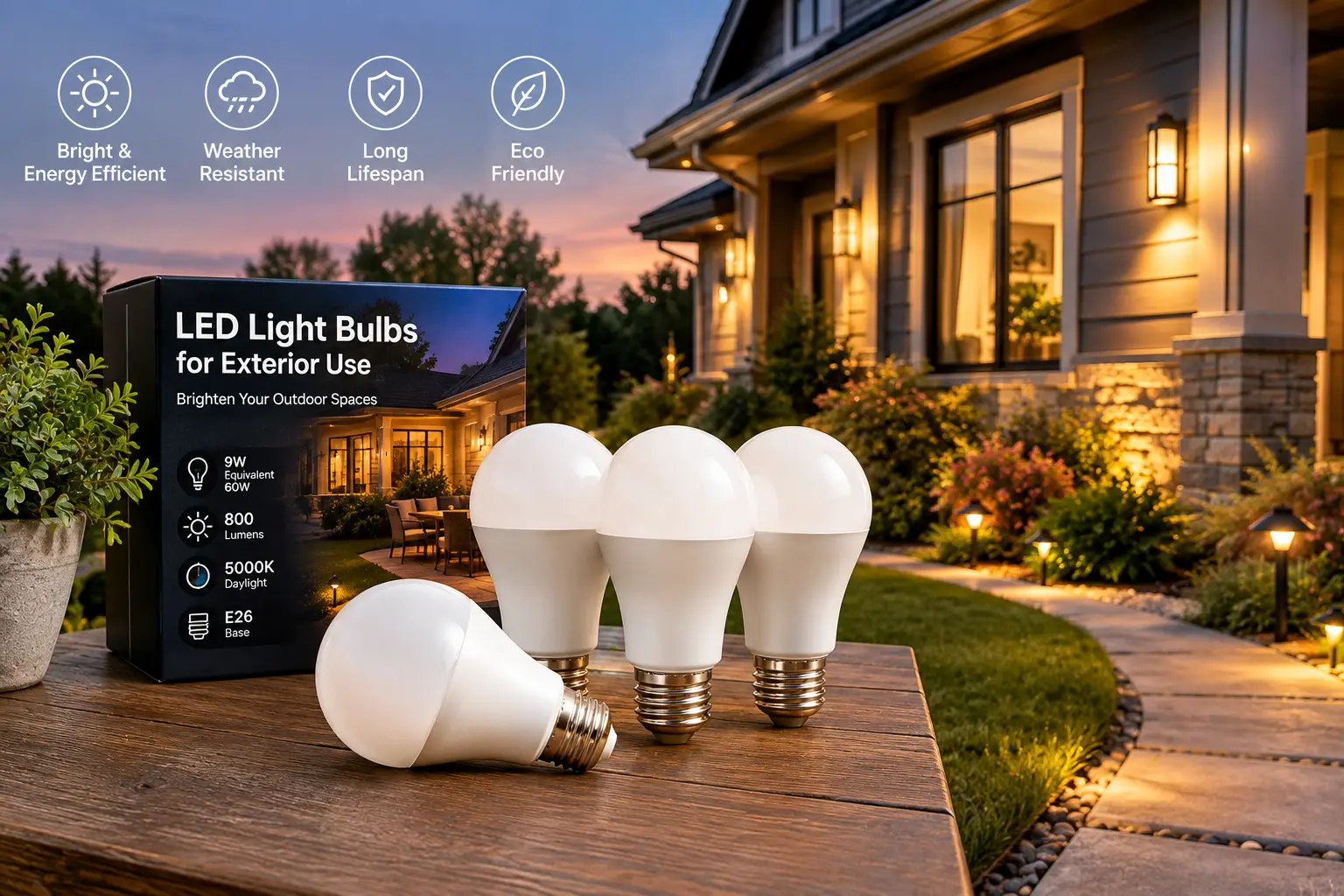
LED light bulbs for exterior use are light-emitting diode bulbs built and certified to handle outdoor conditions — moisture, temperature swings, and long run times. They carry a UL or ETL damp or wet location rating, often include features like dusk-to-dawn photocells, and typically use 75–85% less energy than the incandescent or halogen bulbs they replace.
The two shapes you’ll see most
Most outdoor LED light bulbs fall into two families. A19 bulbs are the classic pear shape that fits porch lights, wall lanterns, and lamp posts. They throw light in nearly every direction, which is perfect for a glowing fixture by the front door. PAR38 bulbs are the chunky reflector floods used in security lights and eave-mounted holders; their built-in reflector aims light in a defined beam, usually 25° (narrow flood) or 40° (wide flood). If you want the engineering background, the parabolic aluminized reflector (PAR) lamp entry on Wikipedia explains how the reflector shape and diameter (38 = 38 eighths of an inch, or 4.75 inches) define the beam.
Both shapes use the standard E26 medium screw base in the US, so swapping out old incandescent or halogen bulbs rarely requires new hardware. What does change is the rating on the box — and that’s where most buying mistakes happen.
Quick Comparison: The 7 Best LED Light Bulbs for Exterior Use
| Product | Type | Brightness | Location Rating | Price Range | Best For |
|---|---|---|---|---|---|
| TORCHSTAR Dusk to Dawn A19 LED Bulb | A19, photocell | 800 lm | Damp | $15–$25 (4-pack) | Budget porch lights |
| GE LED+ Dusk to Dawn A19 | A19, photocell | 800 lm | Damp | $15–$30 (2–3 pack) | Brand-name set-and-forget |
| EDISHINE Dusk to Dawn Yellow Bug Light A19 | A19, amber, photocell | ~600 lm | Check listing (outdoor use) | $12–$20 (4-pack) | Patios with bug problems |
| Sylvania Dusk to Dawn PAR38 LED | PAR38 flood, photocell | 1,250 lm | Indoor/outdoor | $10–$15 each | Automatic security floods |
| Sunco PAR38 LED Outdoor Flood | PAR38 flood, dimmable | 1,050 lm | Wet (UL) | $35–$50 (6-pack) | Multi-fixture homes |
| LEDVANCE Sylvania Night Chaser PAR38 | High-output PAR38 | 2,650 lm | Wet (UL) | $30–$50 (2-pack) | Driveways and big yards |
| Feit Electric Smart PAR38 RGBW | Smart Wi-Fi PAR38 | ~1,000 lm | Wet | $15–$25 each | App control and color |
Looking at the table, the split is clear: A19 bulbs handle decorative fixtures where you see the glow, while PAR38 floods handle the jobs where you need light thrown somewhere — a driveway, a side yard, a garage apron. The Sunco PAR38 LED Outdoor Flood and the LEDVANCE Sylvania Night Chaser PAR38 are the only picks here with a confirmed UL wet rating plus dimming, which makes them the safest bets for fixtures fully exposed to rain. If automation matters more than raw brightness, the TORCHSTAR Dusk to Dawn A19 LED Bulb and Sylvania Dusk to Dawn PAR38 LED deliver it at the lowest cost per socket.
💬 One click helps other shoppers make an informed choice too! 😊
Top 7 LED Light Bulbs for Exterior Use: Expert Analysis
1. TORCHSTAR Dusk to Dawn A19 LED Bulb — cheapest way to automate porches
The TORCHSTAR Dusk to Dawn A19 LED Bulb turns any ordinary porch fixture into an automatic security light for a few dollars per socket. Each bulb draws 9W for 800 lumens (a 60W-incandescent equivalent), comes in 2700K soft white or 5000K daylight, and spreads light across a wide 240° beam. The photocell switches on instantly at dusk, while a roughly three-minute delay before switching off keeps passing headlights from causing on-off flicker. TORCHSTAR lists the bulb as UL and ENERGY STAR certified, damp-rated, rated for roughly -4°F to 104°F, and backed by a three-year warranty.
Based on the spec sheet, this is the bulb for renters, first-time homeowners, and anyone outfitting four or five covered fixtures on a tight budget. The damp rating is the limit: it belongs under a porch roof or inside a lantern with a top cap, not in an open-faced socket that takes direct rain.
Customer feedback on dusk-to-dawn A19s in this price class consistently centers on one theme: they work well when the sensor can actually “see” daylight, and misbehave when the fixture is heavily shaded or enclosed. Treat sensor exposure as part of the install, not an afterthought.
Pros:
- ✅ Very low cost per bulb in multi-packs
- ✅ Wide 240° spread suits glass lanterns
- ✅ Three-year warranty beats many budget rivals
Cons:
- ❌ Damp-rated only, so keep it covered
- ❌ Non-dimmable and incompatible with timers
Price and value: Usually around $15–$25 for a 4-pack at the time of writing — outstanding value for covered fixtures.
2. GE LED+ Dusk to Dawn A19 — trusted name, zero setup
The GE LED+ Dusk to Dawn A19 is the “I just want it to work” option from a brand most hardware stores already stock. It uses 8.5W to produce 800 lumens, ships in soft white or 5000K daylight versions, and carries a 25,000-hour rated life — roughly double the 15,000 hours common among bargain photocell bulbs. GE markets it as damp-rated with a CRI of 80, and it needs no app, hub, Wi-Fi, or schedule: screw it in, leave the switch on, and the sensor handles the rest.
What most buyers overlook here is that rated life matters more outdoors than inside. A porch light running 12 hours a night racks up about 4,380 hours a year, so a 25,000-hour rating translates to over five years of all-night use, compared with three to four years for a 15,000-hour bulb. For homeowners who hate ladders — or who have a high entry fixture — that difference is the real selling point.
Reviews generally describe it as reliable and “set and forget,” with the most frequent caveat being brightness: 800 lumens is fine for an entryway but modest for illuminating an entire yard. Note that some GE LED+ versions are listed as restricted for sale in California, so check the listing if you live there.
Pros:
- ✅ Long 25,000-hour rated life
- ✅ Simple photocell with no app required
- ✅ Widely available, recognizable brand support
Cons:
- ❌ Costs more per bulb than generic packs
- ❌ 800 lumens is modest for open yards
Price and value: Typically $15–$30 for a 2–3 pack — worth the premium if you value longevity over upfront savings.
3. EDISHINE Dusk to Dawn Yellow Bug Light A19 — fewer moths on the patio
The EDISHINE Dusk to Dawn Yellow Bug Light A19 solves a problem white bulbs create: the cloud of insects circling your back door. It emits a 2000K amber-yellow glow, replaces a 60W incandescent, and includes a built-in dusk-to-dawn sensor, so it doubles as automatic accent lighting. Listings put output around 600 lumens at roughly 9W.
Here’s the honest science: yellow and amber light sits in longer wavelengths that many flying insects — especially moths — find less attractive than the blue-rich output of cool white bulbs. It won’t repel mosquitoes, which home in on carbon dioxide and body heat, but it can noticeably reduce the swarm around a fixture. A classic trick from lighting manufacturers is to place the yellow bulb where people gather and a regular white bulb 15–20 feet away to draw bugs elsewhere.
On paper, this is ideal for patios, deck sconces, and screened porches where ambience matters more than security. The amber color does make faces look warmer and less true-to-life, and it’s a poor choice for reading house numbers or checking a camera feed.
We couldn’t verify a large body of US reviews specific to this exact listing, so weigh the spec sheet and the brand’s return policy before buying multiples.
Pros:
- ✅ Amber light draws fewer moths and beetles
- ✅ Built-in photocell adds automation
- ✅ Affordable 4-pack pricing
Cons:
- ❌ Lower output than white 60W-equivalent bulbs
- ❌ Poor color accuracy for security cameras
Price and value: Around $12–$20 for a 4-pack — a cheap fix for bug-heavy evenings.
4. Sylvania Dusk to Dawn PAR38 LED — automatic flood for security lights
The Sylvania Dusk to Dawn PAR38 LED brings the photocell convenience of an A19 into a real floodlight. It draws 14W for 1,250 lumens — Sylvania rates it as a 120W-incandescent replacement — with a 40° beam, 80 CRI, and 3000K or 5000K options. A 40-second delay before shutting off after it detects light helps prevent nuisance cycling.
What sets it apart is efficiency: Sylvania lists efficacy up to 115 lumens per watt, so you get noticeably more light per dollar of electricity than older LED floods in the 70–80 lm/W range. The 40° beam is wide enough to wash a typical two-car driveway from an eave-mounted holder without creating harsh hot spots.
This is the pick for homeowners who already have twin-head flood holders and want them on from sunset to sunrise without adding a separate photocell or timer. One caveat: if your flood fixture already has a motion sensor, a photocell bulb can confuse it — use this in plain holders only. It’s non-dimmable and rated for 15,000 hours, which is about three and a half years of dusk-to-dawn use.
Feedback on retailer listings tends to praise the brightness and dependable sensor timing; the occasional complaint is not noticing the small sensor window, so make sure it faces open sky, not the eave.
Pros:
- ✅ Bright 1,250 lumens from only 14W
- ✅ Built-in photocell with anti-flicker delay
- ✅ Choice of warm or daylight white
Cons:
- ❌ Not dimmable or motion-sensor compatible
- ❌ 15,000-hour life trails premium floods
Price and value: Usually $10–$15 per bulb — strong value for automated security lighting.
5. Sunco PAR38 LED Outdoor Flood — best wet-rated value in bulk
The Sunco PAR38 LED Outdoor Flood is the workhorse for anyone replacing a whole house’s worth of exterior floods at once. Each 13W bulb delivers 1,050 lumens (a 100W equivalent), is UL wet-rated for direct rain exposure, and — unlike most budget floods — is dimmable on compatible LED dimmers. It’s offered in 3000K warm white and 5000K daylight, and Sunco backs its bulbs with a five-year protection plan.
The wet rating is the headline feature. Many exterior flood holders are completely open to the weather; a damp-rated bulb in that position is out of spec. Pairing wet location certification with dimmability also means the same bulb can light a back patio at full output for cleanup and drop to 30% for a quiet evening.
Based on comparing the specs, this suits homeowners, landlords, and small property managers who want uniform color across six or twelve fixtures. Customer feedback commonly highlights strong brightness for the wattage and appreciates that a warm 3000K wet-rated flood is otherwise hard to find locally.
The trade-off is that there’s no photocell, so you’ll need a switch, timer, or smart switch to automate it. It also isn’t the brightest option if you’re lighting a long driveway.
Pros:
- ✅ UL wet-rated for fully exposed fixtures
- ✅ Dimmable, unusual at this price
- ✅ Five-year protection from the brand
Cons:
- ❌ No built-in dusk-to-dawn sensor
- ❌ Sold mainly in larger multi-packs
Price and value: Roughly $35–$50 for a 6-pack — the lowest cost per wet-rated, dimmable socket on this list.
6. LEDVANCE Sylvania Night Chaser PAR38 — maximum brightness for big spaces
The LEDVANCE Sylvania Night Chaser PAR38 exists for one job: flooding large areas with serious light. It pulls 23W to produce about 2,650 lumens — a 250W-equivalent rating — in a 3000K beam, while staying UL wet-rated and dimmable down to 10% on compatible dimmers.
To put 2,650 lumens in context, that’s more than three times the output of a standard 60W-equivalent porch bulb. Mounted high on a garage, it can light a long driveway, a barn door, or a backyard where a standard 1,000-lumen flood leaves dark corners. The 10% dimming floor means you aren’t locked into stadium mode; you can tone it down for everyday use and crank it up when you hear something outside.
Here’s what to weigh: high-output bulbs generate more heat in a compact housing, so they’re best in open holders rather than tightly enclosed fixtures, and more light isn’t always better for neighbors. Aim it down, not out. Retail roundups regularly rank the Night Chaser among the best halogen-replacement floods for brightness, though we couldn’t independently confirm current review totals, so verify the latest listing before buying.
This is overkill for a front stoop but exactly right for rural properties, long driveways, and detached garages.
Pros:
- ✅ 2,650 lumens replaces 250W halogen floods
- ✅ Dims smoothly to 10% output
- ✅ UL wet-rated for exposed holders
Cons:
- ❌ Too bright for small porches or close neighbors
- ❌ Higher upfront cost than standard floods
Price and value: Generally $30–$50 for a 2-pack — fair for the brightness, but only if you need it.
7. Feit Electric Smart PAR38 RGBW — app control and color without a hub
The Feit Electric Smart PAR38 RGBW is the flexible option for people who want schedules, voice control, and color. It draws 11.1W (a 90W equivalent, about 1,000 lumens), is wet-location rated, offers tunable white from 2700K to 6500K plus millions of colors, and connects directly to 2.4 GHz Wi-Fi — no hub needed. It works with Alexa and Google Assistant and carries a 25,000-hour rating with a 90 CRI.
That 90 CRI is quietly important. Color rendering affects how natural your landscaping, siding, and visitors’ faces look; most budget outdoor bulbs sit at 80. Combined with tunable white, you can run warm 2700K for evenings and switch to cooler light when you need visibility.
Smart control also replaces a photocell: you can set “on at sunset, off at 1 a.m.” schedules in the app, which a basic dusk-to-dawn bulb can’t do. Holiday color (orange for Halloween, red and green for December) is a fun bonus.
The weak link is Wi-Fi. Outdoor fixtures often sit at the edge of your router’s range, and feedback on smart outdoor bulbs regularly mentions dropped connections. Test the signal at the fixture before buying several.
Pros:
- ✅ Wet-rated with high 90 CRI
- ✅ Schedules and voice control without a hub
- ✅ Tunable white plus full color
Cons:
- ❌ Depends on strong 2.4 GHz Wi-Fi outdoors
- ❌ Wall switch must stay on for control
Price and value: Around $15–$25 per bulb — reasonable for smart features, less so if you only need on/off.
Side-by-Side Specs at a Glance
| Product | Watts | Color Temp | CRI | Dimmable | Rated Life | Best For |
|---|---|---|---|---|---|---|
| TORCHSTAR Dusk to Dawn A19 LED Bulb | 9W | 2700K / 5000K | 80+ | No | Check listing | Covered porches |
| GE LED+ Dusk to Dawn A19 | 8.5W | Soft white / 5000K | 80 | No | 25,000 hrs | Hard-to-reach fixtures |
| EDISHINE Dusk to Dawn Yellow Bug Light A19 | ~9W | 2000K amber | — | No | Check listing | Bug-heavy patios |
| Sylvania Dusk to Dawn PAR38 LED | 14W | 3000K / 5000K | 80 | No | 15,000 hrs | Automated floods |
| Sunco PAR38 LED Outdoor Flood | 13W | 3000K / 5000K | Check listing | Yes | Check listing | Exposed fixtures |
| LEDVANCE Sylvania Night Chaser PAR38 | 23W | 3000K | Check listing | Yes (to 10%) | Check listing | Large yards |
| Feit Electric Smart PAR38 RGBW | 11.1W | 2700K–6500K + color | 90 | Yes (app) | 25,000 hrs | Smart homes |
Reading across, efficiency is excellent everywhere, so the real differentiators are control and longevity. The GE LED+ Dusk to Dawn A19 and Feit Electric Smart PAR38 RGBW lead on rated life, while the Feit Electric Smart PAR38 RGBW is the only pick with high-CRI light and full scheduling. If you need dimming in a wet location without Wi-Fi, the Sunco PAR38 LED Outdoor Flood is the practical middle ground.
✨ Don’t miss these weatherproof upgrades!
🔍 Take your outdoor lighting to the next level with this carefully curated lineup. Click a highlighted bulb to check current pricing and availability. These picks will help you get a safer, brighter, lower-cost exterior the whole family will enjoy!
How to Install Outdoor LED Light Bulbs the Right Way (Your First 30 Days)
Swapping a bulb sounds like a 30-second job, but outdoor installs have a few extra steps that decide whether your new bulb lasts two years or ten.
Before you climb the ladder
- Turn off the circuit, not just the switch. Outdoor fixtures sometimes have corroded sockets that arc. Flip the breaker if you’re unsure.
- Check the fixture’s rating sticker. Look inside the canopy for “Suitable for Wet Locations” or “Damp Locations.” Your bulb’s rating should match or exceed it.
- Inspect the socket. Green or white crust on the brass tab means corrosion. Gently scrape it with a small flat screwdriver (power off!) and wipe it clean.
During installation
- Hand-tighten until snug — overtightening cracks plastic bulb bases and flattens socket tabs.
- For PAR38 floods, angle the holder 20–30° downward. That puts light on the ground where you need it and reduces glare into neighbors’ windows.
- For dusk-to-dawn bulbs, rotate the bulb so the sensor faces open sky, not the wall or the fixture’s metal cap.
- Leave the wall switch in the on position; photocell bulbs need constant power to work.
Your first 30 days
Watch the first few nights. A photocell bulb that flickers at twilight is reacting to its own reflected light (more on that below). Note when it turns on and off — if it lights up at 4 p.m. on a cloudy day, the sensor is shaded. For dimmable floods, test the full dimmer range; buzzing or flicker at the low end usually means the dimmer isn’t LED-compatible. Finally, after the first heavy rain, check that no water has pooled inside open holders. Wet-rated bulbs tolerate rain, but a holder full of standing water still shortens socket life.
Which Outdoor LED Bulb Fits Your Home? Three Real-World Scenarios
Specs are easier to judge when you picture where the bulb will actually live. Here are three common US setups and the reasoning behind each match.
Scenario 1: The suburban starter home ($40–$60 budget)
You have two covered coach lights by the garage, one porch sconce, and a back-door light. Everything is under an overhang, and you want lights on whenever it’s dark. The TORCHSTAR Dusk to Dawn A19 LED Bulb covers all four sockets from a single pack, and the damp rating is fine because none of the fixtures take direct rain. If the back door is where you grill in summer, swap that one socket for the EDISHINE Dusk to Dawn Yellow Bug Light A19. Estimated yearly energy cost for all four bulbs running all night: roughly $25–$30 at average US rates.
Scenario 2: The rural property with a long driveway ($60–$100 budget)
Your twin-head floods on the garage face an 80-foot gravel drive and take rain directly. You need serious output and a wet rating. The LEDVANCE Sylvania Night Chaser PAR38 belongs on the garage, aimed down the drive. For the side-yard and barn floods, the Sunco PAR38 LED Outdoor Flood keeps costs down while matching the warm 3000K color temperature, so your property looks consistent rather than patchwork.
Scenario 3: The smart-home patio ($50–$80 budget)
You already use Alexa or Google Home and want patio floods to come on at sunset, dim at 10 p.m., and turn orange for Halloween. Two Feit Electric Smart PAR38 RGBW bulbs handle the patio, while the front porch gets the no-fuss GE LED+ Dusk to Dawn A19, so a Wi-Fi hiccup never leaves the entry dark.
Common Outdoor LED Problems and How to Fix Them
Even the best LED light bulbs for exterior use can act up when the fixture or wiring fights them. These are the five issues that come up most often, with fixes.
Problem 1: The dusk-to-dawn bulb flickers or cycles all night
Cause: The sensor sees the bulb’s own light bouncing off frosted glass, a white wall, or the fixture lid, decides it’s daytime, switches off, then turns back on. Fix: Move photocell bulbs to open-bottom fixtures or clear-glass lanterns, or rotate the sensor to face away from reflective surfaces. In fully enclosed lanterns, use a standard bulb with an external photocell or smart switch instead.
Problem 2: The light stays on during the day
Cause: A shaded porch, deep overhang, or covered fixture never registers enough daylight. Fix: Choose a bulb with an exposed sensor window, or switch to a timer or smart schedule for heavily shaded locations.
Problem 3: Buzzing or strobing on a dimmer
Cause: Older incandescent-era dimmers don’t play nicely with LED drivers. Fix: Install a dimmer labeled LED/CFL-compatible, and only use bulbs marked dimmable — such as the Sunco PAR38 LED Outdoor Flood or LEDVANCE Sylvania Night Chaser PAR38.
Problem 4: Bulbs die within a year
Cause: Usually a damp-rated bulb in a wet location, heat trapped in an enclosed fixture, or a corroded socket. Fix: Match ratings to exposure, check “enclosed fixture rated” on the package for sealed lanterns, and clean sockets at install.
Problem 5: Smart bulb keeps going offline
Cause: Weak 2.4 GHz signal outdoors. Fix: Add a mesh node or Wi-Fi extender near the exterior wall, and leave the wall switch on permanently.
How to Choose LED Light Bulbs for Exterior Use
Use these seven steps in order. Each one narrows the field, so by the end you’ll have only two or three real candidates.
- Match the location rating. Covered porch? Damp-rated works. Exposed to rain or sprinklers? You need wet-rated. This is non-negotiable for safety and lifespan.
- Pick the shape for the fixture. A19 for lanterns and sconces; PAR38 (or PAR30 for smaller holders) for floods. Check the existing bulb before ordering.
- Size the brightness to the job. About 400–800 lumens for entryways, 1,000–1,300 for driveways and patios, and 2,000+ for large yards or long drives. Lumens, not watts, tell you how bright a bulb is.
- Choose color temperature deliberately. 2700K–3000K looks warm and welcoming and is gentler on night skies; 4000K–5000K looks crisper and helps security cameras capture detail.
- Decide how it turns on. Photocell for zero-effort automation, a dimmable bulb plus timer for flexibility, or a smart bulb for schedules and voice control.
- Check temperature range. If you live in Minnesota or Maine, confirm the bulb’s minimum operating temperature; many budget models are rated to about -4°F.
- Verify listings and warranty. Look for UL or ETL marks and a warranty of at least two to three years. A long warranty is the manufacturer betting on its own product.
Wet Rated LED Flood Light Bulbs vs Damp-Rated Bulbs: What’s the Difference?
This is the single most misunderstood spec in outdoor lighting, and it’s the biggest reason “outdoor” bulbs fail early.
Damp-rated
A damp location is protected from direct weather but exposed to moisture, humidity, or condensation — think a covered porch, a carport ceiling, or the inside of a lantern with a solid top. Damp-rated bulbs, like the TORCHSTAR Dusk to Dawn A19 LED Bulb and GE LED+ Dusk to Dawn A19, are designed to tolerate that humidity but not water running directly over them.
Wet-rated
A wet location means direct exposure: rain, snow, sprinklers, or hose spray. Wet rated LED flood light bulbs are sealed so water can’t reach the driver electronics. That’s why exposed eave holders need bulbs like the Sunco PAR38 LED Outdoor Flood or LEDVANCE Sylvania Night Chaser PAR38.
What about IP ratings?
You’ll also see IP ratings such as IP44 or IP65 on some packaging. The first digit measures dust protection and the second measures water protection, as defined in the IEC ingress protection standard summarized on Wikipedia. IP44 handles splashing water; IP65 is dust-tight and resists water jets. In the US, though, the UL or ETL damp/wet listing is what inspectors and fixture manufacturers care about, so treat it as your primary filter.
LED vs traditional outdoor bulbs
| Factor | LED | Halogen | CFL | Best For |
|---|---|---|---|---|
| Energy for ~1,000 lm | 11–14W | 75–90W | 18–23W | LED for all-night use |
| Typical rated life | 15,000–25,000 hrs | 1,000–3,000 hrs | ~8,000 hrs | LED for hard-to-reach fixtures |
| Cold-weather start | Instant full brightness | Instant | Slow warm-up, dim in cold | LED or halogen in winter |
| Mercury content | None | None | Yes | LED for easy disposal |
The table shows why the old arguments for halogen and CFL outdoors have collapsed. CFLs were once the efficient choice, but they warm up slowly in cold weather and contain mercury; halogens start instantly but burn six to seven times the energy. For any fixture that runs more than an hour or two a night, LEDs win on both operating cost and maintenance.
Dusk to Dawn LED Bulbs vs Motion Sensors vs Smart Control
How your exterior light turns on matters as much as how bright it is. Here’s how the three main approaches compare in practice.
Dusk to dawn LED bulbs
Dusk to dawn LED bulbs have a tiny photocell that switches the light on when ambient light drops and off when it rises. Pros: no wiring, no app, no forgetting. Cons: they run all night, which uses more energy and may bother neighbors, and they misbehave in enclosed or heavily shaded fixtures. Best for front porches and entries where a steady “someone’s home” light improves security. The TORCHSTAR Dusk to Dawn A19 LED Bulb, GE LED+ Dusk to Dawn A19, and Sylvania Dusk to Dawn PAR38 LED all fall here.
Motion-activated lighting
Motion floods stay off until something moves, then blast light. They’re excellent at startling intruders and save energy, but false triggers from cars, cats, and swaying branches are common. Most motion sensing lives in the fixture rather than the bulb, so pair a motion fixture with a standard, non-photocell bulb — putting a photocell bulb inside a motion fixture tends to cause erratic behavior.
Smart control
Smart bulbs like the Feit Electric Smart PAR38 RGBW offer schedules (“sunset to midnight”), remote control, and integration with cameras or doorbells. They’re the most flexible but depend on Wi-Fi and a phone app.
A smart combination many homeowners land on: dusk-to-dawn bulbs at the front door, a motion fixture at the side gate, and smart floods on the patio.
Features That Actually Matter (and Ones That Don’t)
Outdoor bulb boxes are crowded with claims. Here’s how to separate signal from marketing.
Features that matter
- Location rating (damp/wet): Directly determines whether the bulb survives where you put it.
- Lumens: The only honest brightness measure. “100W equivalent” is a translation; lumens are the fact.
- Color temperature: Changes how your home looks at night and how well cameras see. Warm for ambience, cooler for security.
- Rated life in hours: Converts directly into years between ladder trips.
- Enclosed-fixture rating: Critical for sealed lanterns, where heat buildup shortens LED life.
- Certification marks (UL/ETL, FCC): Proof of independent safety testing and reduced radio interference.
Features that matter less than the box suggests
- “Lasts 22 years!” That headline assumes about three hours of use per day. On an all-night porch light, divide by four.
- Huge “equivalent” wattage claims on generic bulbs: Compare lumens instead; equivalence claims are not always calculated consistently.
- Color-changing for security lights: Fun for holidays, irrelevant for safety.
- Extreme CRI for floods: CRI 90+ is nice on a patio, but for a driveway flood, 80 CRI is perfectly adequate.
The takeaway: the cheapest bulb that meets your rating, lumen, and color needs is usually the smartest buy, and premium features only earn their cost when you’ll actually use them.
Long-Term Cost and Maintenance of Outdoor LED Light Bulbs
The sticker price of an outdoor LED light bulb is the smallest part of what it costs you. Let’s run realistic numbers for a fixture running about 12 hours a night (roughly 4,380 hours a year) at a US residential electricity rate of about 17 cents per kWh. Your local rate may differ, so treat these as estimates.
| Bulb Scenario | Watts | Yearly kWh | Est. Yearly Energy Cost | Best For |
|---|---|---|---|---|
| 60W incandescent porch bulb | 60W | ~263 | ~$45 | Nothing — time to replace |
| TORCHSTAR Dusk to Dawn A19 LED Bulb | 9W | ~39 | ~$7 | Budget porches |
| 90W halogen PAR38 flood | 90W | ~394 | ~$67 | Nothing — time to replace |
| Sylvania Dusk to Dawn PAR38 LED | 14W | ~61 | ~$10 | Automated security floods |
The math is striking: swapping one all-night halogen flood for the Sylvania Dusk to Dawn PAR38 LED saves roughly $55–$60 a year, so the bulb pays for itself within a few months. Swapping a 60W porch bulb for the TORCHSTAR Dusk to Dawn A19 LED Bulb saves around $38 a year per socket. Multiply by four or five exterior fixtures and you’re looking at well over $150 a year.
Simple maintenance schedule
- Every spring: Wipe dust, pollen, and spider webs off bulbs and fixture glass; dirt can cut light output noticeably.
- Every fall: Check for water inside open holders and tighten loose bulbs before winter.
- After big storms: Inspect sensor windows on photocell bulbs for debris.
- Every few years: Clean socket contacts if you notice flicker. That’s it — no more replacing burned-out bulbs every season.
Safety, Regulations, and Standards for Exterior LED Bulbs
Outdoor lighting sits at the intersection of electricity and water, so certifications matter more here than indoors.
UL and ETL listings
UL (Underwriters Laboratories) and ETL (Intertek) are both Nationally Recognized Testing Laboratories. A UL or ETL “wet location” or “damp location” listing means the bulb was independently tested for that environment. Avoid bulbs with no listing at all, especially from unknown sellers.
FCC compliance
LED drivers can emit radio interference that disrupts AM radio, garage door remotes, or Wi-Fi. FCC compliance indicates the bulb meets federal emission limits — useful for smart homes.
ENERGY STAR
ENERGY STAR-certified bulbs are independently verified for efficiency, light quality, and lifespan claims. You can look up certified models in the ENERGY STAR light bulb finder. Note that many specialty outdoor bulbs (colored, very high-output) aren’t certified, which doesn’t mean they’re unsafe — just not independently verified for efficiency.
Federal and state rules
Federal efficiency standards for general-service lamps, enforced since 2023, have largely pushed standard incandescent bulbs off US shelves. Some states, notably California, add their own rules (Title 20 and Title 24 JA8), which is why certain bulbs are listed as “restricted in CA.” Many towns also have outdoor lighting ordinances that limit glare and light trespass onto neighboring property. Aiming floods downward and choosing 3000K or warmer keeps you on the right side of most of them — and of your neighbors.
Common Mistakes to Avoid When Buying Outdoor LED Light Bulbs
Most outdoor-lighting regret comes from a handful of predictable errors.
1. Buying “outdoor” bulbs without checking damp vs wet. The word “outdoor” on a listing isn’t a rating. Look for the specific UL/ETL location listing.
2. Putting photocell bulbs in enclosed or motion-sensor fixtures. This is the number-one cause of flickering complaints. Use photocell bulbs only where the sensor can see daylight cleanly.
3. Going too bright and too blue. A 5000K, 2,000-lumen flood at the front door can feel harsh and create glare that actually makes it harder to see into shadows. Match output to the task.
4. Ignoring dimmer compatibility. A non-dimmable bulb on a dimmer can buzz, flicker, or fail early.
5. Mixing color temperatures. One 2700K porch light next to a 5000K flood makes your home look mismatched from the street. Pick a color family and stick with it.
6. Forgetting cold-weather specs. If winter regularly drops below 0°F, verify the operating range rather than assuming.
7. Comparing watts instead of lumens. LED wattage tells you energy use, not brightness. Two 10W LEDs can differ by hundreds of lumens.
Avoid these seven and you’ll be ahead of most buyers — and you won’t be back on the ladder next year.
FAQ About LED Light Bulbs for Exterior Use
❓ What lumen output should an outdoor porch light have?
❓ Do LED light bulbs for exterior use work in freezing weather?
❓ How long do outdoor LED light bulbs last when left on all night?
❓ Do yellow LED bug lights keep mosquitoes away?
❓ Is it worth buying outdoor LED bulbs in multi-packs on Amazon?
Conclusion: Light Up Your Exterior the Smart Way
Choosing LED light bulbs for exterior use comes down to three questions: Where does the bulb live (covered or exposed)? How bright does the job need to be? And how should it turn on? Answer those, and the right bulb almost picks itself.
For covered porches on a budget, the TORCHSTAR Dusk to Dawn A19 LED Bulb is tough to beat, while the GE LED+ Dusk to Dawn A19 earns its premium with a longer rated life. Patio evenings plagued by moths call for the EDISHINE Dusk to Dawn Yellow Bug Light A19. If you need automated floodlighting, the Sylvania Dusk to Dawn PAR38 LED is the efficient pick; for fully exposed holders, the wet-rated, dimmable Sunco PAR38 LED Outdoor Flood delivers the best value in bulk. Large properties belong to the LEDVANCE Sylvania Night Chaser PAR38, and smart-home fans will get the most flexibility from the Feit Electric Smart PAR38 RGBW.
Whichever you choose, match the damp or wet rating to the fixture, aim floods downward, and keep color temperatures consistent. Do that, and your new outdoor lighting should pay for itself in energy savings within months, look better from the street, and spare you years of ladder trips.
🌙 Ready to brighten your nights?
💡 Click any highlighted bulb above to check current pricing and availability on Amazon. A safer, more welcoming home is just one swap away!
Recommended for You
- Does Kasa Work With Alexa? 7 Best Picks + Easy Setup Guide (2026)
- Dual Smart Light Switch: 7 Best Picks That Actually Work in 2026
- ge dimmer switch Guide 2026: 7 Best Picks Honestly Compared
Disclaimer: This post contains affiliate links. As an Amazon Associate, I earn from qualifying purchases made through these links, at no additional cost to you.
✨ Found this article helpful? Share it with someone who needs it! 💬🤗