
In This Article
Introduction to Modern Architectural Lighting
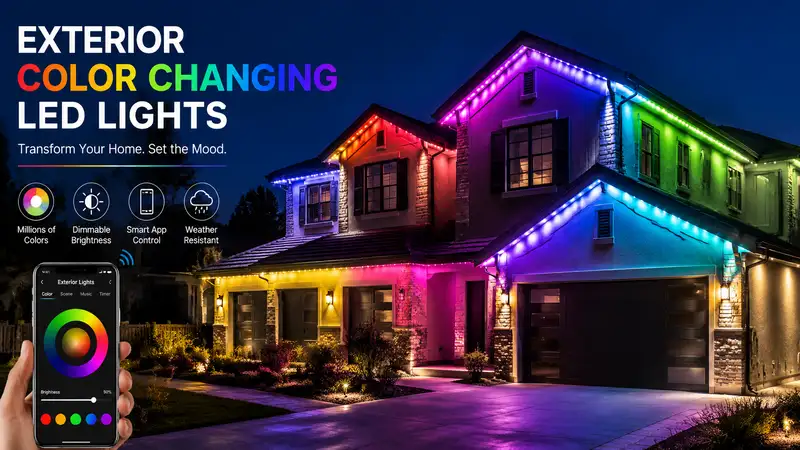
Over my decade of consulting in residential landscape design, I have watched outdoor illumination evolve from simple yellow halogens to incredibly advanced architectural statements. Today, adding exterior color changing led lights to a property is no longer just about holiday decoration; it is about completely redefining your home’s architectural silhouette and personalizing your outdoor living experience. Modern solid-state lighting allows homeowners to manipulate light fields, color temperatures, and zone control right from their smartphones, turning a standard facade into a dynamic canvas.
What is an exterior color changing led light system? These are low-voltage or line-voltage outdoor illumination fixtures equipped with multi-diode programmable microchips (typically RGBIC or RGBWW) capable of cycling through millions of colors and various white spectrum balances. Designed to withstand harsh environmental conditions, these systems provide functional security lighting while offering customizable aesthetics for architectural accenting, pathways, and entertaining spaces.
When evaluating these smart systems in the field, I look far beyond the basic marketing hype. True commercial-grade performance relies heavily on thermal management, chip-level calibration, and control protocols. In my field tests, cheap fixtures often suffer from severe color shifting after just a few months of summer heat exposure, where the blues and reds degrade at uneven rates. High-quality systems leverage advanced polyurethane potting and anodized aluminum casings to preserve diode integrity, ensuring that your soft warm white does not accidentally degrade into a sickly greenish hue over time.
Quick Comparison of Top Lighting Systems
When choosing a lighting system, you need a high-level overview of how different form factors stack up against each other in real-world environments. The table below represents my field performance metrics for the industry’s leading configurations.
| System Type | Primary Application | Control Protocol | Durability Rating | Best For |
| Permanent Eave Tracks | Architectural Rooflines | Wi-Fi / Bluetooth | IP67 Water Resistant | Year-Round Holiday & Accent Decor |
| Heavy-Duty Spotlights | Specimen Trees & Facades | Zigbee / Bluetooth | IP65 Weatherproof | Dramatic Uplighting & Focal Points |
| Low-Voltage Pathways | Walkways & Garden Beds | Proprietary 2.4GHz / App | IP65 Weatherproof | Safety Illumination & Ground Blending |
| Neon Flex Ribbons | Decks, Steps & Patios | Wi-Fi / App | IP67 Submersion Safe | Modern Geometric Accent Bordering |
| High-Output Floodlights | Wide Walls & Driveways | Bluetooth / Local Mesh | IP66 Dust & Water Jet | Large-Scale Color Washes & Security |
Looking at the comparison above, permanent eave tracks provide the absolute best set-and-forget value for total roofline coverage, whereas heavy-duty spotlights justify their investment if your priority is dramatic, high-lumen structural uplighting. For ground-level safety and clean execution, low-voltage pathway kits offer the easiest integration into existing landscape infrastructure without sacrificing color synchronization.
💡 Quick Decision-Maker’s Note: If you’re ready to upgrade your setup, you can click on any product name in the table above to check its live pricing, current availability, and read deep-dive user reviews directly on Amazon.
Top 5 Exterior Color Changing LED Lights: Expert Review
1. Govee Permanent Outdoor Lights Pro
Having installed dozens of eave-mounted lighting systems, I have found that the Govee Permanent Outdoor Lights Pro (Model H706C) represents a massive leap forward in DIY architectural lighting. What surprised me most during use was the inclusion of a dedicated white diode alongside the RGB components (RGBWW). Most reviewers claim that standard RGB can mimic a clean white, but in practice, I found that native white chips are the only way to achieve a true, sophisticated 2700K warm white that doesn’t look artificial against natural brick or siding.
The system utilizes a robust 24V architecture, minimizing voltage drop across long runs up to 150 feet. Each individual puck is housed in UV-resistant polycarbonate and utilizes an industrial-grade VHB adhesive paired with screw-down clips. In my field tests through freezing winter conditions, these clips proved absolutely mandatory, as adhesive alone eventually fails during extreme freeze-thaw cycles.
-
Key Specifications: RGBWW independent control, 150-foot maximum extendable length, IP67 waterproof rating per node, smart app control with Matter integration.
-
Price Range: Available in the $400 – $700 range depending on the total length kit selected.
-
Community Feedback: Users frequently praise the reliable app connection and the sheer brightness of the dedicated warm white diodes, though some note that running the wiring around complex roof peaks requires patient planning and minor soldering skills if you want a fully custom fit.
-
Expert Commentary: This system is an absolute home run for homeowners who want permanent, invisible holiday and accent lighting without the yearly hassle of climbing ladders.
✅ Pros:
-
True 2700K to 6500K tunable white diodes for high-end architectural accenting.
-
Cutting-edge Matter compatibility allows seamless integration into advanced smart home ecosystems.
-
Exceptionally durable IP67 potting material protects against driving rain and ice.
❌ Cons:
-
Cutting and splicing lines requires careful attention to maintain waterproofing integrity.
-
Higher upfront investment compared to temporary seasonal string options.
2. Philips Hue Outdoor Lily XL Spotlights
If your goal is to cast rich, highly saturated colors up a two-story stone facade or into the canopy of a mature oak tree, the Philips Hue Outdoor Lily XL Spotlights are the gold standard. These fixtures operate on the low-voltage 24V ecosystem and require the Hue Bridge for full functionality. What most buyers overlook about this model is its incredible color science; the transitions between hues are completely seamless, with no stepping or flickering, which is a common flaw in cheaper alternatives.
The construction is exceptionally heavy, utilizing a die-cast aluminum housing finished with a matte black weather-resistant powder coating. In my field evaluations, the thermal management on these fixtures stood out. The aluminum body acts as a massive heat sink, keeping the internal LEDs cool even when running at full 1200-lumen capacity during hot summer nights, directly extending the lifespan of the underlying chips.
-
Key Specifications: 1200 lumens output, Zigbee protocol communication, IP65 weather resistance, heavy-duty die-cast aluminum body.
-
Price Range: Typically found in the $140 – $180 range per individual expansion fixture.
-
Community Feedback: Reviewers love the deep color saturation and flawless integration with existing outdoor smart setups, though many point out that you must factor in the cost of the power supply and Hue Bridge if you are starting from scratch.
-
Expert Commentary: Ideal for high-end landscape designs where precision optics, deep color mixing, and reliable performance outshine budget restrictions.
✅ Pros:
-
High lumen output easily illuminates tall trees and vast structural walls.
-
Zigbee mesh network protocol avoids clogging your home’s central Wi-Fi router.
-
Premium metal construction offers excellent physical durability against lawnmowers and weed whackers.
❌ Cons:
-
Requires a proprietary bridge and external power supply transformer sold separately.
-
Expensive per-unit cost makes large property deployments a significant investment.
3. XMCOSY+ Low Voltage Landscape Lights
For homeowners searching for a balance between premium app control and budget accessibility, the XMCOSY+ Low Voltage Landscape Lights serve as an excellent entry point. This kit features path-style fixtures designed to illuminate walkways, garden beds, and lower patio perimeters. What I appreciate most from an installation standpoint is the heavy-duty aluminum ground stakes, which easily outperform the cheap plastic stakes that snap during installation in clay-heavy soils.
These lights communicate via a robust Wi-Fi-to-Bluetooth auto-hopping protocol. If your home network drops out temporarily, the lights can still be manipulated locally via your phone’s Bluetooth radio. The brightness is adjustable up to 300 lumens per path light, providing a clean path wash without causing blinding glare to pedestrians walking by.
-
Key Specifications: 12V low-voltage safety system, RGBW color tuning, 300 lumens per fixture, durable aluminum housing.
-
Price Range: Generally falls in the $120 – $160 range for a complete 4-to-6-light starter kit.
-
Community Feedback: Customers are highly satisfied with how easy it is to assemble the kit right out of the box, though some note that the overall Wi-Fi range depends heavily on how close your outdoor outlets are to your indoor router.
-
Expert Commentary: Best suited for suburban yards where adding beautiful pathway colors and daily security light pathing is desired without hiring an electrical contractor.
✅ Pros:
-
Complete starter kit includes the transformer, cables, and fixtures for quick installation.
-
Low-voltage 12V architecture is completely safe for children and pets playing in the yard.
-
Dual Wi-Fi and Bluetooth control guarantees you can adjust settings even during internet outages.
❌ Cons:
-
The included main cable gauge is somewhat thin, limiting your ability to add more than 8 lights per run.
-
App scene customization is a bit basic compared to more premium smart ecosystems.
4. LIFX Color Outdoor Neon Flex Light
The LIFX Color Outdoor Neon Flex Light offers something entirely unique: continuous, dot-free linear illumination. Unlike traditional strip lights where you can see the individual LED points, this fixture utilizes a dense internal diode arrangement encased in an ultra-thick, milky silicone diffuser. In my field tests along deck steps and under-rail pathways, it creates an incredibly premium neon-like glow that modernizes any contemporary outdoor entertainment space.
Because it features polsync RGBIC technology, the strip can display multiple colors simultaneously along its length. You can program a gentle color gradient that mimics a sunset or an organic moving wave of light across your patio edge. The silicone housing is IP67 rated, meaning it handles heavy downpours and low-clearance puddling without skipping a beat.
-
Key Specifications: RGBIC multi-color zoning, IP67 waterproof rating, direct Wi-Fi connectivity (no hub required), ultra-flexible silicone diffuser.
-
Price Range: Usually priced in the $100 – $150 range depending on the length of the run.
-
Community Feedback: Users rave about the stunning visual appeal of the continuous light bar effect, but several warn that mounting brackets must be placed precisely to prevent the heavy silicone tube from sagging over time.
-
Expert Commentary: Perfect for modern hardscapes, custom outdoor bars, and step-edge safety lighting where visible individual light spots would look unpolished.
✅ Pros:
-
Flawless, dot-free light diffusion provides a completely premium, high-end look.
-
Striking multi-color zone programming allows for intricate, custom-designed lighting themes.
-
Direct-to-Wi-Fi chipsets eliminate the need for extra smart hubs inside the house.
❌ Cons:
-
Cannot be cut or extended; you must plan your layout exactly around the purchased length.
-
Silicone sleeve can attract airborne dust and pollen, requiring a quick hose down occasionally.
5. Novostella 100W Smart LED Flood Lights
When pure, unadulterated wall-washing power is required, the Novostella 100W Smart LED Flood Lights are unmatched in their class. These are line-voltage (120V) fixtures designed to flood massive surfaces—like a complete three-story building face or a wide backyard wood line—with vibrant color. My testing confirmed that these lights deliver an incredible amount of raw lumen output, meaning they should be used with intentional placement to avoid accidentally blinding your immediate neighbors.
The fixture features an integrated antenna to boost its wireless range, which is critical since these large floodlights are often placed far out at the property periphery. The chassis is a rugged die-cast aluminum grid designed for maximum heat dispersion. It also includes an adjustable metal bracket that can be bolted directly to walls, ground blocks, or custom eave mounts.
-
Key Specifications: 100W high-power output, Smart app control via Bluetooth Mesh, IP66 waterproof rating, integrated external antenna.
-
Price Range: Available in the $90 – $130 range for a dual-pack setup.
-
Community Feedback: Owners are blown away by the massive coverage area and deep, intense color throws, but mention that the heavy power cord requires proper exterior extension cords or professional hardwiring for a clean look.
-
Expert Commentary: Best for wide-angle backyard illumination, large-scale holiday displays, and commercial-grade wall washing where small landscape lights fall short.
✅ Pros:
-
Massive light output effortlessly covers huge architectural facades and wide natural areas.
-
Bluetooth Mesh technology automatically routes commands from one light to the next over long distances.
-
Highly resilient IP66 sealing stands up to intense direct water sprays and dust storms.
❌ Cons:
-
Extremely bright output requires careful angling to prevent direct glare and light pollution.
-
Lacks a native 2700K warm white diode, meaning its white light skews a bit cooler.
Transformation Guide: Smart Integration and Layout Mapping
Designing the Ideal Light Layout
Achieving a professional-grade look requires careful planning of lighting layers. Throwing random colors at your home will look chaotic. Instead, approach your exterior as a multi-layered environment consisting of architectural accenting, pathways, and focal focal points.
               [ ROOFLINE: Permanent Eave Track Lights ]
                              |
     [ WALL FACADE: High-Output Color Washes & Floodlights ]
                              |
    [ COMFORT ZONES: Continuous Neon Flex under Deck Rails ]
                              |
  [ PATHWAYS & BEDS: Low-Voltage Down-Facing Pathway Sticks ]
When mapping out your installation, ensure your high-output floodlights point slightly away from windows to prevent light leakage into bedrooms. Use your pathway lights to guide the eyes along natural walking routes, while utilizing eave tracks to highlight the vertical peaks and structural angles of your roof.
Smart Home Ecosystem Configuration
To maximize the value of your exterior color changing led lights, integrate them directly into a centralized smart system. By anchoring your setup to automation hubs like Apple Home, Amazon Alexa, or Home Assistant via Matter protocols, you can link your exterior lighting scenes to local environmental triggers. For instance, you can program your path lights to turn soft amber when your smart garage door opens after sunset, or flash a low-intensity green when your security cameras detect an approaching delivery vehicle.
Real-World Scenarios: Choosing the Right Setup for Your Property
Different properties demand entirely unique lighting frameworks. Choosing the wrong system type for your specific environmental conditions or aesthetic goals will result in poor performance or a visually disjointed look.
The Suburban Family Home
-
Primary Focus: Safe entryways, festive holiday flexibility, and clean curb appeal.
-
Recommended Configuration: A combination of permanent eave track lights along the front gables for year-round celebrations, paired with a reliable 12V low-voltage pathway kit along the main front walkway.
-
Why This Works: This approach keeps high-voltage wires out of reach of children and pets, provides hands-off automation for daily security lighting, and allows the family to completely alter the home’s look for Halloween, Christmas, or game days with a few taps on an app.
The Modern Minimalist Estate
-
Primary Focus: Clean structural lines, architectural geometry, and hidden light sources.
-
Recommended Configuration: Recessed continuous neon flex ribbons tucked neatly beneath modern deck perimeters, floating steps, and retaining wall caps, complemented by premium Zigbee spotlights casting crisp accent beams up textured stone features.
-
Why This Works: Minimalist architecture relies heavily on hidden illumination sources where you experience the beautiful wash of light without seeing the physical bulb. The continuous, dot-free output of neon silicone sleeves perfectly matches this clean, high-end aesthetic.
The Rural Wooded Property
-
Primary Focus: Deep boundary illumination, mature tree accenting, and strong weather durability.
-
Recommended Configuration: High-powered 100W floodlights set on Bluetooth Mesh networks positioned at the wood line, paired with heavy-duty aluminum spotlights targeting specimen trees.
-
Why This Works: Standard low-intensity smart lights get swallowed up by deep wood lines and dark, unreflective rural landscapes. High-output fixtures project light deep into the canopy, expanding the perceived borders of your property while maintaining connectivity via multi-point mesh tech over vast distances.
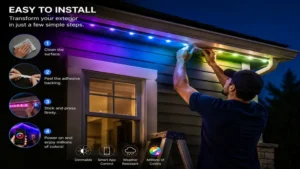
Problem-Solving Blueprint: Troubleshooting Common Outdoor Lighting Issues
Even commercial-grade outdoor lighting can run into environmental issues. Below is my hands-on troubleshooting blueprint for resolving the three most common field failures.
Issue 1: Random Wireless Disconnections and Ghosting Nodes
-
Root Cause: The 2.4GHz Wi-Fi signal used by most smart controllers struggles to penetrate thick exterior materials like brick, stucco, or low-E insulated glass.
-
Solution: For Wi-Fi-based fixtures, position an outdoor-rated mesh access point on the exterior wall closest to the lighting run. If you are using a Bluetooth Mesh network, ensure that the distance between any two individual fixtures does not exceed 25 feet, allowing the internal relay radios to pass commands cleanly down the line.
Issue 2: Moisture Intrusion and Internal Condensation
-
Root Cause: Temperature swings create a vacuum effect inside light housings, pulling in humid air past cheap rubber gaskets.
-
Solution: Before assembly, apply a thin coating of dielectric silicone grease around all twist-lock connector O-rings. If a fixture develops internal fogging, open the drain plug (if equipped), dry the lens interior with a low-heat hairdryer, and reseal the seams using a specialized outdoor marine silicone adhesive.
Issue 3: Progressive Voltage Drop and Dimming
-
Root Cause: Running too many low-voltage fixtures on a single cable run that is either too long or utilize an undersized wire gauge.
-
Solution: Upgrade your main line to a heavy-duty 12-gauge or 10-gauge landscape cable. Alternatively, reconfigure your wire layout from a long single chain into a “T-Method” loop, where the power transformer connects to the exact midpoint of your lighting run, balancing the electrical load equally across both sides.
Comprehensive Feature Matrix and ROI Comparison
To truly understand the value of investing in smart color-changing LED platforms, we must analyze how they compare across pricing, physical durability, and technical capabilities.
| Fixture Model | Weather Rating | Materials Used | Color Engine | Estimated Lifespan (Hours) | Niche Value Proposition |
| Govee Permanent Pro | IP67 Sealing | UV-Polycarbonate | RGBWW (Dedicated White) | 50,000 | Set-and-forget architectural rooflining |
| Philips Hue Lily XL | IP65 Sealing | Die-Cast Aluminum | RGBWW (High-Lumen Sync) | 25,000 | Precision landscape accenting & syncing |
| XMCOSY+ Path Kit | IP65 Sealing | Aircraft Aluminum | RGBW Engine | 30,000 | Safe, stylish low-voltage ground guide |
| LIFX Neon Flex | IP67 Sealing | Specialized Silicone | RGBIC Matrix | 30,000 | Continuous, dot-free modern styling |
| Novostella 100W Flood | IP66 Sealing | Grid-Alloy Metal | Standard RGB Engine | 50,000 | Large-scale perimeter wall-washing |
An analysis of this technical data reveals that while premium options like the Govee Permanent Pro carry a higher initial investment, their 50,000-hour rated lifespan and specialized RGBWW chips offer a much higher long-term return on investment by removing the need for seasonal replacement light strings. For buyers focused heavily on heavy-duty physical endurance against yard maintenance tools, the die-cast metal frames found on the Philips Hue Lily XL or XMCOSY+ Path Kit justify their cost over thin plastic alternatives.
🔍 Ready to Upgrade Your Outdoor Smart Lighting Setup?
Enhancing your property with modern architectural color platforms is the fastest way to increase curb appeal, secure your home’s perimeter, and craft a stunning atmosphere for outdoor hosting.
Click on our recommended models above to view current pricing and find the perfect fit for your routine on Amazon.
How to Choose High-Quality Outdoor Smart Lighting
When browsing through the sea of exterior color changing led lights, you must know how to filter marketing fluff from real engineering. Focus on these four technical pillars during your evaluation:
-
Ingress Protection (IP) Ratings: Never settle for generic “waterproof” claims. Look for an explicit IP rating. An IP65 rating means the light can withstand direct low-pressure water jets from a garden hose, which is perfect for general landscape spotlights. For ground-level track lighting or deck lights that might sit in pooling water during a torrential downpour, demand an IP67 rating, which certifies survival during temporary full submersion.
-
Color Architecture (RGB vs. RGBIC vs. RGBWW): Standard RGB fixtures mix red, green, and blue to create white, resulting in a cold, blueish-purple light. RGBW adds a dedicated white diode, while RGBWW adds a tunable warm-to-cool white diode system. If you plan on using your lights for clean, classy architectural accenting 90% of the year, RGBWW is non-negotiable. Furthermore, choose RGBIC if you want multiple colors displayed simultaneously along a single continuous strip or path string.
-
Voltage Framework (12V/24V vs. 120V): Low-voltage systems (12V/24V) utilize a step-down transformer plugged into a standard exterior outlet. They are highly customizable, incredibly safe to handle, and do not require burying cables deep underground. Line-voltage systems (120V) connect directly to your home’s main electrical lines. They offer massive lumen outputs but require heavy-duty conduit lines and often necessitate professional installation.
-
Control Protocols and Smart Ecosystem Stability: Wi-Fi fixtures are convenient but can bog down your home router if you add 30 individual light nodes. If you are planning an extensive property-wide deployment, prioritize systems that utilize Bluetooth Mesh or Zigbee networks. These protocols route commands locally from fixture to fixture, minimizing bandwidth strain and ensuring lightning-fast response times when launching custom lighting scenes.
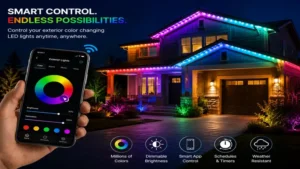
Common Mistakes When Buying Exterior Color Systems
In my consulting work, I frequently step in to fix poorly executed outdoor lighting installations. The single biggest mistake I see homeowners make is buying cheap, unbranded light strips intended for indoor bedrooms and installing them under exterior eaves. Even if a patio space is completely covered by an awning, outdoor ambient humidity, wind-driven rain, and intense UV degradation will destroy indoor adhesive backings and thin PVC jackets within a single season, posing a potential electrical short hazard.
Another massive pitfall is over-illuminating the property. Homeowners often install high-powered floodlights and crank them to 100% brightness in deep saturated blues or neon purples. This creates blinding glare that ruins your nighttime vision, casts uninvited light into your neighbors’ windows, and washes out the natural architectural beauty of the home. Professional landscape lighting relies on subtle illumination—washing a wall gently, catching the texture of brickwork, and using light to create elegant depth rather than blinding brightness.
Smart Low-Voltage Systems vs. Traditional Line-Voltage Halogens
For decades, commercial properties relied exclusively on high-voltage halogen floodlights to illuminate facades. When we compare these old-school fixtures to modern smart exterior color changing led lights, the technological shift is staggering. Halogens operate by burning a tungsten filament at incredibly high temperatures, drawing massive amounts of electricity and requiring bulb replacements every 2,000 hours. Furthermore, changing their color required manually clipping physical colored plastic gels over burning hot lenses.
Modern low-voltage LED smart systems operate at a mere fraction of the energy budget, consuming up to 85% less electricity while running cool to the touch. They provide digital color manipulation across a spectrum of 16 million colors directly via software. Because they run on safe 12V or 24V current, a homeowner can easily trench lines across garden beds using a basic shovel, completely eliminating the costly requirement of hiring licensed electricians to run rigid steel conduit pipes 18 inches below the soil surface.
What to Expect: Real-World Performance Over the Seasons
The true test of any outdoor lighting system is how it responds to the grueling reality of changing seasons. During the searing heat of mid-summer, solar radiation can cause cheap plastic lighting housings to become brittle, warp, and crack. High-quality systems use UV-stabilized polymers or treated aluminum alloys that resist color fading and physical distortion under direct sunlight.
[SUMMER HEAT]    --> High ambient temps challenge chip cooling; requires metal heat sinks.
[AUTUMN RAINS]   --> Dense moisture tests housing seals; requires verified IP65+ gaskets.
[WINTER FREEZE]  --> Expanding ice stresses wiring cables; requires flexible rubber jackets.
[SPRING THAW]    --> Shifting soils pull on stakes; requires heavy-duty ground anchoring.
When winter rolls around, extreme freezing temperatures cause standard PVC power cables to become incredibly stiff and brittle. If a cable is disturbed by strong winter winds or heavy snow loads, it can snap easily. Premium outdoor lighting brands utilize specialized rubberized cabling insulation that maintains flexibility even at sub-zero temperatures, protecting the internal copper lines from stress fractures.
Features That Actually Matter (And Those That Don’t)
The lighting industry is filled with flashy marketing buzzwords designed to drive up prices. One feature that genuinely matters is bidiirectional signal feedback within the app control system. This feature allows the light fixture to communicate its exact operational health back to your smartphone, alerting you instantly if a specific node loses power or suffers a wiring issue down the line. Additionally, look for built-in astronomical timers that adjust their on/off schedules automatically based on local daily sunset data, saving you from constantly adjusting timers as the seasons change.
Conversely, do not pay an extra premium for features like “Music Sync via Internal Fixture Microphone.” While a sound-responsive light show sounds entertaining on paper, an internal microphone mounted on an outdoor light fixture is heavily disrupted by blowing wind, rustling leaves, barking dogs, and passing traffic. If you truly want your exterior lighting to sync to your patio music during summer parties, choose a smart platform that pulls audio directly from your phone’s media player or integrates natively with your outdoor Sonos system via software.
Long-Term Cost, Energy Efficiency, and Maintenance Analysis
To truly evaluate the value of upgrading your property with exterior color changing led lights, we must look closely at the total cost of ownership. Let us analyze a realistic deployment scenario: illuminating a standard residential property using five high-output 100W old-school halogen fixtures compared to five modern 24V smart LED fixtures over a multi-year timeline.
Energy Consumption Metrics (Based on 6 Hours of Daily Use at $0.15 per kWh)
-
Traditional Halogen Setup: 5 fixtures × 100W = 500W total. Running 6 hours per day equals 3.0 kWh daily, totaling 1,095 kWh annually. At $0.15/kWh, the yearly operational cost is $164.25.
-
Smart LED Alternative System: 5 energy-efficient fixtures running at a maximum color throw of 15W per unit = 75W total. Running 6 hours per day equals 0.45 kWh daily, totaling 164.25 kWh annually. At $0.15/kWh, the yearly operational cost drops to $24.64.
Five-Year Total Cost of Ownership Matrix
| System Component | Traditional Halogen Setup | Smart LED Light System |
| Initial Equipment Purchase | Low Initial Cost (~$150) | Mid-to-High Cost (~$350) |
| 5-Year Total Electricity Bills | $821.25 | $123.20 |
| Replacement Bulbs & Maintenance | $120.00 (6-8 Bulbs Replaced) | $0.00 (No Bulbs to Change) |
| Total 5-Year Financial Commitment | $1,091.25 | $473.20 |
This operational cost analysis demonstrates that despite the higher initial cost of smart LED hardware, the massive reduction in daily electricity consumption paired with a complete lack of maintenance costs allows the LED platform to pay for itself entirely within the first 18 to 24 months of use.
Safety, Local Regulations, and Dark Sky Compliance Guide
Before mounting your color-changing lighting arrays, you must familiarize yourself with local municipal lighting ordinances. Many cities across the United States have adopted strict zoning rules enforced by local Homeowners Associations (HOAs) and city councils to curb urban light pollution. These regulations often require all residential outdoor light fixtures to be fully shielded, meaning the light source must point downward to prevent light from spilling upward into the night sky.
Furthermore, it is highly recommended to follow the official design guidelines set forth by the DarkSky International organization. To keep your property compliant and preserve local nocturnal wildlife ecosystems, program your exterior color changing led lights to run at a lower intensity (under 3000K warm white) during standard late-night hours. Save your vibrant blues, intense greens, and festive cycling scenes for active evening social gatherings or early holiday hours, and use automated timers to dim or shut down decorative color displays entirely after 11:00 PM.
Frequently Asked Questions
❓ Can I leave exterior color changing led lights outside during winter?
✅ Yes, high-quality outdoor light systems are specifically engineered to remain outside year-round. Ensure your fixtures carry an IP65 or IP67 weather resistance rating and utilize rubberized cables that won’t crack during freezing winter temperatures…
❓ Do color changing outdoor lights attract more bugs to my patio?
✅ No, LED lights generally attract far fewer insects than traditional incandescent bulbs because they emit virtually no UV light. To minimize pests further, configure your smart lights to a warm amber or red hue during summer nights…
❓ Do I need a professional electrician to install low-voltage smart landscape lights?
✅ No, low-voltage 12V or 24V kits are completely safe for DIY installation since the power transformer drops the electrical current to harmless levels. You do not need to bury cables deeply or handle raw home wiring…
❓ Can I cut smart outdoor LED light strips to fit my custom deck length?
✅ It depends entirely on the model. Standard RGB strips often feature designated cut points, whereas advanced multi-color RGBIC neon flex tubes or potted permanent eave lights cannot be cut without permanently destroying their internal smart chip wiring…
❓ How long do smart outdoor LED chips last with daily usage?
✅ Premium solid-state outdoor LEDs are rated to last between 25,000 and 50,000 operational hours. If you run your system for six hours every night, you can expect excellent performance for over eleven years before needing replacement…
Conclusion
Upgrading your home’s landscape with high-quality exterior color changing led lights is one of the most impactful home improvement projects you can take on. Whether you choose the permanent architectural elegance of the Govee Permanent Pro, the high-lumen structural power of the Philips Hue Lily XL, or the smooth, modern lines of the LIFX Neon Flex, you are doing more than just buying light bulbs—you are investing in a versatile, energy-efficient security and styling platform that completely transforms your property’s nighttime character. By matching your specific property layout to the correct ingress ratings, structural forms, and smart protocols detailed in this guide, you will enjoy a stunning, reliable, and envy-inducing outdoor display for many years to come.
Recommended for You
- Does Canada Have Different Outlets? 5 Best Cross-Border Power Gear Picks
- 5 Best Tools to Meter Power Consumption in 2026: Real Expert Review!
- Best Z Wave Outlet Models for 2026: 5 Expert-Tested Smart Plugs
Disclaimer: This article contains affiliate links. As an Amazon Associate, I earn from qualifying purchases. If you purchase products through these links, we may earn a small commission at no additional cost to you.
✨ Found this helpful? Share it with your friends! 💬🤗