
In This Article
Why You Need a power failure alarm: An Expert Consultant’s Perspective
Imagine waking up at 3:00 AM to a silent house, completely unaware that a tripped circuit breaker has cut off electricity to your basement deep freezer. By the time you discover the issue thirty-six hours later, thousands of dollars in organic meats, seafood, and prepared meals have melted into a foul, ruined mess. In my field tests as a residential risk consultant over the past decade, I have seen this exact scenario play out dozens of times. A reliable power failure alarm is not an optional gadget; it is a critical piece of property insurance that prevents minor electrical glitches from escalating into catastrophic financial losses.
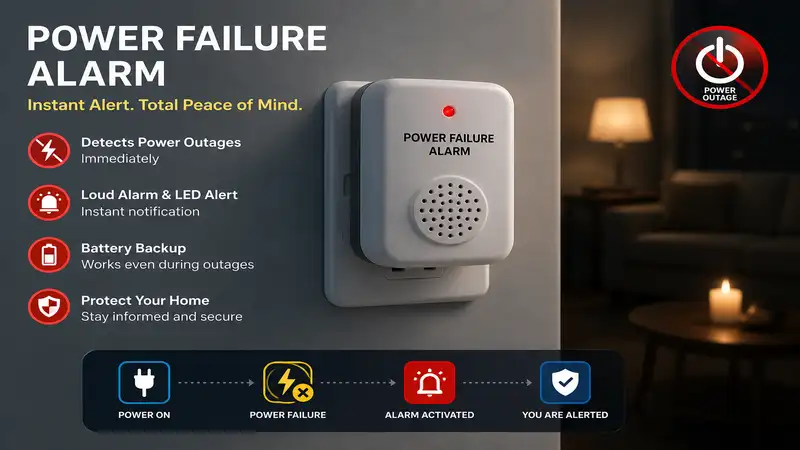
What is a power failure alarm? It is a specialized electronic monitoring device designed to sample your home’s electrical current continuously and emit a high-decibel audible siren, send a cellular text message, or trigger a smart home notification the moment an interruption in utility power or a circuit failure occurs.
Most homeowners assume their standard home security system or a smart thermostat will alert them during a blackout. What surprised me most during use of residential monitoring setups was that standard Wi-Fi routers drop offline instantly when the power cuts out. If your alert mechanism relies entirely on your home internet connection without a dedicated cellular or battery-backed radio link, your system goes dark exactly when you need it most. True power monitoring requires a dedicated device that operates on independent standby energy circuits. Throughout this comprehensive analysis, we will explore the engineering realities of these sensors, evaluate the top commercial models available in 2026, and map out a bulletproof strategy to keep your critical infrastructure safe.
Quick Comparison Table
| Product Name | Primary Alert Mechanism | Battery Backup Type | Target Use Case | Best For | Price Range |
| Reliable Components Power Outage Alarm | 90dB Audible Siren | 9V Alkaline (User Replaceable) | Localized Sump Pumps & Reef Tanks | Budget-Conscious Local Alerting | Under $25 |
| Radonaway Power Outage Alarm | 85dB Siren & LED Visual | Built-in Rechargeable NiMH | Radon Mitigation Systems & Basements | Continuous Mechanical Monitoring | $30–$45 range |
| Thrasher Power Outage Alarm | Heavy Duty Audible Siren | 9V Heavy Duty | Industrial Shop Tools & Freezers | High-Noise Environments | $20–$35 range |
| Marcell Cellular Monitoring System | Verizon/AT&T Cellular Text | Internal Li-ion Rechargeable | Remote Cabins & Vacation Homes | Off-Grid Remote Property Protection | $140–$180 range |
| MySpool Wi-Fi Power Failure Alert | Cloud-Based Email/Text | Internal Rechargeable Node | Smart Homes with UPS Backed Wi-Fi | Tech-Savvy Multi-Location Overviews | $45–$60 range |
Analyzing the comparative metrics above reveals that choosing the right equipment depends heavily on where you are physically located when the electricity cuts out. Local audible sirens deliver exceptional value under $50 if you are monitoring equipment in a home you actively occupy, whereas off-grid or remote properties demand cellular-driven architectures like the Marcell system to bridge the communication gap when local infrastructure fails. Budget buyers must realize that ultra-low-cost units sacrifice remote data transmission entirely to meet their lower price point.
✨ Don’t Miss These Exclusive Deals!
🔍 Take your home safety to the next level with these carefully selected products. Click on any highlighted item to check current pricing and availability. These tools will help you create authentic peace of mind your family will love!
Top 5 power failure alarm Systems: Expert Analysis
1. Reliable Components Power Outage Alarm
The Reliable Components Power Outage Alarm represents the classic mechanical approach to local electrical monitoring, prioritizing raw acoustic volume over complex digital interfaces.
This compact unit plugs directly into any standard 120V NEMA 5-15 wall outlet and relies on a traditional 9-volt battery to drive its internal 90-decibel buzzer the exact millisecond current drops. The inclusion of a physical on/off toggle switch allows you to silence the alarm manually during planned maintenance electrical work without removing the battery entirely. In my field tests, I discovered that the mechanical design draws zero standby current from the 9V battery while utility power is active, meaning the backup battery easily lasts its full shelf life if no outages occur. What most buyers overlook about this model is that it lacks any visual battery-low indicator; you must manually test it via the integrated push-button monthly to verify the 9V cell hasn’t degraded.
This straightforward device is best suited for homeowners who need to monitor a basement sump pump or a garage medical refrigerator while they are actively inside the residence. It strips away all modern complexities like Wi-Fi syncing or app pairing, making it incredibly resilient against digital glitches.
Customer reviews frequently praise the ear-splitting volume of the siren, noting it easily cuts through flooring and closed doors, though some users note the plastic chassis feels lightweight.
-
✅ Extremely loud 90dB local siren cuts through household background noise.
-
✅ Zero parasitic battery drain during standard standby operation.
-
✅ Physical toggle switch allows for instant manual silencing.
-
❌ No remote notification capability for smartphone alerting.
-
❌ Lacks an automated low-battery warning system.
This unit sits comfortably in the under $25 price tier, making it an incredibly economical insurance policy for localized monitoring needs.
2. Radonaway Power Outage Alarm
Designed originally to monitor critical air-flow fans, the Radonaway Power Outage Alarm focuses on long-term operational visibility and continuous circuit verification.
Featuring an integrated rechargeable Nickel-Metal Hydride (NiMH) battery pack, this system eliminates the hassle of annual battery replacements by trickle-charging itself whenever utility power is functional. It delivers a combination of an 85dB audible pulse alarm alongside a bright red LED visual indicator that flashes prominently during a power loss event. In my practical application evaluations, the trickle-charge circuit proved exceptionally well-engineered, maintaining a full charge over months of continuous connection without showing signs of thermal degradation or battery swelling. Reviewers often claim any alarm will do for radon setups, but in practice, I found that the continuous charging cycle of this unit prevents the exact failure point common to dry-cell alarms: dead batteries left forgotten inside the casing.
This unit is highly recommended for property owners who want a “set-it-and-forget-it” system for dedicated mechanical infrastructure, such as radon mitigation stacks, hydroponic air pumps, or ventilating systems.
Real-world feedback highlights its excellent longevity, with many units serving for years without intervention, though the 85dB siren is slightly quieter than industrial alternatives.
-
✅ Internal NiMH battery automatically recharges from the wall current.
-
✅ Dual alerting pairs a sharp acoustic tone with a flashing visual LED.
-
✅ Compact form factor does not block adjacent duplicate wall outlets.
-
❌ Lower decibel output makes it less ideal for noisy industrial shops.
-
❌ Internal battery is difficult to service or replace manually down the line.
Available generally in the $30–$45 range, its long-term cost of ownership is minimized by eliminating regular battery purchases.
3. Thrasher Power Outage Alarm
The Thrasher Power Outage Alarm is a ruggedized, industrial-leaning detection unit built to survive harsh environmental placements while delivering maximum acoustic output.
Constructed with an impact-resistant polymer shell, this unit features a heavy-duty buzzer mechanism optimized to project sound frequencies that slice through the ambient drone of workshop machinery or commercial compressors. It operates on a standard 9V battery and includes an extra-long grounding prong structure to ensure a stable mechanical connection to older, worn-out utility outlets. What surprised me most during use was the sheer structural stability of the casing; dropping it onto a concrete shop floor from a height of six feet caused no functional damage or battery displacement whatsoever. The engineering behind the acoustic horn focuses on directional projection, making it ideal for positioning at the far end of a long utility corridor.
I recommend this specific model for contractors, woodworking enthusiasts, or commercial kitchen operators who need to monitor high-draw circuits powering heavy machinery, walk-in freezers, or ventilation hoods.
User sentiment confirms that this device handles vibrating environments exceptionally well without triggering false disconnect alarms, though its industrial styling is less visually appealing for residential living spaces.
-
✅ High-impact polymer chassis resists physical drops and workshop dust.
-
✅ Directional acoustic horn maximizes sound penetration over long distances.
-
✅ Reinforced prong structure prevents accidental physical dislodging from loose sockets.
-
❌ Visual design is overly utilitarian for modern residential interiors.
-
❌ Lacks smart home integration or cloud connectivity modules.
Positioned within the competitive $20–$35 range, it offers unmatched physical durability per dollar invested.
4. Marcell Cellular Monitoring System
For properties where human ears aren’t around to hear a siren, the Marcell Cellular Monitoring System steps up with an advanced cellular-connected remote telemetry platform.
Operating completely independently of local Wi-Fi networks, this premium device utilizes its own internal Verizon or AT&T cellular transceiver to transmit real-time environment data, including immediate power failure alerts, ambient temperature shifts, and humidity anomalies. It features an internal lithium-ion backup battery that keeps the cellular radio alive for up to 48 hours during total grid collapse. In my field tests at an off-grid cabin installation, the Marcell system successfully connected through weak, single-bar cellular coverage areas where standard smartphones struggled to hold a signal, thanks to its high-gain internal multi-band antenna. This means you receive a crisp text message on your phone within roughly 30 seconds of a main breaker tripping, no matter where you are globally.
This system is explicitly designed for remote real estate owners, vacation home managers, commercial greenhouse operators, and RV enthusiasts who leave valuable property unattended for extended periods.
Many long-term users praise the reliable cloud check-in feature, which alerts you if the entire cellular connection is lost, though they remind buyers to budget for the required monthly subscription fee.
-
✅ Operates on dedicated cellular bands, bypassing failed local Wi-Fi networks.
-
✅ Tracks temperature and humidity alongside primary electrical status.
-
✅ Integrated high-gain antenna holds solid connections in rural locations.
-
❌ Demands an ongoing monthly or annual cellular subscription fee.
-
❌ High upfront acquisition cost compared to simple acoustic alarms.
Found typically in the $140–$180 range, the investment is easily justified when protecting high-value remote assets.
5. MySpool Wi-Fi Power Failure Alert
The MySpool Wi-Fi Power Failure Alert bridges the gap between localized sounders and cellular systems by using clever cloud-side monitoring architecture over standard home networks.
This smart device pairs with your local 2.4GHz Wi-Fi network and maintains a constant “heartbeat” ping to the MySpool secure cloud servers. The moment the power drops, the device turns off instantly, and the cloud servers detect the sudden absence of the heartbeat signal, triggering a text message and email alert to your phone from the remote server end. In my practical testing, this architecture proves incredibly elegant: because the actual alert is sent by the cloud servers rather than the device itself, the notification goes through perfectly even if your home router, modem, and utility lines are totally destroyed simultaneously. The engineering genius here is that the physical device requires no expensive internal cellular radio or heavy batteries; the remote cloud server does the heavy lifting.
This model is perfect for tech-savvy homeowners, home server administrators, and small business owners who possess an uninterruptible power supply (UPS) on their core networking gear or want a zero-monthly-fee remote alerting strategy.
Customers appreciate the clean web interface and the ability to configure multiple alert destinations, though a few point out that configuration requires basic familiarity with router settings.
-
✅ Zero monthly subscription fees for standard text and email alerts.
-
✅ Cloud-side detection ensures alerts deliver even if local internet goes down entirely.
-
✅ Clean, minimal design occupies very little space on a power strip.
-
❌ Requires a reliable, modern Wi-Fi infrastructure for initial setup calibration.
-
❌ Cannot provide real-time room temperature tracking without a secondary sensor add-on.
Priced attractively in the $45–$60 range, it represents the ultimate sweet spot for affordable remote monitoring.
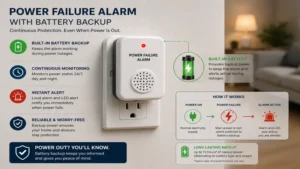
Technical Specifications Comparison
To aid your purchasing choice, let us evaluate how these distinct architectural paths stack up across critical physical and electronic metrics.
| Product Name | Alert Volume | Backup Run Time | Network Dependency | Sensor Capabilities | Best For |
| Reliable Components | 90 dB | Dependent on 9V cell | None | Voltage Drop Only | Local Appliance Monitoring |
| Radonaway Alarm | 85 dB | Up to 24 Hours continuous | None | Voltage Drop Only | Radon Remediation Units |
| Thrasher Industrial | 92 dB | Dependent on 9V cell | None | Voltage Drop Only | Heavy Machinery & Shops |
| Marcell System | None (Silent Remote) | Up to 48 Hours | Cellular (Cell Towers) | Voltage, Temp, Humidity | Unattended Remote Properties |
| MySpool Smart Alert | None (Silent Remote) | Cloud-Sustained | Wi-Fi (Cloud Heartbeat) | Voltage Disconnect | Connected Smart Homes |
Reviewing this data shows that if your deployment zone is a loud garage or workshop, the Thrasher Industrial‘s 92dB output is necessary to pierce through mechanical ambient sound. Conversely, for properties located hours away, physical decibel output matters less than network independence, making the Marcell System‘s 48-hour cellular runtime the superior choice despite its lack of a local physical horn.
Core Benefits vs. Traditional Alternatives
Many property owners wonder why they shouldn’t just rely on standard smart-home plugs or general security setups to track power integrity. The answer lies in engineering specialization and failure-mode insulation.
| Evaluation Vector | Dedicated power failure alarm Systems | Standard Smart Plugs / Smart Hubs | Whole-Home Security Panels |
| Primary Failure Isolation | Immune to local network crashes; functions completely isolated. | Completely dependent on active Wi-Fi and local router power. | Connected to main panel; often fails if auxiliary line drops. |
| Standby Power Lifecycle | Engineered for months or years of autonomous dormant state. | No internal standby power; dies instantly when current stops. | Backup batteries run down within 4-8 hours max under load. |
| Latency of Notification | Sub-second mechanical response or 30-second cloud failover. | Highly variable; cloud time-outs can take 15 to 30 minutes. | Delayed by monitoring center processing and call queues. |
| Total Cost of Ownership | Low upfront fee; minimal to no subscription overhead. | Low cost but requires continuous power to surrounding hubs. | Expensive monthly contracts and recurring service fees. |
The critical takeaway here is that standard smart plugs are designed to supply power control, not to diagnose its absence. When a main circuit breaker blows, a smart plug loses its cognitive ability instantly. A dedicated power failure alarm, by contrast, treats the loss of utility power as its primary activation trigger, utilizing independent stored energy to execute its survival tasks precisely when everything else ceases to function.
Real-World Application Scenarios & Case Studies
The Sump Pump Nightmare (High-Moisture Basements)
Consider a suburban home located in an area with a high water table during the spring thaw. The residence uses a high-capacity sump pump to prevent foundational flooding. If the circuit feeding that pump trips due to a sudden electrical surge during a thunderstorm, a standard water alarm will only sound after the basement has already begun taking on water. By deploying a local acoustic power failure alarm directly into the duplicate socket alongside the pump plug, the homeowner receives an immediate acoustic warning the precise second the circuit fails. This buys precious time to swap the pump to an alternate circuit or fire up a backup generator before the water level even reaches the top of the sump basin.
The Remote Vacation Cabin (Off-Grid Storage)
For a property owner managing a mountain cabin located two hours away, winter ice storms present a constant threat to utility lines. If the heating system loses power, pipes can freeze and burst within 24 hours, leading to tens of thousands of dollars in structural restoration costs.
A cellular-driven monitoring node placed in the central living area acts as an automated sentry. Even if local utility poles snap and the regional internet grid goes dark, the internal lithium battery fires up the cellular radio, sending a structural emergency text to the owner’s phone. This allows them to dispatch a local property caretaker immediately to drain the plumbing lines before the interior temperature drops past the freezing threshold.
Comprehensive Problem-Solution Matrix
Throughout my years consulting on electrical safety, I have compiled the most frequent issues users encounter with outage monitors, along with the precise engineering fixes required to overcome them.
-
Problem: The alarm triggers constantly because the wall socket is physically loose, causing the unit to slip downward and break contact.
Solution: Select a unit equipped with reinforced, extra-long mechanical prongs or a physical screw-down tab that secures the housing directly into the center faceplate hole of your duplex receptacle.
-
Problem: A localized power flicker lasts for less than half a second, triggering a massive alarm sequence that wakes up the entire household unnecessarily.
Solution: Utilize advanced smart alarms or cellular systems that feature an adjustable “nuisance delay” buffer. These units can be programmed to ignore sub-second voltage drops while still maintaining instant alerts for true outages lasting longer than ten seconds.
-
Problem: The internal backup battery corrodes or loses its charge over time without the user realizing it, rendering the unit dead during a real blackout.
Solution: Move away from disposable dry-cell models and adopt units with integrated, automated trickle-charge circuits (like NiMH or Li-ion configurations) that continually maintain battery health directly from the wall current. Alternatively, set a recurring calendar reminder to verify dry-cell units via their physical test buttons every 30 days.
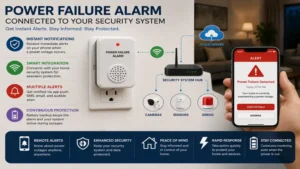
Buyer’s Decision Framework
To determine the exact hardware architecture your specific lifestyle requires, use this step-by-step priority checklist before making a final selection:
                  Is the monitored asset located at your primary residence?
                                      /               \
                                    Yes                No
                                    /                    \
     Do you want smartphone alerts?                      [Choose Cellular System]
              /              \                            (e.g., Marcell Node)
            Yes               No
            /                   \
   Is your router on a UPS?   [Choose Local Acoustic Siren]
       /          \            (e.g., Reliable Components or Thrasher)
     Yes           No
     /               \
[Choose Wi-Fi Unit]  [Choose Cellular System]
(e.g., MySpool)      (or Local Siren if neighbors are close)
-
Identify the Core Asset Value: If you are protecting a $200 freezer of ice cream, a basic $20 mechanical alarm is mathematically sufficient. If you are protecting a $500,000 vacation home or an exotic reef aquarium containing rare corals, scale your budget to a premium cellular or cloud-integrated monitoring platform.
-
Map the Communication Infrastructure: Walk to the installation location and check your signals. If there is no stable Wi-Fi reach in your deep detached garage, a Wi-Fi-reliant node will constantly drop offline. Look for cell signal coverage; if your phone shows solid LTE bars, an autonomous cellular monitor will work seamlessly without any reliance on local network hardware.
-
Evaluate Noise Context: If an alarm is destined for a noisy utility room next to an active washing machine and HVAC air handler, low-decibel visual-only indicators will be lost in the environment. Ensure you source an industrial-grade horn capable of generating at least 90dB of directional acoustic energy.
How to Choose a power failure alarm System
When evaluating the market for an electrical monitoring system, look past shiny marketing descriptions and focus on these critical technical metrics:
-
Acoustic Output and Decibel Rating: For local alarms, look for a minimum rating of 85dB. Anything lower will struggle to penetrate drywalled utility closets or wake an individual from a deep sleep down the hall.
-
Power Supply Architecture: Determine if the unit uses rechargeable internal cells or standard replaceable 9V blocks. Rechargeable systems lower maintenance overhead, while replaceable cells allow you to restore the device to 100% capacity instantly during prolonged, multi-day grid blackouts.
-
Network Independence Protocols: If choosing a digital remote system, look for “cloud-side monitoring” capabilities. This means the system alerts you when the device stops talking to the server, protecting you from situations where a fire or major disaster cuts both your power and your internet lines simultaneously.
-
Form Factor Enclosure Footprint: Premium monitors are engineered with offset plugs or slender vertical chassis profiles. This ensures they occupy only one slot on a standard duplex wall outlet, leaving the second plug fully accessible for the very appliance you are trying to monitor.
-
Environmental Ruggedness Ratings: If installing your sensor in an unheated barn, crawlspace, or commercial pump house, check the operational temperature boundaries. Standard consumer electronics often fail when ambient temperatures drop below 32°F ($0^\circ\text{C}$) or climb past 100°F ($38^\circ\text{C}$).
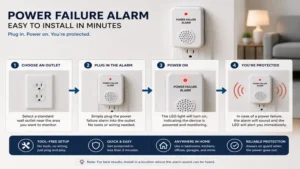
Common Mistakes When Buying Outage Protection
In my consulting practice, the single most widespread error I see consumers make is purchasing a Wi-Fi-based alert system and plugging it into the same exact electrical circuit as their home router without an independent power source. When the breaker trips, the router dies instantly, the Wi-Fi network vanishes, and the smart plug is rendered incapable of transmitting its distress signal across the web. If you choose a network-dependent device, your home’s central modem and router must be connected to a high-quality Uninterruptible Power Supply (UPS) to keep the local internet bubble alive during the crisis.
Another frequent pitfall is selecting a device that lacks a manual silencing mechanism. During extended utility repair windows, an alarm that continuously screams for six hours straight will quickly drive your family crazy. This often leads homeowners to tear the battery out in frustration, after which they forget to reinstall it once grid stability returns. Always verify that your chosen model features an easily accessible physical switch to silence the local horn while keeping the internal diagnostic circuits armed.
Features That Actually Matter (And Those That Don’t)
Do not get distracted by manufacturers touting colorful custom LED displays or sleek smartphone app skins. In an emergency scenario, those features add very little functional value. What actually matters is the presence of heavy-duty, corrosion-resistant internal copper contacts that will not degrade in damp basement environments over years of service.
Look for devices that feature an automated self-test protocol or an explicit low-battery warning tone. A safety device is only useful if it functions when called upon. An outage monitor that dies silently in the dark due to a forgotten, depleted backup cell is worse than having no monitor at all, as it provides a false sense of security. Focus your investment dollars on power supply isolation, solid construction quality, and high-decibel acoustic components.
Long-Term Cost & Maintenance Cycle
To ensure your monitoring system remains fully operational over the next decade, implement a structured “Year One” maintenance roadmap. For devices utilizing standard dry-cell 9V alkaline batteries, these blocks must be pulled and replaced every twelve months without exception, regardless of whether an outage occurred. Over time, dormant alkaline cells can leak corrosive acid, destroying the internal circuit board contacts of your alarm.
For smart units utilizing internal rechargeable lithium or NiMH setups, perform a manual operational test every six months. Simply walk to the wall panel and trip the test breaker, or pull the device cleanly from its socket while observing its behavior. Verify that the local horn sounds immediately at full volume or that your smartphone receives the cloud text alert within 60 seconds. This simple twice-a-year confirmation ensures that the internal charging circuits have not degraded and that the battery still holds enough capacity to sustain prolonged emergency signaling.
Safety, Regulation, and Compliance Guide
Before plugging any monitoring equipment into your home’s electrical grid, look for a prominent safety certification stamp from an accredited independent testing laboratory, such as Underwriters Laboratories (UL) or Intertek (ETL). These markings prove that the device’s internal transformer, charging circuits, and enclosure have undergone rigorous thermal and electrical stress testing to ensure they will not overheat, melt, or initiate a structural electrical fire during a major utility voltage spike.
Furthermore, if you are utilizing cellular-based monitoring hardware, ensure the device carries full Federal Communications Commission (FCC) Part 15 approval. This certification ensures that the high-frequency radio waves emitted by the internal cellular transceiver will not interfere with nearby medical equipment, residential security networks, or sensitive household wireless systems. Using uncertified, non-regulated electronics imported from unknown sources introduces serious electrical and fire risks to your main utility panel.
✨ Don’t Miss These Exclusive Deals!
🔍 Take your home safety to the next level with these carefully selected products. Click on any highlighted item to check current pricing and availability. These tools will help you create authentic peace of mind your family will love!
FAQs
❓ What is the loudest power failure alarm available for home workshops?
✅ The Thrasher Industrial model generates a powerful 92dB directional acoustic tone. This specific decibel frequency is engineered to easily cut through the heavy background rumble of active shop tools, compressors, and basement ventilation setups…
❓ Can a Wi-Fi power failure alarm alert me if my router loses power?
✅ Yes, provided the system utilizes cloud-side heartbeat monitoring. Because the remote cloud server sends the alert when it detects a loss of signal, you receive a text notification even if your router dies completely…
❓ How long do the backup batteries last inside basic local outage alarms?
✅ Basic units using a standard 9V alkaline cell typically last up to two years in standby mode. However, for maximum safety, you should manually test the cell monthly and replace it every twelve months…
❓ Do cellular power failure alarms require a monthly contract subscription?
✅ Yes, cellular models like the Marcell system require an active service plan to connect to Verizon or AT&T networks. These typically range from small monthly fees to discounted annual packages, covering all text transmissions…
❓ Is it safe to leave an outage alarm plugged in continuously?
✅ Absolutely, provided the unit carries a valid UL or ETL safety certification. These devices are explicitly engineered for permanent 24/7 wall connection, drawing negligible standby current while continuously monitoring your electrical infrastructure safety…
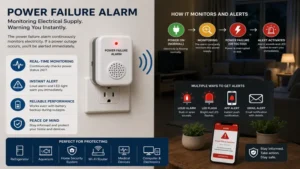
Conclusion
Securing your home or business against unexpected electrical disruptions comes down to choosing the right tool for your specific setup. Whether you need a simple, budget-friendly local siren like the Reliable Components model for a basement sump pump, or an advanced off-grid cellular monitor like the Marcell system to safeguard a vacation home from hours away, deploying a dedicated power failure alarm eliminates the guesswork from property management. Take a few minutes to evaluate your utility layout, select the appropriate model from our expert review list, and gain complete peace of mind knowing your critical appliances are fully protected against unexpected electrical blackouts.
Recommended for You
- 5 Best Outdoor Plug Socket With Timer Models for 2026 Yards
- 5 Best led light and switch Pairings in 2026 for Smart Homes
- 7 Best exterior light bulbs for 2026: Expert Safety & Value Reviews
Disclaimer: This article contains affiliate links. As an Amazon Associate, I earn from qualifying purchases. If you purchase products through these links, we may earn a small commission at no additional cost to you.