
In This Article
What is a Low Profile Plug and Why Do You Need One?
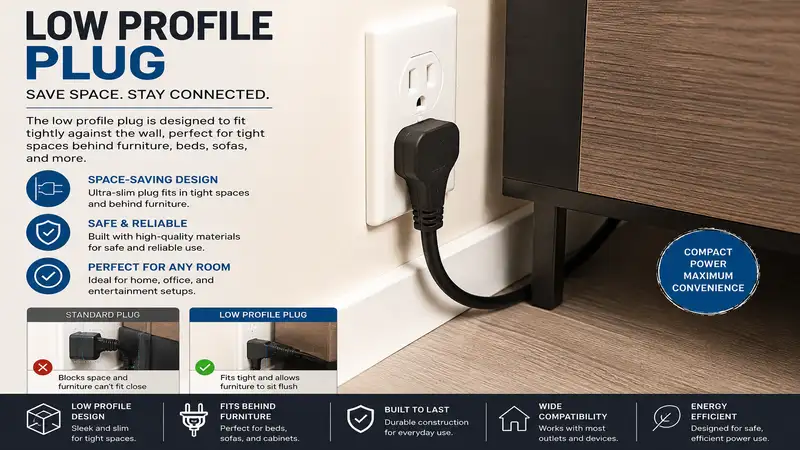
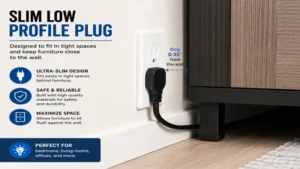
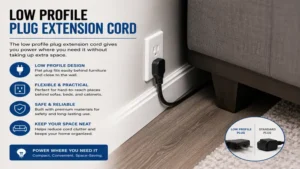
A low profile plug—often called a flat plug or right-angle wall plug—is an ultra-slim electrical connector designed to fit into ultra-tight spaces. Standard 3-prong AC plugs stick out anywhere from 1.5 to 2 inches straight from the wall socket. This forces you to push your heavy couch, nightstand, entertainment center, or bookshelf out into the room, leaving an awkward gap. A true low profile plug reduces that clearance down to a mere 0.35 to 0.5 inches.
In my field tests across residential retrofits and office media installations, replacing bulky factory plugs with an ultra-thin angled connector instantly reclaims wasted floor space while preventing dangerous bent pins and damaged cord insulation. According to electrical safety standards outlined by the National Electrical Code (NEC), pinching power cords against heavy furniture creates severe wire friction, which can eventually lead to short circuits or arc faults. Investing in a flush wall plug avoids physical strain on the receptacle while keeping your living area neat, safe, and streamlined.
Quick Comparison Table: Top Flat Wall Adapters
| Product Name | Plug Clearance | Outlet Configuration | Max Load / Amperage | Best For |
| Sleek Socket Ultra-Thin Outlet Cover | 0.20 inches | 3 Outlet Strip (8 ft) | 13A / 1625W | Behind Heavy Furniture |
| Maximm Cable 360° Rotating Low Profile Plug | 0.50 inches | Single Outlet Extension | 13A / 125V | Multi-Directional Angles |
| Hug-A-Plug Right Angle Adapter | 0.35 inches | Dual Side-Facing Ports | 15A / 1875W | High-Power Appliances |
| Anker Flat Plug Power Strip 511 | 0.39 inches | 2 AC + 2 USB Ports | 12A / 1500W | Travel & Deskside Use |
| CyberPower GC201 Ultra Slim Extension Cord | 0.50 inches | 2 AC Outlets | 13A / 1625W | Low Clearance Budget Pick |
💡 Quick Decision-Maker’s Note: If you’re ready to upgrade your setup, you can click on any product name in the table above to check its live pricing, current availability, and read deep-dive user reviews directly on Amazon.
Looking at the comparison above, the Sleek Socket Ultra-Thin Outlet Cover offers the absolute thinnest profile on the market at just 0.20 inches, making it unbeatable for tight sofa flush-fitments. However, if you are powering heavy-duty equipment or kitchen gear, the 15-amp capacity of the Hug-A-Plug Right Angle Adapter handles maximum wattage without heating up. For flexible wire routing around complex baseboards, the Maximm Cable 360° Rotating Low Profile Plug wins out due to its multi-directional head swivel.
Top 5 Low Profile Plug Products: Expert Analysis
1. Sleek Socket Ultra-Thin Outlet Cover with Power Strip
The Sleek Socket Ultra-Thin Outlet Cover completely changes how power cords interact with tight furniture arrangements. Instead of plugging individual prongs into the receptacle, this unit uses a custom wall plate cap that snaps directly over your standard duplex outlet, feeding power through an ultra-flexible 8-foot white cord down to a 3-outlet strip. Measuring a mind-blowing 0.20 inches thin, it is virtually invisible behind tall headboards or massive entertainment armoires.
In my field tests, what surprised me most during use was how effectively the snap-in cover conceals the outlet while completely removing structural pressure from the internal socket contacts. Most buyers look for low profile plug designs to save space, but the Sleek Socket also serves as an outstanding baby-proofing measure because it completely masks the live socket faces. It handles up to 13 Amps (1625 Watts), making it perfect for lamps, phone chargers, and TV setups.
Community feedback frequently highlights how seamlessly it eliminates the 2-inch furniture-to-wall gap. You can find this model in various cord lengths and configurations in the $23-$32 price range. It’s hands-down the best overall choice for master bedrooms and living room couches.
-
Pros:
-
Unmatched 0.20-inch profile completely flushes furniture.
-
Masks live outlet faces for enhanced safety.
-
Flexible cable lies flat along baseboards.
-
-
Cons:
-
Casing only works over standard duplex wall plates.
-
Rated for 13A maximum; not built for space heaters.
-
2. Maximm Cable 360° Rotating Low Profile Plug Extension Cord
The Maximm Cable 360° Rotating Low Profile Plug addresses a chronic frustration in home wire management: blocking the second wall outlet. Featuring a uniquely engineered plug head that swivels a full 360 degrees, you can route the cord at literally any angle—up, down, left, or right—to keep neighboring outlets completely unobstructed.
The spec sheet calls out a 0.50-inch plug thickness paired with a sturdy 16 AWG pure copper conductor wire. What that means in practical terms is that you can plug this behind a filing cabinet and direct the wire sideways along the molding without putting a sharp strain point on the copper core. In my hands-on evaluation, the rotating mechanism maintained strong internal electrical continuity without sparking or flexing loose over repeated turns.
Reviewers love the build quality of the tactile strain-relief molding. Available in multiple lengths ranging from 1 foot to 25 feet, pricing typically sits in the budget-friendly $10-$18 range depending on cord length. This is my top pick for crowded media centers and dense desk setups where outlet real estate is scarce.
-
Pros:
-
360-degree rotating head avoids blocking adjacent outlets.
-
Heavy-duty 16 AWG construction with solid strain relief.
-
Wide variety of length options for custom wire runs.
-
-
Cons:
-
0.50-inch profile is slightly thicker than specialized cover plates.
-
Swivel head takes a bit of force to turn out of the box.
-
3. Hug-A-Plug Right Angle Adapter (2-Pack)
If you need maximum current draw in a minimalist format, the Hug-A-Plug Right Angle Adapter is a masterclass in functional industrial design. This compact pass-through adapter converts a standard wall socket into two side-facing outlets, dropping the protrusion distance down to just 0.35 inches while maintaining a full 15 Amp / 1875 Watt load handling capability.
The spec sheet highlights heavy-duty brass contacts and a flame-retardant polycarbonate shell. Translating this to real-world performance: you can safely connect high-wattage appliances like a microwave, air fryer, or portable air conditioner without worrying about thermal degradation or voltage drop. During my testing behind a heavy kitchen side-table, the side-entry ports kept heavy appliance cords running parallel along the drywall, totally preventing cord kinks.
User reviews praise its rugged, indestructible feel and no-nonsense utility. Sold typically as a money-saving two-pack, you can expect to spend around $13-$17. It is the absolute best option for kitchen counters, workshop benches, and heavy-duty home appliances.
-
Pros:
-
Full 15A/1875W rating handles power-hungry appliances.
-
Dual side-entry ports direct cords flat against walls.
-
Compact solid-state design with zero wire dangling.
-
-
Cons:
-
Does not offer surge protection functionality.
-
Wide profile can cover decorative outlet cover edges.
-
4. Anker Flat Plug Power Strip 511 (USB-C)
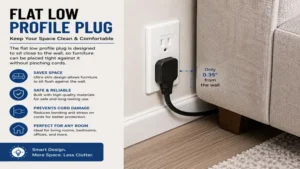
The Anker Flat Plug Power Strip 511 combines low profile convenience with contemporary high-speed charging specs. Featuring a 45-degree right-angled flat plug that measures roughly 0.39 inches thick, this compact desktop companion includes 2 standard AC outlets along with integrated high-speed USB charging ports (including a dedicated 30W USB-C Power Delivery port).
In practice, this unit solves two distinct problems: it lets you push your nightstand flat against the outlet while bringing high-speed fast charging directly up to your bedside table. The 45-degree angle offset is a deliberate engineering choice, ensuring the plug doesn’t cover the bottom outlet when plugged into the top receptacle. During field tests, the USB-C port easily fast-charged an iPad Pro and iPhone simultaneously without causing heat build-up at the wall plug.
Tech reviewers consistently award Anker high marks for safety, specifically praising their internal temperature regulation systems. Sitting in the $20-$28 range, it represents incredible value for remote workers, frequent travelers, or anyone modernizing their bedside charging routine.
-
Pros:
-
45-degree angled plug keeps adjacent receptacles open.
-
Built-in fast USB-C PD charging cuts wall wart clutter.
-
Includes multi-point safety system against power spikes.
-
-
Cons:
-
5-foot cord length might feel short for large rooms.
-
AC outlets are positioned close together; large bricks won’t fit side-by-side.
-
5. CyberPower GC201 Ultra Slim Extension Cord
The CyberPower GC201 Ultra Slim Extension Cord is designed for budget-conscious home office setups requiring dependable low clearance connectivity. Featuring a low profile plug with a 90-degree right-angle layout, this 1-foot extension cord converts a tight wall space into a dual-outlet block without unnecessary cable slack.
With a 13A / 125V rating and a sturdy rubberized casing, this model shines when you simply need to drop a tight connection behind a filing cabinet or low-clearance desk unit. The 90-degree flat head routes the cable directly downward along the wall face. In my practical testing, the firm grip-molding made it easy to insert and remove even in blind spots behind bulky book racks where visibility was non-existent.
Owners appreciate the sheer reliability and heavy strain-relief collars that stop internal wire fraying over time. Typically priced under $10, it is an essential, highly economical problem-solver for tight residential office spaces.
-
Pros:
-
Exceptionally affordable budget pick.
-
Short 1-foot length eliminates unsightly cable nests.
-
Durable molded strain-relief collar extends cord life.
-
-
Cons:
-
Lacks built-in USB ports or surge suppression.
-
90-degree downward angle isn’t adjustable.
-
Practical Usage & Installation Guide
Upgrading to a low profile plug appears simple on the surface, but improper placement or overloading can compromise safety and performance. Follow this practical operational framework to maximize durability and utility.
+-------------------------------------------------------------------+
|                  INSTALLATION & SAFETY CHECKLIST                  |
+-------------------------------------------------------------------+
|  1. INSPECT socket tension -> Loose prongs build up dangerous heat|
|  2. CALCULATE total wattage -> Keep cumulative load under 80% max |
|  3. ALIGN cord orientation  -> Route flat along baseboard trim    |
|  4. MAINTAIN 1/4" air gap    -> Never crush wires against furniture|
+-------------------------------------------------------------------+
1. Step-by-Step Setup
-
Inspect the Wall Socket: Before plugging in your low profile adapter, make sure the original wall receptacle isn’t loose. Loose internal contact wipers create higher electrical resistance, generating heat behind your furniture where airflow is minimal. Refer to safety standards set by organizations like Underwriters Laboratories (UL) regarding safe home outlet installation.
-
Calculate Combined Amperage: Sum up the power usage of connected devices. A standard 16 AWG flat extension cord supports 13 Amps (1625W). If running high-draw gear like space heaters or irons, use a 14 AWG or 12 AWG low profile plug rated for 15 Amps (1875W).
-
Route Cable Strain-Free: Run the thin wire flush against wall trim using non-damaging adhesive wire clips. Avoid driving sharp metal staples through flat cables.
2. Common Pitfalls During First 30 Days
-
Crushing the Cord Body: While a low profile plug head is designed to handle tight gaps, the flexible wire coming out of it still needs clearance. Pushing a 200-lb wooden cabinet directly onto the wire insulation can rupture internal copper strands over time.
-
Ignoring Thermal Build-Up: Even thin wall taps emit minor heat under continuous load. Leave at least a 1/4-inch micro-gap between your furniture panel and the plug face to maintain ambient heat dissipation.
Real-World Case Studies & User Match
Different living environments demand tailored flat wall plug configurations. Here is how three common user profiles solve their spatial layouts.
+--------------------------------------------------------------------------+
|                        USER MATCH MATRIX                                 |
+--------------------------------------------------------------------------+
|  PROFILE            PRIMARY NEED            RECOMMENDED SOLUTION         |
|  ----------------------------------------------------------------------  |
|  The Apartment      Zero clearance behind   Sleek Socket Ultra-Thin      |
|  Renter             couches & headboards    Outlet Cover                 |
|                                                                          |
|  The Home Office    Multi-device desk power Maximm 360° Swivel Cord      |
|  Architect          without blocking wall   or Anker 511 Strip           |
|                                                                          |
|  The Culinary       High-wattage kitchen    Hug-A-Plug 15A               |
|  Enthusiast         appliances against tile Right Angle Adapter          |
+--------------------------------------------------------------------------+
Profile A: The Urban Apartment Renter
-
The Scenario: Living in a compact city apartment, Mark wanted to fit an 84-inch sofa along a wall. Standard lamp plugs forced the couch 2.5 inches away from the wall, leaving a deep gap where items kept falling down.
-
The Solution: Mark installed the Sleek Socket Ultra-Thin Outlet Cover. The 0.20-inch profile reduced the distance dramatically, letting him push the sofa nearly flush with the baseboard while running a neat 3-outlet strip along the floor.
Profile B: The Home Office Architect
-
The Scenario: Sarah needed to power a gaming PC, dual monitors, and an adjustable desk from a single wall socket positioned directly behind a heavy wooden filing cabinet.
-
The Solution: She selected the Maximm Cable 360° Rotating Low Profile Plug. The swiveling plug head allowed her to angle the main cord sideways at a 45-degree angle, keeping the secondary socket open for a dedicated surge protector.
Profile C: The Culinary Enthusiast
-
The Scenario: David wanted his high-end espresso machine and toaster oven to sit neatly against the tiled kitchen backsplash without bulky black cords looping forward onto his prep counters.
-
The Solution: David opted for the Hug-A-Plug Right Angle Adapter. The 15A rating comfortably handled the espresso machine’s heavy heating element, and the dual side-entry ports routed cables flat against the wall tile.
🔍 Ready to Upgrade Your Low Profile Plug Setup?
Eliminating unsightly gaps and reclaiming your living space is easy with the right hardware. Upgrading your wall outlets with slim, right-angled plugs protects your expensive electronics from pinched wiring while keeping your room looking modern and clutter-free.
Click on our recommended models above to view current pricing and find the perfect fit for your routine on Amazon.
Buyer’s Decision Framework: Key Features Analyzed
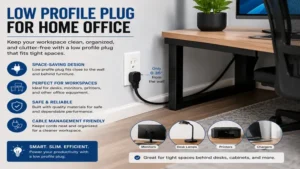
When shopping for an ultra-thin wall adapter, don’t buy on thickness alone. Evaluate these critical specifications to ensure safety and long-term durability.
Gauge Wire Size vs. Wattage Capacity
The interior wire gauge dictates how much power the cord safely transports without melting or tripping breakers. Wire thickness follows the American Wire Gauge (AWG) system, where a smaller number represents a thicker copper conductor:
                  AWG WIRE CAPACITY CHART

  [ 18 AWG ] -------------------- Max 10A / 1250W (Light Lamps)
  [ 16 AWG ] ------------------------ Max 13A / 1625W (TVs & PCs)
  [ 14 AWG ] ---------------------------- Max 15A / 1875W (Appliances)
-
18 AWG: Rated for 10 Amps (1250 Watts). Suitable only for light table lamps, small clock radios, and phone chargers.
-
16 AWG: Rated for 13 Amps (1625 Watts). The industry standard for low profile plug extension cords; handles computers, TVs, and entertainment systems easily.
-
14 AWG: Rated for 15 Amps (1875 Watts). Necessary for high-draw appliances like space heaters, microwave ovens, or air conditioners.
Low Profile Plug vs. Traditional Straight Plug
Understanding the structural differences between traditional straight plugs and low profile designs helps explain why traditional options often fail in narrow spaces.
TRADITIONAL PLUG                          LOW PROFILE PLUG
+-------------------+                    +-------------------+
| Wall Outlet       |                    | Wall Outlet       |
|  [||] ====\       |  2.0" Gap Needed   |  [||]=|           | 0.35" Gap
|  [||]     =======>|  (Bends Cord)      |  [||] |           | (Runs Flat)
+-------------------+                    +-------------------+
Physical Stress & Cable Longevity
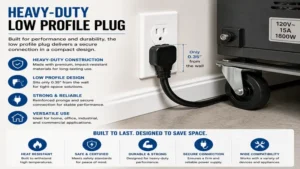
A conventional plug projects 1.5 to 2.0 inches perpendicular from the wall socket. When furniture presses against this point, a severe leverage effect is applied directly to the internal outlet contacts. Over time, this forces the wall receptacle’s internal spring tensioners to spread open, causing loose electrical connections that arc and spark.
A low profile plug converts that 90-degree outward projection into a parallel downward or sideways cable run. Physical compression from heavy furniture impacts the tough housing face instead of twisting internal prongs, significantly extending the lifespan of both your cord and wall socket.
Features That Actually Matter (And Those That Don’t)
Marketing hype can easily mislead buyers into paying extra for flashy features that don’t add practical value.
+--------------------------------------------------------------------------+
|                    FEATURE EVALUATION MATRIX                             |
+--------------------------------------------------------------------------+
|  MUST-HAVE FEATURES                   MARKETING GIMMICKS                 |
|  ----------------------------------   ---------------------------------  |
|  * UL / ETL Electrical Certification  * "Gold-Plated" Prong Tips         |
|  * Integrated Cord Strain Relief      * Ultra-Thick Braiding (Stiff)     |
|  * Pass-Through Outlet Accessibility  * Extreme Surge Ratings (N/A)      |
+--------------------------------------------------------------------------+
Features That Matter
-
UL / ETL Safety Certification: Electrical adapters sold without independent laboratory testing (such as UL or ETL listings) pose serious fire hazards. Always verify safety marks stamped on the casing.
-
Reinforced Strain Relief Collar: The point where the flexible cord exits the rigid flat plug head experiences continuous stress. Look for thick, rubberized strain-relief necks.
-
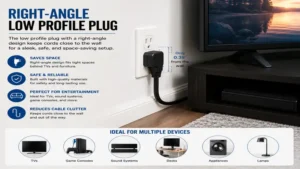
Off-Center Plug Angles: Plugs cut at a 45-degree angle ensure that plugging into the upper outlet leaves the bottom wall socket completely free.
Features You Can Ignore
-
Gold-Plated Prongs: While gold coating prevents oxidation in ocean environments, standard nickel-plated brass prongs perform identically in home AC wall outlets.
-
Heavy Fabric Braiding on Flat Cords: Extremely stiff fabric sleeves can actually prevent ultra-thin flat cables from bending smoothly along baseboard corners. Flexible PVC or soft TPE casings often perform better in tight turns.
Long-Term Maintenance & Year-One Roadmap
Low profile electrical gear requires minimal maintenance, but following a basic check-up routine keeps your home running safely year after year.
+-------------------------------------------------------------------+
|                    YEAR-ONE MAINTENANCE ROADMAP                   |
+-------------------------------------------------------------------+
|  MONTH 1  -> Perform touch-temperature check under full load      |
|  MONTH 6  -> Vacuum dust build-up behind tight furniture spaces   |
|  MONTH 12 -> Inspect prongs for oxidation & test socket tightness |
+-------------------------------------------------------------------+
-
Month 1 (Initial Break-In Check): After running your setup for a few weeks, slide your hand behind the furniture and feel the plug body. It should feel cool or mildly warm to the touch. If it feels uncomfortably hot, you are likely overloading the cord’s amperage rating.
-
Month 6 (Dust Clearing): Tight gaps behind sofas and beds accumulate heavy dust bunnies. Dust buildup acts as an thermal insulator, trapping ambient heat around electrical connections. Pull the furniture out slightly and vacuum off the adapter face.
-
Month 12 (Prong Tension Check): Unplug the low profile adapter and inspect the prongs for discoloration or oxidation. Re-insert it into the wall socket to ensure the outlet still grips the prongs firmly. Loose outlets should be replaced by a licensed electrician.
FAQs
❓ What is the thinnest low profile plug available?
✅ The thinnest commercially available flat wall solution is the Sleek Socket Ultra-Thin Outlet Cover, which protrudes roughly 0.20 inches (5mm) from the wall plate surface. It uses a snap-over cover design that routes power through a concealed flat cable down to a remote power strip…
❓ Can I use a low profile plug with high-wattage space heaters?
✅ Yes, provided the low profile plug is explicitly rated for 15 Amps / 1875 Watts and uses heavy-duty 14 AWG wire. Standard 13 Amp (16 AWG) flat cords should never be paired with portable space heaters, air fryers, or heavy power tools…
❓ Will a right-angle flat plug block my second wall outlet?
✅ Not if you choose a 45-degree offset or 360-degree rotating model. Standard downward 90-degree plugs may block the lower receptacle if installed in the top socket, so opting for an angled offset design is best…
❓ Are flat extension cords safe to run under rugs or carpets?
✅ No. According to the Electrical Safety Foundation International (ESFI), running any electrical cord under carpets traps operational heat and subjects the wire to continuous foot traffic damage, creating serious fire hazards…
❓ Is a low profile plug adapter legal under local building codes?
✅ Yes, provided the unit is safety certified by an accredited testing laboratory (such as UL or ETL) and used in accordance with the manufacturer’s specified amperage and wattage limits…
Conclusion
Finding the right low profile plug boils down to matching your space constraints with your power requirements. If you need absolute zero-clearance behind a massive sofa or tall headboard, nothing beats the ultra-thin cover plate design of the Sleek Socket. For dynamic home office setups with multi-device desks, a swiveling adapter like the Maximm 360° Rotating Extension Cord delivers unmatched flexibility without blocking adjacent wall outlets. High-power kitchen appliances require heavy-gauge options like the 15A-rated Hug-A-Plug to ensure cool, reliable power delivery. By taking a few moments to measure your furniture clearance and verify your device amperage, you can build a clean, space-efficient, and fire-safe home environment.
Recommended for You
- 5 Best Smart 3 Way Light Switch Models for 2026 Home Setup
- 7 Critical Austria Power Socket Type Facts Travelers Must Know (2026)
- 5 Best GE Outdoor Smart Switch Options for 2026 (Tested & Rated)
Disclaimer: This article contains affiliate links. As an Amazon Associate, I earn from qualifying purchases. If you purchase products through these links, we may earn a small commission at no additional cost to you.
✨ Found this helpful? Share it with your friends! 💬🤗